Results by title
22277 books match the query 'Social Science' and 1819 start with a
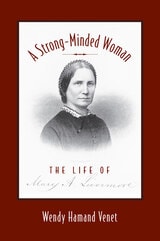
A Strong-Minded Woman
The Life of Mary LivermoreWendy Hamand Venet
University of Massachusetts Press, 2005
When Mary Livermore died in 1905 at age 84, a Boston newspaper praised her as “America's foremost woman.” A leading figure in the struggle for woman's rights as well as in the temperance movement, she was as widely recognized during her lifetime as Susan B. Anthony, and for a time the most popular and highly paid female orator in the country. Yet aside from Civil War historians familiar with her service as a wartime nurse, few today remember even her name.
In this book, Wendy Hamand Venet reconstructs Mary Livermore's remarkable story and explores how and why she became so renowned in her day. Born and raised in Boston, Livermore left home at age eighteen to become the private schoolteacher to a wealthy tobacco planter's children in Virginia, an experience that afforded her an intimate look at slave-based society in the 1840s. Returning to New England, she married and lived a conventional life as the wife of a minister and mother of three daughters. With the coming of the Civil War, however, Livermore's life changed dramatically when she became active with the United States Sanitary Commission, an organization that would propel her into the public limelight and cause her to challenge society's traditional view of the role of women.
After the war Livermore became deeply involved in the woman's rights movement, serving as editor of the newspaper Woman's Journal and later as president of three major suffrage organizations—the American, New England, and Massachusetts Woman Suffrage Associations. She was also founder and president of the Massachusetts Women's Christian Temperance Union, and became active in the Society of Christian Socialists in Boston. Her frequent speaking appearances on behalf of these causes eventually earned her the nickname “Queen of the Platform.” Although she may not have been as radical as some other early feminists, Livermore's ideas resonated with thousands of middle-class women whose experiences paralleled her own. For that reason alone, Venet shows, her life and legacy are worthy of our attention.
A Study of Crisis
Michael Brecher and Jonathan Wilkenfeld
University of Michigan Press, 2000
The culmination of more than twenty years of research by Michael Brecher and Jonathan Wilkenfeld, the book analyzes crucial themes about crisis, conflict, and war and presents systematic knowledge about more than 400 crises, thirty-one protracted conflicts and almost 900 state participants. The authors explore many aspects of conflict, including the ethnic dimension, the effect of different kinds of political regimes--notably the question whether democracies are more peaceful than authoritarian regimes, and the role of violence in crisis management. They employ both case studies and aggregate data analysis in a Unified Model of Crisis to focus on two levels of analysis--hostile interactions among states, and the behavior of decision-makers who must cope with the challenge posed by a threat to values, time pressure, and the increased likelihood that military hostilities will engulf them.
This book will appeal to scholars in history, political science, sociology, and economics as well as policy makers interested in the causes and effects of crises in international relations. The rich data sets will serve researchers for years to come as they probe additional aspects of crisis, conflict and war in international relations.
Michael Brecher is R. B. Angus Professor of Political Science, McGill University. Jonathan Wilkenfeld is Professor and Chair of the Department of Government and Politics, University of Maryland. They are the coauthors of Crises in the Twentieth Century: A Handbook of International Crisis, among other books and articles.
A Study of Some Michigan Indians
Frances Densmore
University of Michigan Press, 1949
A Study of Southwestern Archaeology
Stephen H. Lekson
University of Utah Press, 2018
Focusing on the enigmatic monumental center at Chaco Canyon, the book provides a historical analysis of how Southwest archaeology confined itself, how it can break out of those confines, and how it can proceed into the future. Lekson suggests that much of what we believe about the ancient Southwest should be radically revised. Looking past old preconceptions brings a different Chaco Canyon into view: more than an eleventh-century Pueblo ritual center, Chaco was a political capital with nobles and commoners, a regional economy, and deep connections to Mesoamerica. By getting the history right, a very different science of the ancient Southwest becomes possible and archaeology can be reinvented as a very different discipline.
Notes
https://uofupress.lib.utah.edu/wp-content/uploads/sites/21/2019/04/Lekson-Notes.pdf
A Study of the Glacial Kame Culture in Michigan, Ohio, and Indiana
Wilbur M. Cunningham
University of Michigan Press, 1948
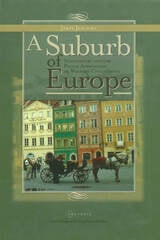
A Suburb of Europe
Nineteenth-Century Polish Approaches to Western CivilizationJerzy Jedlicki
Central European University Press, 2000
In this lively and original book, the distinguished Polish historian Jerzy Jedlicki tells the story of a century-long Polish dispute over the merits and demerits of the Western model of liberal progress and industrial civilization.
As in several countries of Europe, also in Poland, intellectuals--conservatives, liberals, and (later) socialists--quarrelled about whether such a model would suit and benefit their nation, or whether it would spell the ruin of its distinctive cultural features.
This heated debate revolved around several pairs of opposing ideas: native cultures v. cosmopolitan civilization; natural v. artificial ways of economic development; Christian morals v. capitalist laissez-faire; traditional customs v. mobile society; romanticism v. scientism, and so on. It is these various aspects of the main issue which the author analyzes and links together here. He describes how difficult and painful the process of modernization was in a nation deprived of its political independence and cultural autonomy.
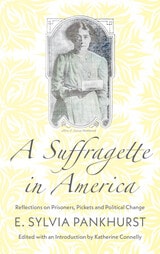
A Suffragette in America
Reflections on Prisoners, Pickets and Political ChangeSylvia Pankhurst
Pluto Press, 2019
This book gathers Pankhurst’s writings from the year-long visit, in which she reveals her shock at the darkness hidden in American life, and draws parallels to her experiences of imprisonment and misogyny in her own country. Never before published, these writings mark an important stage in the development of the suffragette's thought, which she brought back to Britain to inform the burgeoning suffrage campaign there.

A Suitable Enemy
Racism, Migration and Islamophobia in EuropeLiz Fekete
Pluto Press, 2009
Liz Fekete is a leading authority on issues of racism, Islamophobia and national security legislation. A Suitable Enemy draws on sixteen years of research to present a comprehensive overview of EU immigration, asylum, race and security policies.
Fekete argues that at the same time as the EU introduces selective migration policies, it closes its borders against asylum seekers who were the first victims of the growth of the security state which now embraces Muslims. She explores the way in which anti-terrorist legislation has been used to evict undesirable migrants, how deportation policies commodify and de-humanise the most vulnerable and how these go hand in hand with evolving forms of racism, particularly Islamophobia.
At the heart of the book is an examination of xeno-racism -- a non-colour coded form of institutionalised racism -- where migrants who do not assimilate, or who are believed to be incapable of assimilation, are excluded.
A Survey of Indian Assimilation in Eastern Sonora
Thomas B. Hinton
University of Arizona Press, 1959

A Tale of Three Villages
Indigenous-Colonial Interactions in Southwestern Alaska, 1740–1950Liam Frink
University of Arizona Press, 2016
Liam Frink focuses on three indigenous-colonial events along the southwestern Alaskan coast: the late precolonial end of warfare and raiding, the commodification of subsistence that followed, and, finally, the engagement with institutional religion. Frink’s innovative interdisciplinary methodology respectfully and creatively investigates the spatial and material past, using archaeological, ethnoecological, and archival sources.
The author’s narrative journey tracks the histories of three villages ancestrally linked to Chevak, a contemporary Alaskan Native community: Qavinaq, a prehistoric village at the precipice of colonial interactions and devastated by regional warfare; Kashunak, where people lived during the infancy and growth of the commercial market and colonial religion; and Old Chevak, a briefly occupied “stepping-stone” village inhabited just prior to modern Chevak. The archaeological spatial data from the sites are blended with ethnohistoric documents, local oral histories, eyewitness accounts of people who lived at two of the villages, and Frink’s nearly two decades of participant-observation in the region.
Frink provides a model for work that examines interfaces among indigenous women and men, old and young, demonstrating that it is as important as understanding their interactions with colonizers. He demonstrates that in order to understand colonial history, we must actively incorporate indigenous people as actors, not merely as reactors.
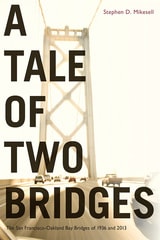
A Tale of Two Bridges
The San Francisco–Oakland Bay Bridges of 1936 and 2013Stephen Mikesell
University of Nevada Press, 2017
A Tale of Two Bridges is a history of two versions of the San Francisco—Oakland Bay Bridge: the original bridge built in 1936 and a replacement for the eastern half of the bridge finished in 2013. The 1936 bridge revolutionized transportation in the Bay Area and profoundly influenced settlement patterns in the region. It was also a remarkable feat of engineering. In the 1950s the American Society of Civil Engineers adopted a list of the “Seven Engineering Wonders” of the United States. The 1936 structure was the only bridge on the list, besting even the more famous Golden Gate Bridge. One of its greatest achievements was that it was built on time (in less than three years) and came in under budget. Mikesell explores in fascinating detail how the bridge was designed by a collection of the best-known engineers in the country as well as the heroic story of its construction by largely unskilled laborers from California, joined by highly skilled steel workers.
By contrast, the East Span replacement, which was planned between 1989 and 1998, and built between 1998 and 2013, fell victim to cost overruns in the billions of dollars, was a decade behind schedule, and suffered from structural problems that has made it a perpetual maintenance nightmare.
This is narrative history in its purest form. Mikesell excels at explaining highly technical engineering issues in language that can be understood and appreciated by general readers. Here is the story of two very important bridges, which provides a fair but uncompromising analysis of why one bridge succeeded and the other did not.

A Tanizaki Feast
The International Symposium in VeniceAdriana Boscaro and Anthony Hood Chambers, Editors
University of Michigan Press, 1998
A Task for Sisyphus
Why Europe’s Roma Policies FailIulius Rostas
Central European University Press, 2020

A Taste for Brown Sugar
Black Women in PornographyMireille Miller-Young
Duke University Press, 2014

A Taste of the Hocking Hills
Matt Rapposelli
Ohio University Press, 2018
When chef Matt Rapposelli left the National Park Service to attend culinary school in New England, he was moving from one passion to another. What later brought those passions together was a job in the Hocking Hills, southeast Ohio’s stunning, wild landscape, where the restaurants he helmed—at Hocking Hills Lodge and Lake Hope Lodge—gained a resounding reputation for classic dishes that, driven by the regional vernacular and the natural seasonal abundance of Appalachia, were impeccably fresh and flavorful.
A Taste of the Hocking Hills intermingles delicious recipes with striking photographs of a region to which thousands trek each year. Rapposelli presents dishes by the season, noting the specialties that appear on his menus in a given time of year. Whether enjoying a winter evening or a summer morning, cooks will be able to bring a bit of the Hocking Hills home.
A Technomoral Politics
Good Governance, Transparency, and Corruption in IndiaAradhana Sharma
University of Minnesota Press, 2024
Examining anticorruption battles and transparency laws to ask: what makes for good governance, and can it limit liberal democratic politics as much as encourage it?
Good governance is meant to empower citizens, increase democratic participation, and make states transparent and accountable, yet this liberal democratic imperative can also promote populist authoritarian rule. Bringing together discourses on ethical goodness with the technicalities of governance as expressed in laws and policies, Aradhana Sharma develops the concept of “technomoral politics” to navigate this fraught topic. With a focus on the work of activists, citizens, and state officials, she offers an ethnographic account of the contradictions and dangers of good-governance politics in twenty-first-century India.
A Technomoral Politics follows the evolution of a group of activists in New Delhi led by Arvind Kejriwal from 2008 to 2014 as they morphed from a protransparency NGO to a mass movement against state corruption to a populist party that promised to change the political system through laws and policies. Sharma explores the technomoral framing of state opacity and corruption as well as the limits of the law in resolving these issues, probing such themes as the contradictory relationship between transparency and bureaucracy and the classed and gendered nature of democratic state institutions.
By examining scalar dimensions of good-governance politics, from the hyperlocal work of activists to global trends, A Technomoral Politics illuminates the paradoxes, limits, and risks of a system that is meant to spread liberal democratic principles but that also ends up promoting antidemocratic, populist-authoritarian forms of rule.
Retail e-book files for this title are screen-reader friendly.
A Telescope on Society
Survey Research and Social Science at the University of Michigan and BeyondJames S. House, F. Thomas Juster, Robert L. Kahn, Howard Schuman, and Eleanor Singer, Editors
University of Michigan Press, 2004
The chapters of this volume illustrate the impact that developments in survey research have had and continue to have on a broad range of social science disciplines and interdisciplinary areas ranging from political behavior and electoral systems to macroeconomics and individual income dynamics, mental and physical health, human development and aging, and racial/ethnic diversity and relationships.
The volume will speak to a wide audience of social science and survey research professionals and students interested in learning more about the broad history of survey-based social science and its contributions to understanding ourselves as social beings. It also seeks to convey how crucial institutional and public support are to the development of social science and survey research, as they have been to development in the natural, biomedical, and life sciences.
The five editors of this book are longtime research professors and colleagues in the Survey Research Center of the Institute for Social Research at the University of Michigan. James S. House is also Professor in the Department of Sociology; F. Thomas Juster is Professor Emeritus in the Department of Economics; Robert L. Kahn is Professor Emeritus in the Department of Psychology and Department of Health Management and Policy; and Howard Schuman is Professor Emeritus in the Department of Sociology; Eleanor Singer is Research Professor in the Survey Research Center, all at the University of Michigan. Professors House (1991-2001), Kahn (1970-76), and Schuman (1982-90) have each served as Director of the Survey Research Center; Professor Juster served (1976-86) as Director of the Institute for Social Research; and Professor Singer served (1999-2002) as Associate Director of the Survey Research Center.

A Theory of Argumentation
Charles Arthur Willard
University of Alabama Press, 1989
Establishes a theoretical context for, and to elaborate the implications of, the claim that argument is a form of interaction in which two or more people maintain what they construe to be incompatible positions
The thesis of this book is that argument is not a kind of logic but a kind of communication—conversation based on disagreement. Claims about the epistemic and political effects of argument get their authority not from logic but from their “fit with the facts” about how communication works. A Theory of Communication thus offers a picture of communication—distilled from elements of symbolic interactionism, personal construct theory, constructivism, and Barbara O’Keefe’s provocative thinking about logics of message design. The picture of argument that emerges from this tapestry is startling, for it forces revisions in thinking about knowledge, rationality, freedom, fallacies, and the structure and content of the argumentation discipline.

A Theory of Assembly
From Museums to MemesKyle Parry
University of Minnesota Press, 2022
A vital reckoning with how we understand the basic categories of cultural expression in the digital era
Digital and social media have transformed how much and how fast we communicate, but they have also altered the palette of expressive strategies: the cultural forms that shape how citizens, activists, and artists speak and interact. Most familiar among these strategies are storytelling and representation. In A Theory of Assembly, Kyle Parry argues that one of the most powerful and pervasive cultural forms in the digital era is assembly.
Whether as subtle photographic sequences, satirical Venn diagrams, or networked archives, projects based in assembly do not so much narrate or represent the world as rearrange it. This work of rearranging can take place at any scale, from a simple pairing of images, undertaken by one person, to the entire history of internet memes, undertaken by millions. With examples ranging from GIFs and paintings to museum exhibitions and social movement hashtags, Parry shows how, in the internet age, assembly has come to equal narrative and representation in its reach and influence, particularly as a response to ecological and social violence. He also emphasizes the ambivalence of assembly—the way it can be both emancipatory and antidemocratic.
As the world becomes ever hotter, more connected, and more algorithmic, the need to map—and remake—assembly’s powers and perils becomes all the more pressing. Interdisciplinary, engaging, and experimental, A Theory of Assembly serves as a playbook of strategies and critical frameworks for artists, activists, and content creators committed to social and environmental justice, ultimately arguing for a collective reenvisioning of which cultural forms matter.
Cover alt text: Letters from the title appear in a jumble, each colored in a blue-orange gradient. Readable title and author sits below the jumble.

A Theory of ISIS
Political Violence and the Global OrderMohammad-Mahmoud Ould Mohamedou
Pluto Press, 2017
Against these established narratives, Mohammad-Mahmoud Ould Mohamedou now presents his new theory of ISIS. Tracing the genealogy of ISIS and documenting its evolution in Iraq and Syria, he argues that ISIS has actually transcended Osama Bin Laden’s original scheme of Al Qaeda, mutating into a unprecedented hybrid between postcolonial violence, postmodernity, and postglobalization. A Theory of ISIS offers an original take on the militant group. Mohamedou explains the proliferation of terrorist attacks on the West and deepens our understanding of the group's impact on the very nature of contemporary political violence.
A Theory of Regret
Brian Price
Duke University Press, 2017
A Theory of Religion
Stark, Rodney
Rutgers University Press, 1996
A Third University Is Possible
la la paperson
University of Minnesota Press, 2017
A Third University is Possible unravels the intimate relationship between the more than 200 US land grant institutions, American settler colonialism, and contemporary university expansion. Author la paperson cracks open uncanny connections between Indian boarding schools, Black education, and missionary schools in Kenya; and between the Department of Homeland Security and the University of California. Central to la paperson’s discussion is the “scyborg,” a decolonizing agent of technological subversion.
Drawing parallels to Third Cinema and Black filmmaking assemblages, A Third University is Possible ultimately presents new ways of using language to develop a framework for hotwiring university “machines” to the practical work of decolonization.
Forerunners: Ideas First is a thought-in-process series of breakthrough digital publications. Written between fresh ideas and finished books, Forerunners draws on scholarly work initiated in notable blogs, social media, conference plenaries, journal articles, and the synergy of academic exchange. This is gray literature publishing: where intense thinking, change, and speculation take place in scholarship.
A Thousand Cuts
Digital Repression and Pro-Democracy Movements in ThailandJanjira Sombatpoonsiri
University of Wisconsin Press, 2027
In response to the 2020–21 youth-led protests throughout Thailand, which were largely fueled by discourse on digital platforms, the government launched a sweeping program of technological suppression. Smear campaigns were orchestrated to discredit young activists, laws were weaponized to criminalize their activities, and surveillance technologies were deployed to keep tabs on them.
In A Thousand Cuts, Janjira Sombatpoonsiri traces the historical development of repression in Thailand, detailing how “traditional” methods of repression have been merged with digital tools to maintain the status quo since 2005, when mass mobilization started to move online. By examining the adverse effects of digital repression on individual activists—their mental health, private lives, and socioeconomic resources—Sombatpoonsiri also offers one of the first systematic analyses of the “reception” side of repression, shedding light on its detrimental consequences for activists and mass movements as a whole.
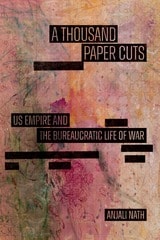
A Thousand Paper Cuts
US Empire and the Bureaucratic Life of WarAnjali Nath
Duke University Press, 2025

A Thousand Pieces of Paradise
Landscape and Property in the Kickapoo ValleyLynne Heasley
University of Wisconsin Press, 2012
A Thousand Pieces of Paradise is an ecological history of property and a cultural history of rural ecosystems set in one of the Midwest’s most historically significant regions, the Kickapoo River Valley. Whether examining the national war on soil erosion, Amish migration, a Corps of Engineers dam project, or Native American land claims, Lynne Heasley traces the history of modern American property debates. Her book holds powerful lessons for rural communities seeking to reconcile competing values about land and their place in it.

A Thousand Screenplays
The French Imagination in a Time of CrisisSabine Chalvon-Demersay
University of Chicago Press, 1999
The time of crisis presented by the amateur writers was not one of war, famine, or disease—it was the millennial dilemma of representation. In a world plagued by alienation, individualization, and a lack of mobility, how can members of a society combat their declining senses of self?
Although the contestants wrote about life in France, their concerns and struggles have a distinctly universal ring. A lucid, witty writer, Chalvon-Demersay offers a clear, if still developing, photograph of the contemporary imagination.
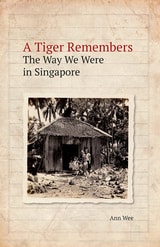
A Tiger Remembers
The Way We Were in SingaporeAnn Wee
National University of Singapore Press, 2017
Wee’s talent is for remembering and paying homage to the things history books often deem insignificant—things that can contain some of the most illuminating details about the day to day inner workings of families from many backgrounds, such as terms of endearment; the emotional nuance in social relations; questions of hygiene; the stories of convicts; tales of ghost wives and changeling babies; anecdotes from rural clan settlements and migrant dormitories; and the migration of families from squatter settlements into public housing. Affectionately observed and wittily narrated, with a deep appreciation of how far Singapore has come, this book brings to life generations of social change through a focus on the institution of the family.
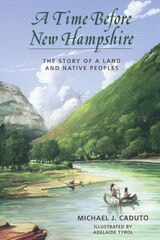
A Time Before New Hampshire
The Story of a Land and Native PeoplesMichael J. Caduto
University Press of New England, 2004
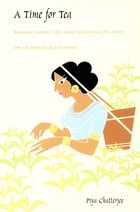
A Time for Tea
Women, Labor, and Post/Colonial Politics on an Indian PlantationPiya Chatterjee
Duke University Press, 2001
Allowing personal, scholarly, and artistic voices to speak in turn and in tandem, Chatterjee discusses the fetishization of women who labor under colonial, postcolonial, and now neofeudal conditions. In telling the overarching story of commodity and empire, A Time for Tea demonstrates that at the heart of these narratives of travel, conquest, and settlement are compelling stories of women workers. While exploring the global and political dimensions of local practices of gendered labor, Chatterjee also reflects on the privileges and paradoxes of her own “decolonization” as a Third World feminist anthropologist. The book concludes with an extended reflection on the cultures of hierarchy, power, and difference in the plantation’s villages. It explores the overlapping processes by which gender, caste, and ethnicity constitute the interlocked patronage system of villages and their fields of labor. The tropes of coercion, consent, and resistance are threaded through the discussion.
A Time for Tea will appeal to anthropologists and historians, South Asianists, and those interested in colonialism, postcolonialism, labor studies, and comparative or international feminism.
Designated a John Hope Franklin Center book by the John Hope Franklin Seminar Group on Race, Religion, and Globalization.

A Tohono O'odham Grammar
Ofelia Zepeda
University of Arizona Press, 1983

A Tolerance for Inequality
American Public Opinion and Economic PolicyAndrew J. Taylor
University of Chicago Press, 2025
A nuanced reassessment of US democratic responsiveness and public opinion on economic policy that explores the real reasons government does not do more to mitigate inequality.
Many believe that the United States’ growing economic inequality is the result of a political system that has been captured by wealthy elites. But is economic capture actually the problem? In A Tolerance for Inequality, Andrew J. Taylor examines this question from multiple angles, drawing on public opinion data and analyses of representation in Congress. Taylor finds that economic policy outcomes are more reflective of public opinion than the common wisdom suggests.
Broadly, less-affluent Americans’ policy preferences are not meaningfully different from the preferences of other Americans, and Washington is responsive to these preferences. Although politicians are more affluent, on average, than most Americans, this does not prevent them from representing the economic views of their poorer constituents. Today’s Democratic Party is more interested in regulation and supplying public goods than redistributing wealth downwards, and political reforms designed to provide more equal outcomes are largely misguided. In short, Americans get the kind of economy they at least say they want.
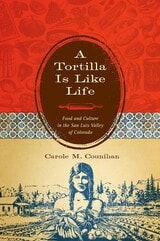
A Tortilla Is Like Life
Food and Culture in the San Luis Valley of ColoradoBy Carole M. Counihan
University of Texas Press, 2009
Located in the southern San Luis Valley of Colorado, the remote and relatively unknown town of Antonito is home to an overwhelmingly Hispanic population struggling not only to exist in an economically depressed and politically marginalized area, but also to preserve their culture and their lifeways. Between 1996 and 2006, anthropologist Carole Counihan collected food-centered life histories from nineteen Mexicanas—Hispanic American women—who had long-standing roots in the Upper Rio Grande region. The interviews in this groundbreaking study focused on southern Colorado Hispanic foodways—beliefs and behaviors surrounding food production, distribution, preparation, and consumption.
In this book, Counihan features extensive excerpts from these interviews to give voice to the women of Antonito and highlight their perspectives. Three lines of inquiry are framed: feminist ethnography, Latino cultural citizenship, and Chicano environmentalism. Counihan documents how Antonito's Mexicanas establish a sense of place and belonging through their knowledge of land and water and use this knowledge to sustain their families and communities. Women play an important role by gardening, canning, and drying vegetables; earning money to buy food; cooking; and feeding family, friends, and neighbors on ordinary and festive occasions. They use food to solder or break relationships and to express contrasting feelings of harmony and generosity, or enmity and envy. The interviews in this book reveal that these Mexicanas are resourceful providers whose food work contributes to cultural survival.
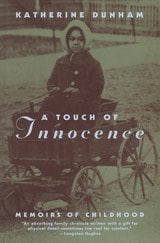
A Touch of Innocence
A Memoir of ChildhoodKatherine Dunham
University of Chicago Press, 1994
In stark prose, she tells of growing up in both black and white households and of the divisions of race and class in Chicago that become the harsh realities of her young life. A riveting narrative of one girl's struggle to transcend the painful confusions of a family and culture in turmoil, Dunham's story is full of the clarity, candor, and intelligence that lifted her above her troubled beginnings.
"A Touch of Innocence is an absorbing family chronicle written with a gift for physical detail sometimes too real for comfort. In quietly graphic prose the growing girl, the slightly older brother, the ambitious father and the kind stepmother are pictured in such human terms that when their lives get tied into harder and harder knots beyond their undoing, one can only continue to read helplessly as doom closes in upon the household."—Langston Hughes, New York Herald Tribune
"A Touch of Innocence is one of the most extraordinary life stories I have ever read . . . . The content of this book is so heartbreaking that only the strongest artistic skills can keep it from leaking out into sobbing self-pity, but Katherine Dunham's art contains it, understands it and refuses to be overwhelmed by its terrors."—Elizabeth Janeway, New York Times
"The first eighteen years of the famous dancer and choreographer's life are brought vividly to the reader in this first volume of her autobiography. She writes of what it is like to be a special, gifted young woman growing up in a racially mixed family in the American Middle West. A beautiful, touching and sometimes discomforting book."—Publishers Weekly
"As writing it is honest, searing, graphic and touching, giving us a rather heartbreaking early view of the young American Negro who was later to make a name for herself as a dancer and choreographer."—Arthur Todd, Saturday Review
A Tough Little Patch of History
Gone with the Wind and the Politics of MemoryJennifer W. Dickey
University of Arkansas Press, 2014
More than seventy-five years after its publication, Gone with the Wind remains thoroughly embedded in American culture. Margaret Mitchell’s novel and the film produced by David O. Selznick have melded with the broader forces of southern history, southern mythology, and marketing to become, and remain, a cultural phenomenon.
A Tough Little Patch of History (the phrase was coined by a journalist in 1996 to describe the Margaret Mitchell home after it was spared from destruction by fire) explores how Gone with the Wind has remained an important component of public memory in Atlanta through an analysis of museums and historic sites that focus on this famous work of fiction. Jennifer W. Dickey explores how the book and film threw a spotlight on Atlanta, which found itself simultaneously presented as an emblem of both the Old South and the New South. Exhibitions produced by the Atlanta History Center related to Gone with the Wind are explored, along with nearby Clayton County’s claim to fame as “the Home of Gone with the Wind,” a moniker bestowed on the county by Margaret Mitchell’s estate in 1969. There’s a recounting of the saga of “the Dump,” the tiny apartment in midtown Atlanta where Margaret Mitchell wrote the book, and how this place became a symbol for all that was right and all that was wrong with Mitchell’s writing.
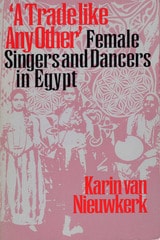
A Trade like Any Other
Female Singers and Dancers in EgyptBy Karin van Nieuwkerk
University of Texas Press, 1995
In Egypt, singing and dancing are considered essential on happy occasions. Professional entertainers often perform at weddings and other celebrations, and a host family's prestige rises with the number, expense, and fame of the entertainers they hire. Paradoxically, however, the entertainers themselves are often viewed as disreputable people and are accorded little prestige in Egyptian society.
This paradox forms the starting point of Karin van Nieuwkerk's look at the Egyptian entertainment trade. She explores the lives of female performers and the reasons why work they regard as "a trade like any other" is considered disreputable in Egyptian society. In particular, she demonstrates that while male entertainers are often viewed as simply "making a living," female performers are almost always considered bad, seductive women engaged in dishonorable conduct. She traces this perception to the social definition of the female body as always and only sexual and enticing—a perception that stigmatizes women entertainers even as it simultaneously offers them a means of livelihood.
Drawn from extensive fieldwork and enriched with the life stories of entertainers and nightclub performers, this is the first ethnography of female singers and dancers in present-day Egypt. It will be of interest to a wide audience in anthropology, women's studies, and Middle Eastern culture, as well as anyone who enjoys belly dancing.

A Translation of Lao-tzu’s Tao Te Ching and Wang Pi’s Commentary
Translated by Paul J. Lin
University of Michigan Press, 1977

A Travel Guide To Basque America
Families, Feasts, and Festivals, 2nd EditionNancy Zubiri
University of Nevada Press, 2006
A Travel Guide to Basque America—the first-ever guide to America’s Basque-American communities, their history, culture, and festivals—has been a best-seller since it first appeared in 1998. This new edition lists dozens of new restaurants, Basque cultural clubs and cultural events, and hundreds of Basque-related Internet sites that have appeared since 1998. It also includes new information about recent events in the Basque Country, their impact on Basque-Americans, and new cultural and community efforts to preserve Basque culture in America. This is the essential guide for Basque-Americans seeking links to their ancient culture and its homeland and their counterparts in the U.S., as well as for any traveler interested in exploring one of this country’s most vibrant and fascinating ethnic minorities.
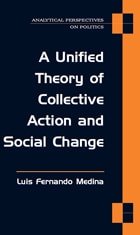
A Unified Theory of Collective Action and Social Change
Luis Fernando Medina
University of Michigan Press, 2007
The notion that groups form and act in ways that respond to objective, external costs and benefits has long been the key to accounting for social change processes driven by collective action. Yet this same notion seems to fall apart when we try to explain how collectivities emerge out of the choices of individuals. This book overcomes that dilemma by offering an analysis of collective action that, while rooted in individual decision making, also brings out the way in which objective costs and benefits can impede or foster social coordination. The resulting approach enables us to address the causes and consequences of collective action with the help of the tools of modern economic theory. To illustrate this, the book applies the tools it develops to the study of specific collective action problems such as clientelism, focusing on its connections with economic development and political redistribution; and wage bargaining, showing its economic determinants and its relevance for the political economy of the welfare state.
"Medina's study is a great step forward in the analytics of collective action. He shows the inadequacies of currently standard models and shows that straightforward revisions reconcile rational-choice and structural viewpoints. It will influence all future work."
—Kenneth Arrow, Stanford University
"Olson, Schelling, and now Medina. A Unified Theory deepens our understanding of collective action and contributes to the foundations of our field. A major work."
—Robert H. Bates, Harvard University
"Medina thinks that the main problem of social action is not whether or not to cooperate but how to do it. To this end he has produced an imaginative approach to analyzing strategic coordination problems that produces plausible predictions in a range of circumstances."
—John Ferejohn, Stanford University
Luis Fernando Medina is Associate Professor in the Department of Politics at the University of Virginia.
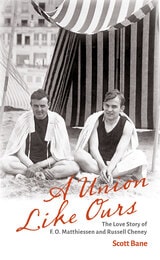
A Union Like Ours
The Love Story of F. O. Matthiessen and Russell CheneyScott Bane
University of Massachusetts Press, 2022
After a chance meeting aboard the ocean liner Paris in 1924, Harvard University scholar and activist F. O. Matthiessen and artist Russell Cheney fell in love and remained inseparable until Cheney’s death in 1945. During the intervening years, the men traveled throughout Europe and the United States, achieving great professional success while contending with serious personal challenges, including addiction, chronic disease, and severe depression.
During a hospital stay, years into their relationship, Matthiessen confessed to Cheney that “never once has the freshness of your life lost any trace of its magic for me. Every day is a new discovery of your wealth.” Situating the couple’s private correspondence alongside other sources, Scott Bane tells the remarkable story of their relationship in the context of shifting social dynamics in the United States. From the vantage point of the present day, with marriage equality enacted into law, Bane provides a window into the realities faced by same-sex couples in the early twentieth century, as they maintained relationships in the face of overt discrimination and the absence of legal protections.
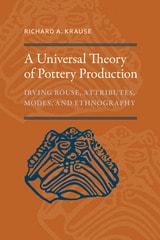
A Universal Theory of Pottery Production
Irving Rouse, Attributes, Modes, and EthnographyRichard A. Krause
University of Alabama Press, 2016
Krause posits that the careful study of an archaeological site’s ceramics can be used to formulate a step-and-stage theory of pottery production for the area. Krause’s work suggests that by comparing the results of inquiries conducted at different sites and for different times, archaeologists may be able to create a general ethnographic theory of pottery production.
Krause demonstrates this process through a comprehensive analysis of potsherds from the highly stratified Puerto Rican site of Paso del Indio. He first provides a comprehensive explanation of the archaeological concepts of attribute, mode, feature, association, site, analysis, and classification. Using these seven concepts, he categorizes the production and decorative techniques in the Paso del Indio site. Krause then applies the concept of “focal form vessels” to the site’s largest fragments to test his step-and-stage theory of production against the evidence they provide. Finally, he assigns the ceramics at Paso del Indio to previously discussed potting traditions.
Unlike other books on the subject that use statistical methods to frame basic archaeological concepts, Krause approaches these topics from the perspective of epistemology and the explicatory practices of empirical science. In A Universal Theory of Pottery Production Krause offers much of interest to North American, Caribbean, and South American archaeologists interested in the manufacture, decoration, and classification of prehistoric pottery, as well as for archaeologists interested in archaeological theory.

A User's Guide to the Age of Tech
Grant Wythoff
University of Minnesota Press, 2025
How users experience and influence technological change—when so much of that change feels out of our control
Every day, we casually employ one of the most complex tools ever created, using it to read the news, plan our day, and connect with friends. In A User’s Guide to the Age of Tech, Grant Wythoff investigates the process by which now-ubiquitous technologies like our phones become integrated into our lives, showing how the “gadget” stage—before devices are widely adopted—opens the door for users to co-create these technologies and adapt them toward unexpected ends.
In this elegant, approachable work, Wythoff offers a view of how users make new technology their own, subverting dominant power structures and imagining uses never intended by their creators. Rooted in a detailed look into the history of technique (focusing on how we do things with tools rather than the tools themselves), A User’s Guide to the Age of Tech proceeds to complicate, and influence, discussion of subjects like the digital divide and AI.
Drawing on a range of sources, including novels, patents, and newspapers, Wythoff explores the vernacular philosophies that have emerged from users and their diverse, everyday practices, bringing down to earth the conversation about digital titans, away from the abstracted domains of server farms and algorithms. Lodging a passionate argument that we know ourselves better than the data brokers who appear to wield influence over our psyches, Wythoff invites readers (and tech users) to imagine their own digital technique, acknowledge their vast expertise, and see its immense value.
Retail e-book files for this title are screen-reader friendly with images accompanied by short alt text and/or extended descriptions.
A Vertebrate Faunal Analysis Coding System, with North American Taxonomy and dBase Support Programs and Procedures (Version 3.3)
Brian S. Shaffer and Barry W. Baker
University of Michigan Press, 1992

A Very Dangerous Woman
Martha Wright and Women's RightsSharon H. Penney
University of Massachusetts Press, 2004
In telling Wright's story, the authors make good use of her lively letters to her family, friends, and colleagues, including Susan B. Anthony and Elizabeth Cady Stanton. These letters reveal Wright's engaging wit and offer an insider's view of nineteenth-century reform and family life. Her correspondence with slaveholding relatives in the South grew increasingly contentious with the approach of the Civil War. One nephew became a hero of the Confederacy with his exploits at the Battle of Fredericksburg, and her son in the Union artillery was seriously wounded at Gettysburg while repelling Pickett's Charge.
Wright's life never lacked for drama. She survived a shipwreck, spent time at a frontier fort, experienced the trauma of the deaths of a fiancé, her first husband, and three of her seven children, and navigated intense conflicts within the women's rights and abolition movements. Throughout her tumultuous career, she drew on a reservoir of humor to promote her ideas and overcome the many challenges she faced. This accessible biography, written with the general reader in mind, does justice to her remarkable life.
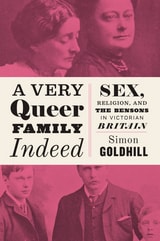
A Very Queer Family Indeed
Sex, Religion, and the Bensons in Victorian BritainSimon Goldhill
University of Chicago Press, 2016
So begins A Very Queer Family Indeed, which introduces us to the extraordinary Benson family. Edward White Benson became Archbishop of Canterbury at the height of Queen Victoria’s reign, while his wife, Mary, was renowned for her wit and charm—the prime minister once wondered whether she was “the cleverest woman in England or in Europe.” The couple’s six precocious children included E. F. Benson, celebrated creator of the Mapp and Lucia novels, and Margaret Benson, the first published female Egyptologist.
What interests Simon Goldhill most, however, is what went on behind the scenes, which was even more unusual than anyone could imagine. Inveterate writers, the Benson family spun out novels, essays, and thousands of letters that open stunning new perspectives—including what it might mean for an adult to kiss and propose marriage to a twelve-year-old girl, how religion in a family could support or destroy relationships, or how the death of a child could be celebrated. No other family has left such detailed records about their most intimate moments, and in these remarkable accounts, we see how family life and a family’s understanding of itself took shape during a time when psychoanalysis, scientific and historical challenges to religion, and new ways of thinking about society were developing. This is the story of the Bensons, but it is also more than that—it is the story of how society transitioned from the high Victorian period into modernity.
A Very Remarkable Sickness
Epidemics in the Petit Nord, 1670 to 1846Paul Hackett
University of Manitoba Press, 2002
A Very Serious Thing
Women’s Humor and American CultureNancy A. Walker
University of Minnesota Press, 1988
A Very Serious Thing was first published in 1988. Minnesota Archive Editions uses digital technology to make long-unavailable books once again accessible, and are published unaltered from the original University of Minnesota Press editions.
"It is a very serious thing to be a funny woman." –Frances Miriam Berry Whitcher
A Very Serious Thing is the first book-length study of a part of American literature that has been consistently neglected by scholars and underrepresented in anthologies—American women's humorous writing. Nancy Walker proposes that the American humorous tradition to be redefined to include women's humor as well as men's, because, contrary to popular opinion, women do have a sense of humor.
Her book draws on history, sociology, anthropology, literature, and psychology to posit that the reasons for neglect of women's humorous expression are rooted in a male-dominated culture that has officially denied women the freedom and self-confidence essential to the humorist. Rather than a study of individual writers, the book is an exploration of relationships between cultural realities—including expectations of "true womanhood"—and women's humorous response to those realities.
Humorous expression, Walker maintains, is at odds with the culturally sanctioned ideal of the "lady," and much of women's humor seems to accept, while actually denying, this ideal. In fact, most of American women's humorous writing has been a feminist critique of American culture and its attitudes toward women, according to the author.
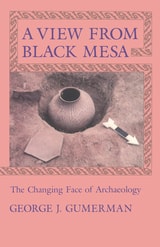
A View From Black Mesa
The Changing Face of ArchaeologyGeorge J. Gumerman
University of Arizona Press, 1984
"In clear and nontechnical language it provides readers with a synopsis of Anasazi prehistory and cultural ecology. ...Gumerman's work is especially useful for anyone seeking an `on-site' introduction to some of the basic techniques and research orientations of modern American archaeology. Highly recommended for students and general readers." —Choice
"It should be read with thoughtful care by the `professional' archaeologist and ethnographer. And it will even more effectively serve the informed general reader, unconcerned with academic minutiae, through its fresh and direct exposition of the procedures, frustrations, and rewards of the calling." —The Kiva
"An outstanding success....a readable book that is suitable for professional archaeologists and the general public as well." —North American Archaeologist
"A readable book that is suitable for professional archaeologists and the general public." —North American Archaeologist

A View from Life's Edge
Discovering What Really Matters with Older Women Across the GlobeCorinne G. Dempsey
Rutgers University Press, 2026
Speaking with nearly one hundred women over the age of eighty in four locations—northern Iceland, south India, a retirement community in California, and a convent in upstate New York—Corinne G. Dempsey finds that, as we near life’s end, we gain clarity about what really matters in life. Women’s stories and reflections, in which sorrow and loss are central to a life well lived, help to expand our sense of what it means to be human.
Drawing on the paradoxical wisdom of world religions and mystical traditions to frame late-life tendencies across cultures, Dempsey portrays these accounts as a corrective to mainstream values that defeat and diminish us. Dempsey encourages us to turn away from ageist fears rather than denying life’s inevitable end. Learning from older women’s perspectives, we might move their edge-of-life views closer to the center.
A View from the Bottom
Asian American Masculinity and Sexual RepresentationNguyen Tan Hoang
Duke University Press, 2014