Results by title
4413 books match the query 'Anthropology' and 193 start with b
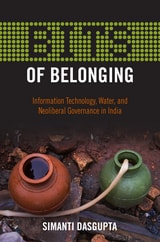
BITS of Belonging
Information Technology, Water, and Neoliberal Governance in IndiaSimanti Dasgupta
Temple University Press, 2015
India’s global success in the Information Technology industry has also prompted the growth of neoliberalism and the re-emergence of the middle class in contemporary urban areas, such as Bangalore. In her significant study, BITS of Belonging, Simanti Dasgupta shows that this economic shift produces new forms of social inequality while reinforcing older ones. She investigates this economic disparity by looking at IT and water privatization to explain how these otherwise unrelated domains correspond to our thinking about citizenship, governance, and belonging.
Dasgupta’s ethnographic study shows how work and human processes in the IT industry intertwine to meet the market stipulations of the global economy. Meanwhile, in the recasting of water from a public good to a commodity, the middle class insists on a governance and citizenship model based upon market participation. Dasgupta provides a critical analysis of the grassroots activism involved in a contested water project where different classes lay their divergent claims to the city.

Babylon East
Performing Dancehall, Roots Reggae, and Rastafari in JapanMarvin D. Sterling
Duke University Press, 2010
Sterling provides a nuanced ethnographic analysis of the ways that many Japanese involved in reggae as musicians and dancers, and those deeply engaged with Rastafari as a spiritual practice, seek to reimagine their lives through Jamaican culture. He considers Japanese performances and representations of Jamaican culture in clubs, competitions, and festivals; on websites; and in song lyrics, music videos, reggae magazines, travel writing, and fiction. He illuminates issues of race, ethnicity, gender, sexuality, and class as he discusses topics ranging from the cultural capital that Japanese dancehall artists amass by immersing themselves in dancehall culture in Jamaica, New York, and England, to the use of Rastafari as a means of critiquing class difference, consumerism, and the colonial pasts of the West and Japan. Encompassing the reactions of Jamaica’s artists to Japanese appropriations of Jamaican culture, as well as the relative positions of Jamaica and Japan in the world economy, Babylon East is a rare ethnographic account of Afro-Asian cultural exchange and global discourses of blackness beyond the African diaspora.
Bacchanalian Sentiments
Musical Experiences and Political Counterpoints in TrinidadKevin K. Birth
Duke University Press, 2008
Birth draws on fieldwork he conducted in one of Trinidad’s ethnically diverse rural villages to explore the relationship between music and social and political consciousness on the island. He describes how Trinidadians use the affective power of music and the physiological experience of performance to express and work through issues related to identity, ethnicity, and politics. He looks at how the performers and audience members relate to different musical traditions. Turning explicitly to politics, Birth recounts how Trinidadians used music as a means of making sense of the attempted coup d’état in 1990 and the 1995 parliamentary election, which resulted in a tie between the two major political parties. Bacchanalian Sentiments is an innovative ethnographic analysis of the significance of music, and particular musical forms, in the everyday lives of rural Trinidadians.

Bachata
A Social History of a Dominican Popular MusicDeborah Pacini
Temple University Press, 1995
Bad Boys
Public Schools in the Making of Black MasculinityAnn Arnett Ferguson
University of Michigan Press, 2020

Bad Film Histories
Ethnography and the Early ArchiveKatherine Groo
University of Minnesota Press, 2019
A daring, deep investigation into ethnographic cinema that challenges standard ways of writing film history and breaks important new ground in understanding archives
Bad Film Histories is a vital work that unsettles the authority of the archive. Katherine Groo daringly takes readers to the margins of the film record, addressing the undertheorization of film history and offering a rigorous corrective. Taking ethnographic cinema as a crucial case study, Groo challenges standard ways of thinking and writing about film history and questions widespread assumptions about what film artifacts are and what makes them meaningful. Rather than filling holes, Groo endeavors to understand the imprecisions and absences that define film history and its archives.
Bad Film Histories draws on numerous works of ethnographic cinema, from Edward S. Curtis’s In the Land of the Head Hunters, to a Citroën-sponsored “croisière” across Africa, to the extensive archives of the Maison Lumière and the Musée Albert-Kahn, to dozens of expedition films from the 1910s and 1920s. The project is deeply grounded in poststructural approaches to history, and throughout Groo draws on these frameworks to offer innovative and accessible readings that explain ethnographic cinema’s destabilizing energies.
As Groo describes, ethnographic works are mostly untitled, unauthored, seemingly infinite in number, and largely unrestored even in their digital afterlives. Her examination of ethnographic cinema provides necessary new thought for both film scholars and those who are thrilled by cinema’s boundless possibilities. In so doing, she boldly reexamines what early ethnographic cinema is and how these films produce meaning, challenging the foundations of film history and prevailing approaches to the archive.

Bad Marxism
Capitalism and Cultural StudiesJohn Hutnyk
Pluto Press, 2004
Bad Souls
Madness and Responsibility in Modern GreeceElizabeth Anne Davis
Duke University Press, 2012
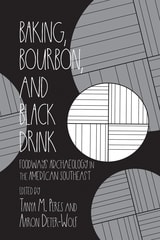
Baking, Bourbon, and Black Drink
Foodways Archaeology in the American SoutheastEdited by Tanya M. Peres and Aaron Deter-Wolf
University of Alabama Press, 2018
Discover the deep cultural roots of Southern cuisine through archaeology.
Understanding and explaining societal rules surrounding food and foodways have been the foci of anthropological studies since the early days of the discipline. Baking, Bourbon, and Black Drink: Foodways Archaeology in the American Southeast, however, is the first collection devoted exclusively to southeastern foodways analyzed through archaeological perspectives. These essays examine which foods were eaten and move the discussion of foodstuffs into the sociocultural realm of why, how, and when they were eaten.
Editors Tanya M. Peres and Aaron Deter-Wolf present a volume that moves beyond basic understandings, applying new methods or focusing on subjects not widely discussed in the Southeast to date. Chapters are arranged using the dominant research themes of feasting, social and political status, food security and persistent places, and foodways histories. Contributors provide in-depth examination of specific food topics such as bone marrow, turkey, Black Drink, bourbon, earth ovens, and hominy.
Contributors bring a broad range of expertise to the collection, resulting in an expansive look at all of the steps taken from field to table, including procurement, production, cooking, and consumption, all of which have embedded cultural meanings and traditions. The scope of the volume includes the diversity of research specialties brought to bear on the topic of foodways as well as the temporal and regional breadth and depth, the integration of multiple lines of evidence, and, in some cases, the reinvestigation of well-known sites with new questions and new data.
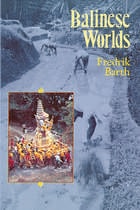
Balinese Worlds
Fredrik Barth
University of Chicago Press, 1993
In this detailed ethnography of the Northern district of Buleleng, Barth rejects mainstream anthropological generalizations of Bali as a cultural system of carefully articulated parts. Instead—drawing on many sources, including the sociology of knowledge, interactional analysis, postmodern thought, and his own exceptionally varied field experience—Barth presents a new model that actually generates variation. Barth's innovative analysis of Balinese life highlights both the constructive and the disorganizing effects of individual action, the constant flux of interpretation, and the powerful interaction of memory and social relationships, and knowledge as a cultural resource.
Balinese Worlds is a unique contribution not only to Balinese studies but also to the theory and methods of the anthropology of complex societies.
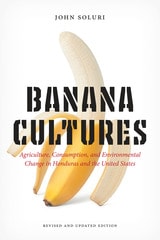
Banana Cultures
Agriculture, Consumption, and Environmental Change in Honduras and the United StatesBy John Soluri
University of Texas Press, 2021
Bananas, the most frequently consumed fresh fruit in the United States, have been linked to Miss Chiquita and Carmen Miranda, "banana republics," and Banana Republic clothing stores—everything from exotic kitsch, to Third World dictatorships, to middle-class fashion. But how did the rise in banana consumption in the United States affect the banana-growing regions of Central America? In this lively, interdisciplinary study, John Soluri integrates agroecology, anthropology, political economy, and history to trace the symbiotic growth of the export banana industry in Honduras and the consumer mass market in the United States.
Beginning in the 1870s, when bananas first appeared in the U.S. marketplace, Soluri examines the tensions between the small-scale growers, who dominated the trade in the early years, and the shippers. He then shows how rising demand led to changes in production that resulted in the formation of major agribusinesses, spawned international migrations, and transformed great swaths of the Honduran environment into monocultures susceptible to plant disease epidemics that in turn changed Central American livelihoods. Soluri also looks at labor practices and workers' lives, changing gender roles on the banana plantations, the effects of pesticides on the Honduran environment and people, and the mass marketing of bananas to consumers in the United States. His multifaceted account of a century of banana production and consumption adds an important chapter to the history of Honduras, as well as to the larger history of globalization and its effects on rural peoples, local economies, and biodiversity.

Banana Wars
Power, Production, and History in the AmericasSteve Striffler and Mark Moberg, eds.
Duke University Press, 2003
Bringing together the work of anthropologists, sociologists, economists, historians, and geographers, this collection reveals how the banana industry marshaled workers of differing nationalities, ethnicities, and languages and, in so doing, created unprecedented potential for conflict throughout Latin American and the Caribbean. The frequently abusive conditions that banana workers experienced, the contributors point out, gave rise to one of Latin America’s earliest and most militant labor movements. Responding to both the demands of workers’ organizations and the power of U.S. capital, Latin American governments were inevitably affected by banana production. Banana Wars explores how these governments sometimes asserted their sovereignty over foreign fruit companies, but more often became their willing accomplices. With several essays focusing on the operations of the extraordinarily powerful United Fruit Company, the collection also examines the strategies and reactions of the American and European corporations seeking to profit from the sale of bananas grown by people of different cultures working in varied agricultural and economic environments.
Contributors. Philippe Bourgois, Marcelo Bucheli, Dario Euraque, Cindy Forster, Lawrence Grossman, Mark Moberg, Laura T. Raynolds, Karla Slocum, John Soluri, Steve Striffler, Allen Wells
Banking on Words
The Failure of Language in the Age of Derivative FinanceArjun Appadurai
University of Chicago Press, 2015
Appadurai moves in four steps through his analysis. In the first, he highlights the importance of derivatives in contemporary finance, isolating them as the core technical innovation that markets have produced. In the second, he shows that derivatives are essentially written contracts about the future prices of assets—they are, crucially, a promise. Drawing on Mauss’s The Gift and Austin’s theories on linguistic performatives, Appadurai, in his third step, shows how the derivative exploits the linguistic power of the promise through the special form that money takes in finance as the most abstract form of commodity value. Finally, he pinpoints one crucial feature of derivatives (as seen in the housing market especially): that they can make promises that other promises will be broken. He then details how this feature spread contagiously through the market, snowballing into the systemic liquidity crisis that we are all too familiar with now.
With his characteristic clarity, Appadurai explains one of the most complicated—and yet absolutely central—aspects of our modern economy. He makes the critical link we have long needed to make: between the numerical force of money and the linguistic force of what we say we will do with it.
Bargaining for Reality
The Construction of Social Relations in a Muslim CommunityLawrence Rosen
University of Chicago Press, 1984
Drawing on the philosophy of speech acts as well as interpretive theory, Rosen shows how, for the people of this Muslim community, reality consists of the network of obligations formed by individuals out of a repertoire of relational possibilities whose defining terms are comprised by a set of essentially negotiable concepts. He thus demonstrates that the bonds of family, tribe, and political alliance take shape only as the bargains struck in and through the malleable terms that describe them take shape; that statements about relationship are no more true than a price mentioned in the marketplace until properly validated; that the relations between men and women, Arabs and Berbers, Muslims and Jews test the limits of interpersonal negotiation; and that the concepts of time, character, and narrative style are consonant with a view of reality as bargained-for network of obligations.
Bargaining for Reality makes an important contribution to our understanding of contemporary Middle Eastern society and to the development of powerful new interpretive strategies for a wide range of social theorists.
"[Rosen's] book is extremely useful for African and Middle Eastern historians, because he challenges some of our most basic ideas about the nature and force of kinship, tribe, ethnicity, and other large- and small-scale political ties."—Allan R. Meyers, International Journal of African Historical Studies
"The book conveys a compelling image of Moroccan social experience and is peppered with vivid anecdotes and case histories."—Stephen William Foster, American Anthropologist
Barger Gulch
A Folsom Campsite in the Rocky MountainsTodd A. Surovell
University of Arizona Press, 2022
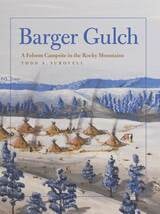
The best archaeological sites are those that present problems and inspire research, writes Surovell. From the start, the Folsom site called Barger Gulch Locality B was one of those sites; it was a problem-rich environment. Many Folsom sites are sparse scatters of stone and bone, a reflection of a mobile lifestyle that leaves little archaeological materials. The people at Barger Gulch left behind tens of thousands of pieces of chipped stone; they appeared to have spent quite a bit of time there in comparison to other places they inhabited.
Summarizing findings from nine seasons of excavations, Surovell explains that the site represents a congregation of mobile hunter-gatherers who spent winter along Barger Gulch, a tributary of the Colorado River. Surovell uses spatial patterns in chipped stone to infer the locations of hearths and house features. He examines the organization of household interiors and discusses differential use of interior and exterior spaces. Data allow inference about the people who lived at the site, including aspects of the identity of flintknappers and household versus group mobility. The site shows evidence of a Paleoindian camp circle, child flintknapping, household production of weaponry, and the fission/fusion dynamics of group composition that is typical of nomadic peoples.
Barger Gulch provides key findings on Paleoindian technological variation and spatial and social organization.
Barrio Libre
Criminalizing States and Delinquent Refusals of the New FrontierGilberto Rosas
Duke University Press, 2012
Rosas argues that although these youths participate in the victimization of others, they should not be demonized. They are complexly and adversely situated. The effects of NAFTA have forced many of them, as well as other Mexicans, to migrate to Nogales. Moving fluidly with the youths through the spaces that they inhabit and control, he shows how the militarization of the border actually destabilized the region and led Barrio Libre to turn to increasingly violent activities, including drug trafficking. By focusing on these youths and their delinquency, Rosas demonstrates how capitalism and criminality shape perceptions and experiences of race, sovereignty, and resistance along the US-Mexico border.
Basic K'ichee' Grammar
38 Lessons, Revised EditionJames L. Mondloch
University Press of Colorado, 2016
A pedagogical rather than a reference grammar, the book is a thorough presentation of the basics of the K’ichee’ Maya language organized around graded grammatical lessons accompanied by drills and exercises. Author James L. Mondloch spent ten years in K’ichee’-speaking communities and provides a complete analysis of the K’ichee’ verb system based on the everyday speech of the people and using a wealth of examples and detailed commentaries on actual usage.
A guide for learning the K’ichee’ language, Basic K'ichee' Grammar is a valuable resource for anyone seeking a speaking and reading knowledge of modern K’ichee’, including linguists, anthropologists, and art historians, as well as nonacademics working in K’ichee’ communities, such as physicians, dentists, community development workers, and educators.
Basin-Plateau Aboriginal Sociopolitical Groups
Julian Steward
University of Utah Press, 1997
First published in 1938 as the Smithsonian Institution Bureau of American Ethnology Bulletin 120, this study is a classic in the field of Great Basin ethnology. Steward is considered one of the foremost exponents of cultural evolution in the United States, and his work is a major contribution to the study of social organization and to North American ethnography.

Bazaar Economy
Edited by H.W. Rosen
HAU, 2021
Beautiful Flowers of the Maquiladora
Life Histories of Women Workers in TijuanaBy Norma Iglesias Prieto
University of Texas Press, 1997
Published originally as La flor mas bella de la maquiladora, this beautifully written book is based on interviews the author conducted with more than fifty Mexican women who work in the assembly plants along the U.S.-Mexico border. A descriptive analytic study conducted in the late 1970s, the book uses compelling testimonials to detail the struggles these women face.
The experiences of women in maquiladoras are attracting increasing attention from scholars, especially in the context of ongoing Mexican migration to the country's northern frontier and in light of the North American Free Trade Agreement (NAFTA). This book is among the earliest accounts of the physical and psychological toll exacted from the women who labor in these plants. Iglesias Prieto captures the idioms of these working women so that they emerge as dynamic individuals, young and articulate personalities, inexorably engaged in the daily struggle to change the fundamental conditions of their exploitation.

Beautiful Mystery
Living in a Wordless WorldDanilyn Rutherford
Duke University Press, 2025
Now in her twenties, Millie has never been able to express herself verbally, but she has a thriving social environment rooted in the people around her and in things her companions and family can see, hear, smell, and feel. Life in Millie’s world is far richer than might be immediately evident to those who think and communicate in conventional ways.
Beautiful Mystery explores what it means to be a person in the spaces between what we can and cannot say, and how we can fight to care for those we love when they don’t have the language to fight for themselves. Through her unique lens as a mother and an anthropologist, Rutherford tells the story of arriving in Millie’s world, what she found there, and how Millie showed her that words aren’t always what makes us human. Enlightening and deeply felt, Beautiful Mystery proves that you don’t have to understand someone to love them—a lesson that, if we all learned it, might allow us to live together in a fractured world.

Beautiful Politics of Music
Trova in Yucatán, MexicoGabriela Vargas-Cetina
University of Alabama Press, 2017
An exploration into the history and practice of trova, a genre of music that is the soul of Yucatán.
Yucatecan trova is a music genre comprising a type of romantic song that is considered “the soul of Yucatán and Yucatecans.” This first book on Yucatecan trova offers an insider’s view of the history and practice of a treasured cultural heritage. A central theme of Gabriela Vargas-Cetina’s ethnography is what she refers to as the “beautiful politics of music” practiced by Yucatecan trova patrons and organizations, which is a way of asserting the importance of groups and issues through nonconfrontational means.
Trova emerged on the peninsula at the end of the nineteenth century and continues to be part of the general urban soundscape in the states of Yucatán and Campeche. Until the 1920s, this music was little known outside Yucatán and became absorbed into the larger Latin American Bolero genre, making it difficult to perceive its uniqueness and relation to life in Yucatán.
Vargas-Cetina, a native Yucatecan and trova musician, offers ethnographic insight into the local music scene. With family connections, she embedded herself as a trovadora, and her fieldwork—singing, playing the guitar in a trova group, and extensively researching the genre and talking with fellow enthusiasts and experts—ensued. Trova, like other types of artistic endeavors, is the result of collaboration and social milieu. She describes the dedicated trova clubs, cultural institutions, the Yucatecan economy of agricultural exports, and identity politics that helped the music come about and have maintained it today.
Positioned in the larger context of the music of Mexico and Latin America and engaging with theories of modernity and cosmopolitanism, experimental ethnography, and the anthropology of organizations, Beautiful Politics of Music consists of rigorous scholarship. It is also a warm tribute to performers and songs that have inspired many people around the world for more than two centuries.
Beauty and Brutality
Manila and Its Global DiscontentsEdited by Martin F. Manalansan IV, Robert Diaz, and Roland B. Tolentino
Temple University Press, 2023
Beauty and Brutality provides an exciting, original, and critical encounter with this labyrinthine city’s imagined and material landscape. The authors and contributors investigate the “messy, fleshy, recalcitrant, mercurial, and immeasurable qualities of the city,” examining its urban space and smell: how it is represented in films, literature, music, and urban streetart; how it has endured the politics of colonialism, U.S. imperialism, neoliberalism, and globalization; as well as how its queer citizens engage with digital media platforms to communicate and connect with each other.
The first volume to offer a cultural and urban studies approach to Manila, Beauty and Brutality considers the tensions of the Filipino diaspora as they migrate and “re-turn,” as well as the citizens’ responses to the Marcos (and post-Marcos) dictatorship, President Duterte’s authoritarianism, and “Drug War.” Essays also map out of geographies of repression and resistance in the urban war of classes, genders and sexualities, ethnicities and races, and generations, along with the violence of urban life and growth. Ultimately, Beauty and Brutality frames Manila as a vibrant and ever-evolving metropolis that, even in the face of its difficulties, instills hope.
Contributors: Paul Michael Leonardo Atienza, Christine Bacareza Balance, Vanessa Banta, Rosa Cordillera A. Castillo, Roland Sintos Coloma, Gary C. Devilles, Faith R. Kares, John B. Labella, Raffy Lerma, Bliss Cua Lim, Ferdinand M. Lopez, Paul Nadal, Jema M. Pamintuan, Oscar Tantoco Serquiña, Jr., Louise Jashil R. Sonido, and the editors.

Beauty and the Beast
Michael Taussig
University of Chicago Press, 2012
Beauty and the Beast begins with the question: Is beauty destined to end in tragedy? Drawing on extensive fieldwork in Colombia, Michael Taussig scrutinizes the anxious, audacious, and sometimes destructive attempts people make to transform their bodies through cosmetic surgery and liposuction. He balances an examination of surgeries meant to enhance an individual’s beauty with an often overlooked counterpart, surgeries performed—often on high profile criminals—to disguise one’s identity. Situating this globally shared phenomenon within the economic, cultural, and political history of Colombia, Taussig links the country’s long civil war and its bodily mutilation and torture to the beauty industry at large, sketching Colombia as a country whose high aesthetic stakes make it a stage where some of the most important and problematic ideas about the body are played out.
Central to Taussig’s examination is George Bataille’s notion of depense, or “wasting.” While depense is often used as a critique, Taussig also looks at the exuberance such squandering creates and its position as a driving economic force. Depense, he argues, is precisely what these procedures are all about, and the beast on the other side of beauty should not be dismissed as simple recompense. At once theoretical and colloquial, public and intimate, Beauty and the Beast is a true-to-place ethnography—written in Taussig’s trademark voice—that tells a thickly layered but always accessible story about the lengths to which people will go to be physically remade.
Becoming Arab in London
Performativity and the Undoing of IdentityRamy M. K. Aly
Pluto Press, 2015
Drawing on the work of Judith Butler, Aly emphasizes the need to move away from the concept of identity and toward the idea of race, gender, and class as performance. Based on seven years of fieldwork, during which time the author immersed himself in London’s Arab community, Becoming Arab in London is an innovative and necessary contribution to the study of diaspora and difference in contemporary Britain.
Becoming Catawba
Catawba Indian Women and Nation-Building, 1540–1840Brooke M. Bauer
University of Alabama Press, 2023
WINNER OF THE ANNE B. & JAMES B. MCMILLAN PRIZE IN SOUTHERN HISTORY
WINNER OF THE ERMINIE WHEELER-VOEGELIN BOOK AWARD
WINNER OF THE BERSHIRE CONFERENCE OF WOMEN HISTORIANS BOOK AWARD
WINNER OF THE GEORGE C. ROGERS, JR. AWARD FROM THE SOUTH CAROLINA HISTORICAL SOCIETY
The story of Catawba women who experienced sweeping changes to their world but held onto traditional customs to create and preserve a Catawba identity and build a nation.
Brooke M. Bauer’s Becoming Catawba: Catawba Indian Women and Nation-Building, 1540–1840 is the first book-length study of the role Catawba women played in creating and preserving a cohesive tribal identity over three centuries of colonization and cultural turmoil. Bauer, a citizen of the Catawba Indian Nation of South Carolina, weaves ethnohistorical methodologies, family history, cultural context, and the Catawba language together to generate an internal perspective on the Catawbas’ history and heritage in the area now known as the Carolina Piedmont.
This unique and important study examines the lives and legacies of women who executed complex decision-making and diplomacy to navigate shifting frameworks of kinship, land ownership, and cultural production in dealings with colonial encroachments, white settlers, and Euro-American legal systems and governments from the mid-sixteenth century to the early nineteenth century. Personified in the figure of Sally New River, a Catawba cultural leader to whom 500 remaining acres of occupied tribal lands were deeded on behalf of the community in 1796 and which she managed until her death in 1821, Bauer reveals how women worked to ensure the survival of the Catawba people and their Catawba identity, an effort that resulted in a unified nation.
Bauer’s approach is primarily ethnohistorical, although it draws on a number of interdisciplinary strategies. In particular, Bauer uses “upstreaming,” a critical strategy that moves toward the period under study by using present-day community members’ connections to historical knowledge—for example, family histories and oral traditions—to interpret primary-source data. Additionally, Bauer employs archaeological data and material culture as a means of performing feminist recuperation, filling the gaps and silences left by the records, newspapers, and historical accounts as primarily written by and for white men. Ultimately, Becoming Catawba effects a welcome intervention at the intersections of Native, women’s, and Southern history, expanding the diversity and modes of experience in the fraught, multifaceted cultural environment of the early American South.
Becoming Creole
Nature and Race in BelizeJohnson, Melissa A.
Rutgers University Press, 2019

Becoming Frum
How Newcomers Learn the Language and Culture of Orthodox JudaismSarah Bunin Benor
Rutgers University Press, 2012
Winner, 2013 Sami Rohr Choice Award for Jewish Literature
When non-Orthodox Jews become frum (religious), they encounter much more than dietary laws and Sabbath prohibitions. They find themselves in the midst of a whole new culture, involving matchmakers, homemade gefilte fish, and Yiddish-influenced grammar. Becoming Frum explains how these newcomers learn Orthodox language and culture through their interactions with community veterans and other newcomers. Some take on as much as they can as quickly as they can, going beyond the norms of those raised in the community. Others maintain aspects of their pre-Orthodox selves, yielding unique combinations, like Matisyahu’s reggae music or Hebrew words and sing-song intonation used with American slang, as in “mamish (really) keepin’ it real.”
Sarah Bunin Benor brings insight into the phenomenon of adopting a new identity based on ethnographic and sociolinguistic research among men and women in an American Orthodox community. Her analysis is applicable to other situations of adult language socialization, such as students learning medical jargon or Canadians moving to Australia. Becoming Frum offers a scholarly and accessible look at the linguistic and cultural process of “becoming.”
Becoming Hopi
A HistoryEdited by Wesley Bernardini, Stewart B. Koyiyumptewa, Gregson Schachner, and Leigh Kuwanwisiwma
University of Arizona Press, 2021
The Hopi and their ancestors have lived on the Hopi Mesas for more than two thousand years, a testimony to sustainable agricultural practices that supported one of the largest populations in the Pueblo world. Becoming Hopi is a truly collaborative volume that integrates Indigenous voices with more than fifteen years of archaeological and ethnographic fieldwork. Accessible and colorful, this volume presents groundbreaking information about Ancestral Pueblo villages in the greater Hopi Mesas region, making it a fascinating resource for anyone who wants to learn about the rich and diverse history of the Hopi people and their enduring connection to the American Southwest.
Contributors: Lyle Balenquah, Wesley Bernardini, Katelyn J. Bishop, R. Kyle Bocinsky, T. J. Ferguson, Saul L. Hedquist, Maren P. Hopkins, Stewart B. Koyiyumptewa, Leigh Kuwanwisiwma, Mowana Lomaomvaya, Lee Wayne Lomayestewa, Joel Nicholas, Matthew Peeples, Gregson Schachner, R. J. Sinensky, Julie Solometo, Kellam Throgmorton, Trent Tu’tsi
Becoming Mapuche
Person and Ritual in Indigenous ChileMagnus Course
University of Illinois Press, 2011
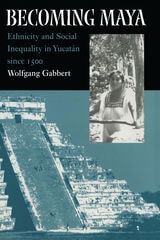
Becoming Maya
Ethnicity and Social Inequality in Yucatán since 1500Wolfgang Gabbert
University of Arizona Press, 2004
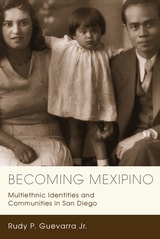
Becoming Mexipino
Multiethnic Identities and Communities in San DiegoGuevarra, Rudy P
Rutgers University Press, 2012
Through racially restrictive covenants and other forms of discrimination, both groups, regardless of their differences, were confined to segregated living spaces along with African Americans, other Asian groups, and a few European immigrant clusters. Within these urban multiracial spaces, Mexicans and Filipinos coalesced to build a world of their own through family and kin networks, shared cultural practices, social organizations, and music and other forms of entertainment. They occupied the same living spaces, attended the same Catholic churches, and worked together creating labor cultures that reinforced their ties, often fostering marriages. Mexipino children, living simultaneously in two cultures, have forged a new identity for themselves. Their lives are the lens through which these two communities are examined, revealing the ways in which Mexicans and Filipinos interacted over generations to produce this distinct and instructive multiethnic experience. Using archival sources, oral histories, newspapers, and personal collections and photographs, Guevarra defines the niche that this particular group carved out for itself.
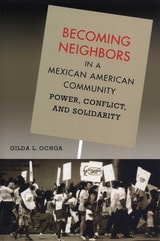
Becoming Neighbors in a Mexican American Community
Power, Conflict, and SolidarityBy Gilda L. Ochoa
University of Texas Press, 2004
On the surface, Mexican Americans and Mexican immigrants to the United States seem to share a common cultural identity but often make uneasy neighbors. Discrimination and assimilationist policies have influenced generations of Mexican Americans so that some now fear that the status they have gained by assimilating into American society will be jeopardized by Spanish-speaking newcomers. Other Mexican Americans, however, adopt a position of group solidarity and work to better the social conditions and educational opportunities of Mexican immigrants.
Focusing on the Mexican-origin, working-class city of La Puente in Los Angeles County, California, this book examines Mexican Americans' everyday attitudes toward and interactions with Mexican immigrants—a topic that has so far received little serious study. Using in-depth interviews, participant observations, school board meeting minutes, and other historical documents, Gilda Ochoa investigates how Mexican Americans are negotiating their relationships with immigrants at an interpersonal level in the places where they shop, worship, learn, and raise their families. This research into daily lives highlights the centrality of women in the process of negotiating and building communities and sheds new light on identity formation and group mobilization in the U.S. and on educational issues, especially bilingual education. It also complements previous studies on the impact of immigration on the wages and employment opportunities of Mexican Americans.
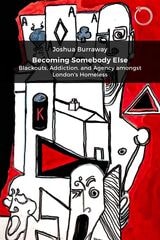
Becoming Somebody Else
Blackouts, Addiction, and Agency amongst London's HomelessJoshua Burraway
HAU, 2025
What does it mean to exist outside the normative temporality of life, of housed living, and, ultimately, of selfhood? Becoming Somebody Else takes up this question, offering a window into the fragmented and chaotic lives of people experiencing homelessness in urban London as they drink and drug themselves into blackout in post-austerity Britain. A state of being where time, body, agency, and self collapse into a memoryless abyss, the blackout is a prism into how human beings make and unmake their selfhood in the wake of social suffering and personal trauma. Attending to the words and histories of several individuals, Joshua Burraway knits together structural, psychological, and phenomenological approaches to understand the ways in which memory, agency, and selfhood are sites of struggle and belonging, and in doing so, suggests new ways of thinking about addiction, homelessness, and therapeutic possibility.
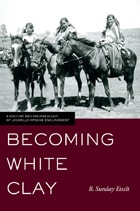
Becoming White Clay
A History and Archaeology of Jicarilla Apache EnclavementB. Sunday Eiselt
University of Utah Press, 2012
The story of one of the longest-lived and most successful nomadic enclaves in North America provides a rare glimpse into the material expressions of Apache self-determination and survival. For nearly 200 years the Jicarilla Apache of New Mexico thrived in the interstices of Pueblo and Spanish settlements following their expulsion from the Plains. Critical to their success was their ability to extend key aspects of Plains-Pueblo exchange to Indian and mixed-blood communities on the fringes of colonial rule. More than other nomadic tribes, the Jicarilla played an enormous role in holding together the social fabric of New Mexican villages after the fall of the Spanish Empire.
This comprehensive study by Sunday Eiselt begins with the great Athapaskan migration out of Canada during prehis-toric times and ends with the forced settlement of the Jicarilla on the Dulce reservation in the 1880s. Eiselt combines archaeological and ethnohistorical data in an examination of Jicarilla strategies for self-preservation. She reveals the ideological and political imperatives of “belonging” that shaped their interactions with local communities and the state and that enabled them to avoid reservation life well into the 1880s. Throughout their long history, Jicarilla identity remained intact, distinctive, and discernable even as life on the reservation disrupted the intimate connections that once existed with their Hispanic and Pueblo neighbors.
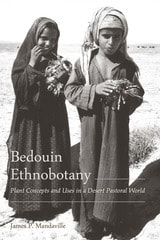
Bedouin Ethnobotany
Plant Concepts and Uses in a Desert Pastoral WorldJames P. Mandaville
University of Arizona Press, 2011
Bedouin Ethnobotany offers the first detailed study of plant uses among the Najdi Arabic–speaking tribal peoples of eastern Saudi Arabia. It also makes a major contribution to the larger project of ethnobotany by describing aspects of a nomadic peoples’ conceptual relationships with the plants of their homeland.
The modern theoretical basis for studies of the folk classification and nomenclature of plants was developed from accounts of peoples who were small-scale agriculturists and, to a lesser extent, hunter-gatherers. This book fills a major gap by extending such study into the world of the nomadic pastoralist and exploring the extent to which these patterns are valid for another major subsistence type. James P. Mandaville, an Arabic speaker who lived in Saudi Arabia for many years, focuses first on the role of plants in Bedouin life, explaining their uses for livestock forage, firewood, medicinals, food, and dyestuffs, and examining other practical purposes. He then explicates the conceptual and linguistic aspects of his subject, applying the theory developed by Brent Berlin and others to a previously unstudied population. Mandaville also looks at the long history of Bedouin plant nomenclature, finding that very little has changed among the names and classifications in nearly eleven centuries.
This volume includes a CD-ROM featuring more than 340 color images of the people, the terrain, and nearly all of the plants mentioned in the text as well as an audio file of a traditional Bedouin song and its translation and analysis.
An essential volume for anyone interested in the interaction between human culture and plant life, Bedouin Ethnobotany will stand as a definitive source for years to come.
Bedouin Life in the Egyptian Wilderness
By Joseph J. Hobbs
University of Texas Press, 1992
Between the Nile River and the Red Sea, in the northern half of Egypt's Eastern Desert, live the Bedouins of the Ma'aza tribe. Joseph Hobbs lived with the Khushmaan Ma'aza clan for almost two years, gathering information for a study of traditional Bedouin life and culture. The resulting work, Bedouin Life in the Egyptian Wilderness, is the first modern ethnographic portrait of the Ma'aza Bedouins.
Before Before
A Story of Discovery and Loss in Sierra LeoneBetsy Small
University of Michigan Press, 2025
2025 Foreword INDIES Finalist for Political and Social Sciences
- 2026 Nautilus Silver Book Award in World Cultures' Transformational Growth & Development
Sierra Leone is often sensationalized as a place of extreme violence and suffering—of blood diamonds, child soldiers, war amputations, and Ebola and now the highly addictive drug Kush. Before Before captures daily life in a different country, one Betsy Small first encountered as a Peace Corps worker between 1984–1987, and then rediscovered when she returned decades later with her daughter. Living in Tokpombu, a remote community of forty rice-farming families, the author faced struggles that changed her forever and witnessed the growing tensions in this rainforest village—between the young and old, between the traditions of oral history and honoring the ancestors valued by the elders and the siren call of the illicit diamond mines faced by the youth.
Before Before offers a rare portrait of everyday people, with particular focus on the lives of women and girls, before the brutal war of 1991 tore the country apart. Through Small’s account of immersion in another world as she witnessed injustice and was welcomed as a friend, readers are invited to explore the shared ground of our humanity.
Before Cultures
The Ethnographic Imagination in American Literature, 1865-1920Brad Evans
University of Chicago Press, 2005
In this work, Brad Evans weaves together the histories of American literature and anthropology. His study brings alive not only the regionalist and ethnographic fiction of the time but also revives a range of neglected materials, including the Zuni sketchbooks of anthropologist Frank Hamilton Cushing; popular magazines such as Century Illustrated Monthly, which published Cushing's articles alongside Henry James's; the debate between Joel Chandler Harris, author/collector of the Uncle Remus folktales, and John Wesley Powell, perhaps the most important American anthropologist of the time; and Du Bois's polemics against the culture concept as it was being developed in the early twentieth century.
Written with clarity and grace, Before Cultures will be of value to students of American literature, history, and anthropology alike.

Before and After Gender
Sexual Mythologies of Everyday LifeMarilyn Strathern
HAU, 2016
Strathern incisively engages some of the leading feminist thinkers of the time, including Shulamith Firestone, Simone de Beauvoir, Ann Oakley, and Kate Millett. Building with characteristic precision toward a bold conclusion in which she argues that we underestimate the materializing grammars of sex and gender at our own peril, she offers a powerful challenge to the intransigent mythologies of sex that still plague contemporary society. The result is a sweeping display of Strathern’s vivid critical thought and an important contribution to feminist studies that has gone unpublished for far too long.

Behind the Bamboo Hedge
The Impact of the Homeland Politics in the Parisian Vietnamese CommunityGisele L. Bousquet
University of Michigan Press, 1991
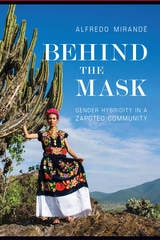
Behind the Mask
Gender Hybridity in a Zapotec CommunityAlfredo Mirandé
University of Arizona Press, 2017
After seeing a video of a muxe vela, or festival, sociologist Alfredo Mirandé was intrigued by the contradiction between Mexico’s patriarchal reputation and its warm acceptance of los muxes. Seeking to get past traditional Mexican masculinity, he presents us with Behind the Mask, which combines historical analysis, ethnographic field research, and interviews conducted with los muxes of Juchitán over a period of seven years. Mirandé observed community events, attended muxe velas, and interviewed both muxes and other Juchitán residents. Prefaced by an overview of the study methods and sample, the book challenges the ideology of a male-dominated Mexican society driven by the cult of machismo, featuring photos alongside four appendixes.
Delving into many aspects of their lives and culture, the author discusses how the muxes are perceived by others, how the muxes perceive themselves, and the acceptance of a third gender status among various North American indigenous groups. Mirandé compares traditional Mexicano/Latino conceptions of gender and sexuality to modern or Western object choice configurations. He concludes by proposing a new hybrid model for rethinking these seemingly contradictory and conflicting gender systems.
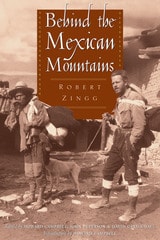
Behind the Mexican Mountains
By Robert Zingg
University of Texas Press, 2001
In 1930, anthropologists Robert Zingg and Wendell Bennett spent nine months among the Tarahumara of Chihuahua, Mexico, one of the least acculturated indigenous societies in North America. Their fieldwork resulted in The Tarahumara: An Indian Tribe of Northern Mexico (1935), a classic ethnography still familiar to anthropologists. In addition to this formal work, Zingg also penned a personal, unvarnished travelogue of his sojourn among the Tarahumara. Unpublished in his lifetime, Behind the Mexican Mountains is now available in print for the first time.
This colorful account provides a compelling description of the landscape, people, traditions, language, and archaeology of the Tarahumara region. Abandoning the scientific detachment of the observer, Zingg frankly records his reactions to the people and their customs as he vividly evokes the daily experience of doing fieldwork. In the introduction, Howard Campbell examines Zingg's writing in light of current critiques of anthropology as literature. He makes a strong case that although earlier anthropological writing reveals unacceptable cultural biases, it also demonstrates the ongoing importance and vitality of field research.
Behold the Black Caiman
A Chronicle of Ayoreo LifeLucas Bessire
University of Chicago Press, 2014
Drawing on ten years of fieldwork, Bessire highlights the stark disconnect between the desperate conditions of Ayoreo life for those out of the forest and the well-funded global efforts to preserve those Ayoreo still living in it. By showing how this disconnect reverberates within Ayoreo bodies and minds, his reflexive account takes aim at the devastating consequences of our society’s continued obsession with the primitive and raises important questions about anthropology’s potent capacity to further or impede indigenous struggles for sovereignty. The result is a timely update to the classic literary ethnographies of South America, a sustained critique of the so-called ontological turn—one of anthropology’s hottest trends—and, above all, an urgent call for scholars and activists alike to rethink their notions of difference.
Beijing from Below
Stories of Marginal Lives in the Capital's CenterHarriet Evans
Duke University Press, 2020
Being Colonized
The Kuba Experience in Rural Congo, 1880–1960Jan Vansina
University of Wisconsin Press, 2010
Vansina’s case study of the colonial experience is the realm of Kuba, a kingdom in Congo about the size of New Jersey—and two-thirds the size of its colonial master, Belgium. The experience of its inhabitants is the story of colonialism, from its earliest manifestations to its tumultuous end. What happened in Kuba happened to varying degrees throughout Africa and other colonized regions: racism, economic exploitation, indirect rule, Christian conversion, modernization, disease and healing, and transformations in gender relations. The Kuba, like others, took their own active part in history, responding to the changes and calamities that colonization set in motion. Vansina follows the region’s inhabitants from the late nineteenth century to the middle of the twentieth century, when a new elite emerged on the eve of Congo’s dramatic passage to independence.
Being Dead Otherwise
Anne Allison
Duke University Press, 2023
Being Human
Political Modernity and Hospitality in Kurdistan-IraqFazil Moradi
Rutgers University Press, 2024
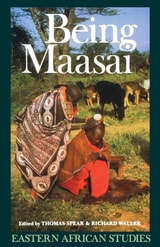
Being Maasai
Ethnicity and Identity In East AfricaThomas Spear
Ohio University Press, 1993
Everyone “knows” the Maasai as proud pastoralists who once dominated the Rift Valley from northern Kenya to central Tanzania.
But many people who identity themselves as Maasai, or who speak Maa, are not pastoralist at all, but farmers and hunters. Over time many different people have “become” something else. And what it means to be Maasai has changed radically over the past several centuries and is still changing today.
This collection by historians, archaeologists, anthropologists and linguists examines how Maasai identity has been created, evoked, contested, and transformed from the time of their earliest settlement in Kenya to the present, as well as raising questions about the nature of ethnicity generally.
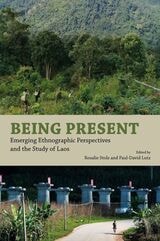
Being Present
Emerging Ethnographic Perspectives and the Study of LaosEdited by Rosalie Stolz and Paul-David Lutz
National University of Singapore Press, 2026
Ethnography has long called on researchers to immerse themselves in the worlds they study—but what does it mean to “be present” in the field today? Being Present investigates this question through innovative research on Laos, a country rapidly changing at the crossroads of Southeast Asia and China. This volume brings together a new generation of scholars to explore Chinese-built railways, shifting farmlands, urban mourning rituals, and changing aspirations in Laos.
Covering infrastructure, health, trade, and spirituality, these studies challenge assumptions about ethnography. They show how immersion and reflexivity remain essential in a connected world. Being Present offers a fresh look at contemporary Laos and a timely reflection on ethnographic practice.