Results by title
435 books match the query 'Asian American & Pacific Islander Studies' and 23 start with b
Beauty and Brutality
Manila and Its Global DiscontentsEdited by Martin F. Manalansan IV, Robert Diaz, and Roland B. Tolentino
Temple University Press, 2023
Beauty and Brutality provides an exciting, original, and critical encounter with this labyrinthine city’s imagined and material landscape. The authors and contributors investigate the “messy, fleshy, recalcitrant, mercurial, and immeasurable qualities of the city,” examining its urban space and smell: how it is represented in films, literature, music, and urban streetart; how it has endured the politics of colonialism, U.S. imperialism, neoliberalism, and globalization; as well as how its queer citizens engage with digital media platforms to communicate and connect with each other.
The first volume to offer a cultural and urban studies approach to Manila, Beauty and Brutality considers the tensions of the Filipino diaspora as they migrate and “re-turn,” as well as the citizens’ responses to the Marcos (and post-Marcos) dictatorship, President Duterte’s authoritarianism, and “Drug War.” Essays also map out of geographies of repression and resistance in the urban war of classes, genders and sexualities, ethnicities and races, and generations, along with the violence of urban life and growth. Ultimately, Beauty and Brutality frames Manila as a vibrant and ever-evolving metropolis that, even in the face of its difficulties, instills hope.
Contributors: Paul Michael Leonardo Atienza, Christine Bacareza Balance, Vanessa Banta, Rosa Cordillera A. Castillo, Roland Sintos Coloma, Gary C. Devilles, Faith R. Kares, John B. Labella, Raffy Lerma, Bliss Cua Lim, Ferdinand M. Lopez, Paul Nadal, Jema M. Pamintuan, Oscar Tantoco Serquiña, Jr., Louise Jashil R. Sonido, and the editors.
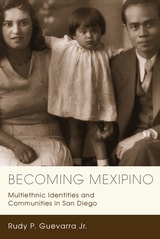
Becoming Mexipino
Multiethnic Identities and Communities in San DiegoGuevarra, Rudy P
Rutgers University Press, 2012
Through racially restrictive covenants and other forms of discrimination, both groups, regardless of their differences, were confined to segregated living spaces along with African Americans, other Asian groups, and a few European immigrant clusters. Within these urban multiracial spaces, Mexicans and Filipinos coalesced to build a world of their own through family and kin networks, shared cultural practices, social organizations, and music and other forms of entertainment. They occupied the same living spaces, attended the same Catholic churches, and worked together creating labor cultures that reinforced their ties, often fostering marriages. Mexipino children, living simultaneously in two cultures, have forged a new identity for themselves. Their lives are the lens through which these two communities are examined, revealing the ways in which Mexicans and Filipinos interacted over generations to produce this distinct and instructive multiethnic experience. Using archival sources, oral histories, newspapers, and personal collections and photographs, Guevarra defines the niche that this particular group carved out for itself.
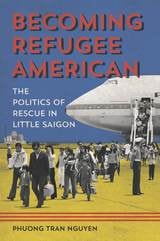
Becoming Refugee American
The Politics of Rescue in Little SaigonPhuong Nguyen
University of Illinois Press, 2017
Phuong Tran Nguyen examines the phenomenon of refugee nationalism among Vietnamese Americans in Southern California. Here, the residents of Little Saigon keep alive nostalgia for the old regime and, by extension, their claim to a lost statehood. Their refugee nationalism is less a refusal to assimilate than a mode of becoming, in essence, a distinct group of refugee Americans. Nguyen examines the factors that encouraged them to adopt this identity. His analysis also moves beyond the familiar rescue narrative to chart the intimate yet contentious relationship these Vietnamese Americans have with their adopted homeland. Nguyen sets their plight within the context of the Cold War, an era when Americans sought to atone for broken promises but also saw themselves as providing a sanctuary for people everywhere fleeing communism.

Before the Fire Dogs Steal the Sun
An ElegyCrystal Mun-hye Baik
Duke University Press, 2026
Being Chinese, Becoming Chinese American
Shehong Chen
University of Illinois Press, 2002
The 1911 revolution in China sparked debates that politicized and divided Chinese communities in the United States. People in these communities affirmed traditional Chinese values and expressed their visions of a modern China, while nationalist feelings emboldened them to stand up for their rights as an integral part of American society. When Japan threatened the China's young republic, the Chinese response in the United States revealed the limits of Chinese nationalism and the emergence of a Chinese American identity.
Shehong Chen investigates how Chinese immigrants to the United States transformed themselves into Chinese Americans during the crucial period between 1911 and 1927. Chen focuses on four essential elements of a distinct Chinese American identity: support for republicanism over the restoration of monarchy; a wish to preserve Confucianism and traditional Chinese culture; support for Christianity, despite a strong anti-Christian movement in China; and opposition to the Nationalist party's alliance with the Soviet Union and cooperation with the Chinese Communist Party.
Sensitive and enlightening, Being Chinese, Becoming Chinese American documents how Chinese immigrants survived exclusion and discrimination, envisioned and maintained Chineseness, and adapted to American society.
Being Chinese
Voices from the DiasporaWei (Angela) Djao
University of Arizona Press, 2003
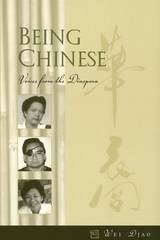
In these pages we meet a surgeon raised in Singapore but westernized in London who still believes in the value of Chinese medicine, which "revitalizes you in ways that Western medicine cannot understand." A member of the Chinese Canadian community who bridles at the insistence that you can't be Chinese unless you speak a Chinese dialect, because "Even though I do not have the Chinese language, I think my ability to manifest many things in Chinese culture to others in English is still very important." Individuals all loyal to their countries of citizenship who continue to observe the customs of their ancestral home to varying degrees, whether performing rites in memory of ancestors, practicing fengshui, wearing jade for good luck, or giving out red packets of lucky money for New Year.
What emerges from many of these accounts is a selective adherence to Chinese values. One person cites a high regard for elders, for high achievement, and for the sense of togetherness fostered by his culture. Another, the bride in an arranged marriage to a transplanted Chinese man, speaks highly of her relationship: "It's the Chinese way to put in the effort and persevere." Several of the stories consider the difference between how Chinese women overseas actually live and the stereotypes of how they ought to live. One writes: "Coming from a traditional Chinese family, which placed value on sons and not on daughters, it was necessary for me to assert my own direction in life rather than to follow in the traditional paths of obedience." Bracketing the testimonies are an overview of the history of emigration from China and an assessment of the extent to which the Chinese overseas retain elements of Chinese culture in their lives.
In compiling these personal accounts, Wei Djao, who was born in China and now lives near Seattle, undertook a quest that took her not only to many countries but also to the inner landscapes of the heart. Being Chinese is a highly personal book that bares the aspirations, despairs, and triumphs of real people as it makes an insightful and lasting contribution to Chinese diasporic studies.
Between Foreign and Family
Return Migration and Identity Construction among Korean Americans and Korean ChineseLee, Helene K
Rutgers University Press, 2018
Between Foreign and Family explores the impact of inconsistent rules of ethnic inclusion and exclusion on the economic and social lives of Korean Americans and Korean Chinese living in Seoul. These actors are part of a growing number of return migrants, members of an ethnic diaspora who migrate “back” to the ancestral homeland from which their families emigrated. Drawing on ethnographic observations and interview data, Helene K. Lee highlights the “logics of transnationalism” that shape the relationships between these return migrants and their employers, co-workers, friends, family, and the South Korean state.
While Koreanness marks these return migrants as outsiders who never truly feel at home in the United States and China, it simultaneously traps them into a liminal space in which they are neither fully family, nor fully foreign in South Korea. Return migration reveals how ethnic identity construction is not an indisputable and universal fact defined by blood and ancestry, but a contested and uneven process informed by the interplay of ethnicity, nationality, citizenship, gender, and history.
Between Mao and McCarthy
Chinese American Politics in the Cold War YearsCharlotte Brooks
University of Chicago Press, 2014
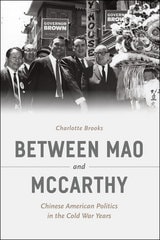
Between Mao and McCarthy looks at the divergent ways that Chinese Americans in these two cities balanced domestic and international pressures during the tense Cold War era. On both coasts, Chinese Americans sought to gain political power and defend their civil rights, yet only the San Franciscans succeeded. Forging multiracial coalitions and encouraging voting and moderate activism, they avoided the deep divisions and factionalism that consumed their counterparts in New York. Drawing on extensive research in both Chinese- and English-language sources, Charlotte Brooks uncovers the complex, diverse, and surprisingly vibrant politics of an ethnic group trying to find its voice and flex its political muscle in Cold War America.
Between the Lines
South Asians and Postcolonialityedited by Deepika Bahri and Mary Vasudeva
Temple University Press, 1996
This ground-breaking collection of new interviews, critical essays, and commentary explores South Asian identity and culture. Sensitive to the false homogeneity implied by "South Asian," "diaspora," "postcolonial," and "Asian American," the contributors attempt to unpack these terms. By examining the social, economic, and historical particularities of people who live "between the lines"—on and between borders—they reinstate questions of power and privilege, agency and resistance. As South Asians living in the United States and Canada, each to some degree must reflect on the interaction of the personal "I," the collective "we," and the world beyond.
The South Asian scholars gathered together in this volume speak from a variety of theoretical perspectives; in the essays and interviews that cross the boundaries of conventional academic disciplines, they engage in intense, sometimes contentious, debate.
Contributors: Meena Alexander, Gauri Viswanathan, Gayatri Chakravorty Spivak, Amritjit Singh, M. G. Vassanji, Sohail Inayatullah, Ranita Chatterjee, Benita Mehta, Sanjoy Majumder, Mahasveta Barua, Sukeshi Kamra, Samir Dayal, Pushpa Naidu Parekh, Indrani Mitra, Huma Ibrahim, Amitava Kumar, Shantanu DuttaAhmed, Uma Parameswaran.
In the series Asian American History and Culture, edited by Sucheng Chan, David Palumbo-Liu, Michael Omi, K. Scott Wong, and Linda Trinh Võ.
Beyond White Picket Fences
Evolution of an American TownCatherine Simpson Bueker
Russell Sage Foundation, 2025
Drawing on interviews, archival data, and participant observations, Bueker examines how Italian, Jewish, and Chinese newcomers influenced and were influenced by the established Wellesley community. She examines the ways in which immigrant and ethnic groups assimilate, retain their cultural backgrounds, and respond to discrimination, sometimes simultaneously, and, in doing so, alter the mainstream. Some new residents responded to Wellesley by assimilating to it. They developed relationships with long-term resident neighbors, volunteered in their children’s schools, and ran for elected positions. In adapting themselves to their new community, however, they also influenced it by virtue of their distinct cultural backgrounds.
Other new residents worked to preserve their cultures by establishing ethnic-specific organizations, lobbying to have new holidays incorporated into the calendar, and hewing to their own ethnic culinary traditions. Their efforts also influenced the established community. When newcomers attempted to retain their culture by requesting ethnic-specific food items be stocked at the local grocery store, opening ethic restaurants, or renting space for a new organization, for example, they impacted the established community. New individuals and groups also responded to experiences of hostility and discrimination. Italian residents fought against attempts at school redistricting targeting them in the 1930s, Jewish residents pushed back against housing discrimination in the 1950s and 1960s, and Chinese residents responded to anti-Asian incidents in the wake of the COVID-19 pandemic in 2020. These groups had to engage with the larger community to rectify these injustices. Some of the changes in Wellesley have come about with little recognition or response, others have been met with resistance and anger. Whether the changes are subtle or obvious and whether new groups are embraced or resisted, the whole town is altered in an ongoing process as new groups continue to move to and settle in Wellesley.
Beyond White Picket Fences is a timely and compelling examination of the ways newcomers become part of and shape American communities.
Beyond the Betrayal
The Memoir of a World War II Japanese American Draft Resister of Conscienceby Yoshito Kuromiya edited by ArthurA.Hansen
University Press of Colorado, 2022
Of the 300 Japanese Americans who resisted the military draft on the grounds that the US government had deprived them of their fundamental rights as US citizens, Kuromiya alone has produced an autobiographical volume that explores the short- and long-term causes and consequences of this fateful wartime decision. In his exquisitely written and powerfully documented testament he speaks truth to power, making evident why he is eminently qualified to convey the plight of the Nisei draft resisters. He perceptively reframes the wartime and postwar experiences of the larger Japanese American community, commonly said to have suffered in the spirit of shikata ga nai—enduring that which cannot be changed—and emerged with dignity.
Beyond the Betrayal makes abundantly clear that the unjustly imprisoned Nisei could and did exercise their patriotism even when they refused to serve in the military in the name of civil liberties and social justice. Kuromiya’s account, initially privately circulated only to family and friends, is an invaluable and insightful addition to the Nikkei historical record.
Beyond the Black and White TV
Asian and Latin American Spectacle in Cold War AmericaBenjamin M. Han
Rutgers University Press, 2020
Beyond the City and the Bridge
East Asian Immigration in a New Jersey SuburbMatsumoto, Noriko
Rutgers University Press, 2018
Winner of the Richard P. McCormick Prize from the New Jersey Historical Association
Honorable Mention, 2019 American Sociological Association Book Award - Asia/Asian American Section
In recent decades, the American suburbs have become an important site for immigrant settlement. Beyond the City and the Bridge presents a case study of Fort Lee, Bergen County, on the west side of the George Washington Bridge connecting Manhattan and New Jersey. Since the 1970s, successive waves of immigrants from East Asia have transformed this formerly white community into one of the most diverse suburbs in the greater New York region. Fort Lee today has one of the largest concentrations of East Asians of any suburb on the East Coast, with Chinese, Japanese, and Koreans forming distinct communities while influencing the structure and everyday life of the borough. Noriko Matsumoto explores the rise of this multiethnic suburb—the complex processes of assimilation and reproduction of ethnicities, the changing social relationships, and the conditions under which such transformations have occurred.
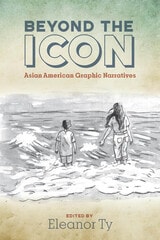
Beyond the Icon
Asian American Graphic NarrativesEdited by Eleanor Ty
The Ohio State University Press, 2022
While most US-based comics studies anthologies tend to neglect race, Beyond the Icon brings it to the foreground through an analysis of the vibrant and growing body of graphic narratives by Asian North American creators in the twenty-first century. By demonstrating how the forms and styles of the comics genre help depict Asian Americans as nuanced individuals in ways that words alone may not, Beyond the Icon makes the case for comics as a crucial artistic form in Asian American cultural production––one used to counter misrepresentations and myths, rewrite official history, and de-exoticize the Asian American experience.
An interdisciplinary team of contributors offers exciting new readings of key texts, including Ms. Marvel, George Takei’s They Called Us Enemy, Thi Bui’s The Best We Could Do, Gene Luen Yang and Sonny Liew’s The Shadow Hero, works by Adrian Tomine and Jillian Tamaki, and more, to uncover the ways in which Asian American comics authors employ graphic narratives to provide full and complex depictions of Asian diasporic subjects and intervene in the wider North American consciousness. Beyond the Icon initiates vital conversations between Asian American studies, ethnic studies, and comics.
Contributors:
Monica Chiu, Shilpa Davé, Melinda Luisa de Jesús, Lan Dong, Jin Lee, erin Khuê Ninh, Stella Oh, Jeanette Roan, Eleanor Ty
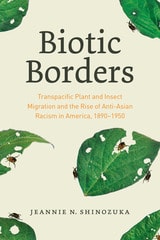
Biotic Borders
Transpacific Plant and Insect Migration and the Rise of Anti-Asian Racism in America, 1890–1950Jeannie N. Shinozuka
University of Chicago Press, 2022
In the late nineteenth century, increasing traffic of transpacific plants, insects, and peoples raised fears of a "biological yellow peril" when nursery stock and other agricultural products shipped from Japan to meet the growing demand for exotics in the United States. Over the next fifty years, these crossings transformed conceptions of race and migration, played a central role in the establishment of the US empire and its government agencies, and shaped the fields of horticulture, invasion biology, entomology, and plant pathology. In Biotic Borders, Jeannie N. Shinozuka uncovers the emergence of biological nativism that fueled American imperialism and spurred anti-Asian racism that remains with us today.
Shinozuka provides an eye-opening look at biotic exchanges that not only altered the lives of Japanese in America but transformed American society more broadly. She shows how the modern fixation on panic about foreign species created a linguistic and conceptual arsenal for anti-immigration movements that flourished in the early twentieth century. Xenophobia inspired concerns about biodiversity, prompting new categories of “native” and “invasive” species that defined groups as bio-invasions to be regulated—or annihilated. By highlighting these connections, Shinozuka shows us that this story cannot be told about humans alone—the plants and animals that crossed with them were central to Japanese American and Asian American history. The rise of economic entomology and plant pathology in concert with public health and anti-immigration movements demonstrate these entangled histories of xenophobia, racism, and species invasions.
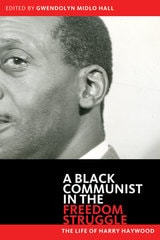
Black Communist in the Freedom Struggle
The Life of Harry HaywoodHarry Haywood
University of Minnesota Press, 2012
Mustering out of the U.S. army in 1919, Harry Haywood stepped into a battle that was to last the rest of his life. Within months, he found himself in the middle of one of the bloodiest race riots in U.S. history and realized that he’d been fighting the wrong war—the real enemy was right here at home. This book is Haywood’s eloquent account of coming of age as a black man in twentieth-century America and of his political awakening in the Communist Party.
For all its cultural and historical interest, Harry Haywood’s story is also noteworthy for its considerable narrative drama. The son of parents born into slavery, Haywood tells how he grew up in Omaha, Nebraska, found his first job as a shoeshine boy in Minneapolis, then went on to work as a waiter on trains and in restaurants in Chicago. After fighting in France during the war, he studied how to make revolutions in Moscow during the 1920s, led the Communist Party’s move into the Deep South in 1931, helped to organize the campaign to free the Scottsboro Boys, worked with the Sharecroppers’ Union, supported protests in Chicago against Mussolini’s invasion of Ethiopia, fought with the International Brigades in Spain, served in the Merchant Marines during World War II, and continued to fight for the right of self-determination for the Afro-American nation in the United States until his death in 1985.
This new edition of his classic autobiography, Black Bolshevik, introduces American readers to the little-known story of a brilliant thinker, writer, and activist whose life encapsulates the struggle for freedom against all odds of the New Negro generation that came of age during and after World War I.
Black Sporting Resistance
Diaspora, Transnationalism, and InternationalismJoseph N. Cooper
Rutgers University Press, 2025
Body Evidence
Intimate Violence against South Asian Women in AmericaEdited by Shamita Das Dasgupta
Rutgers University Press, 2007
In Body Evidence, more than twenty scholars and public health professionals uncover the unique challenges faced by victims of violence in intimate spaces . . . within families, communities and trusted relationships in South Asian American communities. Topics include cultural obsession with women's chastity and virginity; the continued silence surrounding intimate violence among women who identify themselves as lesbian, bisexual, or transgender; the consequences of refusing marriage proposals or failing to meet dowry demands; and, ultimately, the ways in which the United States courts often confuse and exacerbate the plights of these women.
Bold Words
A Century of Asian American WritingEdited by Rajini Srikanth
Rutgers University Press, 2001
Brutal Fantasies
Imagining North Korea in the Long Cold WarChristine Kim
Duke University Press, 2025
Building Diaspora
Filipino Cultural Community Formation on the InternetIgnacio, Emily N
Rutgers University Press, 2004
In Building Diaspora, Emily Noelle Ignacio explores how Filipinos have used these subtle, cyber, but very real social connections to construct and reinforce a sense of national, ethnic, and racial identity with distant others. Through an extensive analysis of newsgroup debates, listserves, and website postings, she illustrates the significant ways that computer-mediated communication has contributed to solidifying what can credibly be called a Filipino diaspora. Lively cyber-discussions on topics including Eurocentrism, Orientalism, patriarchy, gender issues, language, and "mail-order-brides" have helped Filipinos better understand and articulate their postcolonial situation as well as their relationship with other national and ethnic communities around the world. Significant attention is given to the complicated history of Philippine-American relations, including the ways Filipinos are racialized as a result of their political and economic subjugation to U.S. interests.
As Filipinos and many other ethnic groups continue to migrate globally, Building Diaspora makes an important contribution to our changing understanding of "homeland." The author makes the powerful argument that while home is being further removed from geographic place, it is being increasingly territorialized in space.
Building Filipino Hawai'i
Roderick Labrador
University of Illinois Press, 2015
In particular, Labrador speaks to the processes of identity making and the politics of representation among immigrant communities striving to resist marginalization in a globalized, transnational era. Critiquing the popular image of Hawai'i as a postracial paradise, he reveals how Filipino immigrants talk about their relationships to the place(s) they left and the place(s) where they've settled, and how these discourses shape their identities. He also shows how the struggle for community empowerment, identity territorialization, and the process of placing and boundary making continue to affect how minority groups construct the stories they tell about themselves, to themselves and others.
Building Little Saigon
Refugee Urbanism in American Cities and SuburbsErica Allen-Kim
University of Texas Press, 2024
2026 Spiro Kostof Book Award, Society of Architectural Historians
An in-depth look at the diverging paths of Vietnamese American communities, or “Little Saigons,” in America’s built environment.
In the final days before the fall of Saigon in 1975, 125,000 Vietnamese who were evacuated or who made their own way out of the country resettled in the United States. Finding themselves in unfamiliar places yet still connected in exile, these refugees began building their own communities as memorials to a lost homeland. Known both officially and unofficially as Little Saigons, these built landscapes offer space for everyday activities as well as the staging of cultural heritage and political events.
Building Little Saigon examines nearly fifty years of city building by Vietnamese Americans—who number over 2.2 million today. Author Erica Allen-Kim highlights architecture and planning ideas adapted by the Vietnamese communities who, in turn, have influenced planning policies and mainstream practices. Allen-Kim traveled to ten Little Saigons in the United States to visit archives, buildings, and public art and to converse with developers, community planners, artists, business owners, and Vietnam veterans. By examining everyday buildings—who made them and what they mean for those who know them—Building Little Saigon shows us the complexities of migration unfolding across lifetimes and generations.