51 books match the query 'Berlin' and 6 start with b
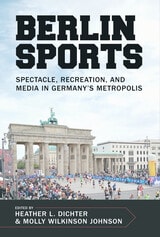
cover of Berlin Sports: Spectacle, Recreation, and Media in Germany’s Metropolis

Berlin Sports

Spectacle, Recreation, and Media in Germany’s Metropolis

Heather L. Dichter

University of Arkansas Press, 2024

In many American cities, individual athletes, professional teams, and university sports are integral to the cities’ sporting identities. Berlin, in contrast, features no single hallmark sport, team, or annual event. Five political regimes, wartime destruction, and four decades of division instead fostered ever-changing teams, allegiances, and venues. Yet, the desire to play and watch sport continued unabated across these political watersheds. Berlin Sports: Spectacle, Recreation, and Media in Germany’s Metropolis explores the history of sport in Berlin from the late nineteenth- to the early twenty-first centuries against the backdrop of the city’s sharp political shifts, diverse populations, and status as a major metropolis with both regional and global resonance.
 
This book begins with a long-distance equestrian race in the 1890s and continues with the role of media in spectacle, celebrity, urban life, and gender from the 1890s to the 1920s.It then turns to grassroots sport participation and spectatorship as well as sport diplomacy at the elite international level during the postwar period and the years of German division. Next, it explores recreational sport associations within the context of immigration and youth counterculture. It concludes with the 2015 European Maccabi Games, an international Jewish sports festival through which Berlin sought to grapple with the infamous 1936 Olympics and showcase Berlin as a cosmopolitan and multicultural city. Taken together, the book’s scholarly essays on all of these sporting endeavors reveal the rich and varied sporting culture in Berlin and yield fresh insights into spectacle, recreation, and media in the city.
 
[more]
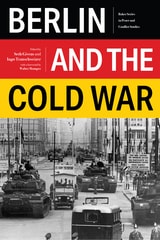
cover of Berlin and the Cold War

Berlin and the Cold War

Seth Givens; Ingo Trauschweizer

Ohio University Press, 2024

The Cold War is back in the news. So is history, in the sense of past geopolitical confrontations that for a span of a few decades were thought to be largely decoupled from present-day political developments. Of course, such reflexive reactions lack nuance and, until the Russian invasion of Ukraine in February 2022, tended to refer more to tensions between the United States and China. We should neither see Russia’s aggressive war in Ukraine immediately as part of a new cold war—though it could certainly become one of its foundation pieces—nor define history simply in terms of warfare and conflict. Yet such history has great appeal in efforts to understand the dizzying and depressing events of recent years. For example, correspondents and commentators have likened the delivery of weapons systems, protective gear, and humanitarian aid to a beleaguered Ukraine to the Berlin Airlift of 1948–49. But relying on history as a guide may mislead as much as enlighten. No city symbolizes the Cold War quite as Berlin does. When we think of the Cold War and of Berlin, we tend to emphasize the crises—the 1948–49 blockade and airlift, perhaps the 1953 East German workers’ uprising, surely the 1958­–61 crisis, during which the Berlin Wall was built—and the climactic ending of the Cold War in Europe when the wall came down. Berlin may conjure up iconic moments and tropes, from a statement attributed to Nikita Khrushchev in 1963 that Berlin was “the testicles of the West,” to John F. Kennedy’s insistence that all free men had to be invested in the defense of Berlin, to Ronald Reagan’s exhortation to Mikhail Gorbachev to “tear down this wall.” For American presidents (or presidential hopefuls), Berlin and the Brandenburg Gate have remained powerful images, even in the twenty-first century. A presence in Berlin signals strong leadership in the West, even though the proximate reasons why the West, as a political construct, emerged in the first place may be gone. In that sense, Berlin also stands for overcoming the past: first, West Berlin as the counterpoint not only to eastern communism but also to defeated fascism, and second, the new Berlin as the capital of a unified Germany and as a symbol that the West has won.
[more]
cover of Berlin for Jews: A Twenty-First-Century Companion

Berlin for Jews

A Twenty-First-Century Companion

Leonard Barkan

University of Chicago Press, 2016

What is it like to travel to Berlin today, particularly as a Jew, and bring with you the baggage of history? And what happens when an American Jew, raised by a secular family, falls in love with Berlin not in spite of his being a Jew but because of it?  The answer is Berlin for Jews. Part history and part travel companion, Leonard Barkan’s personal love letter to the city shows how its long Jewish heritage, despite the atrocities of the Nazi era, has left an inspiring imprint on the vibrant metropolis of today. 

Barkan, voraciously curious and witty, offers a self-deprecating guide to the history of Jewish life in Berlin, revealing how, beginning in the early nineteenth century, Jews became prominent in the arts, the sciences, and the city’s public life. With him, we tour the ivy-covered confines of the Schönhauser Allee cemetery, where many distinguished Jewish Berliners have been buried, and we stroll through Bayerisches Viertel, an elegant neighborhood created by a Jewish developer and that came to be called Berlin’s “Jewish Switzerland.”  We travel back to the early nineteenth century to the salon of Rahel Varnhagen, a Jewish society doyenne, who frequently hosted famous artists, writers, politicians, and the occasional royal. Barkan also introduces us to James Simon, a turn-of-the-century philanthropist and art collector, and we explore the life of Walter Benjamin, who wrote a memoir of his childhood in Berlin as a member of the assimilated Jewish upper-middle class.  Throughout, Barkan muses about his own Jewishness, while celebrating the rich Jewish culture on view in today’s Berlin. 

A winning, idiosyncratic travel companion, Berlin for Jews offers a way to engage with German history, to acknowledge the unspeakable while extolling the indelible influence of Jewish culture.
 
[more]
cover of Berlin: Culture and Metropolis

Berlin

Culture and Metropolis

Charles Haxthausen

University of Minnesota Press, 1991

Berlin: Culture and Metropolis was first published in 1991.Berlin’s recent history is uniquely representative of the major upheavals of the modern era. The city has been a capital under imperialist, democratic, fascist, and communist regimes; it has been devastated by war and has witnessed two revolutions. These changes often have come rapidly, drastically, and unexpectedly.Berlin: Culture and Metropolis includes essays on literature, poetry, film, cabaret, and the visual arts that illustrate how the relationship between the city and its inhabitants has been repeatedly renegotiated with each generation. Scholars in art history, film studies, literature, history, and sociology cover the period from the turn of the century to the present, writing on such topics as twentieth century cabaret, the celebration of the city’s 750th anniversary, and the cultural contributions of Ernst Ludwig Kirchner, George Grosz, Alfred Döblin, Siegfried Kracauer, and Christa Wolf. These essays reveal the often uneasy relationships between twentieth-century Berlin and the culture these changes have produced.
[more]
cover of Berliner Chic: A Locational History of Berlin Fashion

Berliner Chic

A Locational History of Berlin Fashion

Susan Ingram and Katrina Sark

Intellect Books, 2011

Since becoming the capital of reunited Germany, Berlin has had a dose of global money and international style added to its already impressive cultural veneer. Once home to emperors and dictators, peddlers and spies, it is now a fashion showplace that attracts the young and hip. Moving beyond descriptions of Berlin's fashion industry and its ready-to-wear clothing, Berliner Chic charts the turbulent stories of entrepreneurially-savvy manufacturers and cultural workers striving to establish their city as a fashion capital, and being repeatedly interrupted by politics, ideology, and war. There are many stories to tell about Berlin's fashion industry and Berliner Chic tells them all with considerable expertise.

[more]
cover of Bronstein's Children

Bronstein's Children

Jurek Becker

University of Chicago Press, 1999

"East Berlin, 1973: an 18-year-old Jew discovers that his father's friends are holding prisoner a former Nazi concentration camp guard in the family cottage. The three older men have handcuffed the ex-Nazi to the bed and are interrogating and torturing him in an attempt to get him to admit to his war crimes. . . . Becker keenly shows the tension between members of the Holocaust generation and their children, who are unable to understand the complexity of that nightmarish era of human history."—Booklist

"[A] chilly, disquieting novel about historical slippage; about the seemingly inevitable decline of horror into a vague and generic recollection. The East German writer has devised something between story and allegory to evoke the cold generational millennium that separates a father, with his concentration-camp memories, from a son, adrift in a society with no memories whatsoever."—Richard Eder, Los Angeles Times Book Review

"Mr. Becker, writing simply and clearly in an unstrained narrative, speaks with the voice of knowledge, and we do well to listen to him."—Eva Figes, New York Times Book Review

Jurek Becker (1937-1998) is the author of Jacob the Liar, Sleepless Days, The Boxer, and Amanda Herzlos.
[more]