Results by title
85 books match the query 'Black' and 31 start with b
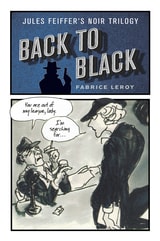
Back to Black
Jules Feiffer’s Noir TrilogyFabrice Leroy
Rutgers University Press, 2025
Named the Best Academic Work of 2025 by The Comics Journal
The legendary American cartoonist and author Jules Feiffer has enjoyed a long and varied career, working on everything from illustrating The Phantom Tollbooth to writing the screenplay for the film Popeye. But some of his most innovative work came very late in his career, with a trio of graphic novels he composed in his eighties: Kill My Mother (2014), Cousin Joseph (2016), and The Ghost Script (2018).
Back to Black provides the first full-length critical analysis of this trilogy, exploring how it pays homage to the iconography and themes of film noir through constant graphic experimentation and a striking reinvention of Feiffer’s distinctive style. Fabrice Leroy shows how Feiffer deftly alternates between dramatic and satirical tones as he plays with the conventions of noir to provide a caustic yet moving commentary on mid-twentieth-century American life. Through close readings of each novel in the trilogy, he examines Feiffer’s singular depiction of the central political issues in the United States from the Great Depression to the 1950s, which still resonate today: unionization struggles, cinematic propaganda, McCarthyism, the American Dream, immigration, antisemitism, civil rights, and gender discrimination. Placing the noir trilogy into the context of Feiffer’s long career, Back to Black demonstrates how he offers a loving pastiche of the genre without losing his unique voice or critical edge.
Between Brown and Black
Anti-Racist Activism in BrazilAntonio José Bacelar da Silva
Rutgers University Press, 2022
Beyond the Black and White TV
Asian and Latin American Spectacle in Cold War AmericaBenjamin M. Han
Rutgers University Press, 2020
Black and Blue TV
Industry Responses to the Black Lives Matter MovementLaurena Bernabo
Rutgers University Press, 2026
Black and Blue TV explores the ways television productions have responded to the Black Lives Matter movement. Television programs’ engagement with BLM was common before George Floyd’s murder sparked international protests in the summer of 2020, at which point it became nearly unavoidable for many series. Images of police using violence against Black Americans fueled criticisms of the role of television—especially cop shows—in perpetuating “copaganda,” highlighting the fact that television’s cops are nearly always the good guys, even when they break the law and use excessive force. Black and Blue TV identifies trends and anomalies in television’s engagement with BLM but also investigates the people who influence what those representations look like. Pairing textual criticism with interviews with television creatives, executives, and media activists, author Laurena Bernabo traces shifts in how these individuals understand their role in televisual culture and the cultural forum of narratives that are produced and distributed as a result.
Black and Blue
The Bruising Passion of Camera Lucida, La Jete, Sans soleil, and Hiroshima mon amourCarol Mavor
Duke University Press, 2012
Personal recollections punctuate Mavor's dazzling interpretations of these and many other works of art and criticism. Childhood memories become Proust's "small-scale contrivances," tiny sensations that open onto panoramas. Mavor's mother lost her memory to Alzheimer's, and Black and Blue is framed by the author's memories of her mother and effort to understand what it means to not be recognized by one to whom you were once so known.
Black and Blur
Fred Moten
Duke University Press, 2017
In Black and Blur—the first volume in his sublime and compelling trilogy consent not to be a single being—Fred Moten engages in a capacious consideration of the place and force of blackness in African diaspora arts, politics, and life. In these interrelated essays, Moten attends to entanglement, the blurring of borders, and other practices that trouble notions of self-determination and sovereignty within political and aesthetic realms. Black and Blur is marked by unlikely juxtapositions: Althusser informs analyses of rappers Pras and Ol' Dirty Bastard; Shakespeare encounters Stokely Carmichael; thinkers like Kant, Adorno, and José Esteban Muñoz and artists and musicians including Thornton Dial and Cecil Taylor play off each other. Moten holds that blackness encompasses a range of social, aesthetic, and theoretical insurgencies that respond to a shared modernity founded upon the sociological catastrophe of the transatlantic slave trade and settler colonialism. In so doing, he unsettles normative ways of reading, hearing, and seeing, thereby reordering the senses to create new means of knowing.
Black and Green
Afro-Colombians, Development, and Nature in the Pacific LowlandsKiran Asher
Duke University Press, 2009
The Pacific region had yet to be overrun by drug traffickers, guerrillas, and paramilitary forces in the early 1990s. It was better known as the largest area of black culture in the country (90 percent of the region’s population is Afro-Colombian) and as a supplier of natural resources, including timber, gold, platinum, and silver. Colombia’s Law 70, passed in 1993, promised ethnic and cultural rights, collective land ownership, and socioeconomic development to Afro-Colombian communities. At the same time that various constituencies sought to interpret and implement Law 70, the state was moving ahead with large-scale development initiatives intended to modernize the economically backward coastal lowlands. Meanwhile national and international conservation organizations were attempting to protect the region’s rich biodiversity. Asher explores this juxtaposition of black rights, economic development, and conservation—and the tensions it catalyzed. She analyzes the meanings attached to “culture,” “nature,” and “development” by the Colombian state and Afro-Colombian social movements, including women’s groups. In so doing, she shows that the appropriation of development and conservation discourses by the social movements had a paradoxical effect. It legitimized the presence of state, development, and conservation agencies in the Pacific region even as it influenced those agencies’ visions and plans.

Black and Green
The Fight For Civil Rights in Northern Ireland & Black AmericaBrian Dooley
Pluto Press, 1998
'Focusing on the period from the 1960s onward, Brian Dooley suggests that the black rights struggle in the US had a formative influence on Northern Ireland's civil rights movement which adopted similar tactics of protest marches and sit-ins ... A well researched book, written from an unusual angle that illuminates this understudied international influence on the Ulster conflict' Political Studies
Ties between political activists in Black America and Ireland span several centuries, from the days of the slave trade to the close links between Frederick Douglass and Daniel O’Connell, and between Marcus Garvey and Eamon de Valera. This timely book traces those historic links and examines how the struggle for black civil rights in America in the 1960s helped shape the campaign against discrimination in Northern Ireland. The author includes interviews with key figures such as Angela Davis, Bernadette McAliskey and Eamonn McCann.

Black and Indigenous
Garifuna Activism and Consumer Culture in HondurasMark Anderson
University of Minnesota Press, 2009
Garifuna live in Central America, primarily Honduras, and the United States. Identified as Black by others and by themselves, they also claim indigenous status and rights in Latin America. Examining this set of paradoxes, Mark Anderson shows how, on the one hand, Garifuna embrace discourses of tradition, roots, and a paradigm of ethnic political struggle. On the other hand, Garifuna often affirm blackness through assertions of African roots and affiliations with Blacks elsewhere, drawing particularly on popular images of U.S. blackness embodied by hip-hop music and culture.
Black and Indigenous explores the politics of race and culture among Garifuna in Honduras as a window into the active relations among multiculturalism, consumption, and neoliberalism in the Americas. Based on ethnographic work, Anderson questions perspectives that view indigeneity and blackness, nativist attachments and diasporic affiliations, as mutually exclusive paradigms of representation, being, and belonging.
As Anderson reveals, within contemporary struggles of race, ethnicity, and culture, indigeneity serves as a normative model for collective rights, while blackness confers a status of subaltern cosmopolitanism. Indigeneity and blackness, he concludes, operate as unstable, often ambivalent, and sometimes overlapping modes through which people both represent themselves and negotiate oppression.
Black and Mormon
Edited by Newell G. Bringhurst and Darron T. Smith
University of Illinois Press, 2004
This challenging collection is required reading for anyone concerned with the history of racism, discrimination, and the Latter-day Saints.
Black and Smart
How Black High-Achieving Women Experience CollegeAdrianne Musu Davis
Rutgers University Press, 2023
Black and White Cinema
A Short HistoryWheeler Winston Dixon
Rutgers University Press, 2015
Black and White Cinema is the first study to consider the use of black-and-white as an art form in its own right, providing a comprehensive and global overview of the era when it flourished, from the 1900s to the 1960s. Acclaimed film scholar Wheeler Winston Dixon introduces us to the masters of this art, discussing the signature styles and technical innovations of award-winning cinematographers like James Wong Howe, Gregg Toland, Freddie Francis, and Sven Nykvist. Giving us a unique glimpse behind the scenes, Dixon also reveals the creative teams—from lighting technicians to matte painters—whose work profoundly shaped the look of black-and-white cinema.
More than just a study of film history, this book is a rallying cry, meant to inspire a love for the artistry of black-and-white film, so that we might work to preserve this important part of our cinematic heritage. Lavishly illustrated with more than forty on-the-set stills, Black and White Cinema provides a vivid and illuminating look at a creatively vital era.

Black and White Strangers
Race and American Literary RealismKenneth W. Warren
University of Chicago Press, 1993
Black and White Styles in Conflict
Thomas Kochman
University of Chicago Press, 1981
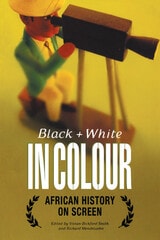
Black and White in Colour
African History on ScreenVivian Bickford-Smith
Ohio University Press, 2007
Black and White in Colour: African History on Screen considers how the African past has been represented in a wide range of historical films. Written by a team of eminent international scholars, the volume provides extensive coverage of both place and time and deals with major issues in the written history of Africa. Themes include the slave trade, imperialism and colonialism, racism, and anticolonial resistance. Many of the films will be familiar to readers: they include Out of Africa, Hotel Rwanda, Breaker Morant, Cry Freedom, The Battle of Algiers, and Chocolat.
This collection of essays is a highly original and useful contribution to African historiography, as well as a significant addition to the growing body of work within the emerging subdiscipline of “film and history.” It will appeal to those interested in African history and the ways in which films use the past to raise questions about the present.
Contributors: Mahir Saul, Ralph A. Austen, Robert Baum, Robert Harms, Nigel Worden, Carolyn Hamilton and Litheko Modisane, Richard Mendelsohn, Shamil Jeppie, Bill Nasson, Nigel Penn, Ruth Watson, Patrick Harries, David Moore, Teresa Barnes, Vivian Bickford-Smith, Mohamed Adhikari, and David Philips.
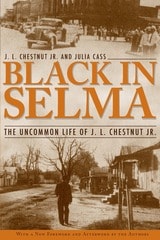
Black in Selma
The Uncommon Life of J. L. Chestnut Jr.J. L. Chestnut
University of Alabama Press, 2007
One man’s fight for justice. One town’s reckoning with history.
Born in Selma in 1930, J. L. Chestnut left home to study law at Howard University in Washington, DC. Returning to Selma, Chestnut was the town’s first and only African American attorney in the late 1950s. As the turbulent struggle for civil rights spread across the South, Chestnut became an active and ardent promoter of social and legal equality in his hometown. A key player on the local and state fronts, Chestnut accrued deep insights into the racial tensions in his community and deftly opened paths toward a more equitable future.
Though intimately involved in many events that took place in Selma, Chestnut was nevertheless often identified in history books simply as “a local attorney.” Black in Selma reveals his powerful yet little-known story.
In the 2014 film Selma, director Ava DuVernay takes audiences to the climactic confrontation between civil rights advocates and the state’s security forces of March 1965. Readers looking for a deeper understanding of the events that preceded that epic moment, as well as how racial integration unfolded in Selma in the decades that followed, will find Chestnut’s story and memories both a vital primary source and an inspiration.
Black in White Space
The Enduring Impact of Color in Everyday LifeElijah Anderson
University of Chicago Press, 2021
A birder strolling in Central Park. A college student lounging on a university quad. Two men sitting in a coffee shop. Perfectly ordinary actions in ordinary settings—and yet, they sparked jarring and inflammatory responses that involved the police and attracted national media coverage. Why? In essence, Elijah Anderson would argue, because these were Black people existing in white spaces.
In Black in White Space, Anderson brings his immense knowledge and ethnography to bear in this timely study of the racial barriers that are still firmly entrenched in our society at every class level. He focuses in on symbolic racism, a new form of racism in America caused by the stubbornly powerful stereotype of the ghetto embedded in the white imagination, which subconsciously connects all Black people with crime and poverty regardless of their social or economic position. White people typically avoid Black space, but Black people are required to navigate the “white space” as a condition of their existence. From Philadelphia street-corner conversations to Anderson’s own morning jogs through a Cape Cod vacation town, he probes a wealth of experiences to shed new light on how symbolic racism makes all Black people uniquely vulnerable to implicit bias in police stops and racial discrimination in our country.
An unwavering truthteller in our national conversation on race, Anderson has shared intimate and sharp insights into Black life for decades. Vital and eye-opening, Black in White Space will be a must-read for anyone hoping to understand the lived realities of Black people and the structural underpinnings of racism in America.
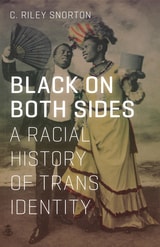
Black on Both Sides
A Racial History of Trans IdentityC. Riley Snorton
University of Minnesota Press, 2017
Winner of the John Boswell Prize from the American Historical Association 2018
Winner of the William Sanders Scarborough Prize from the Modern Language Association 2018
Winner of an American Library Association Stonewall Honor 2018
Winner of Lambda Literary Award for Transgender Nonfiction 2018
Winner of the Sylvia Rivera Award in Transgender Studies from the Center for Lesbian and Gay Studies
The story of Christine Jorgensen, America’s first prominent transsexual, famously narrated trans embodiment in the postwar era. Her celebrity, however, has obscured other mid-century trans narratives—ones lived by African Americans such as Lucy Hicks Anderson and James McHarris. Their erasure from trans history masks the profound ways race has figured prominently in the construction and representation of transgender subjects. In Black on Both Sides, C. Riley Snorton identifies multiple intersections between blackness and transness from the mid-nineteenth century to present-day anti-black and anti-trans legislation and violence.
Drawing on a deep and varied archive of materials—early sexological texts, fugitive slave narratives, Afro-modernist literature, sensationalist journalism, Hollywood films—Snorton attends to how slavery and the production of racialized gender provided the foundations for an understanding of gender as mutable. In tracing the twinned genealogies of blackness and transness, Snorton follows multiple trajectories, from the medical experiments conducted on enslaved black women by J. Marion Sims, the “father of American gynecology,” to the negation of blackness that makes transnormativity possible.
Revealing instances of personal sovereignty among blacks living in the antebellum North that were mapped in terms of “cross dressing” and canonical black literary works that express black men’s access to the “female within,” Black on Both Sides concludes with a reading of the fate of Phillip DeVine, who was murdered alongside Brandon Teena in 1993, a fact omitted from the film Boys Don’t Cry out of narrative convenience. Reconstructing these theoretical and historical trajectories furthers our imaginative capacities to conceive more livable black and trans worlds.
Black on the Block
The Politics of Race and Class in the CityMary Pattillo
University of Chicago Press, 2007
“To see how diversity creates strange and sometimes awkward bedfellows . . . turn to Mary Pattillo's Black on the Block.”—Boston Globe
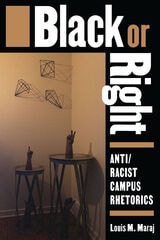
Black or Right
Anti/Racist Campus RhetoricsLouis M. Maraj
Utah State University Press, 2020
Offering four Black rhetorics as antiracist means for rhetorical reclamation—autoethnography, hashtagging, inter(con)textual reading, and reconceptualized disruption—the book uses Black feminist relationality via an African indigenous approach. Maraj examines fluid, quotidian ways Black folk engage anti/racism at historically white institutions in the United States in response to violent campus spaces, educational structures, protest movements, and policy practice. Black or Right’s experimental, creative style strives to undiscipline knowledge from academic confinement. Exercising different vantage points in each chapter—autoethnographer, digital media scholar/pedagogue, cultural rhetorician, and critical discourse analyst—Maraj challenges readers to ecologically understand shifting, multiple meanings of Blackness in knowledge-making. Black or Right’s expressive form, organization, narratives, and poetics intimately interweave with its argument that Black folk must continuously invent “otherwise” in reiterative escape from oppressive white spaces.
In centering Black experiences, Black theory, and diasporic Blackness, Black or Right mobilizes generative approaches to destabilizing institutional whiteness, as opposed to reparative attempts to “fix racism,” which often paradoxically center whiteness. It will be of interest to both academic and general readers and significant for specialists in cultural rhetorics, Black studies, and critical theory.
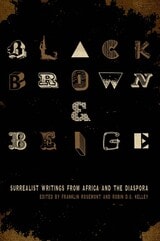
Black, Brown, & Beige
Surrealist Writings from Africa and the DiasporaEdited by Franklin Rosemont and Robin D.G. Kelley
University of Texas Press, 2009
Surrealism as a movement has always resisted the efforts of critics to confine it to any static definition—surrealists themselves have always preferred to speak of it in terms of dynamics, dialectics, goals, and struggles. Accordingly, surrealist groups have always encouraged and exemplified the widest diversity—from its start the movement was emphatically opposed to racism and colonialism, and it embraced thinkers from every race and nation.
Yet in the vast critical literature on surrealism, all but a few black poets have been invisible. Academic histories and anthologies typically, but very wrongly, persist in conveying surrealism as an all-white movement, like other "artistic schools" of European origin. In glaring contrast, the many publications of the international surrealist movement have regularly featured texts and reproductions of works by comrades from Martinique, Haiti, Cuba, Puerto Rico, South America, the United States, and other lands. Some of these publications are readily available to researchers; others are not, and a few fall outside academia's narrow definition of surrealism.
This collection is the first to document the extensive participation of people of African descent in the international surrealist movement over the past seventy-five years. Editors Franklin Rosemont and Robin D. G. Kelley aim to introduce readers to the black, brown, and beige surrealists of the world—to provide sketches of their overlooked lives and deeds as well as their important place in history, especially the history of surrealism.
Black, Jewish, and Interracial
It’s Not the Color of Your Skin, but the Race of Your Kin, and Other Myths of IdentityKatya Gibel Azoulay
Duke University Press, 1997
Beginning with an examination of the concept of identity as it figures in philosophical and political thought, Gibel Azoulay moves on to consider and compare the politics and traditions of the Black and Jewish experience in America. Her inquiry draws together such diverse subjects as Plessy v. Ferguson, the Leo Frank case, "passing," intermarriage, civil rights, and anti-Semitism. The paradoxical presence of being both Black and Jewish, she argues, leads questions of identity, identity politics, and diversity in a new direction as it challenges distinct notions of whiteness and blackness. Rising above familiar notions of identity crisis and cultural confrontation, she offers new insights into the discourse of race and multiculturalism as she suggests that identity can be a more encompassing concept than is usually thought. Gibel Azoulay adds her own personal history and interviews with eight other Black and Jewish individuals to reveal various ways in which interracial identities are being lived, experienced, and understood in contemporary America.
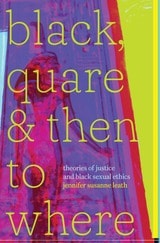
Black, Quare, and Then to Where
Theories of Justice and Black Sexual Ethicsjennifer susanne leath
Duke University Press, 2023
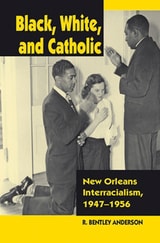
Black, White, and Catholic
New Orleans Interracialism, 1947-1956R. Bentley Anderson
Vanderbilt University Press, 2005
Anderson leads readers through the tumultuous years just after World War II when the Roman Catholic Church in the American South struggled to reconcile its commitment to social justice with the legal and social heritage of Jim Crow society. Though these early efforts at reform, by and large, failed, they did serve to galvanize Catholic supporters and opponents of the Civil Rights Movement and provided a model for more successful efforts at desegregation in the '60s.
As a Jesuit himself, Anderson has access to archives that remain off-limits to other scholars. His deep knowledge of the history of the Catholic Church also allows him to draw connections between this historical period and the present. In the resistance to desegregation, Anderson finds expression of a distinctly American form of Catholicism, in which lay people expect Church authorities to ratify their ideas and beliefs in an almost democratic fashion. The conflict he describes is as much between popular and hierarchical models of the Church as between segregation and integration.
This book has been made possible through a grant from the Louisiana Endowment for the Humanities, a state affiliate of the National Endowment for the Humanities.
Black, White, and Huckleberry Finn
Re-imagining the American DreamElaine Mensh
University of Alabama Press, 2001
Takes a hard, systematic look at the depiction of blacks, whites, and race relations in Mark Twain's classic novel, raising questions about its canonical status in American literature
Huckleberry Finn, one of the most widely taught novels in American literature, has long been the subject of ongoing debates over issues ranging from immorality to racism. Here, Elaine Mensh and Harry Mensh enter the debate with a careful and thoughtful examination of racial messages imbedded in the tale of Huck and Jim.Using as a gauge for analysis the historical record left by both slaves and slaveholders, the Menshes compare Twain's depiction with historical reality, attempting to determine where the book either undermines or upholds traditional racial attitudes. Surveying the opinions of fellow critics, they challenge the current consensus that Huckleberry Finn fosters rapport between blacks and whites, arguing that the book does not subvert ingrained beliefs about race, and demonstrating that the argument over black-white relations in the novel is also an argument over non-fictional racial relations and conflicting perceptions of racial harmony.
Reading the novel in its historical context, the Menshes conclude that Twain, in the character of Huck, never questions the institution of slavery, and even supports it in both thought and action. In response to student and parent challenges to the inclusion of the book in literature classes, they suggest that it should remain in school libraries but not be required reading.Of importance to scholars of Mark Twain and American literature, African American cultural studies, or anyone interested in issues of literature and race, this book adds a strong voice to the long-ranging debate over Huckleberry Finn.
Black, White, and in Color
Essays on American Literature and CultureHortense J. Spillers
University of Chicago Press, 2003
Black, White, and in Color offers a long-awaited collection of major essays by Hortense Spillers, one of the most influential and inspiring black critics of the past twenty years. Spanning her work from the early 1980s, in which she pioneered a broadly poststructuralist approach to African American literature, and extending through her turn to cultural studies in the 1990s, these essays display her passionate commitment to reading as a fundamentally political act-one pivotal to rewriting the humanist project.
Spillers is best known for her race-centered revision of psychoanalytic theory and for her subtle account of the relationships between race and gender. She has also given literary criticism some of its most powerful readings of individual authors, represented here in seminal essays on Ralph Ellison, Gwendolyn Brooks, and William Faulkner. Ultimately, the essays collected in Black, White, and in Color all share Spillers's signature style: heady, eclectic, and astonishingly productive of new ideas. Anyone interested in African American culture and literature will want to read them.
Blue Notes in Black and White
Photography and JazzBenjamin Cawthra
University of Chicago Press, 2011
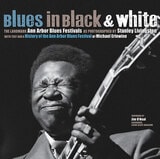
Blues in Black and White
The Landmark Ann Arbor Blues FestivalsAs photographed by Stanley Livingston with Text and a History of the Ann Arbor Blues Festival by Michael Erlewine
University of Michigan Press, 2010
"This was really the first time that blues music, especially Chicago/urban blues, was showcased in this way. Sadly, the festivals were not recorded professionally. So Mr. Livingston's photos are the best record of the festivals."
---Michael Jewett, longtime weekday afternoon host of 89.1 Jazz and host of "Blues & Some Uthuh Stuff"
"The photos are works of art. It is great to see photos of musicians such as Buddy Guy and James Cotton looking so young and vibrant. And it is great to see photos of blues legends such as John Lee Hooker, Roosevelt Sykes, Howlin' Wolf, and Son House, who have long since passed away."
---Peter Madcat Ruth, Grammy-winning blues harmonica player
"If Woodstock was one of the Fifty Moments That Changed Rock 'n' Roll History, as honored in Rolling Stone magazine, then the Ann Arbor Blues Festival was the coronation for the blues roots that sired rock to begin with. . . . finally we have this amazing book of Stanley Livingston's priceless images, along with Michael Erlewine's detailed chronology."
---From the foreword by Jim O'Neal, Cofounder, Living Blues Magazine
In 1969 and 1970, the first Ann Arbor Blues Festivals brought together the greatest-ever selection of blues performers---an enormous blues party that seemed to feature every big name in the world of blues.
The Ann Arbor Blues Festival was just that: a festival and celebration of city blues. It helped to mark the discovery of modern blues music (and the musicians who made that music) by a much larger audience. The festival, however, was something more than just a white audience discovering black music.
Never before had such a far-reaching list of performers been assembled, including the grandfathers of southern country blues and the hottest electric bands from Chicago. These groundbreaking festivals were the seed that grew into the Ann Arbor Blues and Jazz Festival, which was continued annually for many years. To name just a few of the dozens of artists who performed at the festival: Luther Allison, John Lee Hooker, Howlin' Wolf, B.B. King, Muddy Waters, Otis Rush, Hound Dog Taylor, Big Mama Thorton, T-Bone Walker, Sippie Wallace, Junior Wells, and Mighty Joe Young.
Stanley Livingston, a professional photographer from Ann Arbor, captured these legendary performances onstage---as well as the goings-on backstage. Livingston's thousands of photographs from these festivals, previously unpublished and known only to a few, are among the finest candid blues shots ever taken. Together with editor and archivist Michael Erlewine's text accompaniments, these photographs, reproduced here as high-quality duotones, comprise a visual history and important keepsake for blues aficionados everywhere.
Stanley Livingston was an award-winning photographer living and working in Ann Arbor until he passed away in 2010, after the book was released.
Michael Erlewine, also from Ann Arbor, is a renowned archivist of popular culture and founder of the All-Music Guide (allmusic.com) and editor of a number of books on blues and jazz.
Cover photo of B.B. King by Stanley Livingston
Bookmarks
Reading in Black and White, First Paperback EditionKarla F. Holloway
Rutgers University Press, 2006
"BookMarks is a moving and revelatory memoir... a work of fiercely intelligent scholarship." - Susan Larson,
"Erudite and emotional in turns, [BookMarks] is full of truths that appeal to the head and the heart." - Charlotte News Observer"
What are you reading? What books have been important to you? Whether you are interviewing for a job, chatting with a friend or colleague, or making small talk, these questions arise almost unfailingly. Some of us have stock responses, which may or may not be a fiction of our own making. Others gauge their answers according to who is asking the question. Either way, the replies that we give are thoughtfully crafted to suggest the intelligence, worldliness, political agenda, or good humor that we are hoping to convey. We form our answers carefully because we know that our responses say a lot.
But what exactly do our answers say? In BookMarks, Karla FC Holloway explores the public side of reading, and specifically how books and booklists form a public image of African Americans. Revealing her own love of books and her quirky passion for their locations in libraries and on bookshelves, Holloway reflects on the ways that her parents guided her reading when she was young and her bittersweet memories of reading to her children. She takes us on a personal and candid journey that considers the histories of reading in children’s rooms, prison libraries, and “Negro” libraries of the early twentieth century, and that finally reveals how her identity as a scholar, a parent, and an African American woman has been subject to judgments that public cultures make about race and our habits of reading.
Holloway is the first to call our attention to a remarkable trend of many prominent African American writers—including Maya Angelou, W.E.B. Du Bois, Henry Louis Gates, Malcolm X, and Zora Neale Hurston. Their autobiographies and memoirs are consistently marked with booklists—records of their own habits of reading. She examines these lists, along with the trends of selection in Oprah Winfrey’s popular book club, raising the questions: What does it mean for prominent African Americans to associate themselves with European learning and culture? How do books by black authors fare in the inevitable hierarchy of a booklist?
BookMarks provides a unique window into the ways that African Americans negotiate between black and white cultures. This compelling rumination on reading is a book that everyone should add to their personal collections and proudly carry “cover out.”

Born Palestinian, Born Black
& The Gaza SuiteSuheir Hammad
UpSet Press, 2012

Broken Silences
Interviews with Black and White Women WritersEdited by Shirley M Jordan
Rutgers University Press, 1993
In these 20 interviews with women writers of fiction, Jordan, who teaches at Hampton University in Virginia, attempts to plumb the relations between black and white women in fiction and in life, and to explore the creative process. Although the book suffers from lengthy discussions of somewhat obscure work, the interviewees, most of whom have portrayed female characters of a race other than their own, offer intriguing, often conflicting observations about the primacy of race, gender or class. Kaye Gibbons ( Ellen Foster ) suggests that rural locations offer commonality to black and white Southern women; Marita Golden ( Long Distance Life ) observes that white writers emphasize female beauty while black writers focus on character. This book may be a useful supplement to literature courses.
From Library Journal
The message derived from the candid and articulate women interviewed here is, as Belva Plain states, "you learn as you live together." Editor Jordan (Hampton Univ., Virginia) has opened a dialog on writing and race relations by publishing these interviews with 20 significant contemporary black and white women writers, from Alice Childress and Joyce Carol Oates to Mildred Pitts Walker. The substance of these writers' thoughts is that the commonality of women's experience informs the genuine portrayal of a character as much as does the writer's understanding of her blackness or whiteness. This special book, so different from others that examine the writing process, is likely to stimulate dialog among women and to provoke serious study of many excellent women writers working today. Recommended for all collections supporting the study of literature, women's studies, and race relations.