Results by title
79 books match the query 'Books' and 12 start with b
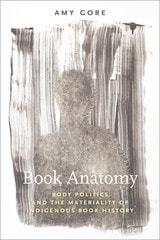
Book Anatomy
Body Politics and the Materiality of Indigenous Book HistoryAmy Gore
University of Massachusetts Press, 2023
Winner of the Beatrice Medicine Award for Scholarship in American Indian Studies
From the marginalia of their readers to the social and cultural means of their production, books bear the imprint of our humanity. Embodying the marks, traces, and scars of colonial survival, Indigenous books are contested spaces. A constellation of nontextual components surrounded Native American–authored publications of the long nineteenth century, shaping how these books were read and understood—including illustrations, typefaces, explanatory prefaces, appendices, copyright statements, author portraits, and more.
Centering Indigenous writers, Book Anatomy explores works from John Rollin Ridge, Sarah Winnemucca Hopkins, Pretty Shield, and D’Arcy McNickle published between 1854 and 1936. In examining critical moments of junction between Indigenous books and a mainstream literary marketplace, Amy Gore argues that the reprints, editions, and paratextual elements of Indigenous books matter: they embody a frontline of colonization in which Native authors battle the public perception and reception of Indigenous books, negotiate representations of Indigenous bodies, and fight for authority and ownership over their literary work.

Book Repair
A How-To-Do-It ManualArtemis BonaDea
American Library Association, 2011
Book Repair
A How-To-Do-It ManualAmerican Library Association, 2011
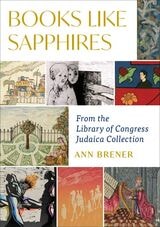
Books Like Sapphires
From the Library of Congress Judaica CollectionAnn Brener
Brandeis University Press, 2024
Books Like Sapphires showcases a wide range of Hebraic treasures from the storied collection at the Library of Congress, many of them for the first time. Tracing the history of Judaica collecting in the twentieth-century United States, the book illuminates varied works, telling their stories alongside vibrant color images. These include a unique manuscript about a betrothal scandal in Renaissance Crete, an illustrated Esther Scroll, a poem from 1477 celebrating the new technology of printing, amusing rhymed couplets in sixteenth-century Padua, and the Washington Haggadah. This book also tells the story of the patrons and collectors, first among them Jacob Schiff, as well as archivists and curators, who made the storied Judaica archive at the Library of Congress the precious resource that it is today.

Books and My Food
Literary Quotations and Recipes for Every YearElisabeth L. Cary
University of Iowa Press, 1997
Books and Readers in the Premodern World
Essays in Honor of Harry GambleKarl Shuve
SBL Press, 2018
A book about the role of books in shaping the ancient religious landscape
This collection of essays by leading scholars from a variety of academic disciplines explores the ongoing relevance of Harry Gamble’s Books and Readers in the Early Church (1995) for the study of premodern book cultures. Contributors expand the conversation of book culture to examine the role the Hebrew Bible, the New Testament, and the Qur’an played in shaping the Jewish, Christian, and Muslim religions in the ancient and medieval world. By considering books as material objects rather than as repositories for stories and texts, the essays examine how new technologies, new materials, and new cultural encounters contributed to these holy books spreading throughout territories, becoming authoritative, and profoundly shaping three global religions.
Features:
- Comparative analysis of book culture in Roman, Jewish, Christian, and Islamic contexts
- Art-historical, papyrological, philological, and historical modes of analysis
- Essays that demonstrate the vibrant, ongoing legacy of Gamble’s seminal work
Books in Motion
Connecting Preschoolers with Books through Art, Games, Movement, Music, Playacting, and PropsJulie Dietzel-Glair
American Library Association, 2013

Books of Secrets
Natural Philosophy in England, 1550-1600Allison Kavey
University of Illinois Press, 2007
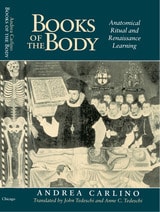
Books of the Body
Anatomical Ritual and Renaissance LearningAndrea Carlino
University of Chicago Press, 1999
In Books of the Body, Andrea Carlino explores the nature and causes of this intellectual inertia. On the one hand, anatomical practice was constrained by a reverence for classical texts and the belief that the study of anatomy was more properly part of natural philosophy than of medicine. On the other hand, cultural resistance to dissection and dismemberment of the human body, as well as moral and social norms that governed access to cadavers and the ritual of their public display in the anatomy theater, also delayed anatomy's development.
A fascinating history of both Renaissance anatomists and the bodies they dissected, this book will interest anyone studying Renaissance science, medicine, art, religion, and society.
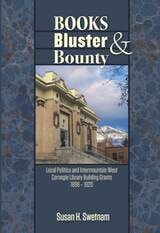
Books, Bluster, and Bounty
Local Politics and Carnegie Library Building Grants in the Intermountain West, 1890-1920Susan H. Swetnam
Utah State University Press, 2012
Books, Bluster, and Bounty examines a cross-section of Carnegie library applications to determine how local support was mustered for cultural institutions in the late nineteenth and early twentieth century West. This comparative study considers the entire region between the Rockies and the Cascades/Sierras, including all of Idaho, Utah, Nevada, and Arizona; western Montana, Wyoming, and Colorado; eastern Oregon and Washington; and small parts of California and New Mexico. The author's purpose is to address not only the how of the process but also the variable why. Although virtually all citizens and communities in the West who sought Carnegie libraries expected tangible benefits for themselves that were only tangentially related to books, what they specifically wanted varied in correlation with the diverse nature of western communities. By looking at the detailed records of the Carnegie library campaigns, the author is able to provide an alternative lens through which to perceive and map the social-cultural makeup and town building of western communities at the turn of the century.
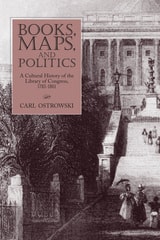
Books, Maps, and Politics
A Cultural History of the Library of Congress, 1783-1861Carl Ostrowski
University of Massachusetts Press, 2004
The author explores the relationship between the Library and the period's expanding print culture. He identifies the books that legislators required to be placed in the Library and establishes how these volumes were used. His analysis of the earliest printed catalogs of the Library reveals that law, politics, economics, geography, and history were the subjects most assiduously collected. These books provided government officials with practical guidance in domestic legislation and foreign affairs, including disputes with European powers over territorial boundaries.
Ostrowski also discusses a number of secondary functions of the Library, one of which was to provide reading material for the entertainment and instruction of government officials and their families. As a result, the richness of America's burgeoning literary culture from the 1830s to the 1860s was amply represented on the Library's shelves. For those with access to its Capitol rooms, the Library served an important social function, providing a space for interaction and the display and appreciation of American works of art.
Ostrowski skillfully demonstrates that the history of the Library of Congress offers a lens through which we can view changing American attitudes toward books, literature, and the relationship between the federal government and the world of arts and letters.

Books, Readers and Libraries in Fiction
Edited by Karen Attar and Andrew Nash
University of London Press, 2024
Books and libraries appear in fiction from the earliest times onwards, in works for all age groups, in canonical literature, and in books that form part of popular culture. Fiction enables writers to teach readers how to read, but it can also portray subversive acts of reading that engage with contemporary cultural anxieties or moral debates. The reading material of fictional personae is part of their characterization; we are often reading readers.
Drawing on approaches from literary studies, book history, library history, and theories and histories of reading, Books, Readers and Libraries in Fiction examines what fictional representations of reading tell us about changing cultural attitudes to different reading practices, and the use (and abuse) of books beyond actual reading, both in the context of specific works and about the reception of books more widely. Through detailed case studies from primarily British fiction that address common themes such as gender, genre, and the relation between reading and writing itself, this collection catalogs the ways in which authors of fiction mediate and interpret books, libraries, and the act of reading to their own readers.