Results by title
121 books match the query 'Cinema' and 5 start with b
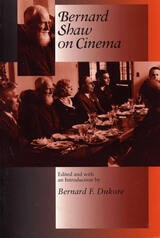
Bernard Shaw on Cinema
Edited by Bernard F. Dukore
Southern Illinois University Press, 1997
With his customary wit and quite often with remarkable prescience, Bernard Shaw maintained a dialogue on cinema that ran almost from the infancy of the industry in 1908 until his death in 1950. Bernard F. Dukore presents the first collection of Bernard Shaw’s writings and oral statements about cinema. Of the more than one hundred comments Dukore has selected, fifty-nine—more than half—are new to today’s readers. Twelve are previously unpublished, one is published in full for the first time, and forty-six appear in a collected edition of Shaw’s writings for the first time since their publication in newspapers and magazines.
Very early in the life of cinema, Shaw perceived that as an invention, movies would be more momentous than the printing press because they appealed to the illiterate as well as the literate, to the manual laborer at the end of an exhausting day as well as to the person with more leisure. He predicted that cinema would form people’s minds and shape their conduct. He recognized that cinema’s "colossal proportions make mediocrity compulsory" by leveling art and life down to the blandest morality and to the lowest common denominator of potential audiences throughout the world.
By 1908, Shaw was familiar with experiments synchronizing movies and sound. When talkies arrived, he discerned that they would precipitate major changes in acting, writing, and economics. He also saw how they would affect live theatre: "The theatre may survive as a place where people are taught to act," he said in 1930, "but apart from that there will be nothing but ‘talkies’ soon." At that time, few people in the theatrical profession were making such prophecies, at least not in public.
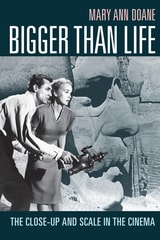
Bigger Than Life
The Close-Up and Scale in the CinemaMary Ann Doane
Duke University Press, 2021
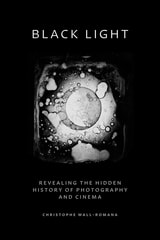
Black Light
Revealing the Hidden History of Photography and CinemaChristophe Wall-Romana
University of Minnesota Press, 2026
A radical assessment of the racial motives underlying the conception of photography and cinema
Conventional histories have long traced the origins of photography and cinema to the goal of reproducing the visible world. Black Light offers a radical counter to this understanding. Investigating the optical, cosmological, and racial thought that surrounded their conception, Christophe Wall-Romana argues that these media developed out of a desire to visualize what cannot be seen.
Taking as its starting point the concurrent invention of the telescope and industrialization of the transatlantic slave trade, Black Light shows how photography and cinema are entangled with two key preoccupations of the Enlightenment: visualizing the mysteries of the cosmos and managing Blackness. Wall-Romana uses literary and technological sources to demonstrate how racial and astronomical thinking interwove throughout the long development of our modern visual media. Retracing the impulses behind nonmimetic photoimaging and dynamic modeling, he exposes the racial underpinnings of research on photosensitive compounds such as silver nitrate and the racist lenses applied in post-Copernican cosmology.
Black Light charts the pivotal period from the seventeenth through the nineteenth century when Europeans were reckoning with “multiple worlds” and natural philosophy was giving way to “mechanical objectivity.” Wall-Romana shows how engagement with the nature of light was always entangled with racist discourses on Blackness—especially after the 1801 discovery of the invisible spectrum and its paradox of “black light.” Deprovincializing media archaeology, this book presents a groundbreaking historical framework with which to reenvision our dominant modes of seeing and understanding the world.
Retail e-book files for this title are screen-reader friendly with images accompanied by short alt text and/or extended descriptions.
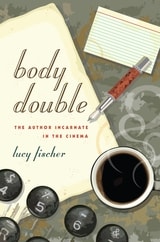
Body Double
The Author Incarnate in the CinemaLucy Fischer
Rutgers University Press, 2013
Body Double explores the myriad ways that film artists have represented the creative process. In this highly innovative work, Lucy Fischer draws on a neglected element of auteur studies to show that filmmakers frequently raise questions about the paradoxes of authorship by portraying the onscreen writer. Dealing with such varied topics as the icon of the typewriter, the case of the writer/director, the authoress, and the omnipresent infirm author, she probes the ways in which films can tell a plausible story while contemplating the conditions and theories of their making.
By examining many forms of cinema, from Hollywood and the international art cinema to the avant-garde, Fischer considers the gender, age, and mental or physical health of fictionalized writers; the dramatized interaction between artists and their audiences and critics; and the formal play of written words and nonverbal images.
By analyzing such movies as Adaptation,Diary of a Country Priest, Naked Lunch, American Splendor, and Irezumi, Fischer tracks the parallels between film author and character, looking not for the creative figure who stands outside the text, but for the one who stands within it as corporeal presence and alter-ego.
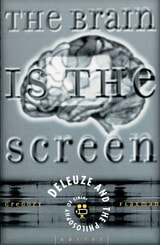
Brain Is The Screen
Deleuze and the Philosophy of CinemaGregory Flaxman
University of Minnesota Press, 2000