Results by title
401 books match the query 'Civil War, 1861-1865' and 13 start with b
Battle
The Nature and Consequences of Civil War CombatEdited by Kent Gramm
University of Alabama Press, 2008
A critical, multidisciplinary examination of Civil War combat that interrogates the technological, medical, psychological, and cultural forces shaping battlefield experience and its enduring national legacy.
“In our youth, our hearts were touched with fire,” wrote Oliver Wendell Holmes of his generation’s Civil War days. Through the ages, war stories have gleamed with romantic glory, and American memories of the cataclysmic Civil War inspire pageantry and poetry even today.
The essays in Battle form a corrective to such celebratory histories by examining the lethal realities of Civil War combat—Enlightenment science applied to the creation of weapons that maimed and killed, which far outpaced advances in diet, sanitation, and medical treatment. The book reveals that behind the drums and trumpets, sashes and swords, the armies of the Union and Confederacy alike were haunted by fear, pain, and death.
The collection includes an introduction and afterword by editor Kent Gramm, who also contributes an essay titled “Numbers” that reveals the war in statistics. Paul Fussell contributes a powerful essay titled “The Culture of War.” D. Scott Hartwig examines the face of battle at Gettysburg. Bruce A. Evans discusses medical technology in “Wounds, Death, and Medical Care in the Civil War.” Eric T. Dean challenges the meanings and consequences of combat in “The Awful Shock and Rage of Battle.” The collection is rounded out by Alan T. Nolan’s masterful review of the national consequences of battle and the resultant myth of the Confederacy’s Lost Cause.
Battles and Leaders of the Civil War, Volume 5
Edited by Peter Cozzens
University of Illinois Press, 2001
Indispensable must-reads for all Civil War buffs and historians, bringing together little-known and never before gathered first-hand accounts, articles, maps, and illustrations
The first four volumes of Battles and Leaders of the Civil War, published in the late nineteenth century, became the best-selling and most frequently cited works ever published on the Civil War. Volume 5, assembled by the acclaimed military historian Peter Cozzens, carries on the tradition of its namesake, offering a dazzling new collection of fresh material written by military and civilian leaders, North and South, on a broad array of war-related topics. Featured articles include General Grant on the second battle of Bull Run, General Beauregard on the Shiloh campaign, General Sherman on the conference at City Point, Joshua Chamberlain on the Fredericksburg campaign, and many more. Also presented are dozens of maps and more than one hundred illustrations.
Battles and Leaders of the Civil War, Volume 6
Edited by Peter Cozzens
University of Illinois Press, 2001
Behind the Guns
The History of Battery I, 2nd Regiment, Illinois Light ArtilleryThaddeus C. S. Brown, Samuel J. Murphy, and William G. Putney. Edited with a Foreword by Clyde C. Walton
Southern Illinois University Press, 2000
Much has been written of the infantry and the cavalry during the Civil War, but little attention has been paid the artillery. Through the battles of Chickamauga and Missionary Ridge in 1863 and the Atlanta Campaign of 1864 and with General Sherman’s forces on the famous March to the Sea, the acts of a courageous fighting group are vividly recounted in Behind the Guns: The History of Battery I, 2nd Regiment, Illinois Light Artillery. Originally published in 1965 in a limited edition, this regimental history of a light artillery unit was written by three of its soldiers, including the bugler.
Battery I was formed in 1861 by Charles W. Keith of Joliet and Henry B. Plant of Peoria. More than a hundred men were mustered into service in December near Springfield and left for Cairo in February 1862. The battery trained at Camp Paine across the Ohio River in Kentucky until March, when the men were dispatched to the South. During the war, the Battery was attached to three different armies: the Army of the Mississippi, the Army of the Ohio, and the Army of the Cumberland.
Clyde C. Walton’s foreword and the narrative discuss the variety of weapons used by the unit, including James, Parrott, and Rodman guns and the bronze, muzzle-loading Napoleons that fired twelve-pound projectiles. The book also includes an account of the prisoner-of-war experience of Battery I lieutenant Charles McDonald, biographical sketches of the battery soldiers, and eighteen maps and five line drawings.
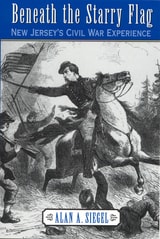
Beneath the Starry Flag
New Jersey's Civil War ExperienceSiegel, Alan A
Rutgers University Press, 2001
Few events in American history can match the triumph and tragedy of the Civil War. Many books have been written about the War between the States, but until now, none has chronicled—in their own words—the many important roles played by people from New Jersey.
Beneath the Starry Flag is a collection of richly detailed eyewitness accounts by New Jerseyans who lived during the Civil War. Drawing from letters, journals, regimental histories, and newspaper accounts, Alan A. Siegel places the reader in the midst of these desperate times. The book depicts the war years chronologically, from the tense days when one state, then another seceded from the Union, through battles lost and won, to the victory at Appomattox and Lincoln’s funeral procession across New Jersey.
Readers will learn of the remarkable valor of New Jersey soldiers such as John Beech, a Trenton potter who won a Medal of Honor for bravery at Spotsylvania’s Bloody Angle. They will learn too of the sacrifices made by civilians, such as Cornelia Hancock of Salem County, who ministered to soldiers wounded on battlefields from Gettysburg to Petersburg. Siegel also tells of other people and institutions who played very different roles in the war, including Somerset County’s Daniel Cory, who said he would shoot the president if he could, the state’s leading Copperhead newspapers, which denounced the draft and discouraged enlistments, and the State Legislature, which at one point called for a truce and negotiations to end the conflict.
Siegel allows them all, enlisted men and officers, politicians and plain citizens, patriots and conspirators, to speak in their own words in often moving firsthand accounts. Their motives, emotions, and deeds are chronicled in this collection of stories, some which have been out of print for many years, others that have not been heard since they were first written more than a century ago.
[Beneath the Starry Flag is an invaluable addition to what we know about this remarkable time in American history, perfect for the general reader or Civil War historian.]
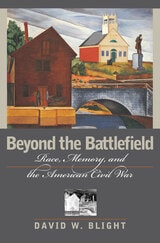
Beyond the Battlefield
Race, Memory, and the American Civil WarDavid W. Blight
University of Massachusetts Press, 2002
The book as a whole demonstrates several ways to probe the history of memory, to understand how and why groups of Americans have constructed versions of the past in the service of contemporary social needs. Topics range from the writing and thought of Frederick Douglass and W.E.B. Du Bois to a comparison of Abraham Lincoln and Douglass on the level of language and memory. The volume also includes a compelling study of the values of a single Union soldier, an analysis of Ken Burns's PBS series The Civil War, and a retrospective treatment of the distinguished African American historian Nathan I. Huggins.
Taken together, these lucidly written pieces offer a thoroughgoing assessment of the stakes of Civil War memory and their consequences for American race relations. Beyond the Battlefield demonstrates not only why we should preserve and study our Civil War battlefields, but also why we should lift our vision above those landscapes and ponder all the unfinished questions of healing and justice, of racial harmony and disharmony, that still bedevil our society and our historical imagination.
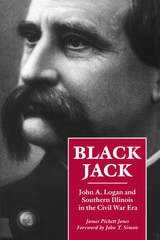
Black Jack
John A. Logan and Southern Illinois in the Civil War EraJames Pickett Jones. Foreword by John Y. Simon
Southern Illinois University Press, 1995
John A. Logan, called "Black Jack" by the men he led in Civil War battles from the Henry-Donelson campaign to Vicksburg, Chattanooga, and on to Atlanta, was one of the Union Army’s most colorful generals.
James Pickett Jones places Logan in his southern Illinois surroundings as he examines the role of the political soldier in the Civil War. When Logan altered his stance on national issues, so did the southern part of the state. Although secession, civil strife, Copperheadism, and the new attitudes created by the war contributed to this change of position in southern Illinois, Logan’s role as political and military leader was important in the region’s swing to strong support of the war against the Confederacy, to the policies of Lincoln, and eventually, to the Republican party.
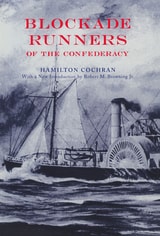
Blockade Runners of the Confederacy
Hamilton Cochran
University of Alabama Press, 2004
An authoritative account of blockade running in Civil War history.
Within four weeks of the fall of Fort Sumter, President Abraham Lincoln had declared a blockade of over four thousand miles of Confederate coastline, from Cape Henry in Virginia to the Mexican border. In response, professional runners, lured by both profits and patriotism, built faster, sleeker, low-profile ships and piloted them through the ever-thickening Northern cordon. The tonnage they imported, including items ranging from straight pins to marine engines, sustained the South throughout the conflict. This exciting chronicle of the men and ships that ran federal naval blockades during the Civil War also provides an overall assessment of the blockades conception, effectiveness, and impact on the Southern populace.
Blockaders, Refugees, and Contrabands
Civil War on Florida's Gulf Coast, 1861-1865George E. Buker
University of Alabama Press, 2004
Bluejackets in the Blubber Room
A Biography of the William Badger,1828-1865Kurtz, Peter
University of Alabama Press, 2013
Boy Soldier of the Confederacy
The Memoir of Johnnie WickershamEdited by Kathleen Gorman
Southern Illinois University Press, 2006
Johnnie Wickersham was fourteen when he ran away from his Missouri home to fight for the Confederacy. Fifty years after the war, he wrote his memoir at the request of family and friends and distributed it privately in 1915. Boy Soldier of the Confederacy: The Memoir of Johnnie Wickersham offers not only a rare look into the Civil War through the eyes of a child but also a coming-of-age story.
Edited by Kathleen Gorman, the volume presents a new introduction and annotations that explain how the war was glorified over time, the harsh realities suppressed in the nation’s collective memory. Gorman describes a man who nostalgically remembers the boy he once was. She maintains that the older Wickersham who put pen to paper decades later likely glorified and embellished the experience, accepting a polished interpretation of his own past.
Wickersham recounts that during his first skirmish he was "wild with the ecstasy of it all" and notes that he was "too young to appreciate the danger." The memoir traces his participation in an October 1861 Confederate charge against Springfield, Missouri; his fight at the battle of Pea Ridge in March 1862; his stay at a plantation he calls Fairyland; and the battle of Corinth.
The volume details Wickersham’s assignment as an orderly for General Sterling Price, his capture at Vicksburg in 1863, his parole, and later his service with General John Bell Hood for the 1864 fighting around Atlanta. Wickersham also describes the Confederate surrender in New Orleans, the reconciliation of the North and the South, and his own return and reunification with his family.
While Gorman’s incisive introduction and annotations allow readers to consider how memories can be affected by the passage of time, Wickersham’s boy-turned-soldier tale offers readers an engaging narrative, detailing the perceptions of a child on the cusp of adulthood during a turbulent period in our nation’s history.
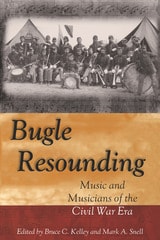
Bugle Resounding
Music and Musicians of the Civil War EraEdited by Bruce C. Kelley & Mark A. Snell
University of Missouri Press, 2004
Although numerous academic resources examine the music and musicians of the Civil War era, the research is spread across a variety of disciplines and is found in a wide array of scholarly journals, books, and papers. It is difficult to assimilate this diverse body of research, and few sources are dedicated solely to a rigorous and comprehensive investigation of the music and the musicians of this era. This anthology, which grew out of the first two National Conferences on Music of the Civil War Era, is an initial attempt to address that need.
Those conferences established the first academic setting solely devoted to exploring the effects of the Civil War on music and musicians. Bridging musicology and history, these essays represent the forefront of scholarship in music of the Civil War era. Each one makes a significant contribution to research in the music of this era and will ultimately encourage more interdisciplinary research on a subject that has relevance both for its own time and for ours. The result is a readable, understandable volume on one of the few understudied—yet fascinating—aspects of the Civil War era.
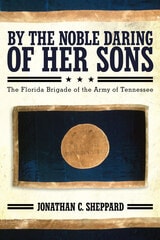
By the Noble Daring of Her Sons
The Florida Brigade of the Army of TennesseeJonathan C. Sheppard
University of Alabama Press, 2012
A fascinating account of Floridians who served in the Confederate army and the changes to Florida society and politics that resulted from the state's Confederate experience
Until recently Florida’s Confederate soldiers have received scant attention. This volume explores the story of Florida soldiers going to war, families left behind, a white population fighting to maintain a society built on slavery, and a state torn by political and regional strife.
Before the war Florida’s inhabitants engaged in bitter political rivalries. Sheppard argues that prior to secession Florida citizens maintained regional loyalties rather than considering themselves “Floridians.” He argues that service in Confederate armies eased tensions between political factions and fostered solidarity among white Floridians. In this illuminated account, Sheppard also addresses the practices of prisoner parole and exchange, unit consolidation and its effects on morale and unit identity, politics within the Army of Tennessee, and conscription and desertion in the Southern armies. These issues come together to demonstrate the connection between the front lines and the home front.