Results by title
679 books match the query 'Ecology' and 28 start with b
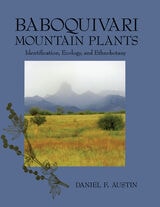
Baboquivari Mountain Plants
Identification, Ecology, and EthnobotanyDaniel F. Austin
University of Arizona Press, 2010
The term “sky island” was first used by Weldon Heald in 1967 to describe mountain ranges that are separated from each other by valleys of grassland or desert. The valleys create barriers to the spread of plant species in a way that is similar to the separation of islands in an ocean. The 70,000-square-mile Sky Islands region of southeastern Arizona, southwestern New Mexico, and northwestern Mexico is of particular interest to botanists because of its striking diversity of plant species and habitats. With more than 3,000 species of plants, the region offers a surprising range of tropical and temperate zones. Although others have written about the region, this is the first book to focus exclusively on the plant life of the Baboquivari Mountains.
The book offers an introduction to the history of the region, along with a discussion of human influences, and includes a useful appendix that lists all of the plants known to be growing in the Baboquivari Mountain chain.
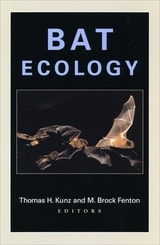
Bat Ecology
Edited by Thomas H. Kunz and M. Brock Fenton
University of Chicago Press, 2003
The first part of the book covers the life history and behavioral ecology of bats, from migration to sperm competition and natural selection. The next section focuses on functional ecology, including ecomorphology, feeding, and physiology. In the third section, contributors explore macroecological issues such as the evolution of ecological diversity, range size, and infectious diseases (including rabies) in bats. A final chapter discusses conservation challenges facing these fascinating flying mammals.
Bat Ecology is the most comprehensive state-of-the-field collection for scientists and researchers.
Contributors:
John D. Altringham, Robert M. R. Barclay, Tenley M. Conway, Elizabeth R. Dumont, Peggy Eby, Abigail C. Entwistle, Theodore H. Fleming, Patricia W. Freeman, Lawrence D. Harder, Gareth Jones, Linda F. Lumsden, Gary F. McCracken, Sharon L. Messenger, Bruce D. Patterson, Paul A. Racey, Jens Rydell, Charles E. Rupprecht, Nancy B. Simmons, Jean S. Smith, John R. Speakman, Richard D. Stevens, Elizabeth F. Stockwell, Sharon M. Swartz, Donald W. Thomas, Otto von Helversen, Gerald S. Wilkinson, Michael R. Willig, York Winter
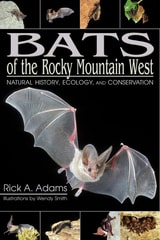
Bats of the Rocky Mountain West
Natural History, Ecology, and ConservationRick A. Adams
University Press of Colorado, 2003
Bats of the Rocky Mountain West begins with a general discussion of bat biology and evolution as well as regional physiography and zoogeography. In addition, Adams describes - based on the results of extensive research - the behavior and ecology of the 31 species of bats found in Montana, Idaho, Wyoming, Utah, Colorado, New Mexico, and Arizona. Naturalists and biologists alike will benefit from the detailed species descriptions, color photographs and illustrations, distribution maps, and echolocation sonograms. Bats of the Rocky Mountain West is a unique and valuable reference for professional bat biologists, naturalists, and wildlife enthusiasts interested in the conservation and ecology of bats in the region.
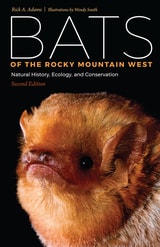
Bats of the Rocky Mountain West
Natural History, Ecology, and ConservationRick A. Adams
University Press of Colorado, 2025
In the twenty years since the original publication of Bats of the Rocky Mountain West, chiropterology (bat science) has exploded, significantly altering our understanding of the ecology, behavior, distribution, and conservation of one of the world's most enigmatic mammals. This notably updated second edition further brings to life the wonderful world of bats with beautiful illustrations and photography that grip the imagination and reveal the magnificent natural history of the only true flying mammal. In addition, thirty-two accounts of regional species with photographs, range maps, and echolocation sonograms report informative and thoroughly revised findings on bats now living in the Rocky Mountain West. Leave any preconceived notions behind and learn the real-life biology of bats, which eclipses the fabled tales of the crypt and macabre.
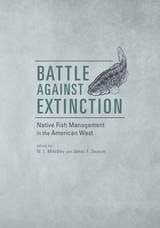
Battle Against Extinction
Native Fish Management in the American WestEdited by W. L. Minckley and James E. Deacon; Foreword by Stewart L. Udall
University of Arizona Press, 1991
Nearly a third of the native fish fauna of North America lives in the arid West; this book traces their decline toward extinction as a result of human interference and the threat to their genetic diversity posed by decreases in their populations. What can be done to slow or end this tragedy? As the most comprehensive treatment ever attempted on the subject, Battle Against Extinction shows how conservation efforts have been or can be used to reverse these trends.
In covering fishes in arid lands west of the Mississippi Valley, the contributors provide a species-by-species appraisal of their status and potential for recovery, bringing together in one volume nearly all of the scattered literature on western fishes to produce a monumental work in conservation biology. They also ponder ethical considerations related to the issue, ask why conservation efforts have not proceeded at a proper pace, and suggest how native fish protection relates to other aspects of biodiversity planetwide. Their insights will allow scientific and public agencies to evaluate future management of these animal populations and will offer additional guidance for those active in water rights and conservation biology.
First published in 1991, Battle Against Extinction is now back in print and available as an open-access e-book thanks to the Desert Fishes Council.

Battle Against Extinction
Native Fish Management in the American WestEdited by W. L. Minckley and James E. Deacon; Foreword by Stewart L. Udall
University of Arizona Press, 1991
Nearly a third of the native fish fauna of North America lives in the arid West; this book traces their decline toward extinction as a result of human interference and the threat to their genetic diversity posed by decreases in their populations. What can be done to slow or end this tragedy? As the most comprehensive treatment ever attempted on the subject, Battle Against Extinction shows how conservation efforts have been or can be used to reverse these trends.
In covering fishes in arid lands west of the Mississippi Valley, the contributors provide a species-by-species appraisal of their status and potential for recovery, bringing together in one volume nearly all of the scattered literature on western fishes to produce a monumental work in conservation biology. They also ponder ethical considerations related to the issue, ask why conservation efforts have not proceeded at a proper pace, and suggest how native fish protection relates to other aspects of biodiversity planetwide. Their insights will allow scientific and public agencies to evaluate future management of these animal populations and will offer additional guidance for those active in water rights and conservation biology.
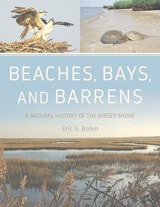
Beaches, Bays, and Barrens
A Natural History of the Jersey ShoreEric G. Bolen
Rutgers University Press, 2024
Beaches, Bays, and Barrens introduces readers to the natural wonders of the Jersey Shore, revealing its unique ecology and fascinating history. The journey begins with the contributions and discoveries of early naturalists who visited the region and an overview of endangered species and natural history, followed by chapters that explore different facets of the shore’s environments. These start with sandy beaches and dunes and culminate in the engaging Pine Barrens, the vital watershed for much of the state’s varied coastline. Along the way, readers will also learn about whaling, decoy carvers, an extinct duck, and the cultivation of wild blueberries.
Including over seventy color photographs, the book also features twenty-three infoboxes that go deep into areas of ecological or historical interest, such as the Forsythe National Wildlife Refuge or the Jaws-like shark attacks of 1916. From Cape May to Sandy Hook, biologist Eric G. Bolen takes you on a guided tour of the Jersey Shore’s rich ecological heritage.
Becoming Creole
Nature and Race in BelizeJohnson, Melissa A.
Rutgers University Press, 2019

Before and After an Oil Spill
The Arthur KillBurger, Joanna
Rutgers University Press, 1994
In January 1990, the New York Harbor suffered a major oil spill when an underwater pipe at an Exxon refinery leaked into the Arthur Kill, the fifteen-mile strait that runs between New Jersey and Staten Island. The waterway is home to herons and egrets, fiddler crabs and sea turtles, and a favorite place for recreational fishing, bird-watching, hiking, and boating. It is also lined with refineries and a busy corridor for oil tankers. Because this industrial activity posed such an imposing threat to the fragile ecosystem, biologists had been monitoring the region’s water, soil, vegetation, and wildlife for some time before the oil spill. Thus, we have before -and-after data about the habitat—the only oil spill anywhere for which this is true.
This unique book discusses the human consequences of the oil spill as well as providing detailed studies of its effects on the plants and animals of the Arthur Kill. Biologists, environmentalists, lawyers, and officials worldwide will find this book an essential guide to dealing with—and possibly preventing—future environmental disasters.
The contributors areJohn Brzorad, Angela Christini, Keith Cooper, Lynn Frink, Michael Gochfeld, Paul Hauge, Gordon Johnson, Alan D. Maccarone, Katherine Parsons, Carolyn Summers, Robert Tucker.
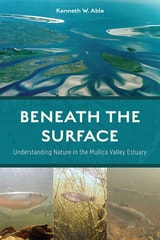
Beneath the Surface
Understanding Nature in the Mullica Valley EstuaryKenneth W. Able
Rutgers University Press, 2020
The Mullica Valley estuary and its watershed, formed over the last 10,000 years, are among the cleanest estuaries along the east coast of the United States. This 365,000-acre ecosystem benefits from a combination of protected watershed, low human population density, and general lack of extensive development. In Beneath the Surface, marine scientist Ken Able helps the reader penetrate the surface and gain insights into the kinds of habitats, animals, and plants that live there. Readers will gain a better understanding of the importance of these shallow waters; how the amount of salt in the water determines where animals and plants are found in estuaries; the day-night, seasonal, and annual variation in their occurrence; and how change is occurring as the result of climate variation. Throughout the book are insightful sidebars telling intimate stories of where various animals came from and where they are going as they travel through the estuary on their way to and from other portions of the east coast. Beneath the Surface emphasizes the kinds and importance of the animals and plants that live beneath the surface of this unique ecosystem.
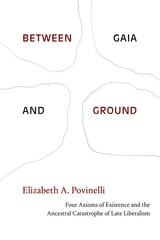
Between Gaia and Ground
Four Axioms of Existence and the Ancestral Catastrophe of Late LiberalismElizabeth A. Povinelli
Duke University Press, 2021

Between Two Fires
A Fire History of Contemporary AmericaStephen J. Pyne
University of Arizona Press, 2015
Pyne is uniquely qualified to tell America’s fire story. The author of more than a score of books, he has told fire’s history in the United States, Australia, Canada, Europe, and the Earth overall. In his earlier life, he spent fifteen seasons with the North Rim Longshots at Grand Canyon National Park.
In Between Two Fires, Pyne recounts how, after the Great Fires of 1910, a policy of fire suppression spread from America’s founding corps of foresters into a national policy that manifested itself as a costly all-out war on fire. After fifty years of attempted fire suppression, a revolution in thinking led to a more pluralistic strategy for fire’s restoration. The revolution succeeded in displacing suppression as a sole strategy, but it has failed to fully integrate fire and land management and has fallen short of its goals.
Today, the nation’s backcountry and increasingly its exurban fringe are threatened by larger and more damaging burns, fire agencies are scrambling for funds, firefighters continue to die, and the country seems unable to come to grips with the fundamentals behind a rising tide of megafires. Pyne has once again constructed a history of record that will shape our next century of fire management. Between Two Fires is a story of ideas, institutions, and fires. It’s America’s story told through the nation’s flames.
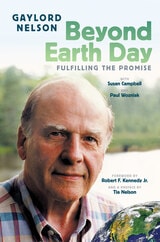
Beyond Earth Day
Fulfilling the PromiseGaylord Nelson; With Susan Campbell and Paul Wozniak; Foreword by Robert F. Kennedy Jr.; Preface by Tia Nelson
University of Wisconsin Press, 2002
Gaylord Nelson’s legacy is known and respected throughout the world. He was a founding father of the modern environmental movement and creator of one of the most influential public awareness campaigns ever undertaken on behalf of global environmental stewardship: Earth Day.
Nelson died in 2005, but his message in this book is still timely and urgent, delivered with the same eloquence with which he articulated the nation’s environmental ills throughout the decades. He details the planet’s most critical concerns—from species and habitat losses to global climate change and population growth. In outlining strategies for planetary health, Nelson inspires citizens to reassert environmentalism as a national priority. Included in this reprint is a new preface by Gaylord Nelson’s daughter, Tia Nelson.
Beyond Preservation
Restoring and Inventing LandscapesDwight Baldwin
University of Minnesota Press, 1994
Beyond Preservation was first published in 1993. Minnesota Archive Editions uses digital technology to make long-unavailable books once again accessible, and are published unaltered from the original University of Minnesota Press editions.
Addressing current ecological issues, from the philosophical to the practical, Frederick Turner and William R. Jordan III Here offer a new paradigm for understanding the relationship between the humans and nature. Challenging the idea that preserving nature is the only solution to environmental problems, they advocate going beyond preservation to restoration and actual construction of our landscape. Fifteen respondents reflect on the implications and consequences of Turner’s and Jordan’s bold proposals.“Ecological restoration is the most helpful and provocative contribution to our thinking about nature to come along in many years, and Beyond Preservation is without a doubt the best book on the subject to date.” Michael Polan, Harper’sContributors include Gary W. Barrett, Ann Cline, David L. Gorchov, William Jordan III, G. Stanley Kane, Jack Temple Kirby, Dora G. Lodwick, Orie L. Loucks, Kimberly E. Medley, Constance Pierce, Ellen Price, Frederick Turner, John E. Wierwille, and Gene E. Willeke.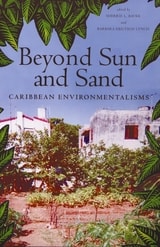
Beyond Sun and Sand
Caribbean EnvironmentalismsEdited by Sherrie L. Baver and Barbara Deutsch Lynch
Rutgers University Press, 2006
In both versions, the image of the exotic landscape overshadows the rich island cultures that are both linguistically and politically diverse, but trapped in a global economy that offers few options for development. Popular depictions also overlook the reality that the region is fraught with environmental problems, including water and air pollution, solid waste mismanagement, destruction of ecosystems, deforestation, and the transition from agriculture to ranching.
Bringing together ten essays by social scientists and activists, Beyond Sun and Sand provides the most comprehensive exploration to date of the range of environmental issues facing the region and the social movements that have developed to deal with them. The authors consider the role that global and regional political economies play in this process and provide valuable insight into Caribbean environmentalism. Many of the essays by prominent Caribbean analysts are made available for the first time in English.
Biophysical Models and Applications in Ecosystem Analysis
Chen, Jiquan
Michigan State University Press, 2021
Biotic Communities
Southwestern United States and Northwestern MexicoDavid E. Brown
University of Utah Press, 1994
Biotic Communities catalogs and defines by biome, or biotic community, the region centered on Arizona, New Mexico, Sonora, Chihuahua, and Baja California Norte, plus California, Nevada, Utah, Colorado, Texas, Coahuila, Sinaloa, and Baja California Sur. Originally published in 1982 by the Boyce Thompson Southwestern Arboretum, this ambitious book is still a "must-have" for those working in natural resources management and ecological research, as well as non-specialists who wish to know more about a particular locale.
Biotic Communities is arranged by climatic formation with a short chapter for each biome describing climate, physiognomy, distribution, dominant and common plant species, and characteristic vertebrates. Subsequent chapters contain careful descriptions of zonal subdivisions. The text is supplemented with over one hundred black and white photographs illustrating almost every community type.

Birds of the Lower Colorado River Valley
Kenneth V. Rosenberg, Robert D. Ohmart, William C. Hunter, and Bertin W. Anderson
University of Arizona Press, 1991
"A tremendous amount of information is included in this book for banders, birders, and people working to restore the 'Nile of the American Southwest.'" —North American Bird Bander
"A report on several years of scientific research undertaken to investigate the ecological relationships among desert riparian wildlife. . . . Well writen and very informative book." —The Canadian Field Naturalist
"This work is a great achievment." —Birding
Birdwatching in Maine
The Complete Site GuideDerek J. Lovitch
Brandeis University Press, 2024
With over 470 species of birds recorded, Maine offers an abundance of birding opportunities for people of all levels of interest and experience, from those looking beyond their backyards for the first time to knowledgeable visitors looking to plug a hole in their list of sightings. The state’s wealth of undeveloped land and its extensive coastline, countless islands, and varied habitat combine to host an impressive diversity of birds at all times of the year. Birders travel to Maine from near and far to seek hard-to-find species, from the only Atlantic puffins breeding in the United States on offshore islands to Bicknell’s thrushes high in the mountains.
This book fills an important niche for the birdwatching community by offering comprehensive entries detailing the best locations for finding birds throughout the state for enthusiasts of all levels of skill and interest. It contains descriptions of 202 birding sites in Maine, with explicit directions on how to get there, for all sixteen of the state’s counties, several as large as other New England states! Each chapter features a county map, a brief overview by Derek J. Lovitch, numerous specific site guides, and a list of rarities. The book also contains a detailed and useful species accounts guide for finding the most sought-after birds.
Lavishly illustrated in color throughout, Birdwatching in Maine is the best available resource for finding birds in the largest of the New England states. This updated edition features a new introduction, as well as new birding sites and maps.

Bleak Joys
Aesthetics of Ecology and ImpossibilityMatthew Fuller
University of Minnesota Press, 2019
A philosophical and cultural distillation of the bleak joys in today’s ambivalent ecologies and patterns of life
Bleak Joys develops an understanding of complex entities and processes—from plant roots to forests to ecological damage and its calculation—as aesthetic. It is also a book about “bad” things, such as anguish and devastation, which relate to the ecological and technical but are also constitutive of politics, the ethical, and the formation of subjects.
Avidly interdisciplinary, Bleak Joys draws on scientific work in plant sciences, computing, and cybernetics, as well as mathematics, literature, and art in ways that are not merely illustrative of but foundational to our understanding of ecological aesthetics and the condition in which the posthumanities are being forged. It places the sensory world of plants next to the generalized and nonlinear infrastructure of irresolvability—the economics of indifference up against the question of how to make a home on Planet Earth in a condition of damaged ecologies. Crosscutting chapters on devastation, anguish, irresolvability, luck, plant, and home create a vivid and multifaceted approach that is as remarkable for its humor as for its scholarly complexity.
Engaging with Deleuze, Guattari, and Bakhtin, among others, Bleak Joys captures the modes of crises that constitute our present ecological and political condition, and reckons with the means by which they are not simply aesthetically known but aesthetically manifest.
Bogs of the Northeast
Charles W. Johnson
University Press of New England, 1985
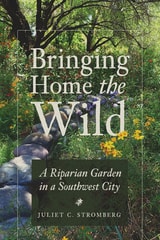
Bringing Home the Wild
A Riparian Garden in a Southwest CityJuliet C. Stromberg
University of Arizona Press, 2023
When living in a large sprawling city, one may feel disconnected and adrift. Finding ways to belong and have positive effects is challenging. In Bringing Home the Wild, botanist Juliet C. Stromberg demonstrates how ecologically guided gardening develops a sense of place, restores connections to nature, and brings joy and meaning to our lives.
This book follows a two-decade journey in ecologically guided gardening on a four-acre irrigated parcel in Phoenix, Arizona, from the perspective of a retired botanist and her science historian partner. Through humor and playful use of language, Bringing Home the Wild not only introduces the plants who are feeding them, buffering the climate, and elevating their moods but also acknowledges the animals and fungi who are pollinating the plants and recycling the waste. Some of the plants featured are indigenous to the American Southwest, while others are part of the biocultural heritage of the cityscape. This book makes the case for valuing inclusive biodiversity and for respectful interactions with all wild creatures, regardless of their historical origin.
As author and partner learn to cohabit with the plants who feed them, calm them, entertain them, and protect them from the increasing heat, their desire to live sustainably, ethically, and close to the land becomes even stronger, revealing the importance of observing, appreciating, and learning from the ecosystems of which we are a part.
Bristlecone Pine in the White Mountains of California
Growth and Ring-Width CharacteristicsHarold C. Fritts
University of Arizona Press, 1969
Papers of the Laboratory of Tree-Ring Research, No. 4
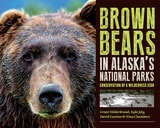
Brown Bears in Alaska's National Parks
Conservation of a Wilderness IconGrant V. Hilderbrand
University of Alaska Press, 2025
Brown bears are powerful symbols of wilderness, thriving in the vast, untamed ecosystems of Alaska’s remote national parks. Brown Bears in Alaska’s National Parks is a unique and thorough exploration of the conservation, ecology, and management of brown bears in these parks, including examinations of bear biology, human-bear interactions, population estimation methods, and the effects of climate change on bear populations. This lavishly illustrated volume offers fresh perspectives about the complex challenges that bears and humans face as they navigate coexistence in the evolving wilderness of Alaska.
Through park-specific chapters, the authors clearly present the current understanding of brown bear ecology across a wide range of ecosystems—from the sparse and frigid Gates of the Arctic, entirely above the Arctic Circle, to the bountiful coast of Katmai, where the marine and terrestrial systems converge. In Glacier Bay, bears roam newly exposed ecosystems shaped by retreating glaciers, while the interior landscapes of Lake Clark and Denali provide a mix of boreal forests, tundra, rivers, and towering mountains.
Brown bears—and the many species that share their habitats—face numerous challenges, with climate change among the greatest threats. The warming climate intensifies other pressures, such as industrial development, both within and around park boundaries. Management actions may also reduce native brown bear populations and, in turn, threaten healthy and naturally functioning ecosystems. The adaptability of brown bears, in concert with thoughtful and science-based management, is essential for the conservation of these majestic creatures and the wilderness landscapes on which they depend.
Written by the wildlife biologists and anthropologists who have dedicated their careers to studying brown (grizzly) bears and their relationship to people, Brown Bears in Alaska’s National Parks is a premier reference for bear enthusiasts, biologists, managers, and academics, as well as advocates for wild things and wild places.
Building Something Better
Environmental Crises and the Promise of Community ChangeStephanie A. Malin
Rutgers University Press, 2022
Sociologists Stephanie A. Malin and Meghan Elizbeth Kallman offer a clear, accessible volume that demonstrates the ways that communities adapt in the face of crises and explains that sociology can help us understand how and why they do this challenging work. Tackling neoliberalism head-on, these communities are making big changes by crafting distributive and regenerative systems that depart from capitalist approaches. The vivid case studies presented range from activist water protectors to hemp farmers to renewable energy cooperatives led by Indigenous peoples and nations. Alongside these studies, Malin and Kallman present incisive critiques of colonialism, extractive capitalism, and neoliberalism, while demonstrating how sociology’s own disciplinary traditions have been complicit with those ideologies—and must expand beyond them.
Showing that it is possible to challenge social inequality and environmental degradation by refusing to continue business-as-usual, Building Something Better offers both a call to action and a dose of hope in a time of crises.
Building a Green Economy
Perspectives from Ecological EconomicsRobert B. Richardson
Michigan State University Press, 2013
The first decade of the twenty-first century has been characterized by a growing global awareness of the tremendous strains that human economic activity place on natural resources and the environment. As the world’s population increases, so does the demand for energy, food, and other resources, which adds to existing stresses on ecosystems, with potentially disastrous consequences. Humanity is at a crossroads in our pathway to future prosperity, and our next steps will impact our long-term sustainability immensely. In this timely volume, leading ecological economics scholars offer a variety of perspectives on building a green economy. Grounded in a critique of conventional thinking about unrestrained economic expansion and the costs of environmental degradation, this book presents a roadmap for an economy that prioritizes human welfare over consumerism and growth. As the authors represented here demonstrate, the objective of ecological economics is to address contemporary problems and achieve long-term socioeconomic well-being without undermining the capacity of the ecosphere. The volume is organized around three sections: “Perspectives on a Green Economy,” “Historical and Theoretical Perspectives,” and “Applications and Practice.” A rich resource in its own right, Building a Green Economy contains the most innovative thinking in ecological economics at a critical time in the reexamination of the human relationship with the natural world.
Burning Up
A Global History of Fossil Fuel ConsumptionSimon Pirani
Pluto Press, 2018
In Burning Up, Simon Pirani recounts the history of the relentless rise of fossil fuels in the past half century, and lays out the ways in which the expansion of the global capitalist economy has driven it forward. Dispelling common explanations that foreground Western consumerism, as well as arguments about unsustainable population growth, Pirani offers instead an insightful intervention in what is arguably the crisis of our time.
Butterflies
Ecology and Evolution Taking FlightEdited by Carol L. Boggs, Ward B. Watt, and Paul R. Ehrlich
University of Chicago Press, 2003
The first international synthesis of butterfly biology in two decades, Butterflies: Ecology and Evolution Taking Flight offers students, scientists, and amateur naturalists a concise overview of the latest developments in the field. Furthermore, it articulates an exciting new perspective of the whole group of approximately 15,000 species of butterflies as a comprehensive model system for all the sciences concerned with biodiversity and its preservation.
Contributors:
Carol L. Boggs, Paul M. Brakefield, Adriana D. Briscoe, Dana L. Campbell, Elizabeth E. Crone, Mark Deering, Henri Descimon, Erika I. Deinert, Paul R. Ehrlich, John P. Fay, Richard ffrench-Constant, Sherri Fownes, Lawrence E. Gilbert, André Gilles, Ilkka Hanski, Jane K. Hill, Brian Huntley, Niklas Janz, Greg Kareofelas, Nusha Keyghobadi, P. Bernhard Koch, Claire Kremen, David C. Lees, Jean-François Martin, Antónia Monteiro, Paulo César Motta, Camille Parmesan, William D. Patterson, Naomi E. Pierce, Robert A. Raguso, Charles Lee Remington, Jens Roland, Ronald L. Rutowski, Cheryl B. Schultz, J. Mark Scriber, Arthur M. Shapiro, Michael C. Singer, Felix Sperling, Curtis Strobeck, Aram Stump, Chris D. Thomas, Richard VanBuskirk, Hans Van Dyck, Richard I. Vane-Wright, Ward B. Watt, Christer Wiklund, and Mark A. Willis