Results by title
1832 books match the query 'Essays' and 68 start with b
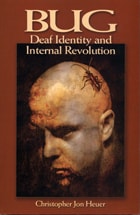
BUG
Deaf Identity and Internal RevolutionChristopher Jon Heuer
Gallaudet University Press, 2007
“What you have in your hands is a bomb. But it is the kind you need to hold on to for dear life, not run away from.”
—From the Foreword, John Lee Clark
Christopher Jon Heuer lost his hearing early, but not before “being able to hear a lot as a kid.” He also received a good education, both in a speech-oriented setting and a signing environment. These varied experiences provided him with the perfect background to write about biases he faced, not only those of a mostly oblivious hearing society, but also those of ideologically restrictive members of the Deaf community. BUG: Deaf Identity and Internal Revolution combines new work of Heuer’s with his best columns from The Tactile Mind Weekly and the National Association of the Deaf’s Mind Over Matter. He addresses all topics – exit interviews, baldness, faith healing, marriage, cats, Christmas trips, backyard campfires in boxer shorts – with a withering wit that spares no aspect of life and deafness.
Being “bugged” for Heuer began early: “When I was growing up, my mother’s response to every problem I had was: ‘Well, he just needs to adjust to his deafness.’ Bloody nose? ‘Chris, you need to adjust to your deafness.’ Homework not done? ‘I know it’s hard adjusting to your deafness, honey, but ....’ Acne scarring? ‘Lots of teenagers get zits, Chris. I know it’s hard for you, dealing with this while trying to adjust to your ....’” He rebelled then, and continues through his even-handed irreverence in BUG, a bomb that should go off in everyone’s consciousness about being deaf and Deaf.
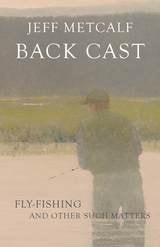
Back Cast
Fly-Fishing and Other Such MattersJeff Metcalf
University of Utah Press, 2018
These essays are much more than fish stories; they reveal the community and communion of fishing and the bonds to place the author nurtured through it. Whether he recalls carousing and tale-swapping with friends or excellence found through the challenge of the cast, Metcalf’s words, sometimes roiling and turbulent, sometimes calm and reflective, like a western river, vividly convey the pull of the steelhead and the fight for survival. Whether or not you fish, Metcalf’s sharp-eyed, open and honest look at life will draw you in.
"These waters have been my home, and I fish them more than most. In truth, they have saved my life on more than a few occasions. I seek refuge in the quiet solitude of rivers, and in dark hours of my life—including this particular year—I need desperately to be fly-fishing." —From the book
Backcountry
Contemporary Writing in West VirginiaIRENE MCKINNEY
West Virginia University Press, 2002
This is as closely-knit an anthology as you are ever likely to see. It is as though a large, extended family were drawing on the same store of family stories, jokes, symbols, landscapes, animals, trees, language, and vernacular. How many snakes are in this book? How many foxes, possums? Fossils? And how very many coal mines? But it is not merely local references that unites these writers. There is a larger vision that ties these works together.
"The connection is not so much in mutual influence, though there is some of that, but in each writer’s total immersion in place. Even those writers who no longer live in the state remember the feel, the physical texture, the overwhelming and enfolding vegetal surround of the place." Editor, Irene McKinney

Bad Objects
Essays Popular and UnpopularNaomi Schor
Duke University Press, 1995
Written in a distinctive personal and self-reflective mode, this collection offers new unpublished work and brings together for the first time some of Schor’s best-known and most influential essays. These engagements with Anglo-American feminist theory, Freud and psychoanalytic theory, French poststructuralists such as Barthes, Foucault, and Irigaray, and French fiction by or about women—especially of the nineteenth century—also address such issues as bilingual identity, professional controversies, female fetishism, and literature and gender. Schor then concludes with a provocative meditation on the future of feminism.
As they read Bad Objects, Anglo-American theoreticians who have been mainly preoccupied with French feminism will find themselves drawn into French literary and cultural history, while French literary critics and historians will be placed in contact with feminist debate.
Bakhtin
Essays and Dialogues on His WorkEdited by Gary Saul Morson
University of Chicago Press, 1986
A groundbreaking collection of essays on the influential critic and philosopher
Mikhail Bakhtin (1895-1975) was a Russian philosopher and literary critic whose influence on a wide range of intellectual fields has only grown since his death, with his emphasis on dialogue and suspicion of systems having particularly resonance in literary studies and linguistics. This collection of essays, all originally published in the the journal Critical Inquiry, explores his literary and linguistic theory and its implications for theory in general and critical practice.
In addition to the critical essays, this book includes previously untranslated excerpts from Bakhtin's essays and notebooks.

Baltimore Sports
Stories from Charm CityDaniel A. Nathan
University of Arkansas Press, 2016
To read a sample chapter, visit www.uapress.com.
Baltimore is the birthplace of Francis Scott Key’s “The Star-Spangled Banner,” the incomparable Babe Ruth, and the gold medalist Michael Phelps. It’s a one-of-a-kind town with singular stories, well-publicized challenges, and also a rich sporting history. Baltimore Sports: Stories from Charm City chronicles the many ways that sports are an integral part of Baltimore’s history and identity and part of what makes the city unique, interesting, and, for some people, loveable.
Wide ranging and eclectic, the essays included here cover not only the Orioles and the Ravens, but also lesser-known Baltimore athletes and teams. Toots Barger, known as the “Queen of the Duckpins,” makes an appearance. So do the Dunbar Poets, considered by some to be the greatest high-school basketball team ever.
Bringing together the work of both historians and journalists, including Michael Olesker, former Baltimore Sun columnist, and Rafael Alvarez, who was named Baltimore’s Best Writer by Baltimore Magazine in 2014, Baltimore Sports illuminates Charm City through this fascinating exploration of its teams, fans, and athletes.
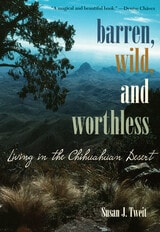
Barren, Wild, and Worthless
Living in the Chihuahuan DesertSusan J. Tweit
University of Arizona Press, 2003
Basques of the American West
New and Collected Essays on History and EthnicityRichard W. Etulain
University of Nevada Press, 2026
This collection offers readers a thoughtful and engaging look at the enduring presence and influence of Basques across the cultural and historical landscape of the American West.
Battles and Leaders of the Civil War, Volume 5
Edited by Peter Cozzens
University of Illinois Press, 2001
Indispensable must-reads for all Civil War buffs and historians, bringing together little-known and never before gathered first-hand accounts, articles, maps, and illustrations
The first four volumes of Battles and Leaders of the Civil War, published in the late nineteenth century, became the best-selling and most frequently cited works ever published on the Civil War. Volume 5, assembled by the acclaimed military historian Peter Cozzens, carries on the tradition of its namesake, offering a dazzling new collection of fresh material written by military and civilian leaders, North and South, on a broad array of war-related topics. Featured articles include General Grant on the second battle of Bull Run, General Beauregard on the Shiloh campaign, General Sherman on the conference at City Point, Joshua Chamberlain on the Fredericksburg campaign, and many more. Also presented are dozens of maps and more than one hundred illustrations.
Battles and Leaders of the Civil War, Volume 6
Edited by Peter Cozzens
University of Illinois Press, 2001
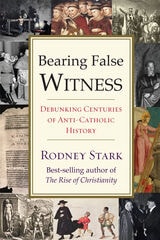
Bearing False Witness
Debunking Centuries of Anti-Catholic HistoryRodney Stark
Templeton Press, 2016
As we all know and as many of our well-established textbooks have argued for decades, the Inquisition was one of the most frightening and bloody chapters in Western history; Pope Pius XII was anti-Semitic and rightfully called “Hitler’s Pope,” the Dark Ages were stunting the progress of knowledge to be redeemed only by the secular spirit of the Enlightenment. The religious Crusades were an early example of the rapacious Western thirst for riches and power. But what if these long held beliefs were all wrong?
In this stunning, powerful, and ultimately persuasive book, Rodney Stark, one of the most highly regarded sociologists of religion and bestselling author of The Rise of Christianity (HarperSanFrancisco 1997), argues that some of our most firmly held ideas about history, ideas that paint the Catholic Church in the least favorable light are, in fact, fiction. Why have we held these wrongheaded ideas so firmly and for so long? And if our beliefs are wrong, what is the truth?
In each chapter, Stark takes on a well-established anti-Catholic myth, gives a fascinating history of how each myth became conventional wisdom and presents a startling picture of the real truth. For example, instead of the Spanish Inquisition being an anomaly of torture and murder of innocent people persecuted for “imaginary” crimes such as witchcraft and blasphemy, Stark argues that not only did the Spanish Inquisition spill very little blood, but it was a major force in support of moderation and justice.
Stark dispels the myth of Pope Pius XII being apathetic or even helpful to the Nazi movement, such as to merit the title “Hitler’s Pope,” and instead shows that the campaign to link Pope Pius XII to Hitler was initiated by the Soviet Union, presumably in hopes of neutralizing the Vatican in post-World War II affairs. Many praised Pope Pius XIIs vigorous and devoted efforts to saving Jewish lives during the war.
Instead of understanding the Dark Ages as a millennium of ignorance and backwardness inspired by the Catholic Church’s power, Stark argues that the whole notion of the “Dark Ages” was an act of pride perpetuated by anti-religious intellectuals who were determined to claim that theirs was the era of “Enlightenment.”
In the end, readers of Bearing False Witness will have a more accurate history of the Catholic Church and will also understand why it became unfairly maligned for so long. Bearing False Witness is a compelling and sobering account of how egotism and ideology often work together to give us a false truth.
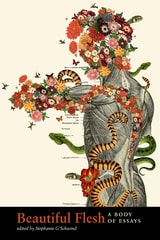
Beautiful Flesh
A Body of EssaysStephanie G'Schwind
University Press of Colorado, 2017
Selected from the country’s leading literary journals and publications—Colorado Review, Creative Nonfiction, Georgia Review, Prairie Schooner, Crazyhorse, The Normal School, and others—Beautiful Flesh gathers eighteen essays on the body, essentially building a multi-gender, multi-ethnic body out of essays, each concerning a different part of the body: belly, brain, bones, blood, ears, eyes, hair, hands, heart, lungs, nose, ovaries, pancreas, sinuses, skin, spine, teeth, and vas deferens. The title is drawn from Wendy Call’s essay “Beautiful Flesh,” a meditation on the pancreas: “gorgeously ugly, hideously beautiful: crimson globes embedded in a pinkish-tan oval, all nestled on a bed of cabbage-olive green, spun through with gossamer gold.”
Other essays include Dinty W. Moore’s “The Aquatic Ape,” in which the author explores the curious design and necessity of sinuses; Katherine E. Standefer’s “Shock to the Heart, Or: A Primer on the Practical Applications of Electricity,” a modular essay about the author’s internal cardiac defibrillator and the nature of electricity; Matt Roberts’s “Vasectomy Instruction 7,” in which the author considers the various reasons for and implications of surgically severing and sealing the vas deferens; and Peggy Shinner’s “Elective,” which examines the author’s own experience with rhinoplasty and cultural considerations of the “Jewish nose.” Echoing the myriad shapes, sizes, abilities, and types of the human body, these essays showcase the many forms of the genre: personal, memoir, lyric, braided, and so on.
Contributors: Amy Butcher, Wendy Call, Steven Church, Sarah Rose Etter, Matthew Ferrence, Hester Kaplan, Sarah K. Lenz, Lupe Linares, Jody Mace, Dinty W. Moore, Angela Pelster, Matt Roberts, Peggy Shinner, Samantha Simpson, Floyd Skloot, Danielle R. Spencer, Katherine E. Standefer, Kaitlyn Teer, Sarah Viren, Vicki Weiqi Yang
Beautiful Losers
Essays on the Failure of American ConservatismSamuel Francis
University of Missouri Press, 1994
The 1992 presidential election campaign showed just how deep were the divisions within the Republican party. In Beautiful Losers, Samuel Francis argues that the victory of the Democratic party marks not only the end of the Reagan-Bush era, but the failure of the American conservatism.
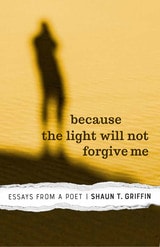
Because the Light Will Not Forgive Me
Essays from a PoetShaun T, Griffin
University of Nevada Press, 2019
In this luminous and moving book of essays, award-winning author Shaun Griffin weaves together a poetic meditation on living meaningfully in this world. Anchored in the American West but reaching well beyond, he recounts his discoveries as a poet and devoted reader of poetry, a teacher of the disadvantaged, a friend of poets and artists, and a responsible member of the human family.
Always grounded in place, be it Nevada, South Africa, North Dakota, Spain, Zimbabwe, or Mexico, Griffin confronts the world with an openness that allows him to learn and grow from the people he meets. This is a meditation on how all of us can confront our own influences to achieve wholeness in our lives. Along with Griffin, readers will reflect on how they might respond to a homeless man walking through central Nevada, viewing the open desert as Thoreau might have viewed Walden, seeing the US-Mexico border as a region of lost identity, reconciling how poets who live west of the Hudson River find anonymity to be their laurel, and experiencing how writing poetry in prison becomes lifesaving.
Whether poets or places in the West or beyond, experiences with other cultures, or an acute awareness that poetry is the refuge of redress—all have influenced Griffin’s writing and thinking as a poet and activist in the Great Basin. The mindfulness of Because the Light Will Not Forgive Me demonstrates that even though the light does not forgive, it still reveals.
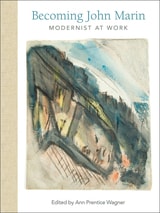
Becoming John Marin
Modernist at WorkAnn Prentice Wagner
University of Arkansas Press, 2018
John Marin was a major figure among the cutting-edge circle of American modernist artists who showed his work in Alfred Stieglitz’s New York galleries from 1909 until 1950. A new collection of the artist’s work at the Arkansas Arts Center, given by Marin’s daughter-in-law, forms the basis of this first book of essays and images to concentrate on Marin’s drawings in the context of Marin’s life, his watercolors, and his etchings.
We follow Marin to his most famous subject matter: New York City and the coast of Maine. Foundational drawings and an unfinished watercolor of the towering Woolworth Building, still under construction when they were made in 1912, begin the story of a renowned group of watercolors first exhibited in 1913 at Alfred Stieglitz’s 291 Gallery and then at the ground-breaking 1913 Armory Show. Other images take us to lesser-known locales, such as the Ramapo Mountains in New York and New Jersey where Marin often painted when he couldn’t get to Maine. More obscure aspects of the artist’s career explored in this collection include portraits of friends and family, charming drawings of animals, and circus scenes.
Becoming John Marin invites readers to look over this important artist’s shoulder as he created and honed the sketches he would interpret into completed watercolors and etchings, illustrating the evolution of his style and methods as he transformed from intuitive draftsman to innovative modernist watercolorist and etcher.
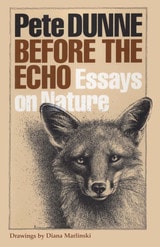
Before the Echo
Essays on NatureBy Pete Dunne
University of Texas Press, 1995
"The natural world is a lot like a game of musical chairs," observes Pete Dunne. "Everywhere you turn, everywhere you go, there are places where living things sit down, niches that support their specific needs. But just as in musical chairs, there aren't enough places to go around. Our species keeps removing them—forcing other creatures to leave the game."
In these twenty-nine essays, one of America's top nature writers trains his sights on the beauties and the vulnerabilities of the natural world. Writing to infuse others with a sense of the richness and diversity that nature holds, Pete Dunne ranges over topics from the wonder of the year's first snowfall to the lost art of stargazing to the mysterious forces that impel people to hunt—and not to hunt. Running like a thread through all the essays is Dunne's desire to preserve all that is "natural" in nature, to stop our unthinking destruction of wild places and wild creatures before we humans find ourselves with "the last chair, in an empty room" on an impoverished earth.
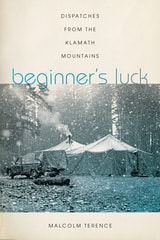
Beginner's Luck
Dispatches from the Klamath MountainsMalcolm Terence
Oregon State University Press, 2018
In the late 1960s, Malcolm Terence left his job as a reporter for the Los Angeles Times to look for adventure and may have found more than he bargained for. The era had triggered unprecedented social and political changes in America, tectonic shifts that challenged war and the social order that oppressed people along lines of class, gender, and race. One branch was a back-to-the-land movement, and Terence, who had just traveled for a year managing a rock band, strayed into Black Bear Ranch, a commune just starting in a remote corner of the Klamath Mountains near the California-Oregon border.
Black Bear Ranch still exists, but many of its early residents eventually returned to urban civilization. A few, Terence among them, stayed on in neighboring river towns. Some tried logging, others gold mining, and some tried growing marijuana, all with mixed success. The local mining and timber communities had a checkered opinion of their new hippie neighbors, as did the Native tribes, but it was the kind of place where people helped each other out, even if they didn’t always agree.
When wildfires grew large, Terence and other veterans of the commune joined the fire crews run by the US Forest Service. In between, the Black Bear expats built homesteads, planted gardens, delivered babies, and raised their children. They gradually overcame the skepticism of the locals and joined them in political battles against the use of herbicides in the forest and the Forest Service’s campaign to close all the mining claims. As in the best of organizing efforts, the organizers learned as much as they led.
Beginner’s Luck will appeal to anyone who experienced life on a commune in the 1960s–1970s or who wants to learn about this chapter in modern American history. Terence offers insight into environmental activism and the long history of conflict between resource exploitation and Native American rights without lecturing or pontificating. With wit, humor, and humility, his anecdotal essays chronicle a time and place where disparate people came together to form an unlikely community.
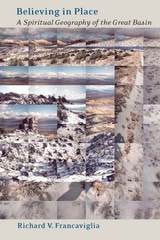
Believing In Place
A Spiritual Geography Of The Great BasinRichard V. Francaviglia
University of Nevada Press, 2016
The austere landscape of the Great Basin has inspired diverse responses from the people who have moved through or settled in it. Author Richard V. Francaviglia is interested in the connection between environment and spirituality in the Great Basin, for here, he says, "faith and landscape conspire to resurrect old myths and create new ones." As a geographer, Francaviglia knows that place means more than physical space. Human perceptions and interpretations are what give place its meaning. In Believing in Place, he examines the varying human perceptions of and relationships with the Great Basin landscape, from the region's Native American groups to contemporary tourists and politicians, to determine the spiritual issues that have shaped our connections with this place. In doing so, he considers the creation and flood myths of several cultures, the impact of the Judeo-Christian tradition and individualism, Native American animism and shamanist traditions, the Mormon landscape, the spiritual dimensions of gambling, the religious foundations of Cold War ideology, stories of UFOs and alien presence, and the convergence of science and spirituality.
Believing in Place is a profound and totally engaging reflection on the ways that human needs and spiritual traditions can shape our perceptions of the land. That the Great Basin has inspired such a complex variety of responses is partly due to its enigmatic vastness and isolation, partly to the remarkable range of peoples who have found themselves in the region. Using not only the materials of traditional geography but folklore, anthropology, Native American and Euro-American religion, contemporary politics, and New Age philosophies, Francaviglia has produced a fascinating and timely investigation of the role of human conceptions of place in that space we call the Great Basin.
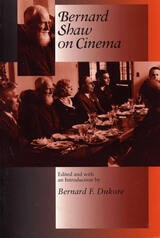
Bernard Shaw on Cinema
Edited by Bernard F. Dukore
Southern Illinois University Press, 1997
With his customary wit and quite often with remarkable prescience, Bernard Shaw maintained a dialogue on cinema that ran almost from the infancy of the industry in 1908 until his death in 1950. Bernard F. Dukore presents the first collection of Bernard Shaw’s writings and oral statements about cinema. Of the more than one hundred comments Dukore has selected, fifty-nine—more than half—are new to today’s readers. Twelve are previously unpublished, one is published in full for the first time, and forty-six appear in a collected edition of Shaw’s writings for the first time since their publication in newspapers and magazines.
Very early in the life of cinema, Shaw perceived that as an invention, movies would be more momentous than the printing press because they appealed to the illiterate as well as the literate, to the manual laborer at the end of an exhausting day as well as to the person with more leisure. He predicted that cinema would form people’s minds and shape their conduct. He recognized that cinema’s "colossal proportions make mediocrity compulsory" by leveling art and life down to the blandest morality and to the lowest common denominator of potential audiences throughout the world.
By 1908, Shaw was familiar with experiments synchronizing movies and sound. When talkies arrived, he discerned that they would precipitate major changes in acting, writing, and economics. He also saw how they would affect live theatre: "The theatre may survive as a place where people are taught to act," he said in 1930, "but apart from that there will be nothing but ‘talkies’ soon." At that time, few people in the theatrical profession were making such prophecies, at least not in public.
Betrayal U
The Politics of Belonging in Higher EducationEdited by Rebecca G. Martínez and Monica J. Casper
University of Arizona Press, 2025
Betrayal U intervenes in this context with a diverse, rich collection of essays, art, poetry, and research that explores these inequities through the lens of institutional betrayal, theorized by psychologist Jennifer Freyd. Edited by Rebecca G. Martínez and Monica J. Casper, this collection brings together thirty-six contributors who share personal experiences covering a range of topics in higher education. The work spans five thematic sections that examine the complexities of belonging and exclusion in academic settings.
The contributors share their lived experiences of academic life from diverse vantage points, showing the ways minoritized groups are made to feel unwelcome, further marginalized, and often positioned as the problem. Exhibiting courage, compassion, and a commitment to better futures, the voices in this collection offer both a searing indictment of higher education and pathways to alternative practices and structures. They shine a spotlight on academia today, including the promise of inclusion and the perils of exclusion.
Contributors
Celeste Atkins
Jasmine Banks
Krista L. Benson
Jessica Bishop-Royse
Samit Dipon Bordoloi
Monica J. Casper
Aparajita De
Kathy Diehl
Taylor Marie Doherty
Reshmi Dutt-Ballerstadt
Alma Flores
Alanna Gillis
C. Goldberg
Jennifer M. Gómez
Kristina Gupta
Jasmine L. Harris
Susan Hillock
Doreen Hsu
Jennifer Lai
Amy Andrea Martinez
Rebecca G. Martínez
Shantel Martinez
Sara A. Mata
Rachael McCollum
Wang Ping
Emily Rosser
Angélica Ruvalcaba
Brandy L. Simula
Rashna Batliwala Singh
Cierra Raine Sorin
Connor Spencer
Chantelle Spicer
James M. Thomas
Mercedes Valadez
Meg A. Warren
Matthew Wills
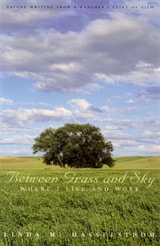
Between Grass And Sky
Where I Live And WorkLinda M. Hasselstrom
University of Nevada Press, 2005
An important collection of personal essays from one of the most widely published American environmental writers addresses the effects of ranching on the environment. Acclaimed nature writer Linda M. Hasselstrom sees herself as a rancher who writes—a definition that shapes the tone and content of her writing. Now owner of the South Dakota cattle ranch where she grew up, Hasselstrom lives in intimate contact with the natural world. "Nature is to me both home and office. Nature is my boss, manager of the branch office—or ranch office—where I toil to convert native grass into meat. . . . If I want to keep my job as well as my home, I pay attention not only to Nature's orders, but to her moods and whims." She writes knowingly of the rancher's toil and of the intelligence and dignity of the wild and domesticated creatures that share the prairie grassland she calls home. As one who knows and loves the land, Hasselstrom appreciates the concerns of environmental activists and understands that responsible ranchers can play a role in nurturing a healthy rural ecosystem. Rich in detail, humor, and pathos, these essays offer wry commentary on the scope of human folly and the even greater human potential for community and empathy. "Only people who live in the country," she writes, "could form a relationship with nature so intimate that they feel concern for one lonely duck. People who live in cities . . . only glimpse nature from high windows or speeding vehicles. Even wilderness lovers who probe deeply are only passing through. We who live on the land truly live within the land, each of our lives only one among the other inhabitants of the place." These are essays to read with wonder and delight, to relish and ponder. Available in hardcover and paperback.
Between Our Legs
Silence-Breaking Personal Narratives on Gynecological HealthJustine Payton
University of Iowa Press, 2026
In a world where even saying the word “vagina” can feel taboo, Between Our Legs breaks the silence surrounding gynecological health. Featuring essays by award-winning authors Nina de Gramont, Nafissa Thompson-Spires, and Jessica Hendry Nelson, as well as by practicing medical experts, this collection explores topics ranging from childbirth, menopause, abortion, endometriosis, and PMOS to yeast and urinary tract infections, while contending with the shame, frustrations, and stigmas that women, nonbinary, and trans individuals navigate when searching for basic care.
Between Our Legs serves as a catalyst for difficult conversations. It illustrates the necessity of not just having access to basic gynecological care, but good, equitable, patient-centered care. Care that sees the patient as a whole person, not solely as someone capable of making a baby. As reproductive rights and maternal healthcare are stripped away in state after state, it’s urgent that our voices be heard, elevated, and addressed. The consequences for not doing so can be fatal.
Between Us
Healing Ourselves and Changing the World Through SociologyEdited by Marika Lindholm and Elizabeth Anne Wood
University of Chicago Press, 2024
The world is a tough place right now. Climate change, income inequality, racist violence, and the erosion of democracy have exposed the vulnerability of our individual and collective futures. But as the sociologists gathered here by Marika Lindholm and Elizabeth Wood show, no matter how helpless we might feel, it’s vital that we discover new paths toward healing and change. The short, accessible, emotionally and intellectually powerful essays in Between Us offer a transformative new way to think about sociology and its ability to fuel personal and social change. These forty-five essays reflect a diverse range of experiences. Whether taking an adult son with autism grocery shopping or fighting fires in Barcelona, contending with sexism at the beach or facing racism at a fertility clinic, celebrating one’s immigrant heritage, or acknowledging one’s KKK ancestors, this book shows students that sociology is deeply rooted in everyday life and can be used to help us process and understand it. A perfect introduction to the discipline and why it matters, Between Us will resonate with students from all backgrounds as they embark on their academic journey.
Between What Was and What Is
EssaysAdriana Páramo
University of Massachusetts Press, 2027
A collection that explores the space between personal loss and collective crisis
The essays in Between What Was and What Is address timely questions of power, identity, history, and resilience. Ranging from intimate personal reflection to global crisis, Adriana Páramo examines the contradictions and tensions that define how we live—and how we make sense of what we’ve lived through.
Grounded in the present moment, Páramo engages directly with current events: the death of Pope Francis and the debates about reform his passing has reopened, and the ongoing devastation of the war in Ukraine. She grapples with the lasting weight of colonial, familial, and national trauma, and with the experience of returning to a homeland that no longer matches memory. These essays enter a broader conversation about the liberation of brown and Latina women—voices frequently pushed to the margins of predominantly white feminist spaces. She asks what drives people to persist in the face of systemic inequality. An encounter with a Kumari Devi in Nepal becomes an occasion to examine faith, ritual, and the assumptions we bring to spiritual experience. Throughout, Páramo moves between the everyday and the sacred to interrogate how culture and identity are lived and inherited.
From personal reflections on age, feminism, and rebuilding after failure to larger examinations of race and systemic oppression, Between What Was and What Is asks readers to engage seriously with difficult realities. It takes stock of what we inherit, what we survive, and what we carry forward.
Beyond Biopolitics
Essays on the Governance of Life and DeathPatricia Ticineto Clough and Craig Willse, eds.
Duke University Press, 2011
Contributors. Ann Anagnost, Una Chung, Patricia Ticineto Clough, Steve Goodman, Sora Y. Han, Stefano Harney, May Joseph, Randy Martin, Brian Massumi, Luciana Parisi, Jasbir Puar, Amit S. Rai, Eugene Thacker, Çağatay Topal, Craig Willse
Beyond Borders
The Selected Essays of Mary AustinRueben J Ellis
Southern Illinois University Press, 1996
Seventeen essays by Mary Hunter Austin (1868–1934), author of the western classic The Land of Little Rain (1903), demonstrate her wide-ranging interests and equally varied writing styles.
Although she was born in Carlinville, Illinois, and graduated from Blackburn College, Mary Austin spent most of her writing career in California, New York, and finally Sante Fe, New Mexico. A well-known, popular, and prolific writer, Austin published thirty-three books and three plays and was closely associated with many important literary figures of her time, including H. G. Wells, George Bernard Shaw, Mabel Dodge Luhan, Jack London, and Willa Cather. Still best known today for her nature writing and southwestern cultural studies, Austin has been increasingly recognized for her work on feminist themes, including the play The Arrow Maker, the nonfiction The Young Woman Citizen, and the novels A Woman of Genius and No. 26 Jayne Street. What has been perhaps an overemphasis on Austin’s nature writing has, since her death, eclipsed the fact that Austin was known during her lifetime as a colorful, eccentric, and controversial person whose direct and outspoken opinions engaged a wide variety of topics.
Beyond Borders demonstrates that variety. In addition to her monographs, Austin also published her short fiction and essays in periodicals. In fact, like many a writer earning a living from her work, Austin wrote prolifically for the magazine market, producing during her career over two hundred individual pieces published in over sixty periodicals. Although a collection of her short fiction appeared in 1987, Austin’s nonfiction periodical work has remained uncollected until now.
In support of Austin’s essays, Reuben J. Ellis provides an introduction that establishes a biographical and historical context for Austin’s work. In addition, each Austin essay is prefaced by brief introductory remarks by the editor. A selected bibliography of Austin’s essays is also included.
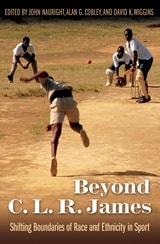
Beyond C. L. R. James
Shifting Boundaries of Race and Ethnicity in SportsJohn Nauright
University of Arkansas Press, 2014
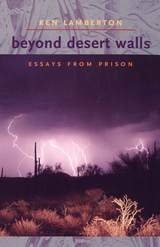
Beyond Desert Walls
Essays from PrisonKen Lamberton
University of Arizona Press, 2005
For some people, even prison cannot shut out the natural world.
A teacher and family man incarcerated in Arizona State Prison—the result of a transgression that would cost him a dozen years of his life—Ken Lamberton can see beyond his desert walls. In essays that focus on the natural history of the region and on his own personal experiences with desert places, the author of the Burroughs Medal-winning book Wilderness and Razor Wire takes readers along as he revisits the Southwest he knew when he was free, and as he makes an inner journey toward self-awareness. Whether considering the seemingly eternal cacti or the desolate beauty of the Pinacate, he draws on sharp powers of observation to re-create what lies beyond his six-by-eight cell and to contemplate the thoughts that haunt his mind as tenaciously as the kissing bugs that haunt his sleep.
Ranging from prehistoric ruins on the Colorado Plateau to the shores of the Sea of Cortez, these writings were begun before Wilderness and Razor Wire and serve as a prequel to it. They seamlessly interweave natural and personal history as Lamberton explores caves, canyons, and dry ponds, evoking the mysteries and rhythms of desert life that elude even the most careful observers. He offers new ways of thinking about how we relate to the natural world, and about the links between those relationships and the ones we forge with other people. With the assurance of a gifted writer, he seeks to make sense of his own place in life, crafting words to come to terms with an insanity of his own making, to look inside himself and understand his passions and flaws.
Whether considering rattlesnakes of the hellish summer desert or the fellow inmates of his own personal hell, Lamberton finds meaningful connections—to his crime and his place, to the people who remained in his life and those who didn’t. But what he reveals in Beyond Desert Walls ultimately arises from language itself: a deep, and perhaps even frightening, understanding of a singular human nature.
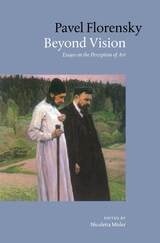
Beyond Vision
Essays on the Perception of ArtPavel Florensky
Reaktion Books, 2004
Pavel Florensky was a true polymath: trained in mathematics and philosophy at Moscow University, he rejected a scholarship in advanced mathematics in order to study theology at the Moscow Theological Academy. He was also an expert linguist, scientist and art historian. A victim of the Soviet government’s animosity towards religion, he was condemned to a Siberian labor camp in 1933 where he continued his work under increasingly difficult circumstances. He was executed in 1937.
Beyond the Classroom
Essays on American AuthorsMerton M. Sealts, Jr.
University of Missouri Press, 1996
Merton M. Sealts, Jr., a long-respected scholar and teacher of Emerson and Melville, has written, "I shall never tire of such writers, nor absorb all that they have to teach." This new collection of Sealts's essays reflects his many years of classroom experience and ongoing scholarship since his retirement in 1982. Most of these essays were originally delivered as public lectures before diverse audiences beyond the classroom; others first appeared in study pamphlets and as chapters of books.
These lucid essays, though varied in subject, have the commonality of an emphasis on teaching. The first essay, entitled "Emerson as Teacher," demonstrates how Emerson "provoked and inspired and educated his students--and his students' students."
In the most recently written essays Sealts deals with four of Emerson's contemporaries--Whitman, Thoreau, Hawthorne, and Melville--who responded variously to Emerson's teachings. A common thread among these four essays is each author's distinctive use of first-person narration.
Teachers of literature at every level will greatly benefit from these highly readable discussions, which illustrate practical strategies for reading and teaching literary works. Included in the appendixes are questions for the study of Melville's Bartleby, Benito Cereno, and Billy Budd, Sailor, which are also treated in individual essays.
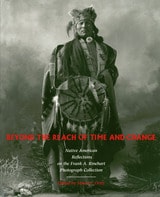
Beyond the Reach of Time and Change
Native American Reflections on the Frank A. Rinehart Photograph CollectionEdited by Simon J. Ortiz
University of Arizona Press, 2004
This book provides an unusual perspective on the Rinehart collection. It features one hundred outstanding images printed from the original negatives made by Rinehart and Muhr at the Congress and over the course of the next two years. It also includes 14 essays by modern Native American writers, artists, and educators—some of them descendants of the individuals photographed—reflecting on the place of these images in their heritage.
Beyond the Reach of Time and Change is not another coffee-table book of historical Indian photographs but rather a conversation between Indian people of a century ago and today. Just as the Rinehart collection offers today's Native Americans a unique connection to the past, this book offers all readers a positive understanding of continuity and endurance within the American Indian community.
Big Digital Humanities
Imagining a Meeting Place for the Humanities and the DigitalPatrik Svensson
University of Michigan Press, 2016
Svensson’s own unique perspective and special stake in the Digital Humanities conversation comes from his role as director of the HUMlab at Umeå University. HUMlab is a unique collaborative space and Digital Humanities center, which officially opened its doors in 2000. According to its own official description, the HUMlab is an open, creative studio environment where “students, researchers, artists, entrepreneurs and international guests come together to engage in dialogue, experiment with technology, take on challenges and move scholarship forward.” It is this last element “moving scholarship forward” that Svensson argues is the real opportunity in what he terms the “big digital humanities,” or digital humanities as practiced in collaborative spaces like the HUMlab, and he is uniquely positioned to take an account of this evolving dimension of Digital Humanities practice.
Big Wonderful
Notes from WyomingKevin Holdsworth
University Press of Colorado, 2006
Growing up in Utah, Holdsworth couldn't wait to move away. Once ensconced on the East Coast, however, he found himself writing westerns and dreaming of the mountains he'd skied and climbed. Fed up with city life, he moved to a small Wyoming town.
In Big Wonderful, he writes of a mountaineering companion's death, the difficult birth of his son, and his father's terminal illness - encounters with mortality that sharpened his ideas about risk, care, and commitment. He puts a new spin on mountaineering literature, telling wild tales from his reunion with the mountains but also relating the surprising willpower it took to turn back from risks he would have taken before he became a father. He found he needed courage to protect and engage deeply with his family, his community, and the wild places he loves.
Holdsworth's essays and poems are rich with anecdotes, characters, and vivid images. Readers will feel as if they themselves watched a bear destroy an entire expedition's food, walked with his great-great-grandmother along the icy Mormon Trail, and tried to plant a garden in Wyoming's infamous wind.
Readers who love the outdoors will enjoy this funny and touching take on settling down and adventuring in the West's most isolated country.
Biographical Passages
Essays on Victorian and Modernist BiographyEdited by Joe Law & Linda K. Hughes
University of Missouri Press, 2000
In the last two decades, biographies have grown in popularity, often eclipsing the novel in sales and accessibility to specialists and the general public alike. Widely regarded as a distinctly modern form, today's biographies are marked by their willingness to "tell all" or to pursue overt political aims. But how new, how unprecedented, are today's biographies? Biographical Passages addresses this important question by juxtaposing Victorian and Modernist biography from diverse perspectives.
Challenging the view that modern biographies are radically different from the straitlaced and ponderous Victorian tomes, Joe Law and Linda K. Hughes illustrate that continuities in biographical practice do exist, proving, for example, that the "tell-all" biography is not the exclusive preserve of the twentieth century. Enlisting the talents of such acclaimed biographers and scholars as P. N. Furbank and Michael Holroyd, Biographical Passages is a true exploration of the art and craft of biography. Essays on the usefulness of biography in approaching late Victorian artists provide a detailed scrutiny of modern biography across disciplines and from a rich array of vantage points. Additional essays on E. M. Forster and the relations between England and India analyze the role of cultural difference in biography.
Law and Hughes conclude Biographical Passages with an epilogue in tribute to a scholar whose work is closely connected to all the essays in this collection—Mary Lago. Widely known for her important contributions to studies of late Victorian and Edwardian literature, art, music, and Anglo-Indian relations, Lago is the author of biographies of Christina Herringham and E. M. Forster.
Biomedicalization
Technoscience, Health, and Illness in the U.S.Adele E. Clarke, Laura Mamo, Jennifer Ruth Fosket, Jennifer R. Fishman, and Janet K. Shim, eds.
Duke University Press, 2010
Contributors. Natalie Boero, Adele E. Clarke, Jennifer R. Fishman, Jennifer Ruth Fosket, Kelly Joyce, Jonathan Kahn, Laura Mamo, Jackie Orr, Elianne Riska, Janet K. Shim, Sara Shostak
Bird-Witched!
How Birds Can Change a LifeBy Marjorie Valentine Adams
University of Texas Press, 2005
Birding can become an addiction. It starts when you hang a bird feeder in the backyard. Then you buy a bird book to identify the birds you see. Then, before you know it, you're keeping a life list and traveling the region, the country, perhaps even the world to catch glimpses of rare birds. Marjorie Adams's birding passion progressed through all these stages and continues today in her tenth decade. In this engaging and informative book, she looks back at her evolution into a full-fledged birder and the concurrent growth of the sport of birding, to which she contributed significantly as a founding member of the American Birding Association, a newspaper columnist on birding, and a teacher and producer of educational wildlife films with her husband and lifelong birding partner, "Red" Adams.
As one who was there from the beginning, Marjorie Adams is uniquely qualified to recount the astonishing rise of birding to a major pastime and recreational industry. She describes the founding of the American Birding Association and profiles its founder, James A. Tucker. She vividly recalls many of her and Red's birding adventures, from southern Canada to Mexico, as well as their encounters with a host of highly regarded birders, including Roger Tory Peterson, Pete Dunne, Victor Emanuel, Charles Hartshorne, and Roy Bedichek. She also explains how her and Red's love for birds led them to become conservation activists and how they produced an award-winning film on the endangered Golden-cheeked Warbler. Offering an important chapter in the story of birding in Texas and the United States, this book establishes Marjorie and Red Adams's rightful place among the leading Texas naturalists of recent decades.
Birding While Indian
A Mixed-Blood MemoirThomas C. Gannon
The Ohio State University Press, 2023
Bjarki, Not Bjarki
On Floorboards, Love, and Irreconcilable DifferencesMatthew J. C. Clark
University of Iowa Press, 2023
These are the words of Bjarki Thor Gunnarsson, the young man who manufactures the widest, purest, most metaphorical pine floorboards on the planet.
As Matthew Clark—a carpenter by trade—begins researching a magazine-style essay about Bjarki and his American Dream Boards, he comes to discover that nothing is quite as it seems. Santa Claus arrives by helicopter. A wedding diamond disappears. A dead coyote jumps to its feet. And then, at a Thai restaurant in central Maine, Bjarki is transformed into an eggplant.
In Bjarki, Not Bjarki, Clark wants nothing less than to understand everything, to make the world a better place, for you and him to love each other, and to be okay. He desires all of this sincerely, desperately even, and at the same time he proceeds with a light heart, playfully, with humor and awe. As Clark reports on the people and processes that transform the forest into your floor, he also ruminates on gift cards, crab rangoon, and Jean Claude Van Damme. He considers North American colonization, masculinity, the definition of disgusting, his own uncertain certainty. When the boards beneath our feet are so unstable, always expanding and cupping and contracting, how can we make sense of the world? What does it mean to know another person and to connect with them, especially in an increasingly polarized America?
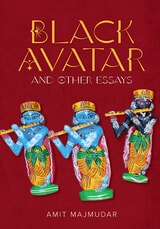
Black Avatar
and Other EssaysAmit Majmudar
Acre Books, 2023
The eight pieces in this deeply engaging volume reflect author Amit Majmudar’s comprehensive studies of American, European, and Indian traditions, as well as his experiences in both suburban Ohio and the western Indian state of Gujarat. The volume begins with the title piece, a fifteen-part examination of “How Colorism Came to India.” Tracing the evolution of India’s bias in favor of light skin, Majmudar reflects on the effects of colonialism, drawing upon sources ranging from early Sanskrit texts to contemporary film and television.
Other essays illuminate subjects both timely and timeless. “The Ramayana and the Birth of Poetry” discusses how suffering is portrayed in art and literature (“The spectrum of suffering: slapstick on one end, scripture on the other, with fiction and poetry . . . in the vastness between them”), while in “Five Famous Asian War Photographs”—a 2018 Best American Essays selection—Majmudar analyzes why these iconic images of atrocity have such emotional resonance. In “Nature/Worship,” another multi-part piece, the author turns his attention to climate change, linking notions of environmentalism to his ancestral tradition of finding divinity within the natural world, connections that form the basis of religious belief.
Perhaps the greatest achievement of these wide-ranging essays is the prose itself—learned yet lively, erudite yet accessible—nimbly revealing the workings of a wonderfully original mind.
Black Paper
Writing in a Dark TimeTeju Cole
University of Chicago Press, 2021
“Darkness is not empty,” writes Teju Cole in Black Paper, a book that meditates on what it means to sustain our humanity—and witness the humanity of others—in a time of darkness. One of the most celebrated essayists of his generation, Cole here plays variations on the essay form, modeling ways to attend to experience—not just to take in but to think critically about what we sense and what we don’t.
Wide-ranging but thematically unified, the essays address ethical questions about what it means to be human and what it means to bear witness, recognizing how our individual present is informed by a collective past. Cole’s writings in Black Paper approach the fractured moment of our history through a constellation of interrelated concerns: confrontation with unsettling art, elegies both public and private, the defense of writing in a time of political upheaval, the role of the color black in the visual arts, the use of shadow in photography, and the links between literature and activism. Throughout, Cole gives us intriguing new ways of thinking about blackness and its numerous connotations. As he describes the carbon-copy process in his epilogue: “Writing on the top white sheet would transfer the carbon from the black paper onto the bottom white sheet. Black transported the meaning.”
Black, White, and in Color
Essays on American Literature and CultureHortense J. Spillers
University of Chicago Press, 2003
Black, White, and in Color offers a long-awaited collection of major essays by Hortense Spillers, one of the most influential and inspiring black critics of the past twenty years. Spanning her work from the early 1980s, in which she pioneered a broadly poststructuralist approach to African American literature, and extending through her turn to cultural studies in the 1990s, these essays display her passionate commitment to reading as a fundamentally political act-one pivotal to rewriting the humanist project.
Spillers is best known for her race-centered revision of psychoanalytic theory and for her subtle account of the relationships between race and gender. She has also given literary criticism some of its most powerful readings of individual authors, represented here in seminal essays on Ralph Ellison, Gwendolyn Brooks, and William Faulkner. Ultimately, the essays collected in Black, White, and in Color all share Spillers's signature style: heady, eclectic, and astonishingly productive of new ideas. Anyone interested in African American culture and literature will want to read them.
Blindness and Insight
Essays in the Rhetoric of Contemporary CriticismPaul De Man
University of Minnesota Press, 1983
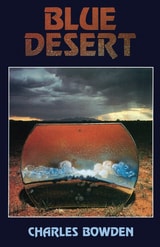
Blue Desert
Charles Bowden
University of Arizona Press, 1986
In Blue Desert, Charles Bowden presents a view of the Southwest that seeks to measure how rapid growth has taken its toll on the land. Writing with a reporter's objectivity and a desert rat's passion, Bowden takes us into the streets as well as the desert to depict not a fragile environment but the unavoidable reality of abuse, exploitation, and human cruelty. Blue Desert shows us the Sunbelt's darker side as it has developed in recent times—where “the land always makes promises of aching beauty and the people always fail the land”—and defies us to ignore it.
Blue Desert has no boundaries, no terrain, no topographical coordinates; it is a state of mind inescapable to one who sees change and knows that nothing can be done to stop it.
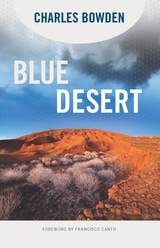
Blue Desert
Charles Bowden; Foreword by Francisco Cantú
University of Arizona Press, 2018
Bowden presents a view of the Southwest that measures how rapid growth takes its toll on the land. Writing with a reporter’s objectivity and a desert rat’s passion, Bowden offers us his trademarked craft and wit to take us into the streets as well as the desert to depict not a fragile environment but the unavoidable reality of abuse, exploitation, and human cruelty. Blue Desert shows us the darker side of development—where “the land always makes promises of aching beauty and the people always fail the land”—and defies us to ignore it.
In a thoughtful new foreword, Francisco Cantú writes, “In Blue Desert, we follow Bowden in the processes of becoming. We see the version of Bowden that he would likely most want us to remember—someone who did their best to be an honest witness, someone who was haunted by modernity and his place in it, someone who grappled with his demons by gazing deeply into the desert.” Blue Desert is a critical piece in the oeuvre of Charles Bowden, and it continues to remind readers of the cruelty and beauty of the world around us.
Blue Notes
Essays, Interviews, and CommentariesYusef Komunyakaa
University of Michigan Press, 2000
As editor Radiclani Clytus makes clear in the volume's introductory essay, although Komunyakaa's poetry has its roots in the stylistic innovations of early twentieth-century American modernists, his writing often reflects his understanding that a "black" experience should not particularize the presentation of one's art. This volume, according to the editor, is an attempt to understand Komunyakaa's critical eclecticism within the context of his own words.
Yusef Komunyakaa's books of poetry include I Apologize for the Eyes in My Head, Magic City, Thieves of Paradise, and Neon Vernacular, for which he received the Pulitzer Prize and the Kingsley Tufts Poetry Award in 1994.
Bodies in Formation
An Ethnography of Anatomy and Surgery EducationRachel Prentice
Duke University Press, 2012
Body and Soul
Essays on PoetryMark Jarman
University of Michigan Press, 2002
The essays "Where Poems Take Place" and "A Shared Humanity" consider the relation between setting or situation and representation. The psychological roots of narrative are considered in "The Primal Storyteller." But the main interest of these essays is how and why narrative is used as a form. The influence of Robinson Jeffers's style of narrative is argued in "Slip, Shift, and Speed Up: The Influence of Robinson Jeffers's Narrative Syntax." In "The Trace of a Story Line" an argument is made that the poets Philip Levine and Charles Wright employ narration or storytelling in their poetry as a mode of meaning. Other essays consider Donald Davie, Philip Larkin, Herbert Lomas, Louis Simpson, Lyn Hejinian, Tess Gallagher, and Ellen Bryant Voigt.
Mark Jarman's poetry has appeared in many publications, including the American Poetry Review and the New Yorker. He has won the Lenore Marshall/Nation Prize of the Academy of American Poets, a Guggenheim fellowship, and multiple grants from the National Endowment for the Arts. He is Professor of English, Vanderbilt University.

Bolivia
Revolution and the Power of History in the PresentJames Dunkerley
University of London Press, 2007

Bond
The Nature of UsJill Sission Quinn
University of Iowa Press, 2027
Bonelight
Ruin And Grace In The New SouthwestMary Sojourner
University of Nevada Press, 2004