Results by title
932 books match the query 'Genres & Styles' and 108 start with b
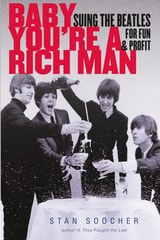
Baby You're a Rich Man
Suing the Beatles for Fun and ProfitStan Soocher
University Press of New England, 2015
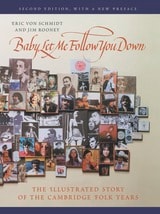
Baby, Let Me Follow You Down
The Illustrated Story of the Cambridge Folk YearsEric von Schmidt
University of Massachusetts Press, 1979
Compiled by two musicians who were active participants in the Cambridge folk scene, the volume documents a special time in United States culture when the honesty and vitality of traditional folk music were combined with the raw power of urban blues and the high energy of electric rock and roll to create a new American popular music.
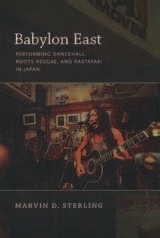
Babylon East
Performing Dancehall, Roots Reggae, and Rastafari in JapanMarvin D. Sterling
Duke University Press, 2010
Sterling provides a nuanced ethnographic analysis of the ways that many Japanese involved in reggae as musicians and dancers, and those deeply engaged with Rastafari as a spiritual practice, seek to reimagine their lives through Jamaican culture. He considers Japanese performances and representations of Jamaican culture in clubs, competitions, and festivals; on websites; and in song lyrics, music videos, reggae magazines, travel writing, and fiction. He illuminates issues of race, ethnicity, gender, sexuality, and class as he discusses topics ranging from the cultural capital that Japanese dancehall artists amass by immersing themselves in dancehall culture in Jamaica, New York, and England, to the use of Rastafari as a means of critiquing class difference, consumerism, and the colonial pasts of the West and Japan. Encompassing the reactions of Jamaica’s artists to Japanese appropriations of Jamaican culture, as well as the relative positions of Jamaica and Japan in the world economy, Babylon East is a rare ethnographic account of Afro-Asian cultural exchange and global discourses of blackness beyond the African diaspora.
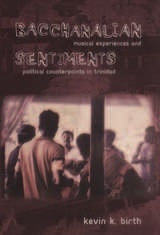
Bacchanalian Sentiments
Musical Experiences and Political Counterpoints in TrinidadKevin K. Birth
Duke University Press, 2008
Birth draws on fieldwork he conducted in one of Trinidad’s ethnically diverse rural villages to explore the relationship between music and social and political consciousness on the island. He describes how Trinidadians use the affective power of music and the physiological experience of performance to express and work through issues related to identity, ethnicity, and politics. He looks at how the performers and audience members relate to different musical traditions. Turning explicitly to politics, Birth recounts how Trinidadians used music as a means of making sense of the attempted coup d’état in 1990 and the 1995 parliamentary election, which resulted in a tie between the two major political parties. Bacchanalian Sentiments is an innovative ethnographic analysis of the significance of music, and particular musical forms, in the everyday lives of rural Trinidadians.
Bach Perspectives, Volume 1
Edited by Russel Stinson
University of Illinois Press, 2025
In Volume One, Bach scholar Russell Stinson edits essays from Stephen A. Crist, Michael Marissen, David Schulenberg, and other experts. Topics range from issues of composition and improvisation to works like the Orgelbüchlein and the First Brandenburg Concerto.
Contributors: James A. Brokaw II, Eric T. Chafe, Stephen A. Crist, Michael Marissen, David Schulenberg, and Russell Stinson

Bach Perspectives, Volume 10
Bach and the OrganMatthew Dirst
University of Illinois Press, 2016

Bach Perspectives, Volume 11
J. S. Bach and His SonsEdited by Mary Oleskiewicz
University of Illinois Press, 2017
Robert L. Marshall traces how each of the sons grappled with—and at times suffocated beneath—their illustrious father’s legacy. Mary Oleskiewicz’s essay investigates the Bach family’s connections to historical keyboard instruments and musical venues at the Prussian court, while David Schulenberg looks at Carl Philipp Emanuel Bach’s diverse and innovative keyboard works. Evan Cortens digs into everything from performance materials to pay stubs to offer a detailed view of the business of Carl Philipp Emanuel Bach’s liturgical music. Finally, Christine Blanken discusses how the rediscovery of Bach family musical manuscripts in the Breitkopf archive opens up new perspectives on familiar topics.
A supplemental companion website is now available for Bach Perspectives 11. This resource features additional images, captions, and short descriptions to provide an essential supplement to the printed text.
Bach Perspectives, Volume 12
Bach and the Counterpoint of ReligionEdited by Robin A. Leaver
University of Illinois Press, 2018
Bach Perspectives, Volume 13
Bach ReworkedEdited by Laura Buch
University of Illinois Press, 2020
An insightful look at how composers build on each other's work, Bach Reworked reveals how nuanced understandings of parody procedures can fuel both musical innovation and historically informed performance.
Contributors: Stephen A. Crist, Ellen Exner, Moira Leanne Hill, Erinn E. Knyt, and Markus Zepf
Bach Perspectives, Volume 14
Bach and Mozart: Connections, Patterns, and PathwaysEdited by Paul Corneilson
University of Illinois Press, 2022
An official publication of the American Bach Society, Bach Perspectives, Volume 14 draws on a variety of approaches and a broad range of subject matter in presenting a new wave of innovative classical musical scholarship.
Contributors: Eleanor Selfridge-Field, Yoel Greenberg, Noelle M. Heber, Michael Maul, Stephen Roe, and David Schulenberg
Bach Perspectives, Volume 2
J. S. Bach, the Breitkopfs, and Eighteenth-Century Music TradeEdited by George B. Stauffer
University of Illinois Press, 2025
Launched in 1995, Bach Perspectives has become the premier English-language serial book series dedicated to cutting-edge Bach scholarship. The University of Illinois Press now offers the first four volumes in open access editions available for free to all interested readers.
From 1727 to 1787, the Bach and the Breitkopf families enjoyed close professional ties forged by the growing trade between music composers and music printers. The second volume of Bach Perspectives examines the inventive and far-flung activities of the Breitkopf firm from the vantage point of its commerce with J. S. Bach and his relatives.
Contributors: Gregory G. Butler, Robert M. Cammarota, Peggy Daub, Andreas Glöckner, George R. Hill, Yoshitake Kobayashi, Ortrun Landmann, Ernest May, Hans-Joachim Schulze, George B. Stauffer, and Neal Zaslaw
Bach Perspectives, Volume 3
Creative Responses to Bach, from Mozart to HindemithEdited by Michael Marissen.
University of Illinois Press, 2025
Launched in 1995, Bach Perspectives has become the premier English-language serial book series dedicated to cutting-edge Bach scholarship. The University of Illinois Press now offers the first four volumes in open access editions available for free to all interested readers.
The third volume of the acclaimed series features a roster of scholars analyzing the crucial influence of J. S. Bach’s music upon compositions by Mozart, Beethoven, Brahms, Hindemith, and others. Throughout, the contributors highlight Bach’s subtle presence in the history of composition and illuminate the intertwined works of Bach and his successors.
Contributors: Thomas Christensen, Ludwig Finscher, Walter Frisch, Stephen Hinton, William Kinderman, and Robert L. Marshall

Bach Perspectives, Volume 4
The Music of J. S. Bach: Analysis and InterpretationEdited by David Schulenberg
University of Illinois Press, 2025
Launched in 1995, Bach Perspectives has become the premier English-language serial book series dedicated to cutting-edge Bach scholarship. The University of Illinois Press now offers the first four volumes in open access editions available for free to all interested readers.
The fourth volume of Bach Perspectives analyzes J. S. Bach’s orchestral works, especially his concertos, and the interpretation and performance of his music in general. The diverse contributors come from the fields of performance, organology, music theory, and music history, and their expertise across multiple areas provides an interdisciplinary perspective to their chapters.
Contributors: Gregory G. Butler, John Butt, John Koster, Alfred Mann, Mary Oleskiewicz, William Renwick, David Schulenberg, Jeanne Swack, and Paul Walker
Bach Perspectives, Volume 5
Bach in AmericaEdited by Stephen A. Crist
University of Illinois Press, 2002
More than a century passed after Johann Sebastian Bach's death in 1750 before his music found an audience in the United States. Volume Five in the Bach Perspectives series tracks the composer's reputation in America from obscure artist to a cultural mainstay whose music has spread to all parts of the country.
Barbara Owen surveys Bach's early reception in America. Matthew Dirst focuses on John Sullivan Dwight's role in advocating Bach's work. Michael Broyles considers Bach's early impact in Boston while Mary J. Greer offers a counterpoint in her study of Bach's reception in New York. Hans-Joachim Schulze's essay links the American descendants of August Reinhold Bach to the composer. Christoph Wolff also focuses on Bach's descendants in America, particularly Friederica Sophia Bach, the daughter of Bach's eldest son. Peter Wollny evaluates manuscripts not included in Gerhard Herz's study of Bach Sources in America. The volume concludes with Carol K. Baron's comparison of Bach with Charles Ives while Stephen A. Crist measures Bach's influence on the jazz icon Dave Brubeck.
Bach Perspectives, Volume 6
J. S. Bach's Concerted Ensemble Music, The OuvertureEdited by Gregory Butler
University of Illinois Press, 2005
The sixth volume in the Bach Perspectives series opens with Joshua Rifkin's seminal study of the early source history of the B-minor orchestral suite. Rifkin elaborates on his discovery that the work in its present form for solo flute goes back to an earlier version in A minor, ostensibly for solo violin. He also takes the discovery as the point of departure for a wide-ranging discussion of the origins and extent of Bach's output in the area of concerted ensemble music.
In other essays, Jeanne Swack presents an enlightening comparison of Georg Phillip Telemann's and Bach's approach to the French overture as concerted movements in their church cantatas. Steven Zohn views the B-minor orchestral suite from the standpoint of the "concert en ouverture." In addition, Zohn responds to Rifkin by suggesting Bach may have scored the early version of the B-minor orchestral suite for flute.

Bach Perspectives, Volume 7
J. S. Bach's Concerted Ensemble Music: The ConcertoEdited by Gregory Butler
University of Illinois Press, 2007
Gregory Butler focuses on Bach's Concerto for Harpsichord and Strings in E Major (BWV 1053) as a pastiche created by a process of assemblage of three earlier heterogeneous movements. Pieter Dirksen delves into the source history of the Concerto for Harpsichord and Strings in F Minor (BWV 1056) and concludes it represents a transcription of an earlier violin concerto in G minor. David Schulenberg investigates the generic ambiguity of the concerto in the early eighteenth century and how it diverged from the sonata to become a distinct genre. Completing the volume is Christoph Wolff's examination of the ""Siciliano"" as a slow movement in Bach's concertos and its implications for the source history of his Concerto for Harpsichord and Strings in E Major (BWV 1053).
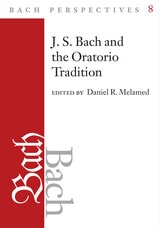
Bach Perspectives, Volume 8
J.S. Bach and the Oratorio TraditionEdited by Daniel R. Melamed
University of Illinois Press, 2011

Bach Perspectives, Volume 9
J.S. Bach and His Contemporaries in GermanyEdited by Andrew Talle
University of Illinois Press, 2013
In this volume, Wolfgang Hirschmann proposes an ethnographic approach that contextualizes Bach's works, addressing the aesthetic paths he took as well as those he did not pursue. Steven Zohn's essay considers Telemann's contribution to the orchestral Ouverture genre, observering how Telemann's approach to integrating the national styles of his time was quite different from, but no less rich than, Bach's. Andrew Talle compares settings and strategies of Vergnügte Ruh, beliebte Seelenlust by Bach and Graupner. Alison Dunlop presents valuable primary research on Muffat, the most commonly cited keyboard music composer in Vienna during Bach's lifetime. Finally, Michael Maul sheds new light on the Scheibe-Birnbaum controversy, contextualizing the most famous critique of J. S. Bach's compositional style by discussing the other composers that Scheibe critiqued.
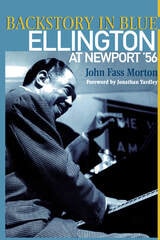
Backstory in Blue
Ellington at Newport '56John Fass Morton
Rutgers University Press, 2008
Certificate of Merit for the 2009 Association for Recorded Sound Collections Award for Excellence in Historical Recorded Sound Research
It may be that the song most baby boomers identify from July 1956 is a simple twelve-bar blues, hyped on national television by a twenty-one-year-old Elvis Presley and his handlers. But it is a very different song, with its elongated fourteen-bar choruses of rhythm and dissonance, played on the night of July 7, 1956, by a fifty-seven-year-old Duke Ellington and his big band that got everybody on their feet and moving as one. More than fifty years later, “Diminuendo and Crescendo in Blue,” recorded at the 1956 Newport Jazz Festival, still makes a profound statement about postwar America—how we got there and where it all went.
Backstory in Blue is a behind-the-scenes look at this epic moment in American cultural history. It is the story of who and what made Ellington’s composition so compelling and how one piece of music reflected the feelings and shaped the sensibilities of the postwar generation. As John Fass Morton explains, it was music expressed as much by those who performed offstage as by those who performed on.
Written from the point of view of the audience, this unique account draws on interviews with fans and music professionals of all kinds who were there and whose lives were touched, and in some cases changed, by the experience. Included are profiles of George Avakian, who recorded and produced Ellington at Newport 1956; Paul Gonsalves, the tenor sax player responsible for the legendary twenty-seven choruses that enabled the rebirth of Ellington’s career; and the “Bedford Blonde,” Elaine Anderson, whose dance ignited both the band and the crowd.
Duke Ellington once remarked, “I was born at Newport.” Here we learn that Newport was much more than the turning point for Ellington’s career. It was the tipping point for a generation and a musical genre.

Ballad Hunting with Max Hunter
Stories of an Ozark Folksong CollectorSarah Jane Nelson; Foreword by Robert Cochran
University of Illinois Press, 2023
Sarah Jane Nelson chronicles Hunter’s song collecting adventures alongside portraits of the singers and mentors he met along the way. The guitar-strumming Hunter picked up the recording habit to expand his repertoire but almost immediately embraced the role of song preservationist. Being a local allowed Hunter to merge his native Ozark earthiness with sharp observational skills to connect--often more than once--with his singers. Hunter’s own ability to be present added to that sense of connection. Despite his painstaking approach, ballad collecting was also a source of pleasure for Hunter. Ultimately, his dedication to capturing Ozarks song culture in its natural state brought Hunter into contact with people like Vance Randolph, Mary Parler, and non-academic folklorists who shared his values.
Ballads Beyond Borders
How the Irish Diaspora Shaped Music in the Nineteenth-Century United StatesSarah Gerk
University of Illinois Press, 2026
Gerk opens by considering the popularity of Thomas Moore’s iconic collection Irish Melodies in relation to the history of British colonization shared by the US and Ireland, arguing that these songs modeled what the music of an Anglo-Celtic republic could sound like. She considers blackface minstrelsy’s complicated relationship with both Irish-American performers and theatrical stereotypes of Irish people, and positions Irish-American performers and audiences as a primary driving force in new musical styles in 1840s sheet music, in which minstrelsy’s resemblances to Anglo-Celtic traditional music disappeared. She examines the legacy of the Great Famine in music of the US Civil War, considering how that music’s role in emotional life offers robust source material for understanding famine memory. She explores the increasingly elaborate sketches in the 1870s and 1880s of the variety duo Harrigan and Hart, highlighting ways in which violent conflict between the Black community and the Irish lies at the very heart of the Mulligan entertainments. Finally, she contextualizes the work of Irish-American tenor Chauncey Olcott, showing how a number of confluent trends—the growing wealth and social status of Irish-American middle classes, the Gaelic revival, new immigration patterns, and the consolidation of the US’s sheet music industry—allowed Olcott to perform an elevated version of Irish-American musical culture, influenced by superficial elements of Italian operatic music.
Band People
Life and Work in Popular MusicFranz Nicolay
University of Texas Press, 2024
A close look at the lives of working musicians who aren’t the center of their stage.
Secret (and not-so-secret) weapons, side-of-the-stagers, rhythm and horn sections, backup singers, accompanists—these and other “band people” are the anonymous but irreplaceable character actors of popular music. Through interviews and incisive cultural critique, writer and musician Franz Nicolay provides a portrait of the musical middle class. Artists talk frankly about their careers and attitudes toward their craft, work environment, and group dynamics, and shed light on how support musicians make sense of the weird combination of friend group, gang, small business consortium, long-term creative collaboration, and chosen family that constitutes a band. Is it more important to be a good hang or a virtuoso player? Do bands work best as democracies or autocracies? How do musicians with children balance their personal and professional lives? How much money is too little? And how does it feel to play on hundreds of records, with none released under your name? In exploring these and other questions, Band People gives voice to those who collaborate to create and dissects what it means to be a laborer in the culture industry.
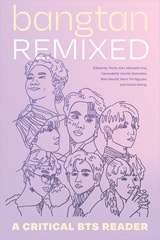
Bangtan Remixed
A Critical BTS ReaderPatty Ahn, Michelle Cho, Vernadette Vicuña Gonzalez, Rani Neutill, Mimi Thi Nguyen, and Yutian Wong, editors
Duke University Press, 2024
Contributors. Andrea Acosta, Patty Ahn, Carolina Alves, Inez Amihan Anderson, Allison Anne Gray Atis, Kaina “Kai” Bernal, Mutlu Binark, Jheanelle Brown, Sophia Cai, Michelle Cho, Mariam Elba, Ameena Fareeda, Vernadette Vicuña Gonzalez, Rosanna Hall, Dal Yong Jin, JIN Youngsun, Despina Kakoudaki, Yuni Kartika, Alptekin Keskin, Rachel Kuo, Marci Kwon, Courtney Lazore, Regina Yung Lee, S. Heijin Lee, Wonseok Lee, Amanda Lovely, Melody Lynch-Kimery, Maria Mison, Noel Sajid I. Murad, Sara Murphy, UyenThi Tran Myhre, Rani Neutill, Johnny Huy Nguyễn, Mimi Thi Nguyen, Karlina Octaviany, Nykeah Parham, Stefania Piccialli, Raymond San Diego, Hannah Ruth L. Sison, Prerna Subramanian, Havannah Tran, Andrew Ty, Gracelynne West, Yutian Wong, Jaclyn Zhou
Banjo Roots and Branches
Edited by Robert B. Winans
University of Illinois Press, 2018
Wide-ranging and illustrated with twenty color images, Banjo Roots and Branches offers a wealth of new information to scholars of African American and folk musics as well as the worldwide community of banjo aficionados.
Contributors: Greg C. Adams, Nick Bamber, Jim Dalton, George R. Gibson, Chuck Levy, Shlomo Pestcoe, Pete Ross, Tony Thomas, Saskia Willaert, and Robert B. Winans.
Bar Yarns and Manic-Depressive Mixtapes
Jim Walsh on Music from Minneapolis to the Outer LimitsJim Walsh
University of Minnesota Press, 2016
Bar Yarns and Manic Depressive Mix Tapes distills thirty delirious, jam-packed years of some of the best music writing ever to come out of the Twin Cities. As a writer and musician, the ever-curious Jim Walsh has lived a life immersed in music, and it all makes its way into his columns and feature articles, interviews and reviews, including personal essays on life, love, music, family, death, and, yes, the manic-depressive highs and lows that come with being an obsessive music lover and listener.
From Minneapolis’s own Prince to such far-flung acts as David Bowie, the Waterboys, Lucinda Williams, Parliament-Funkadelic, L7, the Rolling Stones, the Ramones, U2, Hank Williams, Britney Spears, Elvis Presley and Nirvana, Walsh’s work treats us to a chorus of the voices and sounds that have made the music scene over the past three decades. The big names are here, from Rosanne Cash to Bruce Springsteen to Bob Marley and Jackson Browne, but so are those a little shy of superstardom, like the Tin Star Sisters and Uncle Tupelo, Son Volt, the Gear Daddies, Semisonic, and The Belfast Cowboys.
The book is also a tour (de force) of the Twin Cities' most celebrated music venues past and present, from the Prom Ballroom to Paisley Park to Duffy's. When Walsh isn't celebrating the sheer magic of live music or dreaming to tunes blasting from the car console, he might be surveying the scene with the Hamm's Bear at Grumpy's or the Double Deuce or singing the last night at the Uptown Bar blues. Whether he's dishing dirt with Yoko Ono or digging the Replacements' roots, giving an old rocker a spin or offering a mic to the latest upstart, Jim Walsh reminds us that in the land of a thousand lakes there are a thousand dances, and the music never dies.
Capturing the pure notes and character of the sound of the Twin Cities and beyond, with a keen eye for trends and the telling detail, his book truly is a mix tape of thirty years of unforgettable music.
Barrelhouse Words
A Blues Dialect DictionaryStephen Calt
University of Illinois Press, 2009
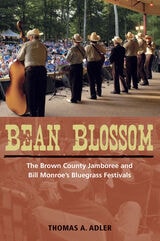
Bean Blossom
The Brown County Jamboree and Bill Monroe's Bluegrass FestivalsThomas A. Adler
University of Illinois Press, 2011

Beautiful Politics of Music
Trova in Yucatán, MexicoGabriela Vargas-Cetina
University of Alabama Press, 2017
An exploration into the history and practice of trova, a genre of music that is the soul of Yucatán.
Yucatecan trova is a music genre comprising a type of romantic song that is considered “the soul of Yucatán and Yucatecans.” This first book on Yucatecan trova offers an insider’s view of the history and practice of a treasured cultural heritage. A central theme of Gabriela Vargas-Cetina’s ethnography is what she refers to as the “beautiful politics of music” practiced by Yucatecan trova patrons and organizations, which is a way of asserting the importance of groups and issues through nonconfrontational means.
Trova emerged on the peninsula at the end of the nineteenth century and continues to be part of the general urban soundscape in the states of Yucatán and Campeche. Until the 1920s, this music was little known outside Yucatán and became absorbed into the larger Latin American Bolero genre, making it difficult to perceive its uniqueness and relation to life in Yucatán.
Vargas-Cetina, a native Yucatecan and trova musician, offers ethnographic insight into the local music scene. With family connections, she embedded herself as a trovadora, and her fieldwork—singing, playing the guitar in a trova group, and extensively researching the genre and talking with fellow enthusiasts and experts—ensued. Trova, like other types of artistic endeavors, is the result of collaboration and social milieu. She describes the dedicated trova clubs, cultural institutions, the Yucatecan economy of agricultural exports, and identity politics that helped the music come about and have maintained it today.
Positioned in the larger context of the music of Mexico and Latin America and engaging with theories of modernity and cosmopolitanism, experimental ethnography, and the anthropology of organizations, Beautiful Politics of Music consists of rigorous scholarship. It is also a warm tribute to performers and songs that have inspired many people around the world for more than two centuries.
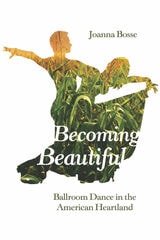
Becoming Beautiful
Ballroom Dance in the American HeartlandJoanna Bosse
University of Illinois Press, 2015
Bosse uses sensitive fieldwork as well as her own immersion in ballroom culture to lead readers into a community that springs up around ballroom dance. The result is a portrait of the real people who connect with others, change themselves, and join a world that foxtrots to its own rules, conventions, and rewards. Bosse's eye for revealing, humorous detail adds warmth and depth to discussions around critical perspectives on the experiences the dance hall provides, the nature of partnership and connection, and the notion of how dancing allows anyone to become beautiful.
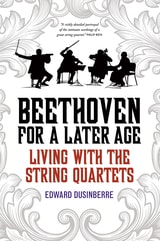
Beethoven for a Later Age
Living with the String QuartetsEdward Dusinberre
University of Chicago Press, 2016
Founded in Hungary in 1975 and now based in Boulder, Colorado, the Takács is one of the world’s preeminent string quartets, and performances of Beethoven have been at the center of their work together for over forty years. Using the history of both the Takács Quartet and the Beethoven quartets as a foundation, Beethoven for a Later Age provides a backstage look at the daily life of a quartet, showing the necessary creative tension between individual and group and how four people can at the same time forge a lasting artistic connection and enjoy making music together over decades. The key, Dusinberre reveals, to a quartet crafting its own sound is in balancing continuity with change and experimentation—a theme that lies at the heart of Beethoven’s remarkable compositions. In an accessible style, suitable for novices and chamber music enthusiasts alike, Dusinberre illuminates the variety and contradictions of Beethoven's quartets, which were composed against the turbulent backdrop of the Napoleonic Wars and their aftermath, and he brings the technical aspects of the music to life.
Beethoven for a Later Age vividly shows that creative engagement with Beethoven’s radical and brilliant quartets continues to be as stimulating now as it was for its first performers and audiences. Musicians and music lovers will be intrigued by Dusinberre’s exploration of the close collaboration at the heart of any great performance.
Beethoven in Beijing
Stories from the Philadelphia Orchestra's Historic Journey to ChinaJennifer Lin
Temple University Press, 2022
In 1973, Western music was banned in the People’s Republic of China. But in a remarkable breakthrough cultural exchange, the Philadelphia Orchestra conducted a tour of closed-off China, becoming the first American orchestra to visit the communist nation. Jennifer Lin’s Beethoven in Beijing provides a fabulous photo-rich oral history of this boundary-breaking series of concerts the orchestra performed under famed conductor Eugene Ormandy.
Lin draws from interviews, personal diaries, and news accounts to give voice to the American and Chinese musicians, diplomats, journalists, and others who participated in and witnessed this historic event. Beethoven in Beijing is filled with glorious images as well as anecdotes ranging from amusing sidewalk Frisbee sessions and acupuncture treatments for sore musicians to a tense encounter involving Madame Mao dictating which symphony was to be played at a concert.
A companion volume to the film of the same name, Beethoven in Beijing shows how this 1973 tour came at the dawn of a resurgence of interest in classical music in China—now a vital source of revenue for touring orchestras.
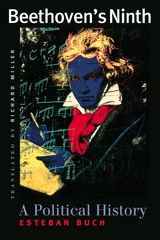
Beethoven's Ninth
A Political HistoryEsteban Buch
University of Chicago Press, 2003
In his remarkable history of one of the most popular symphonic works of the modern period, Buch traces such complex and contradictory uses—and abuses—of Beethoven's Ninth Symphony since its premier in 1824. Buch shows that Beethoven consciously drew on the tradition of European political music, with its mix of sacred and profane, military and religious themes, when he composed his symphony. But while Beethoven obviously had his own political aspirations for the piece—he wanted it to make a statement about ideal power—he could not have had any idea of the antithetical political uses, nationalist and universalist, to which the Ninth Symphony has been put since its creation. Buch shows us how the symphony has been "deployed" throughout nearly two centuries, and in the course of this exploration offers what was described by one French reviewer as "a fundamental examination of the moral value of art." Sensitive and fascinating, this account of the tangled political existence of a symphony is a rare book that shows the life of an artwork through time, shifted and realigned with the currents of history.
Beethoven's Symphonies
Nine Approaches to Art and IdeasMartin Geck
University of Chicago Press, 2017
Martin Geck opens the book with an enthralling series of cultural, political, and musical motifs that run throughout the symphonies. A leading theme is Beethoven’s intense intellectual and emotional engagement with the figure of Napoleon, an engagement that survived even Beethoven’s disappointment with Napoleon’s decision to be crowned emperor in 1804. Geck also delves into the unique ways in which Beethoven approached beginnings and finales in his symphonies, as well as his innovative use of particular instruments. He then turns to the individual symphonies, tracing elements—a pitch, a chord, a musical theme—that offer a new way of thinking about each work and will make even the most devoted fans of Beethoven admire the symphonies anew.
Offering refreshingly inventive readings of the work of one of history’s greatest composers, this book shapes a fascinating picture of the symphonies as a cohesive oeuvre and of Beethoven as a master symphonist.
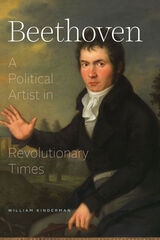
Beethoven
A Political Artist in Revolutionary TimesWilliam Kinderman
University of Chicago Press, 2021
William Kinderman presents Beethoven as a civically engaged thinker faced with severe challenges. The composer lived through many tumultuous events—the French Revolution, the rise and fall of Napoleon Bonaparte, and the Congress of Vienna among them. Previous studies of Beethoven have emphasized the importance of his personal suffering and inner struggles; Kinderman instead establishes that musical tensions in works such as the Eroica, the Appassionata, and his final piano sonata in C minor reflect Beethoven’s attitudes toward the political turbulence of the era. Written for the 250th anniversary of his birth, Beethoven takes stock of the composer’s legacy, showing how his idealism and zeal for resistance have ensured that masterpieces such as the Ninth Symphony continue to inspire activists around the globe. Kinderman considers how the Fifth Symphony helped galvanize resistance to fascism, how the Sixth has energized the environmental movement, and how Beethoven’s civic engagement continues to inspire in politically perilous times. Uncertain times call for ardent responses, and, as Kinderman convincingly affirms, Beethoven’s music is more relevant today than ever before.
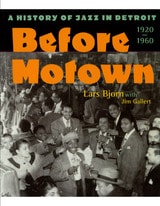
Before Motown
A History of Jazz in Detroit, 1920-60Lars Bjorn with Jim Gallert
University of Michigan Press, 2001
Beneath the Skin of Sorrow
Improvisations on LossNnenna Freelon
Duke University Press, 2025
Part love story, part homage to jazz, and part guide to creative practice within bereavement, Beneath the Skin of Sorrow follows Freelon’s difficult and personal journey to healing. Calling on the improvisational skills that she had built over her forty-year career as a jazz singer, Freelon crafted her new reality by improvising—thinking about grieving as a series of small, daily engagements with the world around her. Slowly, Freelon regained the pieces of her musical sensibility, realizing that flowing between words spoken and words sung allowed her to understand what could not be fully realized in either realm.
By improvising a new life, Freelon forged a new companionship between grief, art, and daily life. In the essays, poems, lyrics, and explorations of jazz standards that comprise this lyrical and elegiac memoir, Freelon shows how thinking about grief as an exercise in improvisation can lead to a creative coexistence with grief in all its forms.

Berlioz and His Century
An Introduction to the Age of RomanticismJacques Barzun
University of Chicago Press, 1982

Berlioz and His World
Edited by Francesca Brittan and Sarah Hibberd
University of Chicago Press, 2024
Hector Berlioz (1803–1869) has long been a difficult figure to place and interpret. Famously, in Richard Wagner’s estimation, he hovered as a “transient, marvelous exception,” a composer woefully and willfully isolated. In the assessment of German composer Ferdinand Hiller, he was a fleeting comet who “does not belong in our musical solar system,” the likes of whom would never be seen again. For his contemporaries, as for later critics, Berlioz was simply too strange—and too noisy, too loud, too German, too literary, too cavalier with genre and form, and too difficult to analyze. He was, in many ways, a composer without a world.
Berlioz and His World takes a deep dive into the composer’s complex legacy, tracing lines between his musical and literary output and the scientific, sociological, technological, and political influences that shaped him. Comprising nine essays covering key facets of Berlioz’s contribution and six short “object lessons” meant as conversation starters, the book reveals Berlioz as a richly intersectional figure. His very difficulty, his tendency to straddle the worlds of composer, conductor, and critic, is revealed as a strength, inviting new lines of cross-disciplinary inquiry and a fresh look at his European and American reception.

Bernhard Lang
Critical Guides to Contemporary ComposersChristine Dysers
Intellect Books, 2026
This introduction to a challenging contemporary composer delves into the theory and philosophy of repetition.
The work of Austrian composer Bernhard Lang eludes easy categorization. While rooted simultaneously in DJ culture, free jazz, pop culture, and the Austro-European new music scene, his oeuvre explicitly foregrounds repetition. He is, in his own words, a “repeat offender.”
Bernhard Lang serves as a critical guide to the composer’s music and traces the phenomenon of repetition throughout his oeuvre. To examine Lang’s repetitive aesthetics, Christine Dysers employs various philosophical methods, such as Gilles Deleuze’s differential ontology. Fusing critical musicology, aesthetic theory, poststructuralist thought, and music analysis, Bernhard Lang brings fresh insight to the work of an award-winning contemporary composer.
Between Montmartre and the Mudd Club
Popular Music and the Avant-GardeBernard Gendron
University of Chicago Press, 2002
When and how did popular music earn so much cultural capital? To find out, Bernard Gendron investigates five key historical moments when popular music and avant-garde art transgressed the rigid boundaries separating high and low culture to form friendly alliances. He begins at the end of the nineteenth century in Paris's Montmartre district, where cabarets showcased popular music alongside poetry readings in spaces decorated with modernist art works. Two decades later, Parisian poets and musicians "slumming" in jazz clubs assimilated jazz's aesthetics in their performances and compositions. In the bebop revolution in mid-1940s America, jazz returned the compliment by absorbing modernist devices and postures, in effect transforming itself into an avant-garde art form. Mid-1960s rock music, under the leadership of the Beatles, went from being reviled as vulgar music to being acclaimed as a cutting-edge art form. Finally, Gendron takes us to the Mudd Club in the late 1970s, where New York punk and new wave rockers were setting the aesthetic agenda for a new generation of artists.
Between Montmartre and the Mudd Club should be on the shelves of anyone interested in the intersections between high and low culture, art and music, or history and aesthetics.
Beyoncé in Formation
Remixing Black FeminismBy Omise'eke Tinsley
University of Texas Press, 2018
Making headlines when it was launched in 2015, Omise’eke Tinsley’s undergraduate course “Beyoncé Feminism, Rihanna Womanism” has inspired students from all walks of life. In Beyoncé in Formation, Tinsley now takes her rich observations beyond the classroom, using the blockbuster album and video Lemonade as a soundtrack for vital new-millennium narratives.
Woven with candid observations about her life as a feminist scholar of African studies and a cisgender femme married to a trans spouse, Tinsley’s “Femme-onade” mixtape explores myriad facets of black women’s sexuality and gender. Turning to Beyoncé’s “Don’t Hurt Yourself,” Tinsley assesses black feminist critiques of marriage and then considers the models of motherhood offered in “Daddy Lessons,” interspersing these passages with memories from Tinsley’s multiracial family history. Her chapters on nontraditional bonds culminate in a discussion of contemporary LGBT politics through the lens of the internet-breaking video “Formation,” underscoring why Beyoncé’s black femme-inism isn’t only for ciswomen. From pleasure politics and the struggle for black women’s reproductive justice to the subtext of blues and country music traditions, the landscape in this tour is populated by activists and artists (including Loretta Lynn) and infused with vibrant interpretations of Queen Bey’s provocative, peerless imagery and lyrics.
In the tradition of Roxanne Gay’s Bad Feminist and Jill Lepore’s best-selling cultural histories, Beyoncé in Formation is the work of a daring intellectual who is poised to spark a new conversation about freedom and identity in America.
Beyond Bach
Music and Everyday Life in the Eighteenth CenturyAndrew Talle
University of Illinois Press, 2018
Eschewing the great composer style of music history, Andrew Talle takes us on a journey that looks at how ordinary people made music in Bach's Germany. Talle focuses in particular on the culture of keyboard playing as lived in public and private. As he ranges through a wealth of documents, instruments, diaries, account ledgers, and works of art, Talle brings a fascinating cast of characters to life. These individuals--amateur and professional performers, patrons, instrument builders, and listeners--inhabited a lost world, and Talle's deft expertise teases out the diverse roles music played in their lives and in their relationships with one another. At the same time, his nuanced re-creation of keyboard playing's social milieu illuminates the era's reception of Bach's immortal works.
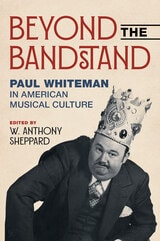
Beyond the Bandstand
Paul Whiteman in American Musical CultureEdited by W. Anthony Sheppard
University of Illinois Press, 2024
The most successful bandleader of the 1920s, Paul Whiteman was an entertainment icon who played a major role in the mainstreaming of jazz. Whiteman and his band premiered Gershwin’s Rhapsody in Blue. Duke Ellington acknowledged his achievements. His astonishing ear for talent vaulted a who’s who of artists toward prominence. But Whiteman’s oversized presence eclipsed Black jazz musicians while his middlebrow music prompted later generations to jettison him from jazz history.
W. Anthony Sheppard’s collection of essays confronts the racial implications of Whiteman’s career. The contributors explore Whiteman’s broad impact on popular culture, tracking his work and influence in American marketing, animated films, the Black press, Hollywood, and the music publication industry, and following him behind the scenes with arrangers, into grand concert halls, across the Atlantic, into the courtroom, and on television.
Multifaceted and cutting-edge, Beyond the Bandstand explores the racial politics and artistic questions surrounding a controversial figure in popular music.
Contributors: Ryan Raul Bañagale, Stephanie Doktor, John Howland, Katherine M. Leo, Sarah Caissie Provost, W. Anthony Sheppard, Catherine Tackley, Elijah Wald, and Christi Jay Wells

Bhangra and Asian Underground
South Asian Music and the Politics of Belonging in BritainFalu Bakrania
Duke University Press, 2013

Bianca e Falliero, o sia Il Consiglio dei Tre
Melodramma in Two Acts by Felice RomaniGioachino Rossini
University of Chicago Press, 1996
Heavily butchered in later productions, Bianca e Falliero soon disappeared from the stage, but its finest pieces remained in concert repertory for half a century. The critical edition—the first publication of the full score—restores the original Milan version. An appendix offers Rossini's vocal variants for the two lead roles.
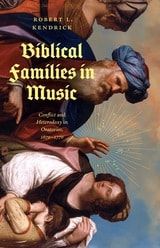
Biblical Families in Music
Conflict and Heterodoxy in Oratorios, 1670–1770Robert L. Kendrick
University of Chicago Press, 2025
Based to a great extent on the Old Testament, the largely Catholic musical-dramatic genre was popular in Italy, Austria, and southern Germany in the seventeenth and eighteenth centuries. Biblical Families in Music reveals how difficult stories of fratricide, child sacrifice, death, and forbidden love performed a didactic function in oratorios, teaching early modern audiences about piety and the rules of proper family life.
In the century after 1670, the heavily adapted tales of Abraham and Isaac, Cain and Abel, and the Egyptian slave Hagar and her son Ishmael were set to music by figures such as Alessandro Scarlatti and Antonio Sacchini and performed during Lent in churches and other sacred spaces for an audience of court nobility, clergy, and the urban patriciate. By examining the resonance of Catholic oratorios within predominantly upper-class social realities, the book broadens our cultural understanding of the early modern European family and underscores the centrality of family and familial relation to social position, devotional taste, and identity.
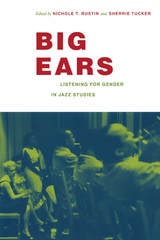
Big Ears
Listening for Gender in Jazz StudiesNichole T. Rustin and Sherrie Tucker, eds.
Duke University Press, 2008
Scholars of music, ethnomusicology, American studies, literature, anthropology, and cultural studies approach the question of gender in jazz from multiple perspectives. One contributor scrutinizes the tendency of jazz historiography to treat singing as subordinate to the predominantly male domain of instrumental music, while another reflects on her doubly inappropriate position as a female trumpet player and a white jazz musician and scholar. Other essays explore the composer George Russell’s Lydian Chromatic Concept as a critique of mid-twentieth-century discourses of embodiment, madness, and black masculinity; performances of “female hysteria” by Les Diaboliques, a feminist improvising trio; and the BBC radio broadcasts of Ivy Benson and Her Ladies’ Dance Orchestra during the Second World War. By incorporating gender analysis into jazz studies, Big Ears transforms ideas of who counts as a subject of study and even of what counts as jazz.
Contributors: Christina Baade, Jayna Brown, Farah Jasmine Griffin, Monica Hairston, Kristin McGee, Tracy McMullen, Ingrid Monson, Lara Pellegrinelli, Eric Porter, Nichole T. Rustin, Ursel Schlicht, Julie Dawn Smith, Jeffrey Taylor, Sherrie Tucker, João H. Costa Vargas

Big Feelings
Queer and Feminist Indie Rock After Riot GrrrlDan DiPiero
University of Michigan Press, 2025
By bringing listeners’ experiences into the analysis, DiPiero shows how indie rock feminisms have shifted since the 1990s, rejecting overt political messages in favor of sonic catharsis, and reflecting the complex, ambivalent feeling of being young while the world burns. In reprising the sounds of an alt-rock associated in public consciousness with white male pain, Big Feelings doubles down on the stereotypical association between femininity and emotionality to perform whole spectrums of feeling in varied states of overwhelm. In doing so, these artists draw attention to overlooked histories of women and queer musicians who have been forging indie rock all along, while also remaking how the music matters in the present.
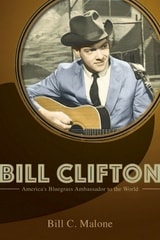
Bill Clifton
America's Bluegrass Ambassador to the WorldBill C Malone
University of Illinois Press, 2016
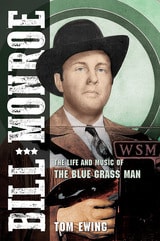
Bill Monroe
The Life and Music of the Blue Grass ManTom Ewing
University of Illinois Press, 2021
The Father of Bluegrass Music, Bill Monroe was a major star of the Grand Ole Opry for over fifty years; a member of the Country Music, Songwriters, and Rock and Roll Halls of Fame; and a legendary figure in American music. This authoritative biography sets out to examine his life in careful detail--to move beyond hearsay and sensationalism to explain how and why he accomplished so much.
Former Blue Grass Boy and longtime music journalist Tom Ewing draws on hundreds of interviews, his personal relationship with Monroe, and an immense personal archive of materials to separate the truth from longstanding myth. Ewing tells the story of the Monroe family's musical household and Bill's early career in the Monroe Brothers duo. He brings to life Monroe's 1940s heyday with the Classic Bluegrass Band, the renewed fervor for his music sparked by the folk revival of the 1960s, and his declining fortunes in the years that followed. Throughout, Ewing deftly captures Monroe's relationships and the personalities of an ever-shifting roster of band members while shedding light on his business dealings and his pioneering work with Bean Blossom and other music festivals.
Filled with a wealth of previously unknown details, Bill Monroe offers even the most devoted fan a deeper understanding of Monroe's towering achievements and timeless music.