Results by title
433 books match the query 'Immigrants' and 17 start with b
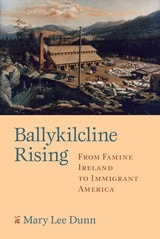
Ballykilcline Rising
From Famine Ireland to Immigrant AmericaMary Lee Dunn Maguire
University of Massachusetts Press, 2008
In 1847, in the third year of Ireland's Great Famine and the thirteenth year of their rent strike against the Crown, hundreds of tenant farmers in Ballykilcline, County Roscommon, were evicted by the Queen's agents and shipped to New York. Mary Lee Dunn tells their story in this meticulously researched book. Using numerous Irish and U.S. sources and with descendants' help, she traces dozens of the evictees to Rutland, Vermont, as railroads and marble quarries transformed the local economy. She follows the immigrants up to 1870 and learns not only what happened to them but also what light American experience and records cast on their Irish “rebellion.”
Dunn begins with Ireland's pre-Famine social and political landscape as context for the Ballykilcline strike. The tenants had rented earlier from the Mahons of Strokestown, whose former property now houses Ireland's Famine Museum. In 1847, landlord Denis Mahon evicted and sent nearly a thousand tenants to Quebec, where half died before or just after reaching the Grosse Ile quarantine station. Mahon was gunned down months later. His murder provoked an international controversy involving the Vatican. An early suspect in the case was a man from Ballykilcline.
In the United States, many of the immigrants resettled in clusters in several locations, including Vermont, Illinois, Iowa, Maryland, and New York. In Vermont they found jobs in the marble quarries, but some of them lost their homes again in quarry labor actions after 1859. Others prospered in their new lives. A number of Ballykilcline families who stopped in Rutland later moved west; one had a son kidnapped by Indians in Minnesota. Readers who have Irish Famine roots will gain a sense of their own “back story” from this account of Ireland and the native Irish, and scholars in the field of immigration studies will find it particularly useful.
Bamboo Son
A Hmong Refugee’s Search for Identity and the American DreamPao Lor
Wisconsin Historical Society Press, 2026
“In Hmong, the word bamboo or ntsuag has two meanings. It refers to the bamboo plant, which has many significant cultural and practical uses in Hmong life. The word also means orphan. Therefore, bamboo son, in Hmong, means tub ntsuag or orphan son. To survive and succeed as a Hmong orphan, like bamboo, one must be resilient and adaptable, bend without breaking, and stand tall against enormous odds.”
In this follow-up to his acclaimed memoir, Modern Jungles, Pao Lor picks up his story as a young Hmong immigrant building a new life in a new home and shares the narrative of his ensuing journey into adulthood. Lor emerged from war and tragedies in the jungles of Laos and refugee camps of Thailand in the 1970s to pursue a vision of the American dream in Green Bay, Wisconsin, in the 1980s. The distance between his humble beginnings and that dream life was littered with challenges as well as possibilities.
Lor’s transformation from an insecure but determined high school student to a husband, father, teacher, administrator, and author is marked by triumph and defeat, trauma and joy, and always hope and optimism. As he navigates school, first loves, family relationships, and a career, Lor must contend with language barriers, discrimination, and his own inner demons stemming from feelings of inferiority. Threads of his identity—Hmong, American, and Wisconsinite—intersect and occasionally come into conflict.
Lor’s search for belonging comes full circle when he travels to Laos and Thailand with his wife, Maya, in 2022. Seeing his birthplace for the first time in forty-five years, he revisits the isolated mountain villages where he spent his early childhood; the places where his parents and sister died as the family fled the region in the violent aftermath of the Vietnam War; and the two refugee camps where Pao and his siblings lived before being relocated to the United States when he was seven. As he reexamines these memories and reconciles his past, Lor finds peace and the freedom to move forward with his soul renewed.
Lor’s story is an uplifting journey of resilience, adaptation, love, and forgiveness, inspiring readers to reflect on the meaning and accessibility of the American dream.
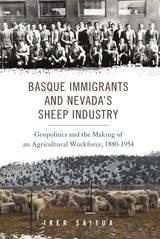
Basque Immigrants and Nevada's Sheep Industry
Geopolitics and the Making of an Agricultural Workforce, 1880-1954Iker Saitua
University of Nevada Press, 2019
Between the 1880s and the 1950s, the western open-range sheep industry was the original economic attraction for Basque immigrants. This engaging study tracks the development of the Basque presence in the American West, providing deep detail about the sheepherders’ history, native and local culture, the challenges they faced, and the changing conditions under which the Basques lived and worked. Saitua also shows how Basque immigrant sheepherders went from being a marginalized labor group to a desirable, high-priced workforce in response to the constant demand for their labor power.
As the twentieth century progressed, the geopolitical tide in America began to change. In 1924, the Restrictive Immigration Act resulted in a truncated labor supply from the Basque Country in Spain. During the Great Depression and the Second World War, the labor shortage became acute. In response, Senator Patrick McCarran from Nevada lobbied on behalf of his wool-growing constituency to open immigration doors for Basques, the most desirable laborers for tending sheep in remote places. Subsequently, Cold War international tensions offered opportunities for a reconciliation between the United States and Francisco Franco, despite Spain’s previous sympathy with the Axis powers.
This fresh portrayal shows how Basque immigrants became the backbone of the sheep industry in Nevada. It also contributes to a wider understanding of the significance of Basque immigration by exploring the role of Basque agricultural labor in the United States, the economic interests of Western ranchers, and McCarran’s diplomacy as catalysts that eventually helped bring Spain into the orbit of western democracies.
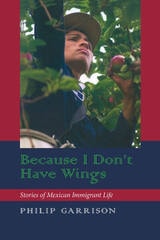
Because I Don't Have Wings
Stories of Mexican Immigrant LifePhilip Garrison
University of Arizona Press, 2006
Philip Garrison has spent most of his life in this region and shares in vivid prose tales of immigrant life, both contemporary and historical, revealing the dual lives of first-generation Mexican immigrants who move smoothly between the Yakima Valley and their homes in Mexico. And with a scholar’s eye he examines figures of speech that reflect mexicano feelings about immigrant life, offering glimpses of adaptation through offhand remarks, family spats, and town gossip.
Written with irony but bursting with compassion, Because I Don’t Have Wings features vivid characters, telling anecdotes, and poignant reflections on life, unfolding an immigrant’s world strikingly different from the one we usually read about. Adaptation, persistence, and survival, we learn, are traits that mexicano culture values. We also learn that, over time, mexicano immigrants don’t merely adapt to the culture of el norte, they transform it.
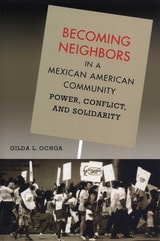
Becoming Neighbors in a Mexican American Community
Power, Conflict, and SolidarityBy Gilda L. Ochoa
University of Texas Press, 2004
On the surface, Mexican Americans and Mexican immigrants to the United States seem to share a common cultural identity but often make uneasy neighbors. Discrimination and assimilationist policies have influenced generations of Mexican Americans so that some now fear that the status they have gained by assimilating into American society will be jeopardized by Spanish-speaking newcomers. Other Mexican Americans, however, adopt a position of group solidarity and work to better the social conditions and educational opportunities of Mexican immigrants.
Focusing on the Mexican-origin, working-class city of La Puente in Los Angeles County, California, this book examines Mexican Americans' everyday attitudes toward and interactions with Mexican immigrants—a topic that has so far received little serious study. Using in-depth interviews, participant observations, school board meeting minutes, and other historical documents, Gilda Ochoa investigates how Mexican Americans are negotiating their relationships with immigrants at an interpersonal level in the places where they shop, worship, learn, and raise their families. This research into daily lives highlights the centrality of women in the process of negotiating and building communities and sheds new light on identity formation and group mobilization in the U.S. and on educational issues, especially bilingual education. It also complements previous studies on the impact of immigration on the wages and employment opportunities of Mexican Americans.

Being German Canadian
History, Memory, GenerationsAlexander Freund
University of Manitoba Press, 2021

Belgians in Michigan
Bernard A. Cook
Michigan State University Press, 2007
At the beginning of the twenty-first century, Michigan was home to the second-largest Belgian population in the United States, and Detroit had one of the largest Belgian populations in the nation. Although immigration declined after World War I, the Belgian- American community is still prominent in the state. Political, religious, and economic conditions, including a nineteenth- century economic depression, helped motivate the move to America. Belgians brought with them the ability and willingness to innovate, as well as a tradition of hard work and devotion. The Gazette van Detroit, a Flemish-language newspaper first printed in Detroit in 1914, continues to be produced and distributed to subscribers throughout the United States and overseas. Belgian-Americans continue to incorporate traditional values with newfound American values, enabling them to forever preserve their heritage.
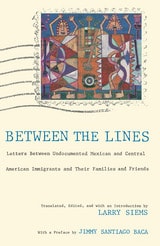
Between the Lines
Letters Between Undocumented Mexican and Latin American Immigrants and Their Families and FriendsLarry Siems
University of Arizona Press, 1992

Beyond the Field
How Soccer Built Community in the United StatesBrian D. Bunk
University of Illinois Press, 2025
Played by both migrants and native-born Americans, soccer created communities across the United States. Brian D. Bunk ranges from Pawtucket to Honolulu as he illuminates the deep and diverse origins of the American sport.
Soccer took root as immigration, urbanization, and industrialization triggered immense changes across society. Matches built local pride as teams battled rival neighborhoods and towns. Teammates and supporters shared meals, raised money for fallen players, and attended each other’s weddings and funerals. If sometimes damaged by economic depression or shattered by war, clubs often bounced back to provide a steadying, resilient force in their towns. Bunk follows the story from the 1880s through World War I by profiling the struggles and joys of players while also tracing the overlooked impact of people of African, Chinese, Hawaiian, Jewish, and Filipino descent on American soccer culture.
Engaging and rich in detail, Beyond the Field draws on extensive original research to expand our idea of the people and places that formed the American game.

Bitter English
Ahmad Almallah
University of Chicago Press, 2019
Through finely crafted poems that utilize a plainspoken roughness to keep the reader slightly disoriented, Almallah replicates his own verbal and cultural experience of existing between languages and societies. There is a sense of displacement to these poems as Almallah recounts the amusing, sad, and perilous moments of day-to-day living in exile. At the heart of Bitter English is a sense of loss, both of home and of his mother, whose struggle with Alzheimer’s becomes a reflection of his own reality in exile. Filled with wit, humor, and sharp observations of the world, Bitter English brings a fresh poetic voice to the American immigrant experience.
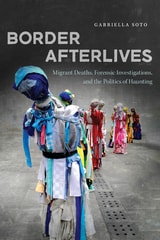
Border Afterlives
Migrant Deaths, Forensic Investigations, and the Politics of HauntingGabriella Soto
University of Arizona Press, 2026
Drawing on over a decade of ethnographic, participatory, and community-engaged research, author Gabriella Soto examines the postmortem journeys of these migrants through the fragmented infrastructure of medicolegal death investigation in the U.S. Southwest. She reveals how the state’s deterrence-based border policies not only generate death but also fail to provide adequate care for the dead. Soto argues that these deaths should be understood as structural homicides and that the forensic neglect they face is a form of ongoing violence.
Moving between the practical and the philosophical, Soto asks what it means to care for the dead and what society owes to those who die in its name. Through the lens of haunting, she explores how the dead continue to shape the living, not as objects of horror but as moral agents whose presence demands justice. Border Afterlives offers a border-scale comparative account of forensic practices, critiques the limits of “best practices” in under-resourced systems, and calls for a reimagining of forensic humanitarianism grounded in reciprocity and dignity, beyond human rights. This is a book that insists on remembering the dead.
Borders of Care
Immigrants, Migrants, and the Fight for Health Care in the United StatesBeatrix Hoffman
University of Chicago Press, 2025
For the roughly ten million undocumented immigrants living in the United States, federal health care coverage is out of reach. Barred from Medicare, Medicaid, and the Affordable Care Act, most rely on hospital emergency rooms when they get sick, or clinics that don’t inquire about immigration status. Further obstacles to health care, including discrimination and the fear of deportation, mean that immigrants, undocumented or not, seek and receive less medical attention than any other population in the country. Yet immigrants haven’t always been ostracized from health care in the United States—providers and activists have for over a century worked to make medical services available to newcomers and migrants, including, at times, the undocumented.
Drawing together stories from diverse communities from the mid-nineteenth century to the present, Borders of Care examines how health care in the United States has both included and excluded immigrants. Beatrix Hoffman analyzes both the health and immigration systems, adding to our understanding of why these structures, and the policies that support them, have resisted reform. Moreover, she shows that immigrants, often scapegoated as burdens on the health-care system, have strengthened it through their responses to systemic exclusion. By creating hospitals and clinics, serving as practitioners, fighting for safer workplaces, filing lawsuits, organizing and protesting, immigrants and migrants have improved medical access for everybody and advanced the idea of health care as a universal right. As accessible as it is authoritative, Hoffman’s survey could not be more timely.
Borders of Care
Immigrants, Migrants, and the Fight for Health Care in the United StatesBeatrix Hoffman
University of Chicago Press, 2025
Probes the relationship between the immigration and health care systems in the United States.
For the roughly ten million undocumented immigrants living in the United States, federal health care coverage is out of reach. Barred from Medicare, Medicaid, and the Affordable Care Act, most rely on hospital emergency rooms when they get sick, or clinics that don’t inquire about immigration status. Further obstacles to health care, including discrimination and the fear of deportation, mean that immigrants, undocumented or not, seek and receive less medical attention than any other population in the country. Yet immigrants haven’t always been ostracized from health care in the United States—providers and activists have for over a century worked to make medical services available to newcomers and migrants, including, at times, the undocumented.
Drawing together stories from diverse communities from the mid-nineteenth century to the present, Borders of Care examines how health care in the United States has both included and excluded immigrants. Beatrix Hoffman analyzes both the health and immigration systems, adding to our understanding of why these structures, and the policies that support them, have resisted reform. Moreover, she shows that immigrants, often scapegoated as burdens on the health-care system, have strengthened it through their responses to systemic exclusion. By creating hospitals and clinics, serving as practitioners, fighting for safer workplaces, filing lawsuits, organizing and protesting, immigrants and migrants have improved medical access for everybody and advanced the idea of health care as a universal right. As accessible as it is authoritative, Hoffman’s survey could not be more timely.
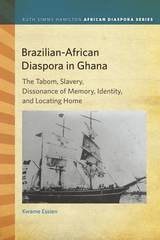
Brazilian-African Diaspora in Ghana
The Tabom, Slavery, Dissonance of Memory, Identity, and Locating HomeKwame Essien
Michigan State University Press, 2016
Brokered Boundaries
Immigrant Identity in Anti-Immigrant TimesDouglas S. Massey
Russell Sage Foundation, 2010
Brown Tide Rising
Metaphors of Latinos in Contemporary American Public DiscourseBy Otto Santa Ana
University of Texas Press, 2002
2002 – Best Book on Ethnic and Racial Political Ideology and/or Political Theory – Organized Section on Race, Ethnicity, and Politics of the American Political Science Association
"...awash under a brown tide...the relentless flow of immigrants..like waves on a beach, these human flows are remaking the face of America...." Since 1993, metaphorical language such as this has permeated mainstream media reporting on the United States' growing Latino population. In this groundbreaking book, Otto Santa Ana argues that far from being mere figures of speech, such metaphors produce and sustain negative public perceptions of the Latino community and its place in American society, precluding the view that Latinos are vested with the same rights and privileges as other citizens.
Applying the insights of cognitive metaphor theory to an extensive natural language data set drawn from hundreds of articles in the Los Angeles Times and other media, Santa Ana reveals how metaphorical language portrays Latinos as invaders, outsiders, burdens, parasites, diseases, animals, and weeds. He convincingly demonstrates that three anti-Latino referenda passed in California because of such imagery, particularly the infamous anti-immigrant measure, Proposition 187. Santa Ana illustrates how Proposition 209 organizers broadcast compelling new metaphors about racism to persuade an electorate that had previously supported affirmative action to ban it. He also shows how Proposition 227 supporters used antiquated metaphors for learning, school, and language to blame Latino children's speech—rather than gross structural inequity—for their schools' failure to educate them. Santa Ana concludes by calling for the creation of insurgent metaphors to contest oppressive U.S. public discourse about minority communities.

Burek
A Culinary MetaphorJernej Mlekuz
Central European University Press, 2015