Results by title
477 books match the query 'Italy' and 18 start with b
Beauty's Rigor
Patterns of Production in the Work of Pier Luigi NerviThomas Leslie
University of Illinois Press, 2017
Beauty's Rigor offers a comprehensive overview of Nervi's long career. Drawing on the Nervi archives and a wealth of photographs and architectural drawings, Thomas Leslie explores celebrated buildings like Palazetto dello Sport built for the 1960 Rome Olympics, St. Mary's Cathedral in San Francisco, and the UNESCO headquarters in Paris. He also sheds new light on unbuilt projects such as the Pavilion of Italian Civilization for the Universal Exposition of Rome E42. What emerges is the first complete account of Nervi's contributions to modern architecture and his essential role in a revolution that realized concrete's potential to match grace with strength.
Belisarius
The Last Roman GeneralIan Hughes
Westholme Publishing, 2009
Hughes has written a lively and detailed account of Belisarius’s remarkable career.” - Adrian Goldsworthy, author of The Complete Roman Army
Belisarius (c. 505–565 AD) was the greatest general of the Eastern Roman Empire and is among history’s most notable military personalities. At the age of 29, he twice defeated the Persians and reconquered North Africa from the Vandals, before going on to regain the Italian peninsula from the Ostrogoths, including the Eternal City, Rome. Fighting in the name of Justinian I, Belisarius recaptured large portions of the original territory of the ancient Roman Empire. However, Byzantium was both unwilling and incapable of retaining much of Belisarius’s hard-won advances, and soon after his death, the empire once again retracted.
In Belisarius: The Last Roman General, historian Ian Hughes recounts the life of this great soldier. In addition, he explains the evolution of classical Roman armies and systems of warfare into those of the Byzantine Empire, as well as those of their chief enemies, the Persians, Goths, and Vandals. Based on ancient source and drawing on a wealth of modern research, Belisarius’s career is set in the context of the turbulent times in which he lived and his reputation is reassessed to give a balanced portrait of this neglected giant among ancient commanders.
Berlusconi's Italy
Mapping Contemporary Italian PoliticsMichael E. Shin and John A. Agnew
Temple University Press, 2008
Bernini
Flights of Love, the Art of DevotionGiovanni Careri
University of Chicago Press, 1994
In the Fonseca Chapel, the Albertoni Chapel, and the church of Sant' Andrea al Quirinale, all in Rome, Careri identifies three types of ensemble and links each to a particular spiritual journey. Using contemporary theories in anthropology, film, and reception aesthetics, he shows how Bernini's formal mechanisms established an emotional dynamic between the beholder and a specific arrangement of forms. As an inquiry into the ways art in a certain historical context transformed and was transformed by its audience, Bernini: Flights of Love, the Art of Devotion is also a penetrating investigation into the aesthetic principles of multimedia composition.
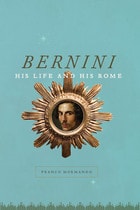
Bernini
His Life and His RomeFranco Mormando
University of Chicago Press, 2011
Sculptor, architect, painter, playwright, and scenographer, Gian Lorenzo Bernini (1598–1680) was the last of the great universal artistic geniuses of early modern Italy, placed by both contemporaries and posterity in the same exalted company as Leonardo, Raphael, and Michelangelo. And his artistic vision remains palpably present today, through the countless statues, fountains, and buildings that transformed Rome into the Baroque theater that continues to enthrall tourists today.
Betting on Freedom
My Life in the ChurchCarinal Angelo Scola
Catholic University of America Press, 2021

Between East and West
Trieste, the United States, and the Cold War, 1941–1954Roberto G. Rabel
Duke University Press, 1988
Rabel explains the causes, significance, and consequences of American involvement in this classic European territorial dispute. The author sees U.S. involvement as closely linked to the larger issues of American participation in World War II and belief in democracy and self-determination, as well as to the subsequent unfolding of the Cold War. After 1945, Rabel asserts, American policy interest shifted to concern for Trieste due to its geographic and symbolic position between the Eastern and Western blocs. U.S. policies toward the Trieste issue were therefore shaped by several factors; a commitment to the principle of self-determination; the exigencies of maintaining stability and effective administration under the occupation; the need for close cooperation with the British; and the larger realities of the Cold War, especially in terms of American perceptions of the changing roles of Italy and Yugoslavia in that conflict. By examining the dynamic interplay of these factors, Between East and West seeks to explain the origins and evolution of U.S. Cold War policy, as well as its impact on the traditional American liberal principles of democracy and self-determination.
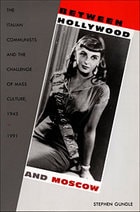
Between Hollywood and Moscow
The Italian Communists and the Challenge of Mass Culture, 1943-1991Stephen Gundle
Duke University Press, 2000
Gundle focuses on the theme of cultural policy, examining how the PCI’s political strategies incorporated cultural policies and activities that were intended to respond to the Americanization of daily life in Italy. In formulating this policy, Gundle contends, the Italian Communists were torn between loyalty to the alternative values generated by the Communist tradition and adaptation to the dominant influences of Italian modernization. This equilibrium eventually faltered because the attractive aspects of Americanization and pop culture proved more influential than the PCI’s intellectual and political traditions.
The first analysis in English of the cultural policies and activities of the PCI, this book will appeal to readers with an interest in modern Italy, the European left, political science, and media studies.
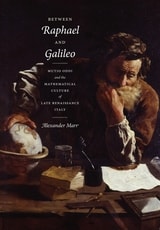
Between Raphael and Galileo
Mutio Oddi and the Mathematical Culture of Late Renaissance ItalyAlexander Marr
University of Chicago Press, 2011
Although largely unknown today, during his lifetime Mutio Oddi of Urbino (1569–1639) was a highly esteemed scholar, teacher, and practitioner of a wide range of disciplines related to mathematics. A prime example of the artisan-scholar so prevalent in the late Renaissance, Oddi was also accomplished in the fields of civil and military architecture and the design and retail of mathematical instruments, as well as writing and publishing.
In Between Raphael and Galileo, Alexander Marr resurrects the career and achievements of Oddi in order to examine the ways in which mathematics, material culture, and the book shaped knowledge, society, and the visual arts in late Renaissance Italy. Marr scrutinizes the extensive archive of Oddi papers, documenting Oddi’s collaboration with prominent intellectuals and officials and shedding new light on the practice of science and art during his day. What becomes clear is that Oddi, precisely because he was not spectacularly innovative and did not attain the status of a hero in modern science, is characteristic of the majority of scientific practitioners and educators active in this formative age, particularly those whose energetic popularization of mathematics laid the foundations for the Scientific Revolution. Marr also demonstrates that scientific change in this era was multivalent and contested, governed as much by friendship as by principle and determined as much by places as by purpose.
Plunging the reader into Oddi’s world, Between Raphael and Galileo is a finely wrought and meticulously researched tale of science, art, commerce, and society in the late sixteenth and early seventeenth century. It will become required reading for any scholar interested in the history of science, visual art, and print culture of the Early Modern period.

Beyond Auteurism
New Directions in Authorial Film Practices in France, Italy and Spain since the 1980sRosanna Maule
Intellect Books, 2008
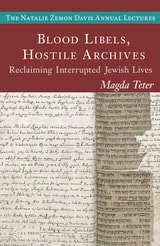
Blood Libels, Hostile Archives
Reclaiming Interrupted Jewish LivesMagda Teter
Central European University Press, 2025
As a minority group for most of their history, Jews were often marginalized and persecuted. Traces of their lives can be found in the archives of the dominant societies, but only as they intersected with the concerns of those in power. Just as Natalie Zemon Davis, Emmanuel Le Roy Ladurie, Carlo Ginzburg, and others recovered the voices of the peasants, so, too, scholars of Jewish history and culture have productively mined these reservoirs of evidence to retrieve glimpses of the ordinary lives of Jews. Blood Libels, Hostile Archives explores what can be reclaimed about everyday lives from what can be called “hostile archives”—from archival evidence produced and collected explicitly to manufacture malicious tales and pass them as “facts.” For Jewish history, in some places, these archival sources may be the only remaining records documenting the lives of Jews there.
The book explores two places: Trent, in northern Italy, and Sandomierz, in eastern Poland. Though hundreds of miles away, the towns have many things in common: both had been sites of anti-Jewish libels falsely accusing Jews of killing Christian children, Trent in 1475 and Sandomierz twice—in 1698 and 1710; in both, the instigators of the Jews’ persecution left unique and extensive archives, both towns have physical remnants of these deadly affairs, and, finally, neither town has an existing Jewish population. Yet, centuries later, these anti-Jewish libels have not been relegated to the past; in both towns, their legacies still reverberate today.
Boccaccio
A Critical Guide to the Complete WorksEdited by Victoria Kirkham, Michael Sherberg, and Janet Levarie Smarr
University of Chicago Press, 2013
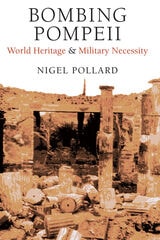
Bombing Pompeii
World Heritage and Military NecessityNigel Pollard
University of Michigan Press, 2020
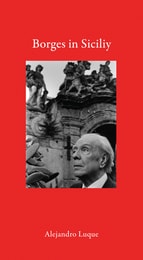
Borges in Sicily
Journey with a Blind GuideAlejandro Luque
Haus Publishing, 2017
This winding journey features literati both past and present, indigenous and foreign. These characters live alongside Luque’s own comments and observations in a narrative that is rich in historical and personal detail. The writer who inspired this great journey, Borges himself, becomes a character in this narrative that is infused with extracts and reflections from his essays and poetry. Borges in Sicily acts as a travel diary, a guide to the most fascinating places in Sicily, a recounting of Borges’s journey around the island, and a deeply poetic story of Luque’s own adventures. The book also includes twenty-three photographs from the renowned Magnum photographer Ferdinando Scianna, and it won the 1st Premio International del Libros de Viajes.
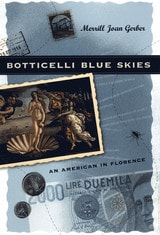
Botticelli Blue Skies
An American in FlorenceMerrill Joan Gerber
University of Wisconsin Press, 2002
When writer Merrill Joan Gerber is invited to join her husband, a history professor, as he takes a class of American college students to study in Florence, Italy, she feels terrified at the idea of leaving her comforts, her friends, and her aged mother in California. Her husband tries to assure her that her fear of Italy—and her lack of knowledge of the Italian language—will be offset by the discoveries of travel. "I can’t tell you exactly what will happen, but something will. And it will all be new and interesting." Botticelli Blue Skies is the tale of a woman who readily admits to fear of travel, a fear that many experience but are embarrassed to admit. When finally she plunges into the new adventure, she describes her experiences in Florence with wit, humor, and energy.
Instead of sticking to the conventional tourist path, Gerber follows her instincts. She makes discoveries without tour guides droning in her ear and reclaims the travel experience as her own, taking time to shop in a thrift shop, eat in a Chinese restaurant that serves "Dragon chips," make friends with her landlady who turns out to be a Countess, and visit the class of a professor at the university. She discovers a Florence that is not all museums and wine. With newfound patience and growing confidence, Gerber makes her way around Florence, Venice, and Rome. She visits famous places and discovers obscure ones—in the end embracing all that is Italian. Botticelli Blue Skies (accompanied by the author’s own photographs) is an honest, lyrical, touching account of the sometimes exhausting, often threatening, but always enriching physical and emotional challenge that is travel.
Broken Mirrors/Broken Minds
The Dark Dreams of Dario ArgentoMaitland McDonagh
University of Minnesota Press, 2010
Brutal Vision
The Neorealist Body in Postwar Italian CinemaKarl Schoonover
University of Minnesota Press, 2012
Film history identifies Italian neorealism as the exemplar of national cinema, a specifically domestic response to wartime atrocities. Brutal Vision challenges this orthodoxy by arguing that neorealist films—including such classics as Rome, Open City; Paisan; Shoeshine; and Bicycle Thieves—should be understood less as national products and more as complex agents of a postwar reorganization of global politics. For these films, cinema facilitates the liberal humanist sympathy required to usher in a new era of world stability.
In his readings of crucial films and newly discovered documents from the archives of neorealism’s international distribution, Karl Schoonover reveals how these films used images of the imperiled body to reconstitute the concept of the human and to recalibrate the scale of human community. He traces how Italian neorealism emerges from and consolidates the transnational space of the North Atlantic, with scenarios of physical suffering dramatizing the geopolitical stakes of a newly global vision. Here we see how—in their views of injury, torture, and martyrdom—these films propose a new mode of spectating that answers the period’s call for extranational witnesses, makes the imposition of limited sovereignty palatable, and underwrites a new visual politics of liberal compassion that Schoonover calls brutal humanism.
These films redefine moviegoing as a form of political action and place the filmgoer at the center of a postwar geopolitics of international aid. Brutal Vision interrogates the role of neorealism’s famously heart-wrenching scenes in a new global order that requires its citizenry to invest emotionally in large-scale international aid packages, from the Marshall Plan to the liberal charity schemes of NGOs. The book fundamentally revises ideas of cinematic specificity, the human, and geopolitical scale that we inherit from neorealism and its postwar milieu—ideas that continue to set the terms for political filmmaking today.
Building the New Man
Eugenics, Racial Science and Genetics in Twentieth-Century ItalyFrancesco Cassata
Central European University Press, 2011