Results by title
1445 books match the query 'Life Sciences' and 65 start with b
Baboon Metaphysics
The Evolution of a Social MindDorothy L. Cheney and Robert M. Seyfarth
University of Chicago Press, 2007
“The vivid narrative is like a bush detective story.”—Steven Poole, Guardian
“Baboon Metaphysics is a distillation of a big chunk of academic lives. . . . It is exactly what such a book should be—full of imaginative experiments, meticulous scholarship, limpid literary style, and above all, truly important questions.”—Alison Jolly, Science
“Cheney and Seyfarth found that for a baboon to get on in life involves a complicated blend of short-term relationships, friendships, and careful status calculations. . . . Needless to say, the ensuing political machinations and convenient romantic dalliances in the quest to become numero uno rival the bard himself.”—Science News
“Through ingenious playback experiments . . . Cheney and Seyfarth have worked out many aspects of what baboons used their minds for, along with their limitations. Reading a baboon’s mind affords an excellent grasp of the dynamics of baboon society. But more than that, it bears on the evolution of the human mind and the nature of human existence.”—Nicholas Wade, New York Times
Baboon Mothers and Infants
Jeanne Altmann
University of Chicago Press, 2001
Baboquivari Mountain Plants
Identification, Ecology, and EthnobotanyDaniel F. Austin
University of Arizona Press, 2010
The term “sky island” was first used by Weldon Heald in 1967 to describe mountain ranges that are separated from each other by valleys of grassland or desert. The valleys create barriers to the spread of plant species in a way that is similar to the separation of islands in an ocean. The 70,000-square-mile Sky Islands region of southeastern Arizona, southwestern New Mexico, and northwestern Mexico is of particular interest to botanists because of its striking diversity of plant species and habitats. With more than 3,000 species of plants, the region offers a surprising range of tropical and temperate zones. Although others have written about the region, this is the first book to focus exclusively on the plant life of the Baboquivari Mountains.
The book offers an introduction to the history of the region, along with a discussion of human influences, and includes a useful appendix that lists all of the plants known to be growing in the Baboquivari Mountain chain.
Backcasts
A Global History of Fly Fishing and ConservationEdited by Samuel Snyder, Bryon Borgelt, and Elizabeth Tobey
University of Chicago Press, 2016
Though Maclean writes of an age-old focus of all anglers—the day’s catch—he may as well be speaking to another, deeper accomplishment of the best fishermen and fisherwomen: the preservation of natural resources.
Backcasts celebrates this centuries-old confluence of fly fishing and conservation. However religious, however patiently spiritual the tying and casting of the fly may be, no angler wishes to wade into rivers of industrial runoff or cast into waters devoid of fish or full of invasive species like the Asian carp. So it comes as no surprise that those who fish have long played an active, foundational role in the preservation, management, and restoration of the world’s coldwater fisheries. With sections covering the history of fly fishing; the sport’s global evolution, from the rivers of South Africa to Japan; the journeys of both native and nonnative trout; and the work of conservation organizations such as the Federation of Fly Fishers and Trout Unlimited, Backcasts casts wide.
Highlighting the historical significance of outdoor recreation and sports to conservation in a collection important for fly anglers and scholars of fisheries ecology, conservation history, and environmental ethics, Backcasts explores both the problems anglers and their organizations face and how they might serve as models of conservation—in the individual trout streams, watersheds, and landscapes through which these waters flow.
Bacteria to AI
Human Futures with Our Nonhuman SymbiontsN. Katherine Hayles
University of Chicago Press, 2025
A new theory of mind that includes nonhuman and artificial intelligences.
The much-lauded superiority of human intelligence has not prevented us from driving the planet into ecological disaster. For N. Katherine Hayles, the climate crisis demands that we rethink basic assumptions about human and nonhuman intelligences. In Bacteria to AI, Hayles develops a new theory of mind—what she calls an integrated cognitive framework (ICF)—that includes the meaning-making practices of lifeforms from bacteria to plants, animals, humans, and some forms of artificial intelligence. Through a sweeping survey of evolutionary biology, computer science, and contemporary literature, Hayles insists that another way of life, with ICF at its core, is not only possible but necessary to safeguard our planet’s future.
Bacula of North American Mammals
William Henry Burt
University of Michigan Press, 1960
Bamboos of Bhutan
C. Stapleton
Royal Botanic Gardens, Kew, 1994
Banquet at Delmonico's
The Gilded Age and the Triumph of Evolution in AmericaBarry Werth
University of Chicago Press, 2011
In Banquet at Delmonico’s, Barry Werth draws readers inside the circle of intellectuals, scientists, politicians, businessmen, and clergymen who brought Charles Darwin’s controversial ideas to post-Civil-War America. Each chapter is dedicated to a crucial intellectual encounter, culminating with an exclusive farewell dinner held in English philosopher Herbert Spencer’s honor at the venerable New York restaurant Delmonico’s in 1882. In this thought-provoking and nuanced account, Werth firmly situates social Darwinism in the context of the Gilded Age. Banquet at Delmonico’s is social history at its finest.
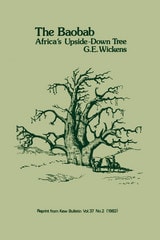
Baobab - Africa's Upside-Down Tree
G. E. Wickens
Royal Botanic Gardens, Kew, 1982
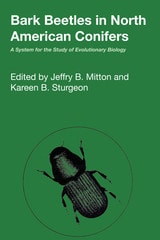
Bark Beetles in North American Conifers
A System for the Study of Evolutionary BiologyEdited by Jeffry B. Mitton and Kareen B. Sturgeon
University of Texas Press, 1982
Because they prey upon a wide variety of conifers, bark beetles have a major impact upon western forests. In most of the western states, for example, we have witnessed bark beetles in epidemic outbreaks, attacking and damaging ponderosa pine, limber pine, and other hosts.
The ecosystem of bark beetle and host tree is a highly coevolved community of organisms in which the evolution of one member of the community significantly influences the evolution of the other. Largely because of the enormous economic impact these insects exert on the management of our forests, few other such communities have been studied so extensively. Bark Beetles in North American Conifers brings together in one volume both theory and a wealth of empirical data gathered by researchers from all the fields in which bark beetles are studied: ecology, evolutionary biology, population genetics, entomology, and forestry.
Topics covered include the life cycle of bark beetles and their population dynamics, their genetic variation and evolutionary mechanisms, the evolution and systematics of the major groups of bark beetles, pheromone production and its implications for coevolution among these organisms, the interaction between bark beetles and their predators, host resistance and susceptibility, the relationship of parasites and symbiotic micro-organisms in general, and management and control of bark beetles based on sound ecological and evolutionary concepts. The concluding section of the book summarizes the dynamics of the coevolved system of bark beetle and host tree and discusses controversial issues for which this system may provide important answers.
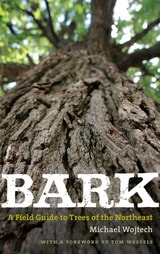
Bark
A Field Guide to Trees of the NortheastMichael Wojtech
Brandeis University Press, 2020
What kind of tree is that? Whether you’re hiking in the woods or simply sitting in your backyard, from Maine to New York you’ll never be without an answer to that question, thanks to this handy companion to the trees of the Northeast. Featuring detailed information and illustrations covering each phase of a tree’s lifecycle, this indispensable guidebook explains how to identify trees by their bark alone—no more need to wait for leaf season. Chapters on the structure and ecology of tree bark, descriptions of bark appearance, an easy-to-use identification key, and supplemental information on non-bark characteristics—all enhanced by more than 450 photographs, illustrations, and maps—will show you how to distinguish the textures, shapes, and colors of bark to recognize various tree species, and also understand why these traits evolved.
Whether you’re a professional naturalist or a parent leading a family hike, this new edition of Bark: A Field Guide to Trees of the Northeast is your essential guide to the region’s 67 native and naturalized tree species.
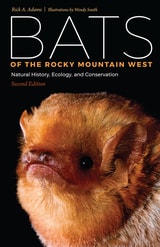
Bats of the Rocky Mountain West
Natural History, Ecology, and ConservationRick A. Adams
University Press of Colorado, 2025
In the twenty years since the original publication of Bats of the Rocky Mountain West, chiropterology (bat science) has exploded, significantly altering our understanding of the ecology, behavior, distribution, and conservation of one of the world's most enigmatic mammals. This notably updated second edition further brings to life the wonderful world of bats with beautiful illustrations and photography that grip the imagination and reveal the magnificent natural history of the only true flying mammal. In addition, thirty-two accounts of regional species with photographs, range maps, and echolocation sonograms report informative and thoroughly revised findings on bats now living in the Rocky Mountain West. Leave any preconceived notions behind and learn the real-life biology of bats, which eclipses the fabled tales of the crypt and macabre.
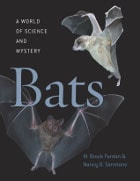
Bats
A World of Science and MysteryM. Brock Fenton and Nancy B. Simmons
University of Chicago Press, 2015
Bats: A World of Science and Mystery presents these fascinating nocturnal creatures in a new light. Lush, full-color photographs portray bats in flight, feeding, and mating in views that show them in exceptional detail. The photos also take the reader into the roosts of bats, from caves and mines to the tents some bats build out of leaves. A comprehensive guide to what scientists know about the world of bats, the book begins with a look at bats’ origins and evolution. The book goes on to address a host of questions related to flight, diet, habitat, reproduction, and social structure: Why do some bats live alone and others in large colonies? When do bats reproduce and care for their young? How has the ability to fly—unique among mammals—influenced bats’ mating behavior? A chapter on biosonar, or echolocation, takes readers through the system of high-pitched calls bats emit to navigate and catch prey. More than half of the world’s bat species are either in decline or already considered endangered, and the book concludes with suggestions for what we can do to protect these species for future generations to benefit from and enjoy.
From the tiny “bumblebee bat”—the world’s smallest mammal—to the Giant Golden-Crowned Flying Fox, whose wingspan exceeds five feet, A Battery of Bats presents a panoramic view of one of the world’s most fascinating yet least-understood species.
Battle Against Extinction
Native Fish Management in the American WestEdited by W. L. Minckley and James E. Deacon; Foreword by Stewart L. Udall
University of Arizona Press, 1991
Nearly a third of the native fish fauna of North America lives in the arid West; this book traces their decline toward extinction as a result of human interference and the threat to their genetic diversity posed by decreases in their populations. What can be done to slow or end this tragedy? As the most comprehensive treatment ever attempted on the subject, Battle Against Extinction shows how conservation efforts have been or can be used to reverse these trends.
In covering fishes in arid lands west of the Mississippi Valley, the contributors provide a species-by-species appraisal of their status and potential for recovery, bringing together in one volume nearly all of the scattered literature on western fishes to produce a monumental work in conservation biology. They also ponder ethical considerations related to the issue, ask why conservation efforts have not proceeded at a proper pace, and suggest how native fish protection relates to other aspects of biodiversity planetwide. Their insights will allow scientific and public agencies to evaluate future management of these animal populations and will offer additional guidance for those active in water rights and conservation biology.
First published in 1991, Battle Against Extinction is now back in print and available as an open-access e-book thanks to the Desert Fishes Council.

Battle Against Extinction
Native Fish Management in the American WestEdited by W. L. Minckley and James E. Deacon; Foreword by Stewart L. Udall
University of Arizona Press, 1991
Nearly a third of the native fish fauna of North America lives in the arid West; this book traces their decline toward extinction as a result of human interference and the threat to their genetic diversity posed by decreases in their populations. What can be done to slow or end this tragedy? As the most comprehensive treatment ever attempted on the subject, Battle Against Extinction shows how conservation efforts have been or can be used to reverse these trends.
In covering fishes in arid lands west of the Mississippi Valley, the contributors provide a species-by-species appraisal of their status and potential for recovery, bringing together in one volume nearly all of the scattered literature on western fishes to produce a monumental work in conservation biology. They also ponder ethical considerations related to the issue, ask why conservation efforts have not proceeded at a proper pace, and suggest how native fish protection relates to other aspects of biodiversity planetwide. Their insights will allow scientific and public agencies to evaluate future management of these animal populations and will offer additional guidance for those active in water rights and conservation biology.
Beasts of the Earth
Animals, Humans, and DiseaseTorrey, E. Fuller
Rutgers University Press, 2014
Humans have lived in close proximity to other animals for thousands of years. Recent scientific studies have even shown that the presence of animals has a positive effect on our physical and mental health. People with pets typically have lower blood pressure, show fewer symptoms of depression, and tend to get more exercise.
But there is a darker side to the relationship between animals and humans. Animals are carriers of harmful infectious agents and the source of a myriad of human diseases. In recent years, the emergence of high-profile illnesses such as AIDS, SARS, West Nile virus, and bird flu has drawn much public attention, but as E. Fuller Torrey and Robert H. Yolken reveal, the transfer of deadly microbes from animals to humans is neither a new nor an easily avoided problem.
Beginning with the domestication of farm animals nearly 10,000 years ago, Beasts of the Earth traces the ways that human-animal contact has evolved over time. Today, shared living quarters, overlapping ecosystems, and experimental surgical practices where organs or tissues are transplanted from non-humans into humans continue to open new avenues for the transmission of infectious agents. Other changes in human behavior like increased air travel, automated food processing, and threats of bioterrorism are increasing the contagion factor by transporting microbes further distances and to larger populations in virtually no time at all.
While the authors urge that a better understanding of past diseases may help us lessen the severity of some illnesses, they also warn that, given our increasingly crowded planet, it is not a question of if but when and how often animal-transmitted diseases will pose serious challenges to human health in the future.
Beautiful Flesh
A Body of EssaysStephanie G'Schwind
University Press of Colorado, 2017
Selected from the country’s leading literary journals and publications—Colorado Review, Creative Nonfiction, Georgia Review, Prairie Schooner, Crazyhorse, The Normal School, and others—Beautiful Flesh gathers eighteen essays on the body, essentially building a multi-gender, multi-ethnic body out of essays, each concerning a different part of the body: belly, brain, bones, blood, ears, eyes, hair, hands, heart, lungs, nose, ovaries, pancreas, sinuses, skin, spine, teeth, and vas deferens. The title is drawn from Wendy Call’s essay “Beautiful Flesh,” a meditation on the pancreas: “gorgeously ugly, hideously beautiful: crimson globes embedded in a pinkish-tan oval, all nestled on a bed of cabbage-olive green, spun through with gossamer gold.”
Other essays include Dinty W. Moore’s “The Aquatic Ape,” in which the author explores the curious design and necessity of sinuses; Katherine E. Standefer’s “Shock to the Heart, Or: A Primer on the Practical Applications of Electricity,” a modular essay about the author’s internal cardiac defibrillator and the nature of electricity; Matt Roberts’s “Vasectomy Instruction 7,” in which the author considers the various reasons for and implications of surgically severing and sealing the vas deferens; and Peggy Shinner’s “Elective,” which examines the author’s own experience with rhinoplasty and cultural considerations of the “Jewish nose.” Echoing the myriad shapes, sizes, abilities, and types of the human body, these essays showcase the many forms of the genre: personal, memoir, lyric, braided, and so on.
Contributors: Amy Butcher, Wendy Call, Steven Church, Sarah Rose Etter, Matthew Ferrence, Hester Kaplan, Sarah K. Lenz, Lupe Linares, Jody Mace, Dinty W. Moore, Angela Pelster, Matt Roberts, Peggy Shinner, Samantha Simpson, Floyd Skloot, Danielle R. Spencer, Katherine E. Standefer, Kaitlyn Teer, Sarah Viren, Vicki Weiqi Yang
Becoming Creole
Nature and Race in BelizeJohnson, Melissa A.
Rutgers University Press, 2019
Becoming Undone
Darwinian Reflections on Life, Politics, and ArtElizabeth Grosz
Duke University Press, 2011
Behavioral Mechanisms in Evolutionary Ecology
Leslie A. Real
University of Chicago Press, 1994
With studies of species ranging from insects to primates, the contributors examine how various animals identify and use environmental resources and deal with ecological constraints, as well as the roles of learning, communication, and cognitive aspects of social interaction in behavioral evolution. Taken together, the chapters demonstrate how the study of internal mechanistic foundations of behavior in relation to their ecological and evolutionary contexts and outcomes provides valuable insight into such behaviors as predation, mating, and dispersal.
Behavioral Mechanisms in Evolutionary Ecology shows how a mechanistic approach unites various levels of biological organization to provide a broader understanding of the biological bases of behavioral evolution.
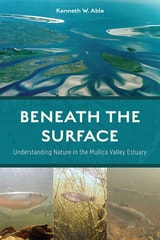
Beneath the Surface
Understanding Nature in the Mullica Valley EstuaryKenneth W. Able
Rutgers University Press, 2020
The Mullica Valley estuary and its watershed, formed over the last 10,000 years, are among the cleanest estuaries along the east coast of the United States. This 365,000-acre ecosystem benefits from a combination of protected watershed, low human population density, and general lack of extensive development. In Beneath the Surface, marine scientist Ken Able helps the reader penetrate the surface and gain insights into the kinds of habitats, animals, and plants that live there. Readers will gain a better understanding of the importance of these shallow waters; how the amount of salt in the water determines where animals and plants are found in estuaries; the day-night, seasonal, and annual variation in their occurrence; and how change is occurring as the result of climate variation. Throughout the book are insightful sidebars telling intimate stories of where various animals came from and where they are going as they travel through the estuary on their way to and from other portions of the east coast. Beneath the Surface emphasizes the kinds and importance of the animals and plants that live beneath the surface of this unique ecosystem.
Between Two Fires
A Fire History of Contemporary AmericaStephen J. Pyne
University of Arizona Press, 2015
Pyne is uniquely qualified to tell America’s fire story. The author of more than a score of books, he has told fire’s history in the United States, Australia, Canada, Europe, and the Earth overall. In his earlier life, he spent fifteen seasons with the North Rim Longshots at Grand Canyon National Park.
In Between Two Fires, Pyne recounts how, after the Great Fires of 1910, a policy of fire suppression spread from America’s founding corps of foresters into a national policy that manifested itself as a costly all-out war on fire. After fifty years of attempted fire suppression, a revolution in thinking led to a more pluralistic strategy for fire’s restoration. The revolution succeeded in displacing suppression as a sole strategy, but it has failed to fully integrate fire and land management and has fallen short of its goals.
Today, the nation’s backcountry and increasingly its exurban fringe are threatened by larger and more damaging burns, fire agencies are scrambling for funds, firefighters continue to die, and the country seems unable to come to grips with the fundamentals behind a rising tide of megafires. Pyne has once again constructed a history of record that will shape our next century of fire management. Between Two Fires is a story of ideas, institutions, and fires. It’s America’s story told through the nation’s flames.
Beyond Earth Day
Fulfilling the PromiseGaylord Nelson; With Susan Campbell and Paul Wozniak; Foreword by Robert F. Kennedy Jr.; Preface by Tia Nelson
University of Wisconsin Press, 2002
Gaylord Nelson’s legacy is known and respected throughout the world. He was a founding father of the modern environmental movement and creator of one of the most influential public awareness campaigns ever undertaken on behalf of global environmental stewardship: Earth Day.
Nelson died in 2005, but his message in this book is still timely and urgent, delivered with the same eloquence with which he articulated the nation’s environmental ills throughout the decades. He details the planet’s most critical concerns—from species and habitat losses to global climate change and population growth. In outlining strategies for planetary health, Nelson inspires citizens to reassert environmentalism as a national priority. Included in this reprint is a new preface by Gaylord Nelson’s daughter, Tia Nelson.
Beyond Preservation
Restoring and Inventing LandscapesDwight Baldwin
University of Minnesota Press, 1994
Beyond Preservation was first published in 1993. Minnesota Archive Editions uses digital technology to make long-unavailable books once again accessible, and are published unaltered from the original University of Minnesota Press editions.
Addressing current ecological issues, from the philosophical to the practical, Frederick Turner and William R. Jordan III Here offer a new paradigm for understanding the relationship between the humans and nature. Challenging the idea that preserving nature is the only solution to environmental problems, they advocate going beyond preservation to restoration and actual construction of our landscape. Fifteen respondents reflect on the implications and consequences of Turner’s and Jordan’s bold proposals.“Ecological restoration is the most helpful and provocative contribution to our thinking about nature to come along in many years, and Beyond Preservation is without a doubt the best book on the subject to date.” Michael Polan, Harper’sContributors include Gary W. Barrett, Ann Cline, David L. Gorchov, William Jordan III, G. Stanley Kane, Jack Temple Kirby, Dora G. Lodwick, Orie L. Loucks, Kimberly E. Medley, Constance Pierce, Ellen Price, Frederick Turner, John E. Wierwille, and Gene E. Willeke.
Big Fleas Have Little Fleas
How Discoveries of Invertebrate Diseases Are Advancing Modern ScienceElizabeth W. Davidson
University of Arizona Press, 2006
In this book, Elizabeth Davidson shares amazing stories about diseases of insects and other invertebrates important to people—and about the scientists who learned to use those diseases to control pests and create products beneficial to humans. Focusing on insect-microbial interactions crucial to public health, she tells detective stories ranging across global history, from the silkworm farms of nineteenth-century Japan to the research labs of modern America. In these fascinating accounts, Davidson shows us how human health often comes down to a contest of bug against bug. Even habitats seething with bacteria, such as the runoff from cattle farms or sewage treatment plants, are also teeming with invertebrate life—animals that, like ourselves, have ways of fighting infection.
Scientific curiosity about what allows creatures as simple as water fleas to survive in such polluted environments has led to the discovery of chemicals with remarkable properties and potential usefulness to humankind. From diseases of shellfish to parasites of bees, Davidson opens a window on a world most of us never stop to consider—but which matters to all of us more than we might ever imagine. In our present era of pandemic scares, Big Fleas Have Little Fleas is a sweeping historical review that’s as timely as tomorrow’s headlines, showing us that the most exciting discoveries can emerge from the smallest sources.
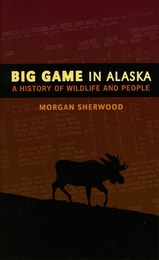
Big Game in Alaska
A History of Wildlife and PeopleMorgan Sherwood
University of Alaska Press, 2008
In concise and clear prose, Sherwood charts the history of this environmental and political conflict, examining the creation of the Alaska Game Commission in the early 1930s, the use of distorted science and menacing technologies, the antipathy of farmers and fishermen toward animals, and the prevailing belief in man’s right to shoot wild animals at will. An incisive historical study of the flawed attempts to govern big game predation, Big Game in Alaska will be essential reading for historians and environmentalists alike.
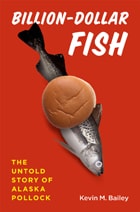
Billion-Dollar Fish
The Untold Story of Alaska PollockKevin M. Bailey
University of Chicago Press, 2013
In Billion-Dollar Fish, Kevin M. Bailey combines his years of firsthand pollock research with a remarkable talent for storytelling to offer the first natural history of Alaska pollock. Crucial to understanding the pollock fishery, he shows, is recognizing what aspects of its natural history make pollock so very desirable to fish, while at the same time making it resilient, yet highly vulnerable to overfishing. Bailey delves into the science, politics, and economics surrounding Alaska pollock in the Bering Sea, detailing the development of the fishery, the various political machinations that have led to its current management, and, perhaps most important, its impending demise. He approaches his subject from multiple angles, bringing in the perspectives of fishermen, politicians, environmentalists, and biologists, and drawing on revealing interviews with players who range from Greenpeace activists to fishing industry lawyers.
Seamlessly weaving the biology and ecology of pollock with the history and politics of the fishery, as well as Bailey’s own often raucous tales about life at sea, Billion-Dollar Fish is a book for every person interested in the troubled relationship between fish and humans, from the depths of the sea to the dinner plate.
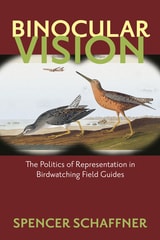
Binocular Vision
The Politics of Representation in Birdwatching Field GuidesSpencer Schaffner
University of Massachusetts Press, 2011
From meadows to marshlands, seashores to suburbs, field guides help us identify many of the things we find outdoors: plants, insects, mammals, birds. In these texts, nature is typically represented, both in words and images, as ordered, clean, and untouched by human technology and development. This preoccupation with species identification, however, has produced an increasingly narrow view of nature, a “binocular vision,” that separates the study of individual elements from a range of larger, interconnected environmental issues. In this book, Spencer Schaffner reconsiders this approach to nature study by focusing on how birds are presented in field guides.
Starting with popular books from the late nineteenth century and moving ultimately to the electronic guides of the current day, Binocular Vision contextualizes birdwatching field guides historically, culturally, and in terms of a wide range of important environmental issues. Schaffner questions the assumptions found in field guides to tease out their ideological workings. He argues that the sanitized world represented in these guides misleads readers by omitting industrial landscapes and so-called nuisance birds, leaving users of the guides disconnected from environmental degradation and its impact on bird populations.
By putting field guides into direct conversation with concerns about species conservation, environmental management, the human alteration of the environment, and the problem of toxic pollution, Binocular Vision is a field guide to field guides that takes a novel perspective on how we think about and interact with the world around us.
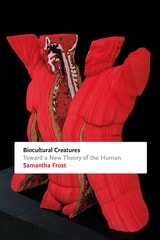
Biocultural Creatures
Toward a New Theory of the HumanSamantha Frost
Duke University Press, 2016
Biogenetic Paradoxes of the Nation
Finncattle, Apples, and Other Genetic-Resource PuzzlesSakari Tamminen
Duke University Press, 2019
Biogeography of Reptiles and Amphibians in the Gomez Farias Region, Tamaulipas, Mexico
Paul S. Martin
University of Michigan Press, 1958

Biohackers
The Politics of Open ScienceAlessandro Delfanti
Pluto Press, 2013
Biohackers explores fundamental changes occuring in the circulation and ownership of scientific information. Alessandro Delfanti argues that the combination of the ethos of 20th century science, the hacker movement and the free software movement is producing an open science culture which redefines the relationship between researchers, scientific institutions and commercial companies.
Biohackers looks at the emergence of the citizen biology community ‘DIYbio’, the shift to open access by the American biologist Craig Venter and the rebellion of the Italian virologist Ilaria Capua against WHO data-sharing policies.
Delfanti argues that these biologists and many others are involved in a transformation of both life sciences and information systems, using open access tools and claiming independence from both academic and corporate institutions.
Biological Individuality
Integrating Scientific, Philosophical, and Historical PerspectivesEdited by Scott Lidgard and Lynn K. Nyhart
University of Chicago Press, 2017
Bringing together biologists, historians, and philosophers, this book provides a multifaceted exploration of biological individuality that identifies leading and less familiar perceptions of individuality both past and present, what they are good for, and in what contexts. Biological practice and theory recognize individuals at myriad levels of organization, from genes to organisms to symbiotic systems. We depend on these notions of individuality to address theoretical questions about multilevel natural selection and Darwinian fitness; to illuminate empirical questions about development, function, and ecology; to ground philosophical questions about the nature of organisms and causation; and to probe historical and cultural circumstances that resonate with parallel questions about the nature of society. Charting an interdisciplinary research agenda that broadens the frameworks in which biological individuality is discussed, this book makes clear that in the realm of the individual, there is not and should not be a direct path from biological paradigms based on model organisms through to philosophical generalization and historical reification.
Biology Takes Form
Animal Morphology and the German Universities, 1800-1900Lynn K. Nyhart
University of Chicago Press, 1995
Although there were neither professors of morphology nor a morphologists' society, morphologists achieved influence by "colonizing" niches in a variety of disciplines. Scientists in anatomy, zoology, natural history, and physiology considered their work morphological, and the term encompassed research that today might be classified as embryology, systematics, functional morphology, comparative physiology, ecology, behavior, evolutionary theory, or histology. Nyhart draws on research notes, correspondence, and other archival material to examine how these scientists responded to new ideas and to the work of colleagues. She examines the intertwined histories of morphology and the broader biological enterprise, demonstrating that the study of form was central to investigations of such issues as the relationships between an animal's structure and function, between an organism and its environment, and between living species and their ancestors.
Biology and Ideology from Descartes to Dawkins
Edited by Denis R. Alexander and Ronald L. Numbers
University of Chicago Press, 2010
Over the course of human history, the sciences, and biology in particular, have often been manipulated to cause immense human suffering. For example, biology has been used to justify eugenic programs, forced sterilization, human experimentation, and death camps—all in an attempt to support notions of racial superiority. By investigating the past, the contributors to Biology and Ideology from Descartes to Dawkins hope to better prepare us to discern ideological abuse of science when it occurs in the future.
Denis R. Alexander and Ronald L. Numbers bring together fourteen experts to examine the varied ways science has been used and abused for nonscientific purposes from the fifteenth century to the present day. Featuring an essay on eugenics from Edward J. Larson and an examination of the progress of evolution by Michael J. Ruse, Biology and Ideology examines uses both benign and sinister, ultimately reminding us that ideological extrapolation continues today. An accessible survey, this collection will enlighten historians of science, their students, practicing scientists, and anyone interested in the relationship between science and culture.

Biology and Management of Noxious Rangeland Weeds
Roger L. Sheley
Oregon State University Press, 1999
Biology at Work
Rethinking Sexual EqualityKingsley R. Browne
Rutgers University Press, 2002
Does biology help explain why women, on average, earn less money than men? Is there any evolutionary basis for the scarcity of female CEOs in Fortune 500 companies? According to Kingsley Browne, the answer may be yes.
Biology at Work brings an evolutionary perspective to bear on issues of women in the workplace: the "glass ceiling," the "gender gap" in pay, sexual harassment, and occupational segregation. While acknowledging the role of discrimination and sexist socialization, Browne suggests that until we factor real biological differences between men and women into the equation, the explanation remains incomplete.
Browne looks at behavioral differences between men and women as products of different evolutionary pressures facing them throughout human history. Womens biological investment in their offspring has led them to be on average more nurturing and risk averse, and to value relationships over competition. Men have been biologically rewarded, over human history, for displays of strength and skill, risk taking, and status acquisition. These behavioral differences have numerous workplace consequences. Not surprisingly, sex differences in the drive for status lead to sex differences in the achievement of status.
Browne argues that decision makers should recognize that policies based on the assumption of a single androgynous human nature are unlikely to be successful. Simply removing barriers to inequality will not achieve equality, as women and men typically value different things in the workplace and will make different workplace choices based on their different preferences.
Rather than simply putting forward the "nature" side of the debate, Browne suggests that dichotomies such as nature/nurture have impeded our understanding of the origins of human behavior. Through evolutionary biology we can understand not only how natural selection has created predispositions toward certain types of behavior but also how the social environment interacts with these predispositions to produce observed behavioral patterns.
Biology's First Law
The Tendency for Diversity and Complexity to Increase in Evolutionary SystemsDaniel W. McShea and Robert N. Brandon
University of Chicago Press, 2010
Life on earth is characterized by three striking phenomena that demand explanation: adaptation—the marvelous fit between organism and environment; diversity—the great variety of organisms; and complexity—the enormous intricacy of their internal structure. Natural selection explains adaptation. But what explains diversity and complexity? Daniel W. McShea and Robert N. Brandon argue that there exists in evolution a spontaneous tendency toward increased diversity and complexity, one that acts whether natural selection is present or not. They call this tendency a biological law—the Zero-Force Evolutionary Law, or ZFEL. This law unifies the principles and data of biology under a single framework and invites a reconceptualization of the field of the same sort that Newton’s First Law brought to physics.
Biology’s First Law shows how the ZFEL can be applied to the study of diversity and complexity and examines its wider implications for biology. Intended for evolutionary biologists, paleontologists, and other scientists studying complex systems, and written in a concise and engaging format that speaks to students and interdisciplinary practitioners alike, this book will also find an appreciative audience in the philosophy of science.
Biomechanics
An Approach to Vertebrate BiologyCarl Gans
University of Michigan Press, 1980
Biophysical Models and Applications in Ecosystem Analysis
Chen, Jiquan
Michigan State University Press, 2021

Biotechnology and Society
An IntroductionHallam Stevens
University of Chicago Press, 2016
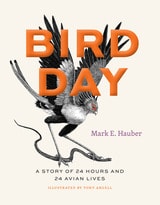
Bird Day
A Story of 24 Hours and 24 Avian LivesMark E. Hauber
University of Chicago Press, 2023
From morning to night and from the Antarctic to the equator, birds have busy days. In this short book, ornithologist Mark E. Hauber shows readers exactly how birds spend their time. Each chapter covers a single bird during a single hour, highlighting twenty-four different bird species from around the globe, from the tropics through the temperate zones to the polar regions. We encounter owls and nightjars hunting at night and kiwis and petrels finding their way in the dark. As the sun rises, we witness the beautiful songs of the “dawn chorus.” At eleven o’clock in the morning, we float alongside a common pochard, a duck resting with one eye open to avoid predators. At eight that evening, we spot a hawk swallowing bats whole, gorging on up to fifteen in rapid succession before retreating into the darkness.
For each chapter, award-winning artist Tony Angell has depicted these scenes with his signature pen and ink illustrations, which grow increasingly light and then dark as our bird day passes. Working closely together to narrate and illustrate these unique moments in time, Hauber and Angell have created an engaging read that is a perfect way to spend an hour or two—and a true gift for readers, amateur scientists, and birdwatchers.
Bird Watch
A Survey of Planet Earth's Changing EcosystemsMartin Walters
University of Chicago Press, 2011
From the tufted puffin in the Pacific Northwest to the hook-billed hermit in the Brazilian rainforest, birds suffer from the effects of climate change in every corner of the globe. Scientists have found declines of up to 90 percent in some troubled bird populations and unprecedented reproductive failure in others. The most recent studies suggest dire prospects: 1,227 avian species are threatened with extinction and an additional 838 near-threatened species are urgent priorities for conservation action.
As much an indispensable guide as a timely call to action, Bird Watch is an illustrated tour of these endangered birds and their habitats. Encyclopedic in scope, this book features all 1,227 species on the International Union for Conservation of Nature (IUCN) Red List, thoroughly detailing the environmental pressures and conservation prescriptions that hold their futures in the balance. After introducing readers to the main threats to birds and regions at high risk, Bird Watch presents a visually stunning and scientifically accurate flight over the major bird habitats, including tropical forests; temperate and northern forests; deserts; mountains; grasslands; and Mediterranean, marine, freshwater, and oceanic islands. The volume concludes with an overview of bird species by region—categorized by family within each region, and a guide to the world’s best birding sites. Produced in cooperation with BirdLife International, Bird Watch is a celebration of the beauty and diversity of birds and their habitats—and a warning of the dangers they face around the world.
Birds of the Great Basin
A Natural HistoryFred A. Ryser
University of Nevada Press, 1985
Birds of the Lower Colorado River Valley
Kenneth V. Rosenberg, Robert D. Ohmart, William C. Hunter, and Bertin W. Anderson
University of Arizona Press, 1991
"A tremendous amount of information is included in this book for banders, birders, and people working to restore the 'Nile of the American Southwest.'" —North American Bird Bander
"A report on several years of scientific research undertaken to investigate the ecological relationships among desert riparian wildlife. . . . Well writen and very informative book." —The Canadian Field Naturalist
"This work is a great achievment." —Birding
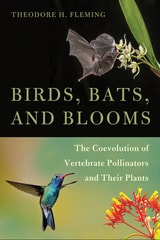
Birds, Bats, and Blooms
The Coevolution of Vertebrate Pollinators and Their PlantsTheodore H. Fleming
University of Arizona Press, 2024
Vertebrate pollinators like bats and birds are keystone species of the Sonoran Desert. Biologist Theodore H. Fleming uses these species—found in the desert around his home—to address two big questions dealing with the evolution of life on Earth: How did these animals evolve, and how did they coevolve with their food plants?
A deeply thoughtful and researched dive into evolutionary history, Birds, Bats, and Blooms offers an engaging trip across evolutionary trajectories as it discusses nectar-feeding birds and bats and their coevolution as pollinators with flowering plants. The primary focus is on New World birds such as hummingbirds and their chiropteran counterparts (nectar-feeding bats in the family Phyllostomidae). It also discusses their Old World ecological counterparts, including sunbirds, honeyeaters, lorikeets, and nectar-feeding bats in the Pteropodidae family. Fleming also addresses the conservation status of these beautiful animals.
Through engaging prose, Fleming pulls together the most recent research in evolutionary biology and pairs it with accounts of his personal interactions with bats and birds. His account includes fourteen color photographs taken by the author during his research trips around the world.
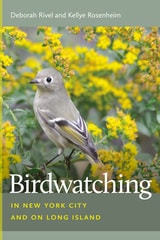
Birdwatching in New York City and on Long Island
Deborah Rivel and Kellye Rosenheim
University Press of New England, 2016
This easy-to-use guide gives seasonal information for both popular birding sites and those off the beaten path. Precise directions to the best viewing locations within the region’s diverse habitats enable birdwatchers to efficiently explore urban and wild birding hotspots. Over 500 species of birds can be seen in New York City’s five boroughs and on Long Island, one of the most densely populated and urbanized regions in North America, which also happens to be situated directly on the Atlantic Flyway. In this fragmented environment of scarce resources, birds concentrate on what’s available. This means that high numbers of birds are found in small spaces. In fact, Central Park alone attracts over 225 species of birds, which birders from around the world flock to see during spring and fall migration. Beyond Central Park, the five boroughs and Long Island have numerous wildlife refuges of extraordinary scenic beauty where resident and migratory birds inhabit forests, wetlands, grasslands, and beaches. These special places present an opportunity to see a wide array of songbirds, endangered nesting shorebirds, raptors, and an unprecedented number and variety of waterfowl. Including the latest information on the seasonal status and distribution of more than 400 species, with 39 maps and over 50 photographs, this full-color guide features information essential to planning a birding visit. It will become the go-to book for both the region’s longtime birders and those exploring the area for the first time.
Bitter Roots
The Search for Healing Plants in AfricaAbena Dove Osseo-Asare
University of Chicago Press, 2013
Blood Relations
Transfusion and the Making of Human GeneticsJenny Bangham
University of Chicago Press, 2020
Blood Ties
A Story of Falconry and FatherhoodBen Crane
University of Chicago Press, 2020
In this artful and moving memoir, we follow Crane on his remarkable journey of flight and return. Traveling from the United Kingdom to Pakistan, we learn first about the history and practice of falconry, a beautiful and brutal partnership between humans and birds that has persisted for thousands of years. And as Crane’s personal story unfolds, we come to understand how he found solace and insight through his relationships with these animals. “I saw that my feelings toward nature, and birds of prey in particular, ran in parallel with my feelings for my son,” Crane writes. “I worked out that they were, in fact, two sides of the same coin—the deep love of one could, with gentle observation, inform and unlock the deep love for the other. . . . Perhaps this then is the central theme of my story.”
Many of us rely upon animal companions to provide a sense of joy, compassion, and empathy. But as Blood Ties teaches us, our relationships with the creatures among us can also transform us, illuminating what it means both to be human and to be part of the greater wild—what it means to be alive.