Results by title
458 books match the query 'Literature' and 16 start with b
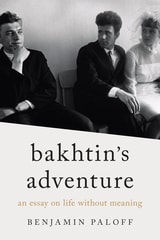
Bakhtin’s Adventure
An Essay on Life without MeaningBenjamin Paloff
Northwestern University Press, 2025
A century after Mikhail Bakhtin first began formulating his now-canonical reflections on freedom and literary representation, we often seem as confused as ever about the relationship between narrative form and what it means to live ethically. Focusing on the throughline of adventure in Bakhtin’s thought, we find a peculiar, yet no less ethically urgent challenge: not to imagine the literary hero as if they were a real person but to recognize how we are always imagining real people as if they were literary characters. This is a provocation with far-reaching consequences for how we understand ourselves, each other, and our situatedness in space and time.
In Bakhtin’s Adventure: An Essay on Life without Meaning, Benjamin Paloff argues that the major aesthetic, ethical, and sociological threads of Bakhtin’s thought intersect in his concept of adventure. Reading across a wide variety of media, from classic literature to contemporary film, Paloff demonstrates how, for Bakhtin and his interlocutors, the test of human freedom is whether narrative means nothing beyond its own adventure. Reframed in this light, Bakhtin’s most influential ideas (eventness, chronotope, heteroglossia, polyphony, carnival) form a cohesive model for how to maintain ethical relations in a world where we can never really know each other the way we know ourselves.
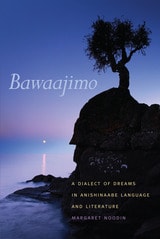
Bawaajimo
A Dialect of Dreams in Anishinaabe Language and LiteratureMargaret Noodin
Michigan State University Press, 2014

Being a Minor Writer
Gail Gilliland
University of Iowa Press, 1994
There are countless theoretical arguments that attempt to define “major” and “minor” literatures, but this lively and deeply felt work is one of the first to speak from the authority of the experience of being minor—of being the “minor writer” who, according to the definition of “author” given by Michel Foucault, does not possess a “name.” This book, then, is an impassioned critical and ethical defense of the act of writing for purposes other than critical acclaim.
In the tradition of Horace's
Ars Poetica,Gilliland uses comments by a broad range of writers, as well as her own experience as a minor woman writer, to consider the basic Horatian questions of purpose, choice of subject matter and genre, diction, characterization, setting, and style. She points out that in the absence of major recognition, the minor writer is continually confronted by the existential question, why do I (still) write? This book offers not only a challenge to existing critical theories but an argument in favor of being—for
stillbeing, for continuing
anywaywith one's life and art
Belated Modernity and Aesthetic Culture
Inventing National LiteratureGregory Jusdanis
University of Minnesota Press, 1991
How does literature function in the formation of a nation-state? What are its pivotal contributions to national discourse and the production of ideological collective will? And, ultimately, how is literature institutionalized and aestheticized?
Belated Modernity and Aesthetic Culture: Inventing National Literature addresses these questions and considers the role literature plays in the construction of a national cultural. Gregory Jusdanis examines the emergence of art and literature in Western Europe in the eighteenth century and traces their introduction to Greece, a stratified, noncapitalist society that was hostile to Enlightenment and secularism. This groundbreaking work explores the importation of national literatures into a largely non-Western society and the inherent resistance they faced.Arguing for the literary status of national culture at its inception, Jusdanis brilliantly demonstrates that in literature, the specific meanings in narratives and fiction form the process of nation building. Culture, history, and literature, he says, merge in those narratives, which in turn provide the imaginary mirror in which a nation reflects itself.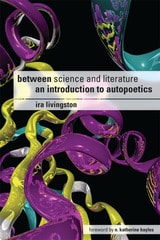
Between Science and Literature
AN INTRODUCTION TO AUTOPOETICSIra Livingston
University of Illinois Press, 2005
The main movement of the book is through a series of model explications and analyses, operational definitions of concepts and terms, more extended case studies, vignettes and thought experiments designed to give the reader a feel for the concepts and how to use them, while working to expand the autopoetic internee by putting cultural self-reference in dialogue with the self-organizing systems of the sciences. Along the way the reader is introduced to self-reference in epistemology (Foucault), sociology (Luhmann), biology (Maturana/Varela/Kauffman), and physics and cosmology (Smolin). Livingston works through the fundamentals of cultural, literary, and science studies and makes them comprehensible to a non-specialist audience.
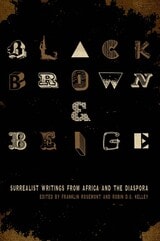
Black, Brown, & Beige
Surrealist Writings from Africa and the DiasporaEdited by Franklin Rosemont and Robin D.G. Kelley
University of Texas Press, 2009
Surrealism as a movement has always resisted the efforts of critics to confine it to any static definition—surrealists themselves have always preferred to speak of it in terms of dynamics, dialectics, goals, and struggles. Accordingly, surrealist groups have always encouraged and exemplified the widest diversity—from its start the movement was emphatically opposed to racism and colonialism, and it embraced thinkers from every race and nation.
Yet in the vast critical literature on surrealism, all but a few black poets have been invisible. Academic histories and anthologies typically, but very wrongly, persist in conveying surrealism as an all-white movement, like other "artistic schools" of European origin. In glaring contrast, the many publications of the international surrealist movement have regularly featured texts and reproductions of works by comrades from Martinique, Haiti, Cuba, Puerto Rico, South America, the United States, and other lands. Some of these publications are readily available to researchers; others are not, and a few fall outside academia's narrow definition of surrealism.
This collection is the first to document the extensive participation of people of African descent in the international surrealist movement over the past seventy-five years. Editors Franklin Rosemont and Robin D. G. Kelley aim to introduce readers to the black, brown, and beige surrealists of the world—to provide sketches of their overlooked lives and deeds as well as their important place in history, especially the history of surrealism.
Bleak Liberalism
Amanda Anderson
University of Chicago Press, 2016
Amanda Anderson examines canonical works of high realism, political novels from England and the United States, and modernist works to argue that liberalism has engaged sober and even stark views of historical development, political dynamics, and human and social psychology. From Charles Dickens’s Bleak House and Hard Times to E. M. Forster’s Howards End to Doris Lessing’s The Golden Notebook, this literature demonstrates that liberalism has inventive ways of balancing sociological critique and moral aspiration. A deft blend of intellectual history and literary analysis, Bleak Liberalism reveals a richer understanding of one of the most important political ideologies of the modern era.
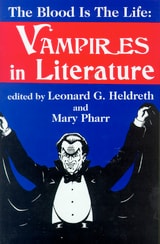
Blood is the Life
Vampires in LiteratureLeonard G. Heldreth
University of Wisconsin Press, 1999
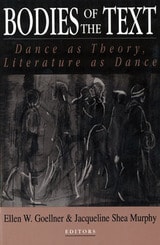
Bodies of the Text
Dance as Theory, Literature as DanceEdited by Ellen W Goellner
Rutgers University Press, 1995
Boundless
Native American Abundance in Art and LiteratureLisa A. Crossman and Heid E. Erdrich
Amherst College Press, 2025
Amherst College’s Collection of Native American Literature contains thousands of Indigenous-authored works spanning centuries. The Collection’s abundance of books, prints, music, ephemera, and artist-made works, all by Native people, provide rich selections for Boundless. Crosscurrents of Indigenous visual art and literature are considered in this broad and interdisciplinary project. Boundless crosses generations to explore relatedness, kinship, and collegiality.
Boundless brings artists and writers together across generations, often drawing together works by members of the same tribe or even the same family to show the history, presence, and futurity of Native American creative and intellectual production.
Boxcar Politics
The Hobo in U.S. Culture and Literature, 1869-1956John Lennon
University of Massachusetts Press, 2014
John Lennon maps the rise and demise of the political hobo from the nineteenth-century introduction of the transcontinental railroad to the Federal Aid Highway Act of 1956. Intertwining literary, historical, and theoretical representations of the hobo, he explores how riders and writers imagined alternative ways that working-class people could use mobility to create powerful dissenting voices outside of fixed hierarchal political organizations. Placing portrayals of hobos in the works of Jack London, Jim Tully, John Dos Passos, and Jack Kerouac alongside the lived reality of people hopping trains (including hobos of the IWW, the Scottsboro Boys, and those found in numerous long-forgotten memoirs), Lennon investigates how these marginalized individuals exerted collective political voices through subcultural practices.

Bridges to Fantasy
Essays from the Eaton Conference on Science Fiction and Fantasy LiteratureGeorge E Slusser
Southern Illinois University Press, 1982
Thirteen original essays written specifically for the second Eaton Conference on Science Fiction and Fantasy Literature, held February 23–24, 1980, at the University of California, Riverside.
These essays demonstrate the variety of fantasy forms and their pervasiveness throughout the ages and will stimulate further study of this complex and elusive mode. The essays—by Harold Bloom, writer and DeVane Professor of the Humanities at Yale University; Larry McCaffery, Assistant Professor of English at San Diego State University; Marta E. Sánchez, Instructor of English at the University of California, San Diego; Arlen J. Hansen, Professor of English at the University of the Pacific, Stockton; David Clayton, Instructor of Comparative Literatureat the University of California, San Diego; Robert Sale, writer and Professor of English at the University of Washington; G. Richard Thompson, Professor of English at Purdue University, West Lafayette; Robert A. Collins, Coordinator of the annual Swann Conference on the Fantastic and Instructor at Florida Atlantic University, Boca Raton; John Gerlach, Associate Professor of English at Cleveland State University; David Ketterer, writer and Professor of English at Concordia University, Montreal; George R. Guffey, Professor of English at the University of California, Los Angeles; Jack P. Rawlins, Associate Professor of English at California State University, Chico; and Gary Kern, writer and translator of early Soviet literature—examine fantasy on many levels of interest: as an element of human thought, as a constant factor in the social and intellectual environment, and as a generator of form in art and literature.
Bridging The Americas
The Literature of Paule Marshall, Toni Morrison, and Gayl JonesStelamaris Coser
Temple University Press, 1994
A literary study of three important black women writers, this book examines the "inter-American" characteristics in the work of Marshall, Morrison, and Jones, including detailed discussions of Morrison's Song of Solomon and Tar Baby, Jones's Corregidora and Song of Anninho, and Marshall's The Chose Place, The Timeless People.
Coser defines the inter-American characteristics in these authors' novels as a connection based on a common African heritage and a shared legacy of colonialism and racism. These three authors redefine the boundaries between the Americas, bridging the "extended Caribbean" that stretches from the U.S. Atlantic coast to Brazil. Their work reinterprets ethnic and sexual identity. Issues of race, class, and nationality overlap. History and identity are reinvented.
To explore the collective forms of resistance and cultural processes in Brazil, the Caribbean, and the United States, Coser also makes provocative connections between the visibility of black women writers and the popularity of male Latin American novelists like Carlos Fuentes and Gabriel Garcia Marquéz.
Building Romanticism
Literature and Architecture in Nineteenth-Century BritainNicole Reynolds
University of Michigan Press, 2010

By Words Alone
The Holocaust in LiteratureSidra DeKoven Ezrahi
University of Chicago Press, 1980
By the Sweat of the Brow
Literature and Labor in Antebellum AmericaNicholas K. Bromell
University of Chicago Press, 1993
In chapters on Thoreau, Melville, Hawthorne, Rebecca Harding Davis, Susan Warner, Harriet Beecher Stowe, and Frederick Douglass, Nicholas Bromell argues that American writers generally sensed a deep affinity between the mental labor of writing and such bodily labors as blacksmithing, house building, housework, mothering, and farming. Combining literary and social history, canonical and noncanonical texts, primary source material, and contemporary theory, Bromell establishes work as an important subject of cultural criticism.