Results by title
534 books match the query 'Making' and 27 start with b
Babes in Tomorrowland
Walt Disney and the Making of the American Child, 1930–1960Nicholas Sammond
Duke University Press, 2005
In vivid detail, Sammond describes how the latest thinking about human development was translated into the practice of child-rearing and how magazines and parenting manuals characterized the child as the crucible of an ideal American culture. He chronicles how Walt Disney Productions’ greatest creation—the image of Walt Disney himself—was made to embody evolving ideas of what was best for the child and for society. Bringing popular child-rearing manuals, periodicals, advertisements, and mainstream sociological texts together with the films, tv programs, ancillary products, and public relations materials of Walt Disney Productions, Babes in Tomorrowland reveals a child that was as much the necessary precursor of popular media as the victim of its excesses.
Back of the Yards
The Making of a Local DemocracyRobert A. Slayton
University of Chicago Press, 1986
Bad Boys
Public Schools in the Making of Black MasculinityAnn Arnett Ferguson
University of Michigan Press, 2020

Bangkok after Dark
Maurice Rocco, Transnational Nightlife, and the Making of Cold War IntimaciesBenjamin Tausig
Duke University Press, 2025
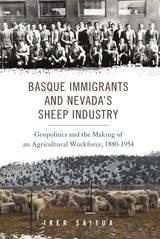
Basque Immigrants and Nevada's Sheep Industry
Geopolitics and the Making of an Agricultural Workforce, 1880-1954Iker Saitua
University of Nevada Press, 2019
Between the 1880s and the 1950s, the western open-range sheep industry was the original economic attraction for Basque immigrants. This engaging study tracks the development of the Basque presence in the American West, providing deep detail about the sheepherders’ history, native and local culture, the challenges they faced, and the changing conditions under which the Basques lived and worked. Saitua also shows how Basque immigrant sheepherders went from being a marginalized labor group to a desirable, high-priced workforce in response to the constant demand for their labor power.
As the twentieth century progressed, the geopolitical tide in America began to change. In 1924, the Restrictive Immigration Act resulted in a truncated labor supply from the Basque Country in Spain. During the Great Depression and the Second World War, the labor shortage became acute. In response, Senator Patrick McCarran from Nevada lobbied on behalf of his wool-growing constituency to open immigration doors for Basques, the most desirable laborers for tending sheep in remote places. Subsequently, Cold War international tensions offered opportunities for a reconciliation between the United States and Francisco Franco, despite Spain’s previous sympathy with the Axis powers.
This fresh portrayal shows how Basque immigrants became the backbone of the sheep industry in Nevada. It also contributes to a wider understanding of the significance of Basque immigration by exploring the role of Basque agricultural labor in the United States, the economic interests of Western ranchers, and McCarran’s diplomacy as catalysts that eventually helped bring Spain into the orbit of western democracies.
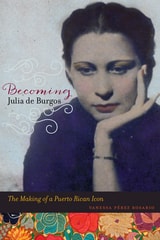
Becoming Julia de Burgos
The Making of a Puerto Rican IconVanessa Perez Rosario
University of Illinois Press, 2014
In the first book-length study written in English, Vanessa Pérez-Rosario examines poet and political activist Julia de Burgos's development as a writer, her experience of migration, and her legacy in New York City, the poet's home after 1940. Pérez-Rosario situates Julia de Burgos as part of a transitional generation that helps to bridge the historical divide between Puerto Rican nationalist writers of the 1930s and the Nuyorican writers of the 1970s. Becoming Julia de Burgos departs from the prevailing emphasis on the poet and intellectual as a nationalist writer to focus on her contributions to New York Latino/a literary and visual culture. It moves beyond the standard tragedy-centered narratives of de Burgos's life to place her within a nuanced historical understanding of Puerto Rico's peoples and culture to consider more carefully the complex history of the island and the diaspora. Pérez-Rosario unravels the cultural and political dynamics at work when contemporary Latina/o writers and artists in New York revise, reinvent, and riff off of Julia de Burgos as they imagine new possibilities for themselves and their communities.
Becoming Rwandan
Education, Reconciliation, and the Making of a Post-Genocide CitizenS. Garnett Russell
Rutgers University Press, 2020
Before Lawrence v. Texas
The Making of a Queer Social MovementWesley G. Phelps
University of Texas Press, 2022
2024 Coral Horton Tullis Memorial Prize, Texas State Historical Association
2024 Award of Merit, The Philosophical Society of Texas Nonfiction Book Prize
The grassroots queer activism and legal challenges that led to a landmark Supreme Court decision in favor of gay and lesbian equality.
In 2003 the US Supreme Court overturned anti-sodomy laws across the country, ruling in Lawrence v. Texas that the Constitution protects private consensual sex between adults. To some, the decision seemed to come like lightning from above, altering the landscape of America’s sexual politics all at once. In actuality, many years of work and organizing led up to the legal case, and the landmark ruling might never have happened were it not for the passionate struggle of Texans who rejected their state’s discriminatory laws.
Before Lawrence v. Texas tells the story of the long, troubled, and ultimately hopeful road to constitutional change. Wesley G. Phelps describes the achievements, setbacks, and unlikely alliances along the way. Over the course of decades, and at great risk to themselves, gay and lesbian Texans and their supporters launched political campaigns and legal challenges, laying the groundwork for Lawrence. Phelps shares the personal experiences of the people and couples who contributed to the legal strategy that ultimately overturned the state’s discriminatory law. Even when their individual court cases were unsuccessful, justice seekers and activists collectively influenced public opinion by insisting that their voices be heard. Nine Supreme Court justices ruled, but it was grassroots politics that vindicated the ideal of equality under the law.

Behind Closed Doors
IRBs and the Making of Ethical ResearchLaura Stark
University of Chicago Press, 2011
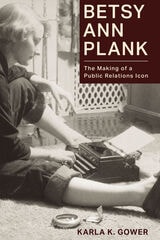
Betsy Ann Plank
The Making of a Public Relations IconKarla K. Gower
University of Missouri Press, 2022
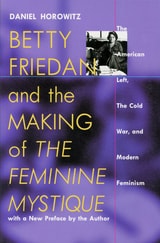
Betty Friedan and the Making of "The Feminine Mystique"
The American Left, the Cold War, and Modern FeminismDaniel Horowitz
University of Massachusetts Press, 1998
Ever since the 1963 publication of her landmark book, The Feminine Mystique, Betty Friedan has insisted that her commitment to women's rights grew out of her experiences as an alienated suburban housewife. Yet as Daniel Horowitz persuasively demonstrates in this illuminating and provocative biography, the roots of Friedan's feminism run much deeper than she has led us to believe. Drawing on an impressive body of new research—including Friedan's own papers—Horowitz traces the development of Friedan's feminist outlook from her childhood in Peoria, Illinois, through her wartime years at Smith College and Berkeley, to her decade-long career as a writer for two of the period's most radical labor journals, the Federated Press and the United Electrical Workers' UE News. He further shows that even after she married and began to raise a family, Friedan continued during the 1950s to write and work on behalf of a wide range of progressive social causes. By resituating Friedan within a broader cultural context, and by offering a fresh reading of The Feminine Mystique against that background, Horowitz not only overturns conventional ideas about “second wave” feminism but also reveals long submerged links to its past.
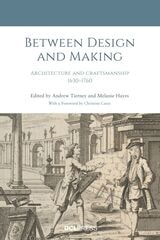
Between Design and Making
Architecture and Craftsmanship, 1630–1760Edited by Andrew Tierney and Melanie Hayes
University College London, 2024
The seventeenth and eighteenth centuries represent a high point in design and workmanship intersectionality. Skilled artisans worked across a spectrum of practices in design, supervision, and execution, and architects relied on this experience when building sites. However, this relationship has been under-studied in the architectural achievement of the early modern era.
Combining analysis of buildings, archival material, and eighteenth-century writings, editors Andrew Tierney and Melanie Hayes re-evaluate the social and professional fabric binding design to the act of making and reflect on the asymmetry between architecture and craft. They argue for a process-oriented understanding of architectural production that explores the scribbled and annotated beginnings of design; the debates and revisions in forging details; and the grappling with building materials that pushed projects from conception to completion.

Beyond Pain
Making the Mind-Body ConnectionAngela Mailis-Gagnon and David Israelson
University of Michigan Press, 2005

Beyond the Makerspace
Making and Relational RhetoricsAnn Shivers-McNair
University of Michigan Press, 2021
Beyond the Makerspace contributes not only to our understanding of making and makerspaces, but also to our understanding of how to study making—and meaning making, more broadly—in ways that examine and intervene in the marking of difference. Thus, the book examines what (and whose) values and practices we are taking up when we identify as makers or when we turn a writing classroom or a library space into a makerspace.

Big Water
The Making of the Borderlands Between Brazil, Argentina, and ParaguayEdited by Jacob Blanc and Frederico Freitas; Foreword by Zephyr Frank
University of Arizona Press, 2018
From the Jesuit reductions in the seventeenth century to the flows of capital and goods accelerated by contemporary trade agreements, the Triple Frontier region has proven fundamental to the development of Brazil, Argentina, and Paraguay, as well as to the Southern Cone and South America itself. Although historians from each of these three countries have tended to construct narratives that stop at their respective borders, the contributors call for a reinterpretation that goes beyond the material and conceptual boundaries of the Triple Frontier. In offering a transnational approach, Big Water helps transcend nation-centered blind spots and approach new understandings of how space and society have developed throughout Latin America.
These essays complicate traditional frontier histories and balance the excessive weight previously given to empires, nations, and territorial expansion. Overcoming stagnant comparisons between national cases, the research explores regional identity beyond border and geopolitical divides. Thus, Big Water focuses on the uniquely overlapping character of the Triple Frontier and emphasizes a perspective usually left at the periphery of national histories.
Contributors
Shawn Michael Austin
Jacob Blanc
Bridget María Chesterton
Christine Folch
Zephyr Frank
Frederico Freitas
Michael Kenneth Huner
Evaldo Mendes da Silva
Eunice Sueli Nodari
Graciela Silvestri
Guillermo Wilde
Daryle Williams
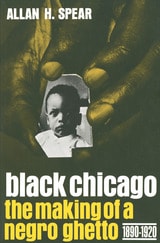
Black Chicago
The Making of a Negro Ghetto, 1890-1920Allan H. Spear
University of Chicago Press, 1969
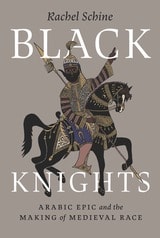
Black Knights
Arabic Epic and the Making of Medieval RaceRachel Schine
University of Chicago Press, 2024
In Black Knights, Rachel Schine reveals how the Arabic-speaking world developed a different form of racial knowledge than their European neighbors during the Middle Ages. Unlike in European vernaculars, Arabic-language ideas about ethnic difference emerged from conversations extending beyond the Mediterranean, from the Sahara to the Indian Ocean. In these discourses, Schine argues, racialized blackness became central to ideas about a global, ethnically inclusive Muslim world.
Schine traces the emergence of these new racial logics through popular Islamic epics, drawing on legal, medical, and religious literatures from the period to excavate a diverse and ever-changing conception of blackness and race. The result is a theoretically nuanced case for the existence and malleability of racial logics in premodern Islamic contexts across a variety of social and literary formations.
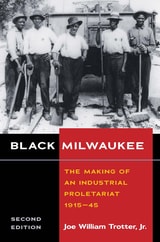
Black Milwaukee
The Making of an Industrial Proletariat, 1915-45Joe William Trotter, Jr.
University of Illinois Press, 2006
Praise for the first edition: “Trotter has written a valuable, provocative book that opens new areas for certain--and heated--debate.”--Journal of American Ethnic History
Other historians have tended to treat black urban life mainly in relation to the ghetto experience, but in Black Milwaukee, Joe William Trotter Jr. offers a new perspective that complements yet also goes well beyond that approach. The blacks in Black Milwaukee were not only ghetto dwellers; they were also industrial workers. The process by which they achieved this status is the subject of Trotter’s ground-breaking study.
This second edition features a new preface and acknowledgments, an essay on African American urban history since 1985, a prologue on the antebellum and Civil War roots of Milwaukee’s black community, and an epilogue on the post-World War II years and the impact of deindustrialization, all by the author. Brief essays by four of Trotter’s colleagues--William P. Jones, Earl Lewis, Alison Isenberg, and Kimberly L. Phillips--assess the impact of the original Black Milwaukee on the study of African American urban history over the past twenty years.
Blood Relations
Transfusion and the Making of Human GeneticsJenny Bangham
University of Chicago Press, 2020

Bluegrass Breakdown
The Making of the Old Southern SoundRobert Cantwell
University of Illinois Press, 1984
Bluegrass Breakdown is an expansive foray into the makings of bluegrass. More than any other book of its kind, it gets to the roots of a uniquely American music that is deeply linked to working-class ideals and romanticism.
Robert Cantwell engages the historical background, commercial origins, internal workings, and cultural and social significance of popular, old-time music to provide a unique musicological and sociological perspective. Well-versed in the history of the tradition and equally as interested in those who listen to the music as in those who create it, Cantwell links bluegrass to its hillbilly roots in Appalachia and shows how the music was transformed by African American folk traditions, the influence of jazz, ragtime, blues, and country music, and the growth of radio and recording technology.
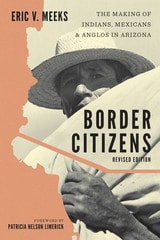
Border Citizens
The Making of Indians, Mexicans, and Anglos in ArizonaBy Eric V. Meeks; foreword by Patricia Nelson Limerick
University of Texas Press, 2007
In Border Citizens, historian Eric V. Meeks explores how the racial classification and identities of the diverse indigenous, mestizo, and Euro-American residents of Arizona’s borderlands evolved as the region was politically and economically incorporated into the United States. First published in 2007, the book examines the complex relationship between racial subordination and resistance over the course of a century. On the one hand, Meeks links the construction of multiple racial categories to the process of nation-state building and capitalist integration. On the other, he explores how the region’s diverse communities altered the blueprint drawn up by government officials and members of the Anglo majority for their assimilation or exclusion while redefining citizenship and national belonging.
The revised edition of this highly praised and influential study features dozens of new images, an introductory essay by historian Patricia Nelson Limerick, and a chapter-length afterword by the author. In his afterword, Meeks details and contextualizes Arizona’s aggressive response to undocumented immigration and ethnic studies in the decade after Border Citizens was first published, demonstrating that the broad-based movement against these measures had ramifications well beyond Arizona. He also revisits the Yaqui and Tohono O’odham nations on both sides of the Sonora-Arizona border, focusing on their efforts to retain, extend, and enrich their connections to one another in the face of increasingly stringent border enforcement.
Born in the Delta
Reflections on the Making of a Southern White SensibilityMargaret Bolsterli
University of Arkansas Press, 2000
Boston and the Making of a Global City
James C. O’Connell
University of Massachusetts Press, 2025
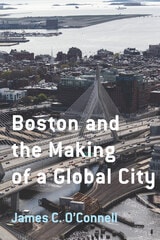
In the late twentieth century the American and global economy shifted from manufacturing toward a knowledge industry. Following an economic low point several decades earlier, the city of Boston took advantage of the new era of globalization, fueled by dramatic advances in telecommunications, computer power, and air and sea travel, as well as its own impressive intellectual capital.
Boston and the Making of a Global City pulls together scholarship, media stories, personal interviews, and city planning documents to tell the story of Boston’s historical trajectory, as it quickly became a competitive global hub. Starting with its role as a colonial port and nineteenth-century maritime power, but moving quickly forward, the book describes how Boston capitalized on its strengths in higher education and such innovation sectors as life sciences, healthcare, information technology, and finance. Author James O’Connell traces the historical sweep of global flows—trade and supply chains, innovation and the dissemination of knowledge, investment, transportation, tourism, telecommunications, and immigration—that have shaped the city and region’s development. This volume also addresses the economic, social, and environmental challenges that Boston currently faces and how it is strategically positioned to confront them going forward.
Breadwinners and Citizens
Gender in the Making of the French Social ModelLaura Levine Frader
Duke University Press, 2008
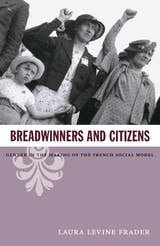
Frader’s analysis moves between the everyday lives of ordinary working women and men and the actions of national policymakers, political parties, and political movements, including feminists, pro-natalists, and trade unionists. In the years following World War I, the many women and an increasing number of immigrant men in the labor force competed for employment and pay. Family policy was used not only to encourage reproduction but also to regulate wages and the size of the workforce. Policies to promote married women’s and immigrants’ departure from the labor force were more common when jobs were scarce, as they were during the Depression. Frader contends that gender and ethnicity exerted a powerful and unacknowledged influence on French social policy during the Depression era and for decades afterward.
Bricks and Mortar
The Making of a Real Education at the Stanford Online High SchoolJeffrey Scarborough and Raymond Ravaglia
CSLI, 2014
This volume shows how a group of online-learning believers built the best high school in the world without laying a single brick: the Stanford Online High School (SOHS). By chronicling SOHS’s distinctive approach to curriculum, gifted education, and school community over SOHS’s first seven years, Bricks and Mortar makes the case that the dynamic use of technology and the best traditional methodologies in education are not, in fact, mutually exclusive. Indeed, while SOHS has redefined what is possible online, a great education is ultimately the product of an interactive community of teachers and students.
Bureaucrats, Planters, and Workers
The Making of the Tobacco Monopoly in Bourbon MexicoBy Susan Deans-Smith
University of Texas Press, 1992
Honorable Mention, Bolton Memorial Prize, Conference on Latin American History
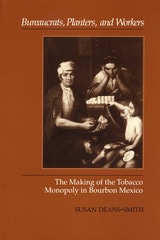
A government monopoly provides an excellent case study of state-society relationships. This is especially true of the tobacco monopoly in colonial Mexico, whose revenues in the later half of the eighteenth century were second only to the silver tithe as the most valuable source of government income. This comprehensive study of the tobacco monopoly illuminates many of the most important themes of eighteenth-century Mexican social and economic history, from issues of economic growth and the supply of agricultural credit to rural relations, labor markets, urban protest and urban workers, class formation, work discipline, and late colonial political culture.
Drawing on exhaustive research of previously unused archival sources, Susan Deans-Smith examines a wide range of new questions. Who were the bureaucrats who managed this colonial state enterprise and what policies did they adopt to develop it? How profitable were the tobacco manufactories, and how rational was their organization? What impact did the reorganization of the tobacco trade have upon those people it affected most—the tobacco planters and tobacco workers?
This research uncovers much that was not previously known about the Bourbon government's management of the tobacco monopoly and the problems and limitations it faced. Deans-Smith finds that there was as much continuity as change after the monopoly's establishment, and that the popular response was characterized by accommodation, as well as defiance and resistance. She argues that the problems experienced by the monopoly at the beginning of the nineteenth century did not originate from any simmering, entrenched opposition. Rather, an emphasis upon political stability and short-term profits prevented any innovative reforms that might have improved the monopoly's long-term performance and productivity.
With detailed quantitative data and rare material on the urban working poor of colonial Mexico, Bureaucrats, Planters, and Workers will be important reading for all students of social, economic, and labor history, especially of Mexico and Latin America.
Burn This House
The Making and Unmaking of YugoslaviaJasminka Udovicki and James Ridgeway, eds.
Duke University Press, 2000
The contributors show that, contrary to descriptions by the Western media, the roots of the warring lie not in ancient Balkan hatreds but rather in a specific set of sociopolitical circumstances that occurred after the death of Tito and culminated at the end of the Cold War. In bringing together these essays, Serbian-born sociologist Jasminka Udovicki and Village Voice Washington correspondent James Ridgeway provide essential historical background for understanding the turmoil in Croatia, Bosnia, and Kosovo and expose the catalytic role played by the propaganda of a powerful few on all sides of what eventually became labeled an ethnic dispute.
Burn This House offers a poignant, informative, and fully up-to-date explication of the continuing Balkan tragedy.
Contributors. Sven Balas, Milan Milosevi´c Branka Prpa-Jovanovi´c, James Ridgeway, Stipe Sikavica, Ejub Stitkovac, Mirko Tepavac, Ivan Torov, Jasminka Udovicki, Susan Woodward