Results by title
70 books match the query 'Mexican American authors' and 8 start with b
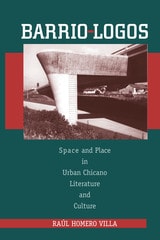
Barrio-Logos
Space and Place in Urban Chicano Literature and CultureBy Raúl Homero Villa
University of Texas Press, 2000
Struggles over space and resistance to geographic displacement gave birth to much of Chicano history and culture. In this pathfinding book, Raúl Villa explores how California Chicano/a activists, journalists, writers, artists, and musicians have used expressive culture to oppose the community-destroying forces of urban renewal programs and massive freeway development and to create and defend a sense of Chicano place-identity.
Villa opens with a historical overview that shows how Chicano communities and culture have grown in response to conflicts over space ever since the United States' annexation of Mexican territory in the 1840s. Then, turning to the work of contemporary members of the Chicano intelligentsia such as Helena Maria Viramontes, Ron Arias, and Lorna Dee Cervantes, Villa demonstrates how their expressive practices re-imagine and re-create the dominant urban space as a community enabling place. In doing so, he illuminates the endless interplay in which cultural texts and practices are shaped by and act upon their social and political contexts.
Blood Lines
Myth, Indigenism, and Chicana/o LiteratureBy Sheila Marie Contreras
University of Texas Press, 2008
2009 — Runner-up, Modern Language Association Prize in United States Latina and Latino and Chicana and Chicano Literary and Cultural Studies
Blood Lines: Myth, Indigenism, and Chicana/o Literature examines a broad array of texts that have contributed to the formation of an indigenous strand of Chicano cultural politics. In particular, this book exposes the ethnographic and poetic discourses that shaped the aesthetics and stylistics of Chicano nationalism and Chicana feminism. Contreras offers original perspectives on writers ranging from Alurista and Gloria Anzaldúa to Lorna Dee Cervantes and Alma Luz Villanueva, effectively marking the invocation of a Chicano indigeneity whose foundations and formulations can be linked to U.S. and British modernist writing.
By highlighting intertextualities such as those between Anzaldúa and D. H. Lawrence, Contreras critiques the resilience of primitivism in the Mexican borderlands. She questions established cultural perspectives on "the native," which paradoxically challenge and reaffirm racialized representations of Indians in the Americas. In doing so, Blood Lines brings a new understanding to the contradictory and richly textured literary relationship that links the projects of European modernism and Anglo-American authors, on the one hand, and the imaginary of the post-revolutionary Mexican state and Chicano/a writers, on the other hand.
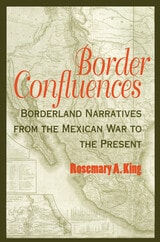
Border Confluences
Borderland Narratives from the Mexican War to the PresentRosemary A. King
University of Arizona Press, 2004
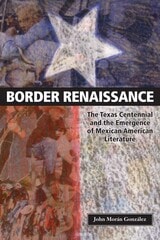
Border Renaissance
The Texas Centennial and the Emergence of Mexican American LiteratureBy John Morán González
University of Texas Press, 2009
The Texas Centennial of 1936, commemorated by statewide celebrations of independence from Mexico, proved to be a powerful catalyst for the formation of a distinctly Mexican American identity. Confronted by a media frenzy that vilified "Meskins" as the antithesis of Texan liberty, Mexican Americans created literary responses that critiqued these racialized representations while forging a new bilingual, bicultural community within the United States. The development of a modern Tejana identity, controversies surrounding bicultural nationalism, and other conflictual aspects of the transformation from mexicano to Mexican American are explored in this study. Capturing this fascinating aesthetic and political rebirth, Border Renaissance presents innovative readings of important novels by María Elena Zamora O'Shea, Américo Paredes, and Jovita González. In addition, the previously overlooked literary texts by members of the League of United Latin American Citizens (LULAC) are given their first detailed consideration in this compelling work of intellectual and literary history.
Drawing on extensive archival research in the English and Spanish languages, John Morán González revisits the 1930s as a crucial decade for the vibrant Mexican American reclamation of Texas history. Border Renaissance pays tribute to this vital turning point in the Mexican American struggle for civil rights.
Border Women
Writing From La FronteraDebra A. Castillo
University of Minnesota Press, 2002
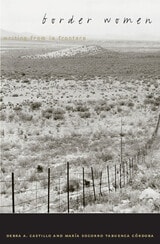
The first study to foreground writing by women who live at the U.S.-Mexico Border.
It is a peculiar fact that U.S.-Mexico border theory is dominated by those who write about, not from, the border. By looking at the work of women writers from both sides of the border, Debra A. Castillo and María-Socorro Tabuenca Córdoba open border studies to a truly transnational analysis while bringing questions of gender to the fore.
Border Women rethinks border theory by emphasizing women writers whose work—in Spanish, English, or a mixture of the two languages—calls into question accepted notions of border identities. These writers include those who are already well recognized internationally (Helena María Viramontes, Sheila and Sandra Ortiz Taylor, and María Novaro); those who have become part of the Chicano canon (Norma Cantú, Alicia Gaspar de Alba, and Demetria Martínez); along with some of the lesser-known, yet most exciting, women’s voices from the Mexican border (Rosario Sanmiguel, Rosina Conde, and Regina Swain).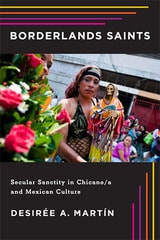
Borderlands Saints
Secular Sanctity in Chicano/a and Mexican CultureMartín, Desirée A
Rutgers University Press, 2013
Winner of the 2014 Latina/o Studies Section - LASA Outstanding Book Award
In Borderlands Saints, Desirée A. Martín examines the rise and fall of popular saints and saint-like figures in the borderlands of the United States and Mexico. Focusing specifically on Teresa Urrea (La Santa de Cabora), Pancho Villa, César Chávez, Subcomandante Marcos, and Santa Muerte, she traces the intersections of these figures, their devotees, artistic representations, and dominant institutions with an eye for the ways in which such unofficial saints mirror traditional spiritual practices and serve specific cultural needs.
Popular spirituality of this kind engages the use and exchange of relics, faith healing, pilgrimages, and spirit possession, exemplifying the contradictions between high and popular culture, human and divine, and secular and sacred. Martín focuses upon a wide range of Mexican and Chicano/a cultural works drawn from the nineteenth century to the present, covering such diverse genres as the novel, the communiqué, drama, the essay or crónica, film, and contemporary digital media. She argues that spiritual practice is often represented as narrative, while narrative—whether literary, historical, visual, or oral—may modify or even function as devotional practice.
Brown Gumshoes
Detective Fiction and the Search for Chicana/o IdentityBy Ralph E. Rodriguez
University of Texas Press, 2005
Winner, Modern Language Association Prize in United States Latina and Latino and Chicana and Chicano Literary and Cultural Studies, 2006
Popular fiction, with its capacity for diversion, can mask important cultural observations within a framework that is often overlooked in the academic world. Works thought to be merely "escapist" can often be more seriously mined for revelations regarding the worlds they portray, especially those of the disenfranchised. As detective fiction has slowly earned critical respect, more authors from minority groups have chosen it as their medium. Chicana/o authors, previously reluctant to write in an underestimated genre that might further marginalize them, have only entered the world of detective fiction in the past two decades.
In this book, the first comprehensive study of Chicano/a detective fiction, Ralph E. Rodriguez examines the recent contributions to the genre by writers such as Rudolfo Anaya, Lucha Corpi, Rolando Hinojosa, Michael Nava, and Manuel Ramos. Their works reveal the struggles of Chicanas/os with feminism, homosexuality, familia, masculinity, mysticism, the nationalist subject, and U.S.-Mexico border relations. He maintains that their novels register crucial new discourses of identity, politics, and cultural citizenship that cannot be understood apart from the historical instability following the demise of the nationalist politics of the Chicana/o movement of the 1960s and 1970s. In contrast to that time, when Chicanas/os sought a unified Chicano identity in order to effect social change, the 1980s, 1990s, and 2000s have seen a disengagement from these nationalist politics and a new trend toward a heterogeneous sense of self. The detective novel and its traditional focus on questions of knowledge and identity turned out to be the perfect medium in which to examine this new self.
Brown on Brown
Chicano/a Representations of Gender, Sexuality, and EthnicityBy Frederick Luis Aldama
University of Texas Press, 2005
Common conceptions permeating U.S. ethnic queer theory tend to confuse aesthetics with real-world acts and politics. Often Chicano/a representations of gay and lesbian experiences in literature and film are analyzed simply as propaganda. The cognitive, emotional, and narrational ingredients (that is, the subject matter and the formal traits) of those representations are frequently reduced to a priori agendas that emphasize a politics of difference.
In this book, Frederick Luis Aldama follows an entirely different approach. He investigates the ways in which race and gay/lesbian sexuality intersect and operate in Chicano/a literature and film while taking into full account their imaginative nature and therefore the specific kind of work invested in them. Also, Aldama frames his analyses within today's larger (globalized) context of postcolonial literary and filmic canons that seek to normalize heterosexual identity and experience. Throughout the book, Aldama applies his innovative approach to throw new light on the work of authors Arturo Islas, Richard Rodriguez, John Rechy, Ana Castillo, and Sheila Ortiz Taylor, as well as that of film director Edward James Olmos. In doing so, Aldama aims to integrate and deepen Chicano literary and filmic studies within a comparative perspective. Aldama's unusual juxtapositions of narrative materials and cultural personae, and his premise that literature and film produce fictional examples of a social and historical reality concerned with ethnic and sexual issues largely unresolved, make this book relevant to a wide range of readers.