Results by title
98 books match the query 'Migrations' and 13 start with b

Beautiful Cosmos
Performance and Belonging in the Caribbean DiasporaTina K. Ramnarine
Pluto Press, 2007
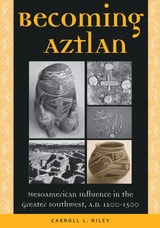
Becoming Aztlan
Mesoamerican Ingluence in the Greater Southwest, A.D. 1200-1500Carroll L Riley
University of Utah Press, 2005
In his latest book, Carroll Riley presents an ambitious overview of the continuities he sees in the geographically vast and culturally complex American Southwest and the adjacent northwest of Mexico. Aided by extensive illustrations, he argues that although the Southwest remained "southwestern" in its basic economy, there were drastic changes beginning around A.D. 1200 that transformed socio-religious life throughout the region. Riley calls this period Aztlan, a name adopted from the mythic Aztec land of origin. A Pueblo Indian in A.D. 800 would have gathered and farmed the same foods as his descendants, but by 1400 those distant relatives had a very different concept of the physical and spiritual universe.
In addition to bringing vast erudition and jargon-free prose to bear on a complex subject, Riley’s conclusions have potentially sweeping implications for the future of archaeological studies in the greater Southwest.
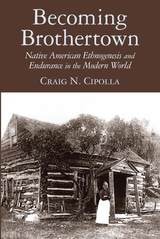
Becoming Brothertown
Native American Ethnogenesis and Endurance in the Modern WorldCraig N. Cipolla
University of Arizona Press, 2013
Covering the eighteenth century to the present, the book explores the emergence of the Brothertown Indians, a "new" community of Native peoples formed in direct response to colonialism and guided by the vision of Samson Occom, a Mohegan Indian and ordained Presbyterian minister. Breaking away from their home settlements of coastal New England during the late eighteenth century, members of various tribes migrated to Oneida Country in central New York State in hopes of escaping East Coast land politics and the corrupting influences of colonial culture. In the nineteenth century, the new community relocated once again, this time to present-day Wisconsin, where the Brothertown Indian Nation remains centered today.
Cipolla combines historical archaeology, gravestone studies, and discourse analysis to tell the story of the Brothertown Indians. The book develops a pragmatic approach to the study of colonialism while adding an archaeological perspective on Brothertown history, filling a crucial gap in the regional archaeological literature.
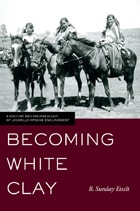
Becoming White Clay
A History and Archaeology of Jicarilla Apache EnclavementB. Sunday Eiselt
University of Utah Press, 2012
The story of one of the longest-lived and most successful nomadic enclaves in North America provides a rare glimpse into the material expressions of Apache self-determination and survival. For nearly 200 years the Jicarilla Apache of New Mexico thrived in the interstices of Pueblo and Spanish settlements following their expulsion from the Plains. Critical to their success was their ability to extend key aspects of Plains-Pueblo exchange to Indian and mixed-blood communities on the fringes of colonial rule. More than other nomadic tribes, the Jicarilla played an enormous role in holding together the social fabric of New Mexican villages after the fall of the Spanish Empire.
This comprehensive study by Sunday Eiselt begins with the great Athapaskan migration out of Canada during prehis-toric times and ends with the forced settlement of the Jicarilla on the Dulce reservation in the 1880s. Eiselt combines archaeological and ethnohistorical data in an examination of Jicarilla strategies for self-preservation. She reveals the ideological and political imperatives of “belonging” that shaped their interactions with local communities and the state and that enabled them to avoid reservation life well into the 1880s. Throughout their long history, Jicarilla identity remained intact, distinctive, and discernable even as life on the reservation disrupted the intimate connections that once existed with their Hispanic and Pueblo neighbors.
Between Home and Homeland
Youth Aliyah from Nazi GermanyBrian Amkraut
University of Alabama Press, 2006
As Hitler consolidated power, Jews and their allies in Germany began efforts to leave the country. Among them was the organization, Youth Aliyah. Based on abundant archival sources and a thorough use of secondary literature, Brian Amkraut details the story of the organization from its origins through its alliances and antagonisms with other Jewish organizations, and the challenges that vexed its efforts from every side, perhaps the greatest being sheer human naiveté ("surely things will get better").
Amkraut also discusses the identity dilemma for Jews who grew up feeling German, and then had to alter their self-image in the face of growing discrimination. He highlights the internal disagreements of Jewish agencies who wrestled with myriad problems. The author explores how German Jews were ideologically heterogeneous, and details how different groups coped with increasing antagonism in a variety of ways.
To this day, Youth Aliyah is considered by Israelis as a major contributor to the foundation of a Jewish presence leading to the modern state of Israel. Between Home and Homeland is an essential account of an important episode in the history of the Holocaust and the founding of the Isreali state.
Between Two Homelands
Argentine Migration to and from IsraelAdrián Krupnik
University of Alabama Press, 2024
Emigration from Israel to other parts of the world has not yet received significant scholarly attention, as the subject is a sensitive one in Israeli society. Zionist ideology has long compelled Israelis to approach emigration from Israel through a biased lens. The Hebrew words aliyah and yerida, which mean, respectively, “ascent” and “descent,” are often used to refer to immigration and emigration. These ideological terms, which are charged with religious meaning, are heavily loaded with praise for immigrants and scorn for emigrants. Yet, thousands of Jews from all over the world have lived between two homelands, as the Israeli-Argentine case demonstrates. This study challenges the formerly dominant Zionist narrative that presents immigration to Israel as unique and emigration as a disgrace, shedding light on issues of immigrant identities, belonging, and expectations.
Covering the better part of the twentieth century and extending into the twenty-first, Adrián Krupnik bases his study both on interviews and on archival documents in English, Spanish, and Hebrew to give voice to Argentine migrants to and from Israel. The pursuit of two often irreconcilable ways of living—peace and economic prosperity—repeatedly vexed migrants moving in either direction. Many Jewish-Argentine migrants between 1980 and 2006 lost everything and became the “new poor” in both countries. Protracted recessions and incessant political crises in Argentina continued to drive migrants in one direction, only to arrive in an Israel submerged in the violence of multiple intifadas.
In our own era, one that will see unprecedented global migration patterns based on similar economic and political—and environmental—upheavals, Between Two Homelands serves as an important and informative cautionary tale of the personal, social, and economic stakes at play in an utterly unsettled globalized landscape.
Beyond Chaco
Great Kiva Communities on the Mogollon Rim FrontierSarah A. Herr
University of Arizona Press, 2001
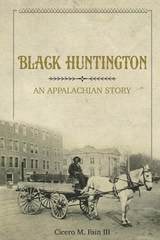
Black Huntington
An Appalachian StoryCicero M. Fain III
University of Illinois Press, 2019
How African Americans thrived in a West Virginia city
By 1930, Huntington had become West Virginia's largest city. Its booming economy and relatively tolerant racial climate attracted African Americans from across Appalachia and the South. Prosperity gave these migrants political clout and spurred the formation of communities that defined black Huntington--factors that empowered blacks to confront institutionalized and industrial racism on the one hand and the white embrace of Jim Crow on the other. Cicero M. Fain III illuminates the unique cultural identity and dynamic sense of accomplishment and purpose that transformed African American life in Huntington. Using interviews and untapped archival materials, Fain details the rise and consolidation of the black working class as it pursued, then fulfilled, its aspirations. He also reveals how African Americans developed a host of strategies--strong kin and social networks, institutional development, property ownership, and legal challenges--to defend their gains in the face of the white status quo. Eye-opening and eloquent, Black Huntington makes visible another facet of the African American experience in Appalachia.
Blacks on the Border
The Black Refugees in British North America, 1815–1860Harvey Whitfield
University Press of New England, 2006
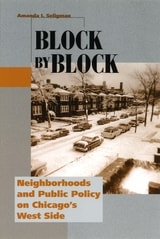
Block by Block
Neighborhoods and Public Policy on Chicago's West SideAmanda I. Seligman
University of Chicago Press, 2005
Seligman's study reveals that the responses of white West Siders to racial changes occurring in their neighborhoods were both multifaceted and extensive. She shows that, despite rehabilitation efforts, deterioration in these areas began long before the color of their inhabitants changed from white to black. And ultimately, the riots that erupted on Chicago's West Side and across the country in the mid-1960s stemmed not only from the tribulations specific to blacks in urban centers but also from the legacy of accumulated neglect after decades of white occupancy. Seligman's careful and evenhanded account will be essential to understanding that the "flight" of whites to the suburbs was the eventual result of a series of responses to transformations in Chicago's physical and social landscape, occurring one block at a time.
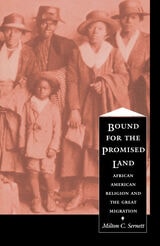
Bound For the Promised Land
African American Religion and the Great MigrationMilton C. Sernett
Duke University Press, 1997
Drawing on a range of sources—interviews, government documents, church periodicals, books, pamphlets, and articles—Sernett shows how the mass migration created an institutional crisis for black religious leaders. He describes the creative tensions that resulted when the southern migrants who saw their exodus as the Second Emancipation brought their religious beliefs and practices into northern cities such as Chicago, and traces the resulting emergence of the belief that black churches ought to be more than places for "praying and preaching." Explaining how this social gospel perspective came to dominate many of the classic studies of African American religion, Bound for the Promised Land sheds new light on various components of the development of black religion, including philanthropic endeavors to "modernize" the southern black rural church. In providing a balanced and holistic understanding of black religion in post–World War I America, Bound for the Promised Land serves to reveal the challenges presently confronting this vital component of America’s religious mosaic.
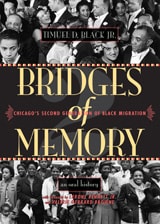
Bridges of Memory Volume 2
Chicago's Second Generation of Black MigrationTimuel Black
Northwestern University Press, 2008
In the second volume of Bridges of Memory, historian Timuel D. Black Jr. continues his conversations with African-Americans who migrated to Chicago from the South in search of economic, social, and cultural opportunities. With his trademark gift for interviewing, Black-himself the son of first-generation migrants to Chicago-guides these individual discussions with ease, resulting in first-person narratives that are informative and entertaining.
Picking up where the first book left off, volume 2 introduces the reader to more members of the first wave of migration and also members of the second generation, the children of those who came in the first wave. In telling their stories, the interviewees paint a vivid picture of the thriving and tight-knit Chicago community formerly known as the Black Belt—today's historic Bronzeville neighborhood. They bring to life the role of family, religion, business, music, and, most of all, the hopes, dreams, and perseverance that enabled a group of people to establish a successful community within a larger society that seemed determined to keep them from success. The experiences of these diverse and vivid personalities often illustrate the role that racial prejudice has played in shaping the specific arcs of their lives. But personal histories such as these are not just chronicles of frustration and despair; more important these narratives reveal an unwavering dedication to breaking the color line and a tireless pursuit of their right to the promise of America.
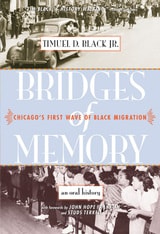
Bridges of Memory
Chicago's First Wave of Black MigrationTimuel D. Black Jr.
Northwestern University Press, 2005
Co-published with the DuSable Museum of African American History
Recipient of 2007 The Hyde Park Historical Society Paul Cornell Award
A collection of interviews with African Americans who came to Chicago from the South. In their first great migration to Chicago that began during World War I, African Americans came from the South seeking a better life--and fleeing a Jim Crow system of racial prejudice, discrimination, and segregation. What they found was much less than what they'd hoped for, but it was much better than what they'd come from--and in the process they set in motion vast changes not only in Chicago but also in the whole fabric of American society. This book, the first of three volumes, revisits this momentous chapter in American history with those who lived it.
Oral history of the first order, Bridges of Memory lets us hear the voices of those who left social, political, and economic oppression for political freedom and opportunity such as they'd never known--and for new forms of prejudice and segregation. These children and grandchildren of ex-slaves found work in the stockyards and steel mills of Chicago, settled and started small businesses in the "Black Belt" on the South Side, and brought forth the jazz, blues, and gospel music that the city is now known for. Historian Timuel D. Black, Jr., himself the son of first-generation migrants to Chicago, interviews a wide cross-section of African Americans whose remarks and reflections touch on issues ranging from fascism to Jim Crow segregation to the origin of the blues. Their recollections comprise a vivid record of a neighborhood, a city, a society, and a people undergoing dramatic and unprecedented changes.