Results by title
129 books match the query 'Natural resources' and 8 start with b
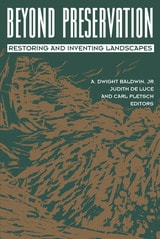
Beyond Preservation
Restoring and Inventing LandscapesDwight Baldwin
University of Minnesota Press, 1994
Beyond Preservation was first published in 1993. Minnesota Archive Editions uses digital technology to make long-unavailable books once again accessible, and are published unaltered from the original University of Minnesota Press editions.
Addressing current ecological issues, from the philosophical to the practical, Frederick Turner and William R. Jordan III Here offer a new paradigm for understanding the relationship between the humans and nature. Challenging the idea that preserving nature is the only solution to environmental problems, they advocate going beyond preservation to restoration and actual construction of our landscape. Fifteen respondents reflect on the implications and consequences of Turner’s and Jordan’s bold proposals.“Ecological restoration is the most helpful and provocative contribution to our thinking about nature to come along in many years, and Beyond Preservation is without a doubt the best book on the subject to date.” Michael Polan, Harper’sContributors include Gary W. Barrett, Ann Cline, David L. Gorchov, William Jordan III, G. Stanley Kane, Jack Temple Kirby, Dora G. Lodwick, Orie L. Loucks, Kimberly E. Medley, Constance Pierce, Ellen Price, Frederick Turner, John E. Wierwille, and Gene E. Willeke.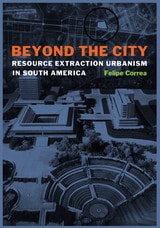
Beyond the City
Resource Extraction Urbanism in South AmericaBy Felipe Correa
University of Texas Press, 2016
During the last decade, the South American continent has seen a strong push for transnational integration, initiated by the former Brazilian president Fernando Henrique Cardoso, who (with the endorsement of eleven other nations) spearheaded the Initiative for the Integration of Regional Infrastructure in South America (IIRSA), a comprehensive energy, transport, and communications network. The most aggressive transcontinental integration project ever planned for South America, the initiative systematically deploys ten east-west infrastructural corridors, enhancing economic development but raising important questions about the polarizing effect of pitting regional needs against the colossal processes of resource extraction. Providing much-needed historical contextualization to IIRSA’s agenda, Beyond the City ties together a series of spatial models and offers a survey of regional strategies in five case studies of often overlooked sites built outside the traditional South American urban constructs.
Implementing the term “resource extraction urbanism,” the architect and urbanist Felipe Correa takes us from Brazil’s nineteenth-century regional capital city of Belo Horizonte to the experimental, circular, “temporary” city of Vila Piloto in Três Lagoas. In Chile, he surveys the mining town of María Elena. In Venezuela, he explores petrochemical encampments at Judibana and El Tablazo, as well as new industrial frontiers at Ciudad Guayana. The result is both a cautionary tale, bringing to light a history of societies that were “inscribed” and administered, and a perceptive examination of the agency of architecture and urban planning in shaping South American lives.
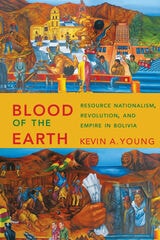
Blood of the Earth
Resource Nationalism, Revolution, and Empire in BoliviaBy Kevin A. Young
University of Texas Press, 2017
Conflicts over subterranean resources, particularly tin, oil, and natural gas, have driven Bolivian politics for nearly a century. “Resource nationalism”—the conviction that resource wealth should be used for the benefit of the “nation”—has often united otherwise disparate groups, including mineworkers, urban workers, students, war veterans, and middle-class professionals, and propelled an indigenous union leader, Evo Morales, into the presidency in 2006. Blood of the Earth reexamines the Bolivian mobilization around resource nationalism that began in the 1920s, crystallized with the 1952 revolution, and continues into the twenty-first century.
Drawing on a wide array of Bolivian and US sources, Kevin A. Young reveals that Bolivia became a key site in a global battle among economic models, with grassroots coalitions demanding nationalist and egalitarian alternatives to market capitalism. While US-supported moderates within the revolutionary regime were able to defeat more radical forces, Young shows how the political culture of resource nationalism, though often comprising contradictory elements, constrained government actions and galvanized mobilizations against neoliberalism in later decades. His transnational and multilevel approach to the 1952 revolution illuminates the struggles among Bolivian popular sectors, government officials, and foreign powers, as well as the competing currents and visions within Bolivia’s popular political cultures. Offering a fresh appraisal of the Bolivian Revolution, resource nationalism, and the Cold War in Latin America, Blood of the Earth is an ideal case study for understanding the challenges shared by countries across the Global South.
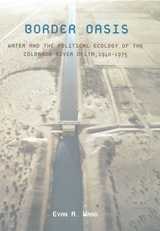
Border Oasis
Water and the Political Ecology of the Colorado River Delta, 1940–1975Evan R. Ward
University of Arizona Press, 2003
Evan Ward explores the rapid development of this region, examining the ways in which regional politics and international relations created a garden in the Mexicali, Yuma, and Imperial Valleys while simultaneously threatening the life of the Colorado River. Tracing the transformation of the delta by irrigated agribusiness through the twentieth century, he draws on untapped archival resources from both sides of the border to offer a new look at one of the world's most contested landscapes.
Border Oasis tells how two very different nations developed the delta into an agricultural oasis at enormous environmental cost. Focusing on the years 1940 to 1975—including the disastrous salinity crisis of the 1960s and 1970s—it combines Mexican, Native American, and U.S. perspectives to demonstrate that the political and diplomatic influences on the delta played as much a part in the region's transformation as did irrigation. Ward reveals how mistrust among political and economic participants has been fueled by conflict between national and local officials on both sides of the border, by Mexican nationalism, and by a mutual recognition that water is the critical ingredient for regional economic development.
With overemphasis on development in both nations leading to an ecological breaking point, Ward demonstrates that conflicting interests have made sound binational management of the delta nearly impossible. By weaving together all of these threads that have produced the fabric of today's lower Colorado, his study shows that the environmental history of the delta must be understood as a whole, not from the standpoint of only one of many competing interests.
Border Water
The Politics of U.S.-Mexico Transboundary Water Management, 1945–2015Stephen Paul Mumme
University of Arizona Press, 2023
The international boundary between the United States and Mexico spans more than 1,900 miles. Along much of this international border, water is what separates one country from the other. Border Water provides a historical account of the development of governance related to transboundary and border water resources between the United States and Mexico in the last seventy years.
This work examines the phases and pivot points in the development of U.S.-Mexico border water resources and reviews the theoretical approaches and explanation that impart a better understanding of these events. Author Stephen Paul Mumme, a leading expert in water policy and border studies, describes three important periods in the chronology of transboundary water management. First, Mumme examines the 1944 Water Treaty, the establishment of the International Boundary and Water Commission (IBWC) in 1945, and early transborder politics between the two governments. Next, he describes the early 1970s and the rise of environmentalism. In this period, pollution and salinization of the Colorado River Delta come into focus. Mumme shows how new actors, now including environmentalists and municipalities, broadened and strengthened the treaty’s applications in transboundary water management. The third period of transborder interaction described covers the opening and restricting of borders due to NAFTA and then 9/11.
Border Water places transboundary water management in the frame of the larger binational relationship, offering a comprehensive history of transnational water management between the United States and Mexico. As we move into the next century of transnational water management, this important work offers critical insights into lessons learned and charts a path for the future.
Bringing in the Future
Strategies for Farsightedness and Sustainability in Developing CountriesWilliam Ascher
University of Chicago Press, 2009
Humans are plagued by shortsighted thinking, preferring to put off work on complex, deep-seated, or difficult problems in favor of quick-fix solutions to immediate needs. When short-term thinking is applied to economic development, especially in fragile nations, the results—corruption, waste, and faulty planning—are often disastrous. In Bringing in the Future, William Ascher draws on the latest research from psychology, economics, institutional design, and legal theory to suggest strategies to overcome powerful obstacles to long-term planning in developing countries.
Drawing on cases from Africa, Asia, and Latin America, Ascher applies strategies such as the creation and scheduling of tangible and intangible rewards, cognitive exercises to increase the understanding of longer-term consequences, self-restraint mechanisms to protect long-term commitments and enhance credibility, and restructuring policy-making processes to permit greater influence of long-term considerations. Featuring theoretically informed research findings and sound policy examples, this volume will assist policy makers, activists, and scholars seeking to understand how the vagaries of human behavior affect international development.

Bureaucrats, Clients, and Geography
The Bailly Nuclear Power Plant Battle in Northern IndianaNancy J. Obermeyer
University of Chicago Press, 1989
Buying Time
Environmental Collapse and the Future of EnergyKaz Makabe
University Press of New England, 2017