Results by title
58 books match the query 'Navajo Indians' and 5 start with b
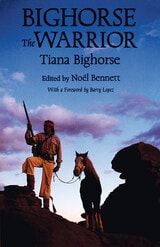
Bighorse the Warrior
Tiana Bighorse; Edited by Noël Bennett
University of Arizona Press, 1994
"I want to talk about my tragic story, because if I don't, it will get into my mind and get into my dream and make me crazy."
When the Navajos were taken from their land by the federal government in the 1860s, thousands lost their lives on the infamous Long Walk, while those who eluded capture lived in constant fear. These men and women are now dead, but their story lives on in the collective memory of their tribe.
Gus Bighorse lived through that period of his people's history, and his account of it—recalled by his daughter Tiana and retold in her father's voice—provides authentic glimpses into Navajo life and values of a century ago. Born around 1846, Gus was orphaned at sixteen when his parents were killed by soldiers, and he went into hiding with other Navajos banded together under chiefs like Manuelito. Over the coming years, he was to see members of his tribe take refuge in Canyon de Chelly, endure the Long Walk from Fort Defiance to Bosque Redondo in 1864, and go into hiding at Navajo Mountain. Gus himself was the leader of one of Manuelito's bands who fought against Kit Carson's troops.
After the Navajos were allowed to return to their land, Gus took up the life of a horseman, only to see his beloved animals decimated in a government stock reduction program.
"I know some people died of their tragic story," says Gus. "They think about it and think about how many relatives they lost. Their parents got shot. They get into shock. That is what kills them. That is why we warriors have to talk to each other. We wake ourselves up, get out of the shock. And that is why I tell my kids what happened, so it won't be forgot." Throughout his narrative, he makes clear those human qualities that for the Navajos define what it is to be a warrior: vision, compassion, courage, and endurance.
Befitting the oral tradition of her people, Tiana Bighorse draws on her memory to tell her father's story. In doing so, she ensures that a new generation of Navajos will know how the courage of their ancestors enabled their people to have their reservation today: "They paid for our land with their lives." Following the text is a chronology of Navajo history, with highlights of Gus Bighorse's life placed in the context of historical events.
[more]
Bitter Water
Diné Oral Histories of the Navajo-Hopi Land DisputeEdited and Translated by Malcolm D. Benally; Foreword by Jennifer Nez Denetdale
University of Arizona Press, 2011
Many know that the removal and relocation of Indigenous peoples from traditional lands is a part of the United States’ colonial past, but few know that—in an expansive corner of northeastern Arizona—the saga continues. The 1974 Settlement Act officially divided a reservation established almost a century earlier between the Diné (Navajo) and the Hopi, and legally granted the contested land to the Hopi. To date, the U.S. government has relocated between 12,000 and 14,000 Diné from Hopi Partitioned Lands, and the Diné—both there and elsewhere—continue to live with the legacy of this relocation.
Bitter Water presents the narratives of four Diné women who have resisted removal but who have watched as their communities and lifeways have changed dramatically. The book, based on 25 hours of filmed personal testimony, features the women’s candid discussions of their efforts to carry on a traditional way of life in a contemporary world that includes relocation and partitioned lands; encroaching Western values and culture; and devastating mineral extraction and development in the Black Mesa region of Arizona. Though their accounts are framed by insightful writings by both Benally and Diné historian Jennifer Nez Denetdale, Benally lets the stories of the four women elders speak for themselves.
Scholars, media, and other outsiders have all told their versions of this story, but this is the first book that centers on the stories of women who have lived it—in their own words in Navajo as well as the English translation. The result is a living history of a contested cultural landscape and the unique worldview of women determined to maintain their traditions and lifeways, which are so intimately connected to the land. This book is more than a collection of stories, poetry, and prose. It is a chronicle of resistance as spoken from the hearts of those who have lived it.
[more]
Blessingway
With Three Versions of the Myth Recorded and Translated from the Navajo by Father Berard Haile, O.F.M.Leland C. Wyman
University of Arizona Press, 1970
An outstanding work crafted from the handwritten pages of translations from the Navajo of the late Father Berard Haile giving three separate versions of the Blessingway rite with each version consisting of a prose text accompanied by the ritual songs and prayers. Valuable insights into the character and use of the Blessingway rite; its ceremonial procedures, its mythology, and its drypaintings.
[more]
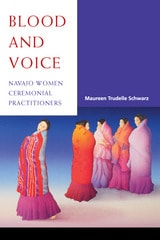
Blood and Voice
Navajo Women Ceremonial PractitionersMaureen Trudelle Schwarz
University of Arizona Press, 2003
Adulthood in the Navajo world is marked by the onset of menstruation in females and by the deepening of the voice in males. Accordingly, young adults must accept responsibility over the powers manifest in blood and voice: for women, the forces that control reproduction and growth; for men, the powers of protection and restoration of order that come through maintaining Navajo oral tradition.
The maintenance of the latter tradition has long been held to be the function of the Navajo singer, a role usually viewed as male. But despite this longstanding assumption, women can and do fill this role. Drawing on interviews with seventeen Navajo women practitioners and five apprentices, Maureen Trudelle Schwarz explicates women's role as ceremonial practitioners and shows that it is more complex than has previously been thought. She examines gender differences dictated by the Navajo origin story, details how women came to be practitioners, and reveals their experiences and the strategies they use to negotiate being both woman and singer.
Women who choose careers as singers face complex challenges, since some rules prohibit menstruating women from conducting ceremonies and others regarding sexual continence can strain marital relationships. Additionally, oral history places men in charge of all ceremonial matters. Schwarz focuses on how the reproductive life courses of Navajo women influence their apprenticeships and practices to demonstrate how they navigate these issues to preserve time-honored traditions. Through the words of actual practitioners, she shows how each woman brings her own unique life experience to the role. While differing among individuals, these experiences represent a commitment to shared cultural symbols and result in a consensus that sustains social cohesion.
By showing the differences and similarities between the apprenticeship, initiation, and practice of men and women singers, Blood and Voice offers a better understanding of the role of Navajo women in a profession usually viewed as a male activity—and of the symbolic construction of the self in Navajo culture. It also addresses classic questions concerning the sexual division of labor, menstrual taboos, gender stereotypes, and the tension between tradition and change that will enlighten students of other cultures.
[more]
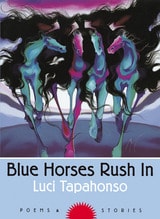
Blue Horses Rush In
Poems and StoriesLuci Tapahonso
University of Arizona Press, 1997
Wrapped in blankets and looking at the stars, a young Navajo girl listened long ago to stories that would guide her for the rest of her life. "Such summer evenings were filled with quiet voices, dogs barking far away, the fire crackling, and often we could hear the faint drums and songs of a ceremony somewhere in the distance," writes Luci Tapahonso in this compelling collection.
Blue Horses Rush In takes its title from a poem about the birth of her granddaughter Chamisa, whose heart "pounded quickly and we recognized / the sound of horses running: / the thundering of hooves on the desert floor." Through such personal insights, this collection follows the cycle of a woman's life and underlines what it means to be Navajo in the late twentieth century. The book marks a major accomplishment in American literature for its successful blending of Navajo cultural values and forms with the English language, while at the same time retaining the Navajo character. Here, Luci Tapahonso walks slowly through an ancient Hohokam village, recalling stories passed down from generation to generation. Later in the book, she may tell a funny story about a friend, then, within a few pages, describe family rituals like roasting green chiles or baking bread in an outside oven. Throughout, Tapahonso shares with readers her belief in the power of pollen and prayer feathers and sacred songs.
Many of these stories were originally told in Navajo, taking no longer than ten minutes in the telling. "Yet, in recreating them, it is necessary to describe the land, the sky, the light, and other details of time and place," writes Tapahonso. "In this way, I attempt to create and convey the setting for the oral text. In writing, I revisit the place or places concerned and try to bring the reader to them, thereby enabling myself and other Navajos to sojourn mentally and emotionally in our home, Dinétah."
[more]