Results by title
208 books match the query 'Ohio' and 12 start with b
BANKSTERS BOSSES SMART MONEY
SOCIAL HISTORY OF GREAT TOLEDO BANK CRASTIMOTHY MESSER-KRUSE
The Ohio State University Press, 2004

BLACK SWAMP FARM
Howard E. Good
The Ohio State University Press, 1997
Good remembers playing shinny with clamp-on skates and a tin can that had been stomped until it could whiz across the ice given just the right combination of speed and accuracy. He tells of the boom of the steam engine as it pulled the threshing machine to a neighboring farm on a hot summer day, and of the excitement of riding high on a wagonload of hay, gazing down on the horses’ broad, shining backs. He describes the springtime task of making soap, the ritual of the shivaree, and the pleasure of the church ice-cream social. He remembers well—and chronicles for the reader—the unproclaimed achievements of men and women whose courage and grueling toil brought them rich rewards.
First published in 1967, this reprint makes available once again a faithful portrayal of Black Swamp—a place that no longer exists—and provides a treasure trove of history for Ohioans.

BUILDERS OF OHIO
A Biographical HistoryEdited by Warren Van Tine and Michael Pierce
The Ohio State University Press, 2003
Becoming Educated
A Midwest StorySimone C. Drake
The Ohio State University Press, 2026
Becoming Educated is Simone C. Drake’s engaging and bold memoir about race, class, gender, and the meaning of education in the urban Midwest. Drake, a scholar of literature, culture, and law, uses her own story as a Black girl attending recently desegregated Columbus public schools in the 1980s and 1990s to explore the United States’ most entrenched social problems and how local systems have tried to combat them. From starting kindergarten the year after an Ohio court decision called for busing to end school segregation, to climbing the ranks of academia, to her decision to send her sons to highly rated but largely white suburban schools, Drake weaves a lively and erudite accounting of her identity formation as an “integration guinea pig.” She punctuates her story with rich evocations of the music, TV, and film that shaped her generation, powerful reflections on relevant works by Black writers and artists from Dawoud Bey to Jay-Z, and images of her own artwork. This prismatic book is a must-read for Gen Xers, Midwesterners, and Americans of any race wanting to think more deeply about how our nation’s educational systems—and by extension, all of us—must reckon with inequalities past and present.
Believing in Cleveland
Managing Decline in “The Best Location in the Nation”J. Mark Souther
Temple University Press, 2017
Detractors have called it "The Mistake on the Lake." It was once America’s "Comeback City." According to author J. Mark Souther, Cleveland has long sought to defeat its perceived civic malaise. Believing in Cleveland chronicles how city leaders used imagery and rhetoric to combat and, at times, accommodate urban and economic decline.
Souther explores Cleveland's downtown revitalization efforts, its neighborhood renewal and restoration projects, and its fight against deindustrialization. He shows how the city reshaped its image when it was bolstered by sports team victories. But Cleveland was not always on the upswing. Souther places the city's history in the postwar context when the city and metropolitan area were divided by uneven growth. In the 1970s, the city-suburb division was wider than ever.
Believing in Cleveland recounts the long, difficult history of a city that entered the postwar period as America's sixth largest, then lost ground during a period of robust national growth. But rather than tell a tale of decline, Souther provides a fascinating story of resilience for what some folks called "The Best Location in the Nation."
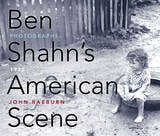
Ben Shahn's American Scene
Photographs, 1938John Raeburn
University of Illinois Press, 2010
The paintings, murals, and graphics of Ben Shahn (1898-1969) have made him one of the most heralded American artists of the twentieth century, but during the 1930s he was also among the nation's premier photographers. Much of his photographic work was sponsored by the New Deal's Farm Security Administration, where his colleagues included Dorothea Lange and Walker Evans.
Ben Shahn's American Scene: Photographs, 1938 presents one hundred superb photographs from his most ambitious FSA project, a survey of small-town life in the Depression. John Raeburn's accompanying text illuminates the thematic and formal significance of individual photographs and reveals how, taken together, they address key cultural and political issues of the years leading up to World War II. Shahn's photographs highlight conflicts between traditional values and the newer ones introduced by modernity as represented by the movies, chain stores, and the tantalizing allure of consumer goods, and they are particularly rich in observation about the changes brought about by Americans' universal reliance on the automobile. They also explore the small town's standing as the nation's symbol of democratic community and expose the discriminatory social and racial practices that subverted this ideal in 1930s America.
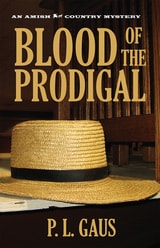
Blood of the Prodigal
An Amish Country MysteryP. L. Gaus
Ohio University Press, 1999
P. L. Gaus’s Blood of the Prodigal, a mystery in the tradition of Tony Hillerman, is back in a new edition, including an exclusive interview with the author, discussion questions for reading groups, and a detailed map and driving guide to Holmes County, Ohio, with everything one needs to visit the iconic scenes depicted in the story.
In Holmes County, Ohio—home to the largest Amish and Mennonite settlements in the world—mystery and foreboding lurk in the quiet Old Order Amish community led by Bishop Eli Miller.
The illusion of peace is shattered one early morning when a young Amish boy goes missing—abducted from his home and from Bishop Miller’s care. At first, the bishop suspects the child’s father, who was exiled from the Old Order ten years ago, but a murder soon casts doubt on the bishop’s theory. With a strong distrust of law enforcement and the modern “English” ways, the bishop must put his faith in an unlikely partnership with Professor Michael Branden before it’s too late.With the help of the peaceful pastor Cal Troyer and the reckless Sheriff Bruce Robertson, Branden plunges headlong into the closed culture to unravel the mystery of the missing child and uncover truths many would prefer to leave undisturbed.
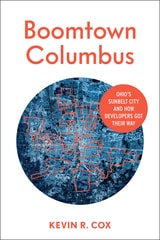
Boomtown Columbus
Ohio’s Sunbelt City and How Developers Got Their WayKevin R. Cox
The Ohio State University Press, 2021
How have development interests become entwined with government? How has a policy of annexation reformed the city’s map? Why have airline service and major league prestige lagged behind its status as a regional center? And what, if anything, makes this city with a reputation for being average stand apart? In Boomtown Columbus, Cox applies both scholarly expertise and his personal experience as a long-time resident of the city to look at the real-life costs of policy. The resulting narrative will fascinate not only locals but anyone with a stake in understanding American cities and a path toward urban livability for all.
Broken English
An Amish Country MysteryP. L. Gaus
Ohio University Press, 2000
Broken English is a tale of honor, deception, and revenge, one in which circumstances and the search for justice test the mettle of the closest of friends and reveal the desperate measures of the strongest of foes. Following on the critical and popular success of P. L. Gaus’ acclaimed Amish mystery series, this new edition of Broken English includes an exclusive interview with the author, discussion questions for reading groups, and a detailed map and driving guide to Holmes County, Ohio, with everything one needs to visit the iconic scenes depicted in the story.
The peaceful town of Millersburg, Ohio, in the heart of Amish country, is rocked by the vicious murder of a woman at the hands of an ex-convict. When a local reporter covering the story turns up dead, while the convict is already behind bars, suspicion falls on David Hawkins, the first victim’s father. With Hawkins nowhere to be found among the protective Amish community that had taken him in as one of its own, Professor Michael Branden, Sheriff Bruce Robertson, and Pastor Cal Troyer set out to uncover the elusive truth in this otherwise quiet corner of the world.
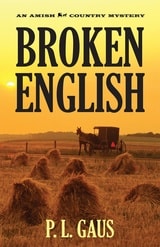
Broken English
An Amish Country MysteryP. L. Gaus
Ohio University Press, 2000
Broken English is a tale of honor, deception, and revenge, one in which circumstances and the search for justice test the mettle of the closest of friends and reveal the desperate measures of the strongest of foes. Following on the critical and popular success of P. L. Gaus’ acclaimed Amish mystery series, this new edition of Broken English includes an exclusive interview with the author, discussion questions for reading groups, and a detailed map and driving guide to Holmes County, Ohio, with everything one needs to visit the iconic scenes depicted in the story.
The peaceful town of Millersburg, Ohio, in the heart of Amish country, is rocked by the vicious murder of a woman at the hands of an ex-convict. When a local reporter covering the story turns up dead, while the convict is already behind bars, suspicion falls on David Hawkins, the first victim’s father. With Hawkins nowhere to be found among the protective Amish community that had taken him in as one of its own, Professor Michael Branden, Sheriff Bruce Robertson, and Pastor Cal Troyer set out to uncover the elusive truth in this otherwise quiet corner of the world.

Buckeye Schoolmaster
A Chronicle of Midwestern Rural Life, 1853–1865J. Merton England
University of Wisconsin Press, 1996
The journals and diaries of John M. Roberts provide an intimate view of the life and dthoughts of a young schoolmaster, miller, itenerant bookseller, and farmer in centreal Ohio in a time of rising sectional crisis and Civil War.
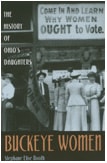
Buckeye Women
The History of Ohio’s DaughtersStephane Elise Booth
Ohio University Press, 2001
By the last two decades of the twentieth century, Ohio women had held positions as university presidents, chief executive officers, judges, superintendents of schools, and lieutenant governor. They had won Pulitzer Prizes and, in one case, the Nobel Prize for Literature.
But these women stood on the shoulders of those who came before: the pioneering women who helped tame the Ohio frontier, who filled the breach, who worked for reform, and who struggled for their own rights as citizens of one of the most prosperous states in the Union.
Buckeye Women is an accessible and comprehensive account of the role Ohio women have assumed in the history of the state and a narrative of their hardships and of the victories that have been won in the past two hundred years.
In this timely contribution to the Ohio Bicentennial Series, Professor Stephane Booth has written a rich and well-researched volume, providing for the first time a record of the vast and pivotal accomplishments shared by the women of Ohio over the last two centuries and documenting their contribution to the state’s remarkable heritage.