Results by title
117 books match the query 'Opera' and 5 start with b
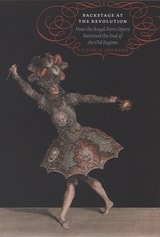
Backstage at the Revolution
How the Royal Paris Opera Survived the End of the Old RegimeVictoria Johnson
University of Chicago Press, 2008
On July 14, 1789, a crowd of angry French citizens en route to the Bastille broke into the Paris Opera and helped themselves to any sturdy weapon they could find. Yet despite its long association with the royal court, its special privileges, and the splendor of its performances, the Opera itself was spared, even protected, by Revolutionary officials. Victoria Johnson’s Backstage at the Revolution tells the story of how this legendary opera house, despite being a lightning rod for charges of tyranny and waste, weathered the most dramatic political upheaval in European history.
Sifting through royal edicts, private letters, and Revolutionary records of all kinds, Johnson uncovers the roots of the Opera’s survival in its identity as a uniquely privileged icon of French culture—an identity established by the conditions of its founding one hundred years earlier under Louis XIV. Johnson’s rich cultural history moves between both epochs, taking readers backstage to see how a motley crew of singers, dancers, royal ministers, poet entrepreneurs, shady managers, and the king of France all played a part in the creation and preservation of one of the world’s most fabled cultural institutions.
Sifting through royal edicts, private letters, and Revolutionary records of all kinds, Johnson uncovers the roots of the Opera’s survival in its identity as a uniquely privileged icon of French culture—an identity established by the conditions of its founding one hundred years earlier under Louis XIV. Johnson’s rich cultural history moves between both epochs, taking readers backstage to see how a motley crew of singers, dancers, royal ministers, poet entrepreneurs, shady managers, and the king of France all played a part in the creation and preservation of one of the world’s most fabled cultural institutions.
[more]

Bianca e Falliero, o sia Il Consiglio dei Tre
Melodramma in Two Acts by Felice RomaniGioachino Rossini
University of Chicago Press, 1996
In 1819, a watershed year in the Milanese debates between "classicism" and "romanticism," Rossini prepared Bianca e Falliero, o sia Il consiglio dei Tre (Bianca and Falliero, or The Council of Three) for La Scala, where his opere serie had never fared well. Working with a confirmed "classicist" librettist, he created a traditionally structured bel canto tour-de-force that ran for thirty-nine performances—still a record for his serious operas at La Scala.
Heavily butchered in later productions, Bianca e Falliero soon disappeared from the stage, but its finest pieces remained in concert repertory for half a century. The critical edition—the first publication of the full score—restores the original Milan version. An appendix offers Rossini's vocal variants for the two lead roles.
Heavily butchered in later productions, Bianca e Falliero soon disappeared from the stage, but its finest pieces remained in concert repertory for half a century. The critical edition—the first publication of the full score—restores the original Milan version. An appendix offers Rossini's vocal variants for the two lead roles.
[more]
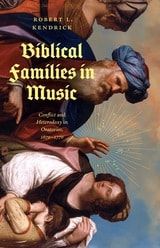
Biblical Families in Music
Conflict and Heterodoxy in Oratorios, 1670–1770Robert L. Kendrick
University of Chicago Press, 2025
Examines how stories of biblical families were reconfigured and projected in the genre of the oratorio, a form of sacred opera, in the seventeenth and eighteenth centuries.
Based to a great extent on the Old Testament, the largely Catholic musical-dramatic genre was popular in Italy, Austria, and southern Germany in the seventeenth and eighteenth centuries. Biblical Families in Music reveals how difficult stories of fratricide, child sacrifice, death, and forbidden love performed a didactic function in oratorios, teaching early modern audiences about piety and the rules of proper family life.
In the century after 1670, the heavily adapted tales of Abraham and Isaac, Cain and Abel, and the Egyptian slave Hagar and her son Ishmael were set to music by figures such as Alessandro Scarlatti and Antonio Sacchini and performed during Lent in churches and other sacred spaces for an audience of court nobility, clergy, and the urban patriciate. By examining the resonance of Catholic oratorios within predominantly upper-class social realities, the book broadens our cultural understanding of the early modern European family and underscores the centrality of family and familial relation to social position, devotional taste, and identity.
[more]
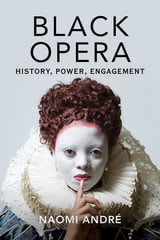
Black Opera
History, Power, EngagementNaomi Andre
University of Illinois Press, 2018
From classic films like Carmen Jones to contemporary works like The Diary of Sally Hemings and U-Carmen eKhayelitsa, American and South African artists and composers have used opera to reclaim black people's place in history. Naomi André draws on the experiences of performers and audiences to explore this music's resonance with today's listeners. Interacting with creators and performers, as well as with the works themselves, André reveals how black opera unearths suppressed truths. These truths provoke complex, if uncomfortable, reconsideration of racial, gender, sexual, and other oppressive ideologies. Opera, in turn, operates as a cultural and political force that employs an immense, transformative power to represent or even liberate. Viewing opera as a fertile site for critical inquiry, political activism, and social change, Black Opera lays the foundation for innovative new approaches to applied scholarship.
[more]
Blackness in Opera
Edited by Naomi André, Karen M. Bryan, and Eric Saylor
University of Illinois Press, 2012
Blackness in Opera critically examines the intersections of race and music in the multifaceted genre of opera. A diverse cross-section of scholars places well-known operas (Porgy and Bess, Aida, Treemonisha) alongside lesser-known works such as Frederick Delius's Koanga, William Grant Still's Blue Steel, and Clarence Cameron White's Ouanga! to reveal a new historical context for re-imagining race and blackness in opera. The volume brings a wide-ranging, theoretically informed, interdisciplinary approach to questions about how blackness has been represented in these operas, issues surrounding characterization of blacks, interpretation of racialized roles by blacks and whites, controversies over race in the theatre and the use of blackface, and extensions of blackness along the spectrum from grand opera to musical theatre and film. In addition to essays by scholars, the book also features reflections by renowned American tenor George Shirley.
Contributors are Naomi André, Melinda Boyd, Gwynne Kuhner Brown, Karen M. Bryan, Melissa J. de Graaf, Christopher R. Gauthier, Jennifer McFarlane-Harris, Gayle Murchison, Guthrie P. Ramsey Jr., Eric Saylor, Sarah Schmalenberger, Ann Sears, George Shirley, and Jonathan O. Wipplinger.
[more]