Results by title
4917 books match the query 'Philosophy' and 154 start with b
BEING PROFILED
COGITAS ERGO SUM: 10 Years of Profiling the European CitizenEmre Bayamlioglu
Amsterdam University Press, 2019

Babies and Beasts
THE ARGUMENT FROM MARGINAL CASESDaniel A. Dombrowski
University of Illinois Press, 1997
Both its defenders and detractors
have described the argument from marginal cases as the most important
to date in defense of animal rights. Hotly debated among philosophers
for some twenty years, the argument concludes that no morally relevant
characteristic distinguishes human beings–including infants, the
severely retarded, the comatose, and other "marginal cases"--from
any other animals.
Babies and Beasts presents
the first book-length exploration of the broad range of views relating
to the argument from marginal cases and sorts out and evaluates its various
uses and abuses.
Daniel Dombrowski analyzes
the views of many who are prominent in the debate--
Peter Singer, Thomas Regan, H. J. McCloskey, Jan Narveson, John Rawls,
R. G. Frey, Peter Carruthers, Michael Leahy, Robert Nozick, and James
Rachels are included--in a volume that will be essential to philosophers,
animal rights activists, those who work in clinical settings, and others
who must sometimes deal with "marginal cases."
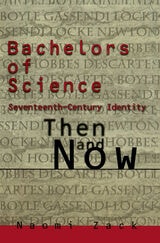
Bachelors of Science
Seventeenth Century Identity, Then and NowNaomi Zack
Temple University Press, 1996
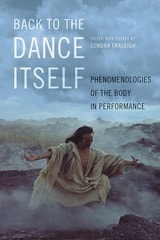
Back to the Dance Itself
Phenomenologies of the Body in PerformanceEdited with Essays by Sondra Fraleigh
University of Illinois Press, 2018
Contributors: Karen Barbour, Christine Bellerose, Robert Bingham, Kara Bond, Hillel Braude, Sondra Fraleigh, Kimerer LaMothe, Joanna McNamara, Vida Midgelow, Ami Shulman, and Amanda Williamson.
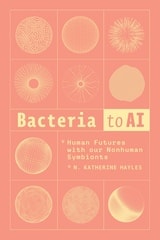
Bacteria to AI
Human Futures with Our Nonhuman SymbiontsN. Katherine Hayles
University of Chicago Press, 2025
A new theory of mind that includes nonhuman and artificial intelligences.
The much-lauded superiority of human intelligence has not prevented us from driving the planet into ecological disaster. For N. Katherine Hayles, the climate crisis demands that we rethink basic assumptions about human and nonhuman intelligences. In Bacteria to AI, Hayles develops a new theory of mind—what she calls an integrated cognitive framework (ICF)—that includes the meaning-making practices of lifeforms from bacteria to plants, animals, humans, and some forms of artificial intelligence. Through a sweeping survey of evolutionary biology, computer science, and contemporary literature, Hayles insists that another way of life, with ICF at its core, is not only possible but necessary to safeguard our planet’s future.
Bad Acts and Guilty Minds
Conundrums of the Criminal LawLeo Katz
University of Chicago Press, 1987
"Bad Acts and Guilty Minds . . . revives the mind, it challenges superficial analyses, it reminds us that underlying the vast body of statutory and case law, there is a rationale founded in basic notions of fairness and reason. . . . It will help lawyers to better serve their clients and the society that permits attorneys to hang out their shingles."—Edward N. Costikyan, New York Times Book Review
Bad Education
Why Queer Theory Teaches Us NothingLee Edelman
Duke University Press, 2022
Bad Faith Good Faith
Ronald E. Santoni
Temple University Press, 1995
From the beginning to the end of his philosophizing, Sartre appears to have been concerned with "bad faith"—our "natural" disposition to flee from our freedom and to lie to ourselves. Virtually no aspect of his monumental system has generated more attention. Yet bad faith has been plagued by misinterpretation and misunderstanding. At the same time, Sartre's correlative concepts of "good faith" and "authenticity" have suffered neglect or insufficient attention, or been confused and wrongly identified by Sartre scholars, even by Sartre himself.
Ronald E. Santoni takes on the challenge of distinguishing these concepts, and of showing whether either or both existential "attitudes" afford deliverance from the hell of Sartre's bad faith. He offers the first fill-scale analysis, reconstruction, and differentiation of these ways of existing as they develop in Sartre's early works (1937-1947).
Although he attempts to redeem Sartre's slighted concept of good faith, Santoni warns that it must not be viewed interchangeably with authenticity. Further, in one of the earliest and most sustained studies of Sartre's Notebooks for an Ethics available in English, Santoni shows how Sartre's posthumously published notes for an "ethics of Salvation" confirm his differentiation and argument. The way out of Sartrean hell, Santoni insists, is authenticity—living "with fidelity" to our unjustifiable freedom and assuming responsibility for it.

Bad Marxism
Capitalism and Cultural StudiesJohn Hutnyk
Pluto Press, 2004
Badiou and Politics
Bruno Bosteels
Duke University Press, 2011
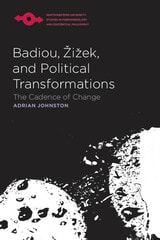
Badiou, Zizek, and Political Transformations
The Cadence of ChangeAdrian Johnston
Northwestern University Press, 2009
Alain Badiou and Slavoj Žižek together have emerged as two of Europe’s most significant living philosophers. In a shared spirit of resistance to global capitalism, both are committed to bringing philosophical reflection to bear upon present-day political circumstances. These thinkers are especially interested in asking what consequences the supposed twentieth-century demise of communism entails for leftist political theory in the early twenty-first century.
Badiou, Žižek, and Political Transformations examines Badiouian and Žižekian depictions of change, particularly as deployed at the intersection of philosophy and politics. The book details the origins of Badiou’s concept of the event and Žižek’s concept of the act as related theoretical visions of revolutionary happenings, delineating a number of difficulties arising from these similar concepts. Johnston finds that Badiou and Žižek tend to favor models of transformation that risk discouraging in advance precisely the efforts at changing the world of today that these uncompromising leftists so ardently desire. Badiou, Žižek, and Political Transformations will surely join Johnston’s Žižek’s Ontology as an instant classic in its field.

Badiou
A Subject To TruthPeter Hallward
University of Minnesota Press, 2003
This book is the first comprehensive introduction to Badiou’s thought to appear in any language. Assuming no prior knowledge of his work, it provides a thorough and searching overview of all the main components of his philosophy, from its decisive political orientation through its startling equation of ontology with mathematics to its resolute engagement with its principal competition (from Wittgenstein, Heidegger, and Deleuze, among others). The book draws on all of Badiou’s published work and a wide sampling of his unpublished work in progress, along with six years of correspondence with the author.
Peter Hallward pays careful attention to the aspect of Badiou’s work most liable to intimidate readers in continental philosophy and critical theory: its crucial reliance on certain key developments in modern mathematics. Eschewing unnecessary technicalities, Hallward provides a highly readable discussion of each of the basic features of Badiou’s ontology, as well as his more recent account of appearance and “being-there.”
Without evading the difficulties, Peter Hallward demonstrates in detail and in depth why Badiou’s ongoing philosophical project should be recognized as the most resourceful and inspiring of his generation.
Bakhtin
Essays and Dialogues on His WorkEdited by Gary Saul Morson
University of Chicago Press, 1986
A groundbreaking collection of essays on the influential critic and philosopher
Mikhail Bakhtin (1895-1975) was a Russian philosopher and literary critic whose influence on a wide range of intellectual fields has only grown since his death, with his emphasis on dialogue and suspicion of systems having particularly resonance in literary studies and linguistics. This collection of essays, all originally published in the the journal Critical Inquiry, explores his literary and linguistic theory and its implications for theory in general and critical practice.
In addition to the critical essays, this book includes previously untranslated excerpts from Bakhtin's essays and notebooks.
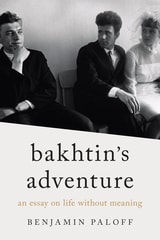
Bakhtin’s Adventure
An Essay on Life without MeaningBenjamin Paloff
Northwestern University Press, 2025
A century after Mikhail Bakhtin first began formulating his now-canonical reflections on freedom and literary representation, we often seem as confused as ever about the relationship between narrative form and what it means to live ethically. Focusing on the throughline of adventure in Bakhtin’s thought, we find a peculiar, yet no less ethically urgent challenge: not to imagine the literary hero as if they were a real person but to recognize how we are always imagining real people as if they were literary characters. This is a provocation with far-reaching consequences for how we understand ourselves, each other, and our situatedness in space and time.
In Bakhtin’s Adventure: An Essay on Life without Meaning, Benjamin Paloff argues that the major aesthetic, ethical, and sociological threads of Bakhtin’s thought intersect in his concept of adventure. Reading across a wide variety of media, from classic literature to contemporary film, Paloff demonstrates how, for Bakhtin and his interlocutors, the test of human freedom is whether narrative means nothing beyond its own adventure. Reframed in this light, Bakhtin’s most influential ideas (eventness, chronotope, heteroglossia, polyphony, carnival) form a cohesive model for how to maintain ethical relations in a world where we can never really know each other the way we know ourselves.
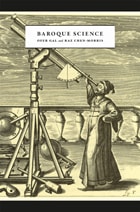
Baroque Science
Ofer Gal and Raz Chen-Morris
University of Chicago Press, 2013
Gal and Chen-Morris show how the protagonists of the new mathematical natural philosophy grasped at the very far and very small by entrusting observation to the mediation of artificial instruments, and how they justified this mediation by naturalizing and denigrating the human senses. They show how the physical-mathematical ordering of heavens and earth demanded obscure and spurious mathematical procedures, replacing the divine harmonies of the late Renaissance with an assemblage of isolated, contingent laws and approximated constants. Finally, they show how the new savants, forced to contend that reason is hopelessly estranged from its surrounding world and that nature is irreducibly complex, turned to the passions to provide an alternative, naturalized foundation for their epistemology and ethics.
Enforcing order in the face of threatening chaos, blurring the boundaries of the natural and the artificial, and mobilizing the passions in the service of objective knowledge, the New Science, Gal and Chen-Morris reveal, is a Baroque phenomenon: deeply entrenched in and crucially formative of the culture of its time.
Basel in the Age of Burckhardt
A Study in Unseasonable IdeasLionel Gossman
University of Chicago Press, 2000
"Remarkable and exceptionally readable . . . There is wit, wisdom and an immense erudition on every page."—Jonathan Steinberg, Times Literary Supplement
"Gossman's book, a product of many years of active contemplation, is a tour de force. It is at once an intellectual history, a cultural history of Basel and Europe, and an important contribution to the study of nineteenth-century historiography. Written with a grace and elegance that many aspire to, few seldom achieve, this is model scholarship."—John R. Hinde, American Historical Review
Basic Color Terms
Their Universality and EvolutionBrent Berlin and Paul Kay
CSLI, 1999
The work reported in this monograph was begun in the winter of 1967 in a graduate seminar at Berkeley. Many of the basic data were gathered by members of the seminar and the theoretical framework presented here was initially developed in the context of the seminar discussions.
Much has been discovered since1969, the date of original publication, regarding the psychophysical and neurophysical determinants of universal, cross-linguistic constraints on the shape of basic color lexicons, and something, albeit less, can now also be said with some confidence regarding the constraining effects of these language-independent processes of color perception and conceptualization on the direction of evolution of basic color term lexicons.
Basic Writings
Paul Rée
University of Illinois Press, 2003
Nietzsche scholars have often incorrectly attributed to him arguments and ideas that are Rée’s and have failed to detect responses to Rée’s works in Nietzsche’s writings. Rée’s thinking combined two strands: a pessimistic conception of human nature, presented in the French moralists’ aphoristic style that would become a mainstay of Nietzsche’s own writings, and a theory of morality derived from Darwin’s theory of natural selection. Rée’s moral Darwinism was a central factor prompting Nietzsche to write On the Genealogy of Morals and the groundwork for much of today’s “evolutionary ethics.”
In an illuminating critical introduction, Robin Small examines Rée’s life and work, locating his application of evolutionary concepts to morality within a broader history of Darwinism while exploring Rée’s theoretical and personal relationship with Nietzsche. In placing Nietzsche in his intellectual and social context, Small profoundly challenges the myth of Nietzsche as a solitary thinker.
Basics Of Semiotics
John Deely
St. Augustine's Press, 2004

Bataille’s Peak
Energy, Religion, and PostsustainabilityAllan Stoekl
University of Minnesota Press, 2007
As the price of oil climbs toward $100 a barrel, our impending post-fossil fuel future appears to offer two alternatives: a bleak existence defined by scarcity and sacrifice or one in which humanity places its faith in technological solutions with unforeseen consequences. Are there other ways to imagine life in an era that will be characterized by resource depletion?
The French intellectual Georges Bataille saw energy as the basis of all human activity—the essence of the human—and he envisioned a society that, instead of renouncing profligate spending, would embrace a more radical type of energy expenditure: la dépense, or “spending without return.” In Bataille’s Peak, Allan Stoekl demonstrates how a close reading of Bataille—in the wake of Giordano Bruno and the Marquis de Sade— can help us rethink not only energy and consumption, but also such related topics as the city, the body, eroticism, and religion. Through these cases, Stoekl identifies the differences between waste, which Bataille condemned, and expenditure, which he celebrated.
The challenge of living in the twenty-first century, Stoekl argues, will be to comprehend—without recourse to austerity and self-denial—the inevitable and necessary shift from a civilization founded on waste to one based on Bataillean expenditure.
Allan Stoekl is professor of French and comparative literature at Penn State University. He is the author of Agonies of the Intellectual: Commitment, Subjectivity, and the Performative in the Twentieth-Century French Tradition and translator of Bataille’s Visions of Excess: Selected Writings, 1927–1939 (Minnesota, 1985).
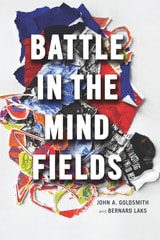
Battle in the Mind Fields
John A. Goldsmith and Bernard Laks
University of Chicago Press, 2019
Taking note of this phenomenon, John Goldsmith and Bernard Laks embark on a uniquely interdisciplinary history of the genesis of linguistics, from nineteenth-century currents of thought in the mind sciences through to the origins of structuralism and the ruptures, both political and intellectual, in the years leading up to World War II. Seeking to explain where contemporary ideas in linguistics come from and how they have been justified, Battle in the Mind Fields investigates the porous interplay of concepts between psychology, philosophy, mathematical logic, and linguistics. Goldsmith and Laks trace theories of thought, self-consciousness, and language from the machine age obsession with mind and matter to the development of analytic philosophy, behaviorism, Gestalt psychology, positivism, and structural linguistics, emphasizing throughout the synthesis and continuity that has brought about progress in our understanding of the human mind. Arguing that it is impossible to understand the history of any of these fields in isolation, Goldsmith and Laks suggest that the ruptures between them arose chiefly from social and institutional circumstances rather than a fundamental disparity of ideas.
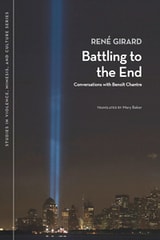
Battling to the End
Conversations with Benoit ChantreRené Girard
Michigan State University Press, 2010
Carl von Clausewitz (1780–1831), the Prussian military theoretician who wrote On War, is known above all for his famous dictum: “War is the continuation of politics by other means.” In René Girard’s view, however, the strategist’s treatise offers up a more disturbing truth to the reader willing to extrapolate from its most daring observations: with modern warfare comes the insanity of tit-for-tat escalation, which political institutions have lost their ability to contain. Having witnessed the Napoleonic Wars firsthand, Girard argues, Clausewitz intuited that unbridled “reciprocal action” could eventually lead foes to total mutual annihilation. Haunted by the Franco-German conflict that was to ravage Europe, in Girard’s account Clausewitz is a prescient witness to the terrifying acceleration of history. Battling to the End issues a warning about the apocalyptic threats hanging over our planet and delivers an authoritative lesson on the mimetic laws of violence.
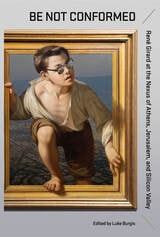
Be Not Conformed
Rene Girard at the Nexus of Athens, Jerusalem, and Silicon ValleyLuke Burgis
Catholic University of America Press, 2026
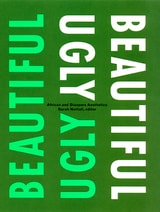
Beautiful/Ugly
African and Diaspora AestheticsSarah Nuttall, ed.
Duke University Press, 2006
Highlighting how ideas of beauty are manifest and how they mutate, travel, and combine across time and distance, continental and diasporic writers examine the work of a Senegalese sculptor inspired by Leni Riefenstahl’s photographs of Nuba warriors; a rich Afro-Brazilian aesthetic incorporating aspects of African, Jamaican, and American cultures; and African Americans’ Africanization of the Santería movement in the United States. They consider the fraught, intricate spaces of the urban landscape in postcolonial South Africa; the intense pleasures of eating on Réunion; and the shockingly graphic images on painted plywood boards advertising “morality” plays along the streets of Ghana. And they analyze the increasingly ritualized wedding feasts in Cameroon as well as the limits of an explicitly “African” aesthetics. Two short stories by the Mozambican writer Mia Couto gesture toward what beauty might be in the context of political failure and postcolonial disillusionment. Together the essays suggest that beauty is in some sense future-oriented and that taking beauty in Africa and its diasporas seriously is a way of rekindling hope.
Contributors. Rita Barnard, Kamari Maxine Clarke, Mia Couto, Mark Gevisser, Simon Gikandi, Michelle Gilbert, Isabel Hofmeyr, William Kentridge, Dominique Malaquais, Achille Mbembe, Cheryl-Ann Michael, Celestin Monga, Sarah Nuttall, Patricia Pinho, Rodney Place, Els van der Plas, Pippa Stein, Françoise Vergès
Beauty and the Bible
Toward a Hermeneutics of Biblical AestheticsRichard J. Bautch
SBL Press, 2013
Beauty and the Good
Recovering the Classical Tradition from Plato to Duns ScotusAlice M. Ramos
Catholic University of America Press, 2021
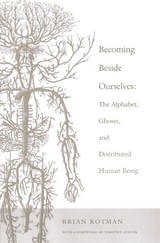
Becoming Beside Ourselves
The Alphabet, Ghosts, and Distributed Human BeingBrian Rotman
Duke University Press, 2008
Alphabetic texts do not convey the bodily gestures of human speech: the hesitations, silences, and changes of pitch that infuse spoken language with affect. Rotman suggests that by removing the body from communication, alphabetic texts enable belief in singular, disembodied, authoritative forms of being such as God and the psyche. He argues that while disembodied agencies are credible and real to “lettered selves,” they are increasingly incompatible with selves and subjectivities formed in relation to new virtual technologies and networked media. Digital motion-capture technologies are restoring gesture and even touch to a prominent role in communication. Parallel computing is challenging the linear thought patterns and ideas of singularity facilitated by alphabetic language. Barriers between self and other are breaking down as the networked self is traversed by other selves to become multiple and distributed, formed through many actions and perceptions at once. The digital self is going plural, becoming beside itself.
Becoming Heidegger
On the Trail of His Early Occasional Writings, 1910-1927Theodore Kisiel
Northwestern University Press, 2007
Accompanied by incisive commentary, these pieces from Heidegger's student days, his early Freiburg period, and the time of his Marburg lecture courses will contribute substantially to rethinking the making and meaning of Being and Time. The contents are of a depth and quality that make this volume the collection for those interested in Heidegger's work prior to his masterwork. The book will also serve those concerned with Heidegger's relation to such figures as Aristotle, Dilthey, Husserl, Jaspers, and Löwith, as well as scholars whose interests are more topically centered on questions of history, logic, religion, and truth. Important in their own right, these pieces will also prove particularly useful to students of Heidegger's thought and of twentieth-century philosophy in general.
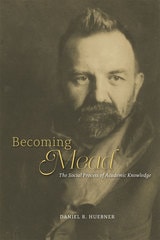
Becoming Mead
The Social Process of Academic KnowledgeDaniel R. Huebner
University of Chicago Press, 2014
In Becoming Mead, Daniel R. Huebner traces the ways in which knowledge has been produced by and about the famed American philosopher. Instead of treating Mead’s problematic reputation as a separate topic of study from his intellectual biography, Huebner considers both biography and reputation as social processes of knowledge production. He uses Mead as a case study and provides fresh new answers to critical questions in the social sciences, such as how authors come to be considered canonical in particular disciplines, how academics understand and use others’ works in their research, and how claims to authority and knowledge are made in scholarship. Becoming Mead provides a novel take on the history of sociology, placing it in critical dialogue with cultural sociology and the sociology of knowledge and intellectuals.
Becoming Political
Spinoza’s Vital Republicanism and the Democratic Power of JudgmentChristopher Skeaff
University of Chicago Press, 2018
Becoming What We Are
Classical and Christian Readings of ModernityJude P. Dougherty
Catholic University of America Press, 2023
Becoming a Place of Unrest
Environmental Crisis and Ecophenomenological PraxisRobert Booth
Ohio University Press, 2021
Before Virtue
Jonathan J. Sanford
Catholic University of America Press, 2015
Before the Law
Humans and Other Animals in a Biopolitical FrameCary Wolfe
University of Chicago Press, 2012

Before the Law
The Complete Text of PréjugésJacques Derrida
University of Minnesota Press, 2018
Thinking judgment in relation to the work of Jean-François Lyotard
“How to judge—Jean-François Lyotard?” It is from this initial question that one of France’s most heralded philosophers of the twentieth century begins his essay on the origin of the law, of judgment, and the work of his colleague Jean-François Lyotard. If Jacques Derrida begins with the term préjugés, it is in part because of its impossibility to be rendered properly in other languages and also contain all its meanings: to pre-judge, to judge before judging, to hold prejudices, to know “how to judge,” and more still, to be already prejudged oneself.
Striving to contain that which comes before the law, that is in front of the law and also prior to it, how to judge Jean-François Lyotard then becomes perhaps a beneficial attempt for Derrida to explore humanity’s rapport with judgment, origins, and naming. For how does one come to judge the author of the Differend? How does one abstain from judgment to accept the term préjugés as suspending judgment and at once as taking into account the impossibility of speaking before the law, prior to naming or judging? If this task indeed seems insurmountable, it is the site where Lyotard’s work itself is played out. Hence this sincere and intriguing essay presented by Jacques Derrida, published here for the first time in English.
Behemoth or The Long Parliament
Thomas Hobbes
University of Chicago Press, 1990
In his insightful and substantial Introduction, Stephen Holmes examines the major themes and implications of Behemoth in Hobbes's system of thought. Holmes notes that a fresh consideration of Behemoth dispels persistent misreadings of Hobbes, including the idea that man is motivated solely by a desire for self-preservation. Behemoth, which is cast as a series of dialogues between a teacher and his pupil, locates the principal cause of the Civil War less in economic interests than in the stubborn irrationality of key actors. It also shows more vividly than any of Hobbe's other works the importance of religion in his theories of human nature and behavior.
Behold an Animal
Four Exorbitant ReadingsThangam Ravindranathan
Northwestern University Press, 2019
As animals recede from our world, what tale is being told by literature’s creatures? Behold an Animal: Four Exorbitant Readings examines incongruous animals in the works of four major contemporary French writers: an airborne horse in a novel by Jean-Philippe Toussaint, extinct orangutans in Éric Chevillard, stray dogs in Marie NDiaye, vanishing (bits of) hedgehogs in Marie Darrieussecq. Resisting naturalist assumptions that an animal in a story is simply—literally or metaphorically—an animal, Thangam Ravindranathan understands it rather as the location of something missing. The animal is a lure: an unfinished figure fleeing the frame, crossing bounds of period, genre, even medium and language. Its flight traces an exorbitant (self-)portrait in which thinking admits to its commerce with life and flesh. It is in its animals, at the same time unbearably real and exquisitely unreal, that literature may today be closest to philosophy.
This book’s primary focus is the contemporary French novel and continental philosophy. In addition to Toussaint, Chevillard, NDiaye, and Darrieussecq, it engages the work of Jean de La Fontaine, Eadweard Muybridge, Edgar Allan Poe, Lewis Carroll, Samuel Beckett, and Francis Ponge.
Being Ethical
D. Q. McInerny
St. Augustine's Press, 2020
The two biggest judgments one will make during life pertain to knowing what is good, what is bad, and the difference between the two. This bleeds into a study of morality and ethics when it pertains to concrete acts, but in reality all aspects of our lives bear on these judgments. “Being ethical is not simply a state of mind, it is a state of being, a way of living one’s life that reflects the fundamental principles of ethics [...] [it is one] who lives in a certain way.” Nevertheless, the subject of this book focuses on ethics––namely, the goodness or badness of human acts. McInerny’s great reason for writing this work is to teach the reader that he or she cannot properly tackle ethical questions (even if they are not identified as such) if one is not himself or herself actually ethical (living virtuously).
Writing very much as a teacher of teachers, McInerny relies on the foundations of Aristotle and Thomas Aquinas, as well as his late brother, Ralph McInerny, to reiterate the principles of ethics that inform both thought and act. To speak of ethics, then, is to admit a commitment to virtue and how the theoretical distinction of good and bad is necessarily practical. Acting well will lead to thinking better, but McInerny notes that culture has lost sight of the former and thereby the coherency to address ethical questions. Being Ethical aims to correct this disconnect in forty-eight cogent lessons.
Being Ethical is fundamentally intended to serve as a sequel to D. Q. McInerny’s Being Logical (Random House, 2004), which has remained in print and has been translated into six languages. Its style lends itself to being used as a textbook in liberal studies. More generally, it is a refreshing presentation of this topic and timely and timeless exhortation to readers of the necessity of a love of virtue for ethical thought. For friends and students of Aristotle, Thomas Aquinas and Ralph McInerny, this book bears a style and manner that is both familiar and much loved.
Being Here Is Glorious
On Rilke, Poetry, and PhilosophyJames D. Reid
Northwestern University Press, 2015
With a new translation of the Duino Elegies
“Who, if I cried out, would hear me among the angels’/orders?” Rainer Maria Rilke’s Duino Elegies opens with one of the most powerful poetic expressions of the search for meaning in the modern world. Published in 1923, the Elegies would influence important philosophers on the Continent, including Heidegger. But with a few exceptions, Rilke’s poetry has not had an impact on philosophy in the Anglo-American world. In Being Here Is Glorious, James D. Reid offers a fresh translation of the Elegies, which hews to the form of the original and provides his own meditation on the place of poetry in philosophy. Reid makes a convincing case that poetry and philosophy can address the problem of finding things significant and worth affirming in light of various reasons to doubt the value of the world in which we find ourselves cast.
Being Human during COVID
Kristin Ann Hass, Editor
University of Michigan Press, 2021
Being Human during COVID documents the first year of the pandemic in real time, bringing together humanities scholars from the University of Michigan to address what it feels like to be human during the COVID-19 crisis. Over the course of the pandemic, the questions that occupy the humanities—about grieving and publics, the social contract and individual rights, racial formation and xenophobia, ideas of home and conceptions of gender, narrative and representations and power—have become shared life-or-death questions about how human societies work and how culture determines our collective fate. The contributors in this collection draw on scholarly expertise and lived experience to try to make sense of the unfamiliar present in works that range from traditional scholarly essays, to personal essays, to visual art projects. The resulting book is shot through with fear, dread, frustration, and prejudice, and, on a few occasions, with a thrilling sense of hope.
Being Human
Philosophical Anthropology through PhenomenologyRobert E. Wood
Catholic University of America Press, 2022
Being Me Being You
Adam Smith and EmpathySamuel Fleischacker
University of Chicago Press, 2019
After laying out a range of meanings for the concept of empathy, Fleischacker proposes that what Smith called “sympathy” is very much what we today consider empathy. Smith’s version has remarkable value, as his empathy calls for entering into the perspective of another—a uniquely human feat that connects people while still allowing them to define their own distinctive standpoints. After discussing Smith’s views in relation to more recent empirical and philosophical studies, Fleischacker shows how turning back to Smith promises to enrich, clarify, and advance our current debates about the meaning and uses of empathy.
Being Philosophical
D. Q. McInerny
St. Augustine's Press, 2023
But most importantly, philosophy requires teachers. To philosophize is, after all, to be an eternal student, a person who even while instructing others relies on the guidance found in the 'fertile' human wisdom cultivated throughout the ages. And the most fecund of all philosophy, according to McInerny, is that contained in Aristotelian-Thomism. His concise and thorough defense of the philosophical life and its lodestar, Thomism, must be read as deliberately as it was written. For McInerny makes a bold claim: if one is truly serious about philosophizing, an encounter with the essentials of Thomism is fundamental and indicates a path for the human mind unlike anything other systems or traditions of thought can offer.
This book begins with logic and is followed by introductions to the philosophy of nature, philosophical psychology, epistemology, ethics, political philosophy, metaphysics and natural theology. It is a companion for students of all ages who have yet to spend quality time with Thomas Aquinas. And it is a real delight to do so in the company of McInerny, who in Being Ethical (2019) has already proven himself to be the affable and able teacher every thinking person longs to meet along the course of his search for truth.
Being Together in Place
Indigenous Coexistence in a More Than Human WorldSoren C. Larsen
University of Minnesota Press, 2017
Being Together in Place explores the landscapes that convene Native and non-Native people into sustained and difficult negotiations over their radically different interests and concerns. Grounded in three sites—the Cheslatta-Carrier traditional territory in British Columbia; the Wakarusa Wetlands in northeastern Kansas; and the Waitangi Treaty Grounds in Aotearoa/New Zealand—this book highlights the challenging, tentative, and provisional work of coexistence around such contested spaces as wetlands, treaty grounds, fishing spots, recreation areas, cemeteries, heritage trails, and traditional village sites. At these sites, activists learn how to articulate and defend their intrinsic and life-supportive ways of being, particularly to those who are intent on damaging or destroying these places.
Using ethnographic research and a geographic perspective, Soren C. Larsen and Jay T. Johnson show how the communities in these regions challenge the power relations that structure the ongoing (post)colonial encounter in liberal democratic settler-states. Emerging from their conversations with activists was a distinctive sense that the places for which they cared had agency, a “call” that pulled them into dialogue, relationships, and action with human and nonhuman others. This being-together-in-place, they find, speaks in a powerful way to the vitalities of coexistence: where humans and nonhumans are working to decolonize their relationships; where reciprocal guardianship is being stitched back together in new and unanticipated ways; and where a new kind of “place thinking” is emerging on the borders of colonial power.
Being Unfolded
Edith Stein on the Meaning of BeingThomas Gricoski
Catholic University of America Press, 2020
Being Useful
Policy Relevance and International Relations TheoryMiroslav Nincic and Joseph Lepgold, Editors
University of Michigan Press, 2000
Being a Skull
Site, Contact, Thought, SculptureGeorges Didi-Huberman
University of Minnesota Press, 2016
What would a sculpture look like that has as its task to touch thought? For the French philosopher and Art Historian, Georges Didi-Huberman, this is the central question that permeates throughout the work of Italian artist Giuseppe Penone. Through a careful study of Penone’s work regarding a sculptural and haptic process of contact with place, thought, and artistic practice, Didi-Huberman takes the reader on a journey through various modes of thinking by way of being. Taking Penone’s artwork “Being the river” as a thematic starting point, Didi-Huberman sketches a sweeping view of how artists through the centuries have worked with conceptions of the skull, that is, the mind, and ruminates on where thought is indeed located.
From Leonardo da Vinci to Albrecht Dürer, Didi-Huberman guides us to the work of Penone and from there, into the attempts of a sculptor whose works strives to touch thought. What we uncover is a sculptor whose work becomes a series of traces of the site of thought. Attempting to trace, by way of a series of frottages, reports, and developments, this imperceptible zone of contact. The result is a kind of fossil of the brain: the site of thought, namely, the site for getting lost and for disproving space. Sculpting at the same time what inhabits as well as what incorporates us.
Being after Rousseau
Philosophy and Culture in QuestionRichard L. Velkley
University of Chicago Press, 2002
The Rousseauian tradition begins, for Velkley, with Rousseau's criticism of modern political philosophy. Although the German Idealists such as Schelling accepted much of Rousseau's critique, they believed, unlike Rousseau, that human wholeness could be attained at the level of society and history. Heidegger and Nietzsche questioned this claim, but followed both Rousseau and the Idealists in their vision of the philosopher-poet striving to recover an original wholeness that the history of reason has distorted.
Being and Predication
Ralph M. McInerny
Catholic University of America Press, 2018
Being and the Cosmos
Robert E. Wood
Catholic University of America Press, 2018
In Being and the Cosmos<\i>, the tack against both is to make explicit the character of the mind that sees and thinks, that actively takes up commitment to the truth available in the disciplines involved. The basic ground of this position rests upon the functioning of the notion of Being that opens up the question of the character of the Whole and the human being’s place in it. Thus position the treatment of the notion of Being as foundation and as orientation toward the Whole between the attack on reductionism and on deconstruction and anti-foundationalism. Wood concludes with a multidimensional sketch of an evolutionary view of the cosmos whose initial phases contain the potentialities for life, sensibility, and intellect as cosmic telos. The holism of contemporary physics has to be reconfigured in terms of this observation. Both reductionists and dualists should know that matter itself has to be re-minded and that mind itself matters.