Results by title
70 books match the query 'Pueblo Indians' and 4 start with b
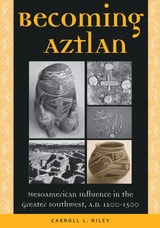
Becoming Aztlan
Mesoamerican Ingluence in the Greater Southwest, A.D. 1200-1500Carroll L Riley
University of Utah Press, 2005
For decades archaeologists insisted that southwestern cultures such as the Anasazi, Hohokam, and Mogollon had little or no relation to peoples south of the "border"' Now American archaeology is beginning to take seriously the notion that goods, gods, and even humans may have passed with some frequency between the high cultures of Mexico and the Southwest.
In his latest book, Carroll Riley presents an ambitious overview of the continuities he sees in the geographically vast and culturally complex American Southwest and the adjacent northwest of Mexico. Aided by extensive illustrations, he argues that although the Southwest remained "southwestern" in its basic economy, there were drastic changes beginning around A.D. 1200 that transformed socio-religious life throughout the region. Riley calls this period Aztlan, a name adopted from the mythic Aztec land of origin. A Pueblo Indian in A.D. 800 would have gathered and farmed the same foods as his descendants, but by 1400 those distant relatives had a very different concept of the physical and spiritual universe.
In addition to bringing vast erudition and jargon-free prose to bear on a complex subject, Riley’s conclusions have potentially sweeping implications for the future of archaeological studies in the greater Southwest.
[more]
Beyond Chaco
Great Kiva Communities on the Mogollon Rim FrontierSarah A. Herr
University of Arizona Press, 2001
During the eleventh and twelfth centuries A.D., the Mogollon Rim region of east-central Arizona was a frontier, situated beyond and between larger regional organizations such as Chaco, Hohokam, and Mimbres. On this southwestern edge of the Puebloan world, past settlement poses a contradiction to those who study it. Population density was low and land abundant, yet the region was overbuilt with great kivas, a form of community-level architecture. Using a frontier model to evaluate household, community, and regional data, Sarah Herr demonstrates that the archaeological patterns of the Mogollon Rim region were created by the flexible and creative behaviors of small-scale agriculturalists. These people lived in a land-rich and labor-poor environment in which expediency, mobility, and fluid social organization were the rule and rigid structures and normative behaviors the exception. Herr's research shows that the eleventh- and twelfth-century inhabitants of the Mogollon Rim region were recent migrants, probably from the southern portion of the Chacoan region. These early settlers built houses and ceremonial structures and made ceramic vessels that resembled those of their homeland, but their social and political organization was not the same as that of their ancestors. Mogollon Rim communities were shaped by the cultural backgrounds of migrants, by their liminal position on the political landscape, and by the unique processes associated with frontiers. As migrants moved from homeland to frontier, a reversal in the proportion of land to labor dramatically changed the social relations of production. Herr argues that when the context of production changes in this way, wealth-in-people becomes more valuable than material wealth, and social relationships and cultural symbols such as the great kiva must be reinterpreted accordingly. Beyond Chaco expands our knowledge of the prehistory of this region and contributes to our understanding of how ancestral communities were constituted in lower-population areas of the agrarian Southwest.
[more]
Broken K Pueblo
Prehistoric Social Organization in the American SouthwestJames N. Hill
University of Arizona Press, 1970
This report presents an analysis of a prehistoric Pueblo community in structural, functional, and evolutionary terms; it is a sequel to William A. Longacre's Archaeology as Anthropology. The emphasis is on social organization (including the patterning of community activities) and on understanding changes in this organization in terms of adaptive responses to a shifting environment.
[more]
Burnt Corn Pueblo
Conflict and Conflagration in the Galisteo Basin, A.D. 1250–1325Edited by James E. Snead and Mark W. Allen
University of Arizona Press, 2011
The Galisteo Basin of northern New Mexico has been a staple of archaeological research since it was first studied almost a century ago. This first book on the area since 1914 lays out an overview of the area, with research provided by the Tano Origins Project and funded by the National Science Foundation.
This volume covers the region’s history (including the Burnt Corn Pueblo, Petroglyph Hill, and Lodestar sites) during the Coalition Period (AD 1200–1300). Including chapters on architecture, ceramics, tree-ring samples, groundstone, and rock art, the book also addresses the stress that development has placed on the future of research in the area.
This volume covers the region’s history (including the Burnt Corn Pueblo, Petroglyph Hill, and Lodestar sites) during the Coalition Period (AD 1200–1300). Including chapters on architecture, ceramics, tree-ring samples, groundstone, and rock art, the book also addresses the stress that development has placed on the future of research in the area.
[more]