Results by title
1017 books match the query 'Reference' and 24 start with b
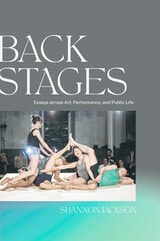
Back Stages
Essays across Art, Performance, and Public LifeShannon Jackson
Northwestern University Press, 2022
At a time of increased aesthetic experimentation and political debate within the art world, these essays alight on artists, groups, and cultural organizations whose experiments have challenged conventions of curation and critique, including Theaster Gates, Paul Ramírez Jonas, Harrell Fletcher, and My Barbarian. Throughout, Jackson navigates the political ambivalences of performance, from the late nineteenth to the twenty-first century, tracking shifts in participatory art that seek to resist capitalism, even as such performance work paradoxically risks neoliberal appropriation by a post-Fordist experience economy.
Back Stages surfaces unexpected cross-disciplinary connections and provides new opportunities for mutual engagement within a wide network of educational, artistic, and civic sectors. A substantial introduction excavates the critical links between the essays and a variety of disciplines and movements.
Bakhtin/ Bakhtin
The Archives and Beyond, Volume 97Peter Hitchcock
Duke University Press, 0
Exploring both the dynamism of Bakhtin versus “Bakhtin” and the dynamics of “possible Bakhtins,” the contributors tackle this theorist’s range of shifting shapes, from the carnival-messianistic and the chronotopic, through the philosophic and the ideologic, to the “applied Bakhtin” of the social sciences. Bakhtin’s texts are examined in the context of work by such disparate figures as Ernst Cassirer and Rudolph Rocker, while various aspects of the academic “Bakhtin industry” are examined, including the “will to mythology by anthology” and the inequities of a world market in ideas exemplified by the resource gap between Russian and Western scholarship. The “state of the archive” is assessed by both UK Bakhtin Centre Director David Shepherd and Russian Bakhtin Archivist Nikolai Pan’kov. Throughout the issue, which is framed by Peter Hitchcock’s introductory polemics and Michael Holquist’s afterword, author and archive are continually deconstructed and reconstructed.
Contributors. Robert Barsky, Rachel Falconer, Maroussia Hadjukowski-Ahmed, Ken Hirschkop, Peter Hitchcock, Michael Holquist, Vitaly Makhlin, Nikolai Pan’kov, Brian Poole, David Shepherd, Galin Tihanov, Anthony Wall
Barrelhouse Words
A Blues Dialect DictionaryStephen Calt
University of Illinois Press, 2009
Becoming a Psychotherapist
A Clinical PrimerRosemary Marshall Balsam and Alan Balsam
University of Chicago Press, 1984
Behind the Academic Curtain
How to Find Success and Happiness with a PhDFrank F. Furstenberg
University of Chicago Press, 2013
While the greatest anxieties for PhD candidates and postgrads are often centered on getting that tenure-track dream job, each stage of an academic career poses a series of distinctive problems. Furstenberg divides these stages into five chapters that cover the entire trajectory of an academic life, including how to make use of a PhD outside of academia. From finding the right job to earning tenure, from managing teaching loads to conducting research, from working on committees to easing into retirement, he illuminates all the challenges and opportunities an academic can expect to encounter. Each chapter is designed for easy consultation, with copious signposts, helpful suggestions, and a bevy of questions that all academics should ask themselves throughout their career, whether at a major university, junior college, or a nonacademic organization. An honest and up-to-date portrayal of how this life really works, Behind the Academic Curtain is an essential companion for any scholar, at any stage of his or her career.
Behind the Book
Eleven Authors on Their Path to PublicationChris Mackenzie Jones
University of Chicago Press, 2018
Behind the Book explores how eleven contemporary first-time authors, in genres ranging from post-apocalyptic fiction to young adult fantasy to travel memoir, navigated these pathways with their debut works. Based on extensive interviews with the authors, it covers the process of writing and publishing a book from beginning to end, including idea generation, developing a process, building a support network, revising the manuscript, finding the right approach to publication, building awareness, and ultimately moving on to the next project. It also includes insights from editors, agents, publishers, and others who helped to bring these projects to life.
Unlike other books on writing craft, Behind the Book looks at the larger picture of how an author’s work and choices can affect the outcome of a project. The authors profiled in each story open up about their challenges, mistakes, and successes. While their paths to publication may be unique, together they offer important lessons that authors of all types can apply to their own writing journeys.

Beijing Film Academy Yearbook 2018
Edited by The Journal of Beijing Film Academy
Intellect Books, 2020
The annual Beijing Film Academy Yearbook continues to showcase the best academic debates, discussions, and research published in the prestigious Journal of Beijing Film Academy from the previous year. This volume brings together specially selected articles, covering the most up-to-date topics in Chinese cinema studies appearing for the first time in English, in order to bridge the gap in cross-cultural research in cinema and media studies, as well as to encourage new conversations.
This book is the latest offering in Intellect China Library series, which publishes work by Chinese scholars that have not previously been available to English-language academia. Covering the subjects of film studies, visual arts, performing arts, media, and cultural studies, the series aims to foster intellectual debate and to promote closer cross-cultural intellectual exchanges by introducing important works of Chinese scholarship to readers.
Beijing Film Academy Yearbook 2021
Edited by the Journal of Beijing Film Academy
Intellect Books, 2024
The annual Beijing Film Academy Yearbook highlights the best academic debates, discussions, and research from the previous year, as previously published in the highly prestigious Journal of Beijing Film Academy. This volume brings together specially selected articles, appearing for the first time in English, to bridge the gap in cross-cultural research in cinema and media studies.
The book is the latest in the Intellect China Library series to produce work by Chinese scholars that have not previously been available to English-language academia. Covering the subjects of film studies, visual arts, performing arts, and media and cultural studies, the series aims to foster intellectual debate and to promote closer cross-cultural intellectual exchanges by introducing important works of Chinese scholarship to readers.
Beliefs and Rituals in Archaic Eastern North America
An Interpretive GuideCheryl Claassen
University of Alabama Press, 2015
A comprehensive and essential field reference, Beliefs and Rituals in Archaic Eastern North America reveals the spiritual landscape in the American Archaic period.
Beliefs and Rituals in Archaic Eastern North America describes, illustrates, and offers nondogmatic interpretations of rituals and beliefs in Archaic America. In compiling a wealth of detailed entries, author Cheryl Claassen has created both an exhaustive reference as well as an opening into new archaeological taxonomies, connections, and understandings of Native American culture.
The material is presented in an introductory essay about Archaic rituals followed by two sections of entries that incorporate reports and articles discussing archaeological sites; studies of relevant practices of ritual and belief; data related to geologic features, artifact attributes, and burial settings; ethnographies; and pilgrimages to specific sites. Claassen’s work focuses on the American Archaic period (marked by the end of the Ice Age approximately 11,000 years ago) and a geographic area bounded by the edge of the Great Plains, Newfoundland, and southern Florida. This period and region share specific beliefs and practices such as human sacrifice, dirt mound burial, and oyster shell middens.
This interpretive guide serves as a platform for new interpretations and theories on this period. For example, Claassen connects rituals to topographic features and posits the Pleistocene-Holocene transition as a major stimulus to Archaic beliefs. She also expands the interpretation of existing data previously understood in economic or environmental terms to include how this same data may also reveal spiritual and symbolic practices. Similarly, Claassen interprets Archaic culture in terms of human agency and social constraint, bringing ritual acts into focus as drivers of social transformation and ethnogenesis.
Richly annotated and cross-referenced for ease of use, Beliefs and Rituals in Archaic Eastern North America will benefit scholars and students of archaeology and Native American culture. Claassen’s overview of the archaeological record should encourage the development of original archaeological and historical connections and patterns. Such an approach, Claassen suggests, may reveal patterns of influence extending from early eastern Americans to the Aztec and Maya.

Beyond Homelessness
Frames Of ReferenceBenedict Giamo
University of Iowa Press, 1992
Homelessness is a haunting social problem that has, by all definitions, outgrown society's conventional solutions. Through their interviews with nine knowledgeable observers who range across the humanities, social and medical sciences, and human services, Giamo and Grunberg examines the nature and conditions of this ongoing crisis. No longer contained by traditional urban skid rows or state mental hospitals, homeless individuals now confront "normal" society face to face—and this "normal" society is at a loss for how to respond. The enormity of the problem has resulted in a stagnation of viable ideas, creating an industry with an endless litany of root cause and quick fix. But as these dialogues point out, there is no one root cause for the fact of homelessness. These timely, penetrating exhanges challenge established misconceptions of this problem.
Beyond Plagiarism
Transforming Pedagogy to Help Students Write with SourcesKenny Harsch and Betsy Gilliland
University of Michigan Press, 2025
Starting with an overview of the complexities underlying plagiarism and source use, the book offers practical tools that teachers can integrate in their classes. These tools include examples of modifications to syllabi; integrating processes into assignment design, classroom support, and feedback and grading; meta-texts to guide student reflection on their use of sources; explanations of why source use is important in academic writing; guiding students through learning how to read for writing, analyze genres to better understand expectations, and practice paraphrasing, summarizing, and quoting in their own assignments; approaching AI tools strategically; and modeling successful strategies for each step of the scholarly process. By taking a pedagogical approach, expert members of the academic community can help students understand how academic writing builds on and incorporates sources, provide support for students to learn to do these things through a process approach, and respond to situations of plagiarism with nuance, compassion, and a growth mindset.

Bibliographical Guide to the Study of the Literature of the USA, 5th ed., revised and enlarged
Clarence Gohdes and Sanford Marovitz
Duke University Press, 1984
Biotic Communities
Southwestern United States and Northwestern MexicoDavid E. Brown
University of Utah Press, 1994
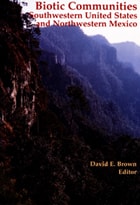
Biotic Communities catalogs and defines by biome, or biotic community, the region centered on Arizona, New Mexico, Sonora, Chihuahua, and Baja California Norte, plus California, Nevada, Utah, Colorado, Texas, Coahuila, Sinaloa, and Baja California Sur. Originally published in 1982 by the Boyce Thompson Southwestern Arboretum, this ambitious book is still a "must-have" for those working in natural resources management and ecological research, as well as non-specialists who wish to know more about a particular locale.
Biotic Communities is arranged by climatic formation with a short chapter for each biome describing climate, physiognomy, distribution, dominant and common plant species, and characteristic vertebrates. Subsequent chapters contain careful descriptions of zonal subdivisions. The text is supplemented with over one hundred black and white photographs illustrating almost every community type.
Black Designers in Chicago
Culture and Community in the Twentieth CenturyEdited by Chris Dingwall, David Hartt, and Daniel Schulman
University of Chicago Press, 2026
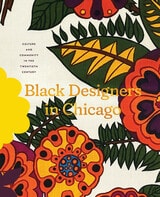
In twentieth-century Chicago, generations of Black artisans, craftspeople, art educators, clothing makers, commercial illustrators, sign painters, furniture makers, beauticians, graphic designers, art directors, and screen printers made and remade the city into an energetic center for modern design. Ambitious, enterprising, and resolutely modern, these Black designers were workers and intellectuals, activists and entrepreneurs. They created works for commercial and everyday use and helped to build community institutions such as the South Side Community Art Center and businesses like the Johnson Publishing Company. Their works ranged from branding and housewares for major corporations to pamphlets and posters made in the name of civil rights and Black Power. Together, they made Black Chicago into a dynamic design scene, working against racism in their professions while embracing the possibilities of design as a medium of social change.
This book is the first to chronicle their collective history while also celebrating their influence on design as well as African American culture more broadly. Based on extensive archival research and building on a major 2018 exhibition, Black Designers in Chicago presents essays by experts in African American history and design. The book features illustrations of a stunning variety of works—from graphic design to screenprints to textiles and household wares—placing African Americans at the center of modern design history, while highlighting the role of design in the cultural history of Black Chicago.
Black and White Cinema
A Short HistoryWheeler Winston Dixon
Rutgers University Press, 2015
Black and White Cinema is the first study to consider the use of black-and-white as an art form in its own right, providing a comprehensive and global overview of the era when it flourished, from the 1900s to the 1960s. Acclaimed film scholar Wheeler Winston Dixon introduces us to the masters of this art, discussing the signature styles and technical innovations of award-winning cinematographers like James Wong Howe, Gregg Toland, Freddie Francis, and Sven Nykvist. Giving us a unique glimpse behind the scenes, Dixon also reveals the creative teams—from lighting technicians to matte painters—whose work profoundly shaped the look of black-and-white cinema.
More than just a study of film history, this book is a rallying cry, meant to inspire a love for the artistry of black-and-white film, so that we might work to preserve this important part of our cinematic heritage. Lavishly illustrated with more than forty on-the-set stills, Black and White Cinema provides a vivid and illuminating look at a creatively vital era.

Blood Bowl
Fictions, Rules, PlayersPaul Wake
University of Michigan Press, 2027
Blood Bowl, Jervis Johnson’s game of fantasy football, has been captivating players worldwide for nearly forty years. But what makes this game—with its painted miniatures, intricate rules, and passionate global community—so enduring? In Blood Bowl: Fictions, Rules, Players, Paul Wake traces the game’s history from its origins to the present day, situating the game within the broader contexts of Games Workshop’s manufacturing and commercial history. Wake draws on interviews with the game’s designers, players, artists, and sculptors alongside archival materials to give a comprehensive account of the game’s rich satirical storytelling, the risk management and spatial puzzles at the heart of its rules, and the psychology that makes Blood Bowl one of the most compelling games ever designed.
Boredom
The Literary History of a State of MindPatricia Meyer Spacks
University of Chicago Press, 1994
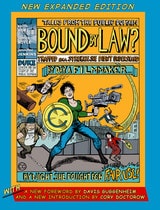
Bound by Law?
Tales from the Public Domain, New Expanded EditionKeith Aoki, James Boyle, and Jennifer Jenkins
Duke University Press, 2008
Breve historia de la lengua española
Segunda edición revisadaDavid A. Pharies
University of Chicago Press, 2015
La Breve historia de la lengua española se concentra en los cambios más importantes de la evolución de la lengua, evitando la jerga académica ininteligible y favoreciendo la claridad en las explicaciones. Por el camino, intenta dar respuesta a muchas de las preguntas que con frecuencia desconciertan a los hablantes nativos y no nativos: ¿Por qué se utiliza tú en algunos lugares y vos en otros? ¿Cómo surgió la pronunciación como fricativa interdental de la zeta castellana? ¿Por qué se dice la mesa pero el agua con un artículo que parece masculino?
David A. Pharies es un experto en el estudio de la historia y evolución del español, que goza de un reconocido prestigio en la escena internacional. Para actualizar esta segunda edición ha revisado en profundidad todos los aspectos de la evolución del español, incluido su desarrollo demográfico. El libro va dirigido a quienes tienen un conocimiento básico del español y desean aprender más sobre sus orígenes. También constituye una base ideal para emprender el estudio de cualquier aspecto de la lingüística histórica española y de la literatura medieval. Entretenida y accesible, la Breve historia de la lengua española es un gran viaje de descubrimiento en una presentación amena y sucinta.
Since its publication in 2007, A Brief History of the Spanish Language has become the leading introduction to the history of one of the world’s most widely spoken languages. Moving from the language’s Latin roots to its present-day forms, this concise book offers readers insights into the origin and evolution of Spanish, the historical and cultural changes that shaped it, and its spread around the world.
A Brief History of the Spanish Language focuses on the most important aspects of the development of the Spanish language, eschewing technical jargon in favor of straightforward explanations. Along the way, it answers many of the common questions that puzzle native and nonnative speakers alike, such as: Why do some regions use tú while others use vos? How did the th sound develop in Castilian? And why is it la mesa but el agua?
David A. Pharies, an internationally recognized expert on the history and development of Spanish, has updated this edition with new research on all aspects of the evolution of Spanish while adding current demographic information as well. This book is perfect for anyone with a basic understanding of Spanish and a desire to further explore its roots. It also provides an ideal foundation for further study in any area of historical Spanish linguistics and early Spanish literature. Both absorbing and accessible, A Brief History of the Spanish Language is a grand journey of discovery in a beautifully compact format.

Bridges to Knowledge
Foreign Students in Comparative PerspectiveElinor G. Barber, Philip G. Altbach, and Robert G. Myers
University of Chicago Press, 1984
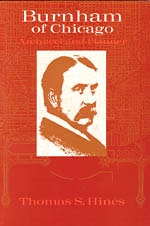
Burnham of Chicago
Architect and PlannerThomas S. Hines
University of Chicago Press, 1979
"Professor Hines has written what may prove to be an epoch-making book in the study of American civilization."—Reyner Banham, Times Literary Supplement
"Indeed, the book as a whole is a model of the balanced portrait, sure of Burnham's importance but always conscious of his failings."—Paul Goldberger, New York Times Book Review
"In every sense this is the definitive biography, and it is long overdue."—Harry Weese, Chicago Tribune
"This is a many-faceted book. Even if one were not interested in architecture or city planning, nor especially in Burnham the man, one would likely find the book rewarding because of the window it provides on a significant period of American history. . . . Hines brings alive many of the forces that were beating upon Burnham and his contemporaries, and which are shaping our lives today."—Edmund M. Bacon, Architectural Record
"Hines has provided an intelligently organized, well-written, and fascinating account of Burnham's entire career. The analysis [is] a model of scholarship, good judgment, and literary grace that satisfies a long felt need."—Kenneth T. Jackson, American Historical Review
Business Plans for Filmmakers
John W. Cones
Southern Illinois University Press, 2010
The practical and legal aspects of writing a business plan for a film venture can be daunting to navigate without a firm grasp of know-how. With this in mind, John W. Cones's Business Plans for Filmmakers arms independent movie-makers and students with everything they need to successfully tackle the confusing intersection of law, business, and art when creating a business plan for a movie. This pragmatic volume offers plenty of examples and strategies for success, sharing straightforward insight into some of the toughest challenges independent filmmakers face when encountering these documents.
With simple yet thorough detail and clarity, Cones outlines the legal requirements affecting movie proposals, including ways to evaluate the necessity for a business plan or a securities disclosure document, as well as the legal definition of "an active investor." Also addressed are the numerous subjects filmmakers and students must consider before a film offering, including the efficacy of a business plan to fund the development, production, and distribution phases of a film; common elements of fraud of which fledgling filmmakers should beware; the intricacies of revenue sharing; and how to render financial projections. Cones also imparts useful distinctions between such industry terms as "company financing" versus "project financing," along with many others.
This bookalso includes in-depth guidance through the murky paths of investor analysis and key strategies to find and attract parties interested in financing film. Drawing upon his many years as a securities and entertainment attorney, and his experiences advising independent film producers, Cones offers the tools necessary not only to understand investors' motivations but also to use that knowledge to the filmmaker's advantage. Also provided are perceptive studies of the investment vehicles commonly used in business plans seeking investors, with analysis of each method's pros and cons. Throughout the volume, Cones uses sample plans to offer a real-world grasp of the intricacies of the business.
In the business of this art, knowledge is power. Business Plans for Filmmakers dispels the myths and misinformation circulating among filmmakers to provide accurate and useful advice.
But Can I Start a Sentence with "But"?
Advice from the Chicago Style Q&AThe University of Chicago Press Editorial Staff
University of Chicago Press, 2016
A. The idiom is “happy medium,” but I like the image of commuters taking refuge from road rage on the happy median.
Q. How do I write a title of a song in the body of the work (caps, bold, underline, italics, etc.)? Example: The Zombies’ “She’s Not There” looped in his head.
A. Noooo! Now that song is looping in my head (“but it’s too late to say you’re sorry . . .”). Use quotation marks. Thanks a lot.
Every month, tens of thousands of self-declared word nerds converge upon a single site: The Chicago Manual of Style Online's Q&A. There the Manual’s editors open the mailbag and tackle readers’ questions on topics ranging from abbreviation to word division to how to reform that coworker who still insists on two spaces between sentences. Champions of common sense, the editors offer smart, direct, and occasionally tongue-in-cheek responses that have guided writers and settled arguments for more than fifteen years.
But Can I Start a Sentence with “But”? brings together the best of the Chicago Style Q&A. Curated from years of entries, it features some of the most popular—and hotly debated—rulings and also recovers old favorites long buried in the archives.
Questions touch on myriad matters of editorial style—capitalization, punctuation, alphabetizing, special characters—as well as grammar, usage, and beyond (“How do I spell out the sound of a scream?”). A foreword by Carol Fisher Saller, the Q&A’s longtime editor, takes readers through the history of the Q&A and addresses its reputation for mischief. (“It’s not that we set out to be cheeky,” she writes.)
Taken together, the questions and answers offer insights into some of the most common issues that face anyone who works with words. They’re also a comforting reminder that even the best writer or editor needs a little help—and humor—sometimes.
Butterflies of Illinois
A Field GuideMichael R. Jeffords, Susan L. Post, and James R. Wiker
University of Illinois Press, 2019
- identification quick guides depicting the tops and undersides of all butterfly species
- scientific information and photos that explain life cycles, habitats, and ecology
- range maps
- flight period charts
- key characteristics relevant to field identification
- descriptions of rarely seen butterflies and irregular visitors from nearby states
- supplemental information on various species, including collection records and unusual sightings