Results by title
4743 books match the query 'Religion' and 170 start with b
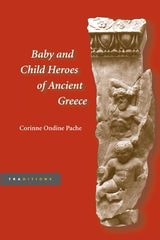
Baby and Child Heroes in Ancient Greece
Corinne Ondine Pache
University of Illinois Press, 2004
Examining literary, pictorial, and numismatic representations, Pache opens up a vast territory once occupied by children such as Charila, Opheltes, Melikertes, and the children of Herakles and Medea. She elegantly argues that the stories, songs, and sanctuaries honoring these heroes express parental fears and guilt about children's death. Pache further demonstrates that while the myths and rituals articulate basic human anxieties, their emphasis is ultimately on the beauty that transcends the gruesomeness of the narrative, turning their dread into poetry. By showing the continuity of child heroes in Greek religion, she is able to throw new light on iconographies that have previously defied explanation.
Babylonian Chronographic Texts from the Hellenistic Period
R. J. van der Spek
SBL Press, 2025
Bach Perspectives, Volume 12
Bach and the Counterpoint of ReligionEdited by Robin A. Leaver
University of Illinois Press, 2018
Baha'i
Studies in Contemporary ReligionMargit Warburg
Signature Books, 2001
In fact, Baha’i draws on a diverse heritage that encompasses both East and West. Reflecting their Islamic roots, they observe daily prayers and the reading of sacred texts; a month of fast; pilgrimage to Haifa, Israel, where the religion’s relics are preserved; and abstinence from alcohol. They face toward their prophet Baha’u'llah’s resting place when praying, which is reminiscent of Muslims facing Mecca to pray.
In other ways, the Baha’i religion has dissociated itself from orthodox Shi’ism. Adherents avoid communal prayer, reject the idea of a professional clergy, promote gender equality, and devote a great deal of attention to education, health care, and environmental issues. They work actively through the United Nations system to promote their view of a new world order of peace and harmony that they feel will one day unify humankind across all nations, races, and religions.
Bakhtin and Religion
A Feeling for FaithSusan M. Felch and Paul J. Contino
Northwestern University Press, 2001
These essays provide an overview of Bakhtin's attitude toward religion in general and Russian Orthodoxy in particular, addressing topics ranging from how Bakhtin's religious ideas informed his linguistic and aesthetic theories to the idea of love in his secular and religious thought and to the religious component of Bakhtin's theory of laughter.
Baptism of Desire and Christian Salvation
Anthony R. Lusvardi
Catholic University of America Press, 2024
Baptist Battles
Social Change and Religious Conflict in the Southern Baptist ConventionNancy Tatom Ammerman
Rutgers University Press, 1990
Since 1979 Southern Baptists have been noisily struggling to agree on symbols, beliefs, and practices as they attempt to make sense of their changing social world. Nancy Ammerman has carefully documented their struggle. She tells the story of the Baptist reversal from a moderate to a fundamentalist outlook and speculates on the future of the denomination.
Ammerman places change among the Southern Baptists in the context of the cultural and economic changes that have transformed the South from its rural past into an urbanizing, culturally diverse region. Not only did the South change; Southern Baptists did as well. Reflecting this diversity, the Southern Baptist bureaucracy was relatively progressive. During the 1960s and 1970s, moderate sentiments prevailed, while fundamentalists remained on the margins. These two were, however, becoming increasingly divergent in what they considered important about being a Baptist, in their views about the Bible, in their attitudes on the origination of women, on Christian morals, and on national politics.
Late in the 1970s, a fundamentalist coalition emerged, followed by unsuccessful efforts by moderates to oppose it. The battles escalated until 1985, when 45,000 Baptists gathered in Dallas to decide between contending presidential candidates. That dramatic event illustrated the extent to which organized political resources were determining the course of the conflict. Ammerman studies these strategies and resources as well.
Examining how this tension affected Baptists, Ammerman begins with case studies of the change it is producing in Baptist agencies. But she also brings us back to the local churches and individual believers who are renegotiating their relationships within their denomination. She asks whether the denomination’s polity can accommodate an increasingly diverse group of Baptists, of whether the only way dissidents can have a voice is through schism.
Baring Witness
36 Mormon Women Talk Candidly about Love, Sex, and MarriageEdited by Holly Welker
University of Illinois Press, 2016

Bataille’s Peak
Energy, Religion, and PostsustainabilityAllan Stoekl
University of Minnesota Press, 2007
As the price of oil climbs toward $100 a barrel, our impending post-fossil fuel future appears to offer two alternatives: a bleak existence defined by scarcity and sacrifice or one in which humanity places its faith in technological solutions with unforeseen consequences. Are there other ways to imagine life in an era that will be characterized by resource depletion?
The French intellectual Georges Bataille saw energy as the basis of all human activity—the essence of the human—and he envisioned a society that, instead of renouncing profligate spending, would embrace a more radical type of energy expenditure: la dépense, or “spending without return.” In Bataille’s Peak, Allan Stoekl demonstrates how a close reading of Bataille—in the wake of Giordano Bruno and the Marquis de Sade— can help us rethink not only energy and consumption, but also such related topics as the city, the body, eroticism, and religion. Through these cases, Stoekl identifies the differences between waste, which Bataille condemned, and expenditure, which he celebrated.
The challenge of living in the twenty-first century, Stoekl argues, will be to comprehend—without recourse to austerity and self-denial—the inevitable and necessary shift from a civilization founded on waste to one based on Bataillean expenditure.
Allan Stoekl is professor of French and comparative literature at Penn State University. He is the author of Agonies of the Intellectual: Commitment, Subjectivity, and the Performative in the Twentieth-Century French Tradition and translator of Bataille’s Visions of Excess: Selected Writings, 1927–1939 (Minnesota, 1985).
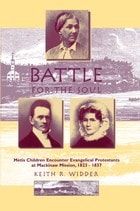
Battle for the Soul
Mètis Children Encounter Evangelical Protestants at Mackinaw Mission, 1823-1837Keith R. Widder
Michigan State University Press, 1999
In 1823 William and Amanda Ferry opened a boarding school for Métis children on Mackinac Island, Michigan Territory, setting in motion an intense spiritual battle to win the souls and change the lives of the children, their parents, and all others living at Mackinac. Battle for the Soul demonstrates how a group of enthusiastic missionaries, empowered by an uncompromising religious motivation, served as agents of Americanization. The Ferrys' high hopes crumbled, however, as they watched their work bring about a revival of Catholicism and their students refuse to abandon the fur trade as a way of life. The story of the Mackinaw Mission is that of people who held differing world views negotiating to create a "middle-ground," a society with room for all.
Widder's study is a welcome addition to the literature on American frontier missions. Using Richard White's "middle ground" paradigm, it focuses on the cultural interaction between French, British, American, and various native groups at the Mackinac mission in Michigan during the early 19th century. The author draws on materials from the American Board of Commissioners for Foreign Missions archives, as well as other manuscript sources, to trace not only the missionaries' efforts to Christianize and Americanize the native peoples, but the religious, social, and cultural conflicts between Protestant missionaries and Catholic priests in the region. Much attention has been given to the missionaries to the Indians in other areas of the US, but little to this region.
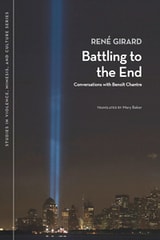
Battling to the End
Conversations with Benoit ChantreRené Girard
Michigan State University Press, 2010
Carl von Clausewitz (1780–1831), the Prussian military theoretician who wrote On War, is known above all for his famous dictum: “War is the continuation of politics by other means.” In René Girard’s view, however, the strategist’s treatise offers up a more disturbing truth to the reader willing to extrapolate from its most daring observations: with modern warfare comes the insanity of tit-for-tat escalation, which political institutions have lost their ability to contain. Having witnessed the Napoleonic Wars firsthand, Girard argues, Clausewitz intuited that unbridled “reciprocal action” could eventually lead foes to total mutual annihilation. Haunted by the Franco-German conflict that was to ravage Europe, in Girard’s account Clausewitz is a prescient witness to the terrifying acceleration of history. Battling to the End issues a warning about the apocalyptic threats hanging over our planet and delivers an authoritative lesson on the mimetic laws of violence.
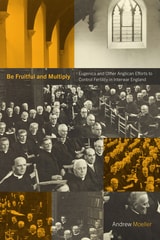
Be Fruitful and Multiply
Eugenics and Other Anglican Efforts to Control Fertility in Interwar EnglandAndrew Moeller
Rutgers University Press, 2027
Be Fruitful and Multiply examines the moral justification offered by Anglican leaders for their support for eugenic, pronatalist, and neo-Malthusian schemes in the United Kingdom during the interwar period. These religious leaders often comprehended their efforts to control fertility within the context of a broader struggle over competing conceptions of human purpose in English society, and regularly justified their efforts on the grounds that fertility-manipulation schemes served to align procreative behaviors with “Christian” conceptions of human purpose. The shared moral logic of Anglican leaders helps to explain the pervasive interest in birthrate patterns, along with the enduring appeal of fertility-manipulation schemes, amongst middle- and upper-classes during the first half of the twentieth century. This book also sheds light on how population concerns led to the liberalization of church positions on marriage and sexuality, and illuminates how Anglican leaders sought to maintain moral influence in the face of the perceived large-scale rejection of Christian moral teachings.
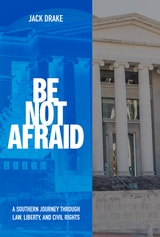
Be Not Afraid
A Southern Journey Through Law, Liberty, and Civil RightsJack Drake
University of Alabama Press, 2026
A civil rights attorney’s unflinching memoir about the fight against segregation and systemic racism through landmark legal battles in Alabama
Be Not Afraid: A Southern Journey Through Law, Liberty, and Civil Rights is a timely and unflinching memoir from civil rights attorney Jack Drake, who has spent decades on the front lines of Alabama’s legal battles for racial justice. Raised in a segregated community in Gardendale, Alabama, Drake came of age during the civil rights movement and became a pivotal figure in cases that reshaped the state’s legal and moral landscape.
Drake helped reform Alabama’s grossly inadequate mental health system and supported voting rights efforts throughout Alabama. His career underscores the crucial role private attorneys and grassroots advocates played in enforcing civil rights laws long after their passage.
Through vivid recollections of courtroom battles, civil rights alliances, and personal transformation, Be Not Afraid offers an intimate view into the persistence and courage required to challenge systemic injustice. At a time when debates over equity and democracy remain pressing, Drake’s story is both a powerful reflection on the past and a call to action for the present. It speaks to the enduring importance of legal advocacy and community solidarity in the fight for a more just society, making it essential reading for those engaged in civil rights history, law, or social change.
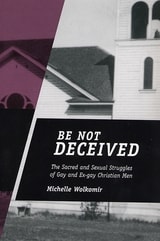
Be Not Deceived
The Sacred and Sexual Struggles of Gay and Ex-gay Christian MenWolkomir, Michelle
Rutgers University Press, 2006
Homosexuality has become increasingly accepted in mainstream America over the past two decades. Yet despite indications of progress that can be found everywhere from academia to popular culture, gay men and women remain the target of much discrimination and stigma, particularly within conservative Christianity.
In Be Not Deceived, Michelle Wolkomir explores the difficult dilemma that gay Christians face in their attempts to reconcile their religious and sexual identities. She introduces the ideologies and practices of two alternative and competing ministries that offer solutions for Christians who experience homosexual desire.
One organization—the Universal Fellowship of Metropolitan Community Churches—believes that God made people gay to suit divine purposes. Changing one’s sexuality is therefore impossible and a defiance of God. In contrast, Exodus International preaches that homosexuality is a sin and a symptom of disordered psychological development—one that can be cured through redemptive prayer. By comparing participant experiences in these ministries, Wolkomir explores the paths and processes by which members learn to become gay or ex-gay Christians.
Through careful analysis of the groups’ ideologies, interactions, and symbolic resources, Be Not Deceived goes far beyond the obvious differences between the ministries to uncover their similarities, namely that both continue to define heterosexuality as the normative and dominant lifestyle.
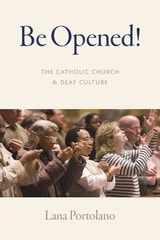
Be Opened! The Catholic Church and Deaf Culture
Lana Portolano
Catholic University of America Press, 2021
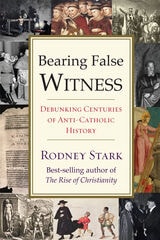
Bearing False Witness
Debunking Centuries of Anti-Catholic HistoryRodney Stark
Templeton Press, 2016
As we all know and as many of our well-established textbooks have argued for decades, the Inquisition was one of the most frightening and bloody chapters in Western history; Pope Pius XII was anti-Semitic and rightfully called “Hitler’s Pope,” the Dark Ages were stunting the progress of knowledge to be redeemed only by the secular spirit of the Enlightenment. The religious Crusades were an early example of the rapacious Western thirst for riches and power. But what if these long held beliefs were all wrong?
In this stunning, powerful, and ultimately persuasive book, Rodney Stark, one of the most highly regarded sociologists of religion and bestselling author of The Rise of Christianity (HarperSanFrancisco 1997), argues that some of our most firmly held ideas about history, ideas that paint the Catholic Church in the least favorable light are, in fact, fiction. Why have we held these wrongheaded ideas so firmly and for so long? And if our beliefs are wrong, what is the truth?
In each chapter, Stark takes on a well-established anti-Catholic myth, gives a fascinating history of how each myth became conventional wisdom and presents a startling picture of the real truth. For example, instead of the Spanish Inquisition being an anomaly of torture and murder of innocent people persecuted for “imaginary” crimes such as witchcraft and blasphemy, Stark argues that not only did the Spanish Inquisition spill very little blood, but it was a major force in support of moderation and justice.
Stark dispels the myth of Pope Pius XII being apathetic or even helpful to the Nazi movement, such as to merit the title “Hitler’s Pope,” and instead shows that the campaign to link Pope Pius XII to Hitler was initiated by the Soviet Union, presumably in hopes of neutralizing the Vatican in post-World War II affairs. Many praised Pope Pius XIIs vigorous and devoted efforts to saving Jewish lives during the war.
Instead of understanding the Dark Ages as a millennium of ignorance and backwardness inspired by the Catholic Church’s power, Stark argues that the whole notion of the “Dark Ages” was an act of pride perpetuated by anti-religious intellectuals who were determined to claim that theirs was the era of “Enlightenment.”
In the end, readers of Bearing False Witness will have a more accurate history of the Catholic Church and will also understand why it became unfairly maligned for so long. Bearing False Witness is a compelling and sobering account of how egotism and ideology often work together to give us a false truth.
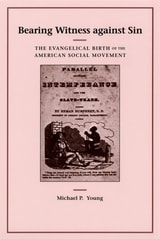
Bearing Witness against Sin
The Evangelical Birth of the American Social MovementMichael P. Young
University of Chicago Press, 2007
During the 1830s the United States experienced a wave of movements for social change over temperance, the abolition of slavery, anti-vice activism, and a host of other moral reforms. Michael Young argues for the first time in Bearing Witness against Sin that together they represented a distinctive new style of mobilization—one that prefigured contemporary forms of social protest by underscoring the role of national religious structures and cultural schemas.
In this book, Young identifies a new strain of protest that challenged antebellum Americans to take personal responsibility for reforming social problems.In this period activists demanded that social problems like drinking and slaveholding be recognized as national sins unsurpassed in their evil and immorality. This newly awakened consciousness undergirded by a confessional style of protest, seized the American imagination and galvanized thousands of people. Such a phenomenon, Young argues, helps explain the lives of charismatic reformers such as William Lloyd Garrison and the Grimké sisters, among others.
Marshalling lively historical materials, including letters and life histories of reformers, Bearing Witness against Sin is a revelatory account of how religion lay at the heart of social reform.
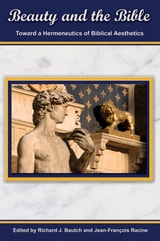
Beauty and the Bible
Toward a Hermeneutics of Biblical AestheticsRichard J. Bautch
SBL Press, 2013
Because My Soul Longs for You
Integrating Theology into Our LivesRabbi Edwin C. Goldberg and Rabbi Elaine S. Zecher
Central Conference of American Rabbis, 2021
Because My Soul Longs for You seeks to answer one of the most enduring human questions: Where can we find God in our lives? While Jewish theologians have long pondered the "God question" from ethical and philosophical perspectives, the last century has made space for a more experiential theology: God is present in our lived experiences. Radical amazement, to use Rabbi Abraham Joshua Heschel's phrase, can be found in everyday life. Contributors to this volume share how they welcome God's presence into their lives, as well as the theological language they use to think and speak about this presence. Chapters explore how we experience God through prayer, text study, poetry, food, music, service, movement, meditation, interpersonal connection, and much more.
Become Like the Angels
Benjamin P. Blosser
Catholic University of America Press, 2012
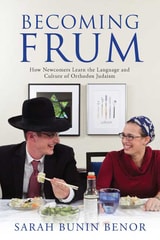
Becoming Frum
How Newcomers Learn the Language and Culture of Orthodox JudaismSarah Bunin Benor
Rutgers University Press, 2012
Winner, 2013 Sami Rohr Choice Award for Jewish Literature
When non-Orthodox Jews become frum (religious), they encounter much more than dietary laws and Sabbath prohibitions. They find themselves in the midst of a whole new culture, involving matchmakers, homemade gefilte fish, and Yiddish-influenced grammar. Becoming Frum explains how these newcomers learn Orthodox language and culture through their interactions with community veterans and other newcomers. Some take on as much as they can as quickly as they can, going beyond the norms of those raised in the community. Others maintain aspects of their pre-Orthodox selves, yielding unique combinations, like Matisyahu’s reggae music or Hebrew words and sing-song intonation used with American slang, as in “mamish (really) keepin’ it real.”
Sarah Bunin Benor brings insight into the phenomenon of adopting a new identity based on ethnographic and sociolinguistic research among men and women in an American Orthodox community. Her analysis is applicable to other situations of adult language socialization, such as students learning medical jargon or Canadians moving to Australia. Becoming Frum offers a scholarly and accessible look at the linguistic and cultural process of “becoming.”
Becoming God
The Doctrine of Theosis in Nicholas of CusaNancy J. Hudson
Catholic University of America Press, 2007
Becoming What We Are
Classical and Christian Readings of ModernityJude P. Dougherty
Catholic University of America Press, 2023
Becoming a New Self
Practices of Belief in Early Modern CatholicismMoshe Sluhovsky
University of Chicago Press, 2017
Practices such as the examination of conscience, general confession, and spiritual exercises, which until the 1400s had been restricted to monastic elites, breached the walls of monasteries in the period that followed. Thanks in large part to Franciscans and Jesuits, lay urban elites—both men and women—gained access to spiritual practices whose goal was to enhance belief and create new selves. Using Michel Foucault’s writing on the hermeneutics of the self, and the French philosopher’s intuition that the early modern period was a moment of transition in the configurations of the self, Sluhovsky offers a broad panorama of spiritual and devotional techniques of self-formation and subjectivation.
Becoming and Remaining a People
Native American Religions on the Northern PlainsHoward L. Harrod
University of Arizona Press, 1995
This book offers a bold new interpretation of anthropological studies, demonstrating how religious traditions and ritual processes became sources of group and individual identity for many people. Harrod reconstructs the long religious development of two village peoples, the Mandans and the Hidatsas, describing how their oral traditions enabled them to reinterpret their experiences as circumstances changed. He then shows how these and other groups on the Northern Plains remained distinct peoples in the face of increased interactions with Euro-Americans, other Indians,.and the new religion of Christianity.
Harrod proposes that other interpretations of culture change may fail to come to terms with the role that religion plays in motivating both cultural conservatism and social change. For Northern Plains peoples, religion was at the heart of social identity and thus resisted change, but religion was also the source of creative reinterpretation, which produced culture change. Viewed from within the group, such change often seemed natural and was understood as an elaboration of traditions having roots in a deeper shared past. In addition to demonstrating religious continuity and change among the Mandans and the Hidatsas, he also describes instances of religious and social transformation among the peoples who became the Crows and the Cheyennes.
Becoming and Remaining a People adopts a challenging analytical approach that draws on the author's creative interpretations of rituals and oral traditions. By enabling us to understand the relation of religion both to the construction of social identity and to the interpretation of social change, it reveals the richness, depth, and cultural complexity of both past Native American people and their contemporary successors.
Bede the Theologian
History, Rhetoric, and SpiritualityJohn P. Bequette
Catholic University of America Press, 2022
Before Amoris Laetitia
The Sources of the ControversyJaroslaw Kupczak
Catholic University of America Press, 2021
Before Truth
Lonergan, Aquinas, and the Problem of WisdomJeremy Wilkins
Catholic University of America Press, 2018
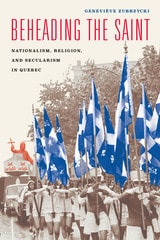
Beheading the Saint
Nationalism, Religion, and Secularism in QuebecGeneviève Zubrzycki
University of Chicago Press, 2016
In Beheading the Saint, Geneviève Zubrzycki studies that transformation through a close investigation of the annual Feast of St. John the Baptist of June 24. The celebrations of that national holiday, she shows, provided a venue for a public contesting of the dominant ethno-Catholic conception of French Canadian identity and, via the violent rejection of Catholic symbols, the articulation of a new, secular Québécois identity. From there, Zubrzycki extends her analysis to the present, looking at the role of Québécois identity in recent debates over immigration, the place of religious symbols in the public sphere, and the politics of cultural heritage—issues that also offer insight on similar debates elsewhere in the world.
Being Generous
Theodore Roosevelt Malloch
Templeton Press, 2010
Through the ages, the world’s cultures and great religions have in profound, though different, ways sought to answer the big question: how should we live? Part of the answer has to do with how we ought to treat others, particularly those who are most in need. Ample evidence suggests that giving selflessly to others lies at the heart of what it means to be a thoughtful and moral human being. In Being Generous, author Theodore Roosevelt Malloch leads an exploration of this important concept of generous giving.
He begins by examining how generosity fits into the various spiritual traditions, philosophical schools, and economic systems. Further chapters illustrate how generosity need not always be about money, showing how it might also involve the sharing of time and talent. Elsewhere, Malloch explores the science behind generosity, looking, for example, at the relationship between various chemicals in the brain and generous behavior. Beyond the theory and the science of generosity, readers will also find a wealth of inspiration in a collection of profiles of past and present icons of generosity.
Being Generous concludes with a practical action plan that lays out concrete steps to guide readers toward lives of greater giving.
Beliefs and Rituals in Archaic Eastern North America
An Interpretive GuideCheryl Claassen
University of Alabama Press, 2015
A comprehensive and essential field reference, Beliefs and Rituals in Archaic Eastern North America reveals the spiritual landscape in the American Archaic period.
Beliefs and Rituals in Archaic Eastern North America describes, illustrates, and offers nondogmatic interpretations of rituals and beliefs in Archaic America. In compiling a wealth of detailed entries, author Cheryl Claassen has created both an exhaustive reference as well as an opening into new archaeological taxonomies, connections, and understandings of Native American culture.
The material is presented in an introductory essay about Archaic rituals followed by two sections of entries that incorporate reports and articles discussing archaeological sites; studies of relevant practices of ritual and belief; data related to geologic features, artifact attributes, and burial settings; ethnographies; and pilgrimages to specific sites. Claassen’s work focuses on the American Archaic period (marked by the end of the Ice Age approximately 11,000 years ago) and a geographic area bounded by the edge of the Great Plains, Newfoundland, and southern Florida. This period and region share specific beliefs and practices such as human sacrifice, dirt mound burial, and oyster shell middens.
This interpretive guide serves as a platform for new interpretations and theories on this period. For example, Claassen connects rituals to topographic features and posits the Pleistocene-Holocene transition as a major stimulus to Archaic beliefs. She also expands the interpretation of existing data previously understood in economic or environmental terms to include how this same data may also reveal spiritual and symbolic practices. Similarly, Claassen interprets Archaic culture in terms of human agency and social constraint, bringing ritual acts into focus as drivers of social transformation and ethnogenesis.
Richly annotated and cross-referenced for ease of use, Beliefs and Rituals in Archaic Eastern North America will benefit scholars and students of archaeology and Native American culture. Claassen’s overview of the archaeological record should encourage the development of original archaeological and historical connections and patterns. Such an approach, Claassen suggests, may reveal patterns of influence extending from early eastern Americans to the Aztec and Maya.
Believe Not Every Spirit
Possession, Mysticism, & Discernment in Early Modern CatholicismMoshe Sluhovsky
University of Chicago Press, 2007
From 1400 through 1700, the number of reports of demonic possessions among European women was extraordinarily high. During the same period, a new type of mysticism—popular with women—emerged that greatly affected the risk of possession and, as a result, the practice of exorcism. Many feared that in moments of rapture, women, who had surrendered their souls to divine love, were not experiencing the work of angels, but rather the ravages of demons in disguise. So how then, asks Moshe Sluhovsky, were practitioners of exorcism to distinguish demonic from divine possessions?
Drawing on unexplored accounts of mystical schools and spiritual techniques, testimonies of the possessed, and exorcism manuals, Believe Not Every Spirit examines how early modern Europeans dealt with this dilemma. The personal experiences of practitioners, Sluhovsky shows, trumped theological knowledge. Worried that this could lead to a rejection of Catholic rituals, the church reshaped the meaning and practices of exorcism, transforming this healing rite into a means of spiritual interrogation. In its efforts to distinguish between good and evil, the church developed important new explanatory frameworks for the relations between body and soul, interiority and exteriority, and the natural and supernatural.
Believing In Place
A Spiritual Geography Of The Great BasinRichard V. Francaviglia
University of Nevada Press, 2016
The austere landscape of the Great Basin has inspired diverse responses from the people who have moved through or settled in it. Author Richard V. Francaviglia is interested in the connection between environment and spirituality in the Great Basin, for here, he says, "faith and landscape conspire to resurrect old myths and create new ones." As a geographer, Francaviglia knows that place means more than physical space. Human perceptions and interpretations are what give place its meaning. In Believing in Place, he examines the varying human perceptions of and relationships with the Great Basin landscape, from the region's Native American groups to contemporary tourists and politicians, to determine the spiritual issues that have shaped our connections with this place. In doing so, he considers the creation and flood myths of several cultures, the impact of the Judeo-Christian tradition and individualism, Native American animism and shamanist traditions, the Mormon landscape, the spiritual dimensions of gambling, the religious foundations of Cold War ideology, stories of UFOs and alien presence, and the convergence of science and spirituality.
Believing in Place is a profound and totally engaging reflection on the ways that human needs and spiritual traditions can shape our perceptions of the land. That the Great Basin has inspired such a complex variety of responses is partly due to its enigmatic vastness and isolation, partly to the remarkable range of peoples who have found themselves in the region. Using not only the materials of traditional geography but folklore, anthropology, Native American and Euro-American religion, contemporary politics, and New Age philosophies, Francaviglia has produced a fascinating and timely investigation of the role of human conceptions of place in that space we call the Great Basin.
Believing Women in Islam
A Brief IntroductionBy Asma Barlas and David Raeburn Finn
University of Texas Press, 2019
Is women’s inequality supported by the Qur’an? Do men have the exclusive right to interpret Islam’s holy scripture? In her best-selling book Believing Women in Islam: Unreading Patriarchal Interpretations of the Qur’an, Asma Barlas argues that, far from supporting male privilege, the Qur’an actually encourages the full equality of women and men. She explains why a handful of verses have been interpreted to favor men and shows how these same verses can be read in an egalitarian way that is fully supported by the text itself and compatible with the Qur’an’s message that it is complete and self-consistent.
A Brief Introduction presents the arguments of Believing Women in a simplified way that will be accessible and inviting to general readers and undergraduate students. The authors focus primarily on the Qur’an’s teachings about women and patriarchy. They show how traditional teachings about women’s inferiority are not supported by the Qur’an but were products of patriarchal societies that used it to justify their existing religious and social structures. The authors’ hope is that by understanding how patriarchal traditionalists have come to exercise so much authority in today’s Islam, as well as by rereading some of the Qur’an’s most controversial verses, adherents of the faith will learn to question patriarchal dogma and see that an egalitarian reading of the Qur’an is equally possible and, for myriad reasons, more plausible.
Believing Women in Islam
Unreading Patriarchal Interpretations of the Qur'anBy Asma Barlas
University of Texas Press, 2019
Does Islam call for the oppression of women? Non-Muslims point to the subjugation of women that occurs in many Muslim countries, especially those that claim to be "Islamic," while many Muslims read the Qur’an in ways that seem to justify sexual oppression, inequality, and patriarchy. Taking a wholly different view, Asma Barlas develops a believer’s reading of the Qur’an that demonstrates the radically egalitarian and antipatriarchal nature of its teachings.
Beginning with a historical analysis of religious authority and knowledge, Barlas shows how Muslims came to read inequality and patriarchy into the Qur’an to justify existing religious and social structures and demonstrates that the patriarchal meanings ascribed to the Qur’an are a function of who has read it, how, and in what contexts. She goes on to reread the Qur’an’s position on a variety of issues in order to argue that its teachings do not support patriarchy. To the contrary, Barlas convincingly asserts that the Qur’an affirms the complete equality of the sexes, thereby offering an opportunity to theorize radical sexual equality from within the framework of its teachings. This new view takes readers into the heart of Islamic teachings on women, gender, and patriarchy, allowing them to understand Islam through its most sacred scripture, rather than through Muslim cultural practices or Western media stereotypes.
For this revised edition of Believing Women in Islam, Asma Barlas has written two new chapters—“Abraham’s Sacrifice in the Qur’an” and “Secular/Feminism and the Qur’an”—as well as a new preface, an extended discussion of the Qur’an’s “wife-beating” verse and of men’s presumed role as women’s guardians, and other updates throughout the book.
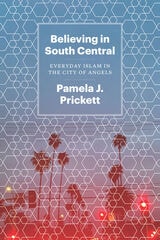
Believing in South Central
Everyday Islam in the City of AngelsPamela J. Prickett
University of Chicago Press, 2021
Prickett offers deep insights into the day-to-day lived religion of the Muslims who call this community home, showing how the mosque provides a system of social support and how believers deepen their spiritual practice not in spite of, but through, conditions of poverty. Prickett breaks past the stigmas of urban poverty, revealing a complex and vibrant community by telling the stories of longstanding residents of South Central—like Sister Ava, who offers food to the local unhoused people and finds the sacred in her extensive DVD collection. In addition to her portraits of everyday life among Muslims in South Central, Prickett also provides vivid and accessible descriptions of Ramadan and histories of the mosque, situates this community within the larger story of the Nation of Islam, explores gender issues, and unpacks the interaction between African American Muslims and South Asian and Arab American Muslims, revealing both the global and local significance of this religious tradition.
Beloved David—Advisor, Man of Understanding, and Writer
A Festschrift in Honor of David SternNaftali S. Cohn
SBL Press, 2024
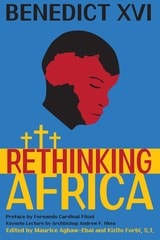
Benedict XVI Rethinking Africa
Tasks for TodayKizito Forbi
St. Augustine's Press, 2024

Benjamin Franklin and His Gods
Kerry S. Walters
University of Illinois Press, 1999
the towering figure--and mind--of Benjamin Franklin. A Renaissance man
in a Revolutionary time, Franklin had interests and knowledge not only
in religion but in literature, philosophy, politics, publishing, history,
and scientific inquiry, among many other disciplines.
Kerry S. Walters examines Franklin's search for the Divine using a similar,
multifaceted approach--and in so doing has created the first extended
treatment of Franklin's religious thought in thirty years. Walters brings
the same intellectual range and depth to the understanding of Franklin's
beliefs that Franklin brought to his own quest. What emerges from this
pilgrimage into the soul of one of America's greatest figures is a very
human Benjamin Franklin who grew with the accumulation of knowledge to
arrive at a "theistic perspectivism," which provided him with
a philosophical explanation for the diversity of religious faiths--and
a justification for the liberty of conscience he advocated throughout
his life.
Benjamin Franklin and His Gods is an original and beautifully
challenging spiritual and intellectual biography. Destined to be a classic.
Bergson, Politics, and Religion
Alexandre Lefebvre and Melanie White, eds.
Duke University Press, 2012
Contributors. Keith Ansell-Pearson, G. William Barnard, Claire Colebrook, Hisashi Fujita, Suzanne Guerlac, Vladimir Jankélévitch, Frédéric Keck, Leonard Lawlor, Alexandre Lefebvre, Paola Marrati, John Mullarkey, Paulina Ochoa Espejo, Carl Power, Philippe Soulez, Jim Urpeth, Melanie White, Frédéric Worms
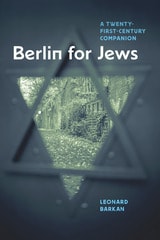
Berlin for Jews
A Twenty-First-Century CompanionLeonard Barkan
University of Chicago Press, 2016
Barkan, voraciously curious and witty, offers a self-deprecating guide to the history of Jewish life in Berlin, revealing how, beginning in the early nineteenth century, Jews became prominent in the arts, the sciences, and the city’s public life. With him, we tour the ivy-covered confines of the Schönhauser Allee cemetery, where many distinguished Jewish Berliners have been buried, and we stroll through Bayerisches Viertel, an elegant neighborhood created by a Jewish developer and that came to be called Berlin’s “Jewish Switzerland.” We travel back to the early nineteenth century to the salon of Rahel Varnhagen, a Jewish society doyenne, who frequently hosted famous artists, writers, politicians, and the occasional royal. Barkan also introduces us to James Simon, a turn-of-the-century philanthropist and art collector, and we explore the life of Walter Benjamin, who wrote a memoir of his childhood in Berlin as a member of the assimilated Jewish upper-middle class. Throughout, Barkan muses about his own Jewishness, while celebrating the rich Jewish culture on view in today’s Berlin.
A winning, idiosyncratic travel companion, Berlin for Jews offers a way to engage with German history, to acknowledge the unspeakable while extolling the indelible influence of Jewish culture.
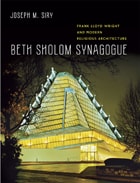
Beth Sholom Synagogue
Frank Lloyd Wright and Modern Religious ArchitectureJoseph M. Siry
University of Chicago Press, 2011
In a suburb just north of Philadelphia stands Beth Sholom Synagogue, Frank Lloyd Wright’s only synagogue and among his finest religious buildings. Designated a National Historic Landmark in 2007, Beth Sholom was one of Wright’s last completed projects, and for years it has been considered one of his greatest masterpieces.
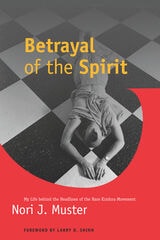
Betrayal of the Spirit
My Life behind the Headlines of the Hare Krishna MovementNori J. Muster
University of Illinois Press, 1996
Combining behind-the-scenes coverage of an often besieged religious group with a personal account of one woman's struggle to find meaning in it, Betrayal of the Spirit takes readers to the center of life in the Hare Krishna movement.
Nori J. Muster joined the International Society of Krishna Consciousness (ISKCON)--the Hare Krishnas--in 1978, shortly after the death of the movement's spiritual master, and worked for ten years as a public relations secretary and editor of the organization's newspaper, the ISKCON World Review. In this candid and critical account, Muster follows the inner workings of the movement and the Hare Krishnas' progressive decline.
Combining personal reminiscences, published articles, and internal documents, Betrayal of the Spirit details the scandals that beset the Krishnas--drug dealing, weapons stockpiling, deceptive fundraising, child abuse, and murder within ISKCON–as well as the dynamics of schisms that forced some 95 percent of the group's original members to leave. In the midst of this institutional disarray, Muster continued her personal search for truth and religious meaning as an ISKCON member until, disillusioned at last with the movement's internal divisions, she quit her job and left the organization.
In a new preface to the paperback edition, Muster discusses the personal circumstances that led her to ISKCON and kept her there as the movement's image worsened. She also talks about "the darkest secret"–child abuse in the ISKCON parochial schools--that was covered up by the public relations office where she worked.

Betting on Freedom
My Life in the ChurchCarinal Angelo Scola
Catholic University of America Press, 2021
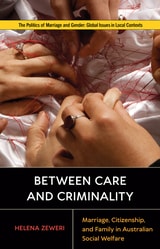
Between Care and Criminality
Marriage, Citizenship, and Family in Australian Social WelfareHelena Zeweri
Rutgers University Press, 2024

Between Church and State
The Lives of Four French Prelates in the Late Middle AgesBernard Guenée
University of Chicago Press, 1990
Guenée chooses as his frame the momentous period from the height of Saint Louis's reign in the mid-thirteenth century to the beginning of the Italian wars two hundred years later. During this time of schism in the church, of war between nascent states, and of treachery among princes, Bernard Gui (1261-1331), Gilles Le Muisit (1272-1353), Pierre D'Ailly (1351-1420), and Thomas Basin (1412-1490) all rose from modest circumstances to the dignity of office. Guenée shows us how these prelates used their talent, ambition, patrons, zeal, and experience to juggle the competing demands of obedience to church and state; to overcome competition from an upcoming new generation; and to cope with plague, war, and violence. Free of jargon yet steeped in learning, Between Church and State reveals the career patterns and politics of an era while forging a new model for points of departure in historical scholarship.
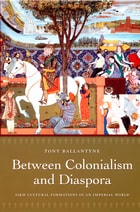
Between Colonialism and Diaspora
Sikh Cultural Formations in an Imperial WorldTony Ballantyne
Duke University Press, 2006
Constructing an expansive historical archive, Ballantyne draws on film, sculpture, fiction, and Web sites, as well as private papers, government records, journalism, and travel narratives. He proceeds from a critique of recent historiography on the development of Sikhism to an analysis of how Sikh identity changed over the course of the long nineteenth century. Ballantyne goes on to offer a reading of the contested interpretations of the life of Dalip Singh, the last Maharaja of Punjab. He concludes with an exploration of bhangra, a traditional form of Punjabi dance that diasporic artists have transformed into a globally popular music style. Much of bhangra’s recent evolution stems from encounters of the Sikh and Afro-Caribbean communities, particularly in the United Kingdom. Ballantyne contends that such cross-cultural encounters are central in defining Sikh identity both in Punjab and the diaspora.
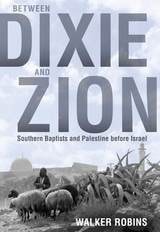
Between Dixie and Zion
Southern Baptists and Palestine before IsraelWalker Robins
University of Alabama Press, 2020
Explores the roots of evangelical Christian support for Israel through an examination of the Southern Baptist Convention
One week after the establishment of the State of Israel in 1948, delegates to the Southern Baptist Convention (SBC) repeatedly and overwhelmingly voted down resolutions congratulating fellow Southern Baptist Harry Truman on his role in Israel’s creation. From today’s perspective, this seems like a shocking result. After all, Christians—particularly the white evangelical Protestants who populate the SBC—are now the largest pro-Israel constituency in the United States. How could conservative evangelicals have been so hesitant in celebrating Israel’s birth in 1948? How did they then come to be so supportive?
Between Dixie and Zion: Southern Baptists and Palestine before Israel addresses these issues by exploring how Southern Baptists engaged what was called the “Palestine question”: whether Jews or Arabs would, or should, control the Holy Land after World War I. Walker Robins argues that, in the decades leading up to the creation of Israel, most Southern Baptists did not directly engage the Palestine question politically. Rather, they engaged it indirectly through a variety of encounters with the land, the peoples, and the politics of Palestine. Among the instrumental figures featured by Robins are tourists, foreign missionaries, Arab pastors, converts from Judaism, biblical interpreters, fundamentalist rebels, editorialists, and, of course, even a president. While all revered Palestine as the Holy Land, each approached and encountered the region according to their own priorities.
Nevertheless, Robins shows that Baptists consistently looked at the region through an Orientalist framework, broadly associating the Zionist movement with Western civilization, modernity, and progress over and against the Arabs, whom they viewed as uncivilized, premodern, and backward. He argues that such impressions were not idle—they suggested that the Zionists were bringing to fruition Baptists’ long-expressed hopes that Israel would regain the prosperity it had held in the biblical era, the Holy Land would one day be revived, and biblical prophecies preceding the return of Christ would be fulfilled.
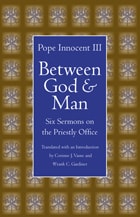
Between God and Man
Pope Innocent III
Catholic University of America Press, 2004
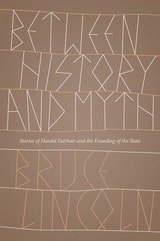
Between History and Myth
Stories of Harald Fairhair and the Founding of the StateBruce Lincoln
University of Chicago Press, 2014
Taking the story of how Harald Fairhair unified Norway in the ninth century as its central example, Bruce Lincoln illuminates the way a state’s foundation story blurs the distinction between history and myth and how variant tellings of origin stories provide opportunities for dissidence and subversion as subtle—or not so subtle—modifications are introduced through details of character, incident, and plot structure. Lincoln reveals a pattern whereby texts written in Iceland were more critical and infinitely more subtle than those produced in Norway, reflecting the fact that the former had a dual audience: not just the Norwegian court, but also Icelanders of the twelfth and thirteenth centuries, whose ancestors had fled from Harald and founded the only non-monarchic, indeed anti-monarchic, state in medieval Europe.
Between History and Myth will appeal not only to specialists in Scandinavian literature and history but also to anyone interested in memory and narrative.