Results by title
149 books match the query 'Russia (Federation)' and 9 start with b
Bergson and Russian Modernism
1900-1930Hilary L. Fink
Northwestern University Press, 2012
Between Two Fires
Gypsy Performance and Romani Memory from Pushkin to Post-SocialismAlaina Lemon
Duke University Press, 2000
Lemon’s ethnographic study is based on extensive fieldwork in 1990s Russia and focuses on Moscow Romani Theater actors as well as Romani traders and metalworkers. Drawing from interviews with Roma and Russians, observations of performances, and conversations, as well as archives, literary texts, and media, Lemon analyzes the role of theatricality and theatrical tropes in Romani life and the everyday linguistics of social relations and of memory. Historically, the way Romani stage performance has been culturally framed and positioned in Russia has served to typecast Gypsies as “natural” performers, she explains. Thus, while theatrical and musical performance may at times empower Roma, more often it has reinforced and rationalized racial and social stereotypes, excluding them from many Soviet and Russian economic and political arenas. Performance, therefore, defines what it means to be Romani in Russia differently than it does elsewhere, Lemon shows. Considering formal details of language as well as broader cultural and social structures, she also discusses how racial categories relate to post-Soviet economic changes, how gender categories and Euro-Soviet notions of civility are connected, and how ontological distinctions between “stage art” and “real life” contribute to the making of social types. This complex study thus serves as a corrective to romantic views of Roma as detached from political forces.
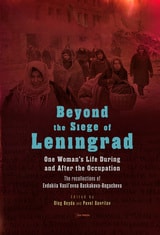
Beyond the Siege of Leningrad
One Woman’s Life during and after the Occupation: The Recollections of Evdokiia Vasil’evna Baskakova-BogachevaPavel Gavrilov
Central European University Press, 2024
This memoir about the experiences of German occupation during the siege of Leningrad (now Saint Petersburg) was written by Moscow-born Evdokiia Vasil’evna Baskakova-Bogacheva (1888–1976), an émigré in Australia, at the age of eighty-one. The text had been forgotten in the Museum of Russian Culture in San Francisco since 1970 until the editors of this volume discovered it.
In the memoirs, after accounting on her youth spent against the background of the First World War and of the two Russian revolutions of 1917, Evdokiia describes the inferno of the Nazi occupation as experienced in a suburb of Leningrad in 1941-43. She survived for nearly two years almost on the front line, within a few kilometers of the blockade ring. As a medical practitioner, she became useful for the occupational authorities and the ever-shrinking town population, until her family was evacuated to the west in October 1943. Besides hunger, discord, disease, the hunt for food and firewood, along with violence and death, Evdokiia’s account deals with various forms of cooperation between Soviet citizens and the new authorities.
All the events she recalls can be confirmed through other sources. The introduction and the detailed notes to the text help the reader to locate Evdokiia’s recollections in time and place, and situate them in their historical context.
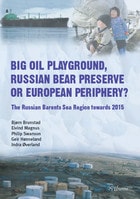
Big Oil Playground, Russian Bear Preserve or European Periphery?
The Russian Barents Sea Region towards 2015Bjørn Brunstad, Eivind Magnus, Philip Swanson, Geir Hønneland, and Indra Øverlan
Eburon Academic Publishers, 2005
The volume considers whether the international energy industry will transform Barents into a "big oil playground," if environmental protection rules will make it a "Russian bear preserve," or if integration into world trade will put it on the "European periphery." The result is a valuable resource for understanding the changing dynamics and challenges in modern public planning and a globalized economy.
Biopower in Putin’s Russia
From Taking Care to Taking LivesSergei Medvedev
Central European University Press, 2024
In this book, Makarychev and Medvedev examine the importance of biopolitics in fueling Russia’s confrontation with the West. In their view, the development of Putin’s illiberal authoritarianism was largely triggered by what they call a biopolitical turn. This shift is exemplified by the use of an increasing number of regulatory mechanisms to discipline and constrain the human body. Such political practices concern issues of sexuality, reproductive behavior, adoption, fertility, family planning, public hygiene, and demography. This turn created a new disciplinary framework for the population and the elite. Bans and restrictions of a biopolitical nature, became one of the main tools for articulating the rules of belonging in the political community and drawing its political boundaries. Biopolitical discourses have taken up the core of the Russian identity formation, which contrasts a positive “conservative Russia” with a supposedly vicious “liberal West.”
The presentation of the political genealogy of the body-centric structures of power and hegemony in Russia implies their transformation from bio- to necropolitics. Necropolitical (repressive and life-depriving) components are inscribed in the biopolitical regimes of power: they form the core of Putin’s rule over Russia and are a key factor behind the war against Ukraine.
Black Earth, White Bread
A Technopolitical History of Russian Agriculture and FoodSusanne A. Wengle
University of Wisconsin Press, 2023
Examining governance, production, consumption, nature, and the ensuing vulnerabilities of the agrifood system, Wengle reveals the intended and unintended consequences of Russian agricultural policies since 1917. Ultimately, Black Earth, White Bread calls attention to Russian technopolitics and how macro systems of government impact life on a daily, quotidian level.
Bourdieu's Secret Admirer in the Caucasus
A World-System BiographyGeorgi M. Derluguian
University of Chicago Press, 2005
Exploring globalization, democratization, ethnic identity, and international terrorism, Derluguian contextualizes Shanib's personal trajectory from de-Stalinization through the nationalist rebellions of the 1990s, to the recent rise in Islamic militancy. He masterfully reveals not only how external economic and political forces affect the former Soviet republics but how those forces are in turn shaped by the individuals, institutions, ethnicities, and social networks that make up those societies. Drawing on the work of Charles Tilly, Immanuel Wallerstein, and, of course, Bourdieu, Derluguian's explanation of the recent ethnic wars and terrorist acts in Russia succeeds in illuminating the role of human agency in shaping history.
Brokers and Bureaucrats
Building Market Institutions in RussiaTimothy Frye
University of Michigan Press, 2000

Bronislava Nijinska
Early MemoirsIrina Nijinska, Jean Rawlinson, eds. and trans.
Duke University Press, 1992