Results by title
72 books match the query 'Survival' and 5 start with b
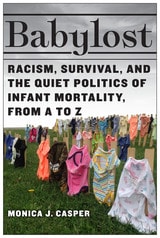
Babylost
Racism, Survival, and the Quiet Politics of Infant Mortality, from A to ZMonica J. Casper
Rutgers University Press, 2021
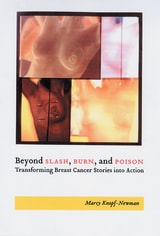
Beyond Slash, Burn, and Poison
Transforming Breast Cancer Stories into ActionMarcy Jane Knopf-Newman
Rutgers University Press, 2004
Depending on one’s vantage point, breast cancer can be a very different experience, and indeed, a very different concern. It is, for some, a personal struggle; for others, it is a disease posing scientific and environmental challenges; and for others it is a highly charged and politicized issue around which policy wars rage. Beyond Slash, Burn, and Poison brings a unique perspective to breast cancer by recognizing the overlapping relationship of all these realities.
Drawing on the writings of Rachel Carson, Betty Ford, Rose Kushner, and Audre Lorde, this book explores the various ways in which patient-centered texts continue to leave their mark on the political realm of breast cancer and, ultimately, the disease itself. Ordered chronologically, the selections trace the progression of discussions about breast cancer from a time when the subject was kept private and silent to when it became part of public discourse. The texts included are personal accounts, written by women struggling to play an active role in their healing process and, at the same time, hoping to help others do the same.
Knopf-Newman also shows us how these writings eventually changed public opinion and the underlying tendency to blame women for their illness. She argues that changes in medical practice and public policy are linked to textual interventions, and makes a case for the politicization of cultural studies of disease through personal and literary expression.
Passionately written and well-researched, Beyond Slash, Burn, and Poison transforms how we think about breast cancer. Rather than facilitating forums for separate discussions, this book brings conversations into dialog with each other. It is essential reading for anyone concerned with breast cancer and its history, as well as for those interested in the effect of the environment on public health and the role that literature plays in public policy and medicine.
Black Street Speech
Its History, Structure, and SurvivalBy John Baugh
University of Texas Press, 1983
In the minds of many, black street speech—the urban dialect of black Americans—bespeaks illiteracy, poverty, and ignorance. John Baugh challenges those prejudices in this brilliant new inquiry into the history, linguistic structure, and survival within white society of black street speech. In doing so, he successfully integrates a scholarly respect for black English with a humanistic approach to language differences that weds rigor of research with a keen sense of social responsibility.
Baugh's is the first book on black English that is based on a long-term study of adult speakers. Beginning in 1972, black men and women in Los Angeles, Philadelphia, Chicago, Austin, and Houston were repeatedly interviewed, in varied social settings, in order to determine the nature of their linguistic styles and the social circumstances where subtle changes in their speech appear. Baugh's work uncovered a far wider breadth of speaking styles among black Americans than among standard English speakers. Having detailed his findings, he explores their serious implications for the employability and education of black Americans.
Black Street Speech is a work of enduring importance for educators, linguists, sociologists, scholars of black and urban studies, and all concerned with black English and its social consequences.
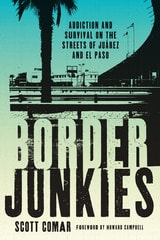
Border Junkies
Addiction and Survival on the Streets of Juárez and El PasoBy Scott Comar
University of Texas Press, 2011
The drug war that has turned Juárez, Mexico, into a killing field that has claimed more than 7,000 lives since 2008 captures headlines almost daily. But few accounts go all the way down to the streets to investigate the lives of individual drug users. One of those users, Scott Comar, survived years of heroin addiction and failed attempts at detox and finally cleaned up in 2003. Now a graduate student at the University of Texas at El Paso in the history department's borderlands doctoral program, Comar has written Border Junkies, a searingly honest account of his spiraling descent into heroin addiction, surrender, change, and recovery on the U.S.-Mexico border.
Border Junkies is the first book ever written about the lifestyle of active addiction on the streets of Juárez. Comar vividly describes living between the disparate Mexican and American cultures and among the fellow junkies, drug dealers, hookers, coyote smugglers, thieves, and killers who were his friends and neighbors in addiction—and the social workers, missionaries, shelter workers, and doctors who tried to help him escape. With the perspective of his anthropological training, he shows how homelessness, poverty, and addiction all fuel the use of narcotics and the rise in their consumption on the streets of Juárez and contribute to the societal decay of this Mexican urban landscape. Comar also offers significant insights into the U.S.-Mexico borderland's underground and peripheral economy and the ways in which the region's inhabitants adapt to the local economic terrain.
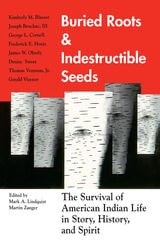
Buried Roots and Indestructible Seeds
The Survival Of American Indian Life In Story, History, and SpiritMark A. Lindquist
University of Wisconsin Press, 1995
This anthology highlights central values and traditions in Native American societies, exploring the ongoing struggles and survival power of Native American people today. The essays and stories by well-known writers provide an excellent introduction for general readers as well as high school and college students. The stories and historical events are drawn especially from the tribes of the Great Lakes region, such as the Ojibwa (Chippewa) of Wisconsin, and are part of a continuing, sustaining storytelling tradition.
Starting with the opening selection, “The Circle of Stories,” which reaffirms the relationship of humans to all living things, the anthology emphasizes themes of connectedness and survival in essays on the environment, identity, community allegiance and treaty rights, marginalization and assimilation in American society, and conflict within the educational system. Several selections about Trickster tales introduce traditions of humor, irony, and imagination that have come to embody native survival, liberation, and continuance.
The authors included in Buried Roots and Indestructible Seeds are Kim Blaeser, Joseph Bruchac, George Cornell, Fred Hoxie, James Oberly, Denise Sweet, Tom Vennum, and Gerald Vizenor.