Results by title
97 books match the query 'Urbanization' and 7 start with b
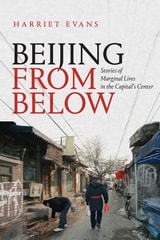
Beijing from Below
Stories of Marginal Lives in the Capital's CenterHarriet Evans
Duke University Press, 2020
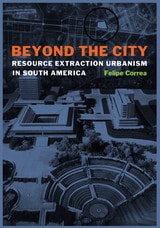
Beyond the City
Resource Extraction Urbanism in South AmericaBy Felipe Correa
University of Texas Press, 2016
During the last decade, the South American continent has seen a strong push for transnational integration, initiated by the former Brazilian president Fernando Henrique Cardoso, who (with the endorsement of eleven other nations) spearheaded the Initiative for the Integration of Regional Infrastructure in South America (IIRSA), a comprehensive energy, transport, and communications network. The most aggressive transcontinental integration project ever planned for South America, the initiative systematically deploys ten east-west infrastructural corridors, enhancing economic development but raising important questions about the polarizing effect of pitting regional needs against the colossal processes of resource extraction. Providing much-needed historical contextualization to IIRSA’s agenda, Beyond the City ties together a series of spatial models and offers a survey of regional strategies in five case studies of often overlooked sites built outside the traditional South American urban constructs.
Implementing the term “resource extraction urbanism,” the architect and urbanist Felipe Correa takes us from Brazil’s nineteenth-century regional capital city of Belo Horizonte to the experimental, circular, “temporary” city of Vila Piloto in Três Lagoas. In Chile, he surveys the mining town of María Elena. In Venezuela, he explores petrochemical encampments at Judibana and El Tablazo, as well as new industrial frontiers at Ciudad Guayana. The result is both a cautionary tale, bringing to light a history of societies that were “inscribed” and administered, and a perceptive examination of the agency of architecture and urban planning in shaping South American lives.
Border Economies
Cities Bridging the U.S.-Mexico DivideJames Gerber
University of Arizona Press, 2024
Enormous legal cross-border flows of people, goods, and finance are embedded in the region’s history and prompted by the need to respond to new opportunities and challenges that originate on the other side. In Border Economies James Gerber examines how the interactivity and sensitivity of communities to conditions across the border differentiates them from communities in the interiors of Mexico and the United States. Gerber explains what makes the region not only unique but uniquely interesting.
In Border Economies readers who want to understand the conditions that make the border controversial but also want to go beyond shallow political narratives will find an in-depth exploration of the economic forces shaping the region and an antidote to common prejudices and misunderstandings.
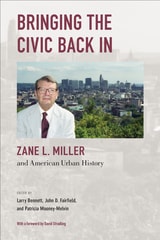
Bringing the Civic Back In
Zane L. Miller and American Urban HistoryEdited by Larry Bennett, John D. Fairfield, and Patricia Mooney-Melvin
Temple University Press, 2022
With the passing of Zane L. Miller in 2016, academia lost a renowned scholar and one of the key founders of new urban history—a branch of the discipline that placed urban life at the center of American history and treated the city as an arena for civic and political action. He was a devoted, tireless mentor who published or fostered dozens of books and articles on urban history. He also co-founded Temple University Press’ foundational series Urban Life, Landscape, and Policy.
Bringing the Civic Back In provides a critical overview, appreciation, and extension of Miller’s work as scholar, editor, mentor, colleague, and citizen. Included are three excerpts from Miller’s final, unfinished work, in which he presented cities as the source of a civic nationalism he viewed as fundamental to the development of American democracy. The editors—along with contributors Robert B. Fairbanks and Charles Lester—reflect on the life and work of their friend as well as his role in creating a Cincinnati school of urban history. These original essays by practitioners of Miller’s approach highlight the power of ideas to shape social change.
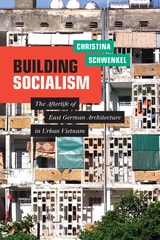
Building Socialism
The Afterlife of East German Architecture in Urban VietnamChristina Schwenkel
Duke University Press, 2020
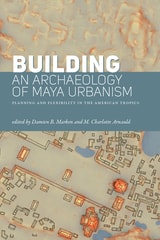
Building an Archaeology of Maya Urbanism
Planning and Flexibility in the American TropicsDamien B. Marken and M. Charlotte Arnauld
University Press of Colorado, 2023
Integrating recent lidar survey data with more traditional excavation and artifact-based archaeological practices, chapters in this volume offer broadened perspectives on the patterns of Maya urban design and planning by viewing bottom-up and self-organizing processes as integral to the form, development, and dissolution of Classic lowland cities alongside potentially centralized civic designs. Full of innovative examples of how to build an archaeology of urbanism that can be applied not just to the lowland Maya and across the region, Building an Archaeology of Maya Urbanism simultaneously improves interpretations of lowland Maya culture history and contributes to empirical and comparative discussions of tropical, non-Western cities worldwide.
Contributors: Divina Perla Barrera, Arianna Campiani, Cyril Castanet, Adrian S. Z. Chase, Lydie Dussol, Sara Dzul Góngora, Keith Eppich, Thomas Garrison, María Rocio González de la Mata, Timothy Hare, Julien Hiquet, Takeshi Inomata, Eva Lemonnier, José Francisco Osorio León, Marilyn Masson, Elsa Damaris Menéndez, Timothy Murtha, Philippe Nondédéo, Keith M. Prufer, Louise Purdue, Francisco Pérez Ruíz, Julien Sion, Travis Stanton, Rodrigo Liendo Stuardo, Karl A. Taube, Marc Testé, Amy E. Thompson, Daniela Triadan
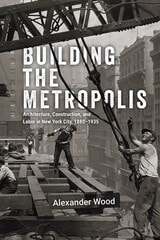
Building the Metropolis
Architecture, Construction, and Labor in New York City, 1880–1935Alexander Wood
University of Chicago Press, 2025
Between the 1880s and the 1930s, New York City experienced explosive growth as nearly a million buildings, dozens of bridges and tunnels, hundreds of miles of subway lines, and thousands of miles of streets were erected to meet the needs of an ever-swelling population. This landscape—jagged with skyscrapers, rattling with the sound of mass transit, alive with people—made the city world-famous.
Building the Metropolis offers a revelatory look at this era of urban development by asking, “Who built New York, and how?” Focusing on the work of architects, builders, and construction workers, Alexander Wood chronicles the physical process of the city’s rapid expansion. New York’s towering buildings and busy thoroughfares aren’t just stylish or structural marvels, Wood shows, but the direct result of the many colorful personalities who worked in one of the city’s largest industries. This development boom drew on the resources of the whole community and required money, political will, creative vision, entrepreneurial drive, skilled workmanship, and hard physical labor. Wood shows this to be an even larger story as well. As cities became nodes in a regional, national, and global economy, the business of construction became an important motor of economic, political, and social development. While they held drastically different views on the course of urban growth, machine politicians, reformers, and radicals alike were all committed to city building on an epic scale.
Drawing on resources that include city archives and the records of architecture firms, construction companies, and labor unions, Building the Metropolis tells the story of New York in a way that’s epic, lively, and utterly original.