Results by title
2284 books match the query 'Women' and 117 start with b
BEYOND THE REPRODUCTIVE BODY
Politics of Women’s Health & Work in Early Victorian EnglandMarjorie Levine-Clark
The Ohio State University Press, 2004
BODIES OF TECHNOLOGY
Women’s Involvement with Reproductive MedicineEdited by Ann R. Saetnan, Nelly Oudshoorn, and Marta Kirejczyk
The Ohio State University Press, 2000
Bodies of Technology is based on the premise that technology and society mutually shape one another, and on a concern for women’s health and autonomy. A basic question is one of cultural appropriation: Do technologies take on different shapes, different practices, and have different impacts as they spread from one place to another? By juxtaposing a number of culturally and historically contextualized studies of similar technologies, the editors demonstrate that although technologies globalize by spreading among cultures, they are also localized by the cultures they encounter.
The first part of the book investigates how potential users of hormone-based contraceptives are represented as these technologies are developed in laboratories and field tests. The next section explores the political and economic processes that regulate access to and practices of assisted fertilization. The final section focuses on individual users engaging with fetal diagnostic technologies in clinical practice. Taken as a whole, the book points out the need and the possibilities for women to become directly involved in the shaping of technologies that so strongly affect their health and their daily lives.

Back Talk
Teaching Lost Selves to SpeakJoan Weimer
University of Chicago Press, 1996
In this elegant, humorous, and brutally frank memoir, Weimer's discoveries—documentative and imaginative, historical and personal—reveal much about what motivates research, and what motivates healing.

Bad Girls of the Arab World
Edited by Nadia Yaqub and Rula Quawas
University of Texas Press, 2017
Women’s transgressive behaviors and perspectives are challenging societal norms in the Arab world, giving rise to anxiety and public debate. Simultaneously, however, other Arab women are unwillingly finding themselves labeled “bad” as authority figures attempt to redirect scrutiny from serious social ills such as patriarchy and economic exploitation, or as they impose new restrictions on women’s behavior in response to uncertainty and change in society. Bad Girls of the Arab World elucidates how both intentional and unintentional transgressions make manifest the social and cultural constructs that define proper and improper behavior, as well as the social and political policing of gender, racial, and class divisions.
The works collected here address the experiences of women from a range of ages, classes, and educational backgrounds who live in the Arab world and beyond. They include short pieces in which the women themselves reflect on their experiences with transgression; academic articles about performance, representation, activism, history, and social conditions; an artistic intervention; and afterwords by the acclaimed novelists Laila al-Atrash and Miral al-Tahawy. The book demonstrates that women’s transgression is both an agent and a symptom of change, a site of both resistance and repression. Showing how transnational forces such as media discourses, mobility and confinement, globalization, and neoliberalism, as well as the legacy of colonialism, shape women’s badness, Bad Girls of the Arab World offers a rich portrait of women’s varied experiences at the boundaries of propriety in the twenty-first century.
Balancing Act
Motherhood, Marriage, and Employment Among American WomenDaphne Spain
Russell Sage Foundation, 1996
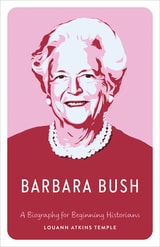
Barbara Bush
A Biography for Beginning HistoriansLouann Atkins Temple
University of Texas Press, 2025
A brief biography of Barbara Bush for young readers.
Louann Temple is a lifelong Texan with a personal passion for arts and education who believes that biography, with its emphasis on personalities, is ideal for introducing young people to history, with its focus on events. Temple is uniquely situated to write this biography for young readers, as she has been personally acquainted with many important people in presidential history, First Lady Barbara Bush included, and she has mentored countless middle and high school students, preparing them for college admission.
Barbara Bush highlights the key events in the life of the First Lady; explores the life lessons afforded by her legacy; and reflects on the broad historical issues during her time in the White House from 1989 to 1993. Married to the forty-first president, George H. W. Bush, Barbara Bush spent her time as First Lady dedicated to charity work and helping the American people, notably supporting Americans during the AIDS crisis. Enhanced with a carefully curated selection of black and white photographs from three presidential libraries, this biography for beginning historians is poised to bring the best of biography and history to a new generation of readers.

Baring Witness
36 Mormon Women Talk Candidly about Love, Sex, and MarriageEdited by Holly Welker
University of Illinois Press, 2016
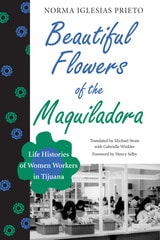
Beautiful Flowers of the Maquiladora
Life Histories of Women Workers in TijuanaBy Norma Iglesias Prieto
University of Texas Press, 1997
Published originally as La flor mas bella de la maquiladora, this beautifully written book is based on interviews the author conducted with more than fifty Mexican women who work in the assembly plants along the U.S.-Mexico border. A descriptive analytic study conducted in the late 1970s, the book uses compelling testimonials to detail the struggles these women face.
The experiences of women in maquiladoras are attracting increasing attention from scholars, especially in the context of ongoing Mexican migration to the country's northern frontier and in light of the North American Free Trade Agreement (NAFTA). This book is among the earliest accounts of the physical and psychological toll exacted from the women who labor in these plants. Iglesias Prieto captures the idioms of these working women so that they emerge as dynamic individuals, young and articulate personalities, inexorably engaged in the daily struggle to change the fundamental conditions of their exploitation.
Beautiful Soon Enough
Margo Berdeshevsky
University of Alabama Press, 2009

Beautiful Work
A Meditation on PainSharon Cameron
Duke University Press, 2000
In order to understand the nature of pain, Anna undertakes a meditation practice. We tend to think of pain as self-absorbing and exclusively our own ("my pain," "I am in pain"). In distinction, Sharon Cameron’s Anna comes to explore pain as common property, and as the basis for a radically reconceived selfhood. Resisting the limitations of memoir, Beautiful Work speaks from experience and simultaneously releases it from the closed shell of personal ownership. Outside of the not quite inevitable stories we tell about it, experience is less protected, less compromised, and more vivid than could be supposed.
Beautiful Work brings to bear the same interest in consciousness and intersubjectivity that characterizes Cameron’s other work.
Beauvoir and Her Sisters
The Politics of Women's Bodies in FranceSandra Reineke
University of Illinois Press, 2011
Because We Must
A MemoirTracy Youngblom
University of Massachusetts Press, 2025
A breathtaking memoir navigating caregiving, motherhood, and letting go after a tragic accident
On March 16th, 2015, Tracy Youngblom was rushing to finish last-minute preparations for a class she would teach the next day when there was an unexpected knock at her door. Grudgingly, she answered it to find a uniformed officer standing on her front porch. Youngblom realized then that her youngest son Elias should have been arriving home from a trip to Fargo where he was visiting friends at North Dakota State University. The officer told her that Elias had been in an accident and was in the hospital. Later, she learned that his car had been struck nearly head on by a drunk driver going 70 miles per hour. Denial and shock took over as she made the long drive from their home in Coon Rapids, Minnesota. When she saw Elias in the ICU—swollen beyond recognition, covered in stitches, with a myriad of tubes attached to him—the full gravity of the situation descended.
On the day of the crash, Elias had been driving back to Coon Rapids to celebrate National Ice Cream Day with friends. An avid lover of music, he’d been working as a conductor while wrapping up his degree, moving toward his dream of becoming a marching band director. After the accident, Elias begins his long journey of recovery, which is set back when doctors announce that his optic nerves are dead. Despite it all, Elias never wavers, approaching each challenge with resilience, grace, and humor.
Alongside Elias, Youngblom faces her own challenges, staying by his side in the ICU for weeks, coordinating with other family members and friends, and never flagging in her care of her severely injured son, yet all the while coping with her own emotions, fears, and trauma. She struggles to support Elias, heal her self, and let him go on with his life. In this riveting memoir, Youngblom traverses her family’s lives before and after the accident, capturing the complications of grief, recovery, and the strength it takes to move forward—because we must.
Becoming Anna
Anna J. Michener
University of Chicago Press, 1998
"A teen's raw, in-your-face chronicle of events almost as they were happening. As such, it's unforgettable. . . . Michener's story gives voice to the thousands of children and adolescents trapped in 'the system,' biding their time until their 18th birthdays. A candid and unstinting tell-all."—Kirkus Reviews
"Extraordinary. . . . Michener's expressive writing does justice to a topic that is clearly very disturbing to her personally and communicates a profoundly important message on behalf of all abused and neglected children."—Booklist
"An important book, painful to read, but essential if other children in similar situations are to be saved."—Library Journal
"An innocent child's account of 16 years in hell and of the terrible wrongs inflicted on children who are without rights or caring advocates."—Choice
"[Michener] emerges as a compelling and courageous advocate for children and their welfare—she's a young writer with an extraordinary voice."Feminist Bookstore News
"Quite simply one of the best, most compelling, well-written autobiographies published in years. . . . Remember the name. We have not heard the last of Anna Michener."—Myree Whitfield, Melbourne Herald-Sun, cover story
Becoming Catawba
Catawba Indian Women and Nation-Building, 1540–1840Brooke M. Bauer
University of Alabama Press, 2023
WINNER OF THE ANNE B. & JAMES B. MCMILLAN PRIZE IN SOUTHERN HISTORY
WINNER OF THE ERMINIE WHEELER-VOEGELIN BOOK AWARD
WINNER OF THE BERSHIRE CONFERENCE OF WOMEN HISTORIANS BOOK AWARD
WINNER OF THE GEORGE C. ROGERS, JR. AWARD FROM THE SOUTH CAROLINA HISTORICAL SOCIETY
The story of Catawba women who experienced sweeping changes to their world but held onto traditional customs to create and preserve a Catawba identity and build a nation.
Brooke M. Bauer’s Becoming Catawba: Catawba Indian Women and Nation-Building, 1540–1840 is the first book-length study of the role Catawba women played in creating and preserving a cohesive tribal identity over three centuries of colonization and cultural turmoil. Bauer, a citizen of the Catawba Indian Nation of South Carolina, weaves ethnohistorical methodologies, family history, cultural context, and the Catawba language together to generate an internal perspective on the Catawbas’ history and heritage in the area now known as the Carolina Piedmont.
This unique and important study examines the lives and legacies of women who executed complex decision-making and diplomacy to navigate shifting frameworks of kinship, land ownership, and cultural production in dealings with colonial encroachments, white settlers, and Euro-American legal systems and governments from the mid-sixteenth century to the early nineteenth century. Personified in the figure of Sally New River, a Catawba cultural leader to whom 500 remaining acres of occupied tribal lands were deeded on behalf of the community in 1796 and which she managed until her death in 1821, Bauer reveals how women worked to ensure the survival of the Catawba people and their Catawba identity, an effort that resulted in a unified nation.
Bauer’s approach is primarily ethnohistorical, although it draws on a number of interdisciplinary strategies. In particular, Bauer uses “upstreaming,” a critical strategy that moves toward the period under study by using present-day community members’ connections to historical knowledge—for example, family histories and oral traditions—to interpret primary-source data. Additionally, Bauer employs archaeological data and material culture as a means of performing feminist recuperation, filling the gaps and silences left by the records, newspapers, and historical accounts as primarily written by and for white men. Ultimately, Becoming Catawba effects a welcome intervention at the intersections of Native, women’s, and Southern history, expanding the diversity and modes of experience in the fraught, multifaceted cultural environment of the early American South.
Becoming Citizens
The Emergence and Development of the California Women's Movement, 1880-1911Gayle Gullett
University of Illinois Press, 2000
In 1880, Californians believed a woman safeguarded the Republic by maintaining a morally sound home. Scarcely forty years later, women in the state won full-fledged citizenship and voting rights by stepping outside the home to engage in robust activism.
Gayle Gullett reveals how this enormous transformation came about and the ways women's search for a larger public life led to a flourishing women's movement in California. Though voters rejected women's radical demand for citizenship in 1896, women rebuilt the movement in the early years of the twentieth century and forged critical bonds between activist women and the men involved in the urban Good Government movement. This alliance formed the basis of progressivism, with male Progressives helping to legitimize women's new public work by supporting their civic campaigns, appointing women to public office, and placing a suffrage referendum before the male electorate in 1911.
Placing local developments in a national context, Becoming Citizens illuminates the links between women's reform movements and progressivism in the American West.

Becoming Laura Ingalls Wilder
The Woman behind the LegendJohn E. Miller
University of Missouri Press, 2005
Becoming Lesbian
A Queer History of Modern FranceTamara Chaplin
University of Chicago Press, 2024
In Becoming Lesbian, historian Tamara Chaplin argues that the history of female same-sex intimacy is central to understanding the struggle to control the public sphere. This monumental study draws on undiscovered sources culled from cabaret culture, sexology, police files, radio, TV, photography, the Minitel (an early form of internet), and private letters, as well as over one hundred interviews filmed by the author. Becoming Lesbian demonstrates how women of diverse classes and races came to define themselves as lesbian and used public spaces and public media to exert claims on the world around them in ways that made possible new forms of gendered and sexual citizenship. Chaplin begins in the sapphic cabarets of interwar Paris. These venues, she shows, exploited female same-sex desire for profit while simultaneously launching an incipient queer female counterpublic. Refuting claims that World War II destroyed this female world, Chaplin reveals instead how prewar sapphic subcultures flourished in the postwar period, laying crucial groundwork for the politicization of lesbian identity into the twenty-first century.
Becoming Lesbian is filled with colorful vignettes about female cabaret owners, singers, TV personalities, writers, and activists, all brought to life to make larger points about rights, belonging, and citizenship. As a history of lesbianism, this book represents a major contribution to modern French history, queer studies, and genealogies of the media and its publics.
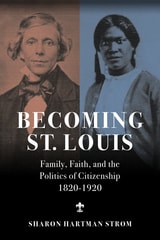
Becoming St. Louis
Family, Faith, and the Politics of Citizenship, 1820-1920Sharon Hartman Strom
University of Illinois Press, 2025
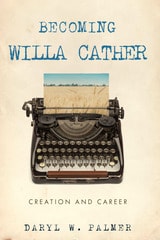
Becoming Willa Cather
Creation and CareerDaryl W. Palmer
University of Nevada Press, 2019
Willa Cather has long been admired for O Pioneers! (1913), Song of the Lark (1915), and My Ántonia (1918)—the “prairie novels” about the lives of early Nebraska pioneers that launched her career. Thanks in part to these masterpieces, she is often viewed as a representative of pioneer life on the Great Plains, a controversial innovator in American modernism, and a compelling figure in the literary history of LGBTQ America. A century later, scholars acknowledge Cather’s place in the canon of American literature and continue to explore her relationship with the West.
Drawing on original archival research and paying unprecedented attention to Cather’s early short stories, Palmer demonstrates that the relationship with Nebraska in the years leading up to O Pioneers! is more dynamic than critics and scholars thought. Readers will encounter a surprisingly bold young author whose youth in Nebraska served as a kind of laboratory for her future writing career. Becoming Willa Cather changes the way we think about Cather, a brilliant and ambitious author who embraced experimentation in life and art, intent on reimagining the American West.
Beer Ghosts
In Search of Lost Hops and the Women Who Grew ThemJennifer A. Jordan
University of Chicago Press, 2026
The little-known story of the young women who played a vital role in the rise of America’s great breweries.
Water, malt, yeast, and hops: these are essential ingredients of beer. Hops, specifically, play an outsized role in determining its flavor and aroma. In Beer Ghosts, Jennifer Jordan takes us back to a brief but pivotal moment in the nineteenth century when Wisconsin produced much of the hops grown in the United States. Yet those long-ago hops are not the only ghosts in Jordan’s story. Haunting the pages of this book are the young women whose work at harvest time was key to the rise of the American beer industry.
Until the early twentieth century, the work of picking hops was a time-consuming process that could only be done by hand, one cone at a time. In nineteenth-century Wisconsin, that work was performed almost exclusively by women and girls, who traveled to hop farms in droves as summer came to a close and the harvest began. At the height of the hop boom in the 1860s, farmers and their families laid out beds and prepared food for tens of thousands of seasonal laborers, and hosted parties and dances well into the night. Despite the scale of Wisconsin’s hop boom (and subsequent crash), the industry left behind little trace aside from local records and archives. And it is that barely discernible trace that lures Jordan to dig deeper.
Jordan’s vivid prose takes us back to this era by drawing on a rich trove of archival sources, from the thousands of hop farmers in the agricultural census to the extraordinary diary of a single hop picker, a young woman named Ella. The history of beer is incomplete without the history of Ella and the others who labored in the hop fields and in the houses that hosted them. In this book, Jordan gives life and voice to these beer ghosts who call to us from the past, showing the rich connections between a nation’s beer and the lives that made it possible.
Before Before
A Story of Discovery and Loss in Sierra LeoneBetsy Small
University of Michigan Press, 2025
2025 Foreword INDIES Finalist for Political and Social Sciences
- 2026 Nautilus Silver Book Award in World Cultures' Transformational Growth & Development
Sierra Leone is often sensationalized as a place of extreme violence and suffering—of blood diamonds, child soldiers, war amputations, and Ebola and now the highly addictive drug Kush. Before Before captures daily life in a different country, one Betsy Small first encountered as a Peace Corps worker between 1984–1987, and then rediscovered when she returned decades later with her daughter. Living in Tokpombu, a remote community of forty rice-farming families, the author faced struggles that changed her forever and witnessed the growing tensions in this rainforest village—between the young and old, between the traditions of oral history and honoring the ancestors valued by the elders and the siren call of the illicit diamond mines faced by the youth.
Before Before offers a rare portrait of everyday people, with particular focus on the lives of women and girls, before the brutal war of 1991 tore the country apart. Through Small’s account of immersion in another world as she witnessed injustice and was welcomed as a friend, readers are invited to explore the shared ground of our humanity.
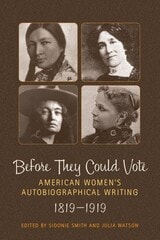
Before They Could Vote
American Women's Autobiographical Writing, 1819–1919Edited by Sidonie A. Smith and Julia Watson
University of Wisconsin Press, 2006
"This rich new anthology sets in motion an inter-textual conversation of remarkable vitality that will change the ways we understand gender, class, ethnicity, culture, and nation in nineteenth-century America."—Susanna Egan, author of Mirror-Talk

Behind Closed Doors
Women's Oral Narratives in TunisHejaiej, Monia
Rutgers University Press, 1996
Tunis has a long history of city life reaching back to ancient times. The Arabic language is firmly rooted among its inhabitants and most embrace the morals and culture of Islam. Behind Closed Doors presents forty-seven tales told by three Beldi women, members of a historic and highly civilized community, the city's traditional elite. Tale-telling is important to all Beldi women, and the book examines its role in their shared world and its significance in the lives of the three tellers.
Tales are told at communal gatherings to share and pass on Beldi women's secret lore of love, marriage and destiny. Ghaya Sa'diyya and Kheira tell stories which echo their life experience and have deep meanings for them. Their tales reflect accepted moral codes, and yet many depict attitudes, relationships, and practices that contradict established norms. Whereas Kheira presents a conservative and moralistic view of the role of women, Sa'diyya's heroines are alive with sexual energy, and Ghaya's stories also offer racy and rebellious comments on a woman's lot. These contradictory visions offer a kaleidoscopic view of the position of women in the rich life of a historic North African city.
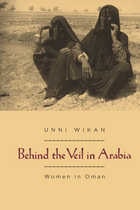
Behind the Veil in Arabia
Women in OmanUnni Wikan
University of Chicago Press, 1991
"Wikan does provide insights into the real position of these secluded and segregated women. . . . All this is interesting and valuable."—Ahdaf Soueif, Times Literary Supplement
"The book is detailed, insightful, and . . . engrossing. Anyone interested in the day-to-day triumphs and sorrows of women who live 'behind the veil' will want to read this account."—Arab Book World
"Wikan, a fine ethnographer, has an eye for everything that is distinctive about the culture and . . . builds up a wholly convincing picture. Above all, there is a sustained attempt to penetrate the inner lives of these strangely serene people."—Frank H. Stewart, Wilson Quarterly
"This book will certainly be of interest to all scholars concerned with sexual identity in the Islamic world."—Henry Munson, American Anthropologist
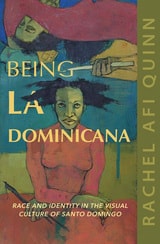
Being La Dominicana
Race and Identity in the Visual Culture of Santo DomingoRachel Afi Quinn
University of Illinois Press, 2021
Engaging and astute, Being La Dominicana reveals the little-studied world of today's young Dominican women and what their personal stories and transnational experiences can tell us about the larger neoliberal world.
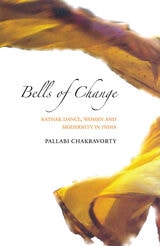
Bells of Change
Kathak Dance, Women and Modernity In IndiaPallabi Chakravorty
Seagull Books, 2008

Benefit Street
A NovelAdria Bernardi
University of Alabama Press, 2022
WINNER OF FC2's CATHERINE DOCTOROW INNOVATIVE FICTION PRIZE
A universal story of exile, of the refugee and emigrant, and of all those displaced who can reconstruct a sense of home only by weaving a new fabric of the imagination
For nearly two decades, Şiva has met after work on Tuesdays with four friends at a teahouse called the Kafiye. In interrupted conversations, the women explore what it is to live engaged lives inside and outside the home. Amidst joking and complaints, while drinking too much tea and eating too many sweets, they tell of their days: a son’s ninth birthday, the bruise on the arm of an aging parent, soldiers stationed outside the school, the funeral of an opposition political leader killed in a mysterious car accident.
Set in an unnamed provincial capital of an unnamed country, Benefit Street tells of a wide circle of friends—teachers, lawyers, missionaries, doctors, artisans—in a time of gathering and dispersal. It tells the story of mothers, daughters, sisters, wives, colleagues, and neighbors, as war to the East threatens and constitutional rights are daily eroded by an increasingly authoritarian regime.
The ideals of youth, freedom, and coexistence are severely tested with the shocking revelation that the charismatic leader of their group has sexually abused the women under his care. The limits of reconciliation are tested as Şiva makes an arduous journey into the mountains to meet an estranged mother with a genius for weaving complex rugs.
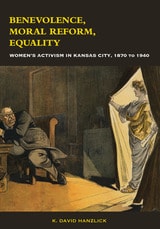
Benevolence, Moral Reform, Equality
Women's Activism in Kansas City, 1870 to 1940K. David Hanzlick
University of Missouri Press, 2018
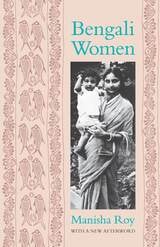
Bengali Women
Manisha Roy
University of Chicago Press, 1992
In a new Afterword, Roy discusses changes in Bengali society and culture over the last two decades which have direct bearings on women's lives: divorce and the breakup of the joint family, education, increasing Westernization via television and women's magazines, and the erosion of traditional religious practices.
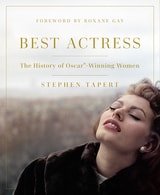
Best Actress
The History of Oscar®-Winning WomenStephen Tapert
Rutgers University Press, 2020
This lavishly illustrated coffee table book offers a vital examination of the first 75 women to have won the Best Actress Oscar over the span of 90 years. From inaugural recipient Janet Gaynor to Frances McDormand’s 2018 acceptance speech that assertively brought women to the forefront, Best Actress: The History of Oscar®-Winning Women serves to promote a new appreciation for the cinematic roles these women won for, as well as the real-life roles many of them played – and still play – in advancing women’s rights and equality. Stories range from Bette Davis’ groundbreaking battle against the studio system; to the cutting-edge wardrobes of Katharine Hepburn, Diane Keaton and Cher; to the historical significance of Halle Berry’s victory; to the awareness raised around sexual violence by the performances of Jodie Foster, Brie Larson, and others.
Showcasing a dazzling collection of 200 photographs, many of which have never before been seen or published, Best Actress honors the legacies of these revered and extraordinary women while scrutinizing the roadblocks that they continue to overcome.
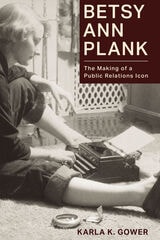
Betsy Ann Plank
The Making of a Public Relations IconKarla K. Gower
University of Missouri Press, 2022
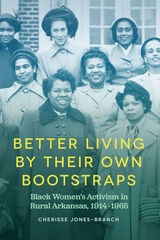
Better Living by Their Own Bootstraps
Black Women's Activism in Rural Arkansas, 1914-1965Cherisse Jones-Branch
University of Arkansas Press, 2021
The first major study to consider Black women’s activism in rural Arkansas, Better Living by Their Own Bootstraps foregrounds activists’ quest to improve Black communities through language and foodways as well as politics and community organizing. In reexamining these efforts, Cherisse Jones-Branch lifts many important figures out of obscurity, positioning them squarely within Arkansas’s agrarian history.
The Black women activists highlighted here include home demonstration agents employed by the Arkansas Agricultural Cooperative Extension Service and Jeanes Supervising Industrial Teachers, all of whom possessed an acute understanding of the difficulties that African Americans faced in rural spaces. Examining these activists through a historical lens, Jones-Branch reveals how educated, middle-class Black women worked with their less-educated rural sisters to create all-female spaces where they confronted economic, educational, public health, political, and theological concerns free from white regulation and interference.
Centered on the period between 1914 and 1965, Better Living by Their Own Bootstraps brings long-overdue attention to an important chapter in Arkansas history, spotlighting a group of Black women activists who uplifted their communities while subverting the formidable structures of white supremacy.
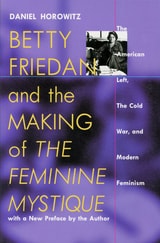
Betty Friedan and the Making of "The Feminine Mystique"
The American Left, the Cold War, and Modern FeminismDaniel Horowitz
University of Massachusetts Press, 1998
Ever since the 1963 publication of her landmark book, The Feminine Mystique, Betty Friedan has insisted that her commitment to women's rights grew out of her experiences as an alienated suburban housewife. Yet as Daniel Horowitz persuasively demonstrates in this illuminating and provocative biography, the roots of Friedan's feminism run much deeper than she has led us to believe. Drawing on an impressive body of new research—including Friedan's own papers—Horowitz traces the development of Friedan's feminist outlook from her childhood in Peoria, Illinois, through her wartime years at Smith College and Berkeley, to her decade-long career as a writer for two of the period's most radical labor journals, the Federated Press and the United Electrical Workers' UE News. He further shows that even after she married and began to raise a family, Friedan continued during the 1950s to write and work on behalf of a wide range of progressive social causes. By resituating Friedan within a broader cultural context, and by offering a fresh reading of The Feminine Mystique against that background, Horowitz not only overturns conventional ideas about “second wave” feminism but also reveals long submerged links to its past.
Between Banat
Queer Arab Critique and Transnational Arab ArchivesMejdulene Bernard Shomali
Duke University Press, 2023
Between Feast and Famine
Food, Health, and the History of Ghana's Long Twentieth CenturyJohn Nott
University College London, 2025
Between Feast and Famine unravels the intertwined histories of food, health, and capitalism in Ghana, charting the country’s shifting nutritional landscape from colonial-era hunger crises to contemporary epidemics of obesity and diabetes. Moving between Ghana’s diverse ecological and economic zones, John Nott excavates how uneven capitalist transformation reshaped diets and childhood nutrition across the twentieth century. At the heart of this story is the evolving science of nutrition itself, from its colonial-era applications to its role in shaping modern health policies.
Using a new historical approach, Between Feast and Famine exposes how global scientific debates and local lived realities co-produced the country’s shifting nutritional conditions. A necessary contribution to African history and medical humanities, this book debunks preconceived notions about hunger and public health, suggesting crucial insights into the complex relationship between food systems and human well-being.

Between Field and Cooking Pot
The Political Economy of Marketwomen in Peru, Revised EditionBy Florence E. Babb
University of Texas Press, 1998
From reviews of the first edition:
"Between Field and Cooking Pot offers details of the daily lives of marketwomen in the central Andean departmental capital of Huaraz.... A welcome addition to studies of women and international development, this book contains a wealth of firsthand material, collected through informal participant-observation as well as formal interviews and analysis of statistical data.... The book encourages us to imagine how the dynamic culture of marketwomen might intersect with the construction, representation, and effects of class and gender."
—American Anthropologist
"The book has a clear and readable style, moving easily between vignettes of marketwomen's lives, descriptions of the markets themselves, and surveys of the theoretical literature. Babb's long, close involvement with the Huaraz markets is apparent. As someone who has spent a lot of time in Andean markets, I found the book pleasurable to read, because it recreated the experience of the marketplace so well."
—American Ethnologist
This revised edition of Between Field and Cooking Pot offers an updated appraisal of what neoliberal politics and economics mean in the lives of marketwomen in the nineties, based on new fieldwork conducted in 1997. Babb also reflects on how recent currents in feminist and anthropological studies have caused her to rethink some aspects of Andean marketers in Peruvian culture and society.
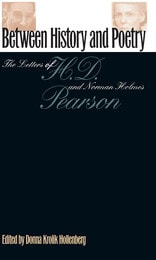
Between History And Poetry
H.D. And Norman Holmes PearsonDonna Krolik Hollenberg
University of Iowa Press, 1997
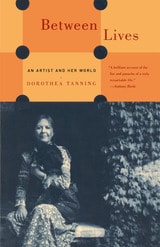
Between Lives
An Artist and Her WorldDorothea Tanning
Northwestern University Press, 2003
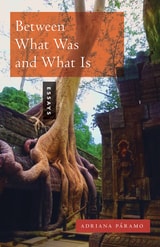
Between What Was and What Is
EssaysAdriana Páramo
University of Massachusetts Press, 2027
A collection that explores the space between personal loss and collective crisis
The essays in Between What Was and What Is address timely questions of power, identity, history, and resilience. Ranging from intimate personal reflection to global crisis, Adriana Páramo examines the contradictions and tensions that define how we live—and how we make sense of what we’ve lived through.
Grounded in the present moment, Páramo engages directly with current events: the death of Pope Francis and the debates about reform his passing has reopened, and the ongoing devastation of the war in Ukraine. She grapples with the lasting weight of colonial, familial, and national trauma, and with the experience of returning to a homeland that no longer matches memory. These essays enter a broader conversation about the liberation of brown and Latina women—voices frequently pushed to the margins of predominantly white feminist spaces. She asks what drives people to persist in the face of systemic inequality. An encounter with a Kumari Devi in Nepal becomes an occasion to examine faith, ritual, and the assumptions we bring to spiritual experience. Throughout, Páramo moves between the everyday and the sacred to interrogate how culture and identity are lived and inherited.
From personal reflections on age, feminism, and rebuilding after failure to larger examinations of race and systemic oppression, Between What Was and What Is asks readers to engage seriously with difficult realities. It takes stock of what we inherit, what we survive, and what we carry forward.

Between Woman and Nation
Nationalisms, Transnational Feminisms, and the StateCaren Kaplan, Norma Alarcón, and Minoo Moallem, eds.
Duke University Press, 1999
This interdisciplinarily collection investigates women in diverse locales—ranging from Quebec to Beirut. The contributors consider such subjects as Yucatan feminism, Islamic fundamentalisms, Canadian gender formations, historic Chicana/o struggles, and Israeli/Palestinian conflicts. Divided into three parts, the collection first examines constructions of nationalism and communities whose practices complicate these constructions. The second section discusses regulations of particular nation-states and how they affect the lives of women, while the third presents studies of transnational identity formation, in which contributors critique ideas such as “multicultural nationalism” and “global feminism.” Arguing provocatively that such movements and concepts inadequately represent women’s interests, contributors examine how such beliefs and their attendant organizations may actually bolster the very formations they ought to subvert.
In its demonstration of the critical possibilities of feminist alliances across discrepant and distinct material conditions, Between Woman and Nation will make a unique contribution to women’s studies, feminist theory, studies of globalization and transnationalism, ethnic studies, and cultural studies.
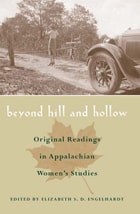
Beyond Hill and Hollow
Original Readings in Appalachian Women’s StudiesElizabeth S. D. Engelhardt
Ohio University Press, 2004
Women’s studies unites with Appalachian studies in Beyond Hill and Hollow, the first book to focus exclusively on studies of Appalachia’s women. Featuring the work of historians, linguists, sociologists, performance artists, literary critics, theater scholars, and others, the collection portrays the diverse cultures of Appalachian women.
The chapters in Beyond Hill and Hollow examine the hidden lives of Appalachian prostitutes, urban Appalachian women in the 1800s, rural women in company towns, and an African American Appalachian poet from the 1900s. Contributors look at Appalachian opera houses, Jewish women in the coalfields, the writings of Wilma Dykeman and Sharyn McCrumb, and activists in out-migrant communities like Cincinnati. With an introduction by editor Elizabeth S. D. Engelhardt, Beyond Hill and Hollow firmly establishes the field of Appalachian Women’s Studies.
Appropriate both as a reference and as a classroom text, Beyond Hill and Hollow expands our understanding of Appalachian women’s lives. Readers, whether from the region or beyond, may recognize themselves or women they know in its pages.
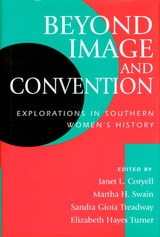
Beyond Image and Convention
Explorations in Southern Women's HistoryEdited by Janet L. Coryell, Martha H. Swain, Sandra Goioa Treadway, & ElizabethHayes Turner
University of Missouri Press, 1998
Despite their prevailing image and stereotype, southern women have often gone "beyond convention," living on their own terms within a society that revered tradition and compliance. Spanning the colonial era to the mid-twentieth century, Beyond Image and Convention documents women from widely varied social, economic, religious, and ethnic backgrounds who acted outside the accepted gender boundaries of their day.
Reflecting the quality and breadth of current scholarship in the field of southern women's history, this collection of essays relies upon previously untapped documentary evidence and, in the process, crafts provocative new interpretations of our collective past. The essays explore the historical experience of black and white southern women across nearly three centuries, including a white woman's sexual misconduct in colonial North Carolina, one slave woman's successful attempt to carve out an autonomous existence in southwestern Virginia, an ex-slave's fight for freedom in postbellum Missouri, and the civil rights activism of two white southern women—Sarah Patton Boyle of Virginia and Alice Norwood Spearman of South Carolina.
Breaking new ground in the study of women's history, Beyond Image and Convention provides valuable insights for both specialists and general readers.

Beyond Left, Right, and Center
The Politics of Gender and Ethnicity in Contemporary GermanyChristina Xydias
Temple University Press, 2024
Christina Xydias shows that some right-leaning parties advocate for women’s rights and interests, while left- and right-leaning parties can be equally indifferent to lack of representation for women from marginalized groups. These findings follow from analyses of election results, transcripts from debates and speeches, and personal interviews, as well as from a close reading of intertwined military and citizenship policies that illustrate how women’s and ethnic minority groups’ rights are constructed.
Beyond Left, Right, and Center concludes with an analysis of women’s representation across OECD countries, showing that right-leaning parties are more likely to support women’s rights and interests in societies that are more egalitarian.
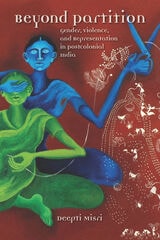
Beyond Partition
Gender, Violence and Representation in Postcolonial IndiaDeepti Misri
University of Illinois Press, 2014
Deepti Misri shows how Partition began a history of politicized animosity associated with the differing ideas of ""India"" held by communities and in regions on one hand, and by the political-military Indian state on the other. She moves beyond that formative national event, however, in order to examine other forms of gendered violence in the postcolonial life of the nation, including custodial rape, public stripping, deturbanning, and enforced disappearances. Assembling literary, historiographic, performative, and visual representations of gendered violence against women and men, Misri establishes that cultural expressions do not just follow violence but determine its very contours, and interrogates the gendered scripts underwriting the violence originating in the contested visions of what ""India"" means.
Ambitious and ranging across disciplines, Beyond Partition offers both an overview of and nuanced new perspectives on the ways caste, identity, and class complicate representations of violence, and how such representations shape our understandings of both violence and India.
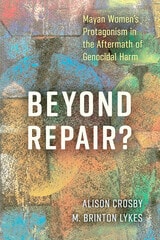
Beyond Repair?
Mayan Women’s Protagonism in the Aftermath of Genocidal HarmAlison Crosby
Rutgers University Press, 2019
Honorable Mention, 2020 CALACS Book Prize
Beyond Repair? explores Mayan women’s agency in the search for redress for harm suffered during the genocidal violence perpetrated by the Guatemalan state in the early 1980s at the height of the thirty-six-year armed conflict. The book draws on eight years of feminist participatory action research conducted with fifty-four Q’eqchi’, Kaqchikel, Chuj, and Mam women who are seeking truth, justice, and reparation for the violence they experienced during the war, and the women’s rights activists, lawyers, psychologists, Mayan rights activists, and researchers who have accompanied them as intermediaries for over a decade. Alison Crosby and M. Brinton Lykes use the concept of “protagonism” to deconstruct dominant psychological discursive constructions of women as “victims,” “survivors,” “selves,” “individuals,” and/or “subjects.” They argue that at different moments Mayan women have been actively engaged as protagonists in constructivist and discursive performances through which they have narrated new, mobile meanings of “Mayan woman,” repositioning themselves at the interstices of multiple communities and in their pursuit of redress for harm suffered.
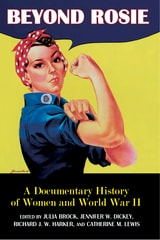
Beyond Rosie
A Documentary History of Women and World War IIJulia Brock
University of Arkansas Press, 2015
Beyond Rosie offers readers an opportunity to see the numerous contributions they made to the fight against the Axis powers and how American women’s roles changed during the war. The primary documents (newspapers, propaganda posters, cartoons, excerpts from oral histories and memoirs, speeches, photographs, and editorials) collected here represent cultural, political, economic, and social perspectives on the diverse roles women played during World War II.
Beyond Slash, Burn, and Poison
Transforming Breast Cancer Stories into ActionMarcy Jane Knopf-Newman
Rutgers University Press, 2004
Depending on one’s vantage point, breast cancer can be a very different experience, and indeed, a very different concern. It is, for some, a personal struggle; for others, it is a disease posing scientific and environmental challenges; and for others it is a highly charged and politicized issue around which policy wars rage. Beyond Slash, Burn, and Poison brings a unique perspective to breast cancer by recognizing the overlapping relationship of all these realities.
Drawing on the writings of Rachel Carson, Betty Ford, Rose Kushner, and Audre Lorde, this book explores the various ways in which patient-centered texts continue to leave their mark on the political realm of breast cancer and, ultimately, the disease itself. Ordered chronologically, the selections trace the progression of discussions about breast cancer from a time when the subject was kept private and silent to when it became part of public discourse. The texts included are personal accounts, written by women struggling to play an active role in their healing process and, at the same time, hoping to help others do the same.
Knopf-Newman also shows us how these writings eventually changed public opinion and the underlying tendency to blame women for their illness. She argues that changes in medical practice and public policy are linked to textual interventions, and makes a case for the politicization of cultural studies of disease through personal and literary expression.
Passionately written and well-researched, Beyond Slash, Burn, and Poison transforms how we think about breast cancer. Rather than facilitating forums for separate discussions, this book brings conversations into dialog with each other. It is essential reading for anyone concerned with breast cancer and its history, as well as for those interested in the effect of the environment on public health and the role that literature plays in public policy and medicine.

Beyond The Whiteness of Whiteness
Memoir of a White Mother of Black SonsJane Lazarre
Duke University Press, 1997
Lazarre has spent over twenty-five years living in a Black American family, married to an African American man, birthing and raising two sons. A teacher of African American literature, she has been influenced by an autobiographical tradition that is characterized by a speaking out against racism and a grounding of that expression in one’s own experience—an overlapping of the stories of one’s own life and the world. Like the stories of that tradition, Lazarre’s is a recovery of memories that come together in this book with a new sense of meaning. From a crucial moment in which consciousness is transformed, to recalling and accepting the nature and realities of whiteness, each step describes an aspect of her internal and intellectual journey. Recalling events that opened her eyes to her sons’ and husband’s experience as Black Americans—an operation, turned into a horrific nightmare by a doctor’s unconscious racism or the jarring truths brought home by a visit to an exhibit on slavery at the Richmond Museum of the Confederacy—or her own revealing missteps, Lazarre describes a movement from silence to voice, to a commitment to action, and to an appreciation of the value of a fluid, even ambiguous, identity. It is a coming of age that permits a final retelling of family history and family reunion.
With her skill as a novelist and her experience as a teacher, Jane Lazarre has crafted a narrative as compelling as it is telling. It eloquently describes the author’s delight at being accepted into her husband’s family and attests to the power of motherhood. And as personal as this story is, it is a remarkably incisive account of how perceptions of racial difference lie at the heart of the history and culture of America.
Beyond the Battlefield
Women and the Nation in Twentieth-Century AngolaSelina S. Makana
Ohio University Press, 0
Beyond the Battlefield offers a critical reappraisal of Angola’s nationalist history by centering the experiences and political agency of women during the country’s transition from Portuguese colonial rule to independence. Challenging dominant masculinist narratives that equate anticolonial resistance with armed combat, this study introduces maternalist nationalism as a theoretical framework to illuminate how women engaged in nation building through often-overlooked forms of labor and activism.
While men were largely visible on the battlefield, women fought a parallel struggle on the home front—mobilizing care work, reproductive labor, and political engagement in ways that were essential to the liberation movement and the postindependence state. Drawing on archival sources and women’s testimonies, Makana explores how patriotic motherhood—a concept defined as the fusion of nationalist politics with gendered expectations of women’s roles—enabled women to see themselves as vital contributors to the nation’s future.
This study contributes to scholarship in African history, gender studies, and postcolonial theory by offering a nuanced account of the intersections among militarism, nationalism, and gender. It invites readers to reconsider the frameworks through which political subjectivity and historical memory are constructed. Beyond the Battlefield is an essential resource for scholars and students interested in the gendered dimensions of colonialism, war, and state formation in modern Africa.

Beyond the Breast-Bottle Controversy
Penny Van Esterik
Rutgers University Press, 1989
--from the Foreword by Michael C. Latham, Cornell University
Penny Van Esterik takes the reader beyond the Nestle boycott and the activist campaigns against infant-formula manufacturers to the issues underlying the controversy. She shows how the controversy is embedded in the problem of urban poverty, the empowerment of women, the medicalization of infant feeding, and the commoditization of infant foods. She argues that the choice between bottle feeding and breast feeding has significant implications for developing countries. Beyond the Breast-Bottle Controversy raises a host of important questions: why has there been no consistent feminist position? How did infant feeding become medicalized in developing and developed countries? What mechanisms encourage the technology and taste transfer necessary for the expansion of bottle feeding? These questions are examined using documentary sources and interdisciplinary research in Thailand, Indonesia, Kenya, and Columbia.
For Van Esterik, the infant-formula controversy is a valuable case study for understanding the relations between women, the environment, and sustainable development. From this perspective, breast feeding has no long-term negative consequences. It depends on renewable resources, works on the principle that as demand increases so does supply, reduces the dependency of women on consumer products and multinational corporations, and puts pressure on governments to improve the health of mothers. On the other hand, the author argues that bottle feeding has definite long-term negative consequences. Her goal is not to have every woman breast-feed her child, but to create living and working conditions so that every woman can do so if she chooses.