Results by title
51 books match the query 'Women immigrants' and 3 start with b
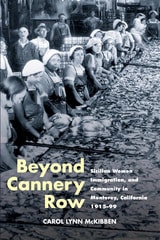
Beyond Cannery Row
Sicilian Women, Immigration, and Community in Monterey, California, 1915-99Carol Lynn McKibben
University of Illinois Press, 2005
McKibben's analysis of gender and gender roles shows that it was the women in this community who had the insight, the power, and the purpose to respond and even prosper amid changing economic conditions. Vividly evoking the immigrants' everyday experiences through first-person accounts and detailed description, McKibben demonstrates that the cannery work done by Sicilian immigrant women was crucial in terms of the identity formation and community development. These changes allowed their families to survive the challenges of political conflicts over citizenship in World War II and intermarriage with outsiders throughout the migration experience. The women formed voluntary associations and celebrated festas that effectively linked them with each other and with their home villages in Sicily. Continuous migration created a strong sense of transnationalism among Sicilians in Monterey, which has enabled them to continue as a viable ethnic community today.
Body Evidence
Intimate Violence against South Asian Women in AmericaEdited by Shamita Das Dasgupta
Rutgers University Press, 2007
In Body Evidence, more than twenty scholars and public health professionals uncover the unique challenges faced by victims of violence in intimate spaces . . . within families, communities and trusted relationships in South Asian American communities. Topics include cultural obsession with women's chastity and virginity; the continued silence surrounding intimate violence among women who identify themselves as lesbian, bisexual, or transgender; the consequences of refusing marriage proposals or failing to meet dowry demands; and, ultimately, the ways in which the United States courts often confuse and exacerbate the plights of these women.
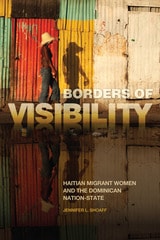
Borders of Visibility
Haitian Migrant Women and the Dominican Nation-Stateby Jennifer L. Shoaff
University of Alabama Press, 2018
An anthropological study of Haitian migrant women in the Dominican Republic.
Borders of Visibility offers extremely timely insight into the Dominican Republic’s racist treatment of Haitian descendants within its borders. Jennifer L. Shoaff employs multisited feminist research to focus on the geographies of power that intersect to inform the opportunities and constraints that migrant women must navigate to labor and live within a context that largely denies their human rights, access to citizenship, and a sense of security and belonging.
Paradoxically, these women are both hypervisible because of the blackness that they embody and invisible because they are marginalized by intersecting power inequalities. Haitian women must contend with diffuse legal, bureaucratic and discursive state-local practices across “border” sites that situate them as a specific kind of threat that must be contained. Shoaff examines this dialectic of mobility and containment across various sites in the northwest Dominican Republic, including the official border crossing, transborder and regional used-clothing markets, migrant settlements (bateyes), and other rural-urban contexts.
Shoaff combines ethnographic interviews, participant observation, institutional analyses of state structures and nongovernmental agencies, and archival documentation to bring this human rights issue to the fore. Although primarily grounded in critical ethnographic practice, this work contributes to the larger fields of transnational feminism, black studies, migration and border studies, political economy, and cultural geography. Borders of Visibility brings much needed attention to Haitian migrant women’s economic ingenuity and entrepreneurial savvy, their ability to survive and thrive, their often impossible choices whether to move or to stay, returning them to a place of visibility, while exposing the very structures that continue to render them invisible and, thus, expendable over time.