Results by title
28167 books match the query 'History' and 1262 start with b
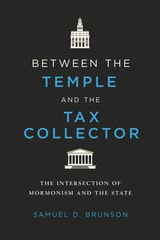
Between the Temple and the Tax Collector
The Intersection of Mormonism and the StateSamuel D. Brunson
University of Illinois Press, 2025
The founding and development of the Church of Jesus Christ of Latter-day Saints run parallel to the rise of the modern tax system and administrative state. Samuel D. Brunson looks at the relationships between the Church and various federal, state, local, and international tax regimes.
The church and its members engage with the state as taxpayers and as members of a faith exempt from taxes. As Brunson shows, LDS members and the Church have at various times enacted, enforced, and collected taxes while also challenging taxes in the courts and politics. Brunson delves into the ways LDS members used their status as taxpayers to affirm themselves as citizens and how outsiders have attacked the Church’s tax-exempt status to delegitimize it. Throughout, Brunson uses the daily interactions between the Latter-day Saints and taxation to explain important and inevitable holes in the wall between church and state.
Enlightening and informed, Between the Temple and the Tax Collector provides general readers and experts alike with a new perspective on a fundamental issue.
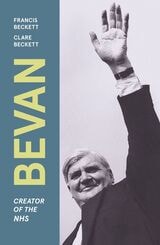
Bevan
Creator of the NHSFrancis Beckett and Clare Beckett
Haus Publishing, 2023
The creation of the National Health Service was the most significant of the many reforms of the post-war Labour government in the UK. The man responsible was Aneurin “Nye” Bevan. The son of a Welsh miner, he became a local trade union leader at only nineteen. In 1929, he was elected as a Labour MP. Bevan believed the war was Britain’s opportunity to create a new society, a position he maintained throughout the conflict. When the war ended in 1945, the landslide Labour victory gave him the chance to make this vision a reality. Known for his impassioned oratory, Bevan’s fundamental belief that the new NHS should be freely available to all was ultimately at odds with a government struggling to balance the books. He resigned in 1951 over the introduction of charges for prescriptions and glasses. With the NHS requiring an ever-increasing share of national income, this updated edition considers Bevan’s legacy as the future of the health service he created is fought over as never before.

Beverley Ditsie's Fearless Speech
A Dialogue on the Pitfalls of Queer StruggleSharad Chari with Beverley Palesa Ditsie
Temple University Press, 2027
Beverley Palesa Ditsie is a key South African Black lesbian activist, part of a world of queer activism during South Africa’s decade of transition from apartheid, when sexuality was crucial to recircuiting post-apartheid power and possibility. Part of the Gay and Lesbian Organization of the Witwatersrand (GLOW) which organized the continent’s first Pride March, she has stood steadfastly for Black lesbian self-determination and African queer representation.
Beverley Ditsie’s Fearless Speech enters this recent history of sexuality politics through an activist and a critical theorist in conversation. This book bends an account of Ditsie’s life and work in the critique of racial and sexual capitalism. Grounded in South Africa, the conversation is cut through with radical queer, materialist, and feminist critique in an internationalist frame.
Through this dialogic form, Beverley Ditsie emerges alongside other figures of fearless speech willing to stand for Black and African queer liberation, yet aware of pitfalls in these struggles that point to work that remains to be done. Beverley Ditsie’s Fearless Speech is a cautionary tale of hope for radical change in a world of deepening injustice and political homophobia.

Beyond Adornment
Jewelry and Identity in ArtYvonne J. Markowitz
J. Paul Getty Trust, The, 2025
Why do people wear jewelry? What meaning does it hold for the wearer? And what does the wearer hope it will convey to those they encounter—or to someone viewing their image decades, even centuries, later?
Artistic renderings of the human figure—in portraiture, sculpture, and other media—in a range of allegorical, historical, and religious images often showcase jewelry. The ornaments depicted in such designs offer an abundance of information that not only heightens our understanding of the subject but also provides insights into the imagination of the artist. Jewelry enhances our enjoyment of works of art because it is visually compelling, sensuous, and laden with an array of associations and symbolic meanings.
Bringing together spectacular and significant art objects depicting figures wearing sumptuous personal adornments that define who they are within the specific milieus in which they lived, this richly illustrated and accessible volume represents a novel, interdisciplinary approach to the ways in which jewelry can be studied and understood.
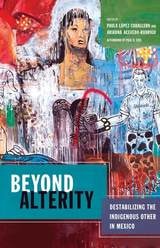
Beyond Alterity
Destabilizing the Indigenous Other in MexicoEdited by Paula López Caballero and Ariadna Acevedo-Rodrigo; Afterword by Paul K. Eiss
University of Arizona Press, 2018
Although previous studies have usually focused on the most visible aspects of differences—cosmovision, language, customs, resistance—the contributors to this volume show that emphasizing difference prevents researchers from seeing all the social phenomena where alterity is not obvious. Those phenomena are equally or even more constitutive of social life and include property relations (especially individual or private ones), participation in national projects, and the use of national languages.
The category of “indigenous” has commonly been used as if it were an objective term referring to an already given social subject. Beyond Alterity shows how this usage overlooks the fact that the social markers of differentiation (language, race or ethnic group, phenotype) are historical and therefore unstable. In opposition to any reification of geographical, cultural, or social boundaries, this volume shows that people who (self-)identify as indigenous share a multitude of practices with the rest of society and that the association between indigenous identification and alterity is the product of a specific political history.
Beyond Alterity is essential reading for anyone interested in understanding indigenous identity, race, and Mexican history and politics.
Contributors
Ariadna Acevedo-Rodrigo
Laura Cházaro
Michael T. Ducey
Paul K. Eiss
José Luis Escalona-Victoria
Vivette García Deister
Peter Guardino
Emilio Kourí
Paula López Caballero
Elsie Rockwell
Diana Lynn Schwartz
Gabriela Torres-Mazuera

Beyond Bach
Music and Everyday Life in the Eighteenth CenturyAndrew Talle
University of Illinois Press, 2018
Eschewing the great composer style of music history, Andrew Talle takes us on a journey that looks at how ordinary people made music in Bach's Germany. Talle focuses in particular on the culture of keyboard playing as lived in public and private. As he ranges through a wealth of documents, instruments, diaries, account ledgers, and works of art, Talle brings a fascinating cast of characters to life. These individuals--amateur and professional performers, patrons, instrument builders, and listeners--inhabited a lost world, and Talle's deft expertise teases out the diverse roles music played in their lives and in their relationships with one another. At the same time, his nuanced re-creation of keyboard playing's social milieu illuminates the era's reception of Bach's immortal works.
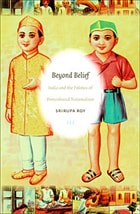
Beyond Belief
India and the Politics of Postcolonial NationalismSrirupa Roy
Duke University Press, 2007
Roy considers several different ways that identification with the Indian nation-state was produced and consolidated during the 1950s and 1960s. She looks at how the Films Division of India, a state-owned documentary and newsreel production agency, allowed national audiences to “see the state”; how the “unity in diversity” formation of nationhood was reinforced in commemorations of India’s annual Republic Day; and how the government produced a policy discourse claiming that scientific development was the ultimate national need and the most pressing priority for the state to address. She also analyzes the fate of the steel towns—industrial townships built to house the workers of nationalized steel plants—which were upheld as the exemplary national spaces of the new India. By prioritizing the role of actual manifestations of and encounters with the state, Roy moves beyond theories of nationalism and state formation based on collective belief.
Beyond Berlin
Twelve German Cities Confront the Nazi PastGavriel D. Rosenfeld and Paul B. Jaskot, Editors
University of Michigan Press, 2015
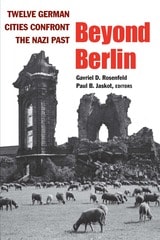
Beyond Berlin breaks new ground in the ongoing effort to understand how memorials, buildings, and other spaces have figured in Germany's confrontation with its Nazi past. The contributors challenge reigning views of Germany's postwar memory work by examining how specific urban centers apart from the nation's capital have wrestled with their respective Nazi legacies. A wide range of West and East German cities is profiled in the volume: prominent metropolises like Hamburg, dynamic regional centers like Dresden, gritty industrial cities like Wolfsburg, and idyllic rural towns like Quedlinburg. In employing historical, art historical, anthropological, and geographical methodologies to examine these and other important urban centers, the volume's case studies shed new light upon the complex ways in which the confrontation with the Nazi past has directly shaped the German urban landscape since the end of the Second World War.
"Beyond Berlin is one of the most fascinating, deeply probing collections ever published on Germany's ongoing confrontation with its Nazi past. Its editors, Gavriel Rosenfeld and Paul Jaskot, have taken the exploration of Germany's urban memorial landscape to its highest level yet."
---James E. Young, Professor and Chair, Department of Judaic and Near Eastern Studies, University of Massachusetts Amherst, and author of The Texture of Memory and At Memory's Edge
"This is a top-notch collection of essays that positions itself in the populated field of memory studies by bringing together original contributions representing the best of new scholarship on architecture, urban design, monuments, and memory in East and West Germany. Taken together, the essays remind readers that the Nazi past is always present when German architects, urban planners, and politicians make decisions to tear down, rebuild, restore, and memorialize."
---S. Jonathan Wiesen, Department of History, Southern Illinois University, Carbondale
Beyond Binary Histories
Re-imagining Eurasia to c. 1830Victor Lieberman, Editor
University of Michigan Press, 1999
The collaborators of this project show, in varying degrees, that political centralization in these areas reflected and inspired the creation of vernacular literatures at the expense of more universal languages. They illustrate that societies in widely separated areas, with no obvious links, became more literate, mobile, specialized, and commercial at roughly the same time. And they point out that administrative development in many of these same areas showed curiously synchronized cycles. Finally, having defined Eurasian parallels and sketched their limits, they push on to explore the underlying dynamics of these discoveries, scrutinizing the role of guns, global climate, markets, new information networks, institutional pressures, and sixteenth-century messianism.
Insofar as similarities between some European and Asian areas exceeded those between different sectors of Asia, this collection invites historians to reject continental perspectives in favor of more thematic, contextually-specific categories. But at the same time, it raises the possibility of a broad "early modern" period for Eurasia at large.
The contributors are Mary Elizabeth Berry (University of California, Berkeley), Peter Carey (University of Oxford), James B. Collins (Georgetown University), Valerie Kivelson (University of Michigan), R. I. Moore (University of Newcastle upon Tyne), Sanjay Subrahmanyam (Ecole des Hautes Etudes en Sciences Sociales, Paris), John K. Whitemore (University of Michigan), and David K. Wyatt (Cornell University).
Beyond Bondage
Free Women of Color in the AmericasEdited by David Barry Gaspar and Darlene Clark Hine
University of Illinois Press, 2004
Beyond Boundaries
The Intellectual tradition of Trinidad and Tobago in the Nineteenth CenturySelwyn R. Cudjoe
University of Massachusetts Press, 2003
When V. S. Naipaul received the Nobel Prize for Literature in 2001, the award marked the culmination of a literary tradition that was almost two hundred years in the making. The island nation of Trinidad and Tobago has produced such important writers and thinkers as C. L. R. James, J. J. Thomas, Eric Williams, Oliver Cromwell Cox, Sylvester Williams, George Padmore, Earl Lovelace, Arnold Rampersad, and Merle Hodge. Yet this literary legacy is not well known, particularly with respect to works dating from the nineteenth century.
Beyond Boundaries traces the development of the country's literary and intellectual history from the “Narrative of Louisa Calderon” (1803) to Stephen Cobham's Rupert Gray: A Tale of Black and White (1907). Selwyn R. Cudjoe examines a wide range of narratives by and about the people of Trinidad and Tobago, from treatises in the natural sciences, to journals and memoirs, histories, slave narratives, travelers' accounts, poems, stories, novels, theatrical works, and writings in the popular press. Along the way, he discusses such seminal works as Jean Baptiste Philippe's Free Mulatto (1824) and Maxwell Philip's Emmanuel Appadocca (1854), the first indigenous novel. He explores books that shed light on ideological processes, such as J. J. Thomas's The Theory and Practice of Creole Grammar (1869) and Froudacity (1899). He examines how notions of savagery and civilization were deployed in the writings of the dominant class to stymie the growing self-awareness of the colonized. And he traces the rise of racial pride and nationalist sentiments among Indo- and Afro-Trinidadians.
Cudjoe demonstrates how Enlightenment concepts, English literature, African philosophy, Hindu theology, Islamic passion plays, and the culture of carnival all contributed to this body of ideas to create a vibrant literature, which in turn helped to shape a national identity.
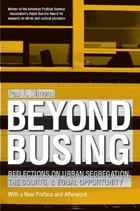
Beyond Busing
Reflections on Urban Segregation, the Courts, and Equal OpportunityPaul R. Dimond
University of Michigan Press, 2005
A compelling insider's account of the fight for educational desegregation, from one of its most dedicated and outspoken heroes. A new afterword explains the author's controversial belief that the moment for litigating educational equality has passed, clear-sightedly critiquing his own courtroom strategies and the courts' responses, before closing with an assessment of the economic and social changes that he feels have already moved us "beyond busing."
"An extraordinarily informative and thoughtful book describing the process of bringing Brown [v. Board of Education] North and the impact this process had upon national attitudes toward desegregation."
--Drew S. Days III, Yale Law Journal
"An original analysis of a tough subject. A must-read for all who care about opportunity for all our children."
--Donna E. Shalala, President, University of Miami
"Paul Dimond remains a passionate and caring voice for inner-city students, whether in his advocacy of school desegregation, school choice plans, or school finance reform. He illuminates these issues as one who participated in the major education cases and as a perceptive scholar."
--Mark Yudof, Chancellor, The University of Texas System
"A must-read for anyone who wants to understand America's continued failure to give inner-city children a quality education or to do something about it!"
--Sheryll Cashin, Author of The Failures of Integration: How Race and Class Are Undermining the American Dream
"Dimond is particularly good at relating his slice of legal history to the broader developments of the 1970s, and his occasional remarks about trial tactics are amusing and instructive. Dimond's
honesty about both his successes and failures makes his book required reading for civil rights lawyers."
--Lawrence T. Gresser, Michigan Law Review
"A fascinating first-hand account of 1970s northern school desegregation decisions."
--Neal E. Devins, American Bar Foundation Research Journal
"Dimond reminds the liberal reader of the promise that lies in the empowerment of ordinary families to choose their own schools."
--John E. Coons, Professor of Law, Emeritus, University of California, Berkeley
Paul R. Dimond is counsel to Miller, Canfield, Paddock and Stone, Michigan's largest law firm; chairman of McKinley, a national commercial real estate investment and management firm; and chairman or member of the board of trustees of numerous education, community, and civic organizations. He spent four years as President Clinton's Special Assistant for Economic Policy.
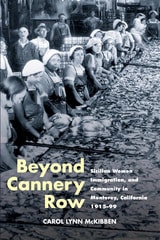
Beyond Cannery Row
Sicilian Women, Immigration, and Community in Monterey, California, 1915-99Carol Lynn McKibben
University of Illinois Press, 2005
McKibben's analysis of gender and gender roles shows that it was the women in this community who had the insight, the power, and the purpose to respond and even prosper amid changing economic conditions. Vividly evoking the immigrants' everyday experiences through first-person accounts and detailed description, McKibben demonstrates that the cannery work done by Sicilian immigrant women was crucial in terms of the identity formation and community development. These changes allowed their families to survive the challenges of political conflicts over citizenship in World War II and intermarriage with outsiders throughout the migration experience. The women formed voluntary associations and celebrated festas that effectively linked them with each other and with their home villages in Sicily. Continuous migration created a strong sense of transnationalism among Sicilians in Monterey, which has enabled them to continue as a viable ethnic community today.
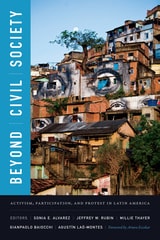
Beyond Civil Society
Activism, Participation, and Protest in Latin AmericaSonia E. Alvarez, Jeffrey W. Rubin, Millie Thayer, Gianpaolo Baiocchi, and Agustín Laó-Montes, editors
Duke University Press, 2017
Contributors. Sonia E. Alvarez, Kiran Asher, Leonardo Avritzer, Gianpaolo Baiocchi, Andrea Cornwall, Graciela DiMarco, Arturo Escobar, Raphael Hoetmer, Benjamin Junge, Luis E. Lander, Agustín Laó-Montes, Margarita López Maya, José Antonio Lucero, Graciela Monteagudo, Amalia Pallares, Jeffrey W. Rubin, Ana Claudia Teixeira, Millie Thayer
Beyond Collapse
Archaeological Perspectives on Resilience, Revitalization, and Transformation in Complex SocietiesEdited by Ronald K. Faulseit
Southern Illinois University Press, 2015
Essays in the book are arranged into five sections. The first section addresses previous research on the subject of collapse and reorganization as well as recent and historic theoretical trends. In the second section, contributors look at collapse and resilience through the concepts of collective action, eventful archaeology, and resilience theory. The third section introduces critical analyses of the effectiveness of resilience theory as a heuristic tool for modeling the phenomena of collapse and resilience. In the fourth section, contributors examine long-term adaptive strategies employed by prehistoric societies to cope with stresses. Essays in the fifth section make connections to contemporary research on post-decline societies in a variety of time periods and geographic locations.
Contributors consider collapse and reorganization not as unrelated phenomena but as integral components in the evolution of complex societies. Using archaeological data to interpret how ancient civilizations responded to various stresses—including environmental change, warfare, and the fragmentation of political institutions—contributors discuss not only what leads societies to collapse but also why some societies are resilient and others are not, as well as how societies reorganize after collapse. The implications of the fate of these societies for modern nations cannot be underestimated. Putting in context issues we face today, such as climate change, lack of social diversity, and the failure of modern states, Beyond Collapse is an essential volume for readers interested in human-environment interaction and in the collapse—and subsequent reorganization—of human societies.
Beyond Constraint
Middle/Passages of Blackness and Indigeneity in the Radical TraditionShona N. Jackson
Duke University Press, 2024

Beyond Control
Medical Power and Abortion LawSally Sheldon
Pluto Press, 1997
Beyond Cortés and Montezuma
The Conquest of Mexico RevisitedVitus Huber
University Press of Colorado, 2025
A diverse group of scholars from Europe, Mexico, and the US with varied methodological backgrounds—linguistics, history, art history, and cultural studies—query the “conquest,” or rather conquista, of Mexico through a series of case studies that interrogate how historians, especially in Europe, Mexico, and the US, understand and interact with this concept. They consider the language used to encapsulate the event in Nahuatl documents from the colonial period, how the Spanish veterans led the transition to settlement in taking land for themselves, and the legacy of the conquista in discrimination against Tlaxcallans in modern Mexico.
Beyond Cortés and Montezuma is a compilation of nuanced reflections on the language, narratives, and memories of the conquista that balances the crimes of Spanish colonialism and asymmetries of power that existed within early New Spain with the abilities of Native peoples to resist, negotiate, and survive.
Beyond Cuban Waters
Africa, La Yuma, and the Island's Global ImaginationPaul Ryer
Vanderbilt University Press, 2016
This pursuit of Western status symbols represents a uniquely Cuban experience, set apart from other cultures pursuing the same things. In the Cuban case, this represents neither an acceptance nor rejection of the American cultural influence, but rather a co-opting or "Yumanizing" of these influences.
Beyond Displacement
Campesinos, Refugees, and Collective Action in the Salvadoran Civil WarMolly Todd
University of Wisconsin Press, 2010
During the civil war that wracked El Salvador from the mid-1970s to the early 1990s, the Salvadoran military tried to stamp out dissidence and insurgency through an aggressive campaign of crop-burning, kidnapping, rape, killing, torture, and gruesome bodily mutilations. Even as human rights violations drew world attention, repression and war displaced more than a quarter of El Salvador’s population, both inside the country and beyond its borders. Beyond Displacement examines how the peasant campesinos of war-torn northern El Salvador responded to violence by taking to the hills. Molly Todd demonstrates that their flight was not hasty and chaotic, but was a deliberate strategy that grew out of a longer history of collective organization, mobilization, and self-defense.
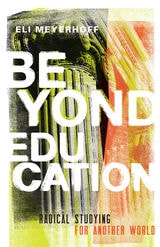
Beyond Education
Radical Studying for Another WorldEli Meyerhoff
University of Minnesota Press, 2019
A bold call to deromanticize education and reframe universities as terrains of struggle between alternative modes of studying and world-making
Higher education is at an impasse. Black Lives Matter and #MeToo show that racism and sexism remain pervasive on campus, while student and faculty movements fight to reverse increased tuition, student debt, corporatization, and adjunctification. Commentators typically frame these issues as crises for an otherwise optimal mode of intellectual and professional development. In Beyond Education, Eli Meyerhoff instead sees this impasse as inherent to universities, as sites of intersecting political struggles over resources for studying.
Meyerhoff argues that the predominant mode of study, education, is only one among many alternatives and that it must be deromanticized in order to recognize it as a colonial-capitalist institution. He traces how key elements of education—the vertical trajectory of individualized development, its role in preparing people to participate in governance through a pedagogical mode of accounting, and dichotomous figures of educational waste (the “dropout”) and value (the “graduate”)—emerged from histories of struggles in opposition to alternative modes of study bound up with different modes of world-making.
Through interviews with participants in contemporary university struggles and embedded research with an anarchist free university, Beyond Education paves new avenues for achieving the aims of an “alter-university” movement to put novel modes of study into practice. Taking inspiration from Black Lives Matter, Occupy Wall Street, and Indigenous resurgence projects, it charts a new course for movements within, against, and beyond the university as we know it.
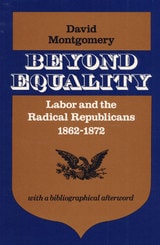
Beyond Equality
Labor and the Radical Republicans, 1862-1872David Montgomery
University of Illinois Press, 1981
"Beyond Equality is a masterpiece. . . . A book of bold and brilliant originality, it is now shaping the perspective of a new generation of graduate students." -- David Brion Davis, author of The Problem of Slavery in Western Culture
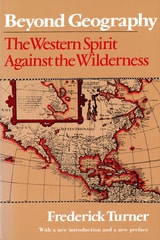
Beyond Geography
The Western Spirit Against the WildernessFrederick Turner
Rutgers University Press, 1992
First published in 1980, Beyond Geography continues to influence and impress its readers. This new edition, prepared for the Columbus quincentennial, includes a new introduction by T. H. Watkins and a new preface by the author. As the public debates Columbus's legacy, it is important for us to learn of the spiritual background of European domination of the Americas, for the Europeans who conquered the Americas substituted history for myth as a way of understanding life.
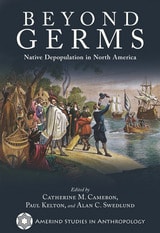
Beyond Germs
Native Depopulation in North AmericaEdited by Catherine M. Cameron, Paul Kelton, and Alan C. Swedlund
University of Arizona Press, 2015
Beyond Germs: Native Depopulation in North America challenges the “virgin soil” hypothesis that was used for decades to explain the decimation of the indigenous people of North America. This hypothesis argues that the massive depopulation of the New World was caused primarily by diseases brought by European colonists that infected Native populations lacking immunity to foreign pathogens. In Beyond Germs, contributors expertly argue that blaming germs lets Europeans off the hook for the enormous number of Native American deaths that occurred after 1492.
Archaeologists, anthropologists, and historians come together in this cutting-edge volume to report a wide variety of other factors in the decline in the indigenous population, including genocide, forced labor, and population dislocation. These factors led to what the editors describe in their introduction as “systemic structural violence” on the Native populations of North America.
While we may never know the full extent of Native depopulation during the colonial period because the evidence available for indigenous communities is notoriously slim and problematic, what is certain is that a generation of scholars has significantly overemphasized disease as the cause of depopulation and has downplayed the active role of Europeans in inciting wars, destroying livelihoods, and erasing identities.
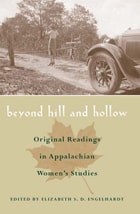
Beyond Hill and Hollow
Original Readings in Appalachian Women’s StudiesElizabeth S. D. Engelhardt
Ohio University Press, 2004
Women’s studies unites with Appalachian studies in Beyond Hill and Hollow, the first book to focus exclusively on studies of Appalachia’s women. Featuring the work of historians, linguists, sociologists, performance artists, literary critics, theater scholars, and others, the collection portrays the diverse cultures of Appalachian women.
The chapters in Beyond Hill and Hollow examine the hidden lives of Appalachian prostitutes, urban Appalachian women in the 1800s, rural women in company towns, and an African American Appalachian poet from the 1900s. Contributors look at Appalachian opera houses, Jewish women in the coalfields, the writings of Wilma Dykeman and Sharyn McCrumb, and activists in out-migrant communities like Cincinnati. With an introduction by editor Elizabeth S. D. Engelhardt, Beyond Hill and Hollow firmly establishes the field of Appalachian Women’s Studies.
Appropriate both as a reference and as a classroom text, Beyond Hill and Hollow expands our understanding of Appalachian women’s lives. Readers, whether from the region or beyond, may recognize themselves or women they know in its pages.
Beyond Image and Convention
Explorations in Southern Women's HistoryEdited by Janet L. Coryell, Martha H. Swain, Sandra Goioa Treadway, & ElizabethHayes Turner
University of Missouri Press, 1998
Despite their prevailing image and stereotype, southern women have often gone "beyond convention," living on their own terms within a society that revered tradition and compliance. Spanning the colonial era to the mid-twentieth century, Beyond Image and Convention documents women from widely varied social, economic, religious, and ethnic backgrounds who acted outside the accepted gender boundaries of their day.
Reflecting the quality and breadth of current scholarship in the field of southern women's history, this collection of essays relies upon previously untapped documentary evidence and, in the process, crafts provocative new interpretations of our collective past. The essays explore the historical experience of black and white southern women across nearly three centuries, including a white woman's sexual misconduct in colonial North Carolina, one slave woman's successful attempt to carve out an autonomous existence in southwestern Virginia, an ex-slave's fight for freedom in postbellum Missouri, and the civil rights activism of two white southern women—Sarah Patton Boyle of Virginia and Alice Norwood Spearman of South Carolina.
Breaking new ground in the study of women's history, Beyond Image and Convention provides valuable insights for both specialists and general readers.

Beyond Left and Right
Insurgency and the EstablishmentDavid A. Horowitz
University of Illinois Press, 1997
Beyond Left and Right is a sweeping overview of political insurgency in the United States from the 1880s to the present. It is at once a stunning synthesis, drawing on a large number of scholarly works, and an ambitious and original piece of research. The book ranges over diverse individuals and groups that have attacked the established order, from the left and the right, from the Populists of the 1890s to Ross Perot and the religious right of our times, dealing along the way with non-interventionists, Klans, monetary radicals, McCarthyites, Birchers, and Reaganites, among many others.
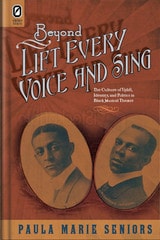
Beyond Lift Every Voice and Sing
The Culture of Uplift, Identity, and Politics in Black Musical TheaterPaula Marie Seniors
The Ohio State University Press, 2009
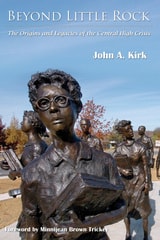
Beyond Little Rock
The Origins and Legacies of the Central High CrisisJohn A. Kirk
University of Arkansas Press, 2007
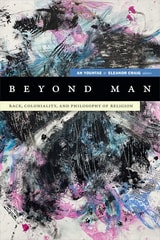
Beyond Man
Race, Coloniality, and Philosophy of ReligionYountae An and Eleanor Craig, editors
Duke University Press, 2021
Contributors. An Yountae, Ellen Armour, J. Kameron Carter, Eleanor Craig, Amy Hollywood, Vincent Lloyd, Filipe Maia, Mayra Rivera, Devin Singh, Joseph R. Winters
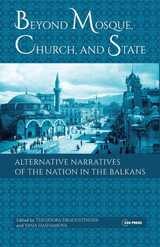
Beyond Mosque, Church, and State
Alternative Narratives of the Nation in the BalkansYana Hashamova
Central European University Press, 2016
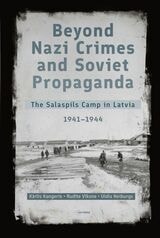
Beyond Nazi Crimes and Soviet Propaganda
The Salaspils Camp in Latvia, 1941-1944Karlis Kangeris
Central European University Press, 2027
The Salaspils camp near Riga, which was operated during the Nazi occupation of Latvia, has long been the subject ofcontrovery. Around 23,000 people were imprisoned there: half were political prisoners, labor resisters and convicted soldiers, the rest prisoners from special operations against civilians in Belarus, Russia and the Latgale region of Latvia. The death toll in the camp, including the number of Jews who died during construction, is well over 3,000 people.
Despite the relatively small size of this camp, it became a model for Russian remembrance policy. Soviet propaganda claimed that up to 100,000 prisoners were killed there, charged that children were used to extract blood, and greatly exaggerated the extent of the persecution of imprisoned lawbreakers and political dissidents . Salaspils became a myth in Russian-speaking society in Latvia that served to reinforce Soviet narratives of the “Great Patriotic War.”
The three authors drew on sources from the archives of Latvia, Germany and Russia and critically analyzed oral testimonies and earlier research to create a comprehensive account of the Salaspils camp in Nazi-occupied Latvia. Their book furthers the understanding of processes of deformation of collective memory and the techniques of memory politics from the Cold War to the present.
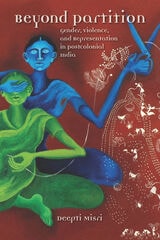
Beyond Partition
Gender, Violence and Representation in Postcolonial IndiaDeepti Misri
University of Illinois Press, 2014
Deepti Misri shows how Partition began a history of politicized animosity associated with the differing ideas of ""India"" held by communities and in regions on one hand, and by the political-military Indian state on the other. She moves beyond that formative national event, however, in order to examine other forms of gendered violence in the postcolonial life of the nation, including custodial rape, public stripping, deturbanning, and enforced disappearances. Assembling literary, historiographic, performative, and visual representations of gendered violence against women and men, Misri establishes that cultural expressions do not just follow violence but determine its very contours, and interrogates the gendered scripts underwriting the violence originating in the contested visions of what ""India"" means.
Ambitious and ranging across disciplines, Beyond Partition offers both an overview of and nuanced new perspectives on the ways caste, identity, and class complicate representations of violence, and how such representations shape our understandings of both violence and India.
Beyond Pontiac's Shadow
Michilimackinac and the Anglo-Indian War of 1763Keith R. Widder
Michigan State University Press, 2013
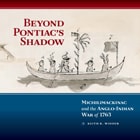
On June 2, 1763, the Ojibwe captured Michigan’s Fort Michilimackinac from the British. Ojibwe warriors from villages on Mackinac Island and along the Cheboygan River had surprised the unsuspecting garrison while playing a game of baggatiway. On the heels of the capture, Odawa from nearby L’Arbre Croche arrived to rescue British prisoners, setting into motion a complicated series of negotiations among Ojibwe, Odawa, and Menominee and other Indians from Wisconsin. Because nearly all Native people in the Michilimackinac borderland had allied themselves with the British before the attack, they refused to join the Michilimackinac Ojibwe in their effort to oust the British from the upper country; the turmoil effectively halted the fur trade. Beyond Pontiac’s Shadow examines the circumstances leading up to the attack and the course of events in the aftermath that resulted in the regarrisoning of the fort and the restoration of the fur trade. At the heart of this discussion is an analysis of French-Canadian and Indian communities at the Straits of Mackinac and throughout the pays d’en haut. An accessible guide to this important period in Michigan, American, and Canadian history, Beyond Pontiac’s Shadow sheds invaluable light on a political and cultural crisis.
Beyond Preservation
Using Public History to Revitalize Inner CitiesAuthored by Andrew Hurley
Temple University Press, 2010
Across the United States, historic preservation has become a catalyst for urban regeneration. Entrepreneurs, urban pioneers, and veteran city dwellers have refurbished thousands of dilapidated properties and put them to productive use as shops, restaurants, nightclubs, museums, and private residences. As a result, inner-cities, once disparaged as zones of poverty, crime, and decay have been re-branded as historic districts. Although these preservation initiatives, often supported by government tax incentives and rigid architectural controls, deserve credit for bringing people back to the city, raising property values, and generating tourist revenue, they have been less successful in creating stable and harmonious communities.
Beyond Preservation proposes a framework for stabilizing and strengthening inner-city neighborhoods through the public interpretation of historic landscapes. Its central argument is that inner-city communities can best turn preserved landscapes into assets by subjecting them to public interpretation at the grass-roots. Based on an examination of successful projects in St. Louis, Missouri and other U.S. cities, Andrew Hurley demonstrates how rigorous historical analysis can help communities articulate a local identity and plan intelligently on the basis of existing cultural and social assets.
Beyond Progress
An Interpretive Odyssey to the FutureHugh De Santis
University of Chicago Press, 1996
Explaining that we have arrived at a great historic divide, De Santis asserts that the old modern order is giving way to an age of "mutualism." He draws on world history and the study of international relations to explore the emerging future, in which new forms of social and political identity and regional associations and alignments will be needed to solve global problems. Demonstrating that mutualism will require a dramatic change in the way states, international institutions, corporations, and local communities interact, De Santis argues that this transformation will be especially difficult for the United States, which will have to abandon its exceptionalist identity and rejoin a world it can no longer escape.
Beyond Redemption
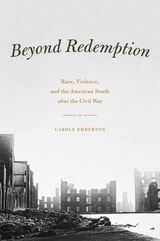
Race, Violence, and the American South after the Civil WarCarole Emberton
University of Chicago Press, 2013
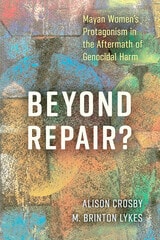
Beyond Repair?
Mayan Women’s Protagonism in the Aftermath of Genocidal HarmAlison Crosby
Rutgers University Press, 2019
Honorable Mention, 2020 CALACS Book Prize
Beyond Repair? explores Mayan women’s agency in the search for redress for harm suffered during the genocidal violence perpetrated by the Guatemalan state in the early 1980s at the height of the thirty-six-year armed conflict. The book draws on eight years of feminist participatory action research conducted with fifty-four Q’eqchi’, Kaqchikel, Chuj, and Mam women who are seeking truth, justice, and reparation for the violence they experienced during the war, and the women’s rights activists, lawyers, psychologists, Mayan rights activists, and researchers who have accompanied them as intermediaries for over a decade. Alison Crosby and M. Brinton Lykes use the concept of “protagonism” to deconstruct dominant psychological discursive constructions of women as “victims,” “survivors,” “selves,” “individuals,” and/or “subjects.” They argue that at different moments Mayan women have been actively engaged as protagonists in constructivist and discursive performances through which they have narrated new, mobile meanings of “Mayan woman,” repositioning themselves at the interstices of multiple communities and in their pursuit of redress for harm suffered.
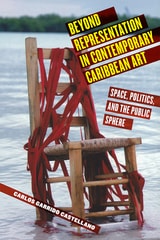
Beyond Representation in Contemporary Caribbean Art
Space, Politics, and the Public SphereCarlos Garrido Castellano
Rutgers University Press, 2019
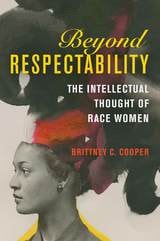
Beyond Respectability
The Intellectual Thought of Race WomenBrittney C. Cooper
University of Illinois Press, 2017
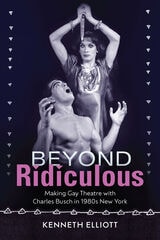
Beyond Ridiculous
Making Gay Theatre with Charles Busch in 1980s New YorkKenneth Elliott
University of Iowa Press, 2023
In Beyond Ridiculous, Elliott narrates in first-person the company’s Cinderella tale of fun, heartbreak, and dishy drama. At the center of the book is a young Charles Busch, an unforgettable personality fighting to be seen, be heard, and express his unique style as a writer-performer in plays such as Psycho Beach Party and The Lady in Question. The tragedy of AIDS among treasured friends in the company, the struggle for mainstream acceptance of LGBTQ+ theatre during the reign of President Ronald Reagan, and the exploration of new ways of being a gay theatre artist make the book a bittersweet and joyous ride.
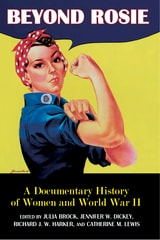
Beyond Rosie
A Documentary History of Women and World War IIJulia Brock
University of Arkansas Press, 2015
Beyond Rosie offers readers an opportunity to see the numerous contributions they made to the fight against the Axis powers and how American women’s roles changed during the war. The primary documents (newspapers, propaganda posters, cartoons, excerpts from oral histories and memoirs, speeches, photographs, and editorials) collected here represent cultural, political, economic, and social perspectives on the diverse roles women played during World War II.
Beyond Settler Time
Temporal Sovereignty and Indigenous Self-DeterminationMark Rifkin
Duke University Press, 2017
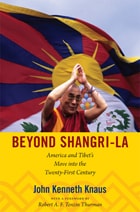
Beyond Shangri-La
America and Tibet's Move into the Twenty-First CenturyJohn Kenneth Knaus
Duke University Press, 2012
Since the late 1950s, the rugged resolve of the Dalai Lama and his people and the growing respect for their efforts to free their homeland from Chinese occupation have made Tibet's political and cultural status a pressing issue in international affairs. So has the realization by nations, including the United States, that their geopolitical interests would best be served by the defeat of the Chinese and the achievement of Tibetan self-determination. Beyond Shangri-La provides unique insight into the efforts of the U.S. government and committed U.S. citizens to support a free Tibet.
Beyond Subsistence
Plains Archaeology and the Postprocessual CritiqueEdited by Philip Duke and Michael C. Wilson
University of Alabama Press, 1995
A series of essays, written by Plains scholars of diverse research interests and backgrounds, that apply postprocessual approaches to the solution of current problems in Plains archaeology
Postprocessual archaeology is seen as a potential vehicle for integrating culture-historical, processual, and postmodernist approaches to solve specific archaeological problems.
The contributors address specific interpretive problems in all the major regions of the North American Plains, investigate different Plains societies (including hunter-gatherers and farmers and their associated archaeological records), and examine the political content of archaeology in such fields as gender studies and cultural resource management. They avoid a programmatic adherence to a single paradigm, arguing instead that a mature archaeology will use different theories, methods, and techniques to solve specific empirical problems. By avoiding excessive infatuation with the correct scientific method, this volume addresses questions that have often been categorized as beyond archaeological investigations.
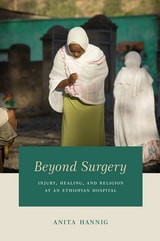
Beyond Surgery
Injury, Healing, and Religion at an Ethiopian HospitalAnita Hannig
University of Chicago Press, 2017
Through her in-depth ethnography of two repair and rehabilitation centers operating in Ethiopia, Hannig takes the reader deep into a world inside hospital walls, where women recount stories of loss and belonging, shame and delight. As she chronicles the lived experiences of fistula patients in clinical treatment, Hannig explores the danger of labeling “culture” the culprit, showing how this common argument ignores the larger problem of insufficient medical access in rural Africa. Beyond Surgery portrays the complex social outcomes of surgery in an effort to deepen our understanding of medical missions in Africa, expose cultural biases, and clear the path toward more effective ways of delivering care to those who need it most.
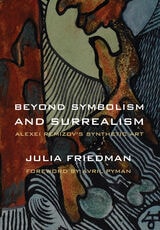
Beyond Symbolism and Surrealism
Alexei Remizov's Synthetic ArtJulia Friedman, Foreword by Avril Pyman
Northwestern University Press, 2011
The great modernist eccentric Alexei Remizov was a “writers’ writer” whose innovative poetic prose has long since entered the Russian literary canon. Gradually expanding his working methods to make drawing an integral part of the writing process, during the 1930s and 1940s, Remizov created hundreds of albums that combined texts with collages and india ink and watercolor illustrations. In Beyond Symbolism and Surrealism, Julia Friedman provides the first extensive examination of the dynamic interplay between text and image in Remizov’s albums, revealing their coequal roles in his oneiric and synaesthetic brand of storytelling. A participant in the Russian symbolist movement, an intellectual ally of many futurists, and during his émigré years, a collaborator of the surrealists, Remizov had unique insight into artistic cultures of the European avant-garde. His reinterpretation of the medieval illuminated manuscripts carries forward the traditions of symbolist mysticism and
This long-overdue examination of Remizov’s visual art addresses modernism’s key theoretical questions surrounding the relationships between image and text. Beyond Symbolism and Surrealism introduces a generous sampling of Remizov’s graphic work, much of which is currently held in private collections.

Beyond Text
Theater and Performance in Print After 1900Jennifer Buckley
University of Michigan Press, 2019
Winner of the 2020 Outstanding Book Award from the Association for Theatre in Higher Education
Taking up the work of prominent theater and performance artists, Beyond Text reveals the audacity and beauty of avant-garde performance in print. With extended analyses of the works of Edward Gordon Craig, German expressionist Lothar Schreyer, the Living Theatre, Carolee Schneemann, and Guillermo Gómez-Peña, the book shows how live performance and print aesthetically revived one another during a period in which both were supposed to be in a state of terminal cultural decline. While the European and American avant-gardes did indeed dismiss the dramatic author, they also adopted print as a theatrical medium, altering the status, form, and function of text and image in ways that continue to impact both the performing arts and the book arts.
Beyond Text participates in the ongoing critical effort to unsettle conventional historical and theoretical accounts of text-performance relations, which have too often been figured in binary, chronological (“from page to stage”), or hierarchical terms. Across five case studies spanning twelve decades, Beyond Text demonstrates that print—as noun and verb—has been integral to the practices of modern and contemporary theater and performance artists.
Beyond The Barricades
Nicaragua and the Struggle for the Sandinista Press, 1979–1998Adam Jones
Ohio University Press, 2002
Throughout the 1980s, Barricada, the official daily newspaper of the ruling Sandinista Front, played the standard role of a party organ, seeking the mobilize the Nicaraguan public to support the revolutionary agenda. Beyond the Barricades, however, reveals a story that is both more intriguing and much more complex. Even during this period of sweeping transformation and outside military siege, another, more professional agenda also motivated Barricada’s journalists and editors.
When the Sandinistas unexpectedly fell from power in the 1990 elections, Barricada gained a substantial degree of autonomy that allowed it to explore a more balanced and nuanced journalism “in the national interest.” This new orientation, however, ran afoul of more orthodox party leaders, who gradually gained the upper hand in the bitter internal struggle that wracked the Sandinista Front in the early 1990s. The paper closed its doors in January 1998.
Adam Jones’s outstanding study offers an unprecedented behin-the-scenes looks at Barricada’s two decades of evolution and dissolution. It also presents an intimate portrait of a key revolutionary institution and the memorable individuals who were a part of it.
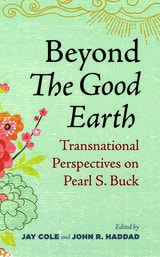
Beyond The Good Earth
Transnational Perspectives on Pearl S. BuckJay Cole
West Virginia University Press, 2019
How well do we really know Pearl S. Buck? Many think of Buck solely as the Nobel laureate and Pulitzer Prize–winning author of The Good Earth, the novel that explained China to Americans in the 1930s. But Buck was more than a novelist and interpreter of China. As the essays in Beyond The Good Earth show, she possessed other passions and projects, some of which are just now coming into focus.
Who knew, for example, that Buck imagined and helped define multiculturalism long before it became a widely known concept? Or that she founded an adoption agency to locate homes for biracial children from Asia? Indeed, few are aware that she advocated successfully for a genocide convention after World War II and was ahead of her time in envisioning a place for human rights in American foreign policy. Buck’s literary works, often dismissed as simple portrayals of Chinese life, carried a surprising degree of innovation as she experimented with the styles and strategies of modernist artists.
In Beyond The Good Earth, scholars and writers from the United States and China explore these and other often overlooked topics from the life of Pearl S. Buck, positioning her career in the context of recent scholarship on transnational humanitarian activism, women’s rights activism, and civil rights activism.