Results by title
22279 books match the query 'Social Science' and 1147 start with b
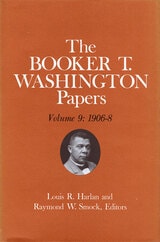
Booker T. Washington Papers Volume 9
1906-8. Assistant editor, Nan E. WoodruffBooker T. Washington
University of Illinois Press, 1980
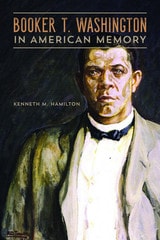
Booker T. Washington in American Memory
Kenneth M. Hamilton
University of Illinois Press, 2017

Bookmarks
Reading in Black and White, First Paperback EditionKarla F. Holloway
Rutgers University Press, 2006
"BookMarks is a moving and revelatory memoir... a work of fiercely intelligent scholarship." - Susan Larson,
"Erudite and emotional in turns, [BookMarks] is full of truths that appeal to the head and the heart." - Charlotte News Observer"
What are you reading? What books have been important to you? Whether you are interviewing for a job, chatting with a friend or colleague, or making small talk, these questions arise almost unfailingly. Some of us have stock responses, which may or may not be a fiction of our own making. Others gauge their answers according to who is asking the question. Either way, the replies that we give are thoughtfully crafted to suggest the intelligence, worldliness, political agenda, or good humor that we are hoping to convey. We form our answers carefully because we know that our responses say a lot.
But what exactly do our answers say? In BookMarks, Karla FC Holloway explores the public side of reading, and specifically how books and booklists form a public image of African Americans. Revealing her own love of books and her quirky passion for their locations in libraries and on bookshelves, Holloway reflects on the ways that her parents guided her reading when she was young and her bittersweet memories of reading to her children. She takes us on a personal and candid journey that considers the histories of reading in children’s rooms, prison libraries, and “Negro” libraries of the early twentieth century, and that finally reveals how her identity as a scholar, a parent, and an African American woman has been subject to judgments that public cultures make about race and our habits of reading.
Holloway is the first to call our attention to a remarkable trend of many prominent African American writers—including Maya Angelou, W.E.B. Du Bois, Henry Louis Gates, Malcolm X, and Zora Neale Hurston. Their autobiographies and memoirs are consistently marked with booklists—records of their own habits of reading. She examines these lists, along with the trends of selection in Oprah Winfrey’s popular book club, raising the questions: What does it mean for prominent African Americans to associate themselves with European learning and culture? How do books by black authors fare in the inevitable hierarchy of a booklist?
BookMarks provides a unique window into the ways that African Americans negotiate between black and white cultures. This compelling rumination on reading is a book that everyone should add to their personal collections and proudly carry “cover out.”

Books for Idle Hours
Nineteenth-Century Publishing and the Rise of Summer ReadingDonna Harrington-Lueker
University of Massachusetts Press, 2019
Drawing on publishing records, book reviews, readers' diaries, and popular novels of the period, Donna Harrington-Lueker explores the beginning of summer reading and the backlash against it. Countering fears about the dangers of leisurely reading—especially for young women—publishers framed summer reading not as a disreputable habit but as a respectable pastime and welcome respite. Books for Idle Hours sheds new light on an ongoing seasonal publishing tradition.
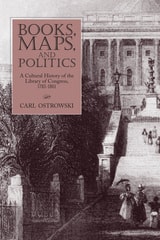
Books, Maps, and Politics
A Cultural History of the Library of Congress, 1783-1861Carl Ostrowski
University of Massachusetts Press, 2004
The author explores the relationship between the Library and the period's expanding print culture. He identifies the books that legislators required to be placed in the Library and establishes how these volumes were used. His analysis of the earliest printed catalogs of the Library reveals that law, politics, economics, geography, and history were the subjects most assiduously collected. These books provided government officials with practical guidance in domestic legislation and foreign affairs, including disputes with European powers over territorial boundaries.
Ostrowski also discusses a number of secondary functions of the Library, one of which was to provide reading material for the entertainment and instruction of government officials and their families. As a result, the richness of America's burgeoning literary culture from the 1830s to the 1860s was amply represented on the Library's shelves. For those with access to its Capitol rooms, the Library served an important social function, providing a space for interaction and the display and appreciation of American works of art.
Ostrowski skillfully demonstrates that the history of the Library of Congress offers a lens through which we can view changing American attitudes toward books, literature, and the relationship between the federal government and the world of arts and letters.
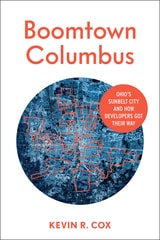
Boomtown Columbus
Ohio’s Sunbelt City and How Developers Got Their WayKevin R. Cox
The Ohio State University Press, 2021
How have development interests become entwined with government? How has a policy of annexation reformed the city’s map? Why have airline service and major league prestige lagged behind its status as a regional center? And what, if anything, makes this city with a reputation for being average stand apart? In Boomtown Columbus, Cox applies both scholarly expertise and his personal experience as a long-time resident of the city to look at the real-life costs of policy. The resulting narrative will fascinate not only locals but anyone with a stake in understanding American cities and a path toward urban livability for all.
Boomtown Saloons
Archaeology And History In Virginia CityKelly J. Dixon
University of Nevada Press, 2006
The image of Old West saloons as sites of violence and raucous entertainment has been perpetuated by film and legend, but the true story of such establishments is far more complex. In Boomtown Saloons, archaeologist Kelly J. Dixon recounts the excavation of four historic saloon sites in Nevada’s Virginia City, one of the West’s most important boomtowns, and shows how the physical traces of this handful of disparate drinking places offer a new perspective on authentic life in the mining West. During the second half of the nineteenth century, the Comstock Lode’s mineral wealth attracted people from all over the world. At its peak, Virginia City had a cosmopolitan population of over 20,000 people. Like people everywhere, they sought to pass their leisure time in congenial company, often in one or another of the four saloons studied here. Dixon’s account of the role these four establishments played in the social and economic life of Virginia City offers keen insight into the businesses and people who made up the backdrop of a mining boomtown. The saloons in this study were quieter than legend would have us believe; they served relatively distinct groups and offered their customers a place of refuge, solidarity, and social contact with peers in a city where few people had longtime ties or initially any close contacts. Boomtown Saloons also offers an equally vivid portrait of the modern historical archaeologist who combines time-honored digging, reconstruction, and analysis methods with such cutting-edge technology as DNA analysis of saliva traces on a 150-year-old pipestem and chemical analysis of the residue in discarded condiment bottles. The book is illustrated with historical photographs and maps, as well as photographs of artifacts uncovered during the excavations of the four sites. Dixon’s sparkling text and thoughtful interpretation of evidence reveal an unknown aspect of daily life in one of the West’s most storied boomtowns and demonstrate that, contrary to legend, the traditional western saloon served an vital and complex social role in its community. Available in hardcover and paperback.
Boomtown
Runaway Globalisation on the Queensland CoastThomas Hylland Eriksen
Pluto Press, 2018
Capturing Gladstone at the peak of its accelerated growth in 2013–14, Thomas Hylland Eriksen dissects here the boomtown phenomenon in all its profound ambivalence. Based on ethnographic fieldwork, the book examines local identity, family life, infrastructure, and local services and explores the tensions and resentments surrounding migrant workers.
Writ large in Boomtown are the clashes of scale at the heart of the town’s contradictions, where the logic of big industry and the state compete with those of the individual and the local community and ecology, crystallizing the current crisis of political legitimacy that is unfurling all over the world.

Bootlegging the Airwaves
Alternative Histories of Radio and Television DistributionEleanor Patterson
University of Illinois Press, 2024
Long before internet archives and the anytime, anywhere convenience of streaming, people collected, traded, and shared radio and television content via informal networks that crisscrossed transnational boundaries.
Eleanor Patterson’s fascinating cultural history explores the distribution of radio and TV tapes from the 1960s through the 1980s. Looking at bootlegging against the backdrop of mass media’s formative years, Patterson delves into some of the major subcultures of the era. Old-time radio aficionados felt the impact of inexpensive audio recording equipment and the controversies surrounding programs like Amos ‘n’ Andy. Bootlegging communities devoted to buddy cop TV shows like Starsky and Hutch allowed women to articulate female pleasure and sexuality while Star Trek videos in Australia inspired a grassroots subculture built around community viewings of episodes. Tape trading also had a profound influence on creating an intellectual pro wrestling fandom that aided wrestling’s growth into an international sports entertainment industry.

Boots, Bikes, and Bombers
Adventures of Alaska Conservationist Ginny Hill WoodEdited by Karen Brewster
University of Alaska Press, 2012
Border Afterlives
Migrant Deaths, Forensic Investigations, and the Politics of HauntingGabriella Soto
University of Arizona Press, 2026
Drawing on over a decade of ethnographic, participatory, and community-engaged research, author Gabriella Soto examines the postmortem journeys of these migrants through the fragmented infrastructure of medicolegal death investigation in the U.S. Southwest. She reveals how the state’s deterrence-based border policies not only generate death but also fail to provide adequate care for the dead. Soto argues that these deaths should be understood as structural homicides and that the forensic neglect they face is a form of ongoing violence.
Moving between the practical and the philosophical, Soto asks what it means to care for the dead and what society owes to those who die in its name. Through the lens of haunting, she explores how the dead continue to shape the living, not as objects of horror but as moral agents whose presence demands justice. Border Afterlives offers a border-scale comparative account of forensic practices, critiques the limits of “best practices” in under-resourced systems, and calls for a reimagining of forensic humanitarianism grounded in reciprocity and dignity, beyond human rights. This is a book that insists on remembering the dead.

Border Biomes
Ecological Imaginaries of Mexico's EdgesEmily Celeste Vázquez Enríquez
Vanderbilt University Press, 2025
This book is freely available in an open-access edition thanks to the generous support by the University of California Davis Library.
What effect do heavily fortified national borders have on the natural environments that surround them? In Border Biomes, Emily Celeste Vázquez Enríquez explores this question by analyzing contemporary Mexican, Latinx, and Indigenous literature that has tried to highlight the human and ecological toll of Mexico’s borders with the United States and Guatemala. By challenging the very premise of borders as permanent, immovable boundaries, she shows how novelists and poets in Mexico and the United States have tried to represent and understand the vast social, political, and ecological harm caused by these constructions. She argues that the environmental destruction that borders create is inseparable from state‑sanctioned, anti‑immigrant racial violence. To do this, she structures the book around three main biomes: rivers, deserts, and forests. Within each chapter, Vázquez Enríquez considers how authors such as Dolores Dorantes, Natalie Diaz, and Ofelia Zepeda have drawn upon alternative Indigenous epistemologies and forms of representation to register the sweeping damage of bordering regimes on the Colorado River, the Southwest Desert, and the Selva El Petén, and other biomes. By critically analyzing the work of these US and Mexican writers, she contests traditional interpretations of Mexican literature as nationally bounded and instead proposes an expansive view of “Mexican literature.” More fundamentally, Border Biomes suggests literature's potential to create new ecological realities and challenge the naturalization of borders and the ecological violence that they provoke.
Border Brokers
Children of Mexican Immigrants Navigating U.S. Society, Laws, and PoliticsChristina M. Getrich
University of Arizona Press, 2019
Based on ethnographic fieldwork in San Diego over more than a decade, Border Brokers documents the continuing deleterious effects of U.S. immigration policies and enforcement practices on a group of now young adults and their families. In the first book-length longitudinal study of mixed-status families, Christina M. Getrich provides an on-the-ground portrayal of these young adults’ lives from their own perspectives and in their own words.
More importantly, Getrich identifies how these individuals have developed resiliency and agency beginning in their teens to improve circumstances for immigrant communities. Despite the significant constraints their families face, these children have emerged into adulthood as grounded and skilled brokers who effectively use their local knowledge bases, life skills honed in their families, and transborder competencies. Refuting the notion of their failure to assimilate, she highlights the mature, engaged citizenship they model as they transition to adulthood to be perhaps their most enduring contribution to creating a better U.S. society.
An accessible ethnography rooted in the everyday, this book portrays the complexity of life in the U.S.-Mexico borderlands. It offers important insights for anthropologists, educators, policy-makers, and activists working on immigration and social justice issues.
Border Cinema
Reimagining Identity through AestheticsEdited by Monica Hanna and Rebecca A. Sheehan
Rutgers University Press, 2019
Border Citizens
The Making of Indians, Mexicans, and Anglos in ArizonaBy Eric V. Meeks; foreword by Patricia Nelson Limerick
University of Texas Press, 2007
In Border Citizens, historian Eric V. Meeks explores how the racial classification and identities of the diverse indigenous, mestizo, and Euro-American residents of Arizona’s borderlands evolved as the region was politically and economically incorporated into the United States. First published in 2007, the book examines the complex relationship between racial subordination and resistance over the course of a century. On the one hand, Meeks links the construction of multiple racial categories to the process of nation-state building and capitalist integration. On the other, he explores how the region’s diverse communities altered the blueprint drawn up by government officials and members of the Anglo majority for their assimilation or exclusion while redefining citizenship and national belonging.
The revised edition of this highly praised and influential study features dozens of new images, an introductory essay by historian Patricia Nelson Limerick, and a chapter-length afterword by the author. In his afterword, Meeks details and contextualizes Arizona’s aggressive response to undocumented immigration and ethnic studies in the decade after Border Citizens was first published, demonstrating that the broad-based movement against these measures had ramifications well beyond Arizona. He also revisits the Yaqui and Tohono O’odham nations on both sides of the Sonora-Arizona border, focusing on their efforts to retain, extend, and enrich their connections to one another in the face of increasingly stringent border enforcement.
Border Contraband
A History of Smuggling across the Rio GrandeBy George T. Díaz
University of Texas Press, 2015

Border Crossings
An Introduction to East German ProseThomas C. Fox
University of Michigan Press, 1993
Border Dilemmas
Racial and National Uncertainties in New Mexico, 1848–1912Anthony Mora
Duke University Press, 2011
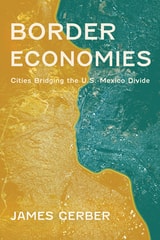
Border Economies
Cities Bridging the U.S.-Mexico DivideJames Gerber
University of Arizona Press, 2024
Enormous legal cross-border flows of people, goods, and finance are embedded in the region’s history and prompted by the need to respond to new opportunities and challenges that originate on the other side. In Border Economies James Gerber examines how the interactivity and sensitivity of communities to conditions across the border differentiates them from communities in the interiors of Mexico and the United States. Gerber explains what makes the region not only unique but uniquely interesting.
In Border Economies readers who want to understand the conditions that make the border controversial but also want to go beyond shallow political narratives will find an in-depth exploration of the economic forces shaping the region and an antidote to common prejudices and misunderstandings.
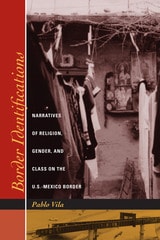
Border Identifications
Narratives of Religion, Gender, and Class on the U.S.-Mexico BorderBy Pablo Vila
University of Texas Press, 2005
From poets to sociologists, many people who write about life on the U.S.-Mexico border use terms such as "border crossing" and "hybridity" which suggest that a unified culture—neither Mexican nor American, but an amalgamation of both—has arisen in the borderlands. But talking to people who actually live on either side of the border reveals no single commonly shared sense of identity, as Pablo Vila demonstrated in his book Crossing Borders, Reinforcing Borders: Social Categories, Metaphors, and Narrative Identities on the U.S.-Mexico Frontier. Instead, people living near the border, like people everywhere, base their sense of identity on a constellation of interacting factors that includes regional identity, but also nationality, ethnicity, and race.
In this book, Vila continues the exploration of identities he began in Crossing Borders, Reinforcing Borders by looking at how religion, gender, and class also affect people's identifications of self and "others" among Mexican nationals, Mexican immigrants, Mexican Americans, Anglos, and African Americans in the Cuidad Juárez-El Paso area. Among the many fascinating issues he raises are how the perception that "all Mexicans are Catholic" affects Mexican Protestants and Pentecostals; how the discourse about proper gender roles may feed the violence against women that has made Juárez the "women's murder capital of the world"; and why class consciousness is paradoxically absent in a region with great disparities of wealth. His research underscores the complexity of the process of social identification and confirms that the idealized notion of "hybridity" is only partially adequate to define people's identity on the U.S.-Mexico border.

Border Killers
Neoliberalism, Necropolitics, and Mexican MasculinityElizabeth Villalobos
University of Arizona Press, 2024
Villalobos focuses on representations of “border killers” in literature, film, and theater. The author develops a metaphor of “maquilization” to describe the mass-production of masculine violence as a result of neoliberalism. The author demonstrates that the killer is an interchangeable cog in a societal factory of violence whose work is to produce dead bodies. By turning to cultural narratives, Villalobos seeks to counter the sensationalistic and stereotyped media depictions of border residents as criminals. The cultural works she examines instead indict the Mexican state and the global economic system for producing agents of violence.
Focusing on both Mexico’s northern and southern borders, Border Killers uses Achille Mbembe’s concept of necropolitics and various theories of masculinity to argue that contemporary Mexico is home to a form of necropolitical masculinity that has flourished in the neoliberal era and made the exercise of death both profitable and necessary for the functioning of Mexico’s state-cartel-corporate governance matrix.
Border Mediascapes
Cinematic Itineraries at the Edge of EuropeFrancesco Zucconi
University of Minnesota Press, 2026
How the cinematic gaze reveals the hidden operations of border zones
Examining a variety of documentary films made along the borders of Europe since the turn of the twenty-first century, Border Mediascapes takes a cinematic eye to the technologies employed in governing spatial movement. Working at the intersections of social sciences, political theory, contemporary media, and cinema aesthetics, this book expands our understanding of the border as not just a static political boundary inscribed on a map but a complex, dynamic network of human and nonhuman agents.
Francesco Zucconi asserts that contemporary borders are environments defined by media: a perpetually shifting set of interactions between physical bodies and sensors, surveillance cameras, satellites, mapping programs, digital signage, and cellular devices. Analyzing documentaries filmed by or in collaboration with migrants, Border Mediascapes demonstrates how cinema can be used to reveal the otherwise unseen apparatuses that facilitate systematized practices of recognition, expulsion, and erasure.
As he details the ways specific border technologies measure and identify individuals as part of the larger project of territorial control, Zucconi illustrates the effectiveness of cinema for capturing the entanglement of geopolitics and biopolitics. Viewing the cinematic perspective as simultaneously analytical, critical, and complicit with the new technological frontier, Zucconi shows how the medium can deepen our understanding of borders as sites of power, resistance, and resilience.
Retail e-book files for this title are screen-reader friendly with images accompanied by short alt text and/or extended descriptions.
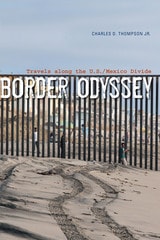
Border Odyssey
Travels along the U.S./Mexico DivideBy Charles D. Thompson, Jr.
University of Texas Press, 2015
“We were trying to change the vision and the conversation about border fears.”
Border Odyssey takes us on a drive toward understanding the U.S./Mexico divide: all 1,969 miles—from Boca Chica to Tijuana—pressing on with the useful fiction of a map.
“We needed to go to the place where countless innocent people had been kicked, cussed, spit on, arrested, detained, trafficked, and killed. It would become clear that the border, la frontera, was more multifaceted and profound than anything we could have invented about it from afar.”
Along the journey, five centuries of cultural history (indigenous, French, Spanish, Mexican, African American, colonist, and U.S.), wars, and legislation unfold. And through observation, conversation, and meditation, Border Odyssey scopes the stories of the people and towns on both sides.
“Stories are the opposite of walls: they demand release, retelling, showing, connecting, each image chipping away at boundaries. Walls are full stops. But stories are like commas, always making possible the next clause.”
Among the terrain traversed: walls and more walls, unexpected roadblocks and patrol officers; a golf course (you could drive a ball across the border); a Civil War battlefield (you could camp there); the southernmost plantation in the United States; a hand-drawn ferry, a road-runner tracked desert, and a breathtaking national park; barbed wire, bridges, and a trucking-trade thoroughfare; ghosts with guns; obscured, unmarked, and unpaved roads; a Catholic priest and his dogs, artwork, icons, and political cartoons; a sheriff and a chain-smoking mayor; a Tex-Mex eatery empty of customers and a B&B shuttering its doors; murder-laden newspaper headlines at breakfast; the kindness of the border-crossing underground; and too many elderly, impoverished, ex-U.S. farmworkers, braceros, lined up to have Thompson take their photograph.
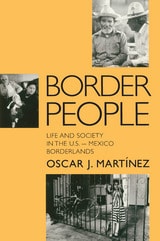
Border People
Life and Society in the U.S.-Mexico BorderlandsOscar J. Martínez
University of Arizona Press, 1994
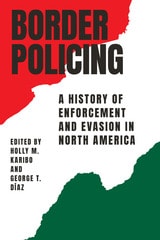
Border Policing
A History of Enforcement and Evasion in North AmericaEdited by Holly M. Karibo and George T. Díaz
University of Texas Press, 2020
An interdisciplinary group of borderlands scholars provide the first expansive comparative history of the way North American borders have been policed—and transgressed—over the past two centuries.
An extensive history examining how North American nations have tried (and often failed) to police their borders, Border Policing presents diverse scholarly perspectives on attempts to regulate people and goods at borders, as well as on the ways that individuals and communities have navigated, contested, and evaded such regulation.
The contributors explore these power dynamics though a series of case studies on subjects ranging from competing allegiances at the northeastern border during the War of 1812 to struggles over Indian sovereignty and from the effects of the Mexican Revolution to the experiences of smugglers along the Rio Grande during Prohibition. Later chapters stretch into the twenty-first century and consider immigration enforcement, drug trafficking, and representations of border policing in reality television. Together, the contributors explore the powerful ways in which federal authorities impose political agendas on borderlands and how local border residents and regions interact with, and push back against, such agendas. With its rich mix of political, legal, social, and cultural history, this collection provides new insights into the distinct realities that have shaped the international borders of North America.
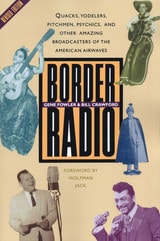
Border Radio
Quacks, Yodelers, Pitchmen, Psychics, and Other Amazing Broadcasters of the American Airwaves, Revised EditionBy Gene Fowler and Bill Crawford
University of Texas Press, 2002
Before the Internet brought the world together, there was border radio. These mega-watt "border blaster" stations, set up just across the Mexican border to evade U.S. regulations, beamed programming across the United States and as far away as South America, Japan, and Western Europe.
This book traces the eventful history of border radio from its founding in the 1930s by "goat-gland doctor" J. R. Brinkley to the glory days of Wolfman Jack in the 1960s. Along the way, it shows how border broadcasters pioneered direct sales advertising, helped prove the power of electronic media as a political tool, aided in spreading the popularity of country music, rhythm and blues, and rock, and laid the foundations for today's electronic church. The authors have revised the text to include even more first-hand information and a larger selection of photographs.
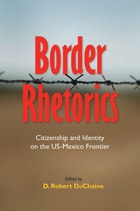
Border Rhetorics
Citizenship and Identity on the US-Mexico FrontierEdited by D. Robert DeChaine
University of Alabama Press, 2012
Undertakes a wide-ranging examination of the US-Mexico border as it functions in the rhetorical production of civic unity in the United States
A “border” is a powerful and versatile concept, variously invoked as the delineation of geographical territories, as a judicial marker of citizenship, and as an ideological trope for defining inclusion and exclusion. It has implications for both the empowerment and subjugation of any given populace. Both real and imagined, the border separates a zone of physical and symbolic exchange whose geographical, political, economic, and cultural interactions bear profoundly on popular understandings and experiences of citizenship and identity.
The border’s rhetorical significance is nowhere more apparent, nor its effects more concentrated, than on the frontier between the United States and Mexico. Often understood as an unruly boundary in dire need of containment from the ravages of criminals, illegal aliens, and other undesirable threats to the national body, this geopolitical locus exemplifies how normative constructions of “proper”; border relations reinforce definitions of US citizenship, which in turn can lead to anxiety, unrest, and violence centered around the struggle to define what it means to be a member of a national political community.
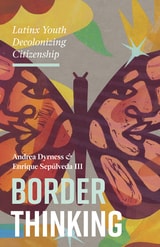
Border Thinking
Latinx Youth Decolonizing CitizenshipAndrea Dyrness
University of Minnesota Press, 2020
Rich accounts of how Latinx migrant youth experience belonging across borders
As anti-immigrant nationalist discourses escalate globally, Border Thinking offers critical insights into how young people in the Latinx diaspora experience belonging, make sense of racism, and long for change. Every year thousands of youth leave Latin America for the United States and Europe, and often the young migrants are portrayed as invaders and, if able to stay, told to integrate into their new society. Border Thinking asks not how to help the diaspora youth assimilate but what the United States and Europe can learn about citizenship from these diasporic youth.
Working in the United States, Spain, and El Salvador, Andrea Dyrness and Enrique Sepúlveda III use participatory action research to collaborate with these young people to analyze how they make sense of their experiences in the borderlands. Dyrness and Sepúlveda engage them in reflecting on their feelings of belonging in multiple places—including some places that treat them as outsiders and criminals. Because of their transnational existence and connections to both home and host countries, diaspora youth have a critical perspective on national citizenship and yearn for new forms of belonging not restricted to national borders. The authors demonstrate how acompañamiento—spaces for solidarity and community-building among migrants—allow youth to critically reflect on their experiences and create support among one another.
Even as national borders grow more restricted and the subject of immigration becomes ever more politically fraught, young people’s identities are increasingly diasporic. As the so-called migrant crisis continues, change in how citizenship and belonging are constructed is necessary, and urgent, to create inclusive and sustainable futures. In Border Thinking, Dyrness and Sepúlveda decouple citizenship from the nation-state, calling for new understandings of civic engagement and belonging.
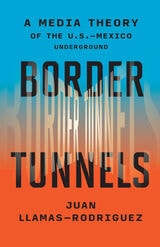
Border Tunnels
A Media Theory of the U.S.-Mexico UndergroundJuan Llamas-Rodriguez
University of Minnesota Press, 2023
A comparative media analysis of the representation of the U.S.–Mexico border
Border tunnels at the U.S.–Mexico border are ubiquitous in news, movies, and television, yet, because they remain hidden and inaccessible, the public can encounter them only through media. Analyzing the technologies, institutional politics, narrative tropes, and aesthetic decisions that go into showing border tunnels across multiple forms of media, Juan Llamas-Rodriguez argues that we cannot properly address border issues without attending to—and fully understanding—the fraught relationship between their representation and reality.
Llamas-Rodriguez reveals that every media text about border tunnels, whether meant for entertainment, cable news, video games, or speculative design, implicitly takes a position on the politics of the border. The examples laid out in Border Tunnels will teach readers how to look differently at the border as it is commonly presented in various forms of media, from ABC’s Nightline and CNN’s Anderson Cooper 360º to reality TV, propaganda videos, and even digital effects in Hollywood action films. Llamas-Rodriguez examines how creative decisions in the production, promotion, and distribution of these media texts either emphasize or downplay issues such as border security, racial dynamics of migration, and sustainability of the borderlands.
Focusing on tunnels to show how media representations can influence all kinds of audiences—even those physically near the border—Border Tunnels helps us make sense of this pressing social issue, ultimately advancing understanding of the U.S.–Mexico border in all of its complexity and precariousness.
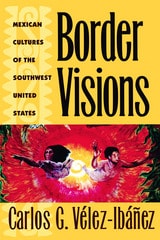
Border Visions
Mexican Cultures of the Southwest United StatesCarlos G. Vélez-Ibáñez
University of Arizona Press, 1996

Border Watch
Cultures of Immigration, Detention and ControlAlexandra Hall
Pluto Press, 2012
Questions over immigration and asylum face almost all Western countries. Should only economically useful immigrants be allowed? What should be done with unwanted or 'illegal' immigrants? In this bold and original intervention, Alexandra Hall shows that immigration detention centres offer a window onto society's broader attitudes towards immigrants.
Despite periodic media scandals, remarkably little has been written about the everyday workings of the grassroots immigration system, or about the people charged with enacting immigration policy at local levels. Detention, particularly, is a hidden side of border politics, despite its growing international importance as a tool of control and security. This book fills the gap admirably, analysing the everyday encounters between officers and immigrants in detention to explore broad social trends and theoretical concerns.
This highly topical book provides rare insights into the treatment of the 'other' and will be essential for policy makers and students studying anthropology and sociology.
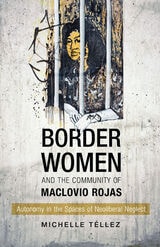
Border Women and the Community of Maclovio Rojas
Autonomy in the Spaces of Neoliberal NeglectMichelle Téllez
University of Arizona Press, 2021
Border Women and the Community of Maclovio Rojas tells the story of the community’s struggle to carve out space for survival and thriving in the shadows of the U.S.-Mexico geopolitical border. This ethnography by Michelle Téllez demonstrates the state’s neglect in providing social services and local infrastructure. This neglect exacerbates the structural violence endemic to the border region—a continuation of colonial systems of power on the urban, rural, and racialized poor. Téllez shows that in creating the community of Maclovio Rojas, residents have challenged prescriptive notions of nation and belonging. Through women’s active participation and leadership, a women’s political subjectivity has emerged—Maclovianas. These border women both contest and invoke their citizenship as they struggle to have their land rights recognized, and they transform traditional political roles into that of agency and responsibility.
This book highlights the U.S.-Mexico borderlands as a space of resistance, conviviality, agency, and creative community building where transformative politics can take place. It shows hope, struggle, and possibility in the context of gendered violences of racial capitalism on the Mexican side of the U.S.-Mexico border.
Border as Method, or, the Multiplication of Labor
Sandro Mezzadra and Brett Neilson
Duke University Press, 2013

Bordering Blackness
Migration and Dispossession in the Afro-MediterraneanLeslie Gross-Wyrtzen
Duke University Press, 2027
Borderland Dreams
The Transnational Lives of Korean Chinese WorkersJune Hee Kwon
Duke University Press, 2023
Borderland Lives in Northern South Asia
David N. Gellner, ed.
Duke University Press, 2013
Contributors. Jason Cons, Rosalind Evans, Nicholas Farrelly, David N. Gellner, Radhika Gupta, Sondra L. Hausner, Annu Jalais, Vibha Joshi, Nayanika Mathur, Deepak K. Mishra, Anastasia Piliavsky, Jeevan R. Sharma, Willem van Schendel
Borderlands Histories
Ethnographic Observations and Archaeological InterpretationsEdited by John Philip Carpenter and Matthew Pailes
University of Utah Press, 2021
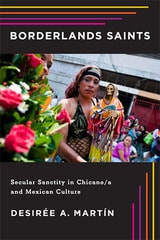
Borderlands Saints
Secular Sanctity in Chicano/a and Mexican CultureMartín, Desirée A
Rutgers University Press, 2013
Winner of the 2014 Latina/o Studies Section - LASA Outstanding Book Award
In Borderlands Saints, Desirée A. Martín examines the rise and fall of popular saints and saint-like figures in the borderlands of the United States and Mexico. Focusing specifically on Teresa Urrea (La Santa de Cabora), Pancho Villa, César Chávez, Subcomandante Marcos, and Santa Muerte, she traces the intersections of these figures, their devotees, artistic representations, and dominant institutions with an eye for the ways in which such unofficial saints mirror traditional spiritual practices and serve specific cultural needs.
Popular spirituality of this kind engages the use and exchange of relics, faith healing, pilgrimages, and spirit possession, exemplifying the contradictions between high and popular culture, human and divine, and secular and sacred. Martín focuses upon a wide range of Mexican and Chicano/a cultural works drawn from the nineteenth century to the present, covering such diverse genres as the novel, the communiqué, drama, the essay or crónica, film, and contemporary digital media. She argues that spiritual practice is often represented as narrative, while narrative—whether literary, historical, visual, or oral—may modify or even function as devotional practice.
Borderless Borders
edited by Frank Bonilla, Edwin Meléndez, Rebecca Morales and María de los Angeles Torres
Temple University Press, 2000
Borderless Borders describes the structural processes and active interventions taking place inside and outside U.S. Latino communities. After a context-setting introduction by urban planner Rebecca Morales, the contributors focus on four themes. Economist Manuel Pastor Jr., urban sociologist Saskia Sassen, and political scientist Carol Wise look at emerging forms of global and transnational interdependence and at whether they are likely to produce individuals who are economically independent or simply more dependent. Sociologist Jorge Chapa, social anthropologist Maria P. Fernandez Kelly, and economist Edwin Melendez examine the negative impact of economic and political restructuring within the United States,especially within Latino communities. Performance artist Guillermo Gomez-Pena, legal scholar Gerald Torres, political scientist Maria de los Angeles Torres, and modern language specialist Silvio Torres-Saillant consider the implications -- for community formation, citizenship, political participation, and human rights -- of the fact that individuals are forced to construct identities for themselves in more than one sociopolitical setting. Finally, sociologist Jeremy Brecher, sociologist Frank Bonilla, and political scientist Pedro Caban speculate on new paths into international relations and issue-oriented social movements and organizations among these mobile populations. To supplement the written contributions, Painter Bibiana Suarez has chosen several artworks that contribute to the interdisciplinary scope of the book.

Borderless Fashion Practice
Contemporary Fashion in the Metamodern AgeVanessa Gerrie
Rutgers University Press, 2023
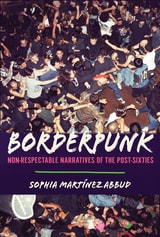
Borderpunk
Non-Respectable Narratives of the Post-SixtiesSophia Martínez Abbud
University of Arizona Press, 2027
The U.S.-Mexico border has long been a home to artists, poets, emos, and punks. In the clandestine undergrounds of borderlands cultural production, there lies an impulse to live below and beyond border surveillance technologies. This book is about the utopic stories that narrate this impulse and the punk literary scenes that facilitate these fabulations.
Using an innovative methodology of “scene-work”—a blend of literary analysis, queer theory, critical regionalism, and auto-ethnography—Borderpunk identifies, aggregates, and outlines the emergent genre of borderpunk cultural productions. Beginning with the post-1960s through the present, author Sophia Martínez Abbud examines how music, playlists, literature, art, and performance borderpunk narratives teach us to elide, undermine, and work against the border’s presumed authority. Through these narratives, readers become attuned to the anarchic sense of abjection that permeates the border regions and the kinds of punk subjectivities emerging from these sites of re-mediation.
Borderpunk offers scenes that refuse notions of respectability at different time periods, geographies, and scales. Following the mechanics of other narrative punk genres, such as cyberpunk or solarpunk, it sketches out the uses of “punk” as a way of being in border spaces—where abjection, relajo, and illegibility become useful tools that encourage us to divest from the norm, participate in horizontal community building, and imagine borders in radical new ways.
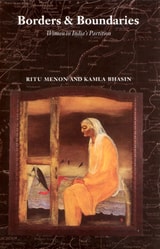
Borders and Boundaries
How Women Experienced the Partition of IndiaRitu Menon
Rutgers University Press, 1998
While there are plenty of official accounts of Partition, there are few social histories and no feminist histories. Borders and Boundaries changes that, providing first-hand accounts and memoirs, juxtaposed alongside official government accounts. The authors make women not only visible but central. They explore what country, nation, and religious identity meant for women, and they address the question of the nation-state and the gendering of citizenship.
In the largest ever peace-time mass migration of people, violence against women became the norm. Thousands of women committed suicide or were done to death by their own kinsmen. Nearly 100,000 women were "abducted" during the migration. A young woman might have been separated from her family when a convoy was ambushed, abducted by people of another religion, forced to convert, and forced into marriage or cohabitation. After bearing a child, she would be offered the opportunity to return only if she left her child behind and if she could face shame in her natal community. These stories do not paint their subjects as victims. Theirs are the stories of battles over gender, the body, sexuality, and nationalism-stories of women fighting for identity.
Borders of Belief
Religious Nationalism and the Formation of Identity in Ireland and TurkeyGregory J. Goalwin
Rutgers University Press, 2022
Borders of Care
Immigrants, Migrants, and the Fight for Health Care in the United StatesBeatrix Hoffman
University of Chicago Press, 2025
For the roughly ten million undocumented immigrants living in the United States, federal health care coverage is out of reach. Barred from Medicare, Medicaid, and the Affordable Care Act, most rely on hospital emergency rooms when they get sick, or clinics that don’t inquire about immigration status. Further obstacles to health care, including discrimination and the fear of deportation, mean that immigrants, undocumented or not, seek and receive less medical attention than any other population in the country. Yet immigrants haven’t always been ostracized from health care in the United States—providers and activists have for over a century worked to make medical services available to newcomers and migrants, including, at times, the undocumented.
Drawing together stories from diverse communities from the mid-nineteenth century to the present, Borders of Care examines how health care in the United States has both included and excluded immigrants. Beatrix Hoffman analyzes both the health and immigration systems, adding to our understanding of why these structures, and the policies that support them, have resisted reform. Moreover, she shows that immigrants, often scapegoated as burdens on the health-care system, have strengthened it through their responses to systemic exclusion. By creating hospitals and clinics, serving as practitioners, fighting for safer workplaces, filing lawsuits, organizing and protesting, immigrants and migrants have improved medical access for everybody and advanced the idea of health care as a universal right. As accessible as it is authoritative, Hoffman’s survey could not be more timely.
Borders of Care
Immigrants, Migrants, and the Fight for Health Care in the United StatesBeatrix Hoffman
University of Chicago Press, 2025
Probes the relationship between the immigration and health care systems in the United States.
For the roughly ten million undocumented immigrants living in the United States, federal health care coverage is out of reach. Barred from Medicare, Medicaid, and the Affordable Care Act, most rely on hospital emergency rooms when they get sick, or clinics that don’t inquire about immigration status. Further obstacles to health care, including discrimination and the fear of deportation, mean that immigrants, undocumented or not, seek and receive less medical attention than any other population in the country. Yet immigrants haven’t always been ostracized from health care in the United States—providers and activists have for over a century worked to make medical services available to newcomers and migrants, including, at times, the undocumented.
Drawing together stories from diverse communities from the mid-nineteenth century to the present, Borders of Care examines how health care in the United States has both included and excluded immigrants. Beatrix Hoffman analyzes both the health and immigration systems, adding to our understanding of why these structures, and the policies that support them, have resisted reform. Moreover, she shows that immigrants, often scapegoated as burdens on the health-care system, have strengthened it through their responses to systemic exclusion. By creating hospitals and clinics, serving as practitioners, fighting for safer workplaces, filing lawsuits, organizing and protesting, immigrants and migrants have improved medical access for everybody and advanced the idea of health care as a universal right. As accessible as it is authoritative, Hoffman’s survey could not be more timely.
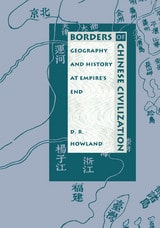
Borders of Chinese Civilization
Geography and History at Empire's EndD. R. Howland
Duke University Press, 1996
With Japan’s decision in the 1870s to modernize and westernize, China’s relationship with Japan underwent a crucial change—one that resulted in its decisive separation from Chinese civilization and, according to Howland, a destabilization of China’s worldview. His examination of the ways in which Chinese perceptions of Japan altered in the 1880s reveals the crucial choice faced by the Chinese of whether to interact with Japan as “kin,” based on geographical proximity and the existence of common cultural threads, or as a “barbarian,” an alien force molded by European influence.
By probing China’s poetic and expository modes of portraying Japan, Borders of Chinese Civilization exposes the changing world of the nineteenth century and China’s comprehension of it. This broadly appealing work will engage scholars in the fields of Asian studies, Chinese literature, history, and geography, as well as those interested in theoretical reflections on travel or modernism.
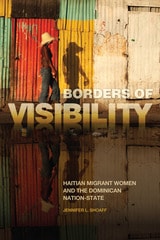
Borders of Visibility
Haitian Migrant Women and the Dominican Nation-Stateby Jennifer L. Shoaff
University of Alabama Press, 2018
An anthropological study of Haitian migrant women in the Dominican Republic.
Borders of Visibility offers extremely timely insight into the Dominican Republic’s racist treatment of Haitian descendants within its borders. Jennifer L. Shoaff employs multisited feminist research to focus on the geographies of power that intersect to inform the opportunities and constraints that migrant women must navigate to labor and live within a context that largely denies their human rights, access to citizenship, and a sense of security and belonging.
Paradoxically, these women are both hypervisible because of the blackness that they embody and invisible because they are marginalized by intersecting power inequalities. Haitian women must contend with diffuse legal, bureaucratic and discursive state-local practices across “border” sites that situate them as a specific kind of threat that must be contained. Shoaff examines this dialectic of mobility and containment across various sites in the northwest Dominican Republic, including the official border crossing, transborder and regional used-clothing markets, migrant settlements (bateyes), and other rural-urban contexts.
Shoaff combines ethnographic interviews, participant observation, institutional analyses of state structures and nongovernmental agencies, and archival documentation to bring this human rights issue to the fore. Although primarily grounded in critical ethnographic practice, this work contributes to the larger fields of transnational feminism, black studies, migration and border studies, political economy, and cultural geography. Borders of Visibility brings much needed attention to Haitian migrant women’s economic ingenuity and entrepreneurial savvy, their ability to survive and thrive, their often impossible choices whether to move or to stay, returning them to a place of visibility, while exposing the very structures that continue to render them invisible and, thus, expendable over time.

Borders, Human Itineraries, and All Our Relation
Dele Adeyemo, Natalie Diaz, Nadia Yala Kisukidi, and Rinaldo Walcott. With a Foreword by Christina Sharpe
Duke University Press, 2024

Borderscapes
Hidden Geographies and Politics at Territory’s EdgePrem Kumar Rajaram
University of Minnesota Press, 2007
Connecting critical issues of state sovereignty with empirical concerns, Borderscapes interrogates the limits of political space. The essays in this volume analyze everyday procedures, such as the classifying of migrants and refugees, security in European and American detention centers, and the DNA sampling of migrants in Thailand, showing the border as a moral construct rich with panic, danger, and patriotism.
Conceptualizing such places as immigration detention camps and refugee camps as areas of political contestation, this work forcefully argues that borders and migration are, ultimately, inextricable from questions of justice and its limits.
Contributors: Didier Bigo, Institut d’Études Politiques, Paris; Karin Dean; Elspeth Guild, U of Nijmegen; Emma Haddad; Alexander Horstmann, U of Münster; Alice M. Nah, National U of Singapore; Suvendrini Perera, Curtin U of Technology, Australia; James D. Sidaway, U of Plymouth, UK; Nevzat Soguk, U of Hawai‘i; Decha Tangseefa, Thammasat U, Bangkok; Mika Toyota, National U of Singapore.
Prem Kumar Rajaram is assistant professor of sociology and social anthropology at the Central European University, Budapest, Hungary.
Carl Grundy-Warr is senior lecturer of geography at the National University of Singapore.
Born Again
The Christian Right GlobalizedJennifer S. Butler
Pluto Press, 2006
This book reveals how Christian conservative groups are able to shape policy in every corner of the world. Drawing on interviews with religious leaders, it reveals how today's most powerful Christian Right organisations are building interfaith coalitions, connecting Catholic, Mormon and Muslim allies to advance a conservative agenda.
The US under Bush Jr. has given them a significant voice in shaping US policy on issues including women's rights, reproductive health, human cloning, children's rights and AIDS.
In short, the Christian Right is globalising -- a phenomenon that promises to challenge progressive social policy on a world-wide scale - as well as transform the Christian Right itself.