Results by title
28167 books match the query 'History' and 1262 start with b

Badger Boneyards
The Eternal Rest of the StoryDennis McCann
Wisconsin Historical Society Press, 2010
Badger and Coyote Were Neighbors
Melville Jacobs on Northwest Indian Myths and TalesWilliam R. Seaburg
Oregon State University Press, 2000
Badmen, Bandits, and Folk Heroes
The Ambivalence of Mexican American Identity in Literature and FilmJuan J. Alonzo
University of Arizona Press, 2009
Alonzo opens his provocative study with a fresh look at the adventure stories of Stephen Crane and the silent Western movies of D. W. Griffith. He also investigates the conflation of the greaser, the bandit, and the Mexican revolutionary into one villainous figure in early Western movies and, more broadly, traces the development of the badman in Westerns. He newly interrogates the writings of Américo Paredes regarding the makeup of Mexican masculinity, and productively trains his analytic eye on the recent films of Jim Mendiola and the contemporary poetry of Evangelina Vigil.
Throughout Badmen, Bandits, and Folk Heroes, Alonzo convincingly demonstrates how fiction and films that formerly appeared one-dimensional in their treatment of Mexicans and Mexican Americans actually offer surprisingly multifarious and ambivalent representations. At the same time, his valuation of indeterminacy, contingency, and hybridity in contemporary cultural production creates new possibilities for understanding identity formation.
Baetica Felix
People and Prosperity in Southern Spain from Caesar to Septimius SeverusBy Evan W. Haley
University of Texas Press, 2003
Baetica, the present-day region of Andalusia in southern Spain, was the wealthiest province of the Roman Empire. Its society was dynamic and marked by upward social and economic mobility, as the imperial peace allowed the emergence of a substantial middle social and economic stratum. Indeed, so mutually beneficial was the imposition of Roman rule on the local population of Baetica that it demands a new understanding of the relationship between Imperial Rome and its provinces.
Baetica Felix builds a new model of Roman-provincial relations through a socio-economic history of the province from Julius Caesar to the end of the second century A.D. Describing and analyzing the impact of Roman rule on a core province, Evan Haley addresses two broad questions: what effect did Roman rule have on patterns of settlement and production in Baetica, and how did it contribute to wealth generation and social mobility? His findings conclusively demonstrate that meeting the multiple demands of the Roman state created a substantial freeborn and ex-slave "middle stratum" of the population that outnumbered both the super-rich elite and the destitute poor.
Baghdad Bulletin
Dispatches on the American OccupationDavid Enders
University of Michigan Press, 2009
-Joe Sacco, author of Safe Area Gorazde
"Baghdad Bulletin takes us where mainstream news accounts do not go. Disrupting the easy clichés that dominate U.S. journalism, Enders blows away the media fog of war. The result is a book that challenges Americans to see through double speak and reconsider the warfare being conducted in their names."
-Norman Solomon, author of War Made Easy: How Presidents and Pundits Keep Spinning Us to Death
"Journalism at its finest and on a shoestring to boot. David Enders shows that courage and honesty can outshine big-budget mainstream media. Wry but self-critical, Baghdad Bulletin tells a story that a few of us experienced but every journalist, nay every citizen, should read."
-Pratap Chatterjee, Managing Editor and Project Director, CorpWatch
"Young and tenacious, Dave Enders went, saw, and wrote it down. Here it is-a well-informed and detailed tale of Iraq's decline under American rule. Baghdad Bulletin offers tragic politics, wacky people, and keen insights about what really matters on the ground in Iraq."
-Christian Parenti
"I wrote my first piece for Baghdad Bulletin after visiting the mass graves at Al-Hilla in 2003. The Baghdad Bulletin was essential reading in the first few months after the end of the war. I handed that particular copy to Prime Minister Tony Blair. I am only sorry that I cannot read it anymore. David Enders and his team were brave, enterprising, and idealistic."
-Rt. Hon. Ann Clwyd, member of the British Parliament
Baghdad Bulletin is a street-level account of the war and turbulent postwar period as seen through the eyes of the young independent journalist David Enders. The book recounts Enders's story of his decision to go to Iraq, where he opened the only English-language newspaper completely written, printed, and distributed there during the war.
Young, courageous, and anti-authoritarian, Enders is the first reporter to cover the war as experienced by ordinary Iraqis. Deprived of the press credentials that gave his embedded colleagues access to press conferences and officially sanitized information, Enders tells the story of a different war, outside the Green Zone. It is a story in which the struggle of everyday life is interspersed with moments of sheer terror and bizarre absurdity: wired American troops train their guns on terrified civilians; Iraqi musicians prepare a recital for Coalition officials who never show; traveling clowns wreak havoc in a Baghdad police station.
Orphans and intellectuals, activists and insurgents: Baghdad Bulletin depicts the unseen complexity of Iraqi society and gives us a powerful glimpse of a new kind of warfare, one that coexists with-and sometimes tragically veers into-the everyday rhythms of life.

Baghdadi Judeo-Arabic
An Introductory TextAssaf Bar-Moshe
University College London, 2024
This textbook is dedicated to spoken Baghdadi Judeo-Arabic—the native tongue spoken by the Jews of Baghdad and other towns of Southern Iraq—and is designed to guide beginners to an advanced level of speaking. It focuses on common expressions, introduces Baghdad’s historic Jewish culture, and guides readers through sample texts, key vocabulary, grammar points, and exercises, as well as particular topics, such as greetings, family, shopping, and cuisine.

Bagpipe Brothers
The FDNY Band's True Story of Tragedy, Mourning, and RecoveryKerry Sheridan
Rutgers University Press, 2004
Bagpipe Brothers tells the unforgettable story of four firefighters in the band, who struggled to bring peace to their families and themselves while searching for the dead, coping with the endless round of funerals, and rethinking the meaning of faith. Their experiences illustrate the grief and recovery of the nation in the aftermath of the terrorist attacks.
Kerry Sheridan has written the first book to cover the ordeal of the massive number of funerals, the importance of recovering bodies in Irish American culture, and the bagpiping ritual, both traditional and modern.
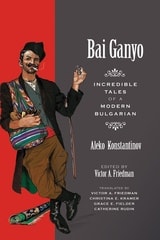
Bai Ganyo
Incredible Tales of a Modern BulgarianAleko Konstantinov
University of Wisconsin Press, 2010
Bai Ganyo has been translated into most European languages, but now Victor Friedman and his fellow translators have finally brought this Balkan masterpiece to English-speaking readers, accompanied by a helpful introduction, glossary, and notes.
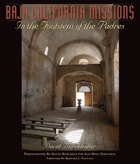
Baja California Missions
In the Footsteps of the PadresDavid Burckhalter; Photographs by David Burckhalter and Mina Sedgwick; Foreword by Bernard L. Fontana
University of Arizona Press, 2013
With gorgeous photographs of the architecture and religious art, and supported by a concise history that outlines the peninsula’s exploration and colonization by Roman Catholic priests, Baja California Missions excels as a book of photography and history. It promises adventure for readers at home, as well as for travelers ready to explore the churches in person.
The eight Spanish colonial stone churches of Baja California endure as the only intact originals of 34 missions built by the padres during the peninsula’s colonization. Due to structural renovations and restorations of the artwork undertaken over the last 30 years, the renowned mission churches have become sources of pride to the citizens of Baja California. Travelers are invited to visit at any time, especially during patron saint day celebrations.
As a guide, Baja California Missions is fully up to date, with directions for navigating Baja’s paved highways and desert and mountain roads. The mission sites are pinpointed on a topographic roadmap of the peninsula. A church floor plan is provided to accompany a walk-through tour for each church interior. The lovely eighteenth-century oil paintings and wooden statues that grace the church altars are also identified and described
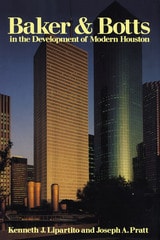
Baker & Botts in the Development of Modern Houston
By Kenneth J. Lipartito and Joseph A. Pratt
University of Texas Press, 1991
As counsel for Pennzoil's successful effort to recover billions of dollars in damages from Texaco over the acquisition of Getty Oil Company, the Baker & Botts law firm of Houston, Texas, achieved wide public recognition in the 1980s. But among its peers in the legal and corporate worlds, Baker & Botts has for more than a century held a preeminent position, handling the legal affairs of such blue-chip clients as the Southern Pacific Railroad, Houston Lighting & Power Company, Rice University, Texas Commerce Bank, and Tenneco. In this study, Kenneth J. Lipartito and Joseph A. Pratt chronicle the history of Baker & Botts, placing particular emphasis on the firm's role in Houston's economic development.
Founded in 1840, Baker & Botts literally grew up with Houston. The authors chart its evolution from a nineteenth-century regional firm that represented eastern-based corporations moving into Texas to a twentieth-century national firm with clients throughout the world. They honestly discuss the criticisms that Baker & Botts has faced as an advocate of big business. But they also identify the important impact that corporate law firms of this type have on business reorganization and government regulation. As the authors demonstrate in this case study, law firms throughout the twentieth century have helped to shape public policy in these critical areas.
Always prominent in the community, and with prominent connections (former Secretary of State James A. Baker III is the great-grandson of the original Baker), the Baker & Botts law firm belongs in any history of the development of Houston and the Southwest.

Baking Powder Wars
The Cutthroat Food Fight that Revolutionized CookingLinda Civitello
University of Illinois Press, 2017
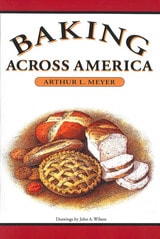
Baking across America
By Arthur L. Meyer
University of Texas Press, 1998
Whether it's a slice of warm bread and butter, a Thanksgiving pumpkin pie, or a piece of cake, baked goods have been among America's favorite comfort foods ever since the Pilgrims arrived. From the days of hand mixing and baking on the hearth to today's use of food processors and electric ranges, American cooks have created an amazing variety of breads and baked goods that are as distinctive as the cultures from which we came.
Spanning colonial times to the present and every region of the United States, this book is a comprehensive guide to baking in America. Certified master baker Arthur L. Meyer brings together some 700 kitchen-tested recipes for America's favorite breads, pies, cakes, and cookies. Compiled from almost 300 regional cookbooks dating from the 1890s to the 1980s, these are the authentic recipes for the traditional baked goods of every part of our country. In these pages, you'll find regional specialties such as Appalachian Buttermilk Cracklin' Bread and Hawaiian Pineapple-Macadamia Bread, as well as old family recipes.
In addition to the recipes, Meyer offers a fascinating overview of the history of baking in America, complete with descriptions of early breads, pies, cakes, and cookies. Whether you're a home or professional baker, a food historian, or someone who just enjoys reading cookbooks, you're sure to find lots of tasty treats here. Let Baking across America become your basic source for all the baked goodies Americans love to eat.
Baking, Bourbon, and Black Drink
Foodways Archaeology in the American SoutheastEdited by Tanya M. Peres and Aaron Deter-Wolf
University of Alabama Press, 2018
Discover the deep cultural roots of Southern cuisine through archaeology.
Understanding and explaining societal rules surrounding food and foodways have been the foci of anthropological studies since the early days of the discipline. Baking, Bourbon, and Black Drink: Foodways Archaeology in the American Southeast, however, is the first collection devoted exclusively to southeastern foodways analyzed through archaeological perspectives. These essays examine which foods were eaten and move the discussion of foodstuffs into the sociocultural realm of why, how, and when they were eaten.
Editors Tanya M. Peres and Aaron Deter-Wolf present a volume that moves beyond basic understandings, applying new methods or focusing on subjects not widely discussed in the Southeast to date. Chapters are arranged using the dominant research themes of feasting, social and political status, food security and persistent places, and foodways histories. Contributors provide in-depth examination of specific food topics such as bone marrow, turkey, Black Drink, bourbon, earth ovens, and hominy.
Contributors bring a broad range of expertise to the collection, resulting in an expansive look at all of the steps taken from field to table, including procurement, production, cooking, and consumption, all of which have embedded cultural meanings and traditions. The scope of the volume includes the diversity of research specialties brought to bear on the topic of foodways as well as the temporal and regional breadth and depth, the integration of multiple lines of evidence, and, in some cases, the reinvestigation of well-known sites with new questions and new data.

Balfour's Shadow
A Century of British Support for Zionism and IsraelDavid Cronin
Pluto Press, 2017
This is the infamous Balfour Declaration, which began one hundred years of conflict with the Palestinian people. Penned in 1917 by British Foreign Secretary Arthur James Balfour, these words had an immense impact on history that still emanates a century later. In the controversial, fast-paced Balfour’s Shadow, David Cronin traces the story of the rhetorical and practical assistance that Britain has given to the Zionist movement and the state of Israel since that day. Skillfully and engagingly written, Balfour’s Shadow uses previously unreleased sources and archives to reveal a new side to an old story. Cronin focuses on important historical events such as the Arab Revolt, the Nakba and establishment of the state, the ‘56 and ‘67 wars, the Cold War, and controversial public figures like Tony Blair. Marking the 100th anniversary of the Balfour Declaration, Cronin provides a fascinating take on this oft-maligned, important history.
Balkan Family Structure and the European Pattern
Demographic Developments in Ottoman BulgariaMaria Todorova
Central European University Press, 2006

Ball Don't Lie
Myth, Genealogy, and Invention in the Cultures of BasketballYago Colás
Temple University Press, 2016
Pro basketball player Rasheed Wallace often exclaimed the pragmatic truth “Ball don’t lie!” during a game. It is a protest against a referee’s bad calls. But the slogan, which originated in pickup games, brings the reality of a racialized urban playground into mainstream American popular culture.
In Ball Don’t Lie!, Yago Colás traces the various forms of power at work in the intersections between basketball and language from the game’s invention to the present day. He critiques existing popular myths concerning the history of basketball, contextualizes them, and presents an alternative history of the sport inspired by innovations. Colás emphasizes the creative prerogative of players and the ways in which their innovations shape—and are shaped by—broader cultural and social phenomena.
Ball Don't Lie! shows that basketball cannot be reduced to a single, fixed or timeless essence but instead is a continually evolving exhibition of physical culture that flexibly adapts to and sparks changes in American society.
Ball Hawks
The Arrival and Departure of the NBA in IowaTim Harwood
University of Iowa Press, 2018
Believe it or not, Waterloo, Iowa, had an NBA team during the league’s first season, 1949 to 1950. Broadcaster and independent sports historian Tim Harwood uncovers the fascinating story of the Waterloo Hawks and the Midwest’s influence on professional basketball. Beginning with the professional leagues that led up to the creation of the National Basketball Association, Harwood recounts big games and dramatic buzzer-beaters, and the players who made them.
The first season of the NBA was far from a success. Teams had a hard time attracting fans, with games often played in half-empty arenas. When Waterloo residents learned that the team was struggling financially, they rallied behind the Hawks and purchased shares of the team in a bid to keep it afloat. Unfortunately, that community-based effort was not enough; owners of teams in larger markets pressured the league to push Waterloo—and other smaller towns like Anderson, Indiana, and Sheboygan, Wisconsin—out of the league.
Though the Hawks disappeared after their lone NBA campaign, Waterloo and other midwestern teams were nonetheless integral to getting the NBA off the ground, and their legacy continues today through some of the current franchises that relocated to larger markets. Combining newspaper accounts and personal interviews with surviving players, Harwood weaves a fascinating story of the underdog team, in the unlikeliest of places, that helped make professional basketball the worldwide success it is today.

Ball, Bat and Bishop
THE ORIGIN OF BALL GAMESRobert W. Henderson
University of Illinois Press, 1947
Henderson traces the origins of ball sports to religious rites in ancient Egypt, where the ball (perhaps a shrunken head) represented a fertility symbol and opposing teams engaged in mock combat signifying the struggle of good against evil. Centuries later, pagan fertility rites featuring the ball were adapted by the Christian church as rituals symbolic of Easter and the Resurrection. Court tennis was also firmly rooted in the church, the earliest players being the bishops, canons, and clerics who played it in their cloistered courtyards.
Henderson overturns the popular belief that the game of racquets originated in the debtors' prison on Fleet Street in the early nineteenth century. He also notes that polo, the most ancient of games played with stick and ball, originated in Persia and migrated to China and India, where it was eventually embraced by English imperialists. Other sports discussed include football, lawn tennis, cricket, and golf.
The most substantial portion of Henderson's study is devoted to the game of baseball. Providing copious evidence of early forms of baseball played in England and the United States before 1829, he offers a meticulous account of the legerdemain by which Abner Doubleday, the famous Civil War general, came to be identified as the inventor in 1839 of a game that was already at least two centuries old.
The new foreword by Leonard Koppett affirms the significance of this classic work of sports history, which was the first to dismantle the Doubleday/Cooperstown myth.
Ballad of an American
A Graphic Biography of Paul RobesonSharon Rudahl
Rutgers University Press, 2021
The first-ever graphic biography of Paul Robeson, Ballad of an American, charts Robeson’s career as a singer, actor, scholar, athlete, and activist who achieved global fame. Through his films, concerts, and records, he became a potent symbol representing the promise of a multicultural, multiracial American democracy at a time when, despite his stardom, he was denied personal access to his many audiences.
Robeson was a major figure in the rise of anti-colonialism in Africa and elsewhere, and a tireless campaigner for internationalism, peace, and human rights. Later in life, he embraced the civil rights and antiwar movements with the hope that new generations would attain his ideals of a peaceful and abundant world. Ballad of an American features beautifully drawn chapters by artist Sharon Rudahl, a compelling narrative about his life, and an afterword on the lasting impact of Robeson’s work in both the arts and politics. This graphic biography will enable all kinds of readers—especially newer generations who may be unfamiliar with him—to understand his life’s story and everlasting global significance.
Ballad of an American: A Graphic Biography of Paul Robeson is published in conjunction with Rutgers University’s centennial commemoration of Robeson’s 1919 graduation from the university.
Study guide for Ballad of an American: A Graphic Biography of Paul Robeson (https://d3tto5i5w9ogdd.cloudfront.net/wp-content/uploads/2021/05/10201015/YA_Adult-Study-Guide-for-A-Graphic-Biography-of-Paul-Robeson.pdf).
View the blad for Ballad of an American.

Ballads Beyond Borders
How the Irish Diaspora Shaped Music in the Nineteenth-Century United StatesSarah Gerk
University of Illinois Press, 2026
Gerk opens by considering the popularity of Thomas Moore’s iconic collection Irish Melodies in relation to the history of British colonization shared by the US and Ireland, arguing that these songs modeled what the music of an Anglo-Celtic republic could sound like. She considers blackface minstrelsy’s complicated relationship with both Irish-American performers and theatrical stereotypes of Irish people, and positions Irish-American performers and audiences as a primary driving force in new musical styles in 1840s sheet music, in which minstrelsy’s resemblances to Anglo-Celtic traditional music disappeared. She examines the legacy of the Great Famine in music of the US Civil War, considering how that music’s role in emotional life offers robust source material for understanding famine memory. She explores the increasingly elaborate sketches in the 1870s and 1880s of the variety duo Harrigan and Hart, highlighting ways in which violent conflict between the Black community and the Irish lies at the very heart of the Mulligan entertainments. Finally, she contextualizes the work of Irish-American tenor Chauncey Olcott, showing how a number of confluent trends—the growing wealth and social status of Irish-American middle classes, the Gaelic revival, new immigration patterns, and the consolidation of the US’s sheet music industry—allowed Olcott to perform an elevated version of Irish-American musical culture, influenced by superficial elements of Italian operatic music.
Ballads of the Lords of New Spain
The Codex Romances de los Senores de la Nueva EspanaTranscribed and translated from the Nahuatl by John Bierhorst
University of Texas Press, 2009
Compiled in 1582, Ballads of the Lords of New Spain is one of the two principal sources of Nahuatl song, as well as a poetical window into the mindset of the Aztec people some sixty years after the conquest of Mexico. Presented as a cancionero, or anthology, in the mode of New Spain, the ballads show a reordering—but not an abandonment—of classic Aztec values. In the careful reading of John Bierhorst, the ballads reveal in no uncertain terms the pre-conquest Aztec belief in the warrior's paradise and in the virtue of sacrifice.
This volume contains an exact transcription of the thirty-six Nahuatl song texts, accompanied by authoritative English translations. Bierhorst includes all the numerals (which give interpretive clues) in the Nahuatl texts and also differentiates the text from scribal glosses. His translations are thoroughly annotated to help readers understand the imagery and allusions in the texts. The volume also includes a helpful introduction and a larger essay, "On the Translation of Aztec Poetry," that discusses many relevant historical and literary issues.
In Bierhorst's expert translation and interpretation, Ballads of the Lords of New Spain emerges as a song of resistance by a conquered people and the recollection of a glorious past.
Ballists, Dead Beats, and Muffins
Inside Early Baseball in IllinoisRobert D. Sampson
University of Illinois Press, 2023
Baseball’s spread across Illinois paralleled the sport’s explosive growth in other parts of the country.Robert D. Sampson taps a wealth of archival research to transport readers to an era when an epidemic of “base ball on the brain” raged from Alton to Woodstock. Focusing on the years 1865 to 1869, Sampson offers a vivid portrait of a game where local teams and civic ambition went hand in hand and teams of paid professionals displaced gentlemen’s clubs devoted to sporting fair play. This preoccupation with competition sparked rules disputes and controversies over imported players while the game itself mirrored society by excluding Black Americans and women. The new era nonetheless brought out paying crowds to watch the Rock Island Lively Turtles, Fairfield Snails, and other teams take the field up and down the state.
A first-ever history of early baseball in Illinois, Ballists, Dead Beats, and Muffins adds the Prairie State game’s unique shadings and colorful stories to the history of the national pastime.
Ballots of Tumult
A Portrait of Volatility in American VotingCourtney Brown
University of Michigan Press, 1991
Ballroom, Boogie, Shimmy Sham, Shake
A Social and Popular Dance ReaderEdited by Julie Malnig
University of Illinois Press, 2008
This dynamic collection documents the rich and varied history of social dance and the multiple styles it has generated, while drawing on some of the most current forms of critical and theoretical inquiry. The essays cover different historical periods and styles; encompass regional influences from North and South America, Britain, Europe, and Africa; and emphasize a variety of methodological approaches, including ethnography, anthropology, gender studies, and critical race theory. While social dance is defined primarily as dance performed by the public in ballrooms, clubs, dance halls, and other meeting spots, contributors also examine social dance’s symbiotic relationship with popular, theatrical stage dance forms.
Contributors are Elizabeth Aldrich, Barbara Cohen-Stratyner, Yvonne Daniel, Sherril Dodds, Lisa Doolittle, David F. García, Nadine George-Graves, Jurretta Jordan Heckscher, Constance Valis Hill, Karen W. Hubbard, Tim Lawrence, Julie Malnig, Carol Martin, Juliet McMains, Terry Monaghan, Halifu Osumare, Sally R. Sommer, May Gwin Waggoner, Tim Wall, and Christina Zanfagna.
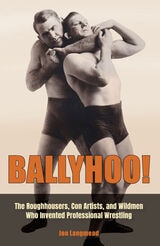
Ballyhoo!
The Roughhousers, Con Artists, and Wildmen Who Invented Professional WrestlingJon Langmead
University of Missouri Press, 2024
Ballyhoo! The Roughhousers, Con Artists, and Wildmen Who Invented Professional Wrestling is a history of professional wrestling’s formative period in the U.S., from roughly 1874 to 1941, and the contested interplay of wrestlers and promoters who built the “sport” as we know it. During this period, the major conventions that would define wrestling to the present day were perfected and codified, as wrestling morphed from a rough sport practiced on farms and at town gatherings to melodramatic mass entertainment that reliably drew large crowds in cities across the nation.
The narrative uses the life and career of Jack Curley—a boxing promoter whose fortune took a turn for the better when he began promoting wrestling matches—as a compass as it charts the development of wrestling. By the late 1910s, Curley’s shows were selling out Madison Square Garden monthly. Ballyhoo chronicles his competition with the other promoters, as well as the lives of colorful athletes like “Strangler” Ed Lewis, Frank Gotch, the “Masked Marvel,” Jim Londos, “Gorgeous George” Wagner, “Farmer” Martin Burns, and “Dynamite” Gus Sonnenberg.
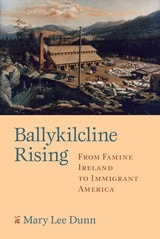
Ballykilcline Rising
From Famine Ireland to Immigrant AmericaMary Lee Dunn Maguire
University of Massachusetts Press, 2008
In 1847, in the third year of Ireland's Great Famine and the thirteenth year of their rent strike against the Crown, hundreds of tenant farmers in Ballykilcline, County Roscommon, were evicted by the Queen's agents and shipped to New York. Mary Lee Dunn tells their story in this meticulously researched book. Using numerous Irish and U.S. sources and with descendants' help, she traces dozens of the evictees to Rutland, Vermont, as railroads and marble quarries transformed the local economy. She follows the immigrants up to 1870 and learns not only what happened to them but also what light American experience and records cast on their Irish “rebellion.”
Dunn begins with Ireland's pre-Famine social and political landscape as context for the Ballykilcline strike. The tenants had rented earlier from the Mahons of Strokestown, whose former property now houses Ireland's Famine Museum. In 1847, landlord Denis Mahon evicted and sent nearly a thousand tenants to Quebec, where half died before or just after reaching the Grosse Ile quarantine station. Mahon was gunned down months later. His murder provoked an international controversy involving the Vatican. An early suspect in the case was a man from Ballykilcline.
In the United States, many of the immigrants resettled in clusters in several locations, including Vermont, Illinois, Iowa, Maryland, and New York. In Vermont they found jobs in the marble quarries, but some of them lost their homes again in quarry labor actions after 1859. Others prospered in their new lives. A number of Ballykilcline families who stopped in Rutland later moved west; one had a son kidnapped by Indians in Minnesota. Readers who have Irish Famine roots will gain a sense of their own “back story” from this account of Ireland and the native Irish, and scholars in the field of immigration studies will find it particularly useful.

Ballymurphy and the Irish War
Ciaran de Baroid
Pluto Press, 2000
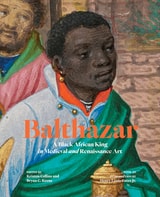
Balthazar
A Black African King in Medieval and Renaissance ArtKristen Collins
J. Paul Getty Trust, The, 0
According to the Gospel of Matthew, magi from the East, following a star, traveled to Jerusalem bearing precious gifts for the infant Jesus. The magi were revered as wise men and later as kings. Over time, one of the three came to be known as Balthazar and to be depicted as a Black man.
Balthazar was familiar to medieval Europeans, appearing in paintings, manuscript illuminations, mosaics, carved ivories, and jewelry. But the origin story of this fascinating character uncovers intricate ties between Europe and Africa, including trade and diplomacy as well as colonization and enslavement.
In this book, experts in the fields of Ethiopian, West African, Nubian, and Western European art explore the representation of Balthazar as a Black African king. They examine exceptional art that portrays the European fantasy of the Black magus while offering clues about the very real Africans who may have inspired these images. Along the way, the authors chronicle the Black presence in premodern Europe, where free and enslaved Black people moved through public spaces and courtly circles. The volume’s lavish illustrations include selected works by contemporary artists who creatively challenge traditional depictions of Black history.
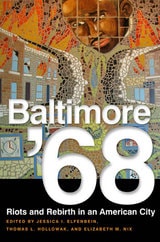
Baltimore '68
Riots and Rebirth in an American CityEdited by Jessica I. Elfenbein, Thomas L. Hollowak and Elizabeth M. Nix
Temple University Press, 2011
In 1968, Baltimore was home to a variety of ethnic, religious, and racial communities that, like those in other American cities, were confronting a quickly declining industrial base. In April of that year, disturbances broke the urban landscape along lines of race and class.
This book offers chapters on events leading up to the turmoil, the riots, and the aftermath as well as four rigorously edited and annotated oral histories of members of the Baltimore community. The combination of new scholarship and first-person accounts provides a comprehensive case study of this period of civil unrest four decades later.
This engaging, broad-based public history lays bare the diverse experiences of 1968 and their effects, emphasizing the role of specific human actions. By reflecting on the stories and analysis presented in this anthology, readers may feel empowered to pursue informed, responsible civic action of their own.
Baltimore '68 is the book component of a larger public history project, "Baltimore '68 Riots: Riots and Rebirth." The project's companion website (http://archives.ubalt.edu/bsr/index.html ) offers many more oral histories plus photos, art, and links to archival sources. The book and the website together make up an invaluable teaching resource on cities, social unrest, and racial politics in the 1960s. The project was the corecipient of the 2009 Outstanding Public History Project Award from the National Council on Public History.
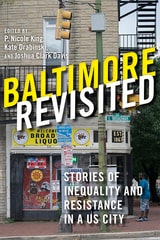
Baltimore Revisited
Stories of Inequality and Resistance in a U.S. CityEdited by P. Nicole King, Kate Drabinski, and Joshua Clark Davis
Rutgers University Press, 2019
To help untangle these apparent paradoxes, the editors of Baltimore Revisited have assembled a collection of over thirty experts from inside and outside academia. Together, they reveal that Baltimore has been ground zero for a slew of neoliberal policies, a place where inequality has increased as corporate interests have eagerly privatized public goods and services to maximize profits. But they also uncover how community members resist and reveal a long tradition of Baltimoreans who have fought for social justice.
The essays in this collection take readers on a tour through the city’s diverse neighborhoods, from the Lumbee Indian community in East Baltimore to the crusade for environmental justice in South Baltimore. Baltimore Revisited examines the city’s past, reflects upon the city’s present, and envisions the city’s future.

Baltimore Sports
Stories from Charm CityDaniel A. Nathan
University of Arkansas Press, 2016
To read a sample chapter, visit www.uapress.com.
Baltimore is the birthplace of Francis Scott Key’s “The Star-Spangled Banner,” the incomparable Babe Ruth, and the gold medalist Michael Phelps. It’s a one-of-a-kind town with singular stories, well-publicized challenges, and also a rich sporting history. Baltimore Sports: Stories from Charm City chronicles the many ways that sports are an integral part of Baltimore’s history and identity and part of what makes the city unique, interesting, and, for some people, loveable.
Wide ranging and eclectic, the essays included here cover not only the Orioles and the Ravens, but also lesser-known Baltimore athletes and teams. Toots Barger, known as the “Queen of the Duckpins,” makes an appearance. So do the Dunbar Poets, considered by some to be the greatest high-school basketball team ever.
Bringing together the work of both historians and journalists, including Michael Olesker, former Baltimore Sun columnist, and Rafael Alvarez, who was named Baltimore’s Best Writer by Baltimore Magazine in 2014, Baltimore Sports illuminates Charm City through this fascinating exploration of its teams, fans, and athletes.
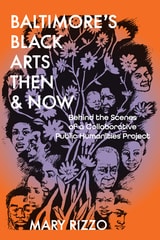
Baltimore's Black Arts Then & Now
Behind the Scenes of a Collaborative Public Humanities ProjectMary Rizzo
University of Iowa Press, 2026
Since 2017, a group of former Chicory editors, scholars, librarians, poets, teachers, and young writers have collaborated to use Chicory as a catalyst for intergenerational dialogue on social justice, race, and place. Baltimore’s Black Arts Then & Now documents this joint effort, offering valuable insights for public historians, educators, and humanists.
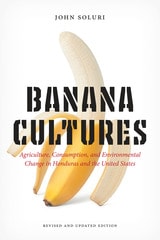
Banana Cultures
Agriculture, Consumption, and Environmental Change in Honduras and the United StatesBy John Soluri
University of Texas Press, 2021
Bananas, the most frequently consumed fresh fruit in the United States, have been linked to Miss Chiquita and Carmen Miranda, "banana republics," and Banana Republic clothing stores—everything from exotic kitsch, to Third World dictatorships, to middle-class fashion. But how did the rise in banana consumption in the United States affect the banana-growing regions of Central America? In this lively, interdisciplinary study, John Soluri integrates agroecology, anthropology, political economy, and history to trace the symbiotic growth of the export banana industry in Honduras and the consumer mass market in the United States.
Beginning in the 1870s, when bananas first appeared in the U.S. marketplace, Soluri examines the tensions between the small-scale growers, who dominated the trade in the early years, and the shippers. He then shows how rising demand led to changes in production that resulted in the formation of major agribusinesses, spawned international migrations, and transformed great swaths of the Honduran environment into monocultures susceptible to plant disease epidemics that in turn changed Central American livelihoods. Soluri also looks at labor practices and workers' lives, changing gender roles on the banana plantations, the effects of pesticides on the Honduran environment and people, and the mass marketing of bananas to consumers in the United States. His multifaceted account of a century of banana production and consumption adds an important chapter to the history of Honduras, as well as to the larger history of globalization and its effects on rural peoples, local economies, and biodiversity.
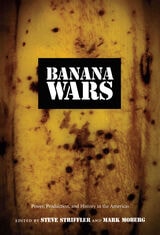
Banana Wars
Power, Production, and History in the AmericasSteve Striffler and Mark Moberg, eds.
Duke University Press, 2003
Bringing together the work of anthropologists, sociologists, economists, historians, and geographers, this collection reveals how the banana industry marshaled workers of differing nationalities, ethnicities, and languages and, in so doing, created unprecedented potential for conflict throughout Latin American and the Caribbean. The frequently abusive conditions that banana workers experienced, the contributors point out, gave rise to one of Latin America’s earliest and most militant labor movements. Responding to both the demands of workers’ organizations and the power of U.S. capital, Latin American governments were inevitably affected by banana production. Banana Wars explores how these governments sometimes asserted their sovereignty over foreign fruit companies, but more often became their willing accomplices. With several essays focusing on the operations of the extraordinarily powerful United Fruit Company, the collection also examines the strategies and reactions of the American and European corporations seeking to profit from the sale of bananas grown by people of different cultures working in varied agricultural and economic environments.
Contributors. Philippe Bourgois, Marcelo Bucheli, Dario Euraque, Cindy Forster, Lawrence Grossman, Mark Moberg, Laura T. Raynolds, Karla Slocum, John Soluri, Steve Striffler, Allen Wells
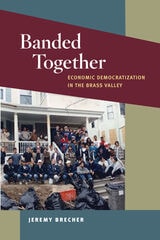
Banded Together
Economic Democratization in the Brass ValleyJeremy Brecher
University of Illinois Press, 2011

Bandits, Peasants, and Politics
The Case of "La Violencia" in ColombiaBy Gonzalo Sánchez and Donny Meertens
University of Texas Press, 2001
The years 1945-1965 saw heavy partisan conflict in the rural areas of Colombia, with at least 200,000 people killed. This virtual civil war began as a sectarian conflict between the Liberal and Conservative parties, with rural workers (campesinos) constituting the majority of combatants and casualties. Yet La Violencia resists classification as a social uprising, since calls for social reform were largely absent during this phase of the struggle. In fact, once the elite leadership settled on a power-sharing agreement in 1958, the conflict appeared to subside.
This book focuses on the second phase (1958-1965) of the struggle, in which the social dimensions of the conflict emerged in a uniquely Colombian form: the campesinos, shaped by the earlier violence, became social and political bandits, no longer acting exclusively for powerful men above them but more in defense of the peasantry. In comparing them with other regional expressions of bandolerismo, the authors weigh the limited prospects for the evolution of Colombian banditry into full-scale social revolution.
Published originally in 1983 as Bandoleros, gamonales y campesinos and now updated with a new epilogue, this book makes a timely contribution to the discourse on social banditry and the Colombian violencia. Its importance rests in the insights it provides not only on the period in question but also on Colombia's present situation.

Bandung Revisited
The Legacy of the 1955 Asian-African Conference for International OrderEdited by Amitav Acharya and Tan See Seng
National University of Singapore Press, 2008
The authors in the present volume argue that the Bandung Conference had a lasting normative influence on the contemporary regional order of Asia, and that it underlies the diplomatic principles and loosely defined normative framework that characterize present-day Asian international relations.
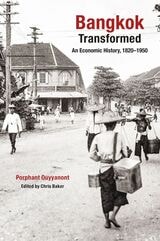
Bangkok Transformed
An Economic History, 1820–1950Porphant Ouyyanont
National University of Singapore Press, 2026
For much of its early history, Bangkok was little more than a riverside settlement, yet by the mid-twentieth century, it had become the commercial and political heart of Thailand. Bangkok Transformed deciphers this progress, outlining how the city’s economy and urban landscape were shaped by global trade and royal intervention. As the rice trade boomed, Chinese immigrants poured in, forming the backbone of Bangkok’s labor force and entrepreneurial class. Meanwhile, the Siamese monarchy, particularly under King Chulalongkorn, wielded economic power through state-run enterprises and control over key industries. These forces propelled Bangkok into modernity but also left behind a centralized governance structure that continues to influence the city today.
Written by Thailand’s foremost economic historian, Porphant Ouyyanont, and completed posthumously by historian Chris Baker, this meticulously researched study offers an innovative economic and social history of Bangkok. Spanning from the early nineteenth century to 1950, it displays how the foundations of contemporary Bangkok were laid in its first great transformation.

Bangkok after Dark
Maurice Rocco, Transnational Nightlife, and the Making of Cold War IntimaciesBenjamin Tausig
Duke University Press, 2025

Bangtan Remixed
A Critical BTS ReaderPatty Ahn, Michelle Cho, Vernadette Vicuña Gonzalez, Rani Neutill, Mimi Thi Nguyen, and Yutian Wong, editors
Duke University Press, 2024
Contributors. Andrea Acosta, Patty Ahn, Carolina Alves, Inez Amihan Anderson, Allison Anne Gray Atis, Kaina “Kai” Bernal, Mutlu Binark, Jheanelle Brown, Sophia Cai, Michelle Cho, Mariam Elba, Ameena Fareeda, Vernadette Vicuña Gonzalez, Rosanna Hall, Dal Yong Jin, JIN Youngsun, Despina Kakoudaki, Yuni Kartika, Alptekin Keskin, Rachel Kuo, Marci Kwon, Courtney Lazore, Regina Yung Lee, S. Heijin Lee, Wonseok Lee, Amanda Lovely, Melody Lynch-Kimery, Maria Mison, Noel Sajid I. Murad, Sara Murphy, UyenThi Tran Myhre, Rani Neutill, Johnny Huy Nguyễn, Mimi Thi Nguyen, Karlina Octaviany, Nykeah Parham, Stefania Piccialli, Raymond San Diego, Hannah Ruth L. Sison, Prerna Subramanian, Havannah Tran, Andrew Ty, Gracelynne West, Yutian Wong, Jaclyn Zhou
Banjo Roots and Branches
Edited by Robert B. Winans
University of Illinois Press, 2018
Wide-ranging and illustrated with twenty color images, Banjo Roots and Branches offers a wealth of new information to scholars of African American and folk musics as well as the worldwide community of banjo aficionados.
Contributors: Greg C. Adams, Nick Bamber, Jim Dalton, George R. Gibson, Chuck Levy, Shlomo Pestcoe, Pete Ross, Tony Thomas, Saskia Willaert, and Robert B. Winans.
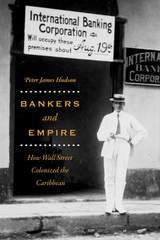
Bankers and Empire
How Wall Street Colonized the CaribbeanPeter James Hudson
University of Chicago Press, 2017
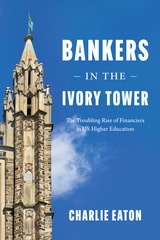
Bankers in the Ivory Tower
The Troubling Rise of Financiers in US Higher EducationCharlie Eaton
University of Chicago Press, 2022
Exposes the intimate relationship between big finance and higher education inequality in America.
Elite colleges have long played a crucial role in maintaining social and class status in America, while public universities have offered a major stepping stone to new economic opportunities. However, as Charlie Eaton reveals in Bankers in the Ivory Tower, finance has played a central role in the widening inequality in recent decades, both in American higher education and in American society at large.
With federal and state funding falling short, the US higher education system has become increasingly dependent on financial markets and the financiers that mediate them. Beginning in the 1980s, the government, colleges, students, and their families took on multiple new roles as financial investors, borrowers, and brokers. The turn to finance, however, has yielded wildly unequal results. At the top, ties to Wall Street help the most elite private schools achieve the greatest endowment growth through hedge fund investments and the support of wealthy donors. At the bottom, takeovers by private equity transform for-profit colleges into predatory organizations that leave disadvantaged students with massive loan debt and few educational benefits. And in the middle, public universities are squeezed between incentives to increase tuition and pressures to maintain access and affordability. Eaton chronicles these transformations, making clear for the first time just how tight the links are between powerful financiers and America’s unequal system of higher education.

Banking On It
Inside Baseball, Hardball Politics, and Building the Best Era in Phillies HistoryPaul Hagen with Kevin Cooney
Temple University Press, 2027
When Citizens Bank Park opened on April 3, 2024, it was the result of twelve years (and many false starts) of maneuvering for the venue to replace Veterans Stadium as the home to the Philadelphia Phillies. Banking On It describes the politicking that took place, from conflicts between the Phillies and the Philadelphia Eagles resulting from sharing a venue, to decisions about where to build the new ballpark, who would pay for it, and where the outfield fences would be placed.
Paul Hagen and Kevin Cooney recount the setbacks, frustrations, missteps, political machinations, and angst the team surmounted as the process played out. But Banking On It also details the benefits of all these efforts—the Phillies became a powerhouse franchise after settling into their new home. The new stadium helped the team elevate its game by generating money to attract and keep better players, including Jim Thome, Ryan Howard, and Kyle Schwarber taking advantage of groundwork laid by scouts and managers. The Phillies have had their most successful two decades in franchise history playing at Citizens Bank Park.
Banking On It celebrates the game, the team, and the stadium that helped create a championship era.
Banking on Slavery
Financing Southern Expansion in the Antebellum United StatesSharon Ann Murphy
University of Chicago Press, 2023
It’s now widely understood that the fullest expression of nineteenth-century American capitalism was found in the structures of chattel slavery. It’s also understood that almost every other institution and aspect of life then was at least entangled with—and often profited from—slavery’s perpetuation. Yet as Sharon Ann Murphy shows in her powerful and unprecedented book, the centrality of enslaved labor to banking in the antebellum United States is far greater than previously thought.
Banking on Slavery sheds light on precisely how the financial relationships between banks and slaveholders worked across the nineteenth-century South. Murphy argues that the rapid spread of slavery in the South during the 1820s and ’30s depended significantly upon southern banks’ willingness to financialize enslaved lives, with the use of enslaved individuals as loan collateral proving central to these financial relationships. She makes clear how southern banks were ready—and, in some cases, even eager—to alter time-honored banking practices to meet the needs of slaveholders. In the end, many of these banks sacrificed themselves in their efforts to stabilize the slave economy. Murphy also details how banks and slaveholders transformed enslaved lives from physical bodies into abstract capital assets. Her book provides an essential examination of how our nation’s financial history is more intimately intertwined with the dehumanizing institution of slavery than scholars have previously thought.
Banking on Slavery
Financing Southern Expansion in the Antebellum United StatesSharon Ann Murphy
University of Chicago Press, 2023
A sobering excavation of how deeply nineteenth-century American banks were entwined with the institution of slavery.
It’s now widely understood that the fullest expression of nineteenth-century American capitalism was found in the structures of chattel slavery. It’s also understood that almost every other institution and aspect of life then was at least entangled with—and often profited from—slavery’s perpetuation. Yet as Sharon Ann Murphy shows in her powerful and unprecedented book, the centrality of enslaved labor to banking in the antebellum United States is far greater than previously thought.
Banking on Slavery sheds light on precisely how the financial relationships between banks and slaveholders worked across the nineteenth-century South. Murphy argues that the rapid spread of slavery in the South during the 1820s and ’30s depended significantly upon southern banks’ willingness to financialize enslaved lives, with the use of enslaved individuals as loan collateral proving central to these financial relationships. She makes clear how southern banks were ready—and, in some cases, even eager—to alter time-honored banking practices to meet the needs of slaveholders. In the end, many of these banks sacrificed themselves in their efforts to stabilize the slave economy. Murphy also details how banks and slaveholders transformed enslaved lives from physical bodies into abstract capital assets. Her book provides an essential examination of how our nation’s financial history is more intimately intertwined with the dehumanizing institution of slavery than scholars have previously thought.
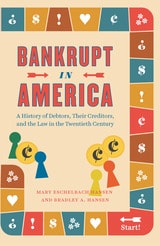
Bankrupt in America
A History of Debtors, Their Creditors, and the Law in the Twentieth CenturyMary Eschelbach Hansen and Bradley A. Hansen
University of Chicago Press, 2020
Interweaving careful legal history and rigorous economic analysis, Bankrupt in America is the first work to trace how bankruptcy was transformed from an intermittently used constitutional provision, to an indispensable tool for business, to a central element of the social safety net for ordinary Americans. To do this, the authors track federal bankruptcy law, as well as related state and federal laws, examining the interaction between changes in the laws and changes in how people in each state used the bankruptcy law. In this thorough investigation, Hansen and Hansen reach novel conclusions about the causes and consequences of bankruptcy, adding nuance to the discussion of the relationship between bankruptcy rates and economic performance.

Bankruptcy and Debt Collection in Liberal Capitalism
Switzerland, 1800–1900Mischa Suter
University of Michigan Press, 2021
Drawing on perspectives from anthropology and social theory, this book explores the quotidian routines of debt collection in nineteenth-century capitalism. It focuses on Switzerland, an exemplary case of liberal rule. Debt collection and bankruptcy relied on received practices until they were standardized in a Swiss federal law in 1889. The vast array of these practices was summarized by the idiomatic Swiss legal term “Rechtstrieb” (literally, “law drive”). Analyzing these forms of summary justice opens a window to the makeshift economies and the contested political imaginaries of nineteenth-century everyday life. Ultimately, the book advances an empirically grounded and theoretically informed history of quotidian legal practices in the everyday economy; it is an argument for studying capitalism from the bottom up.
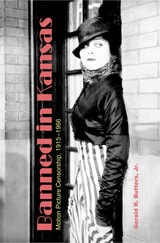
Banned in Kansas
Motion Picture Censorship, 1915-1966Gerald R. Butters, Jr.
University of Missouri Press, 2016
In 1915, Kansas became one of only a handful of states to establish its own film censorship board. The Kansas board controlled screen content in the state for more than fifty years, yet little is known about its activities. This first book-length study of state film censorship examines the unique political, social, and economic factors that led to its implementation in Kansas, examining why censorship legislation was enacted, what the attitudes of Kansans were toward censorship, and why it lasted for half a century.
Cinema historian Gerald Butters places the Kansas Board of Review’s attempts to control screen content in the context of nationwide censorship efforts during the early part of the twentieth century. He tells how factors such as Progressivism, concern over child rearing, and a supportive press contributed to censorship, and he traces the board’s history from the problems posed by the emergence of “talkies” through changing sexual mores in the 1920s to challenges to its power in the 1950s.
In addition to revealing the fine points of film content deemed too sensitive for screening, Butters describes the daily operations of the board, illustrating the difficulties it encountered as it wrestled not only with constantly shifting definitions of morality but also with the vagaries of the political and legal systems. Stills from motion pictures illustrate the type of screen content the board attempted to censor.
As Kansas faced the march of modernity, even state politicians began to criticize film censorship, and Butters tells how by the 1960s the board was fighting to remain relevant as film companies increasingly challenged its attempts to control screen content. Banned in Kansas weaves a fascinating tale of the enforcement of public morality, making it a definitive study for cinema scholars and an entertaining read for film buffs.
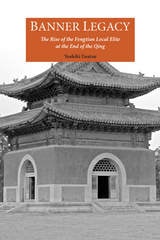
Banner Legacy
The Rise of the Fengtian Local Elite at the End of the QingYoshiki Enatsu
University of Michigan Press, 2004