Results by title
5550 books match the query 'Biography & Autobiography' and 296 start with b
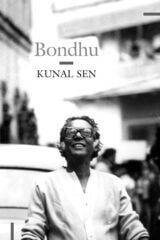
Bondhu
My Father, My FriendKunal Sen
Seagull Books, 2023
“No one remembers when and why I started calling my father Bondhu. It was a strange way to address a father, as the word means ‘friend’ in Bengali. . . . As I got older, I became very self-conscious about such an odd name . . . and yet I cannot explain why I could not switch to the more acceptable Baba or something similar.”
Just as Kunal Sen, son of actor Gita Sen and filmmaker Mrinal Sen, was approaching adolescence, his father’s cinematic celebrity was reaching new heights. In this memoir, Kunal reflects on growing up in a middle-class household in South Calcutta, where his father’s Marxist beliefs and unrelenting urge “to be challenged and contradicted” often collided with the practical challenges of making a living. Through it all, what emerges is a picture of a family’s unyielding commitment to the craft of cinema, the risks each of its members took, and their endearing sense of humor. Celebrating Mrinal Sen’s birth centenary in 2023, Bondhu takes us on an intimate journey of a son attempting to reconcile his father’s public and private selves.

Bonds of Affection
Thoreau on Dogs and CatsWesley T. Mott
University of Massachusetts Press, 2005
Henry David Thoreau is celebrated as one of America's greatest nature writers, yet few readers are aware of the tender, perceptive, and often humorous attention he gave to the animals closest to human domestic life. Bonds of Affection: Thoreau on Dogs and Cats gathers the finest of Thoreau's own writings in which he turns his unflinching powers of observation and his characteristic philosophical wit toward our oldest animal companions.
In these pages, Thoreau emerges not merely as a solitary sojourner in the wild, but as a keen and affectionate chronicler of the relationships between people and the animals who share their lives. Whether tracking the behavior of a neighborhood dog, or meditating on the inscrutable self-possession of a cat, Thoreau reveals the depth of feeling and moral seriousness he believed we owe to all living creatures. His observations are sometimes wry, sometimes lyrical, and always charged with his conviction that an attentive life demands that we see the world through eyes other than our own.
Beautifully complemented by original engravings from celebrated artist Barry Moser and framed by a foreword from bestselling animal author Elizabeth Marshall Thomas, this elegantly produced volume is both a delight for lovers of Thoreau and an essential companion for anyone who has ever shared their home—and their heart—with a dog or a cat.
Published in cooperation with the Thoreau Society, Bonds of Affection introduces readers to a Thoreau who is at once familiar and surprising: playful and profound, grounded in the everyday, and alive to the wonder of the natural and domestic world alike.

Bonds of Enterprise
John Murray Forbes and Western Development in America's Railway AgeJohn Lauritz Larson
University of Iowa Press, 2001
Bonelight
Ruin And Grace In The New SouthwestMary Sojourner
University of Nevada Press, 2004
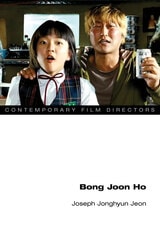
Bong Joon Ho
Joseph Jonghyun Jeon
University of Illinois Press, 2024
Insightful and engaging, Bong Joon Ho offers an up-to-date analysis of the genre-bending international director.

Book M
A London Widow's Life WritingsKatherine Austen, Edited by Pamela S. Hammons
Iter Press, 2013
—Margaret J. M. Ezell
Distinguished Professor of English and John and Sara Lindsay Chair of Liberal Arts
Texas A&M University
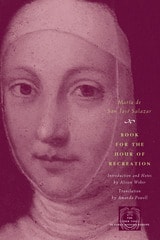
Book for the Hour of Recreation
María de San José Salazar
University of Chicago Press, 2002
María wrote this book as a defense of the Discalced practice of setting aside two hours each day for conversation, music, and staging of religious plays. Casting the book in the form of a dialogue, María demonstrates through fictional conversations among a group of nuns during their hours of recreation how women could serve as very effective spiritual teachers for each other. The book includes one of the first biographical portraits of Teresa and Maria's personal account of the troubled founding of the Discalced convent at Seville, as well as her tribulations as an Inquisitional suspect. Rich in allusions to women's affective relationships in the early modern convent, Book for the Hour of Recreation also serves as an example of how a woman might write when relatively free of clerical censorship and expectations.
A detailed introduction and notes by Alison Weber provide historical and biographical context for Amanda Powell's fluid translation.
Booker T. Washington Papers Volume 1
The Autobiographical WritingsBooker T. Washington
University of Illinois Press, 1972
Volume 1 contains Washington's Up from Slavery, one of the most widely read American autobiographies, in addition to The Story of My Life and Work, and six other autobiographical writings. Together, the selections provide readers with a first step toward understanding Washington and his immense impact. These writings reveal the moral values he absorbed from his mid-nineteenth-century experiences and teachers. As importantly, they present him to the world as he wished to be seen: as the black version of the American success hero and an exemplar of the Puritan work ethic that he believed to be the secret of his success. These works, along with so much of Washington's writing, served as a model for many black Americans striving to overcome poverty and prejudice.
Booker T. Washington Papers Volume 3
1889-95. Assistant editors, Stuart B. Kaufman and Raymond W. SmockBooker T. Washington. Edited by Louis R. Harlan, Assistant editors, Stuart B. Kaufman and Raymond W. Smock
University of Illinois Press, 1974
Booker T. Washington in American Memory
Kenneth M. Hamilton
University of Illinois Press, 2017
Bookwomen
Creating an Empire in Children’s Book Publishing, 1919–1939Jacalyn Eddy
University of Wisconsin Press, 2006
The most comprehensive account of the women who, as librarians, editors, and founders of the Horn Book, shaped the modern children's book industry between 1919 and 1939. The lives of Anne Carroll Moore, Alice Jordan, Louise Seaman Bechtel, May Massee, Bertha Mahony Miller, and Elinor Whitney Field open up for readers the world of female professionalization. What emerges is a vivid illustration of some of the cultural debates of the time, including concerns about "good reading" for children and about women's negotiations between domesticity and participation in the paid labor force and the costs and payoffs of professional life.
Published in collaboration among the University of Wisconsin Press, the Center for the History of Print Culture in Modern America (a joint program of the University of Wisconsin–Madison and the Wisconsin Historical Society), and the University of Wisconsin–Madison General Library System Office of Scholarly Communication.
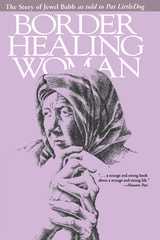
Border Healing Woman
The Story of Jewel Babb as told to Pat LittleDog (second edition)By Jewel Babb as told to Pat Littledog
University of Texas Press, 1994
The story of Jewel Babb, from her early years as a tenderfoot ranch wife to her elder years as a desert healing woman, has enthralled readers since Border Healing Woman was first published in 1981. In this second edition, Pat LittleDog adds an epilogue to conclude the story, describing the mixed blessings that publicity brought to Jewel Babb before her death in 1991.
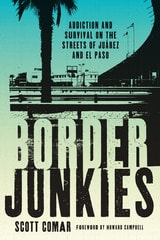
Border Junkies
Addiction and Survival on the Streets of Juárez and El PasoBy Scott Comar
University of Texas Press, 2011
The drug war that has turned Juárez, Mexico, into a killing field that has claimed more than 7,000 lives since 2008 captures headlines almost daily. But few accounts go all the way down to the streets to investigate the lives of individual drug users. One of those users, Scott Comar, survived years of heroin addiction and failed attempts at detox and finally cleaned up in 2003. Now a graduate student at the University of Texas at El Paso in the history department's borderlands doctoral program, Comar has written Border Junkies, a searingly honest account of his spiraling descent into heroin addiction, surrender, change, and recovery on the U.S.-Mexico border.
Border Junkies is the first book ever written about the lifestyle of active addiction on the streets of Juárez. Comar vividly describes living between the disparate Mexican and American cultures and among the fellow junkies, drug dealers, hookers, coyote smugglers, thieves, and killers who were his friends and neighbors in addiction—and the social workers, missionaries, shelter workers, and doctors who tried to help him escape. With the perspective of his anthropological training, he shows how homelessness, poverty, and addiction all fuel the use of narcotics and the rise in their consumption on the streets of Juárez and contribute to the societal decay of this Mexican urban landscape. Comar also offers significant insights into the U.S.-Mexico borderland's underground and peripheral economy and the ways in which the region's inhabitants adapt to the local economic terrain.
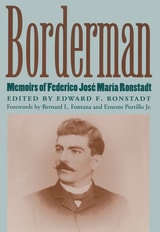
Borderman
Memoirs of Federico José María RonstadtEdited by Edward F. Ronstadt; Forewords by Bernard L. Fontana and Ernesto Portillo, Jr.
University of Arizona Press, 2003
Writing proudly of his Mexican and American heritages, Ronstadt offers readers an extraordinary portrait of the Arizona-Mexico borderlands during the late nineteenth century. His memoirs provide a richness of detail and insight unmatched by traditional histories, relating such scenarios as the hardships of Yaqui hardrock miners working under primitive conditions, the travails of pearl divers in the Gulf of California, and the insurrection of Francisco Serna in 1875 Sonora. They also depict the simple activities of childhood, with its schooling and musical training, its games and mischief. Ronstadt relates his apprenticeship to a wagon- and carriage-maker in Tucson, recalling labor relations in the shop, the establishment of his own business, and the joys and anguish of his personal life. He tells of how he drew on talents nurtured in childhood to become a musician and bandleader, playing weekly concerts with Club Filarmónica Tucsonense for nine years—musical talents that were eventually passed on to his children, his grandchildren (including Linda), and great-grandchildren.
Through Ronstadt's memories, we are better able to understand the sense of independence and self-reliance found today among many lifelong residents of Sonora and Baja California—people isolated from major supply sources and centers of power—and to appreciate a different view of Tucson's past. Enhanced by 22 historical photos, Borderman is a treasure trove of historical source material that will enlighten all readers interested in borderlands history.

Borges in Sicily
Journey with a Blind GuideAlejandro Luque
Haus Publishing, 2017
This winding journey features literati both past and present, indigenous and foreign. These characters live alongside Luque’s own comments and observations in a narrative that is rich in historical and personal detail. The writer who inspired this great journey, Borges himself, becomes a character in this narrative that is infused with extracts and reflections from his essays and poetry. Borges in Sicily acts as a travel diary, a guide to the most fascinating places in Sicily, a recounting of Borges’s journey around the island, and a deeply poetic story of Luque’s own adventures. The book also includes twenty-three photographs from the renowned Magnum photographer Ferdinando Scianna, and it won the 1st Premio International del Libros de Viajes.
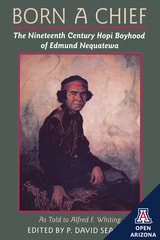
Born a Chief
The Nineteenth Century Hopi Boyhood of Edmund Nequatewa, as told to Alfred F. WhitingEdmund Nequatewa
University of Arizona Press, 1993
"This story was fascinating. . . . One worth the telling and one which will stay with the reader."—American Desert Magazine
"Recommended."—Choice
Born in the Delta
Reflections on the Making of a Southern White SensibilityMargaret Bolsterli
University of Arkansas Press, 2000
Born in the U.S.A.
Bruce Springsteen in American Life, 3rd edition, Revised and ExpandedJim Cullen
Rutgers University Press, 2024
This third edition of Born in the U.S.A. is fully revised and updated, incorporating discussion of Springsteen’s wide output in the 21st century. While addressing Springsteen’s responses to events like 9/11, it also considers the evolution of his attitudes towards religion, masculinity, and his relationship with his audience. Whether a serious Springsteen fan or simply an observer of American popular culture, Born in the U.S.A. will give you a new appreciation for The Boss.
Boston Ballerina
A Dancer, a Company, an EraLaura Young and Janine Parker
University Press of New England, 2017
Boston Mayor Thomas Menino
Lessons for Governing Post-Industrial CitiesWilbur C. Rich
University of Massachusetts Press, 2023
Hailed as one of Boston’s most beloved mayors and its longest serving, Thomas Menino (1942–2014) deftly managed the city’s finances and transformed Boston into the hub of innovation that it is today. During his time in office, Boston embraced modern industrial growth and moved forward with noteworthy developments that altered neighborhoods, while also facing ongoing racial strife, challenges of unaffordable housing, and significant public union negotiations.
Mayors in modern American cities occupy unique positions as government leaders who need to remain active parts of their communities in addition to being tasked with fixing neighborhood issues, managing crises, and keeping schools and public infrastructure on course. Situating news coverage alongside interviews with the mayor and his administration, political scientist Wilbur C. Rich chronicles Menino’s time in office while also considering his personal and professional background, his larger-than-life personality, and his ambitions. Menino’s approach to these challenges and opportunities offers enduring lessons to anyone interested in urban government and political leadership.

Botanical Companions
A Memoir of Plants and PlaceFrieda Knobloch
University of Iowa Press, 2005
Bound for America
Three British ComposersNicholas Temperley
University of Illinois Press, 2002
Bourdieu
Critical PerspectivesEdited by Craig Calhoun, Edward LiPuma, and Moishe Postone
University of Chicago Press, 1993
American reception of his works, however, has lacked a full understanding of their place within the broad context of French human science. His individual works separated by distinct boundaries between social science fields in American academia, Bourdieu's cohesive thought has come to this country in fragments.
Bourdieu: Critical Perspectives provides a unified and balanced appraisal of Bourdieu's varied works by both proponents and skeptics. The essays are written from the varied viewpoints of cultural anthropology, ethnomethodology and other varieties of sociology, existential and Wittgensteinian philosophies, linguistics, media studies, and feminism. They work around three main themes: Bourdieu's effort to transcend gaps between practical knowledge and universal structures, his central concept of "reflexivity," and the relations between social structure, systems of classification, and language.
Ultimately, the contributors raise a variety of crucial theoretical questions and address problems that are important not only to understanding Bourdieu but to advancing empirical work of the kind he has pioneered. In an essay written especially for this volume, Bourdieu describes his own "mode of intellectual production" and the reasons he sees for its common misunderstanding.
The contributors are Hubert Dreyfus, Paul Rabinow, Charles Taylor, Aaron Cicourel, James Collins, William Hanks, Beate Krais, Nicholas Garnham, Scott Lash, Roger Brubaker, and Loic Wacquant, and the editors.
Bowers Mansion
The Legacy of a Comstock FamilyTamera J. Buzick
University of Nevada Press, 2026
Boxing Shadows
By W. K. Stratton, with Anissa "The Assassin" Zamarron
University of Texas Press, 2009
Reaching the top in any sport requires a long, hard climb. But when you start with the baggage of years of family dysfunction and incarceration in a hellish mental hospital, the climb is especially steep. Yet even with such weights to carry, Anissa Zamarron won not one, but two, world championships in women's boxing. Her story, as dramatically intense as the Clint Eastwood film Million Dollar Baby, is one of tremendous courage and determination to overcome the odds against her as a Latina and as a woman working through mental illness and addiction—a fight in which Zamarron has been as powerful and successful as she has been in the boxing ring.
In this compelling biography, acclaimed author W. K. "Kip" Stratton collaborates with Zamarron to tell the story of her unlikely rise to the pinnacle of women's boxing. With searing honesty, Zamarron describes how the chaotic breakup of her childhood family caused her to develop "demons" that drove her to aggressive behavior in school, an addiction to self-destructive habits, including cutting, and eventually to a corrupt for-profit mental hospital in which she spent eighteen months tied to a bed. She explains how boxing became her salvation as an adult; she learned how to turn her anger and aggression into motivation to train hard and excel at her sport, not only becoming the first woman to fight as a professional in a sanctioned fight in New York, but also fighting more ten-round fights than any other woman in history. A gripping account of Zamarron's 2005 upset win over Maribel Zurita to claim her second world championship caps the book.
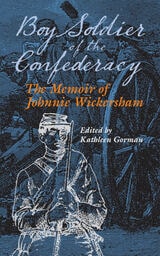
Boy Soldier of the Confederacy
The Memoir of Johnnie WickershamEdited by Kathleen Gorman
Southern Illinois University Press, 2006
Johnnie Wickersham was fourteen when he ran away from his Missouri home to fight for the Confederacy. Fifty years after the war, he wrote his memoir at the request of family and friends and distributed it privately in 1915. Boy Soldier of the Confederacy: The Memoir of Johnnie Wickersham offers not only a rare look into the Civil War through the eyes of a child but also a coming-of-age story.
Edited by Kathleen Gorman, the volume presents a new introduction and annotations that explain how the war was glorified over time, the harsh realities suppressed in the nation’s collective memory. Gorman describes a man who nostalgically remembers the boy he once was. She maintains that the older Wickersham who put pen to paper decades later likely glorified and embellished the experience, accepting a polished interpretation of his own past.
Wickersham recounts that during his first skirmish he was "wild with the ecstasy of it all" and notes that he was "too young to appreciate the danger." The memoir traces his participation in an October 1861 Confederate charge against Springfield, Missouri; his fight at the battle of Pea Ridge in March 1862; his stay at a plantation he calls Fairyland; and the battle of Corinth.
The volume details Wickersham’s assignment as an orderly for General Sterling Price, his capture at Vicksburg in 1863, his parole, and later his service with General John Bell Hood for the 1864 fighting around Atlanta. Wickersham also describes the Confederate surrender in New Orleans, the reconciliation of the North and the South, and his own return and reunification with his family.
While Gorman’s incisive introduction and annotations allow readers to consider how memories can be affected by the passage of time, Wickersham’s boy-turned-soldier tale offers readers an engaging narrative, detailing the perceptions of a child on the cusp of adulthood during a turbulent period in our nation’s history.

Boys Will Be Boys
A Daughter's ElegySara Suleri Goodyear
University of Chicago Press, 2003
Taking its title from that jokingly chosen by her father for his unwritten autobiography, Boys Will Be Boys dips in and out of Suleri Goodyear's upbringing in Pakistan and her life in the United States, moving between public and private history and addressing questions of loss and cultural displacement through a resolutely comic lens. In this rich portrait, Pip emerges as a prodigious figure: an ardent agitator against British rule in the 1930s and 1940s, a founder of the Times of Karachi and the Evening Times, on-and-off editor of the Pakistan Times, for a brief time director of the Pakistan military intelligence service, and a frequently jailed antagonist of successive Pakistani leaders. To the author, though, he was also "preposterous . . . counting himself king of infinite space," a man who imposed outrageously on his children. As Suleri Goodyear chronicles, Pip demanded their loyalty yet banished them easily from his favor; contrary and absurdly unfair, he read their diaries, interfered in their relationships, and believed in a father's inalienable right to oppress his children.
Suleri Goodyear invites the reader into an intimacy shaped equally by history and intensely personal detail, creating an elegant elegy for a man of force and contradiction. And perhaps Pip was not so preposterous after all: "On Judgment Day," he told his daughter, "I will say to God, 'Be merciful, for I have already been judged by my child.'"

Bradbury Beyond Apollo
Jonathan R. Eller
University of Illinois Press, 2020
Drawing on numerous interviews with Bradbury and privileged access to personal papers and private collections, Jonathan R. Eller examines the often-overlooked second half of Bradbury's working life. As Bradbury's dreams took him into a wider range of nonfiction writing and public lectures, the diminishing time that remained for creative pursuits went toward Hollywood productions like the award-winning series Ray Bradbury Theater. Bradbury developed the Spaceship Earth narration at Disney's EPCOT Center; appeared everywhere from public television to NASA events to comic conventions; published poetry; and mined past triumphs for stage productions that enjoyed mixed success. Distracted from storytelling as he became more famous, Bradbury nonetheless published innovative experiments in autobiography masked as detective novels, the well-received fantasy The Halloween Tree and the masterful time travel story "The Toynbee Convector." Yet his embrace of celebrity was often at odds with his passion for writing, and the resulting tension continuously pulled at his sense of self.
The revelatory conclusion to the acclaimed three-part biography, Bradbury Beyond Apollo tells the story of an inexhaustible creative force seeking new frontiers.
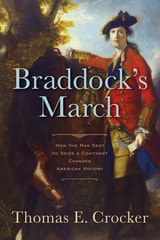
Braddock's March
How the Man Sent to Seize a Continent Changed American HistoryThomas E. Crocker
Westholme Publishing, 2009
Winner of the 2011 New York Society of Colonial Wars Distinguished Book Award
“The strength of this book lies in Crocker’s presentation of the battle and the complicated logistics involved.”—Times Literary Supplement “Braddock’s March is arguably the first truly comprehensive history devoted exclusively to the calamitous march that remade North America. . . . Braddock’s story is superb history.”—Weekly Standard “Drawing on original sources, Crocker grittily reconstructs the advance of Edward Braddock’s army on Fort Duquesne. . . . Attentive to detail, Crocker will engage colonial-history readers in this well illustrated book.”—Booklist
“Both Braddock’s epic march and subsequent destruction are brought to life by Thomas E. Crocker in Braddock’s March, his impeccably researched account of an important but largely forgotten chapter in American history. . . . It all adds up to a stirring tale.”—Washington Times
“Before we parted, the General told me he should never see me more; for he was going with a handful of men to conquer whole nations; and to do this they must cut their way through unknown woods. He produced a map of the country, saying at the same time, ‘Dear Pop, we are sent like sacrifices to the altar.’” - George Anne Bellamy on General Edward Braddock’s departure
In January 1755, Major General Edward Braddock was sent by Great Britain on a mission to drive France once and for all from the New World. Accompanied by the largest armed expeditionary force ever sent to North America, Braddock’s primary target was the Forks of the Ohio, where he planned to seize Fort Duquesne (at present-day Pittsburgh, Pennsylvania), and then march north into Canada. After landing in Alexandria, Virginia, and organizing his troops and supply chain, Braddock and his expedition began its nearly 250-mile trek, heroically cutting through uncharted wilderness, fording rivers, and scaling the Appalachian mountains, all while hauling baggage and heavy artillery. Braddock was joined on this epic mission by a young Virginia colonel, George Washington, and others who would later play major roles in the American Revolution, including Horatio Gates, Thomas Gage, and Charles Lee; among those driving the expedition’s wagons were Daniel Boone and Daniel Morgan. Having withstood the harsh frontier and finally marching upon Fort Duquesne on a hot July morning, Braddock’s exhausted column was ambushed by a combined French and Indian force. Over two-thirds of Braddock’s British and colonial troops were killed or wounded, including Braddock himself, struck by a bullet in the chest while attempting to rally his disoriented troops. George Washington miraculously escaped harm despite four bullet holes through his clothing. With this battle, North America became the greatest stake in the global war between France and Great Britain.
In Braddock’s March: How the Man Sent to Seize a Continent Changed American History, Thomas E. Crocker tells the riveting story of one of the most important events in colonial America. Not only did Braddock’s expedition have a profound impact on American political and military developments, this fateful march laid the foundation for the “National Pike,” the major road for westward expansion, launched the career of George Washington, and sowed the seeds of dissent between England and its colonies that would ultimately lead to the American Revolution.
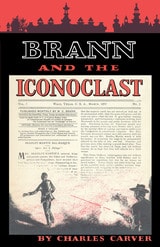
Brann and the Iconoclast
By Charles Carver
University of Texas Press, 1957
"They wouldn't let him rest—even in his grave." Thus Charles Carver opens his story of the climactic years of a journalist who had poured out such blazing prose that readers from England to Hawaii mourned his murder.
The impact of William Cowper Brann's Iconoclast upon the town of Waco, Texas, in the 1890's was like a rocket burst in a quiet sky. Rebelling against Victorian hypocrisy, the newspaperman took aim at organized virtue, exemplified for him by Baylor University and other Baptist organizations.
Dr. Roy Bedichek, noted author and naturalist, knew Brann, and after reading this book in manuscript said, "I am at once delighted and disappointed: disappointed to find my teen-age hero reduced to size... delighted with the art of the biographer.... It has genuine literary excellence... is a chapter in the history of the publishing business in Texas that needs to be put into print...."
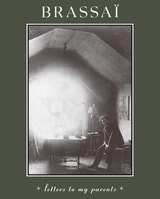
Brassai
Letters to My ParentsBrassaï
University of Chicago Press, 1997
"[Brassaï] is probably the only photographer—at least in France—to have acquired such a vast audience and mastered his material to such a degree that he can express himself with a flexibility and apparent ease that is almost literary in its nature."—Jean Gallien, Photo-Monde
"The letters that Brassaï wrote to his parents between 1920 and 1940 chronicle the sometimes painful stages by which this gifted man hauled himself from penury to celebrity."—Peter Hamilton, Times Literary Supplement
"In these proud, protective, occasionally conscience-stricken missives, the young man full of eager dreams emerges as one of the century's pioneering photographers, revered for his lushly atmospheric portraits of Paris after dark."—Elle
"A fascinating insight into how a bright individual slowly found his calling."—Christine Schwartz Hartley, New York Times Book Review

Brave Are My People
Indian Heroes Not ForgottenFrank Waters
Ohio University Press, 1998
Pontiac, Sequoyah, Geronimo, Sitting Bull, Chief Joseph, and Chief Seattle. These legendary names are familiar even to the uninitiated in Native American history, yet the life stories of these great spiritual leaders have been largely unknown.
In this, his last book, internationally celebrated author Frank Waters makes vivid the poignant, humorous, and tragic stories of these neglected and heroic Native Americans. From the brilliant tactical abilities of famed warriors to the eloquent oratory of indigenous philosophers, poets, and statesmen, the profiles in Brave Are My People help correct this error of omission.
Now in paperback, Brave Are My People represents a major contribution to Water’s remarkable literary work.
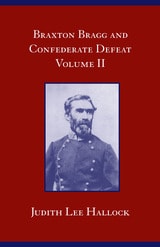
Braxton Bragg and Confederate Defeat V. II
Judith Lee Hallock
University of Alabama Press, 2009
In the summer of 1863, Confederate General Braxton Bragg was commander of the Army of Tennessee., still reeling from its defeat in January at Murfreesboro, Tennessee. Failing to establish a strong defensive position at either Tullahoma or Chattanooga, Bragg saw the heartland of the South gradually slip away from him. Victory at Chickamauga Creek in September—Bragg’s last military success—was followed by disaster at Missionary Ridge and, shortly thereafter, his removal from army command.
Within three months, however, President Jefferson Davis had restored Bragg to active military involvement, naming him military adviser for the Confederacy. Here, finally, Bragg’s skills as an administrator and organizer bore fruit—as did his penchant for provoking quarrels and disunity within the military establishment. Reassigned to field command in late 1864, Bragg concluded his army service with defeats at Wilmington and Bentonville, North Carolina. The prevailing view of Bragg’s is a false one. Rather, he was a valuable asset to the Confederacy, a talented organizer whose gifts were misused by the nation he served. For the first time, Bragg’s tenure in Richmond is examined carefully and evaluated. Contrary to the common view that Bragg was nothing more than a sycophant to President Davis, this study shows that he and Davis often disagreed on policy. Much of Bragg’s present reputation among civil war scholars is based upon how contemporaries viewed him. Despite Bragg’s determined devotion to the Confederacy, his frailties have shaped the literature to such an extent that his real accomplishments have been distorted or ignored. In this study the author has tried, as General Joseph E. Johnston once advised, to “have a little charity for Bragg.”
Judith Lee Hallock draws a balanced picture of Bragg and of his important role in the Confederacy beginning in 1863. Her volume continues and completes the biography of Bragg published in Volume I by Grady McWhiney in 1969. Along with the military details, the author provides a full accounting of Bragg’s fractious relationships with other members of the military, a critical factor in this period for the entire Confederate command. This sympathetic biography of Bragg gives valuable insight into the workings of the Confederacy in the last two years of its struggle for independence.

Braxton Bragg and Confederate Defeat
Volume 1Grady McWhiney
University of Alabama Press, 1991
McWhiney intended this work – first published in 1969 – to be the first of two volumes covering the life of the Confederacy’s most problematic general. This reprint edition is issued along with Braxton Bragg and Confederate Defeat, Volume II by Judith Lee Hallock. McWhiney’s work carries Bragg through the defeat at Murfreesboro in January 1863, and Hallock’s book continues through the staff appointment in Richmond and Bragg’s final days as a private citizen.
Brazilian Women Speak
Contemporary Life StoriesDaphne Patai
Rutgers University Press, 1988
Bread
A Memoir of HungerLisa Knopp
University of Missouri Press, 2025
When she was 54, Lisa Knopp’s weight dropped to a number on the scale that she hadn’t seen since seventh grade. The severe food restricting that left her thin and sick when she was 15 and 25 had returned. This time, she was determined to understand the causes of her malady and how she could heal from a condition that is caused by a tangle of genetic, biological, familial, psychological, cultural, and spiritual factors. This compelling memoir, at once a food and illness narrative, explores the forces that cause eating disorders and disordered eating, including the link between those conditions in women, middle-aged and older, and the fear of aging and ageism.
Winner of the 2017 Nebraska Book Award for Memoir
2017 Choice Outstanding Academic Title
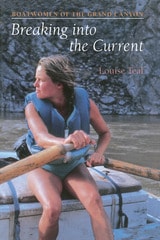
Breaking Into the Current
Boatwomen of the Grand CanyonLouise Teal
University of Arizona Press, 1994
Breaking Into the Current is a story of romance between women and a place. Each woman tells a part of every Canyon boatwoman's story: when Marilyn Sayre talks about leaving the Canyon, when Ellen Tibbets speaks of crew camaraderie, or when Martha Clark recalls the thrill of white water, each tells how all were involved in the same romance.
All the boatwomen have stories to tell of how they first came to the Canyon and why they stayed. Some speak of how they balanced their passion for being in the Canyon against the frustration of working in a traditionally male-oriented occupation, where today women account for about fifteen percent of the Canyon's commercial river guides.
As river guides in love with the Canyon and their work, these women have followed their hearts. "I've done a lot," says Becca Lawton, "but there's been nothing like holding those oars in my hands and putting my boat exactly where I wanted it. Nothing."

Breaking the Barnyard Barrier
A Woman Veterinarian Paves the WayLinda Rhodes
University of Nevada Press, 2026
In Breaking the Barnyard Barrier, Linda Rhodes tells the story of how a woman, through grit and tears, made her way in a man’s world and blazed a path that prevailed against career stereotypes.
Breaking the Silence
The German Who Exposed the Final Solution.Walter Laqueur and Richard Breitman
Brandeis University Press, 1994
Brewtown Tales
More Stories from Milwaukee and BeyondJohn Gurda
Wisconsin Historical Society Press, 2022
Brian W. Aldiss
Paul Kincaid
University of Illinois Press, 2022
Paul Kincaid explores the many contradictions that underlay the distinctive qualities of Aldiss’s writing. Wartime experiences in Asia and the alienation that arose upon his return to the cold austerity of postwar Britain inspired themes and imagery that Aldiss drew upon throughout his career. He wrote of prolific nature overwhelming humanity, believed war was madness even though it provided him with the happiest period of his life, and found parallels in the static lives of Indian peasants and hidebound English society. As Kincaid shows, contradictions created tensions that fueled the metaphorical underpinnings of Aldiss's work and shaped not only his long career but the evolution of postwar British science fiction.
Bridge and Tunnel Boys
Bruce Springsteen, Billy Joel, and the Metropolitan Sound of the American CenturyJim Cullen
Rutgers University Press, 2024
Bridge and Tunnel Boys compares the life and work of Long Islander Joel and Asbury Park, New Jersey, native Springsteen, considering how each man forged a distinctive sound that derived from his unique position on the periphery of the Big Apple. Locating their music within a longer tradition of the New York metropolitan sound, dating back to the early 1900s, cultural historian Jim Cullen explores how each man drew from the city’s diverse racial and ethnic influences. His study explains how, despite frequently releasing songs that questioned the American dream, Springsteen and Joel were able to appeal to wide audiences during both the national uncertainty of the 1970s and the triumphalism of the Reagan era. By placing these two New York–area icons in a new context, Bridge and Tunnel Boys allows us to hear their most beloved songs with new appreciation.

Bridger
By Bobby Bridger
University of Texas Press, 2009
Renowned for A Ballad of the West, his epic trilogy about the American West from the era of mountain man Jim Bridger to the closing of the frontier, Bobby Bridger has had a career in show business that spans the rockabilly-to-"Music City, USA" era in Nashville, the cosmic cowboy scene in Austin, the flowering of folk music, and even Broadway theater. His multifaceted talents have found expression in singing, acting, writing, painting, and sculpting. In this engrossing account of the personal and artistic journey that led him to create a new American art form, the epic ballad, Bridger touches on almost every major musical, entertainment, and cultural movement of the second half of the twentieth century, with a cast of characters that reads like a "Who's Who" of American popular culture.
Bridger's story begins in a small town in northeast Louisiana, where he first experienced the twin attractions of painting and music. He recounts his early efforts to become a successful Nashville singer-songwriter and his growing awareness that the commercial music business would never support his evolving desire to become a historical balladeer. Bridger recalls how his interest in folk music and folk ballads fired his ambition to tell the story of the American West. He movingly describes how this dream eventually became A Ballad of the West, an epic trilogy about Jim Bridger, the Lakota Sioux, and Buffalo Bill that has taken form in an acclaimed cycle of songs, a one-man show, books, full-cast stage performances, and other media.
Included in the book is a DVD that offers songs from A Ballad of the West and a sample from the forthcoming documentary Quest of an Epic Balladeer, based on Bobby Bridger's life and work.

Bridging Two Eras
The Autobiography of Emily Newell Blair, 1877-1951Emily Newell Blair, Edited & Intro by Virginia Jeans Laas
University of Missouri Press, 1999
First written in 1937 and never before published, Bridging Two Eras is the fascinating autobiography of Emily Newell Blair, a remarkable woman who successfully reconciled a productive public life with the traditional values of a housewife and mother.
Because Blair's life essentially spanned two eras, from the end of the nineteenth century through the middle of the twentieth, she thought of herself as a bridge builder. A dedicated feminist, she wanted her autobiography to help women understand what life was like during that transition time. She had moved from being a conventional, middle-class, midwestern wife and mother to becoming an acclaimed author, a nationally known feminist, and vice chairman of the Democratic National Committee only two years after women gained the right to vote. She felt that her story could encourage women to take their rightful places in public life.
Bridging Two Eras is divided into two parts. Book I is a charming evocation of life in southwest Missouri in the closing decades of the nineteenth century. It offers great insight into family relationships, class structure, and social attitudes typical of much of small-town America. Book II addresses Blair's public career and follows her progress as professional writer, suffrage activist, and partisan politician. Included are acute judgments of leading political figures, fascinating vignettes of the suffrage movement, an insider's view of the workings of the national Democratic Party in the 1920s and 1930s, and a valuable outlook on Missouri politics during the first third of the twentieth century.
Perceptive and introspective, Blair captivates her readers as she traces her own evolution. With candor, she explains her conflicts between family and career, acknowledging the difficulties and tensions she faced in pursuing a public life. Delightfully written, Bridging Two Eras provides valuable insight into all the possibilities, as well as the limitations, life then held for an American woman.
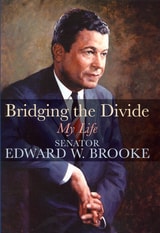
Bridging the Divide
My LifeEdward W. Brooke
Rutgers University Press, 2006
President Lyndon Johnson never understood it. Neither did President Richard Nixon. How could a black man, a Republican no less, be elected to the United States Senate from liberal, Democratic Massachusetts-a state with an African American population of only 2 percent?
The mystery of Senator Edward Brooke's meteoric rise from Boston lawyer to Massachusetts attorney general to the first popularly elected African American U.S. senator with some of the highest favorable ratings of any Massachusetts politician confounded many of the best political minds of the day. After winning a name for himself as the first black man to be elected a state's attorney general, as a crime fighter, and as the organizer of the Boston Strangler Task Force, this articulate and charismatic man burst on the national scene in 1966 when he ran for the Senate.
In two terms in the Senate during some of the most racially tormented years of the twentieth century, Brooke, through tact, personality, charm, and determination, became a highly regarded member of "the most exclusive club in the world." The only African American senator ever to be elected to a second term, Brooke established a reputation for independent thinking and challenged the powerbrokers and presidents of the day in defense of the poor and disenfranchised.
In this autobiography, Brooke details the challenges that confronted African American men of his generation and reveals his desire to be measured not as a black man in a white society but as an individual in a multiracial society. Chided by some in the white community as being "too black to be white" and in the black community as "too white to be black," Brooke sought only to represent the people of Massachusetts and the national interest.
His story encompasses the turbulent post-World War II years, from the gains of the civil rights movement, through the riotous 1960s, to the dark days of Watergate, with stories of his relationships with the Kennedys, Martin Luther King Jr., Lyndon Johnson, Richard Nixon, Henry Kissinger, Colin Powell, and future senator Hillary Clinton. Brooke also speaks candidly of his personal struggles, including his bitter divorce from his first wife and, most recently, his fight against cancer.
A dramatic, compelling, and inspirational account, Brooke's life story demonstrates the triumph of the human spirit, offering lessons about politics, life, reconciliation, and love.
Brief Interviews with the Romantic Past
Kathryn Nuernberger
The Ohio State University Press, 2017
With all the astonishments of history and the intimacy of memoir, Kathryn Nuernberger’s collection juxtaposes peripheral figures from the French Revolution—the assassin, the executioner, the mistress, the spy, the son of a slave, the transgender swordfighter—with the oral histories of poachers, prophets, well witches, and ghosts of the Ozarks a century later. In essays that are equal parts historical and personal, Nuernberger brings the marvelous strangeness of the past into our present moment with wry wit and insight. Nuernberger has an eye for salvaging overlooked snapshots of human decency and moments of moral courage—the memories of which we might just want to save for later.
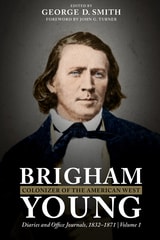
Brigham Young, Colonizer of the American West
Diaries and Office Journals, 1832–1871George D. Smith
Signature Books, 2019
Thus, by 1877, some 400 Mormon settlements spanned the western frontier from Salt Lake City to outposts in Idaho, Nevada, Arizona, Wyoming, and California. As prophet of the LDS Church and governor of the proposed State of Deseret, Young led several campaigns for Utah statehood while defending polygamy and local sovereignty. His skillful and authoritarian leadership led historian Bernard de Voto to classify him as an “American genius,” responsible for turning Joseph Smith’s visions “into the seed of life.”
Young’s diaries and journals reveal a man dedicated to his church, defensive of his spiritual and temporal claims to authority, and determined to create a modern Zion within the Utah desert. Editor George D. Smith’s careful organization and annotation of Young’s personal writings provide insights into the mind of Mormonism’s dynamic church leader and frontier statesman.
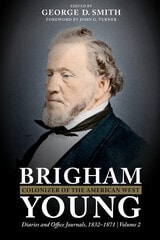
Brigham Young, Colonizer of the American West
Diaries and Office Journals, 1832–1871: Volume 2George D. Smith
Signature Books, 2021
Thus, by 1877, some 400 Mormon settlements spanned the western frontier from Salt Lake City to outposts in Idaho, Nevada, Arizona, Wyoming, and California. As prophet of the LDS Church and governor of the proposed State of Deseret, Young led several campaigns for Utah statehood while defending polygamy and local sovereignty. His skillful and authoritarian leadership led historian Bernard de Voto to classify him as an “American genius,” responsible for turning Joseph Smith’s visions “into the seed of life.”
Young’s diaries and journals reveal a man dedicated to his church, defensive of his spiritual and temporal claims to authority, and determined to create a modern Zion within the Utah desert. Editor George D. Smith’s careful organization and annotation of Young’s personal writings provide insights into the mind of Mormonism’s dynamic church leader and frontier statesman.
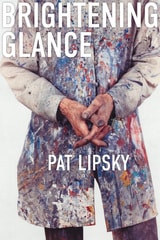
Brightening Glance
Art and LifePat Lipsky
University of Iowa Press, 2025
Brightening Glance offers a stunningly self-revealing portrait of the struggles and sacrifices, joys and excitement inherent in a modern painter’s life, and captures the evergreen allure of New York’s art world between 1970 and 2010. In stripped down, elegant prose, Lipsky summons a New York that no longer exists and ponders why we love (and hate) the art world. Ultimately, it’s a story of a contemporary woman, a mother, and a painter, who dares a career in a field where only a handful of women have succeeded.
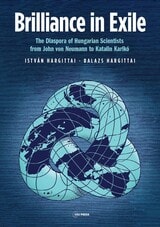
Brilliance in Exile
The Diaspora of Hungarian Scientists from John von Neumann to Katalin KarikóIstván Hargittai
Central European University Press, 2023
By addressing the enigma of the exceptional success of Hungarian emigrant scientists and telling their life stories, Brilliance in Exile combines scholarly analysis with fascinating portrayals of uncommon personalities. István and Balazs Hargittai discuss the conditions that led to five different waves of emigration of scientists from the early twentieth century to the present. Although these exodes were driven by a broad variety of personal motivations, the attraction of an open society with inclusiveness, tolerance, and – needless to say – better circumstances for working and living, was the chief force drawing them abroad.
While emigration from East to West is a general phenomenon, this book explains why and how the emigration of Hungarian scientists is distinctive. The high number of Nobel Prizes among this group is only one indicator. Multicultural tolerance, a quickly emerging, considerably Jewish, urban middle class, and a very effective secondary school system were positive legacies of the Austro-Hungarian Monarchy. Multiple generations, shaped by these conditions, suffered from the increasingly exclusionist, intolerant, antisemitic, and economically stagnating environment, and chose to go elsewhere. “I would rather have roots than wings, but if I cannot have roots, I shall use wings," explained Leo Szilard, one of the fathers of the Atom Bomb.