Results by title
8113 books match the query 'Literary Criticism' and 307 start with b
Boundaries of Genre
Gary Saul Morson
Northwestern University Press, 1989
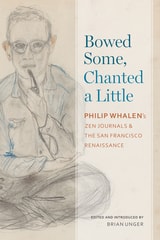
Bowed Some, Chanted a Little
Philip Whalen's Zen Journals and the San Francisco RenaissanceEdited and Introduced by Brian Unger
University of Alabama Press, 2023
The literary journals of a key figure in both the Beat and San Francisco Renaissance movements of the New American Poetry, and an ordained Zen Buddhist priest
Philip Whalen (1923–2002) authored twenty collections of verse, more than twenty broadsides, two novels, a huge assemblage of autobiographical literary journals, nine or ten experimental prose works, and dozens of critical essays, lectures, commentaries, introductions, prefaces, and interviews. But he came to regard his literary journals as his most important prose legacy.
Whalen’s literary work represents a significant turn in American letters, as he and his closest colleagues immersed themselves in East Asian literature and religion, reinvigorating strikingly new linguistic and aesthetic paths for North American writers and artists. However, until now Whalen’s forty-plus years of journals—sixty small eight-by-six-inch notebooks—have been largely inaccessible, archived in the rare book and manuscript library at the University of California, Berkeley, undigitized and unavailable online. Thus, the publication of a critical scholarly edition of Whalen’s journals and notebooks constitutes an important literary event and an invaluable resource for scholars, teachers, poets, and lay readers who follow twentieth-century North American poetry.
Boxcar Politics
The Hobo in U.S. Culture and Literature, 1869-1956John Lennon
University of Massachusetts Press, 2014
John Lennon maps the rise and demise of the political hobo from the nineteenth-century introduction of the transcontinental railroad to the Federal Aid Highway Act of 1956. Intertwining literary, historical, and theoretical representations of the hobo, he explores how riders and writers imagined alternative ways that working-class people could use mobility to create powerful dissenting voices outside of fixed hierarchal political organizations. Placing portrayals of hobos in the works of Jack London, Jim Tully, John Dos Passos, and Jack Kerouac alongside the lived reality of people hopping trains (including hobos of the IWW, the Scottsboro Boys, and those found in numerous long-forgotten memoirs), Lennon investigates how these marginalized individuals exerted collective political voices through subcultural practices.
Boys Abducted
The Homoerotics of Empire and Race in Early ModernityAbdulhamit Arvas
Duke University Press, 2025
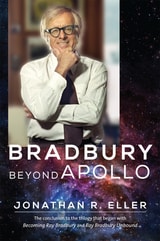
Bradbury Beyond Apollo
Jonathan R. Eller
University of Illinois Press, 2020
Drawing on numerous interviews with Bradbury and privileged access to personal papers and private collections, Jonathan R. Eller examines the often-overlooked second half of Bradbury's working life. As Bradbury's dreams took him into a wider range of nonfiction writing and public lectures, the diminishing time that remained for creative pursuits went toward Hollywood productions like the award-winning series Ray Bradbury Theater. Bradbury developed the Spaceship Earth narration at Disney's EPCOT Center; appeared everywhere from public television to NASA events to comic conventions; published poetry; and mined past triumphs for stage productions that enjoyed mixed success. Distracted from storytelling as he became more famous, Bradbury nonetheless published innovative experiments in autobiography masked as detective novels, the well-received fantasy The Halloween Tree and the masterful time travel story "The Toynbee Convector." Yet his embrace of celebrity was often at odds with his passion for writing, and the resulting tension continuously pulled at his sense of self.
The revelatory conclusion to the acclaimed three-part biography, Bradbury Beyond Apollo tells the story of an inexhaustible creative force seeking new frontiers.
Brave Humanism
Black Women Rewriting the Human in the Age of Jane CrowMollie Godfrey
The Ohio State University Press, 2025
Brave New Words
How Literature Will Save the PlanetAmmons, Elizabeth
University of Iowa Press, 2010
The activist tradition in American literature has long testified to the power of words to change people and the power of people to change the world, yet in recent years many professional humanists have chosen to distract themselves with a postmodern fundamentalism of indeterminacy and instability rather than engage with social and political issues. Throughout her bold and provocative call to action, Elizabeth Ammons argues that the responsibility now facing humanists is urgent: inside and outside academic settings, they need to revive the liberal arts as a progressive cultural force that offers workable ideas and inspiration in the real-world struggle to achieve social and environmental justice.
Brave New Words challenges present and future literary scholars and teachers to look beyond mere literary critique toward the concrete issue of social change and how to achieve it. Calling for a profound realignment of thought and spirit in the service of positive social change, Ammons argues for the continued importance of multiculturalism in the twenty-first century despite attacks on the concept from both right and left. Concentrating on activist U.S. writers—from ecocritics to feminists to those dedicated to exposing race and class biases, from Jim Wallis and Cornel West to Winona LaDuke and Paula Moya and many others—she calls for all humanists to link their work to the progressive literature of the last half century, to insist on activism in the service of positive change as part of their mission, and to teach the power of hope and action to their students.
As Ammons clearly demonstrates, much of American literature was written to expose injustice and motivate readers to work for social transformation. She challenges today’s academic humanists to address the issues of hope and purpose by creating a practical activist pedagogy that gives students the knowledge to connect their theoretical learning to the outside world. By relying on the transformative power of literature and replacing nihilism and powerlessness with conviction and faith, the liberal arts can offer practical, useful inspiration to everyone seeking to create a better world.
Bread and Tea
The Story of a Man from KarakAhmad Tarawneh
Michigan State University Press, 2017
Break Up the Anthropocene
Steve Mentz
University of Minnesota Press, 2019
Takes the singular eco-catastrophic “Age of Man” and redefines this epoch
We live in a new world: the Anthropocene. The Age of Man is defined in many ways, and most dramatically through climate change, mass extinction, and human marks in the geological record. Ideas of the Anthropocene spill out from the geophysical sciences into the humanities, social sciences, the arts, and mainstream debates—but it’s hard to know what the new coinage really means. Break Up the Anthropocene argues that this age should subvert imperial masculinity and industrial conquest by opening up the plural possibilities of Anthropocene debates of resilience, adaptation, and the struggle for environmental justice.
Forerunners: Ideas First
Short books of thought-in-process scholarship, where intense analysis, questioning, and speculation take the lead
Breakfast Served Any Time All Day
Essays on Poetry New and SelectedDonald Hall
University of Michigan Press, 2004
Praise for Breakfast Served:
". . . the essays in this book are engaging, passionate, strange, and unified. Hall has been around a long time, and you can trace the concerns of a generation through the mind of this one man: questions about the diminished scope of poetry, the diminished ambitions of poets, how a poem 'means,' etc. . . . . Criticism . . . is an exercise in sanity, of which these essays are a splendid and useful example."
-Poetry
"A luminous and essential volume about the sensuality of language, its pleasures and sounds."
-Ploughshares
"It is in this merger of a poet's biography and a poem's body that Hall does his best work. . . . [Breakfast Served Any Time All Day] has an undeniably infectious quality to it. Finishing it, you cannot help but want to return to your bookshelf, and read-again or for the first time-the great forgotten poems of our past."
-Nathan Greenwood Thompson, Rain Taxi

Breaking Boundaries
Women'S Regional WritingSherrie A. Inness
University of Iowa Press, 1997
These lively essays reveal the generational continuum of women's regional literature, which has always offered a voice to women and their concerns. By exploring the multiplicity of connections between women and regional writing and the subversive potential of regional writing to put forth social criticisms and correctives, Breaking Boundaries charts some of the major ways in which this literary genre is of particular importance to today's writers.

Breaking the Chains
Gender, Context, and the Politics of Writing in Modern ChinaDong Limin
Seagull Books, 2025
How has literature shaped gender politics in modern China? How has the concept of “woman” evolved within the shifting sociopolitical landscape? Old Chains and New delves into these questions by examining the dynamic interplay between literature, gender, and historical change. Drawing from literary studies, history, and sociology, this book reveals how women’s writing has not only reflected but also actively shaped cultural and national transformations.
From the late Qing era, when the “woman question” emerged as part of China’s response to imperialist pressures, to the ongoing evolution of feminist literary scholarship, this study argues that gender and literature are deeply interwoven. Women’s liberation in modern China was never solely about gender equality—it became a driving force for broader social change and national identity formation. Engaging with the complexities of women’s literature through a cultural-political lens, this book challenges static definitions and calls for a reevaluation of women’s literature not just as a literary category but as a key component in shaping China’s modern intellectual and cultural history.
By adopting the framework of “China as method,” Old Chains and New reimagines the role of literature in ideological and cultural shifts. It highlights women’s writing as a unique form of aesthetic politics—one with the power to intervene in and transform reality.
Breaking the Frames
Populism and Prestige in Comics StudiesBy Marc Singer
University of Texas Press, 2018
A CHOICE Outstanding Academic Title, 2019
Comics studies has reached a crossroads. Graphic novels have never received more attention and legitimation from scholars, but new canons and new critical discourses have created tensions within a field built on the populist rhetoric of cultural studies. As a result, comics studies has begun to cleave into distinct camps—based primarily in cultural or literary studies—that attempt to dictate the boundaries of the discipline or else resist disciplinarity itself. The consequence is a growing disconnect in the ways that comics scholars talk to each other—or, more frequently, do not talk to each other or even acknowledge each other’s work.
Breaking the Frames: Populism and Prestige in Comics Studies surveys the current state of comics scholarship, interrogating its dominant schools, questioning their mutual estrangement, and challenging their propensity to champion the comics they study. Marc Singer advocates for greater disciplinary diversity and methodological rigor in comics studies, making the case for a field that can embrace more critical and oppositional perspectives. Working through extended readings of some of the most acclaimed comics creators—including Marjane Satrapi, Alan Moore, Kyle Baker, and Chris Ware—Singer demonstrates how comics studies can break out of the celebratory frameworks and restrictive canons that currently define the field to produce new scholarship that expands our understanding of comics and their critics.
Breaking the World
Black Insecurity and the Horizons of Speculative FictionJustin L. Mann
Duke University Press, 2026

Breathing Aesthetics
Jean-Thomas Tremblay
Duke University Press, 2022
Brian W. Aldiss
Paul Kincaid
University of Illinois Press, 2022
Paul Kincaid explores the many contradictions that underlay the distinctive qualities of Aldiss’s writing. Wartime experiences in Asia and the alienation that arose upon his return to the cold austerity of postwar Britain inspired themes and imagery that Aldiss drew upon throughout his career. He wrote of prolific nature overwhelming humanity, believed war was madness even though it provided him with the happiest period of his life, and found parallels in the static lives of Indian peasants and hidebound English society. As Kincaid shows, contradictions created tensions that fueled the metaphorical underpinnings of Aldiss's work and shaped not only his long career but the evolution of postwar British science fiction.
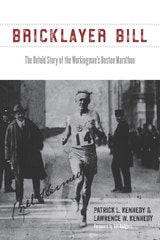
Bricklayer Bill
The Untold Story of the Workingman's Boston MarathonPatrick L. Kennedy and Lawrence W. Kennedy
University of Massachusetts Press, 2017
Two weeks after the United States officially entered World War I, Irish American “Bricklayer Bill” Kennedy won the Boston Marathon wearing his stars-and-stripes bandana, rallying the crowd of patriotic spectators. Kennedy became an American hero and, with outrageous stories of his riding the rails and sleeping on pool tables, a racing legend whose name has since appeared in almost every book written on the Boston Marathon.
When journalist Patrick Kennedy and historian Lawrence Kennedy unearthed their uncle's unpublished memoir, they discovered a colorful character who lived a tumultuous life, beyond his multiple marathons. The bricklayer survived typhoid fever, a five-story fall, auto and train accidents, World War action, Depression-era bankruptcy, decades of back-breaking work, and his own tendency to tipple. In many ways, Bill typified the colorful, newly emerging culture and working-class ethic of competitive long-distance running before it became a professionalized sport. Bricklayer Bill takes us back to another time, when bricklayers, plumbers, and printers could take the stage as star athletes.

Bridges to Fantasy
Essays from the Eaton Conference on Science Fiction and Fantasy LiteratureGeorge E Slusser
Southern Illinois University Press, 1982
Thirteen original essays written specifically for the second Eaton Conference on Science Fiction and Fantasy Literature, held February 23–24, 1980, at the University of California, Riverside.
These essays demonstrate the variety of fantasy forms and their pervasiveness throughout the ages and will stimulate further study of this complex and elusive mode. The essays—by Harold Bloom, writer and DeVane Professor of the Humanities at Yale University; Larry McCaffery, Assistant Professor of English at San Diego State University; Marta E. Sánchez, Instructor of English at the University of California, San Diego; Arlen J. Hansen, Professor of English at the University of the Pacific, Stockton; David Clayton, Instructor of Comparative Literatureat the University of California, San Diego; Robert Sale, writer and Professor of English at the University of Washington; G. Richard Thompson, Professor of English at Purdue University, West Lafayette; Robert A. Collins, Coordinator of the annual Swann Conference on the Fantastic and Instructor at Florida Atlantic University, Boca Raton; John Gerlach, Associate Professor of English at Cleveland State University; David Ketterer, writer and Professor of English at Concordia University, Montreal; George R. Guffey, Professor of English at the University of California, Los Angeles; Jack P. Rawlins, Associate Professor of English at California State University, Chico; and Gary Kern, writer and translator of early Soviet literature—examine fantasy on many levels of interest: as an element of human thought, as a constant factor in the social and intellectual environment, and as a generator of form in art and literature.
Bridges to Science Fiction
George E Slusser
Southern Illinois University Press, 1980
Ten new critical essays written for presentation at the first Eaton Conference on Science Fiction and Fantasy Literature held 24–25February 1979,at the University of California, Riverside.
While critical discussion of science fiction has become increasingly sophisticated during the past decade, there remains a tendency among some teachers and readers to consider science fiction as an independent phenomenon that exists unconnected to the mainstream of our cultural inheritance. These essays—by Harry Levin, Irving Babbitt Professor of Comparative Literature at Harvard University; Kent T. Kraft, Assistant Professor of Comparative Literature at the University of Georgia, Athens; Stephen Potts, writer and instructor at San Diego State University; Gregory Benford, writer and Associate Professor of Physics at the University of California, Irvine; Robert Hunt, an editor at Glencoe Publishing; Eric S. Rabkin, Professor of English at the University of Michigan; Patrick Parrinder, instructor at the University of Reading, England; Thomas Keeling, Lecturer in English at the University of California, Los Angeles; Carl D. Malmgren, instructor at the University of Oregon, Eugene; and Thomas Hanzo, Professor of English and Chairman of the department at the University of California, Davis—suggest the connections that exist between science fiction and other aspects of Western cultural tradition.
Ranging in interest from the specifically philosophical to the specifically literary, the essays relate science fiction to such topics as medieval cosmological discourse, classical empirical philosophy, fairy tale, epic, and Gothic fiction. Emerging from the volume as a whole are both a coherent view of science fiction as a genre and a heightened sense of its complex relation to our cultural heritage.
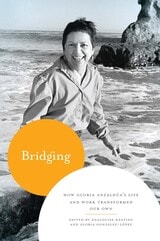
Bridging
How Gloria Anzaldúa's Life and Work Transformed Our OwnEdited by AnaLouise Keating and Gloria González-López
University of Texas Press, 2011
The inspirational writings of cultural theorist and social justice activist Gloria Anzaldúa have empowered generations of women and men throughout the world. Charting the multiplicity of Anzaldúa's impact within and beyond academic disciplines, community trenches, and international borders, Bridging presents more than thirty reflections on her work and her life, examining vibrant facets in surprising new ways and inviting readers to engage with these intimate, heartfelt contributions.
Bridging is divided into five sections: The New Mestizas: "transitions and transformations"; Exposing the Wounds: "You gave me permission to fly in the dark"; Border Crossings: Inner Struggles, Outer Change; Bridging Theories: Intellectual Activism with/in Borders; and "Todas somos nos/otras": Toward a "politics of openness." Contributors, who include Norma Elia Cantú, Elisa Facio, Shelley Fisher Fishkin, Aída Hurtado, Andrea Lunsford, Denise Segura, Gloria Steinem, and Mohammad Tamdgidi, represent a broad range of generations, professions, academic disciplines, and national backgrounds. Critically engaging with Anzaldúa's theories and building on her work, they use virtual diaries, transformational theory, poetry, empirical research, autobiographical narrative, and other genres to creatively explore and boldly enact future directions for Anzaldúan studies.
A book whose form and content reflect Anzaldúa's diverse audience, Bridging perpetuates Anzaldúa's spirit through groundbreaking praxis and visionary insights into culture, gender, sexuality, religion, aesthetics, and politics. This is a collection whose span is as broad and dazzling as Anzaldúa herself.
Bring on the Books for Everybody
How Literary Culture Became Popular CultureJim Collins
Duke University Press, 2010
Collins explores how digital technologies and the convergence of literary, visual, and consumer cultures have changed what counts as a “literary experience” in phenomena ranging from lush film adaptations such as The English Patient and Shakespeare in Love to the customer communities at Amazon. Central to Collins’s analysis and, he argues, to contemporary literary culture, is the notion that refined taste is now easily acquired; it is just a matter of knowing where to access it and whose advice to trust. Using recent novels, he shows that the redefined literary landscape has affected not just how books are being read, but also what sort of novels are being written for these passionate readers. Collins connects literary bestsellers from The Jane Austen Book Club and Literacy and Longing in L.A. to Saturday and The Line of Beauty, highlighting their depictions of fictional worlds filled with avid readers and their equations of reading with cultivated consumer taste.
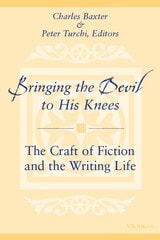
Bringing the Devil to His Knees
The Craft of Fiction and the Writing LifeCharles Baxter and Peter Turchi, Editors
University of Michigan Press, 2001
Each of the contributors is a current or former lecturer at the Warren Wilson College MFA Program for Writers, one of the most highly respected writing programs in the country. Included are essays by Charles Baxter, Robert Boswell, Karen Brennan, Judith Grossman, Ehud Havazelet, C. J. Hribal, Margot Livesey, Michael Martone, Kevin McIlvoy, Pablo Medina, Antonya Nelson, Susan Neville, Richard Russo, Steven Schwartz, Jim Shepard, Joan Silber, Debra Spark, Peter Turchi, and Chuck Wachtel.
Rich with masterful examples and personal anecdotes, these imaginative essays provide hard-earned insight into a writer's work. The book will interest not only those seeking inspiration and guidance to become stronger writers, but also readers of contemporary literary fiction, who will find a number of surprising and original approaches to the writer's work by award-winning practitioners adept at teaching others what they know.
Charles Baxter is author of several novels, including The Feast of Love, Shadow Play, and First Light. and collections of stories including Believers and A Relative Stranger. He teaches writing at the University of Michigan. Peter Turchi is author of the novel The Girls Next Door, a collection of stories, Magician, and a book of non-fiction, The Pirate Prince. He is Director of the MFA Program for Writers, Warren Wilson College.
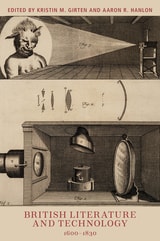
British Literature and Technology, 1600-1830
Kristin M. Girten
Bucknell University Press, 2023
Enlightenment-era writers had not yet come to take technology for granted, but nonetheless were—as we are today—both attracted to and repelled by its potential. This volume registers the deep history of such ambivalence, examining technology’s influence on Enlightenment British literature, as well as the impact of literature on conceptions of, attitudes toward, and implementations of technology. Offering a counterbalance to the abundance of studies on literature and science in seventeenth- and eighteenth-century Britain, this volume’s focus encompasses approaches to literary history that help us understand technologies like the steam engine and the telegraph along with representations of technology in literature such as the “political machine.” Contributors ultimately show how literature across genres provided important sites for Enlightenment readers to recognize themselves as “chimeras”—“hybrids of machine and organism”—and to explore the modern self as “a creature of social reality as well as a creature of fiction.”
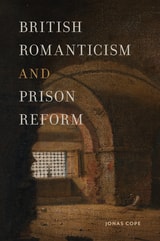
British Romanticism and Prison Reform
Jonas Cope
Bucknell University Press, 2025
In eighteenth-century Britain, criminals were routinely whipped, branded, hanged, or transported to America. Only in the last quarter of the century—with the War of American Independence and legal and sociopolitical challenges to capital punishment—did the criminal justice system change, resulting in the reformed prison, or penitentiary, meant to educate, rehabilitate, and spiritualize even hardened felons. This volume is the first to explore the relationship between historical penal reform and Romantic-era literary texts by luminaries such as Godwin, Keats, Byron, and Austen. The works examined here treat incarceration as ambiguous: prison walls oppress and reinforce the arbitrary power of legal structures but can also heighten meditation, intensify the imagination, and awaken the conscience. Jonas Cope skillfully traces the important ideological work these texts attempt: to reconcile a culture devoted to freedom with the birth of the modern prison system that presents punishment as a form of rehabilitation.
Published by Bucknell University Press. Distributed worldwide by Rutgers University Press.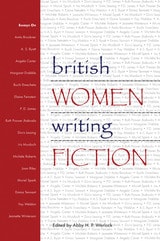
British Women Writing Fiction
Abby H.P. Werlock
University of Alabama Press, 2000
British women in the second half of the 20th century have produced a body of work that is as diverse as it is entertaining. This book offers an informal, jargon-free introduction to the fiction of sixteen contemporary writers either brought up or now living in England, from Muriel Spark to Jeanette Winterson.
British Women Writing Fiction presents a balanced view comprising women writing since the 1950s and 1960s, those who attracted critical attention during the 1970s and 1980s, and those who have burst upon the literary scene more recently, including African-Caribbean and African women. The essays show how all of these writers treat British subjects and themes, sometimes from radically different perspectives, and how those who are daughters of immigrants see themselves as women writing on the margins of society.
Abby Werlock's introduction explores the historical and aesthetic factors that have contributed to the genre, showing how even those writers who began in a traditional vein have created experimental work. The contributors provide complete bibliographies of each writer's works and selected bibliographies of criticism. Exceptional both in its breadth of subjects covered and critical approaches taken, this book provides essential background that will enable readers to appreciate the singular merits of each writer. It offers an approach toward better understanding favorite authors and provides a way to become acquainted with new ones.

British Working-Class and Radical Writing Since 1700
Edited by John Goodridge and Adam Bridgen
University of London Press, 2025
At a time when working-class writing is gaining long-overdue recognition, British Working-Class and Radical Writing Since 1700 explores the intersection of class and literature over more than three centuries. This volume brings together leading scholars to examine the problems faced by working-class writers and the impact of class on themes such as feminism and anti-imperialism. Spanning from early laboring-class poets to contemporary memoirists, the collection revisits figures like John Clare and Ethel Carnie Holdsworth and also recovers overlooked voices and texts.
Covering poetry, fiction, drama, and political writing, the book investigates the relationship between class and literary production, offering fresh perspectives on how working-class and radical literature has shaped British cultural history. From the Romantic-era resistance of laboring poets to mid-century miners’ novels and the evolution of contemporary working-class memoirs, these essays reveal how literature has served as both a site of struggle and a tool of empowerment.
Brodsky Abroad
Empire, Tourism, NostalgiaSanna Turoma
University of Wisconsin Press, 2010
Expelled from the Soviet Union in 1972 and honored with the Nobel Prize fifteen years later, poet Joseph Brodsky in many ways fit the grand tradition of exiled writer. But Brodsky’s years of exile did not render him immobile: though he never returned to his beloved Leningrad, he was free to travel the world and write about it. In Brodsky Abroad, Sanna Turoma discusses Brodsky’s poems and essays about Mexico, Brazil, Turkey, and Venice. Challenging traditional conceptions behind Brodsky’s status as a leading émigré poet and major descendant of Russian and Euro-American modernism, she relocates the analysis of his travel texts in the diverse context of contemporary travel and its critique. Turoma views Brodsky’s travel writing as a response not only to his exile but also to the postmodern and postcolonial landscape that initially shaped the writing of these texts.
In his Latin American encounters, Brodsky exhibits disdain for third-world politics and invokes the elegiac genre to reject Mexico’s postcolonial reality and to ironically embrace the romanticism of an earlier Russian and European imperial age. In an essay on Istanbul he assumes Russia’s ambiguous position between East and West as his own to negotiate a distinct, and controversial, interpretation of Orientalism. And, Venice, the emblematic tourist city, becomes the site for a reinvention of his lyric self as more fluid, hybrid, and cosmopolitan.
Brodsky Abroad reveals the poet’s previously uncharted trajectory from alienated dissident to celebrated man of letters and offers new perspectives on the geopolitical, philosophical, and linguistic premises of his poetic imagination.
Brodsky in English
Zakhar Ishov
Northwestern University Press, 2023
Joseph Brodsky’s translations of his own Russian-language poems into English “new originals” have been criticized for their “un-Englishness,” an appraisal based on a narrow understanding of translation itself. With this radical reassessment of the Nobel Prize winner’s self-translations, Zakhar Ishov proposes a fresh approach to poetry translation and challenges the assumption that poetic form is untranslatable.
Brodsky in English draws on previously unexamined archival materials, including drafts and correspondence with translators and publishers, to trace the arc of Brodsky’s experience with the English language. Ishov shows how Brodsky’s belief in the intellectual continuity between his former life in the Soviet Union and his new career in the United States, including as Poet Laureate, anchored his insistence on maintaining the formal architecture of his poems in translation, locating the transmission of poetic meaning in the rhythms of language itself. This book highlights Brodsky’s place within the long history of the compromises translation must make between linguistic material and poetic process.
Broken Masculinities
Solitude, Alienation, and Frustration in Turkish Literature after 1970Cimen Günay-Erkol
Central European University Press, 2016
Broken Masculinities portrays the post-dictatorial novel of the 1970s in all its complexity, and introduces the reader to a 1968-era Turkey, a period which challenges Turkey’s now reinforced Islamic image by portraying the quest for sexual liberation and critical student uprisings. Günay-Erkol argues that the literature written after the 1971 coup in Turkey constitutes a coherent sub-genre and needs to be considered together. These novels share a common ground which is rich in images of men and women craving for power: general isolation, sexual-emotional frustration, and a traumatic sense of solitude and alienation.
This book is an original and significant contribution to two major fields of study: (1) gender and sexuality with respect to formation of subjectivity through literature, and (2) modern literature and history through the study of Turkish literature. The chief concern in this book is not only literature’s response to a particular period in Turkey, but also the role of literature in bearing witness to trauma and drastic political acts of violence—and coming to terms with them.B
Broken Nuptials in Shakespeare's Plays
Carol Thomas Neely
University of Illinois Press, 1993

Broken Silences
Interviews with Black and White Women WritersEdited by Shirley M Jordan
Rutgers University Press, 1993
In these 20 interviews with women writers of fiction, Jordan, who teaches at Hampton University in Virginia, attempts to plumb the relations between black and white women in fiction and in life, and to explore the creative process. Although the book suffers from lengthy discussions of somewhat obscure work, the interviewees, most of whom have portrayed female characters of a race other than their own, offer intriguing, often conflicting observations about the primacy of race, gender or class. Kaye Gibbons ( Ellen Foster ) suggests that rural locations offer commonality to black and white Southern women; Marita Golden ( Long Distance Life ) observes that white writers emphasize female beauty while black writers focus on character. This book may be a useful supplement to literature courses.
From Library Journal
The message derived from the candid and articulate women interviewed here is, as Belva Plain states, "you learn as you live together." Editor Jordan (Hampton Univ., Virginia) has opened a dialog on writing and race relations by publishing these interviews with 20 significant contemporary black and white women writers, from Alice Childress and Joyce Carol Oates to Mildred Pitts Walker. The substance of these writers' thoughts is that the commonality of women's experience informs the genuine portrayal of a character as much as does the writer's understanding of her blackness or whiteness. This special book, so different from others that examine the writing process, is likely to stimulate dialog among women and to provoke serious study of many excellent women writers working today. Recommended for all collections supporting the study of literature, women's studies, and race relations.
Broken Souths
Latina/o Poetic Responses to Neoliberalism and GlobalizationMichael Dowdy
University of Arizona Press, 2013
Dowdy argues that a transnational Latina/o imaginary has emerged in response to neoliberalism—the free-market philosophy that underpins what many in the northern hemisphere refer to as “globalization.” His work examines how poets represent the places that have been “broken” by globalization’s political, economic, and environmental upheavals. Broken Souths locates the roots of the new imaginary in 1968, when the Mexican student movement crested and the Chicano and Nuyorican movements emerged in the United States. It theorizes that Latina/o poetics negotiates tensions between the late 1960s’ oppositional, collective identities and the present day’s radical individualisms and discourses of assimilation, including the “post-colonial,” “post-national,” and “post-revolutionary.” Dowdy is particularly interested in how Latina/o poetics reframes debates in cultural studies and critical geography on the relation between place, space, and nature.
Broken Souths features discussions of Latina/o writers such as Victor Hernández Cruz, Martín Espada, Juan Felipe Herrera, Guillermo Verdecchia, Marcos McPeek Villatoro, Maurice Kilwein Guevara, Judith Ortiz Cofer, Jack Agüeros, Marjorie Agosín, Valerie Martínez, and Ariel Dorfman, alongside discussions of influential Latin American writers, including Roberto Bolaño, Ernesto Cardenal, David Huerta, José Emilio Pacheco, and Raúl Zurita.
Bronx Accent
A Literary and Pictorial History of the BoroughUltan, Lloyd
Rutgers University Press, 2000
Bringing together a variety of past literary figures as well as emerging talents, this comprehensive book captures the Zeitgeist of the neighborhood through the eyes of its writers. Included are selections from the writings of Jack Kerouac, Mark Twain, James Baldwin, James Fenimore Cooper, Tom Wolfe, Herman Wouk, Theodore Dreiser, Washington Irving, Clifford Odets, Cynthia Ozick, Grace Paley, Edgar Allan Poe, Chaim Potok, Kate Simon, Leon Trotsky, and Sholem Aleichem.
Lloyd Ultan and Barbara Unger place the literature of these and other writers in historical context and reproduce one hundred vintage photographs that bring the writings to life. Filtered through the imaginations of authors of different times, ethnic groups, social classes, and literary styles, the borough of The Bronx emerges not only as a shaper of destinies and lives, but as an important literary mecca.
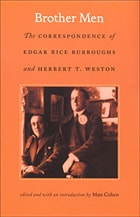
Brother Men
The Correspondence of Edgar Rice Burroughs and Herbert T. WestonEdgar Rice Burroughs and Herbert T. Weston
Duke University Press, 2005
The Burroughs-Weston letters trace a fascinating personal and business relationship that evolved as the two men and their wives embarked on joint capital ventures, traveled frequently, and navigated the difficult waters of child-rearing, divorce, and aging. Brother Men includes never-before-published images, annotations, and a critical introduction in which Cohen explores the significance of the sustained, emotional male friendship evident in the letters. Rich with insights related to visual culture and media technologies, consumerism, the history of the family, the history of authorship and readership, and the development of the West, these letters make it clear that Tarzan was only one small part of Edgar Rice Burroughs’s broad engagement with modern culture.
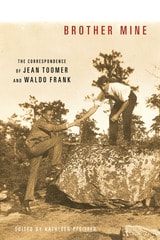
Brother Mine
The Correspondence of Jean Toomer and Waldo FrankEdited by Kathleen Pfeiffer
University of Illinois Press, 2010
The friendship of Jean Toomer and Waldo Frank was one of the most emotionally intense, racially complicated, and aesthetically significant relationships in the history of American literary modernism. Waldo Frank was an established white writer who advised and assisted the younger African American Jean Toomer as he pursued a literary career. They met in 1920, began corresponding regularly in 1922, and were estranged by the end of 1923, the same year that Toomer published his ambitiously modernist debut novel, Cane.
While individual letters between Frank and Toomer have been published separately on occasion, they have always been presented out of context. This volume presents for the first time their entire correspondence in chronological order, comprising 121 letters ranging from 200 to 800 words each. Kathleen Pfeiffer annotates and introduces the letters, framing the correspondence and explaining the literary and historical allusions in the letters themselves.
Reading like an epistolary novel, Brother Mine captures the sheer emotional force of the story that unfolds in these letters: two men discover an extraordinary friendship, and their intellectual and emotional intimacy takes shape before our eyes. This unprecedented collection preserves the raw honesty of their exchanges, together with the developing drama of their ambition, their disappointments, their assessment of their world, and ultimately, the betrayal that ended the friendship.
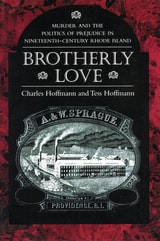
Brotherly Love
Murder and the Politics of Prejudice in Nineteenth-Century Rhode IslandCharles Hoffmann
University of Massachusetts Press, 1993
Brotherly Love is a graphic reconstruction of the crime, its social and economic background, and the subsequent trials. The story reveals the antagonism between native-born Yankees, who commanded great power, and the growing number of Irish Catholic immigrants, most of whom worked in the textile mills. Indeed, the economic, political, and religious dimensions of the conflict are all evident in the trials.
The authors argue persuasively that the Gordons were victims of bigotry and circumstantial evidence, serving as convenient scapegoats to appease a community outraged over the murder of its wealthiest citizen. In telling the story of this notorious case, Brotherly Love reveals the politics of prejudice in nineteenth-century New England as played out in community and courtroom.
Brown Gumshoes
Detective Fiction and the Search for Chicana/o IdentityBy Ralph E. Rodriguez
University of Texas Press, 2005
Winner, Modern Language Association Prize in United States Latina and Latino and Chicana and Chicano Literary and Cultural Studies, 2006
Popular fiction, with its capacity for diversion, can mask important cultural observations within a framework that is often overlooked in the academic world. Works thought to be merely "escapist" can often be more seriously mined for revelations regarding the worlds they portray, especially those of the disenfranchised. As detective fiction has slowly earned critical respect, more authors from minority groups have chosen it as their medium. Chicana/o authors, previously reluctant to write in an underestimated genre that might further marginalize them, have only entered the world of detective fiction in the past two decades.
In this book, the first comprehensive study of Chicano/a detective fiction, Ralph E. Rodriguez examines the recent contributions to the genre by writers such as Rudolfo Anaya, Lucha Corpi, Rolando Hinojosa, Michael Nava, and Manuel Ramos. Their works reveal the struggles of Chicanas/os with feminism, homosexuality, familia, masculinity, mysticism, the nationalist subject, and U.S.-Mexico border relations. He maintains that their novels register crucial new discourses of identity, politics, and cultural citizenship that cannot be understood apart from the historical instability following the demise of the nationalist politics of the Chicana/o movement of the 1960s and 1970s. In contrast to that time, when Chicanas/os sought a unified Chicano identity in order to effect social change, the 1980s, 1990s, and 2000s have seen a disengagement from these nationalist politics and a new trend toward a heterogeneous sense of self. The detective novel and its traditional focus on questions of knowledge and identity turned out to be the perfect medium in which to examine this new self.
Brown on Brown
Chicano/a Representations of Gender, Sexuality, and EthnicityBy Frederick Luis Aldama
University of Texas Press, 2005
Common conceptions permeating U.S. ethnic queer theory tend to confuse aesthetics with real-world acts and politics. Often Chicano/a representations of gay and lesbian experiences in literature and film are analyzed simply as propaganda. The cognitive, emotional, and narrational ingredients (that is, the subject matter and the formal traits) of those representations are frequently reduced to a priori agendas that emphasize a politics of difference.
In this book, Frederick Luis Aldama follows an entirely different approach. He investigates the ways in which race and gay/lesbian sexuality intersect and operate in Chicano/a literature and film while taking into full account their imaginative nature and therefore the specific kind of work invested in them. Also, Aldama frames his analyses within today's larger (globalized) context of postcolonial literary and filmic canons that seek to normalize heterosexual identity and experience. Throughout the book, Aldama applies his innovative approach to throw new light on the work of authors Arturo Islas, Richard Rodriguez, John Rechy, Ana Castillo, and Sheila Ortiz Taylor, as well as that of film director Edward James Olmos. In doing so, Aldama aims to integrate and deepen Chicano literary and filmic studies within a comparative perspective. Aldama's unusual juxtapositions of narrative materials and cultural personae, and his premise that literature and film produce fictional examples of a social and historical reality concerned with ethnic and sexual issues largely unresolved, make this book relevant to a wide range of readers.

Browning’s Beginnings
The Art of DisclosureHerbert F. Tucker Jr.
University of Minnesota Press, 1980
Browning's Beginnings was first published in 1980. Minnesota Archive Editions uses digital technology to make long-unavailable books once again accessible, and are published unaltered from the original University of Minnesota Press editions.
Browning's Beginnings offers a fresh approach to the poet who, among major Victorians, has proved at once the most congenial and most inscrutable to modern readers. Drawing on recent developments in literary theory and in the criticism of romantic poetry, Herbert
F. Tucker, Jr., argues that Browning's stylistic "obscurity" is the result of a principled poetics of evasion. This art of disclosure, in deferring formal and semantic finalities, constitutes an aesthetic counterpart to his open-ended moral philosophy of"incompleteness," Browning's poems, like his enormously productive career, find their motivation and sustenance in his optimistic love of the future—a love that is indistinguishable from his lifelong fear that there will be nothing left to say.The opening chapters trace the workings of Browning's art of disclosure with extensive and original interpretations of the unduly neglected early poems, Pauline, Paracelsus, and Sordello, and place special emphasis on Browning's attitudes toward poetic tradition and language. A chapter on Browning's attitudes toward poetic tradition and language. A chapter on Browning's plays identifies dynamics of representation in Pippa Passes, Strafford,and King Victor and King Charles. Tucker discusses the pervasive analogy between Browning's ideas about poetic representation and about representation in its erotic and religious aspects, and shows how the early poems and plays illustrate correlative developments in poetics and in the exploration and dramatic rendering of human psychology. The remaining chapters follow the poetic psychology of Browning to its culmination in the great poems of his middle years; exemplary readings of selected dramatic lyrics and monologues suggest that the ways of meaning in Browning's mature work variously bear out the sense of endlessness or perpetual initiation that is central to his poetic beginnings.
Tucker thus contends that the "romantic" and the "Victorian" Browning have more in common than is generally supposed, and his book should appeal to students of both periods. Its discussion of general literary issues - poetic influence, closure, representation, and meaning - in application to particular texts should further recommend Browning's Beginnings to the nonspecialist reader interested in poetry and poetic theory.
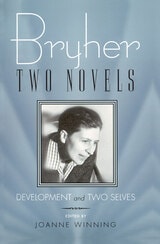
Bryher
Two Novels: Development And Two SelvesUniversity of Wisconsin Press, 2000
Bryher (born Annie Winifred Ellerman) is perhaps best known today as the lifelong partner of the poet H.D. She was, however, a central figure in modernist and avant-garde cultural experimentation in the early twentieth century; a prolific producer of poetry, novels, autobiography, and criticism; and an intimate and patron of such modernist artists as Gertrude Stein, Marianne Moore, and Dorothy Richardson. Bryher’s own path-breaking writing has remained largely neglected, long out of print, and inaccessible to those interested in her oeuvre. Now, for the first time since their original publication in the early 1920s, two of Bryher's pioneering works of fictionalized autobiography, titled Development and Two Selves, are reprinted in one volume for a new audience of readers, scholars, and critics.
Blending poetry, prose, and autobiographical details, Development and Two Selves together constitute a compelling bildungsroman that is among the first ever to follow a young woman's process of coming out. Through the fictionalized character Nancy, the novels trace Bryher’s life through her childhood and young adulthood, giving the reader an account of the development of a unique lesbian, feminist, and modernist consciousness. Development and Two Selves recover significant work by one of the first experimenters of the modernist movement and are a welcome reintroduction of the enigmatic Bryher.
Building Domestic Liberty
Charlotte Perkins Gilman's Architectural FeminismPolly Wynn Allen
University of Massachusetts Press, 1988
Building Domestic Liberty offers a critical and admiring analysis of feminist philosopher Charlotte Perkins Gilman (1860–1935). Polly Allen examines Gilman's approach to architecture, landscape, and neighborhood design and discusses Gilman's case against prevailing household design and looks at her philosophy of world improvement.
Building Fires in the Snow
A Collection of Alaska LGBTQ Short Fiction and PoetryEdited by Martha Amore and Lucian Childs
University of Alaska Press, 2016
In these pages we see the panoply of LGBTQ life in Alaska today, from the quotidian urban adventures of a family—shopping, going out, working—to intimate encounters with Alaska’s breathtaking natural beauty. At a time of great change and major strides in LGBTQ civil rights, Building Fires in the Snow shows us an Alaska that shatters stereotypes and reveals a side of Alaska that’s been little seen until now.
Building Romanticism
Literature and Architecture in Nineteenth-Century BritainNicole Reynolds
University of Michigan Press, 2010
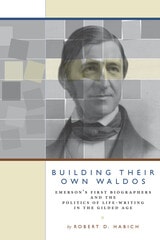
Building Their Own Waldos
Emerson’s First Biographers and the Politics of Life-Writing in the Gilded AgeRobert D. Habich
University of Iowa Press, 2011
@font-face { font-family: "Calibri";}p.MsoNormal, li.MsoNormal, div.MsoNormal { margin: 0in 0in 0.0001pt; font-size: 12pt; font-family: "Times New Roman"; }h4 { margin: 12pt 0in 3pt; page-break-after: avoid; font-size: 14pt; font-family: "Times New Roman"; }span.Heading4Char { font-family: Calibri; font-weight: bold; }div.Section1 { page: Section1; }
By the end of the nineteenth century, Ralph Waldo Emerson was well on his way to becoming the “Wisest American” and the “Sage of Concord,” a literary celebrity and a national icon. With that fame came what Robert Habich describes as a blandly sanctified version of Emerson held widely by the reading public. Building Their Own Waldos sets out to understand the dilemma faced by Emerson’s early biographers: how to represent a figure whose subversive individualism had been eclipsed by his celebrity, making him less a representative of his age than a caricature of it.Drawing on never-before-published letters, diaries, drafts, business records, and private documents, Habich Emerson’s First Biographers explores the making of a cultural hero through the stories of Emerson’s first biographers—George Willis Cooke, a minister most recently from Indianapolis who considered himself a disciple; the English reformer and newspaper mogul Alexander Ireland, a friend for half a century; Moncure D. Conway, a Southern abolitionist then residing in London, who called Emerson his “spiritual father and intellectual teacher”; the poet and medical professor Oliver Wendell Holmes, with Emerson a member of Boston’s gathering of literary elite, the Saturday Club; James Elliot Cabot, the family’s authorized biographer, an architect and amateur philosopher with unlimited access to Emerson’s unpublished papers; and Emerson’s son Edward, a physician and painter whose father had passed over him as literary executor in favor of Cabot.
Just as their biographies reveal a complex, socially engaged Emerson, so too do the biographers’ own stories illustrate the real-world perils, challenges, and motives of life-writing in the late nineteenth century, when biographers were routinely vilified as ghoulish and disreputable and biography as a genre underwent a profound redefinition. Building Their Own Waldos is at once a revealing look at Emerson’s constructed reputation, a case study in the rewards and dangers of Victorian life-writing, and the story of six authors struggling amidst personal misfortunes and shifting expectations to capture the elusive character of America’s “representative man,” as they knew him and as they needed him to be.
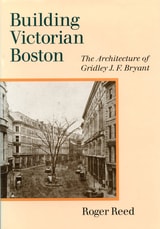
Building Victorian Boston
The Architecture of Gridley J.F. BryantRoger G. Reed
University of Massachusetts Press, 2007
In Building Victorian Boston, Roger Reed focuses on representative projects by Bryant, presenting them in a chronological narrative that both illuminates the trajectory of his career and creates a portrait of the profession of architecture during a defining period of New England history. Bryant designed more major buildings in Boston from 1840 to 1880 than any other architect. He also undertook commissions throughout New
England, especially in towns linked to Boston by newly constructed railroad lines. In many ways, his practice presaged aspects of modern architectural firms. His ability to work with a variety of designers, his expertise in construction management, and his exceptional talent for self-promotion all contributed to his success. Although by the time of his death his work was no longer fashionable, newspaper accounts noted the passing of the "Famed Bostonian" and "Great Builder" whose career had had such a dramatic impact on the face of the city.
For this volume, Reed has tracked down hundreds of Bryant's drawings as well as specifications, letters, newspaper articles, published renderings, and historical photographs. These materials are amply represented in this book, the definitive study of a quintessential Victorian architect.
Bulletproof
Afterlives of Anticolonial Prophecy in South Africa and BeyondJennifer Wenzel
University of Chicago Press, 2009
In 1856 and 1857, in response to a prophet’s command, the Xhosa people of southern Africa killed their cattle and ceased planting crops; the resulting famine cost tens of thousands of lives. Much like other millenarian, anticolonial movements—such as the Ghost Dance in North America and the Birsa Munda uprising in India—these actions were meant to transform the world and liberate the Xhosa from oppression. Despite the movement’s momentous failure to achieve that goal, the event has continued to exert a powerful pull on the South African imagination ever since. It is these afterlives of the prophecy that Jennifer Wenzel explores in Bulletproof.
Wenzel examines literary and historical texts to show how writers have manipulated images and ideas associated with the cattle killing—harvest, sacrifice, rebirth, devastation—to speak to their contemporary predicaments. Widening her lens, Wenzel also looks at how past failure can both inspire and constrain movements for justice in the present, and her brilliant insights into the cultural implications of prophecy will fascinate readers across a wide variety of disciplines.
Bundle
Life, Stories, and Hope Across Díne WorldsJ. Jeffery Clark
University of Arizona Press, 2027
The stories colonizers tell about Diné people represent them as adaptors, uncontrollable, and unruly. These wounding narratives justify the displacement and dispossession of Diné people, masking the ongoing violence of settler colonialism.
Bundle: Life, Stories, and Hope Across Diné Worlds challenges and dismantles these harmful depictions. By shifting the paradigm away from anthropological lenses, this book offers an exploration of bundling: the active, physical, spiritual, and ideological practice through which Diné people assemble stories, tools, and knowledge. From world shifts detailed in oral narratives to the present deadly structures of colonization, Diné people have long relied on their bundled knowledge systems to sustain their presence across worlds and time.
Bundle is a must-read for anyone seeking to understand Diné resistance, hope, and worlding. Rather than studying Diné life from the outside, it prioritizes Diné ways of knowing and being to develop bundling as a theory of continuance. For readers invested in decolonization, place-making, and storytelling, Bundle provides an indispensable roadmap for how Diné people continue even in the face of domination.
Buried in Shades of Night
Contested Voices, Indian Captivity, and the Legacy of King Philip's WarBilly J. Stratton, Foreword by Frances Washburn, Afterword by George E. Tinker
University of Arizona Press, 2013
In this groundbreaking new book, Billy J. Stratton offers a critical examination of the narrative of Mary Rowlandson. Although it has long been thought that the book’s preface was written by the influential Puritan minister Increase Mather, Stratton’s research suggests that Mather was also deeply involved in the production of the narrative itself, which bears strong traces of a literary form that was already well established in Europe. As Stratton notes, the portrayal of Indian people as animalistic “savages” and of Rowlandson’s solace in Biblical exegesis served as a convenient alibi for the colonial aspirations of the Puritan leadership.
Stratton calls into question much that has been accepted as fact by scholars and historians over the last century, and re-centers the focus on the marginalized perspective of Native American people, including those whose land had been occupied by the Puritan settlers. In doing so, Stratton demands a careful reconsideration of the role that the captivity narrative—which was instrumental in shaping conceptions of “frontier warfare”—has played in the development of both American literary history and national identity.
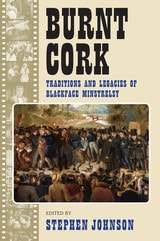
Burnt Cork
Traditions and Legacies of Blackface MinstrelsyStephen Johnson
University of Massachusetts Press, 2012
Beginning in the 1830s and continuing for more than a century, blackface minstrelsy—stage performances that claimed to represent the culture of black Americans—remained arguably the most popular entertainment in North America. A renewed scholarly interest in this contentious form of entertainment has produced studies treating a range of issues: its contradictory depictions of class, race, and gender; its role in the development of racial stereotyping; and its legacy in humor, dance, and music, and in live performance, film, and television. The style and substance of minstrelsy persist in popular music, tap and hip-hop dance, the language of the standup comic, and everyday rituals of contemporary culture. The blackface makeup all but disappeared for a time, though its influence never diminished—and recently, even the makeup has been making a comeback.
This collection of original essays brings together a group of prominent scholars of blackface performance to reflect on this complex and troublesome tradition. Essays consider the early relationship of the blackface performer with American politics and the antislavery movement; the relationship of minstrels to the commonplace compromises of the touring “show” business and to the mechanization of the industrial revolution; the exploration and exploitation of blackface in the mass media, by D. W. Griffith and Spike Lee, in early sound animation, and in reality television; and the recent reappropriation of the form at home and abroad.
In addition to the editor, contributors include Dale Cockrell, Catherine Cole, Louis Chude-Sokei, W. T. Lhamon, Alice Maurice, Nicholas Sammond, and Linda Williams.
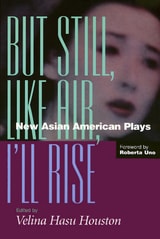
But Still Like Air
edited by Velina Hasu Houston, foreword by Roberta Uno
Temple University Press, 1997
What are Asian American plays about? Family conflicts, sexuality, social upheaval, betrayal ... the stuff of all drama. Whether the characters are a middle-aged Taiwanese woman who is married to an Irish American and who dreams of opening a Chinese restaurant, a Chinese American female bond trader trying to survive a corporate takeover, or an ABC (American Born Chinese) gay man whose lover has AIDS, their Asian-ness is only a part of their story.
As a playwright, Houston is keenly aware of the rigid formulas that often exclude writers of color and women women writers from mainstream theater. But Still, Like air, I'll Rise brings forth vibrant new work that challenges producers and audiences to broaden their expectations, to attend to the unfamiliar voices that expresses the universal and particular vision of Asian American playwrights.