Results by title
28167 books match the query 'History' and 1262 start with b

Between Church and State
The Lives of Four French Prelates in the Late Middle AgesBernard Guenée
University of Chicago Press, 1990
Guenée chooses as his frame the momentous period from the height of Saint Louis's reign in the mid-thirteenth century to the beginning of the Italian wars two hundred years later. During this time of schism in the church, of war between nascent states, and of treachery among princes, Bernard Gui (1261-1331), Gilles Le Muisit (1272-1353), Pierre D'Ailly (1351-1420), and Thomas Basin (1412-1490) all rose from modest circumstances to the dignity of office. Guenée shows us how these prelates used their talent, ambition, patrons, zeal, and experience to juggle the competing demands of obedience to church and state; to overcome competition from an upcoming new generation; and to cope with plague, war, and violence. Free of jargon yet steeped in learning, Between Church and State reveals the career patterns and politics of an era while forging a new model for points of departure in historical scholarship.
Between City and Country
Brookline, Massachusetts, and the Origins of SuburbiaRonald Dale Karr
University of Massachusetts Press, 2018
Already a fashionable retreat for wealthy Bostonians, Brookline began to suburbanize in the 1840s with the arrival of hundreds of commuter families—and significant numbers of Irish Catholic immigrants drawn by opportunities to work as laborers and servants. In Brookline the poor were segregated but not excluded altogether, as they would be from twentieth-century elite suburbs. A half century later, a distinct suburban way of life developed that combined rural activities with urban pastimes, and a political consensus emerged that sought efficient government and large expenditures on education and public works. Brookline had created the template for the concept of suburbia, not just in wealthy communities but in the less affluent communities of postwar America.
Between Colonialism and Diaspora
Sikh Cultural Formations in an Imperial WorldTony Ballantyne
Duke University Press, 2006
Constructing an expansive historical archive, Ballantyne draws on film, sculpture, fiction, and Web sites, as well as private papers, government records, journalism, and travel narratives. He proceeds from a critique of recent historiography on the development of Sikhism to an analysis of how Sikh identity changed over the course of the long nineteenth century. Ballantyne goes on to offer a reading of the contested interpretations of the life of Dalip Singh, the last Maharaja of Punjab. He concludes with an exploration of bhangra, a traditional form of Punjabi dance that diasporic artists have transformed into a globally popular music style. Much of bhangra’s recent evolution stems from encounters of the Sikh and Afro-Caribbean communities, particularly in the United Kingdom. Ballantyne contends that such cross-cultural encounters are central in defining Sikh identity both in Punjab and the diaspora.
Between Contacts and Colonies
Archaeological Perspectives on the Protohistoric SoutheastEdited by Cameron B. Wesson and Mark A. Rees
University of Alabama Press, 2002
This collection of essays brings together diverse approaches to the analysis of Native American culture in the protohistoric period
For most Native American peoples of the Southeast, almost two centuries passed between first contact with European explorers in the 16th century and colonization by whites in the 18th century—a temporal span commonly referred to as the Protohistoric period. A recent flurry of interest in this period by archaeologists armed with an improved understanding of the complexity of culture contact situations and important new theoretical paradigms has illuminated a formerly dark time frame.
This volume pulls together the current work of archaeologists, historians, and anthropologists to demonstrate a diversity of approaches to studying protohistory. Contributors address different aspects of political economy, cultural warfare, architecture, sedentism, subsistence, foods, prestige goods, disease, and trade. From examination of early documents by René Laudonnière and William Bartram to a study of burial goods distribution patterns; and from an analysis of Caddoan research in Arkansas and Louisiana to an interesting comparison of Apalachee and Powhatan elites, this volume ranges broadly in subject matter. What emerges is a tantalizingly clear view of the protohistoric period in North America.
Between Copernicus and Galileo
Christoph Clavius and the Collapse of Ptolemaic CosmologyJames M. Lattis
University of Chicago Press, 1994
Though relatively unknown today, Clavius was enormously influential throughout Europe in the late sixteenth and early seventeenth centuries through his astronomy books—the standard texts used in many colleges and universities, and the tools with which Descartes, Gassendi, and Mersenne, among many others, learned their astronomy. James Lattis uses Clavius's own publications as well as archival materials to trace the central role Clavius played in integrating traditional Ptolemaic astronomy and Aristotelian natural philosophy into an orthodox cosmology. Although Clavius strongly resisted the new cosmologies of Copernicus and Tycho, Galileo's invention of the telescope ultimately eroded the Ptolemaic world view.
By tracing Clavius's views from medieval cosmology the seventeenth century, Lattis illuminates the conceptual shift from Ptolemaic to Copernican astronomy and the social, intellectual, and theological impact of the Scientific Revolution.
Between Culture and Fantasy
A New Guinea Highlands MythologyGillian Gillison
University of Chicago Press, 1993
Gillison shows how the themes expressed in Gimi myths—especially sexual hostility and an obsession with menstrual blood—are dramatized in the elaborate public rituals that accompany marriage, death, and other life crises. The separate myths of Gimi women and men seem to speak to one another, to protest, alter, and enlarge upon myths of the other sex. The sexes cast blame in the veiled imagery of myth and then play out their debate in joint rituals, cooperating in shows of conflict and resolution that leave men undefeated and accord women the greater blame for misfortune.
Between Desert and River
Hohokam Settlement and Land Use in the Los Robles CommunityChristian E. Downum
University of Arizona Press, 1993
"Downum's carefully done volume is an important contribution to Hohokam archaeology. . . . Clearly written and illustrated."—AM Indian Quarterly
Between Design and Making
Architecture and Craftsmanship, 1630–1760Edited by Andrew Tierney and Melanie Hayes
University College London, 2024
The seventeenth and eighteenth centuries represent a high point in design and workmanship intersectionality. Skilled artisans worked across a spectrum of practices in design, supervision, and execution, and architects relied on this experience when building sites. However, this relationship has been under-studied in the architectural achievement of the early modern era.
Combining analysis of buildings, archival material, and eighteenth-century writings, editors Andrew Tierney and Melanie Hayes re-evaluate the social and professional fabric binding design to the act of making and reflect on the asymmetry between architecture and craft. They argue for a process-oriented understanding of architectural production that explores the scribbled and annotated beginnings of design; the debates and revisions in forging details; and the grappling with building materials that pushed projects from conception to completion.
Between Dixie and Zion
Southern Baptists and Palestine before IsraelWalker Robins
University of Alabama Press, 2020
Explores the roots of evangelical Christian support for Israel through an examination of the Southern Baptist Convention
One week after the establishment of the State of Israel in 1948, delegates to the Southern Baptist Convention (SBC) repeatedly and overwhelmingly voted down resolutions congratulating fellow Southern Baptist Harry Truman on his role in Israel’s creation. From today’s perspective, this seems like a shocking result. After all, Christians—particularly the white evangelical Protestants who populate the SBC—are now the largest pro-Israel constituency in the United States. How could conservative evangelicals have been so hesitant in celebrating Israel’s birth in 1948? How did they then come to be so supportive?
Between Dixie and Zion: Southern Baptists and Palestine before Israel addresses these issues by exploring how Southern Baptists engaged what was called the “Palestine question”: whether Jews or Arabs would, or should, control the Holy Land after World War I. Walker Robins argues that, in the decades leading up to the creation of Israel, most Southern Baptists did not directly engage the Palestine question politically. Rather, they engaged it indirectly through a variety of encounters with the land, the peoples, and the politics of Palestine. Among the instrumental figures featured by Robins are tourists, foreign missionaries, Arab pastors, converts from Judaism, biblical interpreters, fundamentalist rebels, editorialists, and, of course, even a president. While all revered Palestine as the Holy Land, each approached and encountered the region according to their own priorities.
Nevertheless, Robins shows that Baptists consistently looked at the region through an Orientalist framework, broadly associating the Zionist movement with Western civilization, modernity, and progress over and against the Arabs, whom they viewed as uncivilized, premodern, and backward. He argues that such impressions were not idle—they suggested that the Zionists were bringing to fruition Baptists’ long-expressed hopes that Israel would regain the prosperity it had held in the biblical era, the Holy Land would one day be revived, and biblical prophecies preceding the return of Christ would be fulfilled.

Between East and West
Trieste, the United States, and the Cold War, 1941–1954Roberto G. Rabel
Duke University Press, 1988
Rabel explains the causes, significance, and consequences of American involvement in this classic European territorial dispute. The author sees U.S. involvement as closely linked to the larger issues of American participation in World War II and belief in democracy and self-determination, as well as to the subsequent unfolding of the Cold War. After 1945, Rabel asserts, American policy interest shifted to concern for Trieste due to its geographic and symbolic position between the Eastern and Western blocs. U.S. policies toward the Trieste issue were therefore shaped by several factors; a commitment to the principle of self-determination; the exigencies of maintaining stability and effective administration under the occupation; the need for close cooperation with the British; and the larger realities of the Cold War, especially in terms of American perceptions of the changing roles of Italy and Yugoslavia in that conflict. By examining the dynamic interplay of these factors, Between East and West seeks to explain the origins and evolution of U.S. Cold War policy, as well as its impact on the traditional American liberal principles of democracy and self-determination.
Between Exile and Asylum
An Eastern EpistolaryPredrag Matvejevic
Central European University Press, 2004
Between Feast and Famine
Food, Health, and the History of Ghana's Long Twentieth CenturyJohn Nott
University College London, 2025
Between Feast and Famine unravels the intertwined histories of food, health, and capitalism in Ghana, charting the country’s shifting nutritional landscape from colonial-era hunger crises to contemporary epidemics of obesity and diabetes. Moving between Ghana’s diverse ecological and economic zones, John Nott excavates how uneven capitalist transformation reshaped diets and childhood nutrition across the twentieth century. At the heart of this story is the evolving science of nutrition itself, from its colonial-era applications to its role in shaping modern health policies.
Using a new historical approach, Between Feast and Famine exposes how global scientific debates and local lived realities co-produced the country’s shifting nutritional conditions. A necessary contribution to African history and medical humanities, this book debunks preconceived notions about hunger and public health, suggesting crucial insights into the complex relationship between food systems and human well-being.
Between Fitness and Death
Disability and Slavery in the CaribbeanStefanie Hunt-Kennedy
University of Illinois Press, 2020
Stefanie Hunt-Kennedy provides a three-pronged analysis of disability in the context of Atlantic slavery. First, she examines the connections of enslavement and representations of disability and the parallel development of English anti-black racism. From there, she moves from realms of representation to reality in order to illuminate the physical, emotional, and psychological impairments inflicted by slavery and endured by the enslaved. Finally, she looks at slave law as a system of enforced disablement.
Audacious and powerful, Between Fitness and Death is a groundbreaking journey into the entwined histories of racism and ableism.
Between HIV Prevention and LGBTI Rights
The Political Economy of Queer Activism in GhanaEllie Gore
University of Michigan Press, 2024
Gore combines original ethnography, documentary analysis, and the examination of development and global health data to connect the struggle for queer liberation in Ghana to broader trajectories of capitalist transformation and crisis and the afterlives of colonialism. In doing so, Between HIV Prevention and LGBTI Rights offers fascinating insights into the political economy of sexuality and global development for scholars, activists, and policymakers seeking to understand and address sexual injustice and oppression, both in Africa and beyond.
The open access edition of this book was made possible through the support of the Economic and Social Research Council (UK).
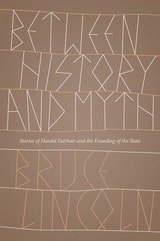
Between History and Myth
Stories of Harald Fairhair and the Founding of the StateBruce Lincoln
University of Chicago Press, 2014
Taking the story of how Harald Fairhair unified Norway in the ninth century as its central example, Bruce Lincoln illuminates the way a state’s foundation story blurs the distinction between history and myth and how variant tellings of origin stories provide opportunities for dissidence and subversion as subtle—or not so subtle—modifications are introduced through details of character, incident, and plot structure. Lincoln reveals a pattern whereby texts written in Iceland were more critical and infinitely more subtle than those produced in Norway, reflecting the fact that the former had a dual audience: not just the Norwegian court, but also Icelanders of the twelfth and thirteenth centuries, whose ancestors had fled from Harald and founded the only non-monarchic, indeed anti-monarchic, state in medieval Europe.
Between History and Myth will appeal not only to specialists in Scandinavian literature and history but also to anyone interested in memory and narrative.
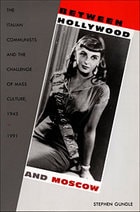
Between Hollywood and Moscow
The Italian Communists and the Challenge of Mass Culture, 1943-1991Stephen Gundle
Duke University Press, 2000
Gundle focuses on the theme of cultural policy, examining how the PCI’s political strategies incorporated cultural policies and activities that were intended to respond to the Americanization of daily life in Italy. In formulating this policy, Gundle contends, the Italian Communists were torn between loyalty to the alternative values generated by the Communist tradition and adaptation to the dominant influences of Italian modernization. This equilibrium eventually faltered because the attractive aspects of Americanization and pop culture proved more influential than the PCI’s intellectual and political traditions.
The first analysis in English of the cultural policies and activities of the PCI, this book will appeal to readers with an interest in modern Italy, the European left, political science, and media studies.
Between Home and Homeland
Youth Aliyah from Nazi GermanyBrian Amkraut
University of Alabama Press, 2006
As Hitler consolidated power, Jews and their allies in Germany began efforts to leave the country. Among them was the organization, Youth Aliyah. Based on abundant archival sources and a thorough use of secondary literature, Brian Amkraut details the story of the organization from its origins through its alliances and antagonisms with other Jewish organizations, and the challenges that vexed its efforts from every side, perhaps the greatest being sheer human naiveté ("surely things will get better").
Amkraut also discusses the identity dilemma for Jews who grew up feeling German, and then had to alter their self-image in the face of growing discrimination. He highlights the internal disagreements of Jewish agencies who wrestled with myriad problems. The author explores how German Jews were ideologically heterogeneous, and details how different groups coped with increasing antagonism in a variety of ways.
To this day, Youth Aliyah is considered by Israelis as a major contributor to the foundation of a Jewish presence leading to the modern state of Israel. Between Home and Homeland is an essential account of an important episode in the history of the Holocaust and the founding of the Isreali state.
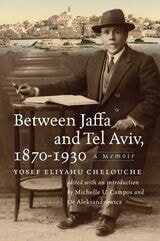
Between Jaffa and Tel Aviv, 1870–1930
A MemoirYosef Eliyahu Chelouche
Brandeis University Press, 2025
Born in Jaffa in 1870, Yosef Eliyahu Chelouche grew up within a notable Sephardi family in the local Jewish community. He went on to become a prominent entrepreneur; a founder of Tel Aviv; and a fierce critic of the Ashkenazi Zionist leadership, Arab nationalism, and British colonial sectarianism; before emerging, in the last decade of his life, as an anguished public figure struggling to repair Arab-Jewish relations.
His memoir paints an intimate portrait of life in Palestine at the turn of the twentieth century, told from the perspective of a Middle Eastern Jew deeply embedded in local society. By centering on the world and experiences of a native Jew who was an eyewitness to and participant in the unfolding conflict in Palestine, this book shows how the course of Zionist politics and Jewish-Arab relations in pre-state Palestine might have taken alternative pathways. A comprehensive introduction sets the scene in late nineteenth- and early twentieth-century Jaffa and thoughtful annotations contextualize Chelouche’s story within the modern history of Palestine and Israel. Between Jaffa and Tel Aviv, 1870–1930 tells the fascinating story of a civic leader—and offers a complex view of the various cultural, social, and political forces that forged multilayered Jewish identities in the Middle East. The book includes a family tree and is illustrated with photographs of the family and scenes of Jaffa and early Tel Aviv.

Between Jesus and the Market
The Emotions that Matter in Right-Wing AmericaLinda Kintz
Duke University Press, 1997
With texts from such organizations as the Christian Coalition, the Heritage Foundation, and Concerned Women for America, and writings by Elizabeth Dole, Newt Gingrich, Pat Robertson, and Rush Limbaugh, Kintz traces the usefulness of this activism for the secular claim that conservative political economy is, in fact, simply an expression of the deepest and most admirable elements of human nature itself. The discussion of Limbaugh shows how he draws on the skepticism of contemporary culture to create a sense of absolute truth within his own media performance—its truth guaranteed by the market. Kintz also describes how conservative interpretations of the Holy Scriptures, the U.S. Constitution, and the Declaration of Independence have been used to challenge causes such as feminism, women’s reproductive rights, and gay and lesbian rights. In addition to critiquing the intellectual and political left for underestimating the power of right-wing grassroots organizing, corporate interests, and postmodern media sophistication, Between Jesus and the Market discusses the proliferation of militia groups, Christian entrepreneurship, and the explosive growth and "selling" of the Promise Keepers.
Between Jew and Arab
The Lost Voice of Simon RawidowiczDavid N. Myers
Brandeis University Press, 2009
Between Legitimacy and Violence
A History of Colombia, 1875–2002Marco Palacios
Duke University Press, 2006
Between Mao and McCarthy
Chinese American Politics in the Cold War YearsCharlotte Brooks
University of Chicago Press, 2014
Between Mao and McCarthy looks at the divergent ways that Chinese Americans in these two cities balanced domestic and international pressures during the tense Cold War era. On both coasts, Chinese Americans sought to gain political power and defend their civil rights, yet only the San Franciscans succeeded. Forging multiracial coalitions and encouraging voting and moderate activism, they avoided the deep divisions and factionalism that consumed their counterparts in New York. Drawing on extensive research in both Chinese- and English-language sources, Charlotte Brooks uncovers the complex, diverse, and surprisingly vibrant politics of an ethnic group trying to find its voice and flex its political muscle in Cold War America.
Between Memory and Reality
Family and Community in Rural Wisconsin, 1870–1970Jane Marie Pederson
University of Wisconsin Press, 1992
An Osseo native looks at the enduring power of immigrant traditions in rural Trempealeau County, from its pioneer days to recent decades.
Between Mussolini and Hitler
The Jews and the Italian Authorities in France and TunisiaDaniel Carpi
University Press of New England, 2002
Between National Socialism and Soviet Communism
Displaced Persons in Postwar GermanyAnna Holian
University of Michigan Press, 2015
"Though its primary focus is on the immediate postwar, Between National Socialism and Soviet Communism will surely illuminate the contemporary crisis around citizenship and definitions of Germanness in the context of European Union and globalization."
---Geoff Eley, University of Michigan
In May of 1945, there were more than eight million "displaced persons" (or DPs) in Germany---recently liberated foreign workers, concentration camp prisoners, and prisoners of war from all of Nazi-occupied Europe, as well as eastern Europeans who had fled west before the advancing Red Army. Although most of them quickly returned home, it soon became clear that large numbers of eastern European DPs could or would not do so. In the aftermath of National Socialism, Germany thus ironically became a temporary home for a large population of "foreigners." Focusing on Bavaria, in the heart of the American occupation zone, Between National Socialism and Soviet Communism examines the cultural and political worlds that four groups of displaced persons---Polish, Ukrainian, Russian, and Jewish---created in Germany during the late 1940s and early 1950s. The volume investigates the development of refugee communities and how divergent interpretations of National Socialism and Soviet Communism defined these displaced groups.
Combining German and eastern European history, Anna Holian draws on a rich array of sources in cultural and political history and engages the broader literature on displacement in the fields of anthropology, sociology, political theory, and cultural studies. Her book will interest students and scholars of German, eastern European, and Jewish history; migration and refugees; and human rights.
Between Past and Future
The Revolution of 1989 and Their AftermathSorin Antohi
Central European University Press, 2000
Between Politics and Ethics
Toward a Vocative History of English StudiesJames N. Comas
Southern Illinois University Press, 2006
For nearly twenty-five years, English studies has been focused on two terms: politics and ethics. However, the institutional emergence, development, and relationship of these two concepts have yet to be examined. Between Politics and Ethics: Toward a Vocative History of English Studies traces the development of politics and ethics in contemporary English studies, questions the current political orientation of the discipline, and proposes a rethinking of the history of English studies based on a “vocative” dimension of writing—the idea that writers form a virtual community by “calling to” and listening to other writers.
In a series of interrelated discussions, James Comas examines the historical trends leading to recent confusion regarding ethics and its relation to the politics of English studies. Through close, rhetorical readings of texts by Judith Butler, Stephen Greenblatt, Edward Said, and others, Comas argues that this confusion is largely the result of a “political turn” that resists theorizing itself. In addition, he argues that work on ethics by Wayne Booth, Geoffrey Harpham, and J. Hillis Miller reflects an uneasy dialectic between the ethics and politics of reading and writing. In response to this discord, Comas turns to the theories of Emmanuel Levinas and Maurice Blanchot, as well as to the examples of Georges Bataille and Kenneth Burke, and proposes a vocative approach to assessing English studies and its history. In doing so, this volume offers a thoughtful reassessment of English studies that affects our understanding of the rhetoric of disciplinary histories.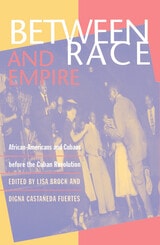
Between Race and Empire
African-Americans and Cubans before the Cuban RevolutionLisa Brock
Temple University Press, 1998
The eleven essays gathered here, written by scholars from both countries, heighten our appreciation of African-Americans as international actors and challenge the notion that Cubans had little or no race consciousness. This is the first study of the world capitalist system to track the international consciousness of working peoples, peoples of color, and women. With a focus on two sets of peoples not in state power, Between Race and Empire expands our understanding of "history from below," and reflects current trends in PanAfricanist and African Diaspora studies by tracing a little-studied linkage between two peoples of African descent.
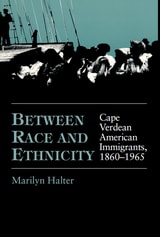
Between Race and Ethnicity
Cape Verdean American Immigrants, 1860-1965Marilyn Halter
University of Illinois Press, 1993
Marilyn Halter combines oral history with analyses of ships' records to chart the history and adaptation patterns of the Cape Verdean Americans. Though identifying themselves in ethnic terms, Cape Verdeans found that their African-European ancestry led their new society to view them as a racial group. Halter emphasizes racial and ethnic identity formation to show how Cape Verdeans set themselves apart from the African Americans while attempting to shrug off white society's exclusionary tactics. She also contrasts rural life on the bogs of Cape Cod with New Bedford’s urban community to reveal the ways immigrants established their own social and religious groups as they strove to maintain their Crioulo customs.
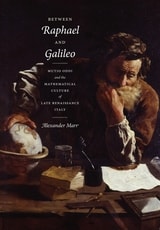
Between Raphael and Galileo
Mutio Oddi and the Mathematical Culture of Late Renaissance ItalyAlexander Marr
University of Chicago Press, 2011
Although largely unknown today, during his lifetime Mutio Oddi of Urbino (1569–1639) was a highly esteemed scholar, teacher, and practitioner of a wide range of disciplines related to mathematics. A prime example of the artisan-scholar so prevalent in the late Renaissance, Oddi was also accomplished in the fields of civil and military architecture and the design and retail of mathematical instruments, as well as writing and publishing.
In Between Raphael and Galileo, Alexander Marr resurrects the career and achievements of Oddi in order to examine the ways in which mathematics, material culture, and the book shaped knowledge, society, and the visual arts in late Renaissance Italy. Marr scrutinizes the extensive archive of Oddi papers, documenting Oddi’s collaboration with prominent intellectuals and officials and shedding new light on the practice of science and art during his day. What becomes clear is that Oddi, precisely because he was not spectacularly innovative and did not attain the status of a hero in modern science, is characteristic of the majority of scientific practitioners and educators active in this formative age, particularly those whose energetic popularization of mathematics laid the foundations for the Scientific Revolution. Marr also demonstrates that scientific change in this era was multivalent and contested, governed as much by friendship as by principle and determined as much by places as by purpose.
Plunging the reader into Oddi’s world, Between Raphael and Galileo is a finely wrought and meticulously researched tale of science, art, commerce, and society in the late sixteenth and early seventeenth century. It will become required reading for any scholar interested in the history of science, visual art, and print culture of the Early Modern period.
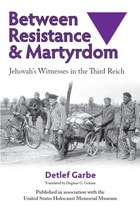
Between Resistance and Martyrdom
Jehovah's Witnesses in the Third ReichDetlef Garbe
University of Wisconsin Press, 2008
Although persecuted and banned from practicing their beliefs by the Nazi regime in 1933, the Jehovah’s Witnesses’ unified resistance has been largely forgotten. Basing his work on a wide range of sources, including documents and archives previously unconsidered as well as critical analyses of Jehovah’s Witness literature and survivor interviews, Detlef Garbe chronicles the Nazi’s relentless persecution of this religious group before and during World War II.
The English translation of this important work features a series of original photographs not published in the German edition. These striking images bring a sense of individual humanity to this story and help readers comprehend the reality of the events documented. Between Resistance and Martyrdom is an indispensable work that will introduce an English-speaking audience to this important but lesser-known part of Holocaust history.
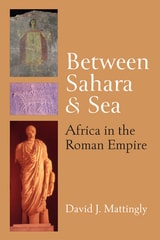
Between Sahara and Sea
Africa in the Roman EmpireDavid J. Mattingly
University of Michigan Press, 2023
Winner of the 2024 Association of American Publishers PROSE Award for Classics
- Winner of the 2025 Vinson Sutlive Book Prize and Lecture
Between Sahara and Sea: Africa in the Roman Empire challenges orthodox views of the story of Africa under Roman domination. It presents a new framework for understanding this and other territories incorporated in the Roman Empire. Based on decades of research in North Africa, David Mattingly’s book is a cleverly constructed and innovative account of the history and archaeology of ancient North Africa (roughly equivalent to Morocco, Algeria, Tunisia, and Libya) from the first century BCE to the third century CE. He charts a new path toward a bottom-up understanding of North African archaeology, exploring in turn the differing material cultures and experiences of the Roman communities of the military and the urban and rural areas. Regional and societal differences emerge as significant and of long duration in the fascinating story of one of the most important sectors of the Roman Empire.
This important book is the most comprehensive in English on Roman North Africa. It is remarkably rich, with up-to-date references and a host of new ideas and perspectives. Well written and illustrated, with a plethora of maps, it will be required reading for anyone interested in the subject. Rather than emphasizing the role of external actors, as studies of “Roman Africa” have traditionally done, Between Sahara and Sea focuses on local contributions to the making of Africa in the Roman Empire. The author demonstrates that the multiple populations encountered by Rome were not an indistinct bloc, but had different identities and cultures.

Between Sea and Sahara
An Algerian JournalEugene Fromentin
Ohio University Press, 1999
Between Sea and Sahara gives us Algeria in the third decade of colonization. Written in the 1850s by the gifted painter and extraordinary writer Eugene Fromentin, the many-faceted work is travelogue, fiction, stylized memoir, and essay on art. Fromentin paints a compelling word picture of Algeria and its people, questioning France’s—and his own—role there. He shows French dynamism tending to arrogance, tinged with malaise, as well as the complexity of the Algerians and their canny survival tactics. In his efforts to capture the non-Western world on paper as well as on canvas, Fromentin reveals much about the roots of a colonial relationship that continues to affect the Algeria of today. He also reveals his own development as painter, writer—and human being.
Now available for the first time in English, Between Sea and Sahara appeals to today’s reader on many levels—as a story of color, romance, and dramatic tension; as an eywitness account of the colonial experience in Algeria; as a study in trans-genre text, foreshadowing Fromentin’s psychological masterpiece, the novel Dominique. And, as Valérie Orlando points out in her introduction, Fromentin opens a window on the ethos informing the fashion of Orientalism that flourished with colonialism.

Between Tedium and Terror
A Soldier's World War II Diary, 1943-45Sy M. KahnForeword by Ronald Spector
University of Illinois Press, 1993
Often writing in tents by candlelight, in foxholes, or on board ships, Kahn documents life during four campaigns and over three hundred air attacks. He describes the 244th Port Company's backbreaking work of loading and unloading ships, the suffocating heat, the debilitating tropical diseases, and the relentless, sometimes terrifying bombings, accidents, casualties, and deaths.
His wartime odyssey also includes encounters with civilians in Australia, in the Philippines, and, as among the earliest occupation troops, in Japan. A detailed record of the daily cost of war, Kahn's journal reflects his increasing maturity and his personal coming of age, representative of thousands of young Americans who served in World War II.
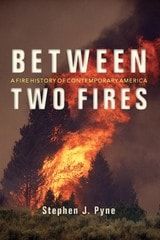
Between Two Fires
A Fire History of Contemporary AmericaStephen J. Pyne
University of Arizona Press, 2015
Pyne is uniquely qualified to tell America’s fire story. The author of more than a score of books, he has told fire’s history in the United States, Australia, Canada, Europe, and the Earth overall. In his earlier life, he spent fifteen seasons with the North Rim Longshots at Grand Canyon National Park.
In Between Two Fires, Pyne recounts how, after the Great Fires of 1910, a policy of fire suppression spread from America’s founding corps of foresters into a national policy that manifested itself as a costly all-out war on fire. After fifty years of attempted fire suppression, a revolution in thinking led to a more pluralistic strategy for fire’s restoration. The revolution succeeded in displacing suppression as a sole strategy, but it has failed to fully integrate fire and land management and has fallen short of its goals.
Today, the nation’s backcountry and increasingly its exurban fringe are threatened by larger and more damaging burns, fire agencies are scrambling for funds, firefighters continue to die, and the country seems unable to come to grips with the fundamentals behind a rising tide of megafires. Pyne has once again constructed a history of record that will shape our next century of fire management. Between Two Fires is a story of ideas, institutions, and fires. It’s America’s story told through the nation’s flames.
Between Two Fires
Gypsy Performance and Romani Memory from Pushkin to Post-SocialismAlaina Lemon
Duke University Press, 2000
Lemon’s ethnographic study is based on extensive fieldwork in 1990s Russia and focuses on Moscow Romani Theater actors as well as Romani traders and metalworkers. Drawing from interviews with Roma and Russians, observations of performances, and conversations, as well as archives, literary texts, and media, Lemon analyzes the role of theatricality and theatrical tropes in Romani life and the everyday linguistics of social relations and of memory. Historically, the way Romani stage performance has been culturally framed and positioned in Russia has served to typecast Gypsies as “natural” performers, she explains. Thus, while theatrical and musical performance may at times empower Roma, more often it has reinforced and rationalized racial and social stereotypes, excluding them from many Soviet and Russian economic and political arenas. Performance, therefore, defines what it means to be Romani in Russia differently than it does elsewhere, Lemon shows. Considering formal details of language as well as broader cultural and social structures, she also discusses how racial categories relate to post-Soviet economic changes, how gender categories and Euro-Soviet notions of civility are connected, and how ontological distinctions between “stage art” and “real life” contribute to the making of social types. This complex study thus serves as a corrective to romantic views of Roma as detached from political forces.
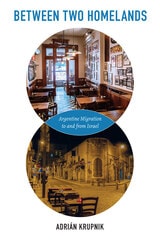
Between Two Homelands
Argentine Migration to and from IsraelAdrián Krupnik
University of Alabama Press, 2024
Emigration from Israel to other parts of the world has not yet received significant scholarly attention, as the subject is a sensitive one in Israeli society. Zionist ideology has long compelled Israelis to approach emigration from Israel through a biased lens. The Hebrew words aliyah and yerida, which mean, respectively, “ascent” and “descent,” are often used to refer to immigration and emigration. These ideological terms, which are charged with religious meaning, are heavily loaded with praise for immigrants and scorn for emigrants. Yet, thousands of Jews from all over the world have lived between two homelands, as the Israeli-Argentine case demonstrates. This study challenges the formerly dominant Zionist narrative that presents immigration to Israel as unique and emigration as a disgrace, shedding light on issues of immigrant identities, belonging, and expectations.
Covering the better part of the twentieth century and extending into the twenty-first, Adrián Krupnik bases his study both on interviews and on archival documents in English, Spanish, and Hebrew to give voice to Argentine migrants to and from Israel. The pursuit of two often irreconcilable ways of living—peace and economic prosperity—repeatedly vexed migrants moving in either direction. Many Jewish-Argentine migrants between 1980 and 2006 lost everything and became the “new poor” in both countries. Protracted recessions and incessant political crises in Argentina continued to drive migrants in one direction, only to arrive in an Israel submerged in the violence of multiple intifadas.
In our own era, one that will see unprecedented global migration patterns based on similar economic and political—and environmental—upheavals, Between Two Homelands serves as an important and informative cautionary tale of the personal, social, and economic stakes at play in an utterly unsettled globalized landscape.
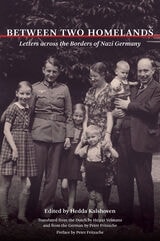
Between Two Homelands
Letters across the Borders of Nazi GermanyEdited by Hedda Kalshoven
University of Illinois Press, 2014
In 1920, at the age of thirteen, Irmgard Gebensleben first traveled from Germany to The Netherlands on a "war-children transport." She would later marry a Dutch man and live and raise her family there while keeping close to her German family and friends through the frequent exchange of letters. Yet during this period geography was not all that separated them. Increasing divergence in political opinions and eventual war between their countries meant letters contained not only family news but personal perspectives on the individual, local, and national choices that would result in the most destructive war in history.
This important collection, first assembled by Irmgard Gebensleben's daughter Hedda Kalshoven, gives voice to ordinary Germans in the Weimar Republic and the Third Reich and in the occupied Netherlands. The correspondence between Irmgard, her friends, and four generations of her family delve into their most intimate and candid thoughts and feelings about the rise of National Socialism. The responses to the German invasion and occupation of the Netherlands expose the deeply divided loyalties of the family and reveal their attempts to bridge them. Of particular value to historians, the letters evoke the writers' beliefs and their understanding of the events happening around them.
This first English translation of Ik denk zoveel aan jullie: Een briefwisseling tussen Nederland en Duitsland 1920-1949, has been edited, abridged, and annotated by Peter Fritzsche with the assent and collaboration of Hedda Kalshoven. After the book's original publication the diary of Irmgard's brother and loyal Wehrmacht soldier, Eberhard, was discovered and edited by Hedda Kalshoven. Fritzsche has drawn on this important additional source in his preface.
Between Two Plenums
China’s Intraleadership Conflict, 1959–1962Ellis Joffe
University of Michigan Press, 1975
Between Watergate and the Gulag
The French Press and Politics, 1970–1985Charles R. Eisendrath
Michigan Publishing Services, 2022
Also introduced: “surplus freedom” a novel approach for gauging self-censorship by comparing the degree of free expression a legal system permits to what publications actually exercise.

Between Worlds
Interpreters, Guides, and SurvivorsFrances Karttunen
Rutgers University Press, 1994
Spanning the globe and the centuries, Frances Karttunen tells the stories of sixteen men and women who served as interpreters and guides to conquerors, missionaries, explorers, soldiers, and anthropologists. These interpreters acted as uncomfortable bridges between two worlds; their own marginality, the fact that they belonged to neither world,underscores the complexity and tension between cultures meeting for the first time. The interpreters include:
o Do–a Marina (La Malinche), who interpreted for Cortes in the conquest of Mexico
o Sacajawea, who accompanied Lewis and Clark on their expedition
o Sarah Winnemucca, a U.S. army scout and Washington lobbyist for the Northern Paiutes
o Gaspar Antonio Chi, Maya Interpreter General for Yucatan
o Guaman Poma de Ayala, eyewitness reporter of the destruction of Inca culture
o Charles Eastman, a Sioux physician at Wounded Knee
o Larin Paraske, an informant for Finnish ethnographers
o Do–a Luz Jimenez, Diego Rivera’s model and a native informant to anthropologists
o Mar’a Sabina, the Mazatec mushroom shaman who became a celebrity in the drug culture of the 1960s
o Ishi, the last surviving Yahi Indian.
Between a River and a Mountain
The AFL-CIO and the Vietnam WarEdmund F. Wehrle
University of Michigan Press, 2010
"Stunning in its research and sophisticated in its analysis, Between a River and a Mountain is one of the best studies we have of labor and the Vietnam War."
--Robert K. Brigham, Shirley Ecker Boskey Professor of History and International Relations, Vassar College
"Skillfully blending diplomatic and labor history, Wehrle's book is a valuable contribution to the ever-widening literature on the Vietnam War."
--George Herring, University of Kentucky
"Wehrle has written a compelling and original study of the AFL-CIO, the South Vietnamese labor movement and the Vietnam War."
--Judith Stein, Professor of History, City College and Graduate School of the City University of New York
"With this important book, Edmund Wehrle gives us the first full-fledged scholarly examination of organized labor's relationship to the Vietnam War. Based on deep research in U.S. and foreign archives, and presented in clear and graceful prose, Between a River and a Mountain adds a great deal to our understanding of how the AFL-CIO approached the war and in turn was fundamentally altered by its staunch support for Americanization. Nor is it merely an American story that Wehrle tells, for he also presents fascinating information on the Vietnamese Confederation of Labor and its sometimes-strained relations with U.S. labor."
--Fredrik Logevall, Cornell University
Edmund F. Wehrle is Assistant Professor of History, Eastern Illinois University.
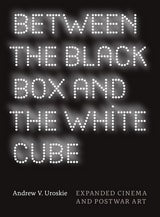
Between the Black Box and the White Cube
Expanded Cinema and Postwar ArtAndrew V. Uroskie
University of Chicago Press, 2014
Explaining that the postwar expanded cinema was a response to both developments, Andrew V. Uroskie argues that, rather than a formal or technological innovation, the key change for artists involved a displacement of the moving image from the familiarity of the cinematic theater to original spaces and contexts. He shows how newly available, inexpensive film and video technology enabled artists such as Nam June Paik, Robert Whitman, Stan VanDerBeek, Robert Breer, and especially Andy Warhol to become filmmakers. Through their efforts to explore a fresh way of experiencing the moving image, these artists sought to reimagine the nature and possibilities of art in a post-cinematic age and helped to develop a novel space between the “black box” of the movie theater and the “white cube” of the art gallery. Packed with over one hundred illustrations, Between the Black Box and the White Cube is a compelling look at a seminal moment in the cultural life of the moving image and its emergence in contemporary art.
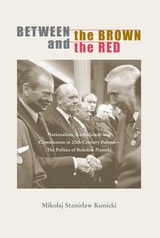
Between the Brown and the Red
Nationalism, Catholicism, and Communism in Twentieth-Century Poland—The Politics of Boleslaw PiaseckiMikolaj Stanislaw Kunicki
Ohio University Press, 2012
Between the Brown and the Red captures the multifaceted nature of church-state relations in communist Poland, relations that oscillated between mutual confrontation, accommodation, and dialogue. Ironically, under communism the bond between religion and nation in Poland grew stronger. This happened in spite of the fact that the government deployed nationalist themes in order to portray itself as more Polish than communist. Between the Brown and the Red also introduces one of the most fascinating figures in the history of twentieth-century Poland and the communist world.
In this study of the complex relationships between nationalism, communism, authoritarianism, and religion in twentieth-century Poland, Mikołaj Kunicki shows the ways in which the country’s communist rulers tried to adapt communism to local traditions, particularly ethnocentric nationalism and Catholicism. Focusing on the political career of Bolesław Piasecki, a Polish nationalist politician who began his surprising but illuminating journey as a fascist before the Second World War and ended it as a procommunist activist, Kunicki demonstrates that Polish communists reinforced an ethnocentric self-definition of Polishness and—as Piasecki’s case demonstrates—thereby prolonged the existence of Poland’s nationalist Right.
Between the Eagle and the Sun
Traces of JapanIhab Hassan
University of Alabama Press, 1996
A fascinating memoir by Egypt-born American literary theorist and writer Ihab Hassan about his life in Japan. Part recollection, part cultural perception, Between the Eagle and the Sun records his journey, living and seeing himself sometimes as another, assaying always to read the hieroglyphs of his past in the scripts of Japan. As lucid as it is intensely felt, at once lyrical and critical, the work offers a beguiling vision of Japan and, by tacit contrast, of America. For writing, the author says, is more than praise or blame, it is also knowledge, empathy, and delight. These attributes are evident in Hassan's treatment of Japanese culture, its people and scenes. Indeed, the people, rendered in vibrant portraits throughout the book, abide when all the shadows of romance and exasperation have fled.
True to its moment, the work also reinvests the forms of memoir, travel, and quest. Cultural essays, travel anecdotes, autobiographical meditations, portraits of Japanese friends, a section titled "Entries, A to Z," fit into a tight frame, with clear transitions from one section to another. The style, however, alters subtly to suit topic, occasion, and mood.
Japan may not hold the key to this planet's future; no single nation does. Yet the continuing interest in its history, society, and people and the incresed awareness of its recent trends and growing global impact engage an expanding audience. Avoiding cliches, sympathetic to its subject yet analytical, unflinching in judgment, and withal highly personal, Between the Eagle and the Sun offers a unique image of its subject by a distinguished and well-traveled critic, at home in several cultures.
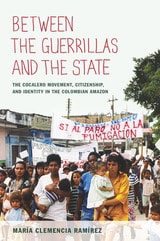
Between the Guerrillas and the State
The Cocalero Movement, Citizenship, and Identity in the Colombian AmazonMaría Clemencia Ramírez
Duke University Press, 2011
Between the Living and the Dead
A Perspective on Witches and Seers in the Early Modern AgeÉva Pócs
Central European University Press, 1998
Between the Middle East and the Americas
The Cultural Politics of DiasporaEdited by Evelyn Alsultany and Ella Shohat
University of Michigan Press, 2013
Between the Middle East and the Americas: The Cultural Politics of Diaspora traces the production and circulation of discourses about "the Middle East" across various cultural sites, against the historical backdrop of cross-Atlantic Mahjar flows. The book highlights the fraught and ambivalent situation of Arabs/Muslims in the Americas, where they are at once celebrated and demonized, integrated and marginalized, simultaneously invisible and spectacularly visible. The essays cover such themes as Arab hip-hop's transnational imaginary; gender/sexuality and the Muslim digital diaspora; patriotic drama and the media's War on Terror; the global negotiation of the Prophet Mohammad cartoons controversy; the Latin American paradoxes of Turcophobia/Turcophilia; the ambiguities of the bellydancing fad; French and American commodification of Rumi spirituality; the reception of Iranian memoirs as cultural domestication; and the politics of translation of Turkish novels into English. Taken together, the essays analyze the hegemonic discourses that position "the Middle East" as a consumable exoticized object, while also developing complex understandings of self-representation in literature, cinema/TV, music, performance, visual culture, and digital spaces. Charting the shifting significations of differing and overlapping forms of Orientalism, the volume addresses Middle Eastern diasporic practices from a transnational perspective that brings postcolonial cultural studies methods to bear on Arab American studies, Middle Eastern studies, and Latin American studies. Between the Middle East and the Americas disentangles the conventional separation of regions, moving beyond the binarist notion of "here" and "there" to imaginatively reveal the thorough interconnectedness of cultural geographies.
Between the Sea and the Lagoon
An Eco-social History of the Anlo of Southeastern Ghana c. 1850 to Recent TimesEmmanuel Kwaku Akyeampong
Ohio University Press, 2002
This study offers a “social interpretation of environmental process” for the coastal lowlands of southeastern Ghana. The Anlo-Ewe, sometimes hailed as the quintessential sea fishermen of the West African coast, are a previously non-maritime people who developed a maritime tradition. As a fishing community the Anlo have a strong attachment to their land. In the twentieth century coastal erosion has brought about a collapse of the balance between nature and culture. The Anlo have sought spiritual explanations but at the same time have responded politically by developing broader ties with Ewe-speaking peoples along the coast.
Between the Sword and the Wall
The Santos Peace Negotiations with the Revolutionary Armed Forces of ColombiaHarvey F. Kline
University of Alabama Press, 2020
Chronicles the peace process negotiations between Colombian president Juan Manuel Santos and the Marxist Revolutionary Armed Forces of Colombia
In Between the Sword and the Wall: The Santos Peace Negotiations with the Revolutionary Armed Forces of Colombia, Harvey Kline, a noted expert on contemporary Colombian politics, brings to a close his multivolume chronicle of the incessant violence that has devastated Colombia’s population, politics, and military for decades. This, his newest work on the subject, recounts and analyzes the negotiations between Colombian president Juan Manuel Santos and the Marxist Revolutionary Armed Forces of Colombia (FARC), which ended with a peace agreement in 2016.
The FARC insurgency began in 1964, and every Colombian president after 1980 unsuccessfully tried to negotiate a peace agreement with the group. Kline analyzes how the Santos administration was ultimately able to negotiate peace with the FARC. The agreement failed to receive the approval of the Colombian people in an October 2016 plebiscite, but a renegotiated version was later approved by the congress in the same year. Afterward, more than 7,000 rebels turned over their weapons to the UN mission in Colombia. The former combatants were then to be judged by a special court empowered to punish but not imprison those who had violated human rights. Throughout the book, Kline emphasizes the dual nature of the Santos negotiations, first with the FARC and second with the democratic opposition to the agreement led by former president Álvaro Uribe Vélez.
Kline provides readers with a well-researched analysis based on a variety of resources, including media articles and primary documents from the government, international organizations, and the FARC. He also conducted extensive interviews with twenty-eight government officials and Colombian experts from all ideological persuasions.