Results by title
977 books match the query 'American literature' and 75 start with c
CROSS-CULTURAL VISIONS IN AFRICAN AMERICAN MODERNISM
FROM SPATIAL NARRATIVE TO JAZZ HAIKUYOSHINOBU HAKUTANI
The Ohio State University Press, 2006
In writing Black Boy, the centerpiece of the Chicago Renaissance, Wright was inspired by Theodore Dreiser. Because the European and African cultural visions that Wright, Ralph Ellison, Alice Walker, and Toni Morrison acquired were buttressed by the universal humanism that is common to all cultures, this ideology is shown to transcend the problems of society. Fascinated by Eastern thought and art, Wright, Walker, Sonia Sanchez, and James Emanuel wrote highly accomplished poetry and prose. Like Ezra Pound, Wright was drawn to classic haiku, as reflected in the 4,000 haiku he wrote at the end of his life. As W. B. Yeats’s symbolism was influenced by his cross-cultural visions of noh theatre and Irish folklore, so is James Emanuel’s jazz haiku energized by his cross-cultural rhythms of Japanese poetry and African American music.
The book demonstrates some of the most visible cultural exchanges in modern and postmodern African American literature. Such a study can be extended to other contemporary African American writers whose works also thrive on their cross-cultural visions, such as Amiri Baraka, Ishmael Reed, Charles Johnson, and haiku poet Lenard Moore.
California And The Fictions Of Capital
George Henderson
Temple University Press, 2003
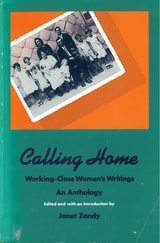
Calling Home
Working-Class Women's WritingsZandy, Janet
Rutgers University Press, 1990
The geography of home, identity, parents, sex, motherhood, the dominance of the job, the overlapping of private and public worlds, the promise of solidarity and community are a few of the themes of this book. Here is a chorus of working class women's voices: Sandra Cisneros, Barbara Garson, Meridel Le Sueur, Tillie Olsen, Barbara Smith, Endesha I. M. Holland, Mother Jones, Nellie Wong, Agnes Smedley, Bobbie Louise Hawkins, Sharon Doubiago, Carol Tarlen, Hazel Hall, Margaret Randall, Judy Grahn, and many others!
The aesthetic impulse is shaped by class, but not limited to one ruling class. What connects these writers is a collective consciousness, a class, which rejects bondage and lays claim to liberation through all the possibilities of language. Calling Home is illustrated with family photographs as well as images of working women by professional photographers.
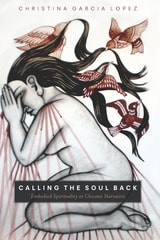
Calling the Soul Back
Embodied Spirituality in Chicanx NarrativeChristina Garcia Lopez
University of Arizona Press, 2019
Calling the Soul Back explores the spiritual and ancestral knowledge offered in narratives of bodies in trauma, bodies engaged in ritual, grieving bodies, bodies immersed in and becoming part of nature, and dreaming bodies. Reading across narrative nonfiction, performative monologue, short fiction, fables, illustrated children’s books, and a novel, Garcia Lopez asks how these narratives draw on the embodied intersections of ways of knowing and being to shift readers’ consciousness regarding relationships to space, time, and natural environments.
Using an interdisciplinary approach, Calling the Soul Back draws on literary and Chicanx studies scholars as well as those in religious studies, feminist studies, sociology, environmental studies, philosophy, and Indigenous studies, to reveal narrative’s healing potential to bring the soul into balance with the body and mind.
Camino del Sol
Fifteen Years of Latina and Latino WritingEdited by Rigoberto González
University of Arizona Press, 2010
Featuring both established writers and first-time authors, Camino del Sol has published poetry and prose that convey something about the Latina/o experience—works that tap into universal truths through a distinct cultural lens. This volume celebrates fifteen years of books by bringing together some of the series’ best work, such as poetry from Francisco X. Alarcón, fiction from Christine Granados, and nonfiction from Luis Alberto Urrea. These voices echo the entire spectrum of Latina/o writing, from Chicana/o to Puerto Rican to Brazilian-American, and take in themes ranging from migration to gender.
Awards bestowed upon Camino del Sol titles include the PEN/Beyond Margins Award to Richard Blanco’s Directions to the Beach of the Dead; Before Columbus Foundation American Book Awards to Diana García’s When Living Was a Labor Camp and Luis Alberto Urrea’s Nobody’s Son; International Latino Book Awards to Pat Mora’s Adobe Odes and Kathleen Alcalá’s The Desert Remembers My Name; the Premio Aztlán literary prize to Sergio Troncoso’s The Last Tortilla; and the PEN Oakland-Josephine Miles National Literary Award to Kathleen de Azevedo’s Samba Dreamers. All of these works are represented in this outstanding collection.
In a short span of time, Camino del Sol has cultivated an admirable and sizeable list of distinguished contemporary authors—and even garnered the first National Book Critics Circle Award for a Chicana/o for Juan Felipe Herrera’s Half of the World in Light. Camino del Sol: Fifteen Years of Latina and Latino Writing is a benchmark for the series and a wonderful introduction to the world of Latina/o literature.

Cannibal Democracy
Race and Representation in the Literature of the AmericasZita Nunes
University of Minnesota Press, 2008
Zita Nunes argues that the prevailing narratives of identity formation throughout the Americas share a dependence on metaphors of incorporation and, often, of cannibalism. From the position of the incorporating body, the construction of a national and racial identity through a process of assimilation presupposes a remainder, a residue.
Nunes addresses works by writers and artists who explore what is left behind in the formation of national identities and speak to the limits of the contemporary discourse of democracy. Cannibal Democracy tracks its central metaphor’s circulation through the work of writers such as Mário de Andrade, W. E. B. Du Bois, and Toni Morrison and journalists of the black press, as well as work by visual artists including Magdalena Campos-Pons and Keith Piper, and reveals how exclusion-understood in terms of what is left out-can be fruitfully understood in terms of what is left over from a process of unification or incorporation.
Nunes shows that while this remainder can be deferred into the future-lurking as a threat to the desired stability of the present-the residue haunts discourses of national unity, undermining the ideologies of democracy that claim to resolve issues of race.
Zita Nunes is associate professor of English at the University of Maryland, College Park.
Canons by Consensus
Critical Trends and American Literature AnthologiesJoseph Csicsila, with a foreword by Tom Quirk
University of Alabama Press, 2004
The first systematic analysis of American literature textbooks used by college instructors in the last century
Scholars have long noted the role that college literary anthologies play in the rising and falling reputations of American authors. Canons by Consensus examines this classroom fixture in detail to challenge and correct a number of assumptions about the development of the literary canon throughout the 20th century.
Joseph Csicsila analyzes more than 80 anthologies published since 1919 and traces not only the critical fortunes of individual authors, but also the treatment of entire genres and groupings of authors by race, region, gender, and formal approach. In doing so, he calls into question accusations of deliberate or inadvertent sexism and racism. Selections by anthology editors, Csicsila demonstrates, have always been governed far more by prevailing trends in academic criticism than by personal bias.
Academic anthologies are found to constitute a rich and often overlooked resource for studying American literature, as well as an irrefutable record of the academy’s changing literary tastes throughout the last century.
Capital Letters
Authorship in the Antebellum Literary MarketDavid Dowling
University of Iowa Press, 2009
In the 1840s and 1850s, as the market revolution swept the United States, the world of literature confronted for the first time the gaudy glare of commercial culture. Amid growing technological sophistication and mounting artistic rejection of the soullessness of materialism, authorship passed from an era of patronage and entered the clamoring free market. In this setting, romantic notions of what it meant to be an author came under attack, and authors became professionals.
In lively and provocative writing, David Dowling moves beyond a study of the emotional toll that this crisis in self-definition had on writers to examine how three sets of authors—in pairings of men and women: Harriet Wilson and Henry David Thoreau, Fanny Fern and Walt Whitman, and Rebecca Harding Davis and Herman Melville—engaged with and transformed the book market. What were their critiques of the capitalism that was transforming the world around them? How did they respond to the changing marketplace that came to define their very success as authors? How was the role of women influenced by these conditions?
Capital Letters concludes with a fascinating and daring transhistorical comparison of how two superstar authors—Herman Melville in the nineteenth century and Stephen King today—have negotiated the shifty terrain of the literary marketplace. The result is an important contribution to our understanding of print culture and literary work.

Captains of Charity
The Writing and Wages of Postrevolutionary Atlantic BenevolenceMary Kathleen Eyring
University of New Hampshire Press, 2017
According to Eyring, the men and women who most successfully wrote about and engaged in benevolent work strategically connected their work with the affluence generated by maritime commerce. The water trades supported the growth of the American publishing industry, but they also generated both vast inequities in wealth and physically and economically hazardous conditions that, in the absence of a welfare state, required the intervention of benevolent societies. Laborers in Atlantic port cities barred from lucrative professions by gender, race, physical ability, or social status found a way to make a living wage by conjoining the literary with the charitable—and attaching both to a profit structure. In so doing, they transformed the nature of American benevolence and gave rise to the nonprofit sector, which has since its inception provided discontented laborers with a forum in which to express their critique of for-profit American enterprise, by imitating it.
In Captains of Charity, Eyring looks at writers who overcame their marginalized status by bringing together the strands of maritime industry, publishing, and benevolence. These include Richard Allen and Absalom Jones, two black clergymen who managed a massive relief effort when refugees fleeing revolution in Haiti transported the yellow fever virus to Philadelphia in 1793; Nancy Prince, a free woman of color who sought her livelihood in the Protestant missions of Jamaica in the years immediately following Britain's emancipation of laborers in its Caribbean colonies; Sarah Josepha Hale, who parlayed the social influence she had gained as the founder of a seaman's aid society in Boston into a role as editor of the hugely popular periodical Godey's Lady's Book; and Sarah Pogson Smith, who donated the proceeds of her writing to such prominent charitable causes as the New York Institution for the Instruction of the Deaf and Dumb and then capitalized on the goodwill this charity work generated among her wealthy friends in New York City, Philadelphia, and Charleston.
Hardcover is un-jacketed.

Captive Ecologies
The Environmental Afterlives of SlaveryJennifer C. James
Duke University Press, 2026

Captivity and Sentiment
Cultural Exchange in American Literature, 1682–1861Michelle Burnham
Dartmouth College Press, 2000
Capturing Mariposas
Reading Cultural Schema in Gay Chicano LiteratureDoug P. Bush
The Ohio State University Press, 2019
In Capturing Mariposas: Reading Cultural Schema in Gay Chicano Literature, Doug P. Bush looks at the book as only the beginning, considering how this literature has the power to bring understanding to disparate groups, speak truth about repressed sexuality and repressive communities, and recast traditional spaces as ones of inclusion, all through the idea of the cultural schema. Integrating elements of narratology and cognitive studies of literature, the cultural schema speaks to how these authors challenge, reaffirm, and transform commonly held experiences of gay Chicanos—or potentially any audience who reads their works. Focusing on twenty-first-century writers such as Manuel Muñoz, Rigoberto González, and Alex Espinoza, Bush examines the cultural schema of their works and then moves toward a more holistic discussion of the publishing and political implications of this genre. In addition to Bush’s important scholarship, the book includes extensive interviews with the authors themselves.
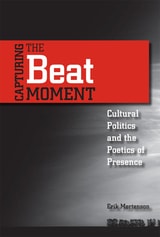
Capturing the Beat Moment
Cultural Politics and the Poetics of PresenceErik Mortenson
Southern Illinois University Press, 2010
CHOICE Outstanding Academic Title
Examining “the moment” as one of the primary motifs of Beat writing, Erik Mortenson offers the first book to investigate immediacy and its presence and importance in Beat writing. Capturing the Beat Moment: Cultural Politics and the Poetics of Presence places an expanded canon of Beat writers in an early postmodern context that highlights their importance in American poetics and provides an account of Beat practices that reveal how gender and race affect Beat politics of the moment.
Mortenson argues that Beat writers focused on action, desire, and spontaneity to establish an authentic connection to the world around them and believed that “living in the moment” was the only way in which they might establish the kind of life that led to good writing. With this in mind, he explores the possibility that, far from being the antithesis of their times, the Beats actually were a product of them. Mortenson outlines the effects of gender and race on Beat writing in the postwar years, as well as the Beats’ attempts to break free of the constrictive notions of time and space prevalent during the 1950s.
Mortenson discusses such topics as the importance of personal visionary experiences; the embodiment of sexuality and the moment of ecstasy in Beat writing; how the Beats used photographs to evoke the past; and the ways that Beat culture was designed to offer alternatives to existing political and social structures. Throughout the volume, Mortenson moves beyond the Kerouac-Ginsberg-Burroughs triumvirate commonly associated with Beat literature, discussing women—such as Diane di Prima, Janine Pommy Vega, and Joyce Johnson—and African American writers, including Bob Kaufman and Amiri Baraka. With the inclusion of these authors comes a richer understanding of the Beat writers’ value and influence in American literary history.
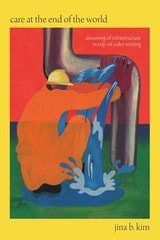
Care at the End of the World
Dreaming of Infrastructure in Crip-of-Color WritingJina B. Kim
Duke University Press, 2025
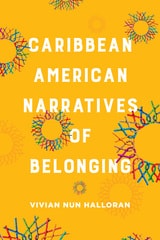
Caribbean American Narratives of Belonging
Vivian Nun Halloran
The Ohio State University Press, 2023
In Caribbean American Narratives of Belonging, Vivian Nun Halloran analyzes memoirs, picture books, comic books, young adult novels, musicals, and television shows through which Caribbean Americans recount and celebrate their contributions to contemporary politics, culture, and activism in the United States. The writers, civil servants, illustrators, performers, and entertainers whose work is discussed here show what it is like to fit in and be included within the body politic. From civic memoirs by Sonia Sotomayor and others, to West Side Story, Hamilton, and Into the Spider-Verse, these texts share a forward-looking perspective, distinct from the more nostalgic rhetoric of traditional diasporic texts that privilege connections to the islands of origin.
There is no one way of being Caribbean. Diasporic communities exhibit a broad spectrum of ethnic, racial, religious, linguistic, and political qualities. Claiming a Caribbean American identity asks wider society to recognize and affirm hybridity in ways that challenge binaristic conceptions of race and nationality. Halloran provides a common language and critical framework to discuss the achievements of members of the Caribbean diaspora and their considerable cultural and political capital as evident in their contributions to literature and popular culture.
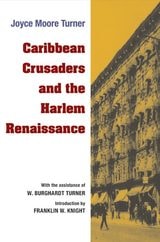
Caribbean Crusaders and the Harlem Renaissance
Joyce Moore Turner
University of Illinois Press, 2005
To explore the roots of the Caribbean emigres' radical ideology and the strategies used to extend agitation from Harlem to national and international platforms, the study draws on the papers and writings of Hermina Huiswoud, Cyril Briggs, the Reverend E. Ethelred Brown, Langston Hughes, and Richard B. Moore, as well as from interviews and biographies of related contemporary figures. It also incorporates census records, FBI files, and hundreds of documents from the recently opened Russian Archive.
Through a focus on Otto Huiswoud, the sole African American charter member of the Communist Party, and his wife, Hermina, Turner exposes the complex developments within the socialist and communist parties on the question of race. The account ranges beyond Harlem to Europe, Africa, and the Soviet Union to reveal the breadth, depth, and nearly global reach of the Afro-Caribbean activists' activities.
Cato's Tears and the Making of Anglo-American Emotion
Julie Ellison
University of Chicago Press, 1999
Early popular dramas of this time, Ellison shows, linked male stoicism with sentimentality through portrayals of stoic figures whose civic sacrifices bring other men to tears. Later works develop a different model of sensibility, drawing their objects of sympathy from other races and classes—Native Americans, African slaves, servants. Only by examining these texts in light of the complex masculine tradition of stoic sentimentality, Ellison argues, can one interpret women's roles in the culture of sensibility.
In her conclusion, Ellison offers "a short history of liberal guilt," exploring the enduring link between male stoicism and male sensibility in political and cultural life from the late seventeenth century to today.
Centering Anishinaabeg Studies
Understanding the World through StoriesJill Doerfler
Michigan State University Press, 2013
Challenges of Diversity
Essays on AmericaSollors, Werner
Rutgers University Press, 2017
What unites and what divides Americans as a nation? Who are we, and can we strike a balance between an emphasis on our divergent ethnic origins and what we have in common? Opening with a survey of American literature through the vantage point of ethnicity, Werner Sollors examines our evolving understanding of ourselves as an Anglo-American nation to a multicultural one and the key role writing has played in that process.
Challenges of Diversity contains stories of American myths of arrival (pilgrims at Plymouth Rock, slave ships at Jamestown, steerage passengers at Ellis Island), the powerful rhetoric of egalitarian promise in the Declaration of Independence and the heterogeneous ends to which it has been put, and the recurring tropes of multiculturalism over time (e pluribus unum, melting pot, cultural pluralism). Sollors suggests that although the transformation of this settler country into a polyethnic and self-consciously multicultural nation may appear as a story of great progress toward the fulfillment of egalitarian ideals, deepening economic inequality actually exacerbates the divisions among Americans today.
Chang and Eng Reconnected
The Original Siamese Twins in American CultureCynthia Wu
Temple University Press, 2012
Conjoined twins Chang and Eng Bunker have fascinated the world since the nineteenth century. In her captivating book, Chang and Eng Reconnected, Cynthia Wu traces the “Original Siamese Twins” through the terrain of American culture, showing how their inseparability underscored tensions between individuality and collectivity in the American popular imagination.
Using letters, medical documents and exhibits, literature, art, film, and family lore, Wu provides a trans-historical analysis that presents the Bunkers as both a material presence and as metaphor. She also shows how the twins figure in representations of race, disability, and science in fictional narratives about nation building.
As astute entrepreneurs, the twins managed their own lives; nonetheless, as Chang and Eng Reconnected shows, American culture has always viewed them through the multiple lenses of difference.

Changing Our Own Words
Cheryl A. Wall
Rutgers University Press, 1991
Changing the Subject
Writing Women across the African DiasporaK. Merinda Simmons
The Ohio State University Press, 2014
The starting point for this study is the nineteenth-century Caribbean narrative The History of Mary Prince (1831). Simmons puts Prince’s narrative in conversation with three twentieth-century novels: Zora Neale Hurston’s Their Eyes Were Watching God, Gloria Naylor’s Mama Day, and Maryse Condé’s I, Tituba, Black Witch of Salem. She incorporates autobiography theory to shift the critical focus from the object of study—slave histories—to the ways people talk about those histories and to the guiding interests of such discourses. In its reframing of women’s migration narratives, Simmons’s study unsettles theoretical certainties and disturbs the very notion of a cohesive diaspora.
Charisma and the Fictions of Black Leadership
Erica R. Edwards
University of Minnesota Press, 2012
Social and political change is impossible in the absence of gifted male charismatic leadership—this is the fiction that shaped African American culture throughout the twentieth century. If we understand this, Erica R. Edwards tells us, we will better appreciate the dramatic variations within both the modern black freedom struggle and the black literary tradition.
By considering leaders such as Marcus Garvey, Martin Luther King Jr., Malcolm X, and Barack Obama as both historical personages and narrative inventions of contemporary American culture, Edwards brings to the study of black politics the tools of intertextual narrative analysis as well as deconstruction and close reading. Examining a number of literary restagings of black leadership in African American fiction by W. E. B. Du Bois, George Schuyler, Zora Neale Hurston, William Melvin Kelley, Paul Beatty, and Toni Morrison, Edwards demonstrates how African American literature has contested charisma as a structuring fiction of modern black politics.
Though recent scholarship has challenged top-down accounts of historical change, the presumption that history is made by gifted men continues to hold sway in American letters and life. This may be, Edwards shows us, because while charisma is a transformative historical phenomenon, it carries an even stronger seductive narrative power that obscures the people and methods that have created social and political shifts.
Charlotte Perkins Gilman and Her Contemporaries
Literary and Intellectual ContextsEdited by Cynthia J. Davis and Denise D. Knight
University of Alabama Press, 2004
Considers Gilman’s place in American literary and social history by examining her relationships to other prominent intellectuals of her era
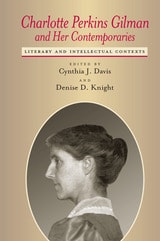
By placing Charlotte Perkins Gilman in the company of her contemporaries, this collection seeks to correct misunderstandings of the feminist writer and lecturer as an isolated radical. Gilman believed and preached that no life is ever led in isolation; indeed, the cornerstone of her philosophy was the idea that “humanity is a relation.”Gilman's highly public and combative stances as a critic and social activist brought her into contact and conflict with many of the major thinkers and writers of the period, including Mary Austin, Margaret Sanger, Ambrose Bierce, Grace Ellery Channing, Lester Ward, Inez Haynes Gillmore, William Randolph Hearst, Karen Horney, William Dean Howells, Catharine Beecher, George Bernard Shaw, and Owen Wister. Gilman wrote on subjects as wide ranging as birth control, eugenics, race, women's rights and suffrage, psychology, Marxism, and literary aesthetics. Her many contributions to social, intellectual, and literary life at the turn of the 20th century raised the bar for future discourse, but at great personal and professional cost.
Chiaroscuro
Essays on Identity: Revised EditionHelen Barolini
University of Wisconsin Press, 1999
“A lively, lucid, and often extremely moving collection of essays.”—Sandra Gilbert, author of Wrongful Death: A Memoir
“Barolini’s essays moved me. Their commitment, their passion, their intelligence struck me very powerfully and made them among the most incisive essays on Italian-Americana, ethnicity, and diversity in literature that I have ever read.”—Fred Misurella, author of Understanding Milan Kundera: Public Events, Private Affairs and Short Time
Part memoir, part social commentary, and part literary criticism, Chiaroscuro is not only profoundly original but also of crucial importance in establishing the contours of an Italian-American tradition. Spanning a quarter century of work, the essays in Helen Barolini’s essays explore her personal search; literature as a formative influence; and the turning of the personal into the political. Included in Chiaroscuro is an updated re-introduction to Barolini’s American Book Award-winning collection, The Dream Book: An Anthology of Writings by Italian-American Women.
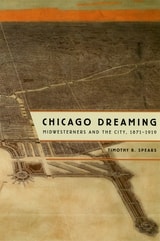
Chicago Dreaming
Midwesterners and the City, 1871-1919Timothy B. Spears
University of Chicago Press, 2005
Through innovative readings of Theodore Dreiser, Willa Cather, and Richard Wright, Spears argues that the migratory perspective was crucial to the rise of Chicago's emerging literary culture. In following the paths of several well-known migrants, including Jane Addams, cartoonist John T. McCutcheon, and businessman John Glessner, Spears also shows how the view from the hinterland permeated urban culture and informed the development of key Chicago institutions. Further exploring the notion of dreaming, he brings to light the internal desires that lured Midwestern migrants to the city as well as the nostalgia that led them to dream of the homes they left behind.
With this fascinating new take on the rise of Chicago, Chicago Dreaming blurs the line between country and city to reveal the provincial character of modern urban culture.
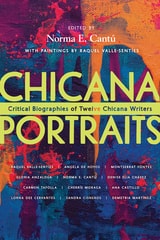
Chicana Portraits
Critical Biographies of Twelve Chicana WritersEdited by Norma E. Cantú; With paintings by Raquel Valle-Sentíes
University of Arizona Press, 2023
Artist Raquel Valle-Sentíes’s portraits bring visual dimension, while essays delve deeply into the authors’ lives for details that inform their literary, artistic, feminist, and political trajectories and sensibilities. The collection brilliantly intersects artistic visual and literary cultural productions, allowing complex themes to emerge, such as the fragility of life, sexism and misogyny, Chicana agency and forging one’s own path, the struggles of becoming a writer and battling self-doubt, economic instability, and political engagement and activism.
Arranged chronologically by birth order of the authors, the book can be read cover to cover for a genealogical overview, or scholars and general readers can easily jump in at any point and read about an individual author, regardless of the chronology.
Biographies included in this work include Raquel Valle-Sentíes, Angela de Hoyos, Montserrat Fontes, Gloria E. Anzaldúa, Norma E. Cantú, Denise Elia Chávez, Carmen Tafolla, Cherríe Moraga, Ana Castillo, Lorna Dee Cervantes, Sandra Cisneros, and Demetria Martínez.
Contributors
Cordelia E. Barrera
Mary Pat Brady
Norma E. Cantú
María Jesus Castro Dopacio
Carlos Nicolás Flores
Myrriah Gómez
Maria Magdalena Guerra de Charur
Gabriella Gutiérrez y Muhs
Georgina Guzmán
Cristina Herrera
María Esther Quintana
Eliza Rodríguez y Gibson
Meagan Solomon
Lourdes Torres
Raquel Valle-Sentíes
Jen Yáñez-Alaniz
Chicana Ways
Conversations With Ten Chicana WritersKarin Rosa Ikas
University of Nevada Press, 2001
Chicano Authors
Inquiry by InterviewBy Bruce-Novoa
University of Texas Press, 1980
The need for this book became apparent to Bruce-Novoa when he first taught a Chicano culture course in 1970. His students could find no source to satisfy their curiosity about Chicano writers' backgrounds, opinions, and attitudes. Chicano Authors: Inquiry by Interview provides that information.
Fourteen leading Chicano authors respond to questions about their personal and educational backgrounds, their perception of the role of the Chicano writer, and their evaluation of the literary, linguistic, and sociocultural significance of Chicano literature. The authors included are José Antonio Villarreal, Rolando Hinojosa, Sergio Elizondo, Miguel Méndez M., Abelardo Delgado, José Montoya, Tomás Rivera, Estela Portillo, Rudolfo A. Anaya, Bernice Zamora, Ricardo Sánchez, Ron Arias, Tino Villanueva, and Alurista.
Each interview is preceded by a brief introductory note which locates the author in the context of Chicano literature and provides a sense of his or her writing. Also included are a general introduction to Chicano literature, a chronological chart of publications by genre, and a selected bibliography. The volume will be an essential research tool for the student of Chicano literature and culture and a useful introduction for the general reader.
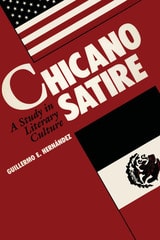
Chicano Satire
A Study in Literary CultureBy Guillermo E. Hernández
University of Texas Press, 1991
Geographically close to Mexico, but surrounded by Anglo-American culture in the United States, Chicanos experience many cultural tensions and contradictions. Their lifeways are no longer identical with Mexican norms, nor are they fully assimilated to Anglo-American patterns. Coping with these tensions—knowing how much to let go of, how much to keep—is a common concern of Chicano writers, who frequently use satire as a means of testing norms and deviations from acceptable community standards. In this groundbreaking study, Guillermo Hernández focuses on the uses of satire in the works of three authors—Luis Valdez, Rolando Hinojosa, and José Montoya—and on the larger context of Chicano culture in which satire operates.
Hernández looks specifically at the figures of the pocho (the assimilated Chicano) and the pachuco (the zoot-suiter, or urbanized youth). He shows how changes in their literary treatment—from simple ridicule to more understanding and respect—reflect the culture's changes in attitude toward the process of assimilation.
Hernández also offers many important insights into the process of cultural definition that engaged Chicano writers during the 1960s and 1970s. He shows how the writers imaginatively and syncretically formed new norms for the Chicano experience, based on elements from both Mexican and United States culture but congruent with the historical reality of Chicanos.
With its emphasis on culture change and creation, Chicano Satire will be of interest across a range of human sciences.
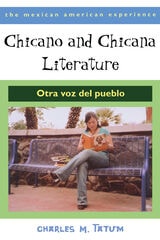
Chicano and Chicana Literature
Otra voz del puebloCharles M. Tatum
University of Arizona Press, 2006
In this comprehensive examination of Chicano and Chicana literature, Charles M. Tatum brings a new and refreshing perspective to the ethnic identity of Mexican Americans. From the earliest sixteenth-century chronicles of the Spanish Period, to the poetry and narrative fiction of the second half of the nineteenth century and the first half of the twentieth century, and then to the flowering of all literary genres in the post–Chicano Movement years, Chicano/a literature amply reflects the hopes and aspirations as well as the frustrations and disillusionments of an often marginalized population.
Exploring the work of Rudolfo Anaya, Sandra Cisneros, Luis Alberto Urrea, and many more, Tatum examines the important social, historical, and cultural contexts in which the writing evolved, paying special attention to the Chicano Movement and the flourishing of literary texts during the 1960s and early 1970s. Chapters provide an overview of the most important theoretical and critical approaches employed by scholars over the past forty years and survey the major trends and themes in contemporary autobiography, memoir, fiction, and poetry.
The most complete and up-to-date introduction to Chicana/o literature available, this book will be an ideal reference for scholars of Hispanic and American literature. Discussion questions and suggested reading included at the end of each chapter are especially suited for classroom use.
Chick Lit 2
No Chick VicsChris Mazza, Jeffrey DeShell, and Elisabeth Sheffield
University of Alabama Press, 1996
Chick-Lit 2: No Chick Vics features new work by Rikki Ducornet, Eurydice, Elizabeth Graver, Ursule Molinaro, and fourteen other witty and deadly serious writers.
Chick-Lit 2 discovers new and alternative voices in women’s fiction whose stories do not involve trauma that comes from the outside. As Mazza writes in her introduction, “Sexual assaults and harassments and injurious poor body images do exist and have waged a war on women (the American Medical Association says so). But for this book, I was interested in seeing what action(s) women characters can incite on their own, whether bad or good, hopeful or dead-end, progressive or destructive.”
Chinese American Literature since the 1850s
Xiao-huang Yin
University of Illinois Press, 2000
The writings of immigrants from China and their descendants in the United States reflect the changes and continuity in the Chinese American experience. Xiao-huang Yin combines literary and historical scholarship to trace the origins and development of this extensive, neglected body of literature.
Chinese American Literature since the 1850s covers representative works from the 1850s to the present. Selections include journalism and autobiography by nineteenth-century Chinese authors; writings on the walls of Angel Island, the main Asian immigrant arrival point on the West Coast; writings of late-nineteenth and early-twentieth-century "cultivated Chinese," students and scholars who came to America to advance their educations; important writing by immigrants such as Chen Ruoxi, Yu Lihua, and Zhang Xiguo; and the works of more recent authors like Sui Sin Far, Jade Snow Wong, Frank Chin, Maxine Hong Kingston, and Amy Tan.
An essential introduction and guide to the field, Chinese American Literature since the 1850s enlarges the available body of literature and provides new insights into the Chinese American immigrant experience and the writing inspired by it.
Claiming Others
Transracial Adoption and National BelongingMark C. Jerng
University of Minnesota Press, 2010
Jerng considers how adoption makes us rethink the parent-child bond as central to issues of race and nationality, showing the ways adoption also speaks to broader questions about our history and identity. He analyzes adoption through a diverse set of texts, including the 1851 Massachusetts statute that established adoption as we understand it today, early adoption manuals, the New York Times blog Relative Choices, and the work of John Tanner, Lydia Maria Child, William Faulkner, Charles Chesnutt, Chang-rae Lee, and David Henry Hwang.
Imaginative and social practices of transracial adoption have shaped major controversies, Jerng argues, from Native American removal to slavery to cold war expansionism in the twentieth century and the contemporary global market in children. As Claiming Others makes clear, understanding adoption is crucial not just to understanding the history between races in the United States, but also the meaning of emancipation and the role of family in nationhood.
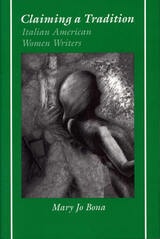
Claiming a Tradition
Italian American Women WritersMary Jo Bona
Southern Illinois University Press, 1999
Bona discusses the novels in pairs according to their focus on Italian American life. She first examines the traditions of italianitá (a flavor of things Italian) that inform and enhance works of fiction. The novelists in that tradition were Mari Tomasi (Like Lesser Gods, 1949) and Marion Benasutti (No Steady Job for Papa, 1966).
Bona then turns to later novels that highlight the Italian American belief in the family's honor and reputation. Conflicts between generations, specifically between autocratic fathers and their children, are central to Octavia Waldo's 1961 A Cup of the Sun and Josephine Gattuso Hendin's 1988 The Right Thing to Do.
Even when writers choose to steer away from the familial focus, Bona notes, their developmental narratives trace the reintegration of characters suffering from a crisis of cultural identity. Relating the characters' struggles to their relationship to the family, Bona examines Diana Cavallo's 1961 A Bridge of Leaves and Dorothy Bryant's 1978 Miss Giardino.
Bona then discusses two innovative novels— Helen Barolini's 1979 Umbertina and Tina De Rosa's 1980 Paper Fish— both of which feature a granddaughter who invokes her grandmother, a godparent figure. Through Barolini's feminist and De Rosa's modernist perspectives, both novels present a young girl developing artistically.
Closing with a discussion of the contemporary terrain Italian American women traverse, Bona examines such topics as sexual identity when it meets cultural identity and the inclusion of italianitá when Italian American identity is not central to the story. Italian American women writers, she concludes, continue in the 1980s and 1990s to focus on the interplay between cultural identity and women's development.
Close Reading
The ReaderFrank Lentricchia and Andrew DuBois, eds.
Duke University Press, 2003
From a 1938 essay by John Crowe Ransom through the work of contemporary scholars, Close Reading highlights the interplay between critics—the ways they respond to and are influenced by others’ works. To facilitate comparisons of methodology, the collection includes discussions of the same primary texts by scholars using different critical approaches. The essays focus on Hamlet, “Lycidas,” “The Rape of the Lock,” Ulysses, Invisible Man, Beloved, Jane Austen, John Keats, and Wallace Stevens and reveal not only what the contributors are reading, but also how they are reading.
Frank Lentricchia and Andrew DuBois’s collection is an essential tool for teaching the history and practice of close reading.
Contributors. Houston A. Baker Jr., Roland Barthes, Homi Bhabha, R. P. Blackmur, Cleanth Brooks, Kenneth Burke, Paul de Man, Andrew DuBois, Stanley Fish, Catherine Gallagher, Sandra Gilbert, Stephen Greenblatt, Susan Gubar, Fredric Jameson, Murray Krieger, Frank Lentricchia, Franco Moretti, John Crowe Ransom, Eve Kosofsky Sedgwick, Helen Vendler
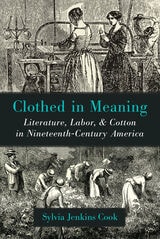
Clothed in Meaning
Literature, Labor, and Cotton in Nineteenth-Century AmericaSylvia Jenkins Cook
University of Michigan Press, 2020
Cloth and clothing provide potent tropes not only for physical but also for intellectual forms of self-expression. Drawing on sources ranging from fugitive slave narratives, newspapers, manifestos, and mill workers’ magazines to fiction, poetry, and autobiographies, Clothed in Meaning examines the significant part played by mill workers and formerly enslaved people, many of whom still worked picking cotton, in this revolution of literary self-expression. They created a new literature from their palpable daily intimacy with cotton, cloth, and clothing, as well as from their encounters with grimly innovative modes of work. In the materials of their labor they discovered vivid tropes for formulating their ideas and an exotic and expert language for articulating them. The harsh conditions of their work helped foster in their writing a trenchant irony toward the demeaning reduction of human beings to “hands” whose minds were unworthy of interest. Ultimately, Clothed in Meaning provides an essential examination of the intimate connections between oppression and luxury as recorded in the many different voices of nineteenth-century labor.
Codes of Conduct
Race, Ethics, and the Color of Our CharacterHolloway, Karla F. C.
Rutgers University Press, 1995
In Codes of Conduct, Karla Holloway meditates on the dynamics of race and ethnicity as they are negotiated in the realms of power. Her uniquely insightful and intelligent analysis guides us in a fresh way through Anita Hill’s interrogation, the assault on Tawana Brawley, the mass murders of Atlanta’s children, the schisms between the personal and public domains of her life as a black professor, and––in a moving epilogue––the story of her son’s difficulties growing up as a young black male in contemporary society. Its three main sections: “The Body Politic,” “Language, Thought, and Culture,” and “The Moral Lives of Children,” relate these issues to the visual power of the black and female body, the aesthetic resonance and racialized drama of language, and our children’s precarious habits of surviving. Throughout, Holloway questions the consequences in African-American community life of citizenship that is meted out sparingly when one’s ethnicity is colored.
This is a book of a culture’s stories––from literature, public life, contemporary and historical events, aesthetic expression, and popular culture––all located within the common ground of African-American ethnicity. Holloway writes with a passion, urgency, and wit that carry the reader swiftly through each chapter. The book should take its place among those other important contemporary works that speak to the future relationships between whites and blacks in this country.
Cold Flashes
Literary Snapshots of AlaskaEdited by Michael Engelhard
University of Alaska Press, 2010
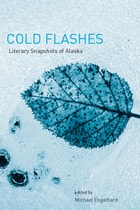
As the old adage goes, "if you can't say it in a few pages, you won't in a hundred." The selections in Cold Flashes—very short prose and black-and-white photographs—embody perfectly this transparency, thrift, and restraint. Found here are highly polished micro-narratives, both fiction and nonfiction, and a series of eloquent and artistic halftones that capture their sizeable subjects in a nutshell. By minimizing the exposition, the selections stimulate the imagination to reflect on the rich diversity of people and places that make up Alaska. To be savored piecemeal at coffee shops, on the bus, or while waiting in line, the images and text in Cold Flashes will resonate with both the reader and each other, fusing into something profound yet elusive.
Cold Warriors
Manliness on Trial in the Rhetoric of the WestSuzanne Clark
Southern Illinois University Press, 2000
Cold Warriors: Manliness on Trial in the Rhetoric of the West returns to familiar cultural forces—the West, anticommunism, and manliness—to show how they combined to suppress dissent and dominate the unruliness of literature in the name of a national identity after World War II. Few realize how much the domination of a “white male” American literary canon was a product not of long history, but of the Cold War. Suzanne Clark describes here how the Cold War excluded women writers on several levels, together with others—African American, Native American, poor, men as well as women—who were ignored in the struggle over white male identity.
Clark first shows how defining national/individual/American identity in the Cold War involved a brand new configuration of cultural history. At the same time, it called upon the nostalgia for the old discourses of the West (the national manliness asserted by Theodore Roosevelt) to claim that there was and always had been only one real American identity.
By subverting the claims of a national identity, Clark finds, many male writers risked falling outside the boundaries not only of public rhetoric but also of the literary world: men as different from one another as the determinedly masculine Ernest Hemingway and the antiheroic storyteller of the everyday, Bernard Malamud. Equally vocal and contentious, Cold War women writers were unwilling to be silenced, as Clark demonstrates in her discussion of the work of Mari Sandoz and Ursula Le Guin.
The book concludes with a discussion of how the silencing of gender, race, and class in Cold War writing maintained its discipline until the eruptions of the sixties. By questioning the identity politics of manliness in the Cold War context of persecution and trial, Clark finds that the involvement of men in identity politics set the stage for our subsequent cultural history.
Collecting Lives
Critical Data Narrative as Modernist Aesthetic in Early Twentieth-Century U.S. LiteraturesElizabeth Rodrigues
University of Michigan Press, 2022
On a near-daily basis, data is being used to narrate our lives. Categorizing algorithms draw from amassed personal data to assign narrative destinies to individuals at crucial junctures, simultaneously predicting and shaping the paths of our lives. Data is commonly assumed to bring us closer to objectivity, but the narrative paths these algorithms assign seem, more often than not, to replicate biases about who an individual is and could become.
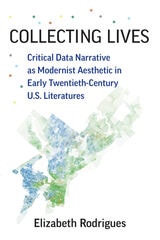
While the social effects of such algorithmic logics seem new and newly urgent to consider, Collecting Lives looks to the late nineteenth and early twentieth century US to provide an instructive prehistory to the underlying question of the relationship between data, life, and narrative. Rodrigues contextualizes the application of data collection to human selfhood in the late nineteenth and early twentieth century US in order to uncover a modernist aesthetic of data that offers an alternative to the algorithmic logic pervading our sense of data’s revelatory potential. Examining the work of W. E. B. Du Bois, Henry Adams, Gertrude Stein, and Ida B. Wells-Barnett, Rodrigues asks how each of these authors draw from their work in sociology, history, psychology, and journalism to formulate a critical data aesthetic as they attempt to answer questions of identity around race, gender, and nation both in their research and their life writing. These data-driven modernists not only tell different life stories with data, they tell life stories differently because of data.
Colonial Legacies in Chicana/o Literature and Culture
Looking Through the KaleidoscopeVanessa Fonseca-Chávez
University of Arizona Press, 2020
Vanessa Fonseca-Chávez traces how Spanish colonial texts reflect the motivation for colonial domination. She argues that layers of U.S. colonialism complicate how Chicana/o literary scholars think about Chicana/o literary and cultural production. She brings into view the experiences of Chicana/o communities that have long-standing ties to the U.S. Southwest but whose cultural heritage is tied through colonialism to multiple nations, including Spain, Mexico, and the United States.
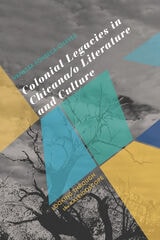
While the legacies of Chicana/o literature simultaneously uphold and challenge colonial constructs, the metaphor of the kaleidoscope makes visible the rupturing of these colonial fragments via political and social urgencies. This book challenges readers to consider the possibilities of shifting our perspectives to reflect on stories told and untold and to advocate for the inclusion of fragmented and peripheral pieces within the kaleidoscope for more complex understandings of individual and collective subjectivities.
This book is intended for readers interested in how colonial legacies are performed in the U.S. Southwest, particularly in the context of New Mexico, Texas, and Arizona. Readers will relate to the book’s personal narrative thread that provides a path to understanding fragmented identities.
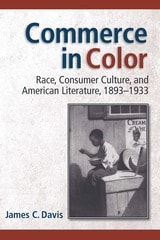
Commerce in Color
Race, Consumer Culture, and American Literature, 1893-1933James C. Davis
University of Michigan Press, 2010
Commerce in Color exploresthe juncture of consumer culture and race by examining advertising, literary texts, mass culture, and public events in the United States from 1893 to 1933. James C. Davis takes up a remarkable range of subjects—including the crucial role publishers Boni and Liveright played in the marketing of Harlem Renaissance literature, Henry James’s critique of materialism in The American Scene, and the commodification of racialized popular culture in James Weldon Johnson’s The Autobiography of anEx-Colored Man—as he argues that racial thinking was central to the emergence of U.S. consumerism and, conversely, that an emerging consumer culture was a key element in the development of racial thinking and the consolidation of racial identity in America. By urging a reassessment of the familiar rubrics of the “culture of consumption” and the “culture of segregation,” Dawson poses new and provocative questions about American culture and social history.
Both an influential literary study and an absorbing historical read, Commerce in Color proves that—in America—advertising, publicity, and the development of the modern economy cannot be understood apart from the question of race.
“A welcome addition to existing scholarship, Davis’s study of the intersection of racial thinking and the emergence of consumer culture makes connections very few scholars have considered.”
—James Smethurst, University of Massachusetts
James C. Davis is Assistant Professor of English at Brooklyn College.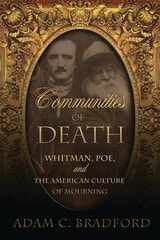
Communities of Death
Whitman, Poe, and the American Culture of MourningAdam C. Bradford
University of Missouri Press, 2014
Conditions of the Present
Selected EssaysLindon Barrett
Duke University Press, 2018
Contributors. Elizabeth Alexander, Jennifer DeVere Brody, Daphne A. Brooks, Linh U. Hua, Janet Neary, Marlon B. Ross, Robyn Wiegman
Confronting AIDS through Literature
The Responsibilities of RepresentationEdited by Judith Laurence Pastore
University of Illinois Press, 1993
Conjuring the Folk
Forms of Modernity in African AmericaDavid G. Nicholls
University of Michigan Press, 2000
In a series of revisionary readings, Nicholls studies how the "folk" is shaped by the ideology of form. He examines the presence of a spectral "folk" in Toomer's modernist pastiche, Cane. He explores how Hurston presents folklore as a contemporary language of resistance in her ethnography, Mules and Men. In Claude McKay's naturalistic romance, Banana Bottom, Nicholls discovers the figuration of an alternative modernity in the heroine's recovery of her lost "folk" identity. He unearths the individualist ethos of Booker T. Washington in two novels by George Wylie Henderson. And he reveals how Richard Wright's photo-documentary history, 12 Million BlackVoices, places the "folk" in a Marxian narrative of modernization toward class-consciousness.
A provocative rereading of the cultural politics of the Harlem Renaissance, Conjuring the Folk offers a new way of understanding literary responses to migration, modernization, and the concept of the "folk" itself.
David G. Nicholls is a post-doctoral fellow in the Center for the Study of Race, Politics, and Culture, University of Chicago.
Constituting Americans
Cultural Anxiety and Narrative FormPriscilla Wald
Duke University Press, 1995
From early-nineteenth-century Supreme Court cases to turn-of-the-century Jim Crow and immigration legislation, from the political speeches of Abraham Lincoln to the historical work of Woodrow Wilson, nation-builders addressed the legal, political, and historical paradoxes of American identity. Against the backdrop of their efforts, Wald shows how works such as Douglass’s autobiographical narratives, Melville’s Pierre, Wilson’s Our Nig, Du Bois’s The Souls of Black Folks, and Stein’s The Making of Americans responded, through formal innovations, to the aggressive demands for literary participation in the building of that nation. The conversation that emerges among these literary works challenges the definitions and genres that largely determine not only what works are read, but also how they are read in classrooms in the United States today.
Offering insight into the relationship of storytelling to national identity, Constituting Americans will compel the attention of those with an interest in American literature, American studies, and cultural studies.
Constructing the Black Masculine
Identity and Ideality in African American Men’s Literature and Culture, 1775–1995Maurice O. Wallace
Duke University Press, 2002
Highlighting their chronic objectification under the gaze of white eyes, Wallace argues that black men suffer a social and representational crisis in being at once seen and unseen, fetish and phantasm, spectacle and shadow in the American racial imagination. Invisible and disregarded on one hand, black men, perceived as potential threats to society, simultaneously face the reality of hypervisibility and perpetual surveillance. Paying significant attention to the sociotechnologies of vision and image production over two centuries, Wallace shows how African American men—as soldiers, Freemasons, and romantic heroes—have sought both to realize the ideal image of the American masculine subject and to deconstruct it in expressive mediums like modern dance, photography, and theatre. Throughout, he draws on the experiences and theories of such notable figures as Frederick Douglass, W. E. B. Du Bois, Booker T. Washington, and James Baldwin.
Constructing the Enemy
Empathy/Antipathy in U.S. Literature and LawRajini Srikanth
Temple University Press, 2011
In her engaging book, Constructing the Enemy, Rajini Srikanth probes the concept of empathy, attempting to understand its different types and how it is—or isn't—generated and maintained in specific circumstances.
Using literary texts to illuminate issues of power and discussions of law, Srikanth focuses on two case studies— the internment of Japanese citizens and Japanese Americans in World War II, after the bombing of Pearl Harbor, and the detainment of Muslim Americans and individuals from various nations in the U.S. prison at Guantanamo Bay.
Through primary documents and interviews that reveal why and how lawyers become involved in defending those who have been designated “enemies,” Srikanth explores the complex conditions under which engaged citizenship emerges. Constructing the Enemy probes the seductive promise of legal discourse and analyzes the emergence and manifestation of empathy in lawyers and other concerned citizens and the wider consequences of this empathy on the institutions that regulate our lives.