Results by title
402 books match the query 'American poetry' and 16 start with c
Called Back
Rosa Lane
Tupelo Press, 2024
In bold tribute with a title utilizing the last two words Emily Dickinson wrote, Rosa Lane’s Called Back converses with one of our greatest poets in theatrical monologue—decoding secrets amid the blatant. Evoked by epigraphs selected from Dickinson’s work, Lane’s poems, through her I-speaker, reveal the extraordinary to be found in the ordinary and speak to the struggle of sexual orientation, otherness, and the challenges of living in a Calvinistic socioreligious world of oughts and noughts as evidenced in Dickinson’s poems. From sapphic eroticism and subsequent pangs of nonbelonging to tacking next life as a welcome reprieve, poems in Called Back create a de novo dot-connecting lyrical narrative.
Canto hondo / Deep Song
Francisco X. Alarcón
University of Arizona Press, 2015
In this new collection, Alarcón creates poetry with roots in Gypsy songs clapped out in the distinctively short rhythms of flamenco music. Each page lifts the heart and stirs the soul by delving deep into the struggle for self and sexual identity.
Canto hondo / Deep Song includes 106 poems divided into four sections that articulate struggle, otherness, and the meaning of the poetic landscape. Like Lorca, Alarcón seeks out the fault lines where the lyric and the political bleed productively and proactively into one another.
An important voice in Chicano and GLBT poetry, Alarcón writes with a complex, emotionally powerful style that is accessible to students and all lovers of poetry and poetic traditions.
Career Moves
Olson, Creeley, Zukofsky, Berrigan, AndLibbie Rifkin
University of Wisconsin Press, 2000
How much did "making it new" have to do with "making it"? For the four "outsider poets" considered in this book—Charles Olson, Robert Creeley, Louis Zukofsky, and Ted Berrigan—the connection was everything. At once a social history of literary ambition in America in the fifties and sixties and a uniquely collective form of literary biography, Career Moves offers an intimate account of the postwar poetry underground.
Making the controversial claim that anti-Establishment poets were at least as "careerist" as their mainstream peers, Libbie Rifkin shows how the nature of these poets’ ambition actually defined postwar avant-garde identity. In doing so, she clarifies the complicated link between the crafting of a literary career and the defining of a literary canon.
Castings
Monuments and Monumentality in Poems by Elizabeth Bishop, Robert Lowell, James Merrill, Derek Walcott, and Seamus HeaneyGuy Rotella
Vanderbilt University Press, 2004
In Castings, Guy Rotella examines the work of five important poets who have engaged in that effort: Elizabeth Bishop, Robert Lowell, James Merrill, Derek Walcott, and Seamus Heaney. Considering their wider careers as well as particular poems--including Bishop's "The Monument," Lowell's "For the Union Dead," Merrill's "Bronze," Walcott's "The Sea Is History," and Heaney's "In Memoriam Francis Ledwidge"--Rotella argues that these writers are less concerned with defending or condemning monuments than with pursuing ancient and current debates about the political, aesthetic, and broadly cultural issues that monuments condense. Among these concerns are the competing claims of life and art, persistence and change, meaning and meaninglessness, the self and society, and the governing and the governed.
Original and provocative, Rotella's readings will make us ponder how the human impulse to build to last, to reify our culturally derived and ideologically driven faiths, might coexist with those other creeds of our place and time: relativism, multiculuralism, and diversity.
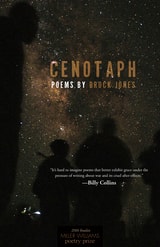
Cenotaph
PoemsBrock Jones
University of Arkansas Press, 2016
Finalist, 2016 Miller Williams Poetry Prize, edited by Billy Collins
Out of the contradiction, paradox, loss, and strange beauty of contemporary warfare, Brock Jones brings us Cenotaph, a collection of poems that have as their genesis Jones’s deployments to Iraq in 2002 and 2005, when he was in the US Army.
These are war poems, but also love poems and hate poems, poems about dying and living, poems about hope and hopelessness. These are poems that beautifully reflect Jones’s resignation to and rejection of the impossibility of saying anything definitive or honest about war.
These are poems that strive to do what poet Bruce Weigl described as the poet’s job: to find “some kind of miraculous way th at if you work hard enough to get the words right, that which you call horrific and wrong is defeated.”
Cenotaph is a poet doing the poet’s work: trying, hoping to get the words right.
Chicano Poetry
A Response to ChaosBy Bruce-Novoa
University of Texas Press, 1982
Alurista. Gary Soto. Bernice Zamora. José Montoya. These names, luminous to some, remain unknown to those who have not yet discovered the rich variety of late twentieth century Chicano poetry.
With the flowering of the Chicano Movement in the mid-1960s came not only increased political awareness for many Mexican Americans but also a body of fine creative writing. Now the major voices of Chicano literature have begun to reach the wider audience they deserve. Bruce-Novoa's Chicano Poetry: A Response to Chaos—the first booklength critical study of Chicano poetry—examines the most significant works of a body of literature that has grown dramatically in size and importance in less than two decades.
Here are insightful new readings of the major writings of Abelardo Delgado, Sergio Elizondo, Rodolfo Gonzales, Miguel Méndez, J. L. Navarro, Raúl Salinas, Ricardo Sánchez, and Tino Villanueva, as well as Alurista, Soto, Zamora, and Montoya. Close textual analyses of such important works as I Am Joaquín, Restless Serpents, and Floricanto en Aztlán enrich and deepen our understanding of their imagery, themes, structure, and meaning.
Bruce-Novoa argues that Chicano poetry responds to the threat of loss, whether of hero, barrio, family, or tradition. Thus José Montoya elegizes a dead Pachuco in "El Louie," and Raúl Salinas laments the disappearance of a barrio in "A Trip through the Mind Jail." But this elegy at the heart of Chicano poetry is both lament and celebration, for it expresses the group's continuing vitality and strength.
Common to twentieth-century poetry is the preoccupation with time, death, and alienation, and the work of Chicano poets—sometimes seen as outside the traditions of world literature—shares these concerns. Bruce-Novoa brilliantly defines both the unique and the universal in Chicano poetry.
Chinese Whispers
Toward a Transpacific PoeticsYunte Huang
University of Chicago Press, 2022
In this new book, the noted critic and best-selling author Yunte Huang explores the dynamics of poetry and poetics in the age of globalization, particularly questions of translatability, universality, and risk in the transpacific context. “Chinese whispers” refers to an American children’s game dating to the years of the Cold War, a period in which everything Chinese, or even Chinese sounding, was suspect. Taking up various manifestations of the phrase in the twentieth and twenty-first centuries, Huang investigates how poetry, always to a significant degree untranslatable, complicates the transpacific production of meanings and values.
The book opens with the efforts of I. A. Richards, arguably the founder of Anglo-American academic literary criticism, to promote Basic English in China in the early twentieth century. It culminates by resituating Ernest Fenollosa’s famous essay “The Chinese Written Character as a Medium for Poetry,” exploring the ways in which Chinese has historically enriched but also entrapped the Western conception of language.
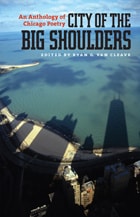
City of the Big Shoulders
An Anthology of Chicago PoetryRyan G. Van Cleave
University of Iowa Press, 2012
The cultural, ethnic, and aesthetic diversity in this gathering of poems springs from a variety of viewpoints, styles, and voices as multifaceted and energetic as the city itself. Cristin O’Keefe Aptowicz: “I want to eat / in a city smart enough to know that if you / are going to have that heart attack, you might / as well have the pleasure of knowing // you’ve really earned it”; Renny Golden: “In the heat of May 1937, my grandfather / sits in the spring grass of an industrial park / with hundreds of striking steelworkers”; Joey Nicoletti: “The wind pulls a muscle / as fans yell the vine off the outfield wall, / mustard-stained shirts, hot dog smiles, and all.”
The combined energies of these poems reveal the mystery and beauty that is Second City, the City by the Lake, New Gotham, Paris on the Prairie, the Windy City, the Heart of America, and Sandburg’s iconic City of the Big Shoulders.
Code Name Puritan
Norman Holmes Pearson at the Nexus of Poetry, Espionage, and American PowerGreg Barnhisel
University of Chicago Press, 2024
Although his impact on twentieth-century American cultural life was profound, few people know the story of Norman Holmes Pearson. Pearson’s life embodied the Cold War alliances among US artists, scholars, and the national-security state that coalesced after World War II. As a Yale professor and editor, he helped legitimize the study of American culture and shaped the public’s understanding of literary modernism—significantly, the work of women poets such as Hilda Doolittle and Gertrude Stein. At the same time, as a spy, recruiter, and cultural diplomat, he connected the academy, the State Department, and even the CIA.
In Code Name Puritan, Greg Barnhisel maps Pearson’s life, from his childhood injury that led to a visible, permanent disability to his wartime counterespionage work neutralizing the Nazis’ spy network to his powerful role in the cultural and political heyday sometimes called the American Century. Written with clarity and informed by meticulous research, Barnhisel’s revelatory portrait of Pearson details how his unique experiences shaped his beliefs about the American character, from the Puritans onward.
Coming After
Essays on PoetryAlice Notley
University of Michigan Press, 2005
Notley explores the work of second-generation New York School poets and their allies: Ted Berrigan, Anne Waldman, Joanne Kyger, Ron Padgett, Lorenzo Thomas, and others. These essays and reviews are among the first to deal with a generation of poets notorious for their refusal to criticize and theorize, assuming the stance that "only the poems matter." The essays are characterized by Notley's strong, compelling voice, which transfixes the reader even in the midst of professional detail. Coming After revives the possibility of the readable book of criticism.
Coming Out of War
Poetry, Grieving, and the Culture of the World WarsJanis P. Stout
University of Alabama Press, 2005
World War I is widely considered “the Great War” and World War II, “the Good War.” Janis Stout thinks of them as two parts of a whole that continues to engage historians and literary scholars searching for an understanding of both the actual war experiences and the modern culture of grief they embody. In Coming Out of War: Poetry, Grieving, and the Culture of the World Wars Stout argues that poetry, of all the arts, most fully captures and conveys those cultural responses.
While probing the work of such well known war poets as Rupert Brooke, Wilfred Owen, and Randall Jarrell, Stout also highlights the impact of the wars on lesser studied, but equally compelling, sources such as the music of Charles Ives and Cole Porter, Aaron Copland and Irving Berlin. She challenges the commonplace belief that war poetry came only from the battlefield and was written only by men by examining the wartime writings of women poets such as Rose Macaulay, Marianne Moore, Elizabeth Bishop, and Gwendolyn Brooks. She also challenges the assumption that World War II did not produce poetry of distinction by studying the work of John Ciardi, Karl Shapiro, Louis Simpson, Robert Frost, and Wallace Stevens. While emphasizing aesthetic continuity between the wars, Stout stresses that the poetry that emerged from each displays a greater variety than is usually recognized.
A final chapter considers Benjamin Britten’s War Requiem as a culmination and embodiment of the anti-war tradition in 20th-century poetry and music, and speculates on the reasons why, despite their abundance and eloquence, these expressions of grief and opposition to war have effected so little change.
Coming to Light
American Women Poets in the Twentieth CenturyDiane Wood Middlebrook and Marilyn Yalom, Editors
University of Michigan Press, 1985
Companion Grasses
Brian Teare
Omnidawn, 2013
Contested Records
The Turn to Documents in Contemporary North American PoetryMichael Leong
University of Iowa Press, 2020
Why have so many contemporary poets turned to source material, from newspapers to governmental records, as inspiration for their poetry? How can citational poems offer a means of social engagement? Contested Records analyzes how some of the most well-known twenty-first century North American poets work with fraught documents. Whether it’s the legal paperwork detailing the murder of 132 African captives, state transcriptions of the last words of death row inmates, or testimony from miners and rescue workers about a fatal mine disaster, author Michael Leong reveals that much of the power of contemporary poetry rests in its potential to select, adapt, evaluate, and extend public documentation.
Examining the use of documents in the works of Kenneth Goldsmith, Vanessa Place, Amiri Baraka, Claudia Rankine, M. NourbeSe Philip, and others, Leong reveals how official records can evoke a wide range of emotions—from hatred to veneration, from indifference to empathy, from desire to disgust. He looks at techniques such as collage, plagiarism, re-reporting, and textual outsourcing, and evaluates some of the most loved—and reviled—contemporary North American poems. Ultimately, Leong finds that if bureaucracy and documentation have the power to police and traumatize through the exercise of state power, then so, too, can document-based poetry function as an unofficial, counterhegemonic, and popular practice that authenticates marginalized experiences at the fringes of our cultural memory.

Cowboy Poets and Cowboy Poetry
Edited by David Stanley and Elaine Thatcher
University of Illinois Press, 2000
Centered around six areas of focus, from historical background to biographical profiles to creative process, Cowboy Poets and Cowboy Poetry approaches the tradition of occupational folk poetry from a variety of perspectives. Contributors trace its history as an extension of the Homeric tradition of storytelling in verse and discuss such topics as the way a text evolves in retelling, how it becomes linked to a tune, and how poetic content fuses with form to generate narrative tension and humor.
Personal and telling portraits of cowboy poets and reciters--including D. J. O'Malley, Henry Herbert Knibbs, and a number of contemporary cowboy poets--illuminate the creative process through which individual poets work within a long community tradition, while comparative studies examine poetry by women, Mexican-American vaqueros, loggers, Argentine gauchos, and Australian bush poets.
Cowboy Poets and Cowboy Poetry offers the first in-depth examination of a distinctive and community-based tradition rich with larger-than-life heroes, vivid occupational language, humor, and unblinking encounters with birth, death, nature, and animals. Throughout, the collection shows that cowboy poetry interweaves two thematic strands: a fierce defense of an endangered way of life and a dynamic celebration of organic wholeness, camaraderie, and individualism.
Cultures of Modernism
Marianne Moore, Mina Loy, and Else Lasker-SchulerCristanne Miller
University of Michigan Press, 2005
Cultures of Modernism explores how the structure and location of literary communities significantly influence who writes, what they write about, and their openness to formal experimentation. These influences particularly affect women writers. Author Cristanne Miller notes striking patterns of similarity in the concerns and lives of women living in geographically distant centers of modernist production. She looks at three significant poets---the American Marianne Moore, the British expatriate Mina Loy, and the German Else Lasker-Schüler---in the context of cultural, national, and local elements to argue that location significantly affected their performances of subjectivity, gender, race, and religion. The first book of its kind, Cultures of Modernism breaks new ground while it contributes to the ongoing reconception of the modernist period.
"A fascinating, provocative, and genuinely original study of a 'different' modernism in poetry---namely, the Modernism of women poets."
---Marjorie Perloff, Stanford University
"An important and ambitious work that makes major contributions to the fields of gender studies and modernist studies, and to the study of modernist poetry."
---Robin Schulze, Pennsylvania State University
"Offers a welcome corrective to the unreflective critical tendency . . . to make broad claims about the historical experiences and cultural conundrums of 'women,' and particularly 'women writers.' Miller offers tour-de-force comparative readings . . . threading together the world-historical with the personal, poetics with the political, and wielding the instruments of scansion as deftly as a surgeon."
---Modernism/modernity, The Official Journal of the Modernist Studies Association
Cristanne Miller is Edward H. Butler Professor of English and Chair of the English Department at the University of Buffalo, State University of New York.