Results by title
99 books match the query 'Censorship' and 15 start with c
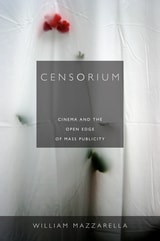
Censorium
Cinema and the Open Edge of Mass PublicityWilliam Mazzarella
Duke University Press, 2013
At the intersection of anthropology, media studies, and critical theory, Censorium is a pathbreaking analysis of Indian film censorship. The book encompasses two moments of moral panic: the consolidation of the cinema in the 1910s and 1920s, and the global avalanche of images unleashed by liberalization since the early 1990s. Exploring breaks and continuities in film censorship across colonial and postcolonial moments, William Mazzarella argues that the censors' obsessive focus on the unacceptable content of certain images and the unruly behavior of particular audiences displaces a problem that they constantly confront yet cannot directly acknowledge: the volatile relation between mass affect and collective meaning. Grounded in a close analysis of cinema regulation in the world's largest democracy, Censorium ultimately brings light to the elusive foundations of political and cultural sovereignty in mass-mediated societies.
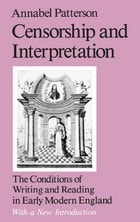
Censorship and Interpretation
Annabel M. Patterson
University of Wisconsin Press, 1991
Annabel Patterson explores the effects of censorship on both writing and reading in early modern England, drawing analogies and connections with France during the same period.

Censorship and Selection
Issues and Answers for SchoolsHenry Reichman
American Library Association, 2001
Censorship and Self-Censorship in History Education
A Comparative Approach to Backsliding DemocraciesRuben Zeeman
Central European University Press, 2026
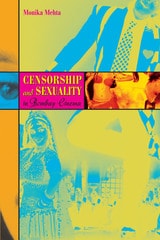
Censorship and Sexuality in Bombay Cinema
By Monika Mehta
University of Texas Press, 2011
India produces an impressive number of films each year in a variety of languages. Here, Monika Mehta breaks new ground by analyzing Hindi films and exploring the censorship of gender and heterosexuality in Bombay cinema. She studies how film censorship on various levels makes the female body and female sexuality pivotal in constructing national identity, not just through the films themselves but also through the heated debates that occur in newspapers and other periodicals. The standard claim is that the state dictates censorship and various prohibitions, but Mehta explores how relationships among the state, the film industry, and the public illuminate censorship's role in identity formation, while also examining how desire, profits, and corruption are generated through the act of censoring.
Committed to extending a feminist critique of mass culture in the global south, Mehta situates the story of censorship in a broad social context and traces the intriguing ways in which the heated debates on sexuality in Bombay cinema actually produce the very forms of sexuality they claim to regulate. She imagines afresh the theoretical field of censorship by combining textual analysis, archival research, and qualitative fieldwork. Her analysis reveals how central concepts of film studies, such as stardom, spectacle, genre, and sound, are employed and (re)configured within the ambit of state censorship, thereby expanding the scope of their application and impact.
Censorship in Romania
Lidia Vianu
Central European University Press, 1998
Censorship in Vietnam
Brave New WorldThomas A. Bass
University of Massachusetts Press, 2017
After the book was published, Bass flew to Vietnam to meet his censors, at least the half dozen who would speak with him. In Censorship in Vietnam, he describes these meetings and examines how censorship works, both in Vietnam and elsewhere in the world. An exemplary piece of investigative reporting, Censorship in Vietnam opens a window into the country today and shows us the precarious nature of intellectual freedom in a world governed by suppression.
Cinema Civil Rights
Regulation, Repression, and Race in the Classical Hollywood EraScott, Ellen C
Rutgers University Press, 2015
Cinema under National Reconstruction
State Censorship and South Korea’s Cold War Film CultureHye Seung Chung
Rutgers University Press, 2025
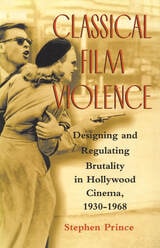
Classical Film Violence
Designing and Regulating Brutality in Hollywood Cinema, 1930-1968Prince, Stephen
Rutgers University Press, 2003
Prince shows that many choices about camera position, editing, and blocking of the action and sound were functional responses by filmmakers to regulatory constraints, necessary for approval from the PCA and then in surviving scrutiny by state and municipal censor boards.
This book is the first stylistic history of American screen violence that is grounded in industry documentation. Using PCA files, Prince traces the negotiations over violence carried out by filmmakers and officials and shows how the outcome left its traces on picture and sound in the films.
Almost everything revealed by this research is contrary to what most have believed about Hollywood and film violence. With chapters such as "Throwing the Extra Punch" and "Cruelty, Sadism, and the Horror Film," this book will become the defining work on classical film violence and its connection to the graphic mayhem of today's movies.
Cold War Broadcasting
Impact on the Soviet Union and Eastern EuropeR. Eugene Parta
Central European University Press, 2010
Compelling Belief
The Culture of American SchoolingStephen Arons
University of Massachusetts Press, 1986
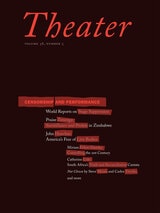
Contemporary Censorship and Performance, Volume 38
Miriam Felton-Dansky and Tom Sellar, eds.
Duke University Press, 0
The collection includes an essay that explores the function of live performance in recent freedom-of-expression debates, such as those featuring Janet Jackson and Don Imus, and persistent national anxieties about performers’ bodies. The issue also features an international censorship forum that brings together reports of incidents from Burma, Singapore, Germany, Italy, and the United States. A special report from Zimbabwe provides an in-depth look at the repression of oppositional theater by one of Africa’s most dictatorial regimes while another article looks at REwind: A Cantata for Voice, Tape and Testimony, a new musical composition that takes once-silenced voices recorded for South Africa’s Truth and Reconciliation Commission and transforms them into a hymn for a postapartheid nation. The issue also includes the first publication of an inventive new play that is a satirical as well as chilling look at suppression and dissent in post-9/11 America.
Contributors: Howard Barker, Reverend Billy, Catherine Cole, Mike Daisey, Dean Damjanovski, Miriam Felton-Dansky, Jacob Gallagher-Ross, John Houchin, Rabih Mroué, Freddie Rokem, Tom Sellar, Fadi Toufiq, Praise Zenenga
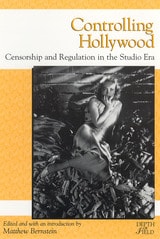
Controlling Hollywood
Censorship and Regulation in the Studio EraBernstein, Matthew
Rutgers University Press, 1999
Controlling Hollywood features ten innovative and accessible essays that examine some of the major turning points, crises, and contradictions affecting the making and showing of Hollywood movies from the 1910s through the early 1970s. The articles included here examine landmark legal cases; various self-regulating agencies and systems in the film industry (from the National Board of Review to the ratings system); and, external to Hollywood, the religious and social interest groups and government bodies that took a strong interest in film entertainment over the decades.
Cracks in the Wall
Beyond Apartheid in Palestine/IsraelBen White
Pluto Press, 2018
But while the situation on the ground is bleak, Ben White argues that there are widening cracks in Israel's traditional pillars of support. Opposition to Israeli policies and even critiques of Zionism are growing in Jewish communities, as well as amongst Western progressives. The election of Donald Trump has served as a catalyst for these processes, including the transformation of Israel from a partisan issue into one that divides the US establishment. Meanwhile, the Palestinian-led boycott campaign is gathering momentum, prompting a desperate backlash by Israel and its allies.
With sharp analysis, Ben White says now is the time to plot a course that avoids the mistakes of the past - a way forward beyond apartheid in Palestine. The solution is not partition and ethnic separation, but equality and self-determination - for all.