Results by title
480 books match the query 'Chicago' and 77 start with c
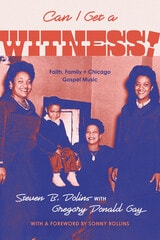
Can I Get a Witness!
Faith, Family, and Chicago Gospel MusicSteven B. Dolins with Gregory Donald Gay
University of Chicago Press, 2026
The remarkable story of pastor Donald Gay and his family’s lasting contributions to gospel music and Chicago culture.
When the preacher Gregory Donald Gay joined his sisters onstage at Carnegie Hall in 1950, on a sold-out bill they shared with Mahalia Jackson and the Clara Ward Singers, he became a participant in a landmark moment: the first concert in the venue to feature entirely gospel music. He was just five years old.
The Gay Sisters—Evelyn, Geraldine, and Mildred—were key figures in gospel’s Golden Age, and their youngest brother had a front-row seat. Evelyn and Geraldine each innovated singular approaches to gospel piano, while Mildred sang. Together, they toured and performed on a series of influential gospel recordings from 1948 to 1973, playing the Apollo Theatre and crossing paths with musical luminaries like Sister Rosetta Tharpe, Sam Cooke, Pops Staples, and Dizzy Gillespie. But despite a hit record and prodigious talent, the Gay Sisters faded from the limelight. In the ensuing years, they weathered personal trials while their mother, Fannie, devoted her attention to another family undertaking: starting a church.
Can I Get a Witness! is a call-and-response between Steven B. Dolins, founder of The Sirens Records, and Donald Gay, who vividly describes his boyhood in Chicago’s Woodlawn neighborhood, his family’s remarkable place in gospel history, his mother’s work as a faith leader, and his own calling as a pastor. The book spotlights the rich contributions of a family remembered not only for the songs they recorded but also for their unwavering kindness to others, a legacy that the legendary Sonny Rollins recounts in a moving foreword.
Carson Pirie Scott
Louis Sullivan and the Chicago Department StoreJoseph M. Siry
University of Chicago Press, 1988
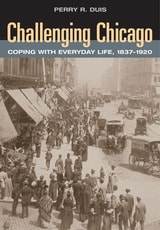
Challenging Chicago
Coping with Everyday Life, 1837-1920Perry R. Duis
University of Illinois Press, 2006
Follow along and encounter some of Chicago’s most infamous citizens--the loathed Traction Baron, high-speed “scorchers,” and peddlers of “swill milk.” Learn about the perils of payday, the lunchtime problems of women, the lure of dime museums, and the fatal attraction of Chicago’s “cruelest place.” Against this bleak backdrop emerged the innovators and institutions that made Chicago the vibrant city it is today. The superbly textured narrative is enhanced by eighty-six historic photographs and illustrations.
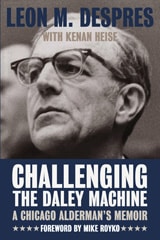
Challenging the Daley Machine
A Chicago Alderman's MemoirLeon M. Despres
Northwestern University Press, 2005
Winner, 2007 The Hyde Park Historical Society Paul Cornell Award
Political war stories from a thorn in the side of Chicago's famous Boss
In 1955, south-sider Leon Despres was elected to the Chicago City Council-the same year that Paddy Bauler famously uttered that "Chicago ain't ready for reform." Ready or not, Chicago got twenty years of reform efforts from Despres, one of the few independents in the council and the most liberal alderman in the city. His demand to cut out the corrupt sale of city driveway permits made him enemies from the very beginning. Over the years his crusades to ban discrimination, preserve Chicago landmark buildings, and gain equality for African-Americans-when Daley-beholden African-American council members refused to help-threw wrench after wrench into the Machine. And, not incidentally, changed the city.
But Challenging the Daley Machine is more than a memoir. It's a historical portrait of the way things were done under the Boss, when changing times and a changing city forced the Machine to confront the problems Despres championed. His battles against the seemingly monolithic Machine are also an inspiration to anyone who is facing long odds, but is convinced he/she is on the side of right.
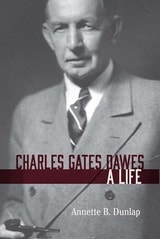
Charles Gates Dawes
A LifeAnnette B. Dunlap
Northwestern University Press, 2016
Charles Gates Dawes: A Life is the first comprehensive biography of an American in whose fascinating story contemporary readers can follow the struggles and triumphs of early twentieth-century America and Europe.
Dawes is most known today as vice president of the United States under Calvin Coolidge, but he also distinguished himself and his hometown of Evanston, Illinois, on the world stage with the 1925 Nobel Peace Prize. This engrossing biography traces how, when the punitive armistice that ended the First World War resulted in a disabled, restive Germany, Dawes’s diplomatic legerdemain averted war through a renegotiation of Germany’s debt repayments.
Dawes’s diplomatic and political achievements, however, were only the illustrious capstones to a multifaceted career that included military service, law, finance, and business on the local, state, national, and global stages. In every arena of his life, he combined the social graces of the Gilded Age with the spirit of service of the Progressive Era.
Despite his life of disciplined service, Dawes was an ebullient and irrepressible figure. Dawes’s salty language was often colorful fodder for tabloid and magazine writers of his era. In this captivating biography, Annette B. Dunlap recounts the story of an original American who enlightened and enlivened his world.
This book was published in cooperation with the Evanston History Center and with generous support from the Tawani Foundation.
Chi Boy
Native Sons and Chicago ReckoningsKeenan Norris
The Ohio State University Press, 2022
Chi Town
Norbert Blei
Northwestern University Press, 2003
Chi Townis the story of Norbert Blei's love affair with a city that shaped both his life and work. Along the route of this walking tour of the Windy City, you'll dine with Petros in Greek Town, see Studs Terkel in action at WFMT interviewing Dave Brubeck, listen to Mike Royko describe his own neighborhood, share the thoughts of Chicago sportswriter Jerome Holtzman, and meet newspaper vendors, trash collectors, bankers and more.
Chicago '68
David Farber
University of Chicago Press, 1988
"Chicago '68 was a watershed summer. Chicago '68 is a watershed book. Farber succeeds in presenting a sensitive, fairminded composite portrait that is at once a model of fine narrative history and an example of how one can walk the intellectual tightrope between 'reporting one's findings' and offering judgements about them."—Peter I. Rose, Contemporary Sociology
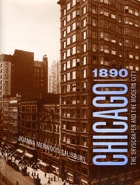
Chicago 1890
The Skyscraper and the Modern CityJoanna Merwood-Salisbury
University of Chicago Press, 2009
Chicago’s first skyscrapers are famous for projecting the city’s modernity around the world. But what did they mean at home, to the Chicagoans who designed and built them, worked inside their walls, and gazed up at their façades? Answering this multifaceted question, Chicago 1890 reveals that early skyscrapers offered hotly debated solutions to the city’s toughest problems and, in the process, fostered an urban culture that spread across the country.
An ambitious reinterpretation of the works of Louis Sullivan, Daniel Burnham, and John Wellborn Root, this volume uses their towering achievements as a lens through which to view late nineteenth-century urban history. Joanna Merwood-Salisbury sheds new light on many of Chicago’s defining events—including violent building trade strikes, the Haymarket bombing, the World’s Columbian Exposition, and Burnham’s Plan of Chicago—by situating the Masonic Temple, the Monadnock Building, and the Reliance Building at the center of the city’s cultural and political crosscurrents.
While architects and property owners saw these pioneering structures as manifestations of a robust American identity, immigrant laborers and social reformers viewed them as symbols of capitalism’s inequity. Illuminated by rich material from the period’s popular press and professional journals, Merwood-Salisbury’s chronicle of this contentious history reveals that the skyscraper’s vaunted status was never as inevitable as today’s skylines suggest.
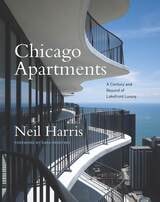
Chicago Apartments
A Century and Beyond of Lakefront LuxuryNeil Harris and Teri J. Edelstein
University of Chicago Press, 2020
Chicago Architecture
Histories, Revisions, AlternativesEdited by Charles Waldheim and Katerina Ruedi Ray
University of Chicago Press, 2005
In Chicago Architecture, Charles Waldheim and Katerina Ruedi Ray revise and offer alternatives to the archetypal story of modern architecture in Chicago. They and an esteemed group of contributors assert that the mythic status of Chicago architecture has distorted our understanding of the historical circumstances in which it was realized. This searching volume illuminates the importance of photographs, books, magazines, and other media in the cultivation of an international audience for Chicago architecture; it explores the pivotal role of real estate developers, finance and insurance sectors, and speculative capital markets in the development of the city itself; and, perhaps most notably, it examines a wide variety of overlooked architectural works and their creators—individuals who did not fit into the dominant modernist narrative.
Offering new insights on Chicago public housing and O'Hare International Airport, on the Columbian Exposition and Marina City, on the city's grid system and the place of women architects in the story of Chicago modernism, and on the subjective experience of living inside Chicago's most well-known buildings, Chicago Architecture is a work of enormous scope and vision—a book as heady and towering as the skyline it considers.
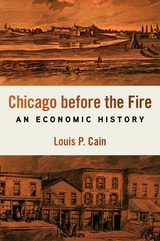
Chicago Before the Fire
An Economic HistoryLouis P. Cain
University of Illinois Press, 2025
An advantageous location and entrepreneurial passion helped fuel Chicago’s transformation from a fur trading post to a thriving city. Louis P. Cain’s economic history places pre-1871 Chicago within the narrative of national expansion and examines infrastructure, finance, and other areas of city life. Business histories tell the story of fortunes made with essential products like meat and grain. Sketches of titans like William Ogden and Cyrus McCormick reveal how real estate, farm equipment, and other industries became engines of local growth. Cain also details public health improvements that made Lake Michigan safe as a water supply while census data informs a portrait of Chicago’s population and the lives of the free Blacks and Irish immigrants at the bottom of the socioeconomic ladder.
Panoramic and up to date, Chicago before the Fire looks at how an intersection of geography, vision, and investment built a great American city.
Chicago Blues
Portraits and StoriesDavid Whiteis
University of Illinois Press, 2006
Through revealing portraits of selected local artists and slice-of-life vignettes drawn from the city’s pubs and lounges, Chicago Blues encapsulates the sound and spirit of the blues as it is lived today. As a committed participant in the Chicago blues scene for more than a quarter century, David Whiteis draws on years of his observations and extensive interviews to paint a full picture of the Chicago blues world, both on and off the stage.
In addition to portraits of blues artists he has personally known and worked with, Whiteis takes readers on a tour of venues like East of Ryan and the Starlight Lounge, home to artists such as Jumpin’ Willie Cobbs, Willie D., and Harmonica Khan. He tells the stories behind the lives of past pioneers, including Junior Wells, pianist Sunnyland Slim, and harpist Big Walter Horton, whose music reflects the universal concerns with love, loss, and yearning that continue to keep the blues so vital for so many.
Chicago Business and Industry
From Fur Trade to E-CommerceEdited by Janice L. Reiff
University of Chicago Press, 2013
Drawing on the award-winning Encyclopedia of Chicago, Janice L. Reiff has compiled a unique history of work in the Windy City. Beginning with an overview of the city’s commercial development, Chicago Business and Industry considers how key industries shaped—and were shaped by—both the local and global economies. The city’s phenomenal population growth, its proximity to water, and its development of railroads made Chicago one of the most productive markets for lumber and grain throughout the nineteenth century. The region’s once-booming steel industry, on the other hand, suffered a dramatic decline in the second half of the twentieth century, when already weakened demand met with increasing international competition. Chicago Business and Industry chronicles the Chicago region’s changing fortunes from its beginning.
Reiff has compiled and updated essays from the Encyclopedia covering the city’s most historically famous—and infamous—companies, from the Union Stock Yard to Montgomery Ward to the Board of Trade. The book concludes with a historical account of labor types and issues in the city, with attention to such topics as health-care workers, unemployment, and unionization. Today, Groupon and a host of other high-tech firms have led some experts to christen Chicago the Silicon Valley of the Midwest. Reiff’s new introduction takes account of these and other recent trends.
Engaging, accessible, and packed with fascinating facts, Chicago Business and Industry invites readers into the history and diversity of work in the city, helping them understand how Chicago became Chicago.
Chicago Católico
Making Catholic Parishes MexicanDeborah E. Kanter
University of Illinois Press, 2020
Deborah E. Kanter tells the story of neighborhood change and rebirth in Chicago's Mexican American communities. She unveils a vibrant history of Mexican American and Mexican immigrant relations as remembered by laity and clergy, schoolchildren and their female religious teachers, parish athletes and coaches, European American neighbors, and from the immigrant women who organized as guadalupanas and their husbands who took part in the Holy Name Society. Kanter shows how the newly arrived mixed memories of home into learning the ways of Chicago to create new identities. In an ever-evolving city, Mexican immigrants and Mexican Americans’ fierce devotion to their churches transformed neighborhoods such as Pilsen.
The first-ever study of Mexican-descent Catholicism in the city, Chicago Católico illuminates a previously unexplored facet of the urban past and provides present-day lessons for American communities undergoing ethnic integration and succession.
Chicago Dreaming
Midwesterners and the City, 1871-1919Timothy B. Spears
University of Chicago Press, 2005
Through innovative readings of Theodore Dreiser, Willa Cather, and Richard Wright, Spears argues that the migratory perspective was crucial to the rise of Chicago's emerging literary culture. In following the paths of several well-known migrants, including Jane Addams, cartoonist John T. McCutcheon, and businessman John Glessner, Spears also shows how the view from the hinterland permeated urban culture and informed the development of key Chicago institutions. Further exploring the notion of dreaming, he brings to light the internal desires that lured Midwestern migrants to the city as well as the nostalgia that led them to dream of the homes they left behind.
With this fascinating new take on the rise of Chicago, Chicago Dreaming blurs the line between country and city to reveal the provincial character of modern urban culture.
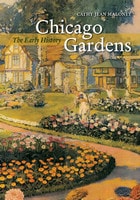
Chicago Gardens
The Early HistoryCathy Jean Maloney
University of Chicago Press, 2008
Cathy Jean Maloney has spent decades researching the city’s horticultural heritage, and here she reveals the unusual history of Chicago’s first gardens. Challenged by the region’s clay soil, harsh winters, and fierce winds, Chicago’s pioneering horticulturalists, Maloney demonstrates, found imaginative uses for hardy prairie plants. This same creative spirit thrived in the city’s local fruit and vegetable markets, encouraging the growth of what would become the nation’s produce hub. The vast plains that surrounded Chicago, meanwhile, inspired early landscape architects, such as Frederick Law Olmsted, Jens Jensen, and O.C. Simonds, to new heights of grandeur.
Maloney does not forget the backyard gardeners: immigrants who cultivated treasured seeds and pioneers who planted native wildflowers. Maloney’s vibrant depictions of Chicagoans like “Bouquet Mary,” a flower peddler who built a greenhouse empire, add charming anecdotal evidence to her argument–that Chicago’s garden history rivals that of New York or London and ensures its status as a world-class capital of horticultural innovation.
With exquisite archival photographs, prints, and postcards, as well as field guide descriptions of living legacy gardens for today’s visitors, Chicago Gardens will delight green-thumbs from all parts of the world.
Chicago Heights
Little Joe College, the Outfit, and the Fall of Sam GiancanaCharles Hager with David T. Miller, Foreword by Louis Corsino, Afterword by Ashleigh D'Andrea
Southern Illinois University Press, 2018
In this riveting true story of coming of age in the Chicago Mob, Charles “Charley” Hager is plucked from his rural West Virginia home by an uncle in the 1960s and thrown into an underworld of money, cars, crime, and murder on the streets of Chicago Heights.
Street-smart and good with his hands, Hager is accepted into the working life of a chauffeur and “street tax” collector, earning the moniker “Little Joe College” by notorious mob boss Albert Tocco. But when his childhood friend is gunned down by a hit man, Hager finds himself a bit player in the events surrounding the mysterious, and yet unsolved, murder of mafia chief Sam Giancana.
Chicago Heights is part rags-to-riches story, part murder mystery, and part redemption tale. Hager, with author David T. Miller, juxtaposes his early years in West Virginia with his life in crime, intricately weaving his own experiences into the fabric of mob life, its many characters, and the murder of Giancana.
Fueled by vivid recollections of turf wars and chop shops, of fix-ridden harness racing and the turbulent politics of the 1960s, Chicago Heights reveals similarities between high-level organized crime in the city and the corrupt lawlessness of Appalachia. Hager candidly reveals how he got caught up in a criminal life, what it cost him, and how he rebuilt his life back in West Virginia with a prison record.
Based on interviews with Hager and supplemented by additional interviews and extensive research by Miller, the book also adds Hager’s unique voice to the volumes of speculation about Giancana’s murder, offering a plausible theory of what happened on that June night in 1975.
Chicago Latina Trailblazers
Testimonios of Political ActivismEdited by Rita D. Hernández, Leticia Villarreal Sosa, Elena R. Gutiérrez
University of Illinois Press, 2024
Mexican American and Puerto Rican women have long taken up the challenge to improve the lives of Chicagoans in the city’s Latino/a/x communities. Rita D. Hernández, Leticia Villarreal Sosa, and Elena R. Gutiérrez present testimonies by Latina leaders who blazed new trails and shaped Latina Chicago history from the 1960s through today.
Taking a do-it-all attitude, these women advanced agendas, built institutions, forged alliances, and created essential resources that Latino/a/x communities lacked. Time and again, they found themselves the first Latina to hold their post or part of the first Latino/a/x institution of its kind. Just as often, early grassroots efforts to address issues affecting themselves, their families, and their neighborhoods grew into larger endeavors. Their experiences ranged from public schools to healthcare to politics to broadcast media, and each woman’s story shows how her work changed countless lives and still reverberates across the entire city.
An eyewitness view of an unknown history, Chicago Latina Trailblazers reveals the vision and passion that fueled a group of women in the vanguard of reform.
Contributors: Ana Castillo, Maria B. Cerda, Carmen Chico, Aracelis Flecha Figueroa, Aida Luz Maisonet Giachello, Mary Gonzales, Ada Nivia López, Emma Lozano, Virginia Martinez, Carmen Mendoza, Elena Mulcahy, Guadalupe Reyes, Luz Maria B. Solis, and Carmen Velasquez
Chicago Lawyers, Revised Edition
The Social Structure of the BarJohn Heinz and Edward Laumann
Northwestern University Press, 1994
Chicago Lawyers
The Social Structure of the BarJohn P. Heinz
Russell Sage Foundation, 1982
Chicago Made
Factory Networks in the Industrial MetropolisRobert Lewis
University of Chicago Press, 2008
Robert Lewis documents how manufacturers, attracted to greenfield sites on the city’s outskirts, began to build factory districts there with the help of an intricate network of railroad owners, real estate developers, financiers, and wholesalers. These immense networks of social ties, organizational memberships, and financial relationships were ultimately more consequential, Lewis demonstrates, than any individual achievement. Beyond simply giving Chicago businesses competitive advantages, they transformed the economic geography of the region. Tracing these transformations across seventy-five years, Chicago Made establishes a broad new foundation for our understanding of urban industrial America.
Chicago Makes Modern
How Creative Minds Changed SocietyEdited by Mary Jane Jacob and Jacquelynn Baas
University of Chicago Press, 2012
Chicago is a city dedicated to the modern—from the skyscrapers that punctuate its skyline to the spirited style that inflects many of its dwellings and institutions, from the New Bauhaus to Hull-House. Despite this, the city has long been overlooked as a locus for modernism in the arts, its rich tradition of architecture, design, and education disregarded. Still the modern in Chicago continues to thrive, as new generations of artists incorporate its legacy into fresh visions for the future. Chicago Makes Modern boldly remaps twentieth-century modernism from our new-century perspective by asking an imperative question: How did the modern mind—deeply reflective, yet simultaneously directed—help to dramatically alter our perspectives on the world and make it new?
Returning the city to its rightful position at the heart of a multidimensional movement that changed the face of the twentieth century, Chicago Makes Modern applies the missions of a brilliant group of innovators to our own time. From the radical social and artistic perspectives implemented by Jane Addams, John Dewey, and Buckminster Fuller to the avant-garde designs of László Moholy-Nagy and Mies van der Rohe, the prodigious offerings of Chicago's modern minds left an indelible legacy for future generations. Staging the city as a laboratory for some of our most heralded cultural experiments, Chicago Makes Modern reimagines the modern as a space of self-realization and social progress—where individual visions triggered profound change. Featuring contributions from an acclaimed roster of contemporary artists, critics, and scholars, this book demonstrates how and why the Windy City continues to drive the modern world.
Chicago Neighborhoods and Suburbs
A Historical GuideEdited by Ann Durkin Keating
University of Chicago Press, 2008
Many of us, in fact, know little of the neighborhoods beyond those where we work, play, and live. This is especially true in Chicagoland, a region that spans over 4,400 square miles and is home to more than 9.5 million residents. In Chicago Neighborhoods and Suburbs, historian Ann Durkin Keating sheds new light on twenty-first-century Chicago by providing a captivating yet compact guide to the Midwest’s largest city. Keating charts Chicago’s evolution with comprehensive, cross-referenced entries on all seventy-seven community areas, along with many suburbs and neighborhoods both extant and long forgotten, from Albany Park to Zion. Thoughtful interpretive essays by urban historians Michael Ebner, Henry Binford, Janice Reiff, Susan Hirsch, and Robert Bruegmann explore how the city’s communities have changed and grown throughout the years, and sixty historic and contemporary photographs and additional maps add depth to each entry.
From the South Side to the West Side to the North Side, just about every local knows how distinctive Chicago’s neighborhoods are. Few of us, however, know exactly how they came to be. Chicago Neighborhoods and Suburbs brings the city—its inimitable neighborhoods, industries, and individuals—to life, making it the perfect guidebook for anyone with an interest in Chicago and its history.
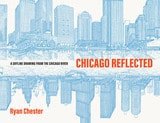
Chicago Reflected
A Skyline Drawing from the Chicago RiverRyan Chester
University of Chicago Press, 2023
As completed, Chester’s two-foot-high, fifty-five-foot-long drawing is a unique vision. In addition to dozens of accurately depicted buildings, Chester included pieces of Chicago’s past, including the Union Station Concourse Building that was demolished in 1969 and the immense SS Eastland, which sank in the river in 1915, killing hundreds of people. Recent architecture is featured as well, including Studio Gang’s St. Regis Chicago tower and the Bank of America Tower by Goettsch Partners.
An essay by acclaimed writer Thomas Dyja accompanies the accordion-fold presentation of Chester’s drawing, enhancing this remarkable volume that will delight any fan of Chicago, architecture, or art. Chicago Reflected opens up fresh vistas of the stunning, ever-evolving architectural landscape that can be found only in Chicago.
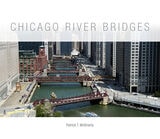
Chicago River Bridges
Patrick T. McBriarty
University of Illinois Press, 2013
The first comprehensive guidebook of these remarkable features of Chicago's urban landscape, Chicago River Bridges chronicles more than 175 bridges spanning 55 locations along the Main Channel, South Branch, and North Branch of the Chicago River. With new full-color photography of the existing bridges by Kevin Keeley and Laura Banick and more than one hundred black and white images of bridges past, the book unearths the rich history of Chicago's downtown bridges from the Michigan Avenue Bridge to the often forgotten bridges that once connected thoroughfares such as Rush, Erie, Taylor, and Polk Streets.
Throughout, McBriarty delivers new research into the bridges' architectural designs, engineering innovations, and their impact on Chicagoans' daily lives. Describing the structure and mechanics of various kinds of moveable bridges (including vertical-lift, Scherer rolling lift, and Strauss heel trunnion mechanisms) in a manner that is accessible and still satisfying to the bridge aficionado, he explains how the dominance of the "Chicago-style" bascule drawbridge influenced the style and mechanics of bridges worldwide. Interspersed throughout are the human dramas that played out on and around the bridges, such as the floods of 1849 and 1992, the cattle crossing collapse of the Rush Street Bridge, or Vincent "The Schemer" Drucci's Michigan Avenue Bridge jump.
A confluence of Chicago history, urban design, and engineering lore, Chicago River Bridges illustrates Chicago's significant contribution to drawbridge innovation and the city's emergence as the drawbridge capital of the world. It is perfect for any reader interested in learning more about the history and function of Chicago's many and varied bridges. The introduction won The Henry N. Barkhausen Award for original research in the field of Great Lakes maritime history sponsored by the Association for Great Lakes Maritime History.
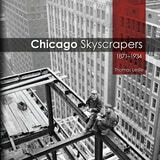
Chicago Skyscrapers, 1871-1934
Leslie Thomas
University of Illinois Press, 2013
For more than a century, Chicago's skyline has included some of the world's most distinctive and inspiring buildings. This history of the Windy City's skyscrapers begins in the key period of reconstruction after the Great Fire of 1871 and concludes in 1934 with the onset of the Great Depression, which brought architectural progress to a standstill. During this time, such iconic landmarks as the Chicago Tribune Tower, the Wrigley Building, the Marshall Field and Company Building, the Chicago Stock Exchange, the Palmolive Building, the Masonic Temple, the City Opera, Merchandise Mart, and many others rose to impressive new heights, thanks to innovations in building methods and materials. Solid, earthbound edifices of iron, brick, and stone made way for towers of steel and plate glass, imparting a striking new look to Chicago's growing urban landscape.
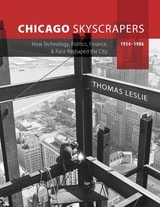
Chicago Skyscrapers, 1934-1986
How Technology, Politics, Finance, and Race Reshaped the CityThomas Leslie
University of Illinois Press, 2023
Illustrated with more than 140 photographs, Chicago Skyscrapers, 1934–1986 tells the fascinating stories of the people, ideas, negotiations, decision-making, compromises, and strategies that changed the history of architecture and one of its showcase cities.

Chicago Soul
Robert Pruter
University of Illinois Press, 1992
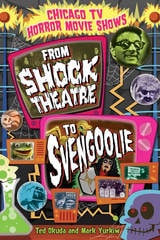
Chicago TV Horror Movie Shows
From Shock Theatre to SvengoolieTed Okuda and Mark Yurkiw
Southern Illinois University Press, 2007
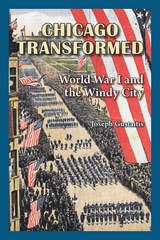
Chicago Transformed
World War I and the Windy CityJoseph Gustaitis
Southern Illinois University Press, 2016
It’s been called the “war that changed everything,” and it is difficult to think of a historical event that had a greater impact on the world than the First World War. Events during the war profoundly changed our nation, and Chicago, especially, was transformed during this period. Between 1913 and 1919, Chicago transitioned from a nineteenth-century city to the metropolis it is today. Despite the importance of the war years, this period has not been documented adequately in histories of the city. In Chicago in World War I: How the Great War Transformed a Great City, Joseph Gustaitis fills this gap in the historical record, covering the important wartime events, developments, movements, and people that helped shape Chicago.
Gustaitis attributes many of Chicago’s changes to the labor shortage caused by the war. African Americans from the South flocked to Chicago during the Great Migration, and Mexican immigration increased as well. This influx of new populations along with a wave of anti-German hysteria—which nearly extinguished German culture in Chicago—changed the city’s ethnic composition. As the ethnic landscape changed, so too did the culture. Jazz and blues accompanied African Americans to the city, and Chicago soon became America’s jazz and blues capital. Gustaitis also demonstrates how the nation’s first sexual revolution occurred not during the 1960s but during the World War I years, when the labor shortage opened up unprecedented employment opportunities for women. These opportunities gave women assertiveness and freedom that endured beyond the war years. In addition, the shortage of workers invigorated organized labor, and determined attempts were made to organize in Chicago’s two leading industrial workplaces—the stockyards and the steel mills—which helped launch the union movement of the twentieth century. Gustaitis explores other topics as well: Prohibition, which practically defined the city in the 1920s; the exploits of Chicago’s soldiers, both white and black; life on the home front; the War Exposition in Grant Park; and some of the city’s contributions to the war effort. The book also contains sketches of the wartime activities of prominent Chicagoans, including Jane Addams, Ernest Hemingway, Clarence Darrow, Rabbi Emil Hirsch, John T. McCutcheon, “Big Bill” Thompson, and Eunice Tietjens.
Although its focus is Chicago, this book provides insight into change nationwide, as many of the effects that the First World War had on the city also affected the United States as a whole. Drawing on a variety of sources and written in an accessible style that combines economic, cultural, and political history, Chicago in World War I: How the Great War Transformed a Great City portrays Chicago before the war, traces the changes initiated during the war years, and shows how these changes still endure in the cultural, ethnic, and political landscape of this great city and the nation.
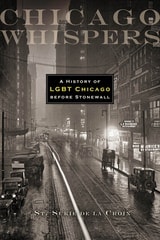
Chicago Whispers
A History of LGBT Chicago before StonewallSt. Sukie de la Croix; Foreword by John D’Emilio
University of Wisconsin Press, 2012
Chicago Whispers illuminates a colorful and vibrant record of lesbian, gay, bisexual, and transgendered people who lived and loved in Chicago from the city’s beginnings in the 1670s as a fur-trading post to the end of the 1960s. Journalist St. Sukie de la Croix, drawing on years of archival research and personal interviews, reclaims Chicago’s LGBT past that had been forgotten, suppressed, or overlooked.
Included here are Jane Addams, the pioneer of American social work; blues legend Ma Rainey, who recorded “Sissy Blues” in Chicago in 1926; commercial artist J. C. Leyendecker, who used his lover as the model for “The Arrow Collar Man” advertisements; and celebrated playwright Lorraine Hansberry, author of A Raisin in the Sun. Here, too, are accounts of vice dens during the Civil War and classy gentlemen’s clubs; the wild and gaudy First Ward Ball that was held annually from 1896 to 1908; gender-crossing performers in cabarets and at carnival sideshows; rights activists like Henry Gerber in the 1920s; authors of lesbian pulp novels and publishers of “physique magazines”; and evidence of thousands of nameless queer Chicagoans who worked as artists and musicians, in the factories, offices, and shops, at theaters and in hotels. Chicago Whispers offers a diverse collection of alternately hip and heart-wrenching accounts that crackle with vitality.
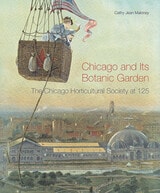
Chicago and Its Botanic Garden
The Chicago Horticultural Society at 125Cathy Jean Maloney
Northwestern University Press, 2015
Formed in 1890, during the heady days before the 1893 World’s Columbian Exposition, the Chicago Horticultural Society boasted members with names deeply rooted in Chicago history: Buckingham, McCormick, and Palmer, among others. Today, as it leads the Garden in a model public-private partnership with the Forest Preserves of Cook County, the Society’s horticultural practices have exceeded the vision of its founders.
Chicago and Its Botanic Garden: The Chicago Horticultural Society at 125 is a lushly illustrated and thoughtful history of the Society and its evolution from a producer of monumental flower and botanical shows, through a fallow period, to the opening in 1972 of the Chicago Botanic Garden, a living museum and world leader in horticulture, plant science and conservation, education, and urban agriculture. Author Cathy Jean Maloney combines meticulous scholarship with a flair for storytelling in a narrative that will delight everyone from casual strollers of the grounds to the volunteers, professionals, and scientists who compose the influential society.

Chicago and the Old Northwest, 1673-1835
Milo Milton Quaife
University of Illinois Press, 1913
Strategically located at the head of the Great Lakes on the Chicago portage, one of the main highways connecting the Great Lakes-St. Lawrence waterway with the Mississippi River, Chicago was equally valued by explorers, traders, settlers, and governments.
Quaife narrates the opening of trade and the course of European exploration, facilitated by the Chicago portage and subsequent construction of the Illinois and Michigan Canal. He profiles the personalities who shaped the early Chicago area, from the French explorers La Salle, Marquette, and Joliet to the ambitious Champlain, who set the course for decades to come by securing for New France the enmity of the Iroquois.
Quaife provides a full description of the Indian trade, which constituted the basis of commerce in the region for the entire period covered by the book, as well as a blow-by-blow account of how old rivalries and alliances between Indian tribes complicated the English and French plans for divvying up the New World. He also describes the conflicts between natives and whites with sympathy and detail on both sides, depicting Indian attacks on white settlements as rationally motivated acts aiming toward specific goals of strategy or revenge.
First published in 1913, Chicago and the Old Northwest, 1673-1835 is one of the earliest works of a man who became one of the premier scholars of his generation. In a new introduction, Chicago historian Perry R. Duis sketches Quaife's long and varied career, his influence on the history profession, and his crusade to prove that a black trader was the first permanent resident of Chicago.
Chicago in Quotations
Compiled by Stuart Shea
Bodleian Library Publishing, 2016
Whether you look upon the city with admiration, disgust, or an incongruous combination of the two, Chicago has captured the imagination of generations of poets, novelists, journalists, and commentators who have visited or called it home. Chicago in Quotations offers a compendium of the most colorful impressions that citizens of—or visitors to—the Second City will appreciate.
Chicago in the Age of Capital
Class, Politics, and Democracy during the Civil War and ReconstructionJohn B. Jentz and Richard Schneirov
University of Illinois Press, 2015
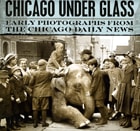
Chicago under Glass
Early Photographs from the Chicago Daily NewsMark Jacob and Richard Cahan in association with the Chicago History Museum
University of Chicago Press, 2007
These cameramen helped sell papers, but, as Mark Jacob and Richard Cahan reveal, they also made art. Chicago under Glass: Early Photographs from the Chicago Daily News is the first collection of images from the photo staff’s early years, 1901 to 1930. Jacob and Cahan, seasoned journalists themselves, have selected more than 250 images—many of which have never before been published—from the nearly 57,000 glass negatives housed at the Chicago History Museum. They include rare photographs of a young Buster Keaton with his wife and child, waiting to board a train and the notorious Al Capone outside a courtroom, smoking a cigar and consulting with his lawyer. Each thematic section begins with a fascinating introduction by the authors, and each image is accompanied by insightful historical commentary.
These fragile glass records are a remarkable piece of American history. Together, they capture a time of massive change and stark contrasts, the defining years in a place Nelson Algren called “Hustlertown.” From candid shots of the Eastland steamer disaster to the glittering electric lights of the White City amusement park and the grim aftermath of the Saint Valentine’s Day Massacre, the history these images reveal is not simply the story of Chicago, but the history of the modern American city.
Chicago's Block Clubs
How Neighbors Shape the CityAmanda I. Seligman
University of Chicago Press, 2016
In Chicago’s Block Clubs, Amanda I. Seligman uncovers the history of the block club in Chicago—from its origins in the Urban League in the early 1900s through to the Chicago Police Department’s twenty-first-century community policing program. Recognizing that many neighborhood problems are too big for one resident to handle—but too small for the city to keep up with—city residents have for more than a century created clubs to establish and maintain their neighborhood’s particular social dynamics, quality of life, and appearance. Omnipresent yet evanescent, block clubs are sometimes the major outlets for community organizing in the city—especially in neighborhoods otherwise lacking in political strength and clout. Drawing on the stories of hundreds of these groups from across the city, Seligman vividly illustrates what neighbors can—and cannot—accomplish when they work together.
Chicago's Fabulous Fountains
Greg Borzo. Photographs by Julia Thiel. Foreword by Geoffrey Baer. Preface by Debra Shore.
Southern Illinois University Press, 2017
Winner, ISHS Annual Award for Other Publications, 2018
Most people do not realize it, but Chicago is home to many diverse, artistic, fascinating, and architecturally and historically important fountains. In this attractive volume, Greg Borzo reveals more than one hundred outdoor public fountains of Chicago with noteworthy, amusing, or surprising stories about these gems. Complementing Borzo’s engagingly written text are around one hundred beautiful fine-art color photos of the fountains, taken by photographer Julia Thiel for this book, and a smaller number of historical photos.
Greg Borzo begins by providing an overview of Chicago’s fountains and discussing the oldest ones, explaining who built them and why, how they survived as long as they have, and what they tell us about early Chicago. At the heart of the book are four thematic chapters on drinking fountains, iconic fountains, plaza fountains, and park and parkway fountains. Among the iconic fountains described are Buckingham (in Grant Park), Crown (in Millennium Park), Centennial (with its water cannon shooting over the Chicago River), and two fountains designed by famed sculptor Lorado Taft (Time and Great Lakes). Plazas all around Chicago—in the neighborhoods as well as downtown—have fountains that anchor communities or enhance the skyscrapers they adorn. Also presented are the fountains in Chicago’s parks, some designed by renowned artists and many often overlooked or taken for granted. A chapter on the self-proclaimed City of Fountains, Kansas City, Missouri, shows how Chicago’s city planners could raise public awareness and funding for the care and preservation of these important landmarks. Also covered are a brief period of fountain building and rehabbing (1997–2002) that vastly enriched the city; fountains that no longer exist; and proposed Chicago fountains that were never built, as well as the future of fountain design.
A beautiful photography book and a guide to the city’s many fountains, Chicago’s Fabulous Fountains also provides fascinating histories and behind-the-scenes stories of these underappreciated artistic and architectural treasures of the Windy City.
Chicago's Famous Buildings
Franz Schulze and Kevin Harrington
University of Chicago Press, 2003
Chicago's Famous Buildings, fifth edition, completely updated and revised by Franz Schulze and Kevin Harrington, covers more than a decade of extraordinary new architecture and takes a fresh look back at the city's classical legacy of Adler, Sullivan, Burnham, Root, Wright, and Mies van der Rohe. The authors have added many new descriptions and images of the most important projects in Chicago since the fourth edition, including the massive reconstruction of Grant Park around Frank Gehry's Music Pavilion, and they cover as well the current status of older buildings—some destroyed, others, such as Burnham's Reliance Building, marvelously restored and brought back to life. Chicago's Famous Buildings, fifth edition, also includes expanded sections on the city's future and the development of its diverse neighborhoods, presented with new maps to serve as an even more effective walking guide. A glossary of architectural terms, an extensive index, and more than sixty new photographs of both old and new buildings bring this guide completely up-to-date.
Authoritative, informative, and easier to use than ever before, this fifth edition of Chicago's Famous Buildings will serve tourists and residents alike as the leading architectural guide to the treasures of this marvelous city.
Chicago's Grand Midway
A Walk around the World at the Columbian ExpositionNorman Bolotin
University of Illinois Press, 2017
Chicago's Greatest Year, 1893
The White City and the Birth of a Modern MetropolisJoseph Gustaitis
Southern Illinois University Press, 2013
In 1893, the 27.5 million visitors to the Chicago World’s Fair feasted their eyes on the impressive architecture of the White City, lit at night by thousands of electric lights. In addition to marveling at the revolutionary exhibits, most visitors discovered something else: beyond the fair’s 633 acres lay a modern metropolis that rivaled the world’s greatest cities. The Columbian Exposition marked Chicago’s arrival on the world stage, but even without the splendor of the fair, 1893 would still have been Chicago’s greatest year.
An almost endless list of achievements took place in Chicago in 1893. Chicago’s most important skyscraper was completed in 1893, and Frank Lloyd Wright opened his office in the same year. African American physician and Chicagoan Daniel Hale Williams performed one of the first known open-heart surgeries in 1893. Sears and Roebuck was incorporated, and William Wrigley invented Juicy Fruit gum that year. The Field Museum, the Art Institute of Chicago, and the Museum of Science and Industry all started in 1893. The Cubs’ new ballpark opened in this year, and an Austro-Hungarian immigrant began selling hot dogs outside the World’s Fair grounds. His wares became the famous “Chicago hot dog.”
“Cities are not buildings; cities are people,” writes author Joseph Gustaitis. Throughout the book, he brings forgotten pioneers back to the forefront of Chicago’s history, connecting these important people of 1893 with their effects on the city and its institutions today. The facts in this history of a year range from funny to astounding, showcasing innovators, civic leaders, VIPs, and power brokers who made 1893 Chicago about so much more than the fair.
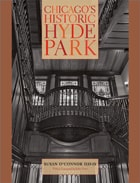
Chicago's Historic Hyde Park
Susan O'Connor Davis
University of Chicago Press, 2013
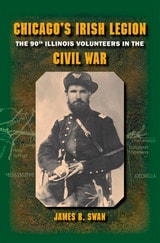
Chicago's Irish Legion
The 90th Illinois Volunteers in the Civil WarJames B. Swan
Southern Illinois University Press, 2009
Extensively documented and richly detailed, Chicago’s Irish Legion tells the compelling story of Chicago’s 90th Illinois Volunteer Infantry, the only Irish regiment in Major General William Tecumseh Sherman’s XV Army Corps. Swan’s sweeping history of this singular regiment and its pivotal role in the Western Theater of the Civil War draws heavily from primary documents and first-person observations, giving readers an intimate glimpse into the trials and triumphs of ethnic soldiers during one of the most destructive wars in American history.
At the onset of the bitter conflict between the North and the South, Irish immigrants faced a wall of distrust and discrimination in the United States. Many Americans were deeply suspicious of Irish religion and politics, while others openly doubted the dedication of the Irish to the Union cause. Responding to these criticisms with a firm show of patriotism, the Catholic clergy and Irish politicians in northern Illinois—along with the Chicago press and community—joined forces to recruit the Irish Legion. Composed mainly of foreign-born recruits, the Legion rapidly dispelled any rumors of disloyalty with its heroic endeavors for the Union. The volunteers proved to be instrumental in various battles and sieges, as well as the marches to the sea and through the Carolinas, suffering severe casualties and providing indispensable support for the Union. Swan meticulously traces the remarkable journey of these unique soldiers from their regiment’s inception and first military engagement in 1862 to their disbandment and participation in the Grand Review of General Sherman’s army in 1865.
Enhancing the volume are firsthand accounts from the soldiers who endured the misery of frigid winters and brutal environments, struggling against the ravages of disease and hunger as they marched more than twenty-six hundred miles over the course of the war. Also revealed are personal insights into some of the war’s most harrowing events, including the battle at Chattanooga and Sherman’s famous campaign for Atlanta. In addition, Swan exposes the racial issues that affected the soldiers of the 90th Illinois, including their reactions to the Emancipation Proclamation and the formations of the first African American fighting units. Swan rounds out the volume with stories of survivors’ lives after the war, adding an even deeper personal dimension to this absorbing chronicle.

Chicago's North Michigan Avenue
Planning and Development, 1900-1930John W. Stamper
University of Chicago Press, 1991
John W. Stamper traces the complex development of North Michigan Avenue from the 1880s to the 1920s building boom that solidified its character and economic base, describing the initiation of the planning process by private interests to its execution aided by the city's powerful condemnation and taxation proceedings. He focuses on individual buildings constructed on the avenue, including the Renaissance- and Gothic-inspired Wrigley Building, Tribune Tower, and Drake Hotel, and places them within the context of factors governing their construction—property ownership, financing, zoning laws, design theory, and advertising.
Stamper compares this stylistically diverse mixture of low- and high-rise structures with earlier, rejected planning proposals, all of which had prescribed a uniformly designed, European-like avenue of continuous cornice heights, consistent facade widths, and complementary stylistic features. He analyzes the drastically different character the avenue took by 1930, with high-rise towers reaching thirty stories and beyond, in terms of the clash among economic, political, and architectural interests. His argument—that the discrepancies between the rejected plans and reality illustrate the developers' choice of economic return on their investment over aesthetic community—is extended through to the present avenue and the virtual disregard of the urban qualities proposed at its inception. Generously illustrated, with an epilogue condensing the avenue's history between the end of World War II and the present, this is an exhaustive account of an important topic in the history of modern architecture and city planning.
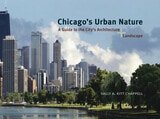
Chicago's Urban Nature
A Guide to the City's Architecture + LandscapeSally A. Kitt Chappell
University of Chicago Press, 2007
At the heart of this new urban concept is the idea of connection, bringing buildings and landscapes, culture and nature, commerce and leisure into an energetic harmony. With Chicago’s Urban Nature in hand, you’ll see those connections woven through the fabric of the city. Chappell provides new insights into such historic Chicago sites as Jens Jensen’s Garfield Park Conservatory, Frederick Law Olmsted’s Jackson Park, and Alfred Caldwell’s Lily Pond, then takes us to the innovative contemporary green spaces they influenced, from City Hall’s rooftop garden to the North Lawndale Green Youth Farm to Chicago’s heralded new Millennium Park. These beautiful green spaces, with their unprecedented melding of art, architecture, and ecology, have become far more than places of escape for Chicagoans—they’re now fully integrated into the urban scene, an essential part of the cultural life of the modern city.
Packed with maps and recommended tours, and bursting with splendid photos, this is an essential guidebook for day-trippers, lifelong Chicago residents, and professionals in landscape architecture, urbanism, and design.
Chicago's War on Syphilis, 1937-40
The Times, the "Trib," and the Clap DoctorSuzanne Poirier
University of Illinois Press, 1995
the importance of her subject." -- Thomas N. Bonner, author of To
the Ends of the Earth: Women's Search for Education in Medicine
Those struggling to deal with the AIDS epidemic might learn valuable
lessons from the earlier struggle of the U.S. to deal with syphilis. Here,
Suzanne Poirier tells the story of the Chicago Syphilis Control Program
launched in 1937 by the Chicago Board of Health and the U.S. Public Health
Service and severely limited from the start because of the refusal of
government, the press, and the public to confront directly the issues
underlying the problem.
Poirier's narrative is memorable for its vivid scenes, colorful characters
that include Chicago's "clap doctor," Dr. Ben Reitman, and its
account of the heated debate that surrounded the effort. In an epilogue,
the author discusses similarities between current efforts against AIDS
and the handling and politics of the syphilis problem in the late 1930s.
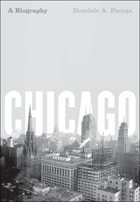
Chicago
A BiographyDominic A. Pacyga
University of Chicago Press, 2009
Chicago has been called by many names. Nelson Algren declared it a “City on the Make.” Carl Sandburg dubbed it the “City of Big Shoulders.” Upton Sinclair christened it “The Jungle,” while New Yorkers, naturally, pronounced it “the Second City.”
At last there is a book for all of us, whatever we choose to call Chicago. In this magisterial biography, historian Dominic Pacyga traces the storied past of his hometown, from the explorations of Joliet and Marquette in 1673 to the new wave of urban pioneers today. The city’s great industrialists, reformers, and politicians—and, indeed, the many not-so-great and downright notorious—animate this book, from Al Capone and Jane Addams to Mayor Richard J. Daley and President Barack Obama. But what distinguishes this book from the many others on the subject is its author’s uncommon ability to illuminate the lives of Chicago’s ordinary people. Raised on the city’s South Side and employed for a time in the stockyards, Pacyga gives voice to the city’s steelyard workers and kill floor operators, and maps the neighborhoods distinguished not by Louis Sullivan masterworks, but by bungalows and corner taverns.
Filled with the city’s one-of-a-kind characters and all of its defining moments, Chicago: A Biography is as big and boisterous as its namesake—and as ambitious as the men and women who built it.
Chicago
A BiographyDominic A. Pacyga
University of Chicago Press, 2009
This is an auto-narrated audiobook version of this book.
Chicago has been called by many names. Nelson Algren declared it a “City on the Make.” Carl Sandburg dubbed it the “City of Big Shoulders.” Upton Sinclair christened it “The Jungle,” while New Yorkers, naturally, pronounced it “the Second City.”
At last there is a book for all of us, whatever we choose to call Chicago. In this magisterial biography, historian Dominic Pacyga traces the storied past of his hometown, from the explorations of Joliet and Marquette in 1673 to the new wave of urban pioneers today. The city’s great industrialists, reformers, and politicians—and, indeed, the many not-so-great and downright notorious—animate this book, from Al Capone and Jane Addams to Mayor Richard J. Daley and President Barack Obama. But what distinguishes this book from the many others on the subject is its author’s uncommon ability to illuminate the lives of Chicago’s ordinary people. Raised on the city’s South Side and employed for a time in the stockyards, Pacyga gives voice to the city’s steelyard workers and kill floor operators, and maps the neighborhoods distinguished not by Louis Sullivan masterworks, but by bungalows and corner taverns.
Filled with the city’s one-of-a-kind characters and all of its defining moments, Chicago: A Biography is as big and boisterous as its namesake—and as ambitious as the men and women who built it.
Chicago
A Geography of the City and Its RegionJohn C. Hudson
University of Chicago Press, 2006
Renowned geographer John C. Hudson leaves no aspect unexplored in this ambitious and peerless book. Beginning with an overview of metropolitan Chicago, Hudson describes how the city has served as a model to social scientists and examines its unique neighborhoods and communities from the perspectives of Chicagoans themselves. A thorough description of the physical geography of the region introduces a series of studies in historical geography that consider the origins of the city and its early development through to its present state, paying particular attention to race, ethnicity, and suburbanization, as well as commuting patterns, neighborhood change, and patterns of income distribution. Chicago concludes with a comparison of the balanced geography that prevailed in the early twentieth century with the skewed pattern of sectoral imbalances that exists today.
Supplemented with more than one hundred maps that illustrate the evolution of Chicago over time and sixty-four black-and-white and color photographs that capture iconic images of the city’s landscapes and its people, Chicago beautifully synthesizes the city’s social and economic strata with geographical features to provide an authoritative guide to modern Chicagoland.