Results by title
264 books match the query 'Chicago (Ill.)' and 51 start with c
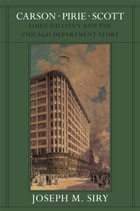
Carson Pirie Scott
Louis Sullivan and the Chicago Department StoreJoseph M. Siry
University of Chicago Press, 1988
Central Air
PoemsMike Puican
Northwestern University Press, 2020
Puican’s focus on the city, its people and underbellied spaces, pays homage in the tradition of the great Chicago masters: Carl Sandburg, Gwendolyn Brooks, and Campbell McGrath. This contemporary Chicago son finds his own place with lyrical integrity.
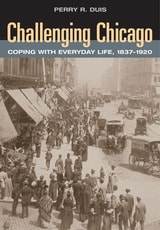
Challenging Chicago
Coping with Everyday Life, 1837-1920Perry R. Duis
University of Illinois Press, 2006
Follow along and encounter some of Chicago’s most infamous citizens--the loathed Traction Baron, high-speed “scorchers,” and peddlers of “swill milk.” Learn about the perils of payday, the lunchtime problems of women, the lure of dime museums, and the fatal attraction of Chicago’s “cruelest place.” Against this bleak backdrop emerged the innovators and institutions that made Chicago the vibrant city it is today. The superbly textured narrative is enhanced by eighty-six historic photographs and illustrations.
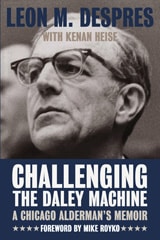
Challenging the Daley Machine
A Chicago Alderman's MemoirLeon M. Despres
Northwestern University Press, 2005
Winner, 2007 The Hyde Park Historical Society Paul Cornell Award
Political war stories from a thorn in the side of Chicago's famous Boss
In 1955, south-sider Leon Despres was elected to the Chicago City Council-the same year that Paddy Bauler famously uttered that "Chicago ain't ready for reform." Ready or not, Chicago got twenty years of reform efforts from Despres, one of the few independents in the council and the most liberal alderman in the city. His demand to cut out the corrupt sale of city driveway permits made him enemies from the very beginning. Over the years his crusades to ban discrimination, preserve Chicago landmark buildings, and gain equality for African-Americans-when Daley-beholden African-American council members refused to help-threw wrench after wrench into the Machine. And, not incidentally, changed the city.
But Challenging the Daley Machine is more than a memoir. It's a historical portrait of the way things were done under the Boss, when changing times and a changing city forced the Machine to confront the problems Despres championed. His battles against the seemingly monolithic Machine are also an inspiration to anyone who is facing long odds, but is convinced he/she is on the side of right.
Chi Boy
Native Sons and Chicago ReckoningsKeenan Norris
The Ohio State University Press, 2022
Chi Town
Norbert Blei
Northwestern University Press, 2003
Chi Townis the story of Norbert Blei's love affair with a city that shaped both his life and work. Along the route of this walking tour of the Windy City, you'll dine with Petros in Greek Town, see Studs Terkel in action at WFMT interviewing Dave Brubeck, listen to Mike Royko describe his own neighborhood, share the thoughts of Chicago sportswriter Jerome Holtzman, and meet newspaper vendors, trash collectors, bankers and more.
Chicago '68
David Farber
University of Chicago Press, 1988
"Chicago '68 was a watershed summer. Chicago '68 is a watershed book. Farber succeeds in presenting a sensitive, fairminded composite portrait that is at once a model of fine narrative history and an example of how one can walk the intellectual tightrope between 'reporting one's findings' and offering judgements about them."—Peter I. Rose, Contemporary Sociology
Chicago 1890
The Skyscraper and the Modern CityJoanna Merwood-Salisbury
University of Chicago Press, 2009
Chicago’s first skyscrapers are famous for projecting the city’s modernity around the world. But what did they mean at home, to the Chicagoans who designed and built them, worked inside their walls, and gazed up at their façades? Answering this multifaceted question, Chicago 1890 reveals that early skyscrapers offered hotly debated solutions to the city’s toughest problems and, in the process, fostered an urban culture that spread across the country.
An ambitious reinterpretation of the works of Louis Sullivan, Daniel Burnham, and John Wellborn Root, this volume uses their towering achievements as a lens through which to view late nineteenth-century urban history. Joanna Merwood-Salisbury sheds new light on many of Chicago’s defining events—including violent building trade strikes, the Haymarket bombing, the World’s Columbian Exposition, and Burnham’s Plan of Chicago—by situating the Masonic Temple, the Monadnock Building, and the Reliance Building at the center of the city’s cultural and political crosscurrents.
While architects and property owners saw these pioneering structures as manifestations of a robust American identity, immigrant laborers and social reformers viewed them as symbols of capitalism’s inequity. Illuminated by rich material from the period’s popular press and professional journals, Merwood-Salisbury’s chronicle of this contentious history reveals that the skyscraper’s vaunted status was never as inevitable as today’s skylines suggest.
Chicago Apartments
A Century and Beyond of Lakefront LuxuryNeil Harris and Teri J. Edelstein
University of Chicago Press, 2020
Chicago Architecture
Histories, Revisions, AlternativesEdited by Charles Waldheim and Katerina Ruedi Ray
University of Chicago Press, 2005
In Chicago Architecture, Charles Waldheim and Katerina Ruedi Ray revise and offer alternatives to the archetypal story of modern architecture in Chicago. They and an esteemed group of contributors assert that the mythic status of Chicago architecture has distorted our understanding of the historical circumstances in which it was realized. This searching volume illuminates the importance of photographs, books, magazines, and other media in the cultivation of an international audience for Chicago architecture; it explores the pivotal role of real estate developers, finance and insurance sectors, and speculative capital markets in the development of the city itself; and, perhaps most notably, it examines a wide variety of overlooked architectural works and their creators—individuals who did not fit into the dominant modernist narrative.
Offering new insights on Chicago public housing and O'Hare International Airport, on the Columbian Exposition and Marina City, on the city's grid system and the place of women architects in the story of Chicago modernism, and on the subjective experience of living inside Chicago's most well-known buildings, Chicago Architecture is a work of enormous scope and vision—a book as heady and towering as the skyline it considers.
Chicago Before the Fire
An Economic HistoryLouis P. Cain
University of Illinois Press, 2025
An advantageous location and entrepreneurial passion helped fuel Chicago’s transformation from a fur trading post to a thriving city. Louis P. Cain’s economic history places pre-1871 Chicago within the narrative of national expansion and examines infrastructure, finance, and other areas of city life. Business histories tell the story of fortunes made with essential products like meat and grain. Sketches of titans like William Ogden and Cyrus McCormick reveal how real estate, farm equipment, and other industries became engines of local growth. Cain also details public health improvements that made Lake Michigan safe as a water supply while census data informs a portrait of Chicago’s population and the lives of the free Blacks and Irish immigrants at the bottom of the socioeconomic ladder.
Panoramic and up to date, Chicago before the Fire looks at how an intersection of geography, vision, and investment built a great American city.
Chicago Business and Industry
From Fur Trade to E-CommerceEdited by Janice L. Reiff
University of Chicago Press, 2013
Drawing on the award-winning Encyclopedia of Chicago, Janice L. Reiff has compiled a unique history of work in the Windy City. Beginning with an overview of the city’s commercial development, Chicago Business and Industry considers how key industries shaped—and were shaped by—both the local and global economies. The city’s phenomenal population growth, its proximity to water, and its development of railroads made Chicago one of the most productive markets for lumber and grain throughout the nineteenth century. The region’s once-booming steel industry, on the other hand, suffered a dramatic decline in the second half of the twentieth century, when already weakened demand met with increasing international competition. Chicago Business and Industry chronicles the Chicago region’s changing fortunes from its beginning.
Reiff has compiled and updated essays from the Encyclopedia covering the city’s most historically famous—and infamous—companies, from the Union Stock Yard to Montgomery Ward to the Board of Trade. The book concludes with a historical account of labor types and issues in the city, with attention to such topics as health-care workers, unemployment, and unionization. Today, Groupon and a host of other high-tech firms have led some experts to christen Chicago the Silicon Valley of the Midwest. Reiff’s new introduction takes account of these and other recent trends.
Engaging, accessible, and packed with fascinating facts, Chicago Business and Industry invites readers into the history and diversity of work in the city, helping them understand how Chicago became Chicago.
Chicago Dreaming
Midwesterners and the City, 1871-1919Timothy B. Spears
University of Chicago Press, 2005
Through innovative readings of Theodore Dreiser, Willa Cather, and Richard Wright, Spears argues that the migratory perspective was crucial to the rise of Chicago's emerging literary culture. In following the paths of several well-known migrants, including Jane Addams, cartoonist John T. McCutcheon, and businessman John Glessner, Spears also shows how the view from the hinterland permeated urban culture and informed the development of key Chicago institutions. Further exploring the notion of dreaming, he brings to light the internal desires that lured Midwestern migrants to the city as well as the nostalgia that led them to dream of the homes they left behind.
With this fascinating new take on the rise of Chicago, Chicago Dreaming blurs the line between country and city to reveal the provincial character of modern urban culture.
Chicago Neighborhoods and Suburbs
A Historical GuideEdited by Ann Durkin Keating
University of Chicago Press, 2008
Many of us, in fact, know little of the neighborhoods beyond those where we work, play, and live. This is especially true in Chicagoland, a region that spans over 4,400 square miles and is home to more than 9.5 million residents. In Chicago Neighborhoods and Suburbs, historian Ann Durkin Keating sheds new light on twenty-first-century Chicago by providing a captivating yet compact guide to the Midwest’s largest city. Keating charts Chicago’s evolution with comprehensive, cross-referenced entries on all seventy-seven community areas, along with many suburbs and neighborhoods both extant and long forgotten, from Albany Park to Zion. Thoughtful interpretive essays by urban historians Michael Ebner, Henry Binford, Janice Reiff, Susan Hirsch, and Robert Bruegmann explore how the city’s communities have changed and grown throughout the years, and sixty historic and contemporary photographs and additional maps add depth to each entry.
From the South Side to the West Side to the North Side, just about every local knows how distinctive Chicago’s neighborhoods are. Few of us, however, know exactly how they came to be. Chicago Neighborhoods and Suburbs brings the city—its inimitable neighborhoods, industries, and individuals—to life, making it the perfect guidebook for anyone with an interest in Chicago and its history.

Chicago Poems
Carl Sandburg
University of Illinois Press, 1992
Chicago Portraits
New EditionJune Skinner Sawyers
Northwestern University Press, 2012
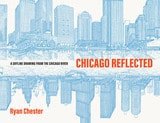
Chicago Reflected
A Skyline Drawing from the Chicago RiverRyan Chester
University of Chicago Press, 2023
As completed, Chester’s two-foot-high, fifty-five-foot-long drawing is a unique vision. In addition to dozens of accurately depicted buildings, Chester included pieces of Chicago’s past, including the Union Station Concourse Building that was demolished in 1969 and the immense SS Eastland, which sank in the river in 1915, killing hundreds of people. Recent architecture is featured as well, including Studio Gang’s St. Regis Chicago tower and the Bank of America Tower by Goettsch Partners.
An essay by acclaimed writer Thomas Dyja accompanies the accordion-fold presentation of Chester’s drawing, enhancing this remarkable volume that will delight any fan of Chicago, architecture, or art. Chicago Reflected opens up fresh vistas of the stunning, ever-evolving architectural landscape that can be found only in Chicago.
Chicago Skyscrapers, 1871-1934
Leslie Thomas
University of Illinois Press, 2013
For more than a century, Chicago's skyline has included some of the world's most distinctive and inspiring buildings. This history of the Windy City's skyscrapers begins in the key period of reconstruction after the Great Fire of 1871 and concludes in 1934 with the onset of the Great Depression, which brought architectural progress to a standstill. During this time, such iconic landmarks as the Chicago Tribune Tower, the Wrigley Building, the Marshall Field and Company Building, the Chicago Stock Exchange, the Palmolive Building, the Masonic Temple, the City Opera, Merchandise Mart, and many others rose to impressive new heights, thanks to innovations in building methods and materials. Solid, earthbound edifices of iron, brick, and stone made way for towers of steel and plate glass, imparting a striking new look to Chicago's growing urban landscape.
Chicago Skyscrapers, 1934-1986
How Technology, Politics, Finance, and Race Reshaped the CityThomas Leslie
University of Illinois Press, 2023
Illustrated with more than 140 photographs, Chicago Skyscrapers, 1934–1986 tells the fascinating stories of the people, ideas, negotiations, decision-making, compromises, and strategies that changed the history of architecture and one of its showcase cities.
Chicago Transformed
World War I and the Windy CityJoseph Gustaitis
Southern Illinois University Press, 2016
It’s been called the “war that changed everything,” and it is difficult to think of a historical event that had a greater impact on the world than the First World War. Events during the war profoundly changed our nation, and Chicago, especially, was transformed during this period. Between 1913 and 1919, Chicago transitioned from a nineteenth-century city to the metropolis it is today. Despite the importance of the war years, this period has not been documented adequately in histories of the city. In Chicago in World War I: How the Great War Transformed a Great City, Joseph Gustaitis fills this gap in the historical record, covering the important wartime events, developments, movements, and people that helped shape Chicago.
Gustaitis attributes many of Chicago’s changes to the labor shortage caused by the war. African Americans from the South flocked to Chicago during the Great Migration, and Mexican immigration increased as well. This influx of new populations along with a wave of anti-German hysteria—which nearly extinguished German culture in Chicago—changed the city’s ethnic composition. As the ethnic landscape changed, so too did the culture. Jazz and blues accompanied African Americans to the city, and Chicago soon became America’s jazz and blues capital. Gustaitis also demonstrates how the nation’s first sexual revolution occurred not during the 1960s but during the World War I years, when the labor shortage opened up unprecedented employment opportunities for women. These opportunities gave women assertiveness and freedom that endured beyond the war years. In addition, the shortage of workers invigorated organized labor, and determined attempts were made to organize in Chicago’s two leading industrial workplaces—the stockyards and the steel mills—which helped launch the union movement of the twentieth century. Gustaitis explores other topics as well: Prohibition, which practically defined the city in the 1920s; the exploits of Chicago’s soldiers, both white and black; life on the home front; the War Exposition in Grant Park; and some of the city’s contributions to the war effort. The book also contains sketches of the wartime activities of prominent Chicagoans, including Jane Addams, Ernest Hemingway, Clarence Darrow, Rabbi Emil Hirsch, John T. McCutcheon, “Big Bill” Thompson, and Eunice Tietjens.
Although its focus is Chicago, this book provides insight into change nationwide, as many of the effects that the First World War had on the city also affected the United States as a whole. Drawing on a variety of sources and written in an accessible style that combines economic, cultural, and political history, Chicago in World War I: How the Great War Transformed a Great City portrays Chicago before the war, traces the changes initiated during the war years, and shows how these changes still endure in the cultural, ethnic, and political landscape of this great city and the nation.

Chicago and the Old Northwest, 1673-1835
Milo Milton Quaife
University of Illinois Press, 1913
Strategically located at the head of the Great Lakes on the Chicago portage, one of the main highways connecting the Great Lakes-St. Lawrence waterway with the Mississippi River, Chicago was equally valued by explorers, traders, settlers, and governments.
Quaife narrates the opening of trade and the course of European exploration, facilitated by the Chicago portage and subsequent construction of the Illinois and Michigan Canal. He profiles the personalities who shaped the early Chicago area, from the French explorers La Salle, Marquette, and Joliet to the ambitious Champlain, who set the course for decades to come by securing for New France the enmity of the Iroquois.
Quaife provides a full description of the Indian trade, which constituted the basis of commerce in the region for the entire period covered by the book, as well as a blow-by-blow account of how old rivalries and alliances between Indian tribes complicated the English and French plans for divvying up the New World. He also describes the conflicts between natives and whites with sympathy and detail on both sides, depicting Indian attacks on white settlements as rationally motivated acts aiming toward specific goals of strategy or revenge.
First published in 1913, Chicago and the Old Northwest, 1673-1835 is one of the earliest works of a man who became one of the premier scholars of his generation. In a new introduction, Chicago historian Perry R. Duis sketches Quaife's long and varied career, his influence on the history profession, and his crusade to prove that a black trader was the first permanent resident of Chicago.
Chicago by Day and Night
The Pleasure Seeker's Guide to the Paris of AmericaPaul Durica and Bill Savage
Northwestern University Press, 2013
Chicago by Day and Night: The Pleasure Seeker’s Guide to the Paris of America is an actual guidebook to Chicago for visitors to the World’s Columbian Exposition of 1893. This unauthorized handbook to the rowdy city outside the elegant fairgrounds explores pleasures high and low. The theaters and music, architectural glories, parks and boulevards, churches and synagogues, and other elevated pursuits the authors included in 1893 gave the book a veneer of high culture. But the book owed its popularity to its insider tips about Chicago's lurid and louche entertainments—drink, gambling, and sex. With a wink and tongue firmly in cheek, the original authors condemned Gilded Age vice while offering curious travelers precise directions to the dubious, decadent, and debauched quarters of the Windy City.
To introduce this compulsively readable, gift-quality journey through the Chicago of 1893, Chicago writers and humorists Paul Durica and Bill Savage have added an expert introduction to Gilded Age Chicago and the World's Columbian Exposition. Showcasing the first Ferris wheel, dazzling new electrification technologies, and exhibits from around the world, the Exposition was Chicago’s chance to prove it had risen from the ashes of the Great Fire and would claim a place among the world’s great cities.
Both a perfect keepsake or gift for Chicago travelers as well as an invaluable text for readers interested in the history of Chicago, the Midwest, or Gilded Age urban life, Chicago by Day and Night is a beloved classic of Chicago writing.
Chicago by the Book
101 Publications That Shaped the City and Its ImageCaxton Club
University of Chicago Press, 2018
Chicago by the Book profiles 101 landmark publications about Chicago from the past 170 years that have helped define the city and its image. Each title—carefully selected by the Caxton Club, a venerable Chicago bibliophilic organization—is the focus of an illustrated essay by a leading scholar, writer, or bibliophile.
Arranged chronologically to show the history of both the city and its books, the essays can be read in order from Mrs. John H. Kinzie’s 1844 Narrative of the Massacre of Chicago to Sara Paretsky’s 2015 crime novel Brush Back. Or one can dip in and out, savoring reflections on the arts, sports, crime, race relations, urban planning, politics, and even Mrs. O’Leary’s legendary cow. The selections do not shy from the underside of the city, recognizing that its grit and graft have as much a place in the written imagination as soaring odes and boosterism. As Neil Harris observes in his introduction, “Even when Chicagoans celebrate their hearth and home, they do so while acknowledging deep-seated flaws.” At the same time, this collection heartily reminds us all of what makes Chicago, as Norman Mailer called it, the “great American city.”
With essays from, among others, Ira Berkow, Thomas Dyja, Ann Durkin Keating, Alex Kotlowitz, Toni Preckwinkle, Frank Rich, Don Share, Carl Smith, Regina Taylor, Garry Wills, and William Julius Wilson; and featuring works by Saul Bellow, Gwendolyn Brooks, Sandra Cisneros, Clarence Darrow, Erik Larson, David Mamet, Studs Terkel, Ida B. Wells-Barnett, Frank Lloyd Wright, and many more.
Chicago in the Age of Capital
Class, Politics, and Democracy during the Civil War and ReconstructionJohn B. Jentz and Richard Schneirov
University of Illinois Press, 2015
Chicago under Glass
Early Photographs from the Chicago Daily NewsMark Jacob and Richard Cahan in association with the Chicago History Museum
University of Chicago Press, 2007
These cameramen helped sell papers, but, as Mark Jacob and Richard Cahan reveal, they also made art. Chicago under Glass: Early Photographs from the Chicago Daily News is the first collection of images from the photo staff’s early years, 1901 to 1930. Jacob and Cahan, seasoned journalists themselves, have selected more than 250 images—many of which have never before been published—from the nearly 57,000 glass negatives housed at the Chicago History Museum. They include rare photographs of a young Buster Keaton with his wife and child, waiting to board a train and the notorious Al Capone outside a courtroom, smoking a cigar and consulting with his lawyer. Each thematic section begins with a fascinating introduction by the authors, and each image is accompanied by insightful historical commentary.
These fragile glass records are a remarkable piece of American history. Together, they capture a time of massive change and stark contrasts, the defining years in a place Nelson Algren called “Hustlertown.” From candid shots of the Eastland steamer disaster to the glittering electric lights of the White City amusement park and the grim aftermath of the Saint Valentine’s Day Massacre, the history these images reveal is not simply the story of Chicago, but the history of the modern American city.
Chicago's Fabulous Fountains
Greg Borzo. Photographs by Julia Thiel. Foreword by Geoffrey Baer. Preface by Debra Shore.
Southern Illinois University Press, 2017
Winner, ISHS Annual Award for Other Publications, 2018
Most people do not realize it, but Chicago is home to many diverse, artistic, fascinating, and architecturally and historically important fountains. In this attractive volume, Greg Borzo reveals more than one hundred outdoor public fountains of Chicago with noteworthy, amusing, or surprising stories about these gems. Complementing Borzo’s engagingly written text are around one hundred beautiful fine-art color photos of the fountains, taken by photographer Julia Thiel for this book, and a smaller number of historical photos.
Greg Borzo begins by providing an overview of Chicago’s fountains and discussing the oldest ones, explaining who built them and why, how they survived as long as they have, and what they tell us about early Chicago. At the heart of the book are four thematic chapters on drinking fountains, iconic fountains, plaza fountains, and park and parkway fountains. Among the iconic fountains described are Buckingham (in Grant Park), Crown (in Millennium Park), Centennial (with its water cannon shooting over the Chicago River), and two fountains designed by famed sculptor Lorado Taft (Time and Great Lakes). Plazas all around Chicago—in the neighborhoods as well as downtown—have fountains that anchor communities or enhance the skyscrapers they adorn. Also presented are the fountains in Chicago’s parks, some designed by renowned artists and many often overlooked or taken for granted. A chapter on the self-proclaimed City of Fountains, Kansas City, Missouri, shows how Chicago’s city planners could raise public awareness and funding for the care and preservation of these important landmarks. Also covered are a brief period of fountain building and rehabbing (1997–2002) that vastly enriched the city; fountains that no longer exist; and proposed Chicago fountains that were never built, as well as the future of fountain design.
A beautiful photography book and a guide to the city’s many fountains, Chicago’s Fabulous Fountains also provides fascinating histories and behind-the-scenes stories of these underappreciated artistic and architectural treasures of the Windy City.
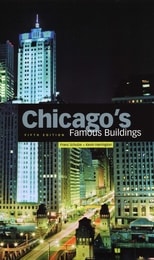
Chicago's Famous Buildings
Franz Schulze and Kevin Harrington
University of Chicago Press, 2003
Chicago's Famous Buildings, fifth edition, completely updated and revised by Franz Schulze and Kevin Harrington, covers more than a decade of extraordinary new architecture and takes a fresh look back at the city's classical legacy of Adler, Sullivan, Burnham, Root, Wright, and Mies van der Rohe. The authors have added many new descriptions and images of the most important projects in Chicago since the fourth edition, including the massive reconstruction of Grant Park around Frank Gehry's Music Pavilion, and they cover as well the current status of older buildings—some destroyed, others, such as Burnham's Reliance Building, marvelously restored and brought back to life. Chicago's Famous Buildings, fifth edition, also includes expanded sections on the city's future and the development of its diverse neighborhoods, presented with new maps to serve as an even more effective walking guide. A glossary of architectural terms, an extensive index, and more than sixty new photographs of both old and new buildings bring this guide completely up-to-date.
Authoritative, informative, and easier to use than ever before, this fifth edition of Chicago's Famous Buildings will serve tourists and residents alike as the leading architectural guide to the treasures of this marvelous city.
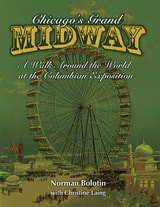
Chicago's Grand Midway
A Walk around the World at the Columbian ExpositionNorman Bolotin
University of Illinois Press, 2017
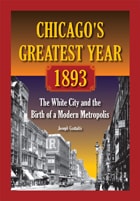
Chicago's Greatest Year, 1893
The White City and the Birth of a Modern MetropolisJoseph Gustaitis
Southern Illinois University Press, 2013
In 1893, the 27.5 million visitors to the Chicago World’s Fair feasted their eyes on the impressive architecture of the White City, lit at night by thousands of electric lights. In addition to marveling at the revolutionary exhibits, most visitors discovered something else: beyond the fair’s 633 acres lay a modern metropolis that rivaled the world’s greatest cities. The Columbian Exposition marked Chicago’s arrival on the world stage, but even without the splendor of the fair, 1893 would still have been Chicago’s greatest year.
An almost endless list of achievements took place in Chicago in 1893. Chicago’s most important skyscraper was completed in 1893, and Frank Lloyd Wright opened his office in the same year. African American physician and Chicagoan Daniel Hale Williams performed one of the first known open-heart surgeries in 1893. Sears and Roebuck was incorporated, and William Wrigley invented Juicy Fruit gum that year. The Field Museum, the Art Institute of Chicago, and the Museum of Science and Industry all started in 1893. The Cubs’ new ballpark opened in this year, and an Austro-Hungarian immigrant began selling hot dogs outside the World’s Fair grounds. His wares became the famous “Chicago hot dog.”
“Cities are not buildings; cities are people,” writes author Joseph Gustaitis. Throughout the book, he brings forgotten pioneers back to the forefront of Chicago’s history, connecting these important people of 1893 with their effects on the city and its institutions today. The facts in this history of a year range from funny to astounding, showcasing innovators, civic leaders, VIPs, and power brokers who made 1893 Chicago about so much more than the fair.
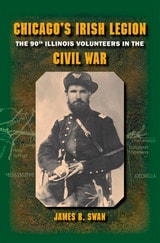
Chicago's Irish Legion
The 90th Illinois Volunteers in the Civil WarJames B. Swan
Southern Illinois University Press, 2009
Extensively documented and richly detailed, Chicago’s Irish Legion tells the compelling story of Chicago’s 90th Illinois Volunteer Infantry, the only Irish regiment in Major General William Tecumseh Sherman’s XV Army Corps. Swan’s sweeping history of this singular regiment and its pivotal role in the Western Theater of the Civil War draws heavily from primary documents and first-person observations, giving readers an intimate glimpse into the trials and triumphs of ethnic soldiers during one of the most destructive wars in American history.
At the onset of the bitter conflict between the North and the South, Irish immigrants faced a wall of distrust and discrimination in the United States. Many Americans were deeply suspicious of Irish religion and politics, while others openly doubted the dedication of the Irish to the Union cause. Responding to these criticisms with a firm show of patriotism, the Catholic clergy and Irish politicians in northern Illinois—along with the Chicago press and community—joined forces to recruit the Irish Legion. Composed mainly of foreign-born recruits, the Legion rapidly dispelled any rumors of disloyalty with its heroic endeavors for the Union. The volunteers proved to be instrumental in various battles and sieges, as well as the marches to the sea and through the Carolinas, suffering severe casualties and providing indispensable support for the Union. Swan meticulously traces the remarkable journey of these unique soldiers from their regiment’s inception and first military engagement in 1862 to their disbandment and participation in the Grand Review of General Sherman’s army in 1865.
Enhancing the volume are firsthand accounts from the soldiers who endured the misery of frigid winters and brutal environments, struggling against the ravages of disease and hunger as they marched more than twenty-six hundred miles over the course of the war. Also revealed are personal insights into some of the war’s most harrowing events, including the battle at Chattanooga and Sherman’s famous campaign for Atlanta. In addition, Swan exposes the racial issues that affected the soldiers of the 90th Illinois, including their reactions to the Emancipation Proclamation and the formations of the first African American fighting units. Swan rounds out the volume with stories of survivors’ lives after the war, adding an even deeper personal dimension to this absorbing chronicle.

Chicago's North Michigan Avenue
Planning and Development, 1900-1930John W. Stamper
University of Chicago Press, 1991
John W. Stamper traces the complex development of North Michigan Avenue from the 1880s to the 1920s building boom that solidified its character and economic base, describing the initiation of the planning process by private interests to its execution aided by the city's powerful condemnation and taxation proceedings. He focuses on individual buildings constructed on the avenue, including the Renaissance- and Gothic-inspired Wrigley Building, Tribune Tower, and Drake Hotel, and places them within the context of factors governing their construction—property ownership, financing, zoning laws, design theory, and advertising.
Stamper compares this stylistically diverse mixture of low- and high-rise structures with earlier, rejected planning proposals, all of which had prescribed a uniformly designed, European-like avenue of continuous cornice heights, consistent facade widths, and complementary stylistic features. He analyzes the drastically different character the avenue took by 1930, with high-rise towers reaching thirty stories and beyond, in terms of the clash among economic, political, and architectural interests. His argument—that the discrepancies between the rejected plans and reality illustrate the developers' choice of economic return on their investment over aesthetic community—is extended through to the present avenue and the virtual disregard of the urban qualities proposed at its inception. Generously illustrated, with an epilogue condensing the avenue's history between the end of World War II and the present, this is an exhaustive account of an important topic in the history of modern architecture and city planning.
Chicago's Urban Nature
A Guide to the City's Architecture + LandscapeSally A. Kitt Chappell
University of Chicago Press, 2007
At the heart of this new urban concept is the idea of connection, bringing buildings and landscapes, culture and nature, commerce and leisure into an energetic harmony. With Chicago’s Urban Nature in hand, you’ll see those connections woven through the fabric of the city. Chappell provides new insights into such historic Chicago sites as Jens Jensen’s Garfield Park Conservatory, Frederick Law Olmsted’s Jackson Park, and Alfred Caldwell’s Lily Pond, then takes us to the innovative contemporary green spaces they influenced, from City Hall’s rooftop garden to the North Lawndale Green Youth Farm to Chicago’s heralded new Millennium Park. These beautiful green spaces, with their unprecedented melding of art, architecture, and ecology, have become far more than places of escape for Chicagoans—they’re now fully integrated into the urban scene, an essential part of the cultural life of the modern city.
Packed with maps and recommended tours, and bursting with splendid photos, this is an essential guidebook for day-trippers, lifelong Chicago residents, and professionals in landscape architecture, urbanism, and design.
Chicago
A BiographyDominic A. Pacyga
University of Chicago Press, 2009
Chicago has been called by many names. Nelson Algren declared it a “City on the Make.” Carl Sandburg dubbed it the “City of Big Shoulders.” Upton Sinclair christened it “The Jungle,” while New Yorkers, naturally, pronounced it “the Second City.”
At last there is a book for all of us, whatever we choose to call Chicago. In this magisterial biography, historian Dominic Pacyga traces the storied past of his hometown, from the explorations of Joliet and Marquette in 1673 to the new wave of urban pioneers today. The city’s great industrialists, reformers, and politicians—and, indeed, the many not-so-great and downright notorious—animate this book, from Al Capone and Jane Addams to Mayor Richard J. Daley and President Barack Obama. But what distinguishes this book from the many others on the subject is its author’s uncommon ability to illuminate the lives of Chicago’s ordinary people. Raised on the city’s South Side and employed for a time in the stockyards, Pacyga gives voice to the city’s steelyard workers and kill floor operators, and maps the neighborhoods distinguished not by Louis Sullivan masterworks, but by bungalows and corner taverns.
Filled with the city’s one-of-a-kind characters and all of its defining moments, Chicago: A Biography is as big and boisterous as its namesake—and as ambitious as the men and women who built it.
Chicago
A Geography of the City and Its RegionJohn C. Hudson
University of Chicago Press, 2006
Renowned geographer John C. Hudson leaves no aspect unexplored in this ambitious and peerless book. Beginning with an overview of metropolitan Chicago, Hudson describes how the city has served as a model to social scientists and examines its unique neighborhoods and communities from the perspectives of Chicagoans themselves. A thorough description of the physical geography of the region introduces a series of studies in historical geography that consider the origins of the city and its early development through to its present state, paying particular attention to race, ethnicity, and suburbanization, as well as commuting patterns, neighborhood change, and patterns of income distribution. Chicago concludes with a comparison of the balanced geography that prevailed in the early twentieth century with the skewed pattern of sectoral imbalances that exists today.
Supplemented with more than one hundred maps that illustrate the evolution of Chicago over time and sixty-four black-and-white and color photographs that capture iconic images of the city’s landscapes and its people, Chicago beautifully synthesizes the city’s social and economic strata with geographical features to provide an authoritative guide to modern Chicagoland.
Chicago
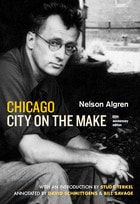
City on the Make: 50th Anniversary Edition, Newly AnnotatedNelson Algren
University of Chicago Press, 2001
"This short, crisp, fighting creed is both a social document and a love poem, a script in which a lover explains his city's recurring ruthlessness and latent power; in which an artist recognizes that these are portents not of death, but of life."—New York Herald Tribune
Nelson Algren (1909-1981) won the National Book Award in 1950 for The Man with the Golden Arm. His other works include Walk on the Wild Side, The Neon Wilderness, and Conversations with Nelson Algren, the last available from the University of Chicago Press. David Schmittgens teaches English at St. Ignatius College Prep in Chicago, Illinois. Bill Savage is a lecturer at Northwestern University and coeditor of the 50th Anniversary Critical Edition of The Man with the Golden Arm.
Chicago
City on the Make: Sixtieth Anniversary EditionNelson Algren
University of Chicago Press, 2011
“Once you’ve become a part of this particular patch, you’ll never love another. Like loving a woman with a broken nose, you may well find lovelier lovelies. But never a lovely so real.”
Ernest Hemingway once said of Nelson Algren’s writing that “you should not read it if you cannot take a punch.” The prose poem, Chicago: City on the Make, filled with language that swings and jabs and stuns, lives up to those words. In this sixtieth anniversary edition, Algren presents 120 years of Chicago history through the lens of its “nobodies nobody knows”: the tramps, hustlers, aging bar fighters, freed death-row inmates, and anonymous working stiffs who prowl its streets.
Upon its original publication in 1951, Algren’s Chicago: City on the Make was scorned by the Chicago Chamber of Commerce and local journalists for its gritty portrayal of the city and its people, one that boldly defied City Hall’s business and tourism initiatives. Yet the book captures the essential dilemma of Chicago: the dynamic tension between the city’s breathtaking beauty and its utter brutality, its boundless human energy and its stifling greed and violence.
The sixtieth anniversary edition features historic Chicago photos and annotations on everything from defunct slang to Chicagoans, famous and obscure, to what the Black Sox scandal was and why it mattered. More accessible than ever, this is, as Studs Terkel says, “the best book about Chicago.”
Chicago
Growth of a MetropolisHarold M. Mayer and Richard C. Wade
University of Chicago Press, 1969
This volume, however, which comprises over 1,000 pictures and 50 maps, tries to do more than show physical development—it attempts to suggest how the city expanded and why it looks the way it does. Because it asks different questions, this book differs markedly from other "pictorial histories" of American cities. Instead of emphasizing society and customs, this volume deals with the physical conditions of life. In place of the conventional interest in "founding fathers" and leading families, it is more concerned with street scenes and ordinary people. Without neglecting downtown, it also reaches into the residential areas and neighborhood shopping centers. Moreover, this volume is concerned with suburbs and "satellite" towns as well as the historic city.
"Chicago: Growth of a Metropolis is an incredible book. Like its subject it is excessive, and nothing succeeds like excess. It is handsomely designed, with a thousand photographs that document the physical growth and the spatial patterns of the city. . . . A dimensionalism comes through that no other city has. Carl Sandburg sang it in his poetry, and the book does more to grasp it . . . than any other book I have seen."—Hugh Newell Jacobson, New Republic
Chicago
With the Chicago Tribune Articles That Inspired ItMaurine Watkins, Edited by Thomas H. Pauly, Foreword by Charles H. Cosgrove
Southern Illinois University Press, 2025
In 1924, the murder trials of Beulah Annan and Belva Gaertner shocked the world, providing the real-life inspiration for Maurine Watkins’s unforgettable characters, Roxie Hart and Velma Kelly. Now, a century later, this reissue of Watkins’s play offers a fresh look at the origins of the story that has since become a household name.
From the silent film Chicago produced by Cecil B. DeMille in 1927 to the 1942 film Roxie Hart starring Ginger Rogers and the Broadway sensation created by Bob Fosse, Fred Ebb, and John Kander, this play has continuously evolved. It even inspired the 2002 Oscar-winning film Chicago starring Renée Zellweger, Catherine Zeta-Jones, and Richard Gere. But until recently, as editor Thomas H. Pauly writes in the book’s introduction, the real-life roots of the story were obscured.
While researching for a book on crime-as-entertainment during the 1920s, Pauly came across Maurine Watkins’s play, which was then out of print. After noticing similarities between the play and a series of articles Watkins penned for the Chicago Tribune prior to the creation of her play, Pauly knew he had stumbled upon a revelation: Watkins’s play was based on real people. His republication of the play, alongside substantial background material and a reprinting of Watkins’s news articles, has become an indispensable starting point for all subsequent interest in Watkins and Chicago, whose subject remains as topical as ever.
This special edition includes a new foreword by Charles H. Cosgrove, author of They Both Reached for the Gun: Beulah Annan, Maurine Watkins, and the Trial That Became Chicago. Cosgrove’s extensive research into the real-life cases provides deeper insight into the world that Watkins portrayed with such satirical brilliance. Additionally, the original editor, Thomas H. Pauly, has contributed a new preface, further enhancing understanding of the play and its inspiration, the thrilling true-crime story that captivated a nation and birthed a cultural phenomenon.
Chicago’s Art Deco Skyscrapers
Joseph Gustaitis
University of Chicago Press, 2026
With stunning photography and abundant historical details, this book is a treasure trove that will delight any fan of architecture, Chicago, or the Art Deco era.
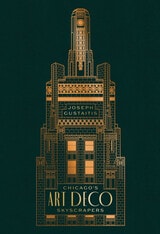
Chicago is America’s premier city for both historic and modern architecture. Even so, many of its finest buildings remain little known to visitors and Chicagoans alike. In Chicago’s Art Deco Skyscrapers, Joseph Gustaitis showcases nearly two dozen Art Deco towers that were built during the exhilarating years of the Jazz Age, from 1927 to 1933. These skyscrapers exemplify a state of mind from the time—an optimistic, forward-looking aesthetic that has been called the “last of the total styles,” as well as the first American style that spread across the globe. In the time between the Great War and the Great Depression, cities and their architects embraced industrial modernity and the exciting new possibilities of scale. Exploring places like the Board of Trade Building, the Merchandise Mart, and the Carbide and Carbon tower, Gustaitis tells the stories of their creation, architects and developers, construction and financing, zoning and engineering, and so much more.
With stunning aerial photography by Ian McClellan, this book also includes color photos of the buildings’ features, vintage images, a travel map, and in-depth historical information. Chicago’s Art Deco Skyscrapers is both a guidebook to these remarkable structures and a history of the upbeat era that created them.
Chicago’s Modern Mayors
From Harold Washington to Lori LightfootEdited by Dick Simpson and Betty O'Shaughnessy
University of Illinois Press, 2024
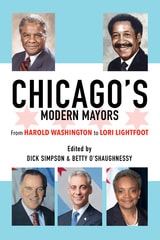
Chicago’s transformation into a global city began at City Hall. Dick Simpson and Betty O’Shaughnessy edit in-depth analyses of the five mayors that guided the city through this transition beginning with Harold Washington’s 1983 election: Washington, Eugene Sawyer, Richard M. Daley, Rahm Emmanuel, and Lori Lightfoot. Though the respected political science, sociologist, and journalist contributors approach their subjects from distinct perspectives, each essay addresses three essential issues: how and why each mayor won the office; whether the City Council of their time acted as a rubber stamp or independent body; and the ways the unique qualities of each mayor’s administration and accomplishments influenced their legacy.
Filled with expert analysis and valuable insights, Chicago’s Modern Mayors illuminates a time of transition and change and considers the politicians who--for better and worse--shaped the Chicago of today.
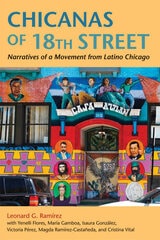
Chicanas of 18th Street
Narratives of a Movement from Latino ChicagoLeonard G. Ramirez
University of Illinois Press, 2011
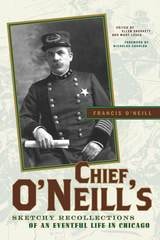
Chief O'Neill's Sketchy Recollections of an Eventful Life in Chicago
Francis O'Neill, Edited by Ellen Skerrett and Mary Lesch with a foreword by Nicholas Carolan
Northwestern University Press, 2008
This remarkable memoir of immigration and assimilation provides a rare view of urban life in Chicago in the late 1800s by a newcomer to the city and the Midwest, and the nation as well. Francis O’Neill left Ireland in 1865. After five years traveling the world as a sailor, he and his family settled in Chicago just shortly before the Great Fire of 1871.
As O’Neill looked back on his life, writing in Chicago at the age of 83, he could give first-hand accounts of the Pullman strike of 1894, the railway strike of 1903, and the packing-house strike of 1904. He could also reflect on the corruption that kept him, in spite of his innovations, extremely high exam scores, and performance, subject to powerful aldermen who prevented his advance as a member of the Chicago Police Department. Despite these obstacles, O’Neill eventually rose to be chief of police—a position from which he could enact much-needed civil service reform. In addition to his professional success, O’Neill is also remembered and beloved for his hobby, preserving traditional Irish music.
O’Neill’s story offers perspective on the inner workings of the police department at the turn of the twentieth century. His memoir also brings to life the challenges involved in succeeding in a new land, providing for his family, and integrating into a new culture. Francis O’Neill serves as a fine documentarian of the Irish immigrant experience in Chicago.
Childhood and Other Neighborhoods
StoriesStuart Dybek
University of Chicago Press, 2003
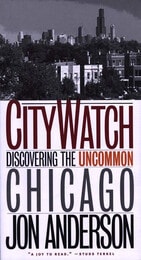
City Watch
Discovering The Uncommon ChicagoJon Anderson
University of Iowa Press, 2000
In forty-five years as one of Chicago's liveliest journalists for Time, Life, and the Chicago Tribune, Jon Anderson has established a reputation for picking up on what someone once called "the beauty of the specific fact." Part "Talk of the Town," part On the Road with Charles Kuralt, Anderson's twice-a-week "City Watch" columns in the Chicago Tribune seek out interesting and unexpected people and places from the everyday life of what the author calls the "most typical American big city." In the process he discovers the joys and triumphs of ordinary people.
Anderson writes with wit and insight about those who find themselves inspired or obsessed with alternative ways of viewing life or getting through the day. Like the man who started with one light pole, then painted all the poles in his southside neighborhood. Or the founder of Cats-Are-Purrsons-Too, a nun who lives with sixty-seven cats. Or the philosopher who, with no financial success, still publishes a newsletter called "The Meaning of Life." After years of hunting down moments of everyday life that have drama and meaning, Anderson offers a book that has curious power, because all of its stories are true.
Drawn from the best of Anderson's columns, City Watch introduces readers to an eclectic mix of social clubs, subcultures, and minor celebrities. From Foraging Friends, a group of penniless ecologists who forage for wild foods in a county forest preserve, to the annual Dumpster Diver fashion show, from the Oakton Elementary School chess team to a group that calls itself Some Chicago Anarchists, readers will discover the characters and events that define Chicago's local color.
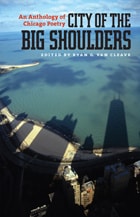
City of the Big Shoulders
An Anthology of Chicago PoetryRyan G. Van Cleave
University of Iowa Press, 2012
The cultural, ethnic, and aesthetic diversity in this gathering of poems springs from a variety of viewpoints, styles, and voices as multifaceted and energetic as the city itself. Cristin O’Keefe Aptowicz: “I want to eat / in a city smart enough to know that if you / are going to have that heart attack, you might / as well have the pleasure of knowing // you’ve really earned it”; Renny Golden: “In the heat of May 1937, my grandfather / sits in the spring grass of an industrial park / with hundreds of striking steelworkers”; Joey Nicoletti: “The wind pulls a muscle / as fans yell the vine off the outfield wall, / mustard-stained shirts, hot dog smiles, and all.”
The combined energies of these poems reveal the mystery and beauty that is Second City, the City by the Lake, New Gotham, Paris on the Prairie, the Windy City, the Heart of America, and Sandburg’s iconic City of the Big Shoulders.
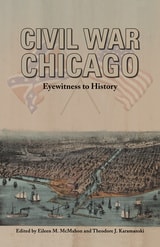
Civil War Chicago
Eyewitness to HistoryTheodore J. Karamanski
Ohio University Press, 2014
The American Civil War was a crucial event in the development of Chicago as the metropolis of the heartland. Not only did Chicagoans play an important role in the politics of the conflict, encouraging emancipation and promoting a “hard war” policy against Southern civilians, but they supported the troops materially through production of military supplies and foodstuffs as well as morally and spiritually through patriotic publications and songs. The Civil War transformed Chicago from a mere commercial center to an industrial power as well as the nation’s railroad hub and busiest port. The war also divided Chicago, however, between Lincoln supporters and Copperheads, whites and blacks, workers and owners, natives and newcomers.
The city played a key role in elevating Abraham Lincoln to the Republican presidential nomination in 1860, yet only four years later a Chicago politician’ s influence was key in declaring the war a failure and promoting a platform of peace with the Confederacy. Using seldom seen or newly uncovered sources, this book tells the story of the Civil War through the eyes of those who lived that history. Photographs throughout the book effectively convey the geography of events in this pivotal period of Chicago’s history, and the editors have provided a useful driving guide to Civil War sites in and around the city.
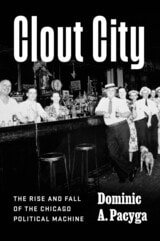
Clout City
The Rise and Fall of the Chicago Political MachineDominic A. Pacyga
University of Chicago Press, 2025
Unearths the religious and cultural roots of a powerful political machine that empowered some everyday Chicagoans but ruled all of the city for decades.
In politics, clout is essential. Too often, it determines whether insider access is granted or denied, favors are given or withheld, and payoffs are made or received. But Chicago clout, as we know it today, is even more potent than that—it’s the absolute currency of a social, cultural, and political order that is self-reinforcing and self-dealing. Or, at least, it was.
In Clout City, award-winning historian Dominic A. Pacyga reveals how cultural, ethnic, and religious forces created this distinctive system—and ultimately led to its collapse. Tracing clout’s origins in the Irish Catholic–dominated working-class neighborhood of Bridgeport, shaped by De La Salle Institute and home to the legendary Daley family, Pacyga shows how communal ties can be a force for good and also the deepest wellspring of corruption. He maps Chicago’s unique politics to its remarkable history, from the Great Fire of 1871 through its rise and decline as an industrial center to its emergence as a global city in the early twenty-first century. With deep research and firsthand experience from a lifetime in the city, Pacyga argues that Chicago’s politics is understood best as a mixture of cultural and religious influences and more worldly pursuits, exploring how both Jewish and Catholic communalism played central roles in the creation and sustenance of the Chicago machine.
Chicago’s politics today aren’t as defined by its distinctive brand of clout. But they are shaped by clout’s decline and the ghost of the machine. Pacyga’s tour of the city’s multilayered past is an indispensable guide to its present and future.
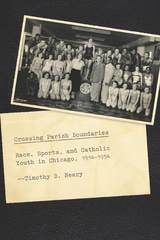
Crossing Parish Boundaries
Race, Sports, and Catholic Youth in Chicago, 1914-1954Timothy B. Neary
University of Chicago Press, 2016
In this book, Timothy B. Neary reveals the history of Bishop Bernard Sheil’s Catholic Youth Organization (CYO), which brought together thousands of young people of all races and religions from Chicago’s racially segregated neighborhoods to take part in sports and educational programming. Tens of thousands of boys and girls participated in basketball, track and field, and the most popular sport of all, boxing, which regularly filled Chicago Stadium with roaring crowds. The history of Bishop Sheil and the CYO shows a cosmopolitan version of American Catholicism, one that is usually overshadowed by accounts of white ethnic Catholics aggressively resisting the racial integration of their working-class neighborhoods. By telling the story of Catholic-sponsored interracial cooperation within Chicago, Crossing Parish Boundaries complicates our understanding of northern urban race relations in the mid-twentieth century.
Crossing Segregated Boundaries
Remembering Chicago School DesegregationDionne Danns
Rutgers University Press, 2021
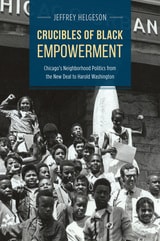
Crucibles of Black Empowerment
Chicago's Neighborhood Politics from the New Deal to Harold WashingtonJeffrey Helgeson
University of Chicago Press, 2014
In Crucibles of Black Empowerment, Jeffrey Helgeson recounts the rise of African American political power and activism from the 1930s onward, revealing how it was achieved through community building. His book tells stories of the housewives who organized their neighbors, building tradesmen who used connections with federal officials to create opportunities in a deeply discriminatory employment sector, and the social workers, personnel managers, and journalists who carved out positions in the white-collar workforce. Looking closely at black liberal politics at the neighborhood level in Chicago, Helgeson explains how black Chicagoans built the networks that eventually would overthrow the city’s seemingly invincible political machine.