Results by title
153 books match the query 'Comics & Graphic Novels' and 18 start with c
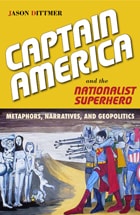
Captain America and the Nationalist Superhero
Metaphors, Narratives, and GeopoliticsJason Dittmer
Temple University Press, 2012
Nationalist superheroes—such as Captain America, Captain Canuck, and Union Jack—often signify the “nation-state” for readers, but how do these characters and comic books address issues of multiculturalism and geopolitical order? In his engaging book Captain America and the Nationalist Superhero, geographer Jason Dittmer traces the evolution of the comic book genre as it adapted to new national audiences. He argues that these iconic superheroes contribute to our contemporary understandings of national identity, the righteous use of power, and the role of the United States, Canada, and Britain in the world.
Tracing the nationalist superhero genre from its World War II origins to contemporary manifestations throughout the world, Captain America and the Nationalist Superhero analyzes nearly one thousand comic books and audience responses to those books. Dittmer also interviews key comic book writers from Stan Lee and J. M. DeMatteis to Steve Englehart and Paul Cornell.
At a time when popular culture is saturated with superheroes and their exploits, Captain America and the Nationalist Superhero highlights the unique relationship between popular culture and international relations.
Christianity and Comics
Stories We Tell about Heaven and HellBlair Davis
Rutgers University Press, 2024
Christianity and Comics presents an 80-year history of the various ways that the comics industry has drawn from biblical source material. It explores how some publishers specifically targeted Christian audiences with titles like Catholic Comics, books featuring heroic versions of Oral Roberts and Billy Graham, and special religious-themed editions of Archie. But it also considers how popular mainstream comics like Daredevil, The Sandman, Ghost Rider, and Batman are infused with Christian themes and imagery.
Comics scholar Blair Davis pays special attention to how the medium’s unique use of panels, word balloons, captions, and serialized storytelling have provided vehicles for telling familiar biblical tales in new ways. Spanning the Golden Age of comics to the present day, this book charts how comics have both reflected and influenced Americans’ changing attitudes towards religion.
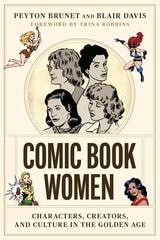
Comic Book Women
Characters, Creators, and Culture in the Golden AgeBy Peyton Brunet and Blair Davis; foreword by Trina Robbins
University of Texas Press, 2022
2023 Ray and Pat Browne Best Single Work by One or More Authors in Popular and American Culture, Popular and American Culture Association (PACA) / Popular Culture Association (PCA)
2023 Ray and Pat Browne Best Edited Reference/Primary Source Work in Popular Culture Award (Honorable Mention), Popular and American Culture Association (PACA) / Popular Culture Association (PCA)
2023 Peter C. Rollins Book Award, Southwest Texas Popular Culture and American Culture Associations (SWPACA)
A revisionist history of women's pivotal roles as creators of and characters in comic books.
The history of comics has centered almost exclusively on men. Comics historians largely describe the medium as one built by men telling tales about male protagonists, neglecting the many ways in which women fought for legitimacy on the page and in publishers’ studios. Despite this male-dominated focus, women played vital roles in the early history of comics. The story of how comic books were born and how they evolved changes dramatically when women like June Tarpé Mills and Lily Renée are placed at the center rather than at the margins of this history, and when characters such as the Black Cat, Patsy Walker, and Señorita Rio are analyzed.
Comic Book Women offers a feminist history of the golden age of comics, revising our understanding of how numerous genres emerged and upending narratives of how male auteurs built their careers. Considering issues of race, gender, and sexuality, the authors examine crime, horror, jungle, romance, science fiction, superhero, and Western comics to unpack the cultural and industrial consequences of how women were represented across a wide range of titles by publishers like DC, Timely, Fiction House, and others. This revisionist history reclaims the forgotten work done by women in the comics industry and reinserts female creators and characters into the canon of comics history.

Comic Fascism
Ideology, Catholicism, and Americanism in Italian Children’s PeriodicalsZane Elward
The Ohio State University Press, 2025
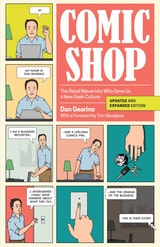
Comic Shop
The Retail Mavericks Who Gave Us a New Geek CultureDan Gearino
Ohio University Press, 2019
The modern comic book shop was born in the early 1970s. Its rise was due in large part to Phil Seuling, the entrepreneur whose direct market model allowed shops to get comics straight from the publishers. Stores could then better customize their offerings and independent publishers could access national distribution. Shops opened up a space for quirky ideas to gain an audience and helped transform small-press series, from Teenage Mutant Ninja Turtles to Bone, into media giants.
Comic Shop is the first book to trace the history of these cultural icons. Dan Gearino brings us from their origins to the present-day, when the rise of digital platforms and a changing retail landscape have the industry at a crossroads. When the book was first published in 2017, Gearino had spent a year with stores around the country, following how they navigated the business. For this updated and expanded paperback edition, he covers the wild retail landscape of 2017 and 2018, a time that was brutal for stores and rich for comics as an art form.
Along the way he interviews pioneers of comics retailing and other important players, including many women; top creators; and those who continue to push the business in new directions. A revised guide to dozens of the most interesting shops around the United States and Canada is a bonus for fans.
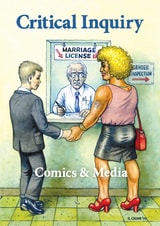
Comics & Media
A Special Issue of "Critical Inquiry"Edited by Hillary L. Chute and Patrick Jagoda
University of Chicago Press, 2014
The twenty-first century has seen the medium of comics reach unprecedented heights of critical acclaim and commercial success. Comics & Media reflects that, bringing together an amazing array of contributors--creators and critics alike--to discuss the state, future, and potential of the medium.
Loaded with full-color reproductions of work by such legends as R. Crumb, Art Spiegelman, Alison Bechdel, Chris Ware, Daniel Clowes, and Lynda Barry, the book addresses the place of comics in both a contemporary and historical context. Essays by such high-profile figures as Tom Gunning, N. Katherine Hayles, Patrick Jagoda, and W. J. T. Mitchell address a stunning range of topics, including the place of comics in the history of aesthetics, changes to popular art forms, digital humanities, and ongoing tensions between new and old media. The result is a substantial step forward for our understanding of what comics are and can be, and the growing place they hold in our culture.
Comics Beyond the Page in Latin America
Edited by James Scorer
University College London, 2019
Comics Studies
A GuidebookCharles Hatfield
Rutgers University Press, 2020
In the twenty-first century, the field of comics studies has exploded. Scholarship on graphic novels, comic books, comic strips, webcomics, manga, and all forms of comic art has grown at a dizzying pace, with new publications, institutions, and courses springing up everywhere. The field crosses disciplinary and cultural borders and brings together myriad traditions. Comics Studies: A Guidebook offers a rich but concise introduction to this multifaceted field, authored by leading experts in multiple disciplines. It opens diverse entryways to comics studies, including history, form, audiences, genre, and cultural, industrial, and economic contexts. An invaluable one-stop resource for veteran and new comics scholars alike, this guidebook represents the state of the art in contemporary comics scholarship.
Comics and Nation
Power, Pop Culture, and Political Transformation in PolandEwa Stanczyk
The Ohio State University Press, 2022
Winner, BASEES George Blazyca Award in East European Studies
Comics and Nation offers a fresh perspective on the role of popular culture in the one-hundred-year history of the Polish state, from its foundation in 1918 to the present. Drawing on dozens of press articles, interviews, and readers’ letters, Ewa Stanczyk discusses how journalists, artists, and audiences used comics to probe the boundaries of national culture and scrutinize the established notions of Polishness. Critical moments of Poland’s political transformation ––the establishment of the interwar Polish Republic, the Cold War, the liberalization of the 1970s, the 1989 democratic transition, the turn to memory politics in the 2000s––have all been reflected in the history of Polish comics. Stanczyk offers new insights into how the production of homegrown comics and the influx of foreign works enabled commentators to express their fears, hopes, and disillusionment with political, economic, and cultural changes in Poland and beyond. At its core, Comics and Nation rethinks the impact of popular culture and transnational exchange on Polish nation building, citizenship formation, and the legitimation of power.
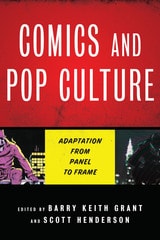
Comics and Pop Culture
Adaptation from Panel to FrameBy Barry Keith Grant and Scott Henderson
University of Texas Press, 2019
It is hard to discuss the current film industry without acknowledging the impact of comic book adaptations, especially considering the blockbuster success of recent superhero movies. Yet transmedial adaptations are part of an evolution that can be traced to the turn of the last century, when comic strips such as “Little Nemo in Slumberland” and “Felix the Cat” were animated for the silver screen. Representing diverse academic fields, including technoculture, film studies, theater, feminist studies, popular culture, and queer studies, Comics and Pop Culture presents more than a dozen perspectives on this rich history and the effects of such adaptations.
Examining current debates and the questions raised by comics adaptations, including those around authorship, style, and textual fidelity, the contributors consider the topic from an array of approaches that take into account representations of sexuality, gender, and race as well as concepts of world-building and cultural appropriation in comics from Modesty Blaise to Black Panther. The result is a fascinating re-imagination of the texts that continue to push the boundaries of panel, frame, and popular culture.
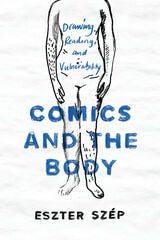
Comics and the Body
Drawing, Reading, and VulnerabilityEszter Szép
The Ohio State University Press, 2020
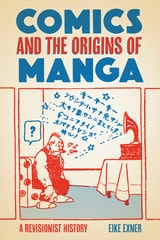
Comics and the Origins of Manga
A Revisionist HistoryEike Exner
Rutgers University Press, 2022
Japanese comics, commonly known as manga, are a global sensation. Critics, scholars, and everyday readers have often viewed this artform through an Orientalist framework, treating manga as the exotic antithesis to American and European comics. In reality, the history of manga is deeply intertwined with Japan’s avid importation of Western technology and popular culture in the early twentieth century.
Comics and the Origins of Manga reveals how popular U.S. comics characters like Jiggs and Maggie, the Katzenjammer Kids, Felix the Cat, and Popeye achieved immense fame in Japan during the 1920s and 1930s. Modern comics had earlier developed in the United States in response to new technologies like motion pictures and sound recording, which revolutionized visual storytelling by prompting the invention of devices like speed lines and speech balloons. As audiovisual entertainment like movies and record players spread through Japan, comics followed suit. Their immediate popularity quickly encouraged Japanese editors and cartoonists to enthusiastically embrace the foreign medium and make it their own, paving the way for manga as we know it today.
By challenging the conventional wisdom that manga evolved from centuries of prior Japanese art and explaining why manga and other comics around the world share the same origin story, Comics and the Origins of Manga offers a new understanding of this increasingly influential artform.
Considering Maus
Approaches to Art Spiegelman's "Survivor's Tale" of the HolocaustDeborah R. Geis
University of Alabama Press, 2007
The first collection of critical essays on Maus, the searing account of one Holocaust survivor's experiences rendered in comic book form.
In 1992, Art Spiegelmans two-volume illustrated work Maus: A Survivor’s Tale was awarded a special-category Pulitzer Prize. In a comic book form, Spiegelman tells the gripping, heart-rending story of his father's experiences in the Holocaust. The book renders in stark clarity the trials Spiegelman's father endured as a Jewish refugee in the ghettos and concentration camps of Poland during World War II, his American life following his immigration to New York, and the author's own troubled sense of self as he grapples with his father's history. Mixing autobiography, biography, and oral history in the comic form, Maus has been hailed as a daring work of postmodern narration and as a vivid example of the power of the graphic narrative.
Now, for the first time in one collection, prominent scholars in a variety of fields take on Spiegelman's text and offer it the critical and artistic scrutiny it deserves. They explore many aspects of the work, including Spiegelman’s use of animal characters, the influence of other "comix" artists, the role of the mother and its relation to gender issues, the use of repeating images such as smoke and blood, Maus's position among Holocaust testimonials, its appropriation of cinematic technique, its use of language and styles of dialect, and the implications of the work’s critical and commercial success.
Informed readers in many areas of study, from popular culture and graphic arts to psychoanalysis and oral history, will value this first substantial collection of criticism on a revered work of literature.

Considering Watchmen
Poetics, Property, PoliticsHoberek, Andrew
Rutgers University Press, 2014
Demonstrating a keen eye for historical detail, Considering Watchmen gives readers a new appreciation of just how radical Moore and Gibbons’s blend of gritty realism and formal experimentation was back in 1986. The book also considers Watchmen’s place in the history of the comics industry, reading the graphic novel’s playful critique of superhero marketing alongside Alan Moore’s public statements about the rights to the franchise. Andrew Hoberek examines how Moore and Gibbons engaged with the emerging discourses of neoconservatism and neoliberal capitalism, ideologies that have only become more prominent in subsequent years.
Watchmen’s influences on the superhero comic and graphic novel are undeniable, but Hoberek reveals how it has also had profound effects on literature as a whole. He suggests that Watchmen not only proved that superhero comics could rise to the status of literature—it also helped to inspire a generation of writers who are redefining the boundaries of the literary, from Jonathan Lethem to Junot Díaz. Hoberek delivers insight and analysis worthy of satisfying serious readers of the genre while shedding new light on Watchmen as both an artistic accomplishment and a book of ideas.
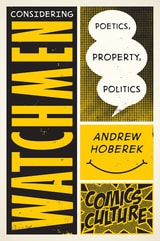
Considering Watchmen
Poetics, Property, Politics: New edition with full color illustrationsHoberek, Andrew
Rutgers University Press, 2017
Demonstrating a keen eye for historical detail, Considering Watchmen gives readers a new appreciation of just how radical Moore and Gibbons’s blend of gritty realism and formal experimentation was back in 1986. The book also considers Watchmen’s place in the history of the comics industry, reading the graphic novel’s playful critique of superhero marketing alongside Alan Moore’s public statements about the rights to the franchise. Andrew Hoberek examines how Moore and Gibbons engaged with the emerging discourses of neoconservatism and neoliberal capitalism, ideologies that have only become more prominent in subsequent years.
Watchmen’s influences on the superhero comic and graphic novel are undeniable, but Hoberek reveals how it has also had profound effects on literature as a whole. He suggests that Watchmen not only proved that superhero comics could rise to the status of literature—it also helped to inspire a generation of writers who are redefining the boundaries of the literary, from Jonathan Lethem to Junot Díaz. Hoberek delivers insight and analysis worthy of satisfying serious readers of the genre while shedding new light on Watchmen as both an artistic accomplishment and a book of ideas.
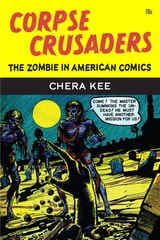
Corpse Crusaders
The Zombie in American ComicsChera Kee
University of Michigan Press, 2024
Using archival research into Golden Age comics and extended analyses of comics from the 1940s to today, Corpse Crusaders explores the profound influence early action/adventure and superheroic generic conventions had on shaping comic book zombies. It takes the reader from the 1940s superhero, the Purple Zombie, through 1950s revenge-from-the-grave zombies, to the 1970s anti-hero, Simon Garth (“The Zombie”) and the gruesome heroes-turned-zombies of Marvel Zombies. In becoming immersed in superheroic logics early on, the zombie in comics became a figure that, unlike the traditional narrative uses of other monsters, actually served to defend the status quo. This continuing trend not only provides insight into the overwhelming influence superheroes have had on the comic book medium, but it also provides a unique opportunity to explore the ways in which zombiism and superheroism parallel each other. Corpse Crusaders explores the ways that truth, justice, and the American way have influenced the undead in comics and turned what is often a rebellious figure into one that works to save the day.
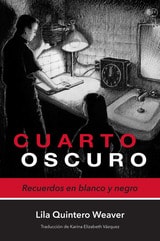
Cuarto oscuro
Recuerdos en blanco y negroLila Quintero Weaver, translated by Karina Elizabeth Vázquez
University of Alabama Press, 2018
Por medio de impresionantes ilustraciones, la autora ofrece una memoria cautivante y conmovedora de la infancia, las relaciones raciales, la etnicidad y la identidad en el sur de los Estados Unidos.
La novela gráfico de Lila Quintero-Weaver que obtuvo amplio reconocimiento crítico. Por medio de impresionantes ilustraciones, la autora ofrece una memoria cautivante y conmovedora de la infancia, las relaciones raciales, la etnicidad y la identidad en el sur de los Estados Unidos. Sus dibujos de estilo sutil, pero efectivo, refuerzan dramáticament una sentida narración.
En 1961, cuando la autora tenía cinco años, su familia salió de Buenos Aires, Argentina, para emigrar a los Estados Unidos y establecerse en Marion, un pueblo en el corazón del Black Belt de Alabama. En una región definida por la segregación racial, la familia Quintero, por su condición de clase media educada, se halló en una situación privilegiada para observar las tensiones que minaban la cultura y la sociedad en la que vivían.
Weaver salió de constancia de lo que signifacaba ser una niña latina en una le las regiones más racistas del sur de los Estados Unidos, tratando de entender tanto un país extranjero, como el horror de las relaciones raciales de nuestra nación. Excluida de las categorías raciales empleadas por entonces, la autora observó desde muy temprana edad las desigualdades de la cultura estadounidense, regida por un ideal de belleza femenina que privilegiaba a la mujer rubia y de ojos azules. A lo largo de su vida, Weaver ha luchado por encontrar su lugar en la sociedad norteamericana cuestionando la discriminación de su entorno. Cuarto oscuro contituye su legado visual y verbal sobre esa lucha.
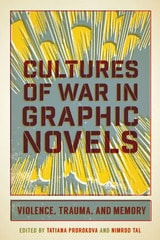
Cultures of War in Graphic Novels
Violence, Trauma, and MemoryProrokova, Tatiana
Rutgers University Press, 2018
Cultures of War in Graphic Novels examines the representation of small-scale and often less acknowledged conflicts from around the world and throughout history. The contributors look at an array of graphic novels about conflicts such as the Boxer Rebellion (1899-1901), the Irish struggle for national independence (1916-1998), the Falkland War (1982), the Bosnian War (1992-1995), the Rwandan genocide (1994), the Israel-Lebanon War (2006), and the War on Terror (2001-). The book explores the multi-layered relation between the graphic novel as a popular medium and war as a pivotal recurring experience in human history. The focus on largely overlooked small-scale conflicts contributes not only to advance our understanding of graphic novels about war and the cultural aspects of war as reflected in graphic novels, but also our sense of the early twenty-first century, in which popular media and limited conflicts have become closely interrelated.