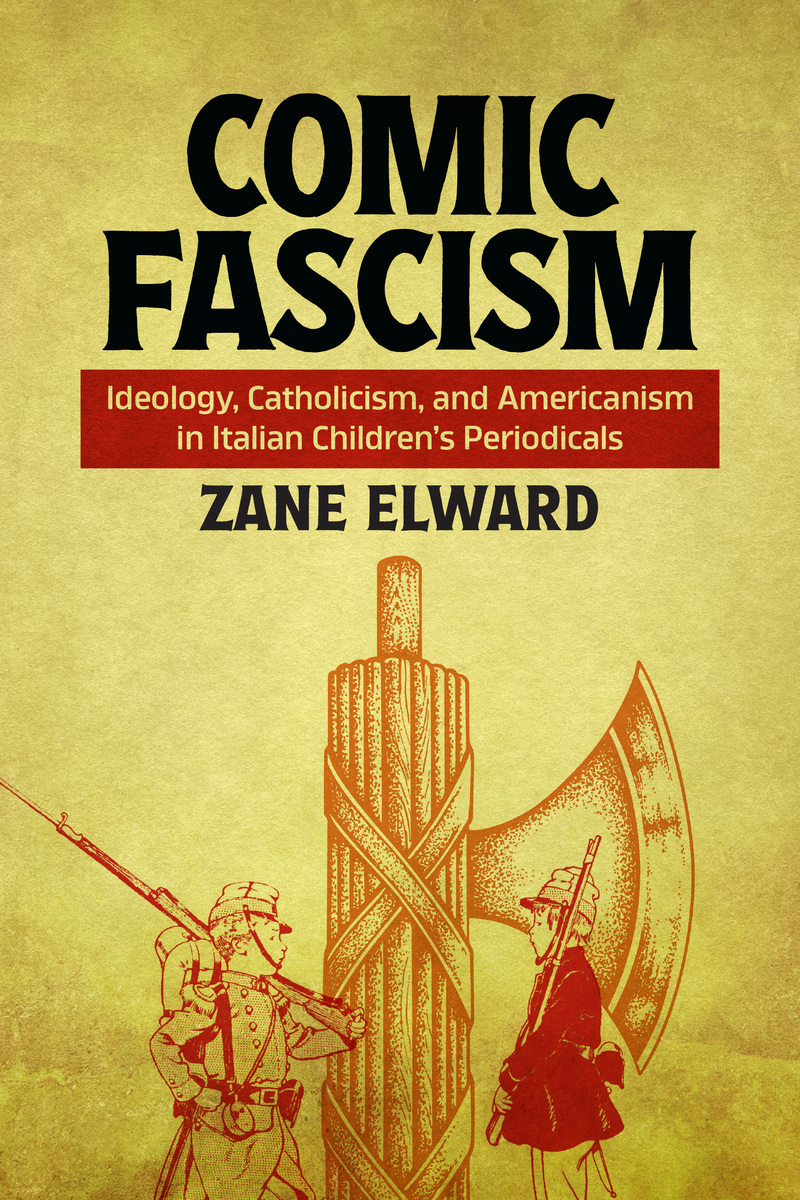
Comic Fascism: Ideology, Catholicism, and Americanism in Italian Children’s Periodicals
The Ohio State University Press, 2025
Cloth: 978-0-8142-1592-0 | Paper: 978-0-8142-5952-8 | eISBN: 978-0-8142-8423-0 (individual)
Library of Congress Classification PN6765.E49 2025
Dewey Decimal Classification 741.5945
Cloth: 978-0-8142-1592-0 | Paper: 978-0-8142-5952-8 | eISBN: 978-0-8142-8423-0 (individual)
Library of Congress Classification PN6765.E49 2025
Dewey Decimal Classification 741.5945
ABOUT THIS BOOK | AUTHOR BIOGRAPHY | REVIEWS | TOC
ABOUT THIS BOOK
Comics in Italy—produced by Fascists, conservatives, Catholics, and, after World War II, youth groups on the political left—promoted competing yet sometimes convergent visions for Italian society to children in the first half of the twentieth century. In Comic Fascism, Zane Elward dives deep into the archives to reveal how Italian comics reflected transformations within Italian society during Fascist rule (1922–45) and how conservative and Catholic circles were entangled with Mussolini’s agenda, normalizing and promoting it through their own periodicals. At the same time, he offers new interpretations of American comics, demonstrating that despite Italian suspicion of US culture, these comics often aligned with Fascism and were co-opted by its proponents. Elward also identifies the persistence of Fascist political ideas after the fall of the Fascist state and highlights growing tensions between the right and the left in the lead-up to the Cold War. Ultimately, Elward broadens previous temporal and cultural frames to offer fresh insights into the origins and long tail of Fascist indoctrination and how it remained at the heart of the ongoing quest to redefine Italian society.
See other books on: Catholicism | Comic books, strips, etc | Comics & Graphic Novels | Fascism & Totalitarianism | Ideology
See other titles from The Ohio State University Press