Results by title
77 books match the query 'Congress' and 16 start with c
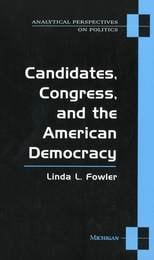
Candidates, Congress, and the American Democracy
Linda L. Fowler
University of Michigan Press, 1993
In Candidates, Congress, and the American Democracy Linda L. Fowler provides a wide-ranging examination of candidacy as a source of both stability and change in U.S. politics. An expert on political candidates, she brings a novel perspective to the topic by emphasizing that candidates are necessary instruments for popular control of government.
Fowler maintains that the ambitions of individual candidates are essential to the functioning of the nation's constitutional system and are important factors in its political history. She traces the influence of candidates in fostering electoral competition, promoting the representation of such newly mobilized groups of citizens as women and ethnic minorities, and transforming political institutions and parties. Despite the importance of candidacy, the institution is poorly understood because both scholars and voters tend to limit their focus on candidates to the narrow context of election campaigns. The author argues that a broader view reveals how candidates are linked to a variety of trends and contradictions in contemporary U.S. politics.
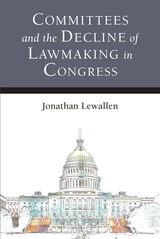
Committees and the Decline of Lawmaking in Congress
Jonathan Lewallen
University of Michigan Press, 2020
He finds that because party leaders have more control over the legislative agenda, committees have spent more of their time conducting oversight instead. Partisanship alone does not explain this trend; changes in institutional rules and practices that empowered party leaders have created more uncertainty for committees and contributed to a shift in their policy activities. The shift toward oversight at the committee level combined with party leader control over the voting agenda means that many members of Congress are effectively cut out of many of the institution’s policy decisions. At a time when many, including Congress itself, are considering changes to modernize the institution and keep up with a stronger executive branch, the findings here suggest that strengthening Congress will require more than running different candidates or providing additional resources.
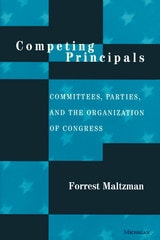
Competing Principals
Committees, Parties, and the Organization of CongressForrest Maltzman
University of Michigan Press, 1997
Since Woodrow Wilson, political scientists have recognized the importance of congressional committees in the policy-making process. Congressional committees often determine what legislation will reach the floor of the House or Senate and what form that legislation will take. In spite of the broad consensus on the importance of congressional committees, there is little agreement on what explains committee action. Committees are alternately viewed as agents of the chamber, the party caucuses, or constituencies outside the institution. Each theory suggests a different distribution of power in the policy-making process. Forrest Maltzman argues that none of these models fully captures the role performed by congressional committees and that committee members attempt to balance the interests of the chamber, the party caucus, and outside constituencies. Over time, and with the changing importance of a committee's agenda to these groups, the responsiveness of members of committees will vary. Maltzman argues that the responsiveness of the committee to these groups is driven by changes in procedure, the strength of the party caucus, and the salience of a committee's agenda. Maltzman tests his theory against historical data. This book will appeal to social scientists interested in the study of Congress and legislative bodies, as well as those interested in studying the impact of institutional structure on the policy-making process. "This specialized study, of value to congressional scholars and partisan activists, enriches an understanding of the increasingly predictable patterns of committee variety." --Choice.
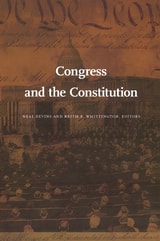
Congress and the Constitution
Neal Devins and Keith E. Whittington, eds.
Duke University Press, 2005
Several contributors offer wide-ranging accounts of the workings of Congress. They look at lawmakers’ attitudes toward Congress’s role as a constitutional interpreter, the offices within Congress that help lawmakers learn about constitutional issues, Congress’s willingness to use its confirmation power to shape constitutional decisions by both the executive and the courts, and the frequency with which congressional committees take constitutional questions into account. Other contributors address congressional deliberation, paying particular attention to whether Congress’s constitutional interpretations are sound. Still others examine how Congress and the courts should respond to one another’s decisions, suggesting how the courts should evaluate Congress’s work and considering how lawmakers respond to Court decisions that strike down federal legislation. While some essayists are inclined to evaluate Congress’s constitutional interpretation positively, others argue that it could be improved and suggest institutional and procedural reforms toward that end. Whatever their conclusions, all of the essays underscore the pervasive and crucial role that Congress plays in shaping the meaning of the Constitution.
Contributors. David P. Currie, Neal Devins, William N. Eskridge Jr.. John Ferejohn, Louis Fisher, Elizabeth Garrett, Michael J. Gerhardt, Michael J. Klarman, Bruce G. Peabody, J. Mitchell Pickerill, Barbara Sinclair, Mark Tushnet, Adrian Vermeule, Keith E. Whittington, John C. Yoo
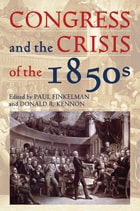
Congress and the Crisis of the 1850s
Paul Finkelman
Ohio University Press, 2011
During the long decade from 1848 to 1861 America was like a train speeding down the track, without an engineer or brakes. The new territories acquired from Mexico had vastly increased the size of the nation, but debate over their status—and more importantly the status of slavery within them—paralyzed the nation. Southerners gained access to the territories and a draconian fugitive slave law in the Compromise of 1850, but this only exacerbated sectional tensions. Virtually all northerners, even those who supported the law because they believed that it would preserve the union, despised being turned into slave catchers. In 1854, in the Kansas-Nebraska Act, Congress repealed the ban on slavery in the remaining unorganized territories. In 1857, in the Dred Scott case, the Supreme Court held that all bans on slavery in the territories were unconstitutional. Meanwhile, northern whites, free blacks, and fugitive slaves resisted the enforcement of the 1850 fugitive slave law. In Congress members carried weapons and Representative Preston Brooks assaulted Senator Charles Sumner with a cane, nearly killing him. This was the decade of the 1850s and these were the issues Congress grappled with.
This volume of new essays examines many of these issues, helping us better understand the failure of political leadership in the decade that led to the Civil War.
Contributors
Spencer R. Crew
Paul Finkelman
Matthew Glassman
Amy S. Greenberg
Martin J. Hershock
Michael F. Holt
Brooks D. Simpson
Jenny Wahl
Congress and the Emergence of Sectionalism
From the Missouri Compromise to the Age of JacksonPaul Finkelman
Ohio University Press, 2008
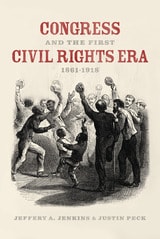
Congress and the First Civil Rights Era, 1861-1918
Jeffery A. Jenkins and Justin Peck
University of Chicago Press, 2021
The authors examine in detail how the Republican Party slowly withdrew its support for a meaningful civil rights agenda, as well as how Democrats and Republicans worked together to keep civil rights off the legislative agenda at various points. In doing so, Jenkins and Peck show how legal institutions can be used both to liberate and protect oppressed minorities and to assert the power of the white majority against those same minority groups.
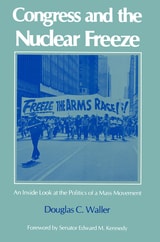
Congress and the Nuclear Freeze
An Inside Look at the Politics of a Mass MovementDouglas Waller
University of Massachusetts Press, 1987
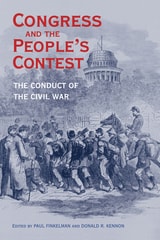
Congress and the People’s Contest
The Conduct of the Civil WarPaul Finkelman
Ohio University Press, 2018
Congress and the Rent-Seeking Society
Glenn R. Parker
University of Michigan Press, 1996
Skillfully blending historical data with microeconomic theory, Glenn Parker argues that the incentives for congressional service have declined over the years, and that with that decline has come a change in the kind of person who seeks to enter Congress. The decline in the attractiveness of Congress is a consequence of congressional careerists and of the growth in the rent-seeking society, a term which describes the efforts of special interests to obtain preferential treatment by using the machinery of government--legislation and regulations.
Parker provides a fresh and controversial perspective to the debate surrounding the relative merits of career or amateur politicians. He argues that driving career politicians from office can have pernicious effects on the political system: it places the running of Congress in the hands of amateur politicians, who stand to lose little if they are found engaging in illegal or quasi-legal practices. On the other hand, career legislators risk all they have invested in their long careers in public service if they engage in unsavory practices. As Parker develops this controversial argument, he provides a fresh perspective on the debate surrounding the value of career versus amateur politicians.
Little attention has been given to the long-term impact of a rent-seeking society on the evolution of political institutions. Parker examines empirically and finds support for hypotheses that reflect potential symptoms of adverse selection in the composition of Congress: (1) rent-seeking politicians are more inclined than others to manipulate institutional arrangements for financial gain; (2) the rent-seeking milieu of legislators are more likely to engage in rent-seeking activity than earlier generations; (3) and the growth of rent-seeking activity has hastened the departure of career legislators.
Glenn R. Parker is Distinguished Research Professor, Florida State University.
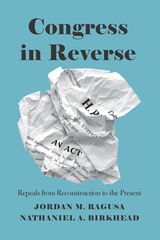
Congress in Reverse
Repeals from Reconstruction to the PresentJordan M. Ragusa and Nathaniel A. Birkhead
University of Chicago Press, 2020
Congress in Reverse is the first book to attempt to answer these questions. Jordan M. Ragusa and Nathaniel A. Birkhead examine when and why existing statutes are successfully “undone,” arguing that repeals are most common when the parties are united on the issue—which was not the case when it came to Obamacare for the Republican Party—and the majority party wins control of Congress after a long stint in the minority. By shifting focus from the making of laws to their un-making, Congress in Reverse opens up a new arena for studying legislative activity in Congress.
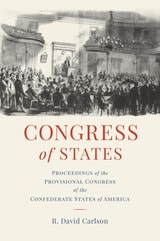
Congress of States
Proceedings of the Provisional Congress of the Confederate States of AmericaR. David Carlson
University of Alabama Press, 2023
A landmark publication of public reports that reveal the founding of the Confederate government
Past publications of the proceedings of the Confederate Congress have focused on the public sessions of the Regular Confederate States Congress that met in Richmond, Virginia from February 1862 to March 1865. Omitted were the formative early sessions of the Montgomery, Alabama and Richmond, Virginia Provisional Congresses of 1861 and 1862. In Congress of States, David Carlson reveals these critical early meetings.
To illuminate this pivot point in American and Southern history, Carlson has drawn on detailed and often verbatim minutes reported in Richmond, Montgomery, Charleston, New Orleans, Savannah, and Augusta newspapers, assembling here a unique set of transcriptions that reveal the birth of the Confederate government.
Congress of States provides an introduction to the Provisional Confederate Congress and the purpose of this work relative to the Southern Historical Society’s landmark 1923 publication “Proceedings of the Confederate Congress,” which detailed the 1862–1865 Regular Confederate Congress. He also includes a chronology outlining the major events of the secession crisis, annotated minutes for the Provisional Confederate Congress’s five sessions, appendices featuring the leadership and committees of the Provisional Congress, and fascinating examples of the proposed Confederate emblem and flags debated by the delegates.
A key set of primary sources that scholars, historians, librarians, and political scientists will value for years to come, Congress of States will also be essential reading for the general reader interested in American and Southern history, the Antebellum South, and the Civil War.
Congress on Display, Congress at Work
William T. Bianco, Editor
University of Michigan Press, 2000
Congress, the President, and the Federal Reserve
The Politics of American Monetary Policy-MakingIrwin L. Morris
University of Michigan Press, 2002
Current formal theories of the general policy-making process are utilized to construct an explanatory framework that identifies the mechanisms through which congressional and executive influence is exercised. The theoretical framework presented in the text also helps to explain the political dynamics of several of the most significant policy decisions of the Federal Reserve during the last half-century. In addition, this book provides a unique perspective on the manner in which Fed policymakers attempt to shield themselves from unwelcome political influence.
While the main focus of Congress, the President, and the Federal Reserve is monetary policy-making, it also speaks to the political nature of policy-making in a more general sense and provides a guide for the future study of the political dynamics in a wide variety of substantive policy areas. Thus it will interest not only political scientists and economists interested in monetary policy-making specifically but also those interested in the nature of public policy-making more generally.
Irwin L. Morris is Assistant Professor of Political Science, University of Maryland.
Congressional Communication
Content and ConsequencesDaniel Lipinski
University of Michigan Press, 2004
--Bruce Oppenheimer, Vanderbilt University
"The communication between representatives and their constituents is where election strategy and policy explanations are merged and, until now, we have had only anecdotal evidence. Lipinski's book sheds light on this important part of American political life."
--David Brady, Stanford University
Congressional Communication challenges the notion that legislators "run against Congress" by routinely denigrating the institution. Using a unique, systematic analysis of the communication from members of Congress to their constituents over a five-year period, Daniel Lipinski challenges this notion, demonstrating key partisan differences in representatives' portrayals of congressional activities. While members of the majority party tend to report that the institution-and, hence, their party-is performing well, members of the minority party are more likely to accuse Congress of doing a poor job.
The findings in Congressional Communication offer the first strong empirical evidence from the electoral arena in support of controversial party government theories. Moving beyond previous studies that look only at legislators' messages, Lipinski's research also reveals the effects of these politically strategic claims on voters, whose interpretations don't necessarily bear out the legislators' intended effects.
Daniel Lipinski is Assistant Professor of Political Science at the University of Tennessee.
Constitutional Deliberation in Congress
The Impact of Judicial Review in a Separated SystemJ. Mitchell Pickerill
Duke University Press, 2004
Pickerill combines legislative histories, extensive empirical findings, and interviews with current and former members of Congress, congressional staff, and others. He examines data related to all of the federal legislation struck down by the Supreme Court from the beginning of the Warren Court in 1953 through the 1996–97 term of the Rehnquist Court. By looking at the legislative histories of Congressional acts that invoked the Commerce Clause and presented Tenth Amendment conflicts—such as the Child Labor Act (1916), the Civil Rights Act (1965), the Gun-Free School Zones Act (1990), and the Brady Bill (1994)—Pickerill illuminates how Congressional deliberation over newly proposed legislation is shaped by the possibility of judicial review. The Court’s invalidation of the Gun-Free School Zones Act in its 1995 ruling United States v. Lopez signaled an increased judicial activism regarding issues of federalism. Pickerill examines that case and compares congressional debate over constitutional issues in key pieces of legislation that preceded and followed it: the Violence Against Women Act of 1994 and the Hate Crimes Prevention Act of 1997. He shows that Congressional attention to federalism increased in the 1990s along with the Court’s greater scrutiny.