56 books match the query 'Context' and 8 start with c

cover of Capitalism in Context: Essays on Economic Development and Cultural Change in Honor of R.M. Hartwell

Capitalism in Context

Essays on Economic Development and Cultural Change in Honor of R.M. Hartwell

Edited by John A. James and Mark Thomas

University of Chicago Press, 1994

Following the approach of R. M. Hartwell, the influential historian of the British Industrial Revolution, these essays explore the cultural contexts and institutional constraints that have shaped growth and development over the past two centuries. Capitalism in Context offers new perspectives on why economic development took place where and when it did.

Thirteen chapters cover: social progress during economic development; the influence of cultural values on social and economic change; economic foundations of development—labor, capital, and technology; and organizational arrangements—property rights, government, and markets. These studies will appeal to economists, historians, and social scientists alike for their wide-ranging treatments of economic development and cultural change.

The contributors are N. F. R. Crafts, Lance E. Davis, Stanley L. Engerman, David W. Galenson, Robert E. Gallman, Stephen Innes, John A. James, Eric L. Jones, Thomas W. Laqueur, Gary D. Libecap, Joel Mokyr, Douglass C. North, Mark Thomas, John J. Wallis, Jeffrey G. Williamson.
[more]
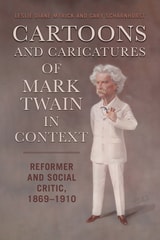
cover of Cartoons and Caricatures of Mark Twain in Context: Reformer and Social Critic, 1869–1910

Cartoons and Caricatures of Mark Twain in Context

Reformer and Social Critic, 1869–1910

Leslie Diane Myrick and Gary Scharnhorst

University of Alabama Press, 2023

The first book-length treatment of Mark Twain’s public persona as depicted in newspaper and magazine illustrations
 
Cartoons and Caricatures of Mark Twain in Context: Reformer and Social Critic, 1869–1910 examines the production, reception, and history of Twain’s reputation as a social and political satirist. Myrick and Scharnhorst trace the evolution of Twain’s depiction throughout his life, career, and even death and across more than seventy illustrations—from portrayals of the famous author as a court jester adorned with cap and bells, to a regally haloed king with a royal train—offering a new perspective on his influence and reputation. Although he was among the most photographed figures of the nineteenth century, Myrick and Scharnhorst focus on a medium that Twain, an expert ofself-promotion and brand management, could not control. As a result, Myrick and Scharnhorst have compiled an innovative and incisive visual reception history.

Cartoons and Caricatures of Mark Twainin Context illustrates the popular and often critical response to many famous and infamous episodes in his career, such as the storm of controversy that surrounded the publication of his anti-imperialist writings at the turn of the twentieth century. Routinely depicted with hair like a fright wig, a beak-like nose, and a cigar in hand, no matter the context or the costume, Twain was instantly recognizable. Yet it was not merely the familiarity of his image that made him a regular feature in visual commentary, but also his willingness to speak out against corruption and to insert himself into controversies of his day.

 
[more]
cover of Charles Johnson in Context

Charles Johnson in Context

Linda Furgerson Selzer

University of Massachusetts Press, 2009

Author of the National Book Award–winning novel Middle Passage, Charles Johnson belongs to a generation of writers who collectively raised African American literature to a new position of prominence during the late twentieth century. In this book, Linda Furgerson Selzer takes an interdisciplinary approach to Johnson's major fiction, providing fresh insight into his work by placing it within a broad historical context. In addition to Middle Passage (1990), Selzer focuses on three other novels: Faith and the Good Thing (1974), Oxherding Tale (1982), and Dreamer (1998). She shows how these works reflect Johnson's participation in the larger cultural projects of several significant but often overlooked groups—young black philosophers who challenged the dominant Anglo-American empiricist tradition during the 1960s and 1970s; black Buddhists of the post–civil rights era who sought to translate an ancient religious practice into an African American idiom; and black public intellectuals who attempted to revive a cosmopolitan social ethic during the 1990s. The cultural histories of each of these groups, Selzer argues, provide important contexts for understanding Johnson's evolution as a novelist. In the academic experience of black students who entered philosophy programs during the turbulent 1960s, the spiritual concerns of black Buddhists who have only recently begun to speak more publicly about their faith, and the cultural issues surrounding the emergence of a new cohort of African American public intellectuals, we see the roots of the social, moral, and aesthetic vision that informs what some have described as Johnson's "philosophical fiction." Selzer's probing analysis of the influence of each of these contexts not only enriches our understanding of Charles Johnson's fiction, it also makes a broader contribution to the cultural history of African America during the past half century.
[more]
cover of Chimpanzees in Context: A Comparative Perspective on Chimpanzee Behavior, Cognition, Conservation, and Welfare

Chimpanzees in Context

A Comparative Perspective on Chimpanzee Behavior, Cognition, Conservation, and Welfare

Edited by Lydia M. Hopper and Stephen R. Ross

University of Chicago Press, 2020

The study of the chimpanzee, one of the human species’ closest relatives, has led scientists to exciting discoveries about evolution, behavior, and cognition over the past half century. In this book, rising and veteran scholars take a fascinating comparative approach to the culture, behavior, and cognition of both wild and captive chimpanzees. By seeking new perspectives in how the chimpanzee compares to other species, the scientists featured offer a richer understanding of the ways in which chimpanzees’ unique experiences shape their behavior. They also demonstrate how different methodologies provide different insights, how various cultural experiences influence our perspectives of chimpanzees, and how different ecologies in which chimpanzees live affect how they express themselves.
 
After a foreword by Jane Goodall, the book features sections that examine chimpanzee life histories and developmental milestones, behavior, methods of study, animal communication, cooperation, communication, and tool use. The book ends with chapters that consider how we can apply contemporary knowledge of chimpanzees to enhance their care and conservation. Collectively, these chapters remind us of the importance of considering the social, ecological, and cognitive context of chimpanzee behavior, and how these contexts shape our comprehension of chimpanzees. Only by leveraging these powerful perspectives do we stand a chance at improving how we understand, care for, and protect this species.
[more]
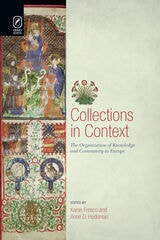
cover of Collections in Context: The Organization of Knowledge and Community in Europe

Collections in Context

The Organization of Knowledge and Community in Europe

Edited by Karen Fresco and Anne D. Hedeman

The Ohio State University Press, 2011

The fourteen essays that comprise Collections in Context: The Organization of Knowledge and Community in Europe interrogate questions posed by French, Flemish, English, and Italian collections of all sorts—libraries as a whole, anthologies and miscellanies assembled within a single manuscript or printed book, and even illustrated ivory boxes.

Collecting became an increasingly important activity during the fourteenth through seventeenth centuries, when the decreased cost of producing books made ownership available to more people. But the act of collecting is never neutral: it gathers information, orders material (especially linear texts), and prioritizes everything—in short, collecting both organizes and comments on knowledge. Moreover, the context of a collection must reveal something about identity, but whose? That of the compiler? The reader or viewer? The donor? The patron?

With essays by a wide array of international scholars, Collections in Context demonstrates that the very act of collecting inevitably imposes some kind of relationship among what might otherwise be naively thought of as disparate elements and simultaneously exposes something about the community that created and used the collection. Thus, Collections in Context offers unusual insights into how collecting both produced knowledge and built community in early modern Europe.
[more]
cover of Context in Literary and Cultural Studies

Context in Literary and Cultural Studies

Edited by Jakob Ladegaard and Jakob Gaardbo Nielsen

University College London, 2019

Context in Literary and Cultural Studies is an interdisciplinary volume that deals with the challenges of studying works of art and literature in their historical context today. The relationship between artworks and context has long been a central concern for aesthetic and cultural disciplines, and the question of context has been asked anew in all eras. Developments in contemporary culture and technology, as well as new theoretical and methodological orientations in the humanities, once again prompt us to rethink context in literary and cultural studies. This volume takes up that challenge. 
Introducing readers to new developments in literary and cultural theory, Context in Literary and Cultural Studies connects all disciplines related to these areas to provide an interdisciplinary overview of the challenges different scholarly fields today meet in their studies of artworks in context. Spanning a number of countries and covering subjects from nineteenth-century novels to rave culture, the chapters together constitute an informed, diverse and wide-ranging discussion.  The volume is written for scholarly readers at all levels in the fields of literary studies, comparative literature, cultural studies, art history, film, theater studies, and digital humanities. 
 
[more]
cover of Context, Cognition, and Deafness

Context, Cognition, and Deafness

M. Diane Clark

Gallaudet University Press, 2001
In past studies of the effect of environment and social settings upon the cognitive development of deaf children, results frequently were confounded by conflicting conclusions related to the particpants' varying degrees of hearing loss. Context, Cognition, and Deafness: An Introduction takes an interdisciplinary approach that clarifies these disparate findings by analyzing many methodologies. Editors M. Diane Clark, Marc Marschark, and Michael Karchmer, widely respected scholars in their own right, have assembled work by a varying cast of renowned researchers to elucidate the effects of family, peers, and schools on deaf children. To integrate the often contrasting approaches of clinical and cultural researchers, this sharply focused volume has called upon experts in anthropology, psychology, linguistics, basic visual sensory processes, education, cognition, and neurophysiology to share complementary observations. One of William C. Stokoe's last contributions, "Deafness, Cognition, and Language" leads fluidly into Jeffrey P. Praden's analysis of clinical assessments of deaf people's cognitive abilities. Margaret Wilson expands on the impace of sign language expertise on visual perception. Context, Cognition, and Deafness also shows that theory can intersect practice, as displayed by editor Marschark and Jennifer Lukomski in their research on literacy, cognition, and education. Amy R. Lederberg and Patricia E. Spencer have combined sequential designs in their study of vocabulary learning. Ethan Remmel, Jeffrey G. Bettger, and Amy M. Weinberg explore the theory of mind development. The emotional development of deaf children also received detailed consideration by Colin D. Gray, Judith A. Hosie, Phil A. Russell, and Ellen A. Ormel. Kathryn P. Meadow-Orlans delineates her perspective on the coming of age of deaf children in relation to their education and development. Marschark concludes with insightful impressions on the future of theory and application, an appropriate close to this exceptional, coherent volume. M. Diane Clark is Professor in the Department of Psychology at Shippensburg University in Shippensburg, PA. Marc Marschark is Professor in the Department of Research at the National Technical Institute for the Deaf in Rochester, NY. Michael Karchmer is Professor in the Department of Education Foundations and Research and Director of the Gallaudet Research Institute at Gallaudet University.
[more]
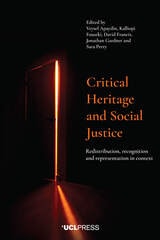
cover of Critical Heritage and Social Justice: Redistribution, Recognition and Representation in Context

Critical Heritage and Social Justice

Redistribution, Recognition and Representation in Context

Edited by Veysel Apaydin, Kalliopi Fouseki, David Francis, Jonathan Gardner, and Sara Perry

University College London, 2026

The first edited volume in the field of heritage to conceptualize and contextualize social justice in depth, both theoretically and through practical applications.

In this edited volume, scholars and practitioners working across heritage, museums, galleries, and cultural institutions explore how principles of social justice can be embedded within these spaces. Highlighting intersections between critical heritage studies and urgent global challenges, the book seeks to foster inclusive, community-engaged heritage practices. Applying Nancy Fraser’s theory of three-dimensional justice—redistribution, recognition, and representation—within the context of heritage studies, the authors reflect on global social, cultural, political, and environmental issues through an interdisciplinary heritage-focused approach. 

[more]