Results by title
476 books match the query 'Criticism' and 35 start with c
Calamity Theory
Three Critiques of Existential RiskJoshua Schuster
University of Minnesota Press, 2021
What are the implications of how we talk about apocalypse?
A new philosophical field has emerged. “Existential risk” studies any real or hypothetical human extinction event in the near or distant future. This movement examines catastrophes ranging from runaway global warming to nuclear warfare to malevolent artificial intelligence, deploying a curious mix of utilitarian ethics, statistical risk analysis, and, controversially, a transhuman advocacy that would aim to supersede almost all extinction scenarios. The proponents of existential risk thinking, led by Oxford philosopher Nick Bostrom, have seen their work gain immense popularity, attracting endorsement from Bill Gates and Elon Musk, millions of dollars, and millions of views.
Calamity Theory is the first book to examine the rise of this thinking and its failures to acknowledge the ways some communities and lifeways are more at risk than others and what it implies about human extinction.
Forerunners: Ideas First is a thought-in-process series of breakthrough digital publications. Written between fresh ideas and finished books, Forerunners draws on scholarly work initiated in notable blogs, social media, conference plenaries, journal articles, and the synergy of academic exchange. This is gray literature publishing: where intense thinking, change, and speculation take place in scholarship.
Callous Objects
Designs against the HomelessRobert Rosenberger
University of Minnesota Press, 2017
Uncovering injustices built into our everyday surroundings
Callous Objects unearths cases in which cities push homeless people out of public spaces through a combination of policy and strategic design. Robert Rosenberger examines such commonplace devices as garbage cans, fences, signage, and benches—all of which reveal political agendas beneath the surface. Such objects have evolved, through a confluence of design and law, to be open to some uses and closed to others, but always capable of participating in collective ends on a large scale. Rosenberger brings together ideas from the philosophy of technology, social theory, and feminist epistemology to spotlight the widespread anti-homeless ideology built into our communities and enacted in law.
Forerunners: Ideas First is a thought-in-process series of breakthrough digital publications. Written between fresh ideas and finished books, Forerunners draws on scholarly work initiated in notable blogs, social media, conference plenaries, journal articles, and the synergy of academic exchange. This is gray literature publishing: where intense thinking, change, and speculation take place in scholarship.

Camera Indica
The Social Life of Indian PhotographsChristopher Pinney
University of Chicago Press, 1997
These quiet but moving images represent the changing role of photographic portraiture in India, a topic anthropologist Christopher Pinney explores in Camera Indica. Studying photographic practice in India, Pinney traces photography's various purposes and goals from colonial through postcolonial times. He identifies three key periods in Indian portraiture: the use of photography under British rule as a quantifiable instrument of measurement, the later role of portraiture in moral instruction, and the current visual popular culture and its effects on modes of picturing. Photographic culture thus becomes a mutable realm in which capturing likeness is only part of the project. Lavishly illustrated, Pinney's account of the change from depiction to invention uncovers fascinating links between these evocative images and the society and history from which they emerge.
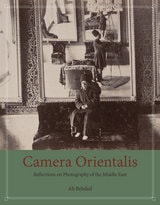
Camera Orientalis
Reflections on Photography of the Middle EastAli Behdad
University of Chicago Press, 2016
Considering a range of Western and Middle Eastern archival material from the late nineteenth and early twentieth centuries, Ali Behdad offers a rich account of how photography transformed Europe’s distinctly Orientalist vision into what seemed objective fact, a transformation that proved central to the project of European colonialism. At the same time, Orientalism was useful for photographers from both regions, as it gave them a set of conventions by which to frame exotic Middle Eastern cultures for Western audiences. Behdad also shows how Middle Eastern audiences embraced photography as a way to foreground status and patriarchal values while also exoticizing other social classes.
An important examination of previously overlooked European and Middle Eastern photographers and studios, Camera Orientalis demonstrates that, far from being a one-sided European development, Orientalist photography was the product of rich cultural contact between the East and the West.
Canons by Consensus
Critical Trends and American Literature AnthologiesJoseph Csicsila, with a foreword by Tom Quirk
University of Alabama Press, 2004
The first systematic analysis of American literature textbooks used by college instructors in the last century
Scholars have long noted the role that college literary anthologies play in the rising and falling reputations of American authors. Canons by Consensus examines this classroom fixture in detail to challenge and correct a number of assumptions about the development of the literary canon throughout the 20th century.
Joseph Csicsila analyzes more than 80 anthologies published since 1919 and traces not only the critical fortunes of individual authors, but also the treatment of entire genres and groupings of authors by race, region, gender, and formal approach. In doing so, he calls into question accusations of deliberate or inadvertent sexism and racism. Selections by anthology editors, Csicsila demonstrates, have always been governed far more by prevailing trends in academic criticism than by personal bias.
Academic anthologies are found to constitute a rich and often overlooked resource for studying American literature, as well as an irrefutable record of the academy’s changing literary tastes throughout the last century.
Carnalities
The Art of Living in LatinidadMariana Ortega
Duke University Press, 2025
Chaos and Order
Complex Dynamics in Literature and ScienceEdited by N. Katherine Hayles
University of Chicago Press, 1991
N. Katherine Hayles traces shifts in meaning that chaos has undergone within the Western tradition, suggesting that the science of chaos articulates categories that cannot be assimilated into the traditional dichotomy of order and disorder. She and her contributors take the relation between order and disorder as a theme and develop its implications for understanding texts, metaphors, metafiction, audience response, and the process of interpretation itself. Their innovative and diverse work opens the interdisciplinary field of chaotics to literary inquiry.
Chicago Architecture
Histories, Revisions, AlternativesEdited by Charles Waldheim and Katerina Ruedi Ray
University of Chicago Press, 2005
In Chicago Architecture, Charles Waldheim and Katerina Ruedi Ray revise and offer alternatives to the archetypal story of modern architecture in Chicago. They and an esteemed group of contributors assert that the mythic status of Chicago architecture has distorted our understanding of the historical circumstances in which it was realized. This searching volume illuminates the importance of photographs, books, magazines, and other media in the cultivation of an international audience for Chicago architecture; it explores the pivotal role of real estate developers, finance and insurance sectors, and speculative capital markets in the development of the city itself; and, perhaps most notably, it examines a wide variety of overlooked architectural works and their creators—individuals who did not fit into the dominant modernist narrative.
Offering new insights on Chicago public housing and O'Hare International Airport, on the Columbian Exposition and Marina City, on the city's grid system and the place of women architects in the story of Chicago modernism, and on the subjective experience of living inside Chicago's most well-known buildings, Chicago Architecture is a work of enormous scope and vision—a book as heady and towering as the skyline it considers.

Citizen Critics
Literary Public SpheresRosa A. Eberly
University of Illinois Press, 2000
The condition of our public discussions about literary and cultural works has much to say about the state of our democracy. Classrooms, newspapers, magazines, Internet forums, and many other places grant citizens a place to hold public discourses—and claim a voice on national artistic matters.
Rosa A. Eberly looks at four censorship controversies where professionals asserted their authority to deny citizen critics a voice—and effectively removed discussion of literature from the public sphere. Eberly compares the outrage sparked by the publication of James Joyce's Ulysses and Henry Miller's Tropic of Cancer with the relative quiescence that greeted the much more violent and sexually explicit content of Bret Easton Ellis's American Psycho and Andrea Dworkin's Mercy. Through a close reading of letters to the editor, reviews, media coverage, and court cases, Eberly shows how literary critics and legal experts defused censorship debates—and undercut the authority of citizen critics—by shifting the focus from content to aesthetics and from social values to publicity.

Closed Encounters
Literary Politics and Public CultureJeffrey Wallen
University of Minnesota Press, 1998
Closed Encounters was first published in 1998. Minnesota Archive Editions uses digital technology to make long-unavailable books once again accessible, and are published unaltered from the original University of Minnesota Press editions.
It's committed. It's political. It's socially engaged. It's academic criticism in the nineties. But what does it achieve? In a provocative and fair-minded look at current critical practices and the future of the academy, Jeffrey Wallen draws a disturbing picture of public intellectuals in search of a public and cultural critics unable to enter a dialogue with others.
Wallen argues that literary politics is no substitute for debate on genuine political issues. Taking up several of the most influential critics of recent years-Edward Said, Eve Kosofsky Sedgwick, Michael Bérubé, Gerald Graff, Richard Rorty, Stanley Fish, and many others-Wallen asks: Can their desire to persuade an audience beyond the classroom be fulfilled? And can cultural critics realize their ambitious social and institutional goals for change? In a work that is neither of the Left nor of the Right, but likely to unsettle both, Wallen argues that literary criticism actually undermines the prospects for the dialogue it calls out for.
In addition, Wallen argues that the institutionalization of critiques of truth and difference-critiques that appear to liberate us by revealing that knowledge and values are constructed, and can therefore be transformed-often leads to a further constraining of thought and narrowing of outlooks. In his analysis of the administration of conflict, Wallen describes the troubled state of academic freedom and points to a shift from the institutional protection of dissenting views to the institutional protection from views one finds unpleasant.
Yet the prospects are not bleak: Wallen emphasizes that academic critics continue to play a crucial role in crafting what we expect from discussion. In this spirit, Closed Encounters lays the groundwork for fashioning a truly public, socially engaged criticism.
Code and Clay, Data and Dirt
Five Thousand Years of Urban MediaShannon Mattern
University of Minnesota Press, 2017
For years, pundits have trumpeted the earthshattering changes that big data and smart networks will soon bring to our cities. But what if cities have long been built for intelligence, maybe for millennia? In Code and Clay, Data and Dirt Shannon Mattern advances the provocative argument that our urban spaces have been “smart” and mediated for thousands of years.
Offering powerful new ways of thinking about our cities, Code and Clay, Data and Dirt goes far beyond the standard historical concepts of origins, development, revolutions, and the accomplishments of an elite few. Mattern shows that in their architecture, laws, street layouts, and civic knowledge—and through technologies including the telephone, telegraph, radio, printing, writing, and even the human voice—cities have long negotiated a rich exchange between analog and digital, code and clay, data and dirt, ether and ore.
Mattern’s vivid prose takes readers through a historically and geographically broad range of stories, scenes, and locations, synthesizing a new narrative for our urban spaces. Taking media archaeology to the city’s streets, Code and Clay, Data and Dirt reveals new ways to write our urban, media, and cultural histories.
Cold War Camera
Thy Phu, Erina Duganne, and Andrea Noble, editors
Duke University Press, 2023
Contributors. Ariella Azoulay, Jennifer Bajorek, Erina Duganne, Evyn Lê Espiritu Gandhi, Eric Gottesman, Tong Lam, Karintha Lowe, Ángeles Donoso Macaya, Darren Newbury, Andrea Noble, Sarah Parsons, Gil Pasternak, Thy Phu, Oksana Sarkisova, Olga Shevchenko, Laura Wexler, Guigui Yao, Donya Ziaee, Marta Ziętkiewicz
Commodification and Spectacle in Architecture
A Harvard Design Magazine ReaderWilliam Saunders
University of Minnesota Press, 2005
Framed with a provocative introduction by Kenneth Frampton, the contributions to Commodification and Spectacle in Architecture stake out a variety of positions in the debate over the extent to which it is possible—or desirable—to escape from, resist, or suggest plausible alternatives to the dominant culture of consumer capitalism. Rejecting any dreamy nostalgia for an idealized present or past in which design is completely divorced from commerce—and, in some cases, celebrating the pleasures of spectacle—the individual essays range from indictments of particular architects and critiques of the profession to broader concerns about what the phenomenon of commodification means for the practice of democracy and the health of society.
Bringing together an impressive and varied group of critics and practitioners, Commodification and Spectacle in Architecture will help to sharpen the discussion of how design can respond to our hypercommodified culture.
Contributors: Michael Benedikt, Luis Fernández-Galiano, Thomas Frank, Kevin Ervin Kelley, Daniel Naegele, Rick Poynor, Michael Sorkin, Wouter Vanstiphout.
William S. Saunders is editor of Harvard Design Magazine and assistant dean for external relations at the Harvard Design School. He is the author of Modern Architecture: Photographs by Ezra Stoller.
Kenneth Frampton is Ware Professor of Architecture at Columbia University Graduate School of Architecture, Planning, and Preservation and author of many books, including Labour, Work, and Architecture.
Congenial Souls
Reading Chaucer from Medieval to PostmodernStephanie Trigg
University of Minnesota Press, 2001
Conspiracy Theories and the Failure of Intellectual Critique
Kurtis Hagen
University of Michigan Press, 2022
Conspiracy Theories and the Failure of Intellectual Critique argues that conspiracy theories, including those that conflict with official accounts and suggest that prominent people in Western democracies have engaged in appalling behavior, should be taken seriously and judged on their merits and problems on a case-by-case basis. It builds on the philosophical work on this topic that has developed over the past quarter century, challenging some of it, but affirming the emerging consensus: each conspiracy theory ought to be judged on its particular merits and faults.
The philosophical consensus contrasts starkly with what one finds in the social science literature. Kurtis Hagen argues that significant aspects of that literature, especially the psychological study of conspiracy theorists, has turned out to be flawed and misleading. Those flaws are not randomly directed; rather, they consistently serve to disparage conspiracy theorists unfairly. This suggests that there may be a bias against conspiracy theorists in the academy, skewing “scientific” results. Conspiracy Theories and the Failure of Intellectual Critique argues that social scientists who study conspiracy theories and/or conspiracy theorists would do well to better absorb the implications of the philosophical literature.
Constructing German Walt Whitman
Walter Grunzweig
University of Iowa Press, 1994
Constructing Mark Twain
New Directions in ScholarshipEdited with an introduction by Laura E. Skandera-Trombley and Michael J. Kiskis
University of Missouri Press, 2001
The thirteen essays in this collection combine to offer a complex and deeply nuanced picture of Samuel Clemens. With the purpose of straying from the usual notions of Clemens (most notably the Clemens/Twain split that has ruled Twain scholarship for over thirty years), the editors have assembled contributions from a wide range of Twain scholars. As a whole, the collection argues that it is time we approach Clemens not as a shadow behind the literary persona but as a complex and intricate creator of stories, a creator who is deeply embedded in the political events of his time and who used a mix of literary, social, and personal experience to fuel the movements of his pen.
The essays illuminate Clemens's connections with people and events not usually given the spotlight and introduce us to Clemens as a man deeply embroiled in the process of making literary gold out of everyday experiences. From Clemens's wonderings on race and identity to his looking to family and domesticity as defining experiences, from musings on the language that Clemens used so effectively to consideration of the images and processes of composition, these essays challenge long-held notions of why Clemens was so successful and so influential a writer. While that search itself is not new, the varied approaches within this collection highlight markedly inventive ways of reading the life and work of Samuel Clemens.
Contemporary Chinese Art
Primary DocumentsWu Hung, editor
Duke University Press, 2010
Publication of the Museum of Modern Art
Contemporary Perspectives on the History of Philosophy
Peter A. French, Theodore E. Uehling Jr., and Howard K. Wettstein, Editors
University of Minnesota Press, 1983
Contemporary Perspectives on the History of Philosophy was first published in 1983. Minnesota Archive Editions uses digital technology to make long-unavailable books once again accessible, and are published unaltered from the original University of Minnesota Press editions.
The authors of the 27 appears in Volume 8, Midwest Studies in Philosophy,have established reputations as historians of philosophy, but their vantage point, here, is from "contemporary perspectives" - they use contemporary analytic skills to examine problems and issues considered by past philosophers. The papers, arranged in historical order, fall into six groups: ancient philosophy (the Pythagoreans, Plato, and Aristotle); the seventeenth-century rationalists (Descartes, Leibniz and Spinoza); the empiricists (Locke, Berkeley, and Hume); Kant; the nineteenth century (Hegel, Schopenhauer, and Mill); and, in conclusion, an essay on Wittgenstein's Tractatus and two broad, retrospective papers entitled "Old Analyses of the Physical World and new Philosophies of Language" and "Moral Crisis and the History of Ethics."
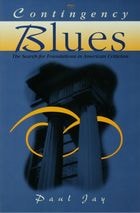
Contingency Blues
The Search For Foundations In American CriticismPaul Jay
University of Wisconsin Press, 1997
From Emerson to Rorty, American criticism has grappled in one way or another with the problem of modernity—specifically, how to determine critical and cultural standards in a world where every position seems the product of an interpretation. Part intellectual history, part cultural critique, this provocative book is an effort to shake American thought out of the grip of the nineteenth century—and out of its contingency blues.
Paul Jay focuses his analysis on two strands of American criticism. The first, which includes Richard Poirier and Giles Gunn, has attempted to revive what Jay insists is an anachronistic pragmatism derived from Emerson, James, and Dewey. The second, represented most forcefully by Richard Rorty, tends to reduce American criticism to a metadiscourse about the contingent grounds of knowledge. In chapters on Emerson, Whitman, Santayana, Van Wyck Brooks, Dewey, and Kenneth Burke, Jay examines the historical roots of these two positions, which he argues are marked by recurrent attempts to reconcile transcendentalism and pragmatism. A forceful rejection of both kinds of revisionism, Contingency Blues locates an alternative in the work of the “border studies” critics, those who give our interest in contingency a new, more concrete form by taking a more historical, cultural, and anthropological approach to the invention of literature, subjectivity, community, and culture in a pan-American context.
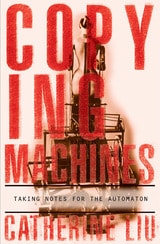
Copying Machines
Taking Notes for the AutomatonCatherine Liu
University of Minnesota Press, 2000
Explores literary theory’s fear of and fascination with the mechanical.
Anxieties about fixing the absolute difference between the human being and the mechanical replica, the automaton, are as old as the first appearance of the machine itself. Exploring these anxieties and the efforts they prompted, this book opens a window on one of the most significant, if subtle, ideological battles waged on behalf of the human against the machine since the Enlightenment—one that continues in the wake of technological and conceptual progress today.
A sustained examination of the automaton as early modern machine and as a curious ancestor of the twentieth-century robot, Copying Machines offers extended readings of mechanistic images in the eighteenth century through the prism of twentieth-century commentary. In readings of texts by Lafayette, Molière, Laclos, and La Bruyère—and in a chapter on the eighteenth-century inventor of automatons, Jacques Vaucanson—Catherine Liu provides a fascinating account of ways in which the automaton and the preindustrial machine haunt the imagination of ancien régime France and structure key moments of the canonical literature and criticism of the period.
Corporeal Words
Mikhail Bakhtins Theology DiscourseAlexandar Mihailovic
Northwestern University Press, 1997
Critical Academic Writing and Multilingual Students
A. Suresh Canagarajah
University of Michigan Press, 2002
This volume facilitates teacher self-reflection and enables readers to better understand the motivations and pedagogical implications--especially for L2 writing--of a more openly pedagogical approach.
Critical Academic Writing and Multilingual Students explains what it means to commit to an academic pedagogy, in terms of form, self, content, and community--and what it can accomplish in the L2 writing classroom. It's a guide for writing teachers who wish to embark on a journey toward increased critical awareness of the role they play, or potentially could play, in the lives of their students.
Critical Conditions
Regarding the Historical MomentHays, Michael
University of Minnesota Press, 1992
Critical Practices in Post-Franco Spain
Silvia L. Lopez, Jenaro Talens, and Dario Villanueva, Editors
University of Minnesota Press, 1994
Critical Practices in Post-Franco Spain was first published in 1994. Minnesota Archive Editions uses digital technology to make long-unavailable books once again accessible, and are published unaltered from the original University of Minnesota Press editions.
This volume offers a sample of Spanish critical work in literary theory and cultural studies. Like all critical histories, Spain's is political: Philology dominated the critical scene during the Franco years, and after Franco, this hegemony has been contested by semiotics, poststructuralism, psychoanalysis, and feminisms. Without trying to represent all the theoretical projects presently underway in Spanish criticism, this book opens a window on the vast field of new critical practices in Spain and provides a general picture of influential theoretical currents.
The essays collected here range widely in topic and style, and they reflect a new generation's preoccupation with critical problems that go beyond the field of literary studies. The authors focus on new discourse in various print and electronic media, on the discursive construction of the museum space, and on literary theory as it confronts issues of translation, subjectivity, writing, and narratology.Silvia López is assistant professor of Spanish at Carlton Collegea doctoral candidate in the departments of cultural studies and comparative literature at the University of Minnesota. Jenaro Talens is professor of Hispanic literature and comparative literature at the University of Geneva. He is the author of The Branded Eye: Buñuel's Un Chien Andalou, (Minnesota 1993). Darío Villanueva is professor of theory of literature at the University of Santiago de Compostela, Spain.
Critical Terms for Literary Study, Second Edition
Edited by Frank Lentricchia and Thomas McLaughlin
University of Chicago Press, 1995
Critical Terms for Literary Study is an essential handbook and introduction to the work of literary theory. Covering a broad range of key terms that include popular culture, diversity, imperialism, ethics, desire, class, gender, race, canon, representation, and much more through essays by leading scholars, it provides a concise history of each term alongside a critical exploration of the issues and questions for the field that it raises, followed by demonstrations of reading strategies driven by the term.
Exploring the concepts that shape the way we read, the essays combine to provide an extraordinary introduction to the work of literature and literary study, as the nation's most distinguished scholars put the tools of critical practice vividly to use.
Critical Understanding
The Powers and Limits of PluralismWayne C. Booth
University of Chicago Press, 1979
Critical Writings, 1953-1978
Paul De Man
University of Minnesota Press, 1989
Twenty-five essays and reviews not previously collected, most of which were written before 1970, and eight of which are appearing in English for the first time. Valuable for the insights they afford into his development as a critic the essays are also significant in addressing de Man’s consistent views of romanticism, modernism and the dilemmas central to literature in recent centuries.
Criticism and Social Change
Frank Lentricchia
University of Chicago Press, 1984
"A profound meditation on relations obtaining among writing, political consciousness, and criticism—this last taken in its most general sense. It is written with passion and grace; it is shot through with learning, intimate knowledge of the critical tradition, and a deep (though by no means uncritical) understanding of the work (as well as social significance) of Kenneth Burke."—Hayden White
Criticism and Truth
On Method in Literary StudiesJonathan Kramnick
University of Chicago Press, 2023
Does literary criticism offer truths about the world? In Criticism and Truth, Jonathan Kramnick offers a new and surprising account of criticism’s power by zeroing in on its singular method: close reading. Long recognized as the distinctive technique of literary studies, close reading is the critic’s way of pursuing arguments and advancing knowledge, as well as the primary skill taught in the English major. But it is also more than that—a creative, immersive, and transformative writing practice that fosters a unique kind of engagement with the world. Drawing on the rich and varied landscape of contemporary criticism, Kramnick changes how we think about the basic tools of literary analysis, including the art of in-text quotation, summary, and other reading methods, helping us to see them as an invaluable form of humanistic expertise. Criticism and Truth is a call to arms, making a powerful case for the necessity of both literature and criticism within a multidisciplinary university.
As the humanities fight for survival in contemporary higher education, the study of literature doesn’t need more plans for reform. Rather, it needs a defense of the work already being done and an account of why it should flourish. This is what Criticism and Truth offers, in vivid and portable form.
Criticism in the Borderlands
Studies in Chicano Literature, Culture, and IdeologyHéctor Calderón and José David Saldívar, eds.
Duke University Press, 1991
The editors have organized essays around four board themes: the situation of Chicano literary studies within American literary history and debates about the “canon”; representations of the Chicana/o subject; genre, ideology, and history; and the aesthetics of Chicano literature. The volume as a whole aims at generating new ways of understanding what counts as culture and “theory” and who counts as a theorist. A selected and annotated bibliography of contemporary Chicano literary criticism is also included.
By recovering neglected authors and texts and introducing readers to an emergent Chicano canon, by introducing new perspectives on American literary history, ethnicity, gender, culture, and the literary process itself, Criticism in the Borderlands is an agenda-setting collection that moves beyond previous scholarship to open up the field of Chicano literary studies and to define anew what is American literature.
Contributors. Norma Alarcón, Héctor Calderón, Angie Chabram, Barbara Harlow, Rolando Hinojosa, Luis Leal, José E. Limón, Terese McKenna, Elizabeth J. Ordóñez, Genero Padilla, Alvina E. Quintana, Renato Rosaldo, José David Saldívar, Sonia Saldívar-Hull, Rosaura Sánchez, Roberto Trujillo
Critique and Postcritique
Elizabeth S. Anker and Rita Felski, editors
Duke University Press, 2017
Contributors: Elizabeth S. Anker, Christopher Castiglia, Russ Castronovo, Simon During, Rita Felski, Jennifer L. Fleissner, Eric Hayot, Heather Love, John Michael, Toril Moi, Ellen Rooney, C. Namwali Serpell
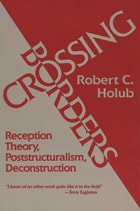
Crossing Borders
Reception Theory, Poststructuralism, DeconstructionRobert C. Holub
University of Wisconsin Press, 1992
Robert C. Holub critically investigates the histories of reception theory, poststructuralism, and deconstruction in postwar Germany and the United States. He looks at how imported theories assume a place in the political discourse of a country, and how indigenous intellectual traditions and prejudices affect, modify, or even distort foreign theories.
Holub addresses many timely questions: Why did reception theory, so prominent in Germany in the 1960s and 1970s, fail to have an impact on American academics until the 1980s? Why did postructuralism, and specifically the writings of Michel Foucault, fail to find a home in German academia while becoming an important theoretical voice in the United States? How did deconstruction, originally considered by American scholars as merely a sophisticated tool for analysis, get taken up by leftists who argued for an affinity between the critique of language and the critique of capitalism? And finally, how have American intellectuals responded to revelations of fascism in the pasts of Paul de Man and Martin Heidegger?
Crossing Borders effectively demonstrates the extent to which theoretical work needs to be understood in cultural, intellectual, and institutional contexts. Holub argues that the praxis of theories is determined not only by their content and style, but also by the environment in which they must function. The success of a transplanted theory, he contends, is due less to its inherent merits than to the hospitability of the environment on to which it is grafted.

Cultural Conservatism, Political Liberalism
From Criticism to Cultural StudiesJames Seaton
University of Michigan Press, 1996
Chapters on Lionel Trilling, H. L. Mencken and Irving Babbitt, Ralph Ellison, Dwight Macdonald, Diana Trilling, and Edmund Wilson affirm the continuing pertinence of their work to today's concerns. Seaton then turns to the careers of Leslie Fiedler and Susan Sontag to explore the impact of the cultural radicalism of the sixties on literary criticism. Subsequent chapters analyze the successes and failures of contemporary cultural studies through the writings of Richard Rorty, Edward Said, Stanley Fish and Fredric Jameson.
Separately, these chapters provide provocative readings of the individual critics; together they make a case for the tradition exemplified by these critics as an alternative to contemporary cultural studies. The issues the book discusses extend beyond literary criticism and the academic world to the political-religious- cultural conflicts of today's culture wars.
"These lively, closely argued essays explain very clearly what the issues are, how they arose, and why they are important." --Christopher Lasch
"A forceful argument about the relationship between literary studies and politics that will add something important to the vigorous, and often fierce, discussion of the canon, the politics of literature, and educational reform."--William Cain, Wellesley College
James Seaton is Professor of English, Michigan State University. He is co-editor, with William K. Buckley, of Beyond Cheering and Bashing: New Perspectives on the Closing of the American Mind.
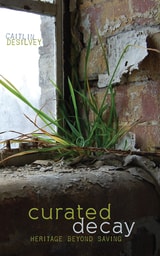
Curated Decay
Heritage beyond SavingCaitlin DeSilvey
University of Minnesota Press, 2017
Transporting readers from derelict homesteads to imperiled harbors, postindustrial ruins to Cold War test sites, Curated Decay presents an unparalleled provocation to conventional thinking on the conservation of cultural heritage. Caitlin DeSilvey proposes rethinking the care of certain vulnerable sites in terms of ecology and entropy, and explains how we must adopt an ethical stance that allows us to collaborate with—rather than defend against—natural processes.
Curated Decay chronicles DeSilvey’s travels to places where experiments in curated ruination and creative collapse are under way, or under consideration. It uses case studies from the United States, Europe, and elsewhere to explore how objects and structures produce meaning not only in their preservation and persistence, but also in their decay and disintegration. Through accessible and engaging discussion of specific places and their stories, it traces how cultural memory is generated in encounters with ephemeral artifacts and architectures.
An interdisciplinary reframing of the concept of the ruin that combines historical and philosophical depth with attentive storytelling, Curated Decay represents the first attempt to apply new theories of materiality and ecology to the concerns of critical heritage studies.