Results by title
436 books match the query 'Disability' and 27 start with c
Captioning and Subtitling for d/Deaf and Hard of Hearing Audiences
Soledad Zárate
University College London, 2021
Captioning and Subtitling for d/Deaf and Hard of Hearing Audiences is a comprehensive guide to the theory and practice of captioning and subtitling, with examples and exercises at the end of each chapter. Analyzing the requirements of d/Deaf and hard of hearing audiences in detail, as well as treating the linguistic and technical considerations necessary for effective captioning, this volume will familiarize the reader with the characteristics, needs, and diversity of d/Deaf and hard of hearing audiences. Based on first-hand experience in the field, the book provides a step-by-step guide to making live performances accessible to d/Deaf and hard of hearing audiences. The guide will be valuable reading to students of audiovisual translation, professional subtitlers, and captioners, as well as any organization or venue that engages with d/Deaf and hard of hearing people.
Care at the End of the World
Dreaming of Infrastructure in Crip-of-Color WritingJina B. Kim
Duke University Press, 2025
Cervantine Futures
Reading Cervantes after the Critical TurnEdited by Nicholas R. Jones and Paul Michael Johnson
Vanderbilt University Press, 2026
Cervantine Futures places the writings of Miguel de Cervantes into conversation with some of the most pressing issues in cultural studies, critical theory, and sociopolitical discourse of the last decade. Assembling a diverse range of prominent and emerging scholars in the field, this volume stakes a claim for Hispanism’s place in the growing scholarly movement to vindicate pre- and early modernity for its incisive and often singular perspective on race, gender, ability, the body, affect, materialism, and other axes of timely debate.
To date, the writings of Miguel de Cervantes have been oddly sidelined from larger, ongoing scholarly projects to link premodern literature with the most recent analytics of critical theory and cultural studies. Cervantine Futures addresses this conspicuous gap by highlighting creative, forward-looking, and rigorous approaches that situate Cervantes in recent theoretical developments in critical cultural studies. Conceived under the rubric of “futures”—collective and capacious, yet also subjunctive and transtemporal—this book tasks the fields of early modern Iberian and Cervantine studies with adopting a more global approach to the early modern period that surveys the current and historical landscapes while charting new horizons. Crucially, Cervantine Futures reflects upon how early modern texts, cultural modes of expression, and visual ideations from Cervantes’s life and legacy resonate with contemporary debates on gender, race, ability, and other issues. The volume thus includes scholarly provocations that deploy feminist, queer, critical race, disability studies, and new materialist approaches to Cervantes’s oeuvre—tendentiously positioned as “canonical”—with the purpose not only of scrutinizing its sociopolitical meanings, but also of creating new archives that productively reframe and rethink early modernity.
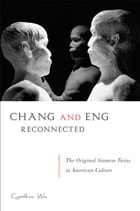
Chang and Eng Reconnected
The Original Siamese Twins in American CultureCynthia Wu
Temple University Press, 2012
Conjoined twins Chang and Eng Bunker have fascinated the world since the nineteenth century. In her captivating book, Chang and Eng Reconnected, Cynthia Wu traces the “Original Siamese Twins” through the terrain of American culture, showing how their inseparability underscored tensions between individuality and collectivity in the American popular imagination.
Using letters, medical documents and exhibits, literature, art, film, and family lore, Wu provides a trans-historical analysis that presents the Bunkers as both a material presence and as metaphor. She also shows how the twins figure in representations of race, disability, and science in fictional narratives about nation building.
As astute entrepreneurs, the twins managed their own lives; nonetheless, as Chang and Eng Reconnected shows, American culture has always viewed them through the multiple lenses of difference.
Cheap Talk
Disability and the Politics of CommunicationJoshua St. Pierre
University of Michigan Press, 2022
Citizenship, Politics, Difference
Perspectives from Sub-Saharan Signed Language CommunitiesAudrey C. Cooper
Gallaudet University Press, 2015
This collection centers upon two interrelated purposes: to examine sub-Saharan African deaf people’s perspectives on citizenship, politics, and difference in relation to SSSL practices, and to analyze SSSL practices in relation to sociopolitical histories and social change interests (including addressing aspects of culture, gender, language usage, race, ethnicity, sexuality, and ability). The editors have organized these themes under three main sections, Sub-Saharan Signed Languages and Deaf Communities, The Politics of Mobilizing Difference, and Citizenship. Such wide-ranging subjects as the ethics of studying Kenyan signed language, sign language and Deaf communities in Eritrea, and overcoming cultural and linguistic barriers to HIV/AIDS education drive home the importance of the unique and varied research in this collection.
Coming to My Senses
One Woman's Cochlear Implant JourneyClaire H. Blatchford
Gallaudet University Press, 2014
Communicative Biocapitalism
The Voice of the Patient in Digital Health and the Health HumanitiesOlivia Banner
University of Michigan Press, 2017
Concerto for the Left Hand
Disability and the Defamiliar BodyMichael Davidson
University of Michigan Press, 2008
Connective Tissue
Factory Accidents and Reconstructive Plastic Surgery in South IndiaLily N. Shapiro
Rutgers University Press, 2025
Connective Tissue revisits scholarship on factory labor by analyzing the accident as constitutive of the experience of work itself, and it refines existing conversations about the body, trauma, and care by introducing an analysis informed by theories of labor and production. Author Lily N. Shapiro argues that care does not happen in spite of or on the margins of capitalism, but rather that capitalism happens in and through care and caring relations. These experiences are intersected by identities of caste, class, and gender, and entangled in state discourse about labor rights, welfare, and industrial law.
Constructing Disability after the Great War
Blind Veterans in the Progressive EraEvan P. Sullivan
University of Illinois Press, 2024
Contingent Figure
Chronic Pain and Queer EmbodimentMichael D. Snediker
University of Minnesota Press, 2021
A masterful synthesis of literary readings and poetic reflections, making profound contributions to our understanding of chronic pain
At the intersection of queer theory and disability studies, acclaimed theorist Michael D. Snediker locates something unexpected: chronic pain. Starting from this paradigm-shifting insight, Snediker elaborates a bracing examination of the phenomenological peculiarity of disability, articulating a complex idiom of figuration as the lived substance of pain’s quotidian. This lexicon helps us differently inhabit both the theoretical and phenomenal dimensions of chronic pain and suffering by illuminating where these modes are least distinguishable.
Suffused with fastidious close readings, and girded by a remarkably complex understanding of phenomenal experience, Contingent Figure resides in the overlap between literary theory and lyric experiment. Snediker grounds his exploration of disability and chronic pain in dazzling close readings of Herman Melville, Emily Dickinson, Henry James, and many others. Its juxtaposition of these readings with candid autobiographical accounts makes Contingent Figure an exemplary instance of literary theory as a practice of lyric attention.
Thoroughly rigorous and anything but predictable, this stirring inquiry leaves the reader with a rich critical vocabulary indebted to the likes of Maurice Blanchot, Gilles Deleuze, D. O. Winnicott, and Eve Kosofsky Sedgwick. A master class in close reading’s inseparability from the urgency of lived experience, this book is essential for students and scholars of disability studies, queer theory, formalism, aesthetics, and the radical challenge of Emersonian poetics across the long American nineteenth century.
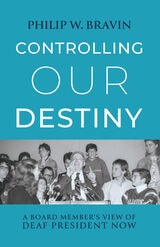
Controlling Our Destiny
A Board Member’s View of Deaf President NowPhilip W. Bravin
Gallaudet University Press, 2020
Bravin recounts the discussions and decision-making that happened behind the scenes leading up to and following the ill-fated announcement. He reflects on the integrity of the process and the internal conflict he experienced as a deaf person who supported a deaf president yet felt compelled to abide by his duties as a board member. After the protests, his leadership was recognized when he was selected as the first deaf chair of the board. Photographs and documents add depth to Bravin’s account, many of which will be seen by the public for the first time. I. King Jordan, the first deaf president of Gallaudet, provides a foreword in which he shares his own unique insight into these events.
Controlling Our Destiny captures the energy and the urgency of DPN. Readers will understand the complexities of the presidential search process and the cultural and historical contexts that triggered the protest. Bravin’s memoir contemplates power, access, community, and the enduring legacy of a movement that inspired deaf people around the world.
Counter-cartographies
Neurodivergence and the Errancies of PerformanceLeon J. Hilton
University of Minnesota Press, 2025
How to remake the world with neurodivergence at its heart
What if we embraced neurodivergent ways of being not as deviations to be corrected but as vital ways of inhabiting the world? What new realities might emerge? Bringing a much-needed humanistic perspective to the study of autism and other forms of neurodivergence, Counter-cartographies offers a bold reimagining of neurological difference, moving beyond rigid diagnostic frameworks to uncover more expansive, generative modes of existence.
Engaging the work of Fernand Deligny to trace how modern taxonomies of neurodivergence have hardened over time, Leon J. Hilton questions how these categories might instead serve as tools for remapping the world with neurodivergence at its center. At the heart of Counter-cartographies is an exploration of performance and performativity that reveals how the norm of neurotypical reality is continually reinforced through acts of doing, redoing, and undoing.
Charting the historical shift away from “mind” and toward “brain” and moving fluidly across disciplines—from digital art and documentary cinema to cybernetics and radical mental health movements—Hilton illuminates the deep interconnections between performance, perception, and the historical construction of the “neurotypical.” Through close readings of works by William Pope.L, Mel Baggs, Wu Tsang, and others, Hilton also examines how neurodivergence has been represented, embodied, and materialized in contemporary art and media. Restless, engrossing, and persistently attuned to moments of rupture when the neurotypical order falters, Counter-cartographies charts a path toward a more capacious, imaginative world.
Retail e-book files for this title are screen-reader friendly with images accompanied by short alt text and/or extended descriptions.
Creating Our Own Lives
College Students with Intellectual DisabilityMichael Gill
University of Minnesota Press, 2023
Young adults with intellectual disability tell the story of their own experience of higher education
How do students with intellectual disability experience higher education? Creating Our Own Lives addresses this question through the eyes of participants themselves. In relating their experiences and aspirations, these student perspectives mount a powerful challenge to assumptions that intellectual disability is best met with protection or segregation.
Taken together, the essays expose and contradict the inherently ableist claim that individuals with intellectual disability cannot be reliable storytellers. Instead, their deeply informative stories serve as a corrective narrative. The first of the four sections, “Laying the Foundation: Why Everyone Belongs in College,” focuses on belonging and inclusion; the second, “Opening Up Possibilities: Overcoming Doubt and Uncertainty,” conveys the optimism of this generation of advocates through stories of personal hardship, hopeful perseverance, and triumph over adversity; the third, “Inclusion as Action: Diversifying Student Experiences,” supports the understanding of diverse student experiences in inclusive higher education; and the fourth, “Supporting Growth: Peer Mentoring and Advice,” offers guidance to those reimagining and creating educational spaces.
Students with disabilities belong in higher education. Not only does this book serve as an important record of students enrolled in inclusive higher education programs, it is also an unprecedented resource, packed with information and inspiration both for parents seeking opportunities for their children and for individuals with intellectual disability who aspire to attend college.
Contributors: Makayla Adkins, Olivia Baist, Brandon Baldwin, George Barham, Marquavious Barnes, Katie Bartlett, Steven Brief, De'Onte Brown, Meghan Brozaitis, Mary Bryant, Gracie Carrol, Taylor Cathey, Maia Chamberlain, Antonio E. Contreras, Kim Dean, Elizabeth Droessler, Katie Ducett, Keiron Dyck, Rachel Gomez, Deriq Graves, Micah Gray, Maggie Guillaume, Cleo Hamilton, Nathan Heald, Joshua R. Hourigan, Hannah Lenae Humes, Courtney Jorgensen, Eilish Kelderman, Kailin Kelderman, Kenneth Kelty, Kaelan Knowles, Karlee Lambert, Kate Lisotta, Rachel Mast, Elise McDaniel, Emma Miller, Jake Miller, Lydia Newnum, Brenna Mantz Nielsen, Carly O’Connell, Nadia Osbey, Stirling Peebles, Breyan Pettaway, Amanda Pilkenton, True Rafferty, Taylor Ruppe, Lawrence Sapp, Tyler Shore, Brianna Silva, Alex Smith, Elliott Smith, Phillandra Smith, Payton Storms, Allen Thomas, Kylie Walter, Stephen Wanser, Sayid Webb, Breana Whittlesey, Luke Wilcox, Adam Wolfond.

Crip Authority
Disability and the Art of Consolation in the RenaissanceElizabeth B. Bearden
University of Michigan Press, 2025
Disabled authors include Francesco Petrarca, Teresa de Cartagena, Giovani Paolo Lomazzo, Miguel de Cervantes Saavedra, Robert Burton, and John Milton. They all explore their experiences of disability, but their work has rarely or never been considered from a disability studies perspective. Bearden thus brings today’s models of disability studies and crip theory together with early modern articulations of disability based on ancient and Renaissance models of military, political, biblical, and literary authority. In sum, Crip Authority makes a significant contribution to the growing field of early modern disability studies and invites us to rethink the extent of crip history and the endurance of disability gain.
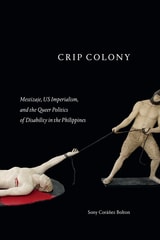
Crip Colony
Mestizaje, US Imperialism, and the Queer Politics of Disability in the PhilippinesSony Coráñez Bolton
Duke University Press, 2023
Crip Genealogies
Mel Y. Chen, Alison Kafer, Eunjung Kim, and Julie A. Minich, editors
Duke University Press, 2023
Contributors. Suzanne Bost, Mel Y. Chen, Sony Coráñez Bolton, Natalia Duong, Lezlie Frye, Magda García, Alison Kafer, Eunjung Kim, Yoo-suk Kim, Kateřina Kolářová, James Kyung-Jin Lee, Stacey Park Milbern, Julie Avril Minich, Tari Young-Jung Na, Therí A. Pickens, Leah Lakshmi Piepzna-Samarasinha, Jasbir K. Puar, Sami Schalk, Faith Njahîra Wangarî

Crip Love Onscreen
Representations of Love, Sex, and DisabilitySarah Rainey-Smithback
The Ohio State University Press, 2026
As disability representation increases, though, new possibilities are emerging. Crip Love Onscreen also draws attention to the exceptional through a close reading of screen narratives (such as 50 First Dates,Love and Other Drugs,American Horror Story: Freak Show, and more) that push against neoliberal, heteronormative, and ableist values. Drawing on the work of queer/crip scholars and activists, Rainey-Smithback uncovers glimpses of what Tobin Siebers calls a “sexual culture for disabled people”—a space and way of being that expands sexual access and sexual experience.

Crip Negativity
J. Logan Smilges
University of Minnesota Press, 2023
Imagining anti-ableist liberation beyond the rubrics of access and inclusion
In the thirty years since the Americans with Disabilities Act was signed into law, the lives of disabled people have not improved nearly as much as activists and politicians had hoped. In Crip Negativity, J. Logan Smilges shows us what’s gone wrong and what we can do to fix it.
Leveling a strong critique of the category of disability and liberal disability politics, Smilges asks and imagines what horizons might exist for the liberation of those oppressed by ableism—beyond access and inclusion. Inspired by models of negativity in queer studies, Black studies, and crip theory, Smilges proposes that bad crip feelings might help all of us to care gently for one another, even as we demand more from the world than we currently believe to be possible.
Forerunners: Ideas First is a thought-in-process series of breakthrough digital publications. Written between fresh ideas and finished books, Forerunners draws on scholarly work initiated in notable blogs, social media, conference plenaries, journal articles, and the synergy of academic exchange. This is gray literature publishing: where intense thinking, change, and speculation take place in scholarship.
Crip Screens
Countering Psychiatric Media TechnologiesOlivia Banner
Duke University Press, 2025

Crip Spacetime
Access, Failure, and Accountability in Academic LifeMargaret Price
Duke University Press, 2024

Cripping Girlhood
Anastasia Todd
University of Michigan Press, 2024
By closely examining the ways that disabled girls represent themselves, Anastasia Todd goes beyond a critique of the figure of the privileged, disabled girl subject in the national imagination to explore how disabled girls circulate their own capacious re-envisioning of what it means to be a disabled girl. In analyzing a range of cultural sites, including YouTube, TikTok, documentaries, and GoFundMe campaigns, Todd shows how disabled girls actively upend what we think we know about them and their experience, recasting the meanings ascribed to their bodyminds in their own terms. By analyzing disabled girls’ self-representational practices and cultural productions, Todd shows how disabled girls deftly theorize their experiences of ableism, sexism, racism, and ageism, and cultivate communities online, creating archives of disability knowledge and politicizing other disabled people in the process.
Cripping the Archive
Disability, History, and PowerEdited by Jenifer L. Barclay and Stefanie Hunt-Kennedy Foreword by Jaipreet Virdi
University of Illinois Press, 2025
Jenifer L. Barclay and Stefanie Hunt-Kennedy edit a collection of interdisciplinary essays that consider how and why physical, sensory, intellectual, and psychological disabilities are underrepresented, erased, or distorted in the historical record. The contributors draw on the methodology and practice of cripping to uncover disability in contested archives and explore ways to build inclusive archives accountable to, and centered on, disabled people and disability justice. Throughout, they show ableness informing the politics of the archive as a physical space, a discriminatory record, and a collection of silences.
An essential contribution to research methods and disability justice, Cripping the Archive offers a blueprint for intersectional and interdisciplinary approaches that bridge disability studies, history, and archival studies.
Crying Hands
Eugenics and Deaf People in Nazi GermanyHorst Biesold
Gallaudet University Press, 2003
When the Nazis assumed power in Germany in 1933, they wasted no time in implementing their radical policies, first by securing passage of the Law for the Prevention of Offspring with Hereditary Diseases. Among those designated by this law as “congenitally disabled” were deaf people. Horst Biesold’s newly translated book examines this neglected aspect of Nazi “racial hygiene” through interviews with more than 1,000 deaf survivors of this brutal law that authorized forced sterilizations, abortions, and eventually murder.
Crying Hands meticulously delineates the antecedents of Nazi eugenics, beginning with Social Darwinism (postulated in the mid-nineteenth century) and tracing the various sterilization laws later initiated throughout the world, including many passed and practiced in the United States. This exceptional scholarship is movingly paralleled by the human faces fixed to the numbing statistics, as in story after story those affected recount their irretrievable loss, pain, and misplaced shame imposed upon them by the Nazi regime. Through their stories, told to Biesold in German Sign Language, they have given voice to the countless others who died from the specious science practiced by the Third Reich. And now their own trials have finally been acknowledged.
Cultural Locations of Disability
Sharon L. Snyder and David T. Mitchell
University of Chicago Press, 2006
Snyder and Mitchell reveal cracks in the social production of human variation as aberrancy. From our modern obsessions with tidiness and cleanliness to our desire to attain perfect bodies, notions of disabilities as examples of human insufficiency proliferate. These disability practices infuse more general modes of social obedience at work today. Consequently, this important study explains how disabled people are instrumental to charting the passage from a disciplinary society to one based upon regulation of the self.
Curative Violence
Rehabilitating Disability, Gender, and Sexuality in Modern KoreaEunjung Kim
Duke University Press, 2017