Results by title
94 books match the query 'Economy' and 3 start with c
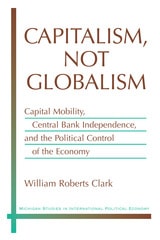
Capitalism, Not Globalism
Capital Mobility, Central Bank Independence, and the Political Control of the EconomyWilliam Roberts Clark
University of Michigan Press, 2009
Capitalism, Not Globalism shows that, while much has been made of recent changes in the international economy, the mechanisms by which politicians control the economy have not changed throughout the postwar period. Challenging both traditional and revisionist globalization theorists, William Roberts Clark argues that increased financial integration has led to neither a widening nor a narrowing of partisan differences in macroeconomic polices or outcomes. Rather, he shows that the absence of partisan differences in macroeconomic policy is a long-standing feature of democratic capitalist societies that can be traced to politicians' attempts to use the economy to help them survive in office.
Changes in the structural landscape such as increased capital mobility and central bank independence do not necessarily diminish the ability of politicians to control the economy, but they do shape the strategies they use to do so. In a world of highly mobile capital, politicians manipulate monetary policy to create macroeconomic expansions prior to elections only if the exchange rate is flexible and the central bank is subservient. But they use fiscal policy to induce political business cycles when the exchange rate is fixed or the central bank is independent.
William Roberts Clark is Assistant Professor, Department of Politics, New York University.
[more]
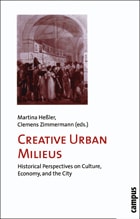
Creative Urban Milieus
Historical Perspectives on Culture, Economy, and the CityEdited by Martina Heßler and Clemens Zimmermann
Campus Verlag, 2008
Fashion Week in Paris and London, the Venice Biennale, and the nineteenth-century Viennese scientific community may seem wildly disparate, but each represent the cultural possibilities of an international metropolis. Creative Urban Milieus is an interdisciplinary examination of the historical relationship between culture and the economy in such cities as Berlin, New York, Helsinki, London, Venice, and many others. This groundbreaking work investigates the contributions of the creative class to the urban renaissance, contextualized by historical examples from the eighteenth century to the present day.
Skeptical of the current euphoria surrounding the commercialization of culture, a distinguished group of contributors apply a comparative and historical perspective to probe how creative works have affected the global economy. Drawing on lessons from urban planning, art history, and cultural spectacles alike, Creative Urban Milieus will change the way we think about the symbiotic relationship between cities and innovation.
Skeptical of the current euphoria surrounding the commercialization of culture, a distinguished group of contributors apply a comparative and historical perspective to probe how creative works have affected the global economy. Drawing on lessons from urban planning, art history, and cultural spectacles alike, Creative Urban Milieus will change the way we think about the symbiotic relationship between cities and innovation.
[more]
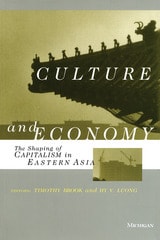
Culture and Economy
The Shaping of Capitalism in Eastern AsiaTimothy Brook and Hy Van Luong, Editors
University of Michigan Press, 1999
In recent years, most of the economies of Eastern Asia have been absorbed into global capitalism. Capitalism has transformed these economies, but the process has not been one-way. The cultures of Eastern Asia have in turn shaped how capitalism organizes labor, capital, and markets in ways that could not have been anticipated even ten years ago. On the basis of rich empirical analyses of East and Southeast Asia, and with theoretical insights from different approaches in the social sciences, Culture and Economy addresses these issues in both macroscopic and microscopic terms. Specific topics discussed range from the use and reinvention of Confucian and Islamic legacies in South Korea and Malaysia to promote a particular vision of the economy, to the role of family- and network-structured firms and the reliance on trust-based personal networks in Southeast Asia, to the cultures of labor and management in Chinese village enterprises and Vietnamese ceramics firms, as well as in South Korean export processing zones and the current Chinese labor market. These careful case studies suggest that it is inevitable that Eastern Asia will shape, even remake, capitalism into a system of production and consumption beyond its original definition. Timothy Brook is Professor of History, Stanford University. Hy V. Luong is Professor of Anthropology, University of Toronto.
[more]