Results by title
542 books match the query 'Emigration and immigration' and 36 start with c
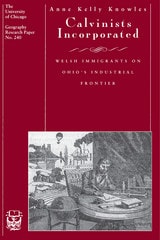
Calvinists Incorporated
Welsh Immigrants on Ohio's Industrial FrontierAnne Kelly Knowles
University of Chicago Press, 1996
capitalist transformation, Anne Kelly Knowles traces a community of
Welsh immigrants to Jackson and Gallia counties in southern Ohio. After
reconstructing the gradual process of community-building, Knowles
focuses on the pivotal moment when the immigrants became involved with
the industrialization of their new region as workers and investors in
Welsh-owned charcoal iron companies. Setting the southern Ohio Welsh in
the context of Welsh immigration as a whole from 1795 to 1850, Knowles
explores how these strict Calvinists responded to the moral dilemmas
posed by leaving their native land and experiencing economic success in
the United States.
Knowles draws on a wide variety of sources, including obituaries and
community histories, to reconstruct the personal histories of over 1,700
immigrants. The resulting account will find appreciative readers not
only among historical geographers, but also among American economic
historians and historians of religion.
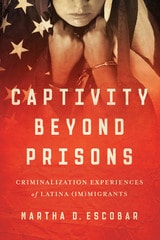
Captivity Beyond Prisons
Criminalization Experiences of Latina (Im)migrantsBy Martha D. Escobar
University of Texas Press, 2016
Today the United States leads the world in incarceration rates. The country increasingly relies on the prison system as a “fix” for the regulation of societal issues. Captivity Beyond Prisons is the first full-length book to explicitly link prisons and incarceration to the criminalization of Latina (im)migrants.
Starting in the 1990s, the United States saw tremendous expansion in the number of imprisoned (im)migrants, specifically Latinas/os. Consequently, there was also an increase in the number of deportations. In addition to regulating society, prisons also serve as a reproductive control strategy, both in preventing female inmates from having children and by separating them from their families. With an eye to racialized and gendered technologies of power, Escobar argues that incarcerated Latinas are especially depicted as socially irrecuperable because they are not considered useful within the neoliberal labor market. This perception impacts how they are criminalized, which is not limited to incarceration but also extends to and affects Latina (im)migrants’ everyday lives. Escobar also explores the relationship between the immigrant rights movement and the prison abolition movement, scrutinizing a variety of social institutions working on solutions to social problems that lead to imprisonment.
Accessible to both academics and those in the justice and social service sectors, Escobar’s book pushes readers to consider how, even in radical spaces, unequal power relations can be reproduced by the very entities that attempt to undo them.
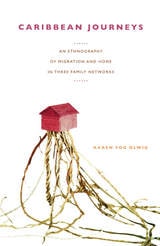
Caribbean Journeys
An Ethnography of Migration and Home in Three Family NetworksKaren Fog Olwig
Duke University Press, 2007
The migratory journeys of the families in this study began more than sixty years ago, when individuals in the three families left home in a British colonial town in Jamaica, a French Creole rural community in Dominica, and an African-Caribbean village of small farmers on Nevis. Olwig follows the three family networks forward in time, interviewing family members living under highly varied social and economic circumstances in locations ranging from California to Barbados, Nova Scotia to Florida, and New Jersey to England. Through her conversations with several generations of these far-flung families, she gives insight into each family’s educational, occupational, and socioeconomic trajectories. Olwig contends that terms such as “Caribbean diaspora” wrongly assume a culturally homogeneous homeland. As she demonstrates in Caribbean Journeys, anthropologists who want a nuanced understanding of how migrants and their descendants perceive their origins and identities must focus on interpersonal relations and intimate spheres as well as on collectivities and public expressions of belonging.
Caribbean Migration to Western Europe and the United States
Essays on Incorporation, Identity, and Citizenshipedited by Margarita Cervantes-Rodriguez, Ramon Grosfoguel and Eric Mielants
Temple University Press, 2009
Caribbean Migration to Western Europe and the United States features a diverse group of scholars from across academic disciplines studying the transnational paths of Caribbean migration. How has the colonial path of the Caribbean influenced migration with regard to power relations, ethnic identities and transnational processes?
Through a series of case studies, the contributors to this volume examine the experiences of Caribbean immigrants to Spain, France, the United Kingdom and the Netherlands as well as the United States. They show the demographic, socioeconomic, political and cultural impact migrants have, as well as their role in the development of transnational social fields. Caribbean Migration to Western Europe and the United States also examines how contrasting discourses of democracy and racism, xenophobia and globalization shape issues pertaining to citizenship and identity.
Contributors: Elizabeth Aranda, Mary Chamberlain, Michel Giraud, Lisa Maya Knauer, John R. Logan, Monique Milia-Marie-Luce, Laura Oso Casas, Livio Sansone, Nina Glick Schiller,Charles (Wenquan) Zhang and the editors.
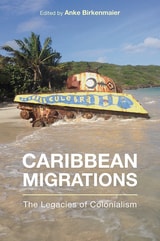
Caribbean Migrations
The Legacies of ColonialismAnke Birkenmaier
Rutgers University Press, 2021
With mass migration changing the configuration of societies worldwide, we can look to the Caribbean to reflect on the long-standing, entangled relations between countries and areas as uneven in size and influence as the United States, Cuba, Hispaniola, Puerto Rico, and Jamaica. More so than other world regions, the Caribbean has been characterized as an always already colonial region. It has long been a key area for empires warring over influence spheres in the new world, and where migration waves from Africa, Europe, and Asia accompanied every political transformation over the last five centuries. In Caribbean Migrations, an interdisciplinary group of humanities and social science scholars study migration from a long-term perspective, analyzing the Caribbean's "unincorporated subjects" from a legal, historical, and cultural standpoint, and exploring how despite often fractured public spheres, Caribbean intellectuals, artists, filmmakers, and writers have been resourceful at showcasing migration as the hallmark of our modern age.

Caribbean Transnational Experience
Harry Goulbourne
Pluto Press, 2002
Unlike much cultural and literary studies, Caribbean Transnational Experience makes a plea for verifiable evidence to inform academic and popular discussions about the exciting experiences of Caribbeans across the Atlantic. Chapters explore questions of definition and theory, the common Atlantic heritage and fate, social and economic contexts of Caribbean transnationality, Africa, the USA and the Caribbean in popular discourses in Britain, transnationality of families and the propensity for Caribbean-born and their offspring to return to the Caribbean from the mother country. Caribbean Transnational Experience concludes with a speculative discussion about possible future directions of what is increasingly being described as the Caribbean Diaspora.
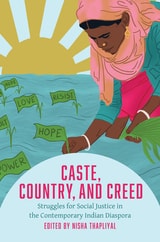
Caste, Country, and Creed
Struggles for Social Justice in the Contemporary Indian DiasporaNisha Thapliyal
Rutgers University Press, 2026
What happens when ancient systems of oppression travel across oceans? How do Indian diaspora communities across five nations challenge centuries-old systems of oppression while building new forms of solidarity? Caste, Country, and Creed: Struggles for Social Justice in the Contemporary Indian Diaspora takes readers inside the dynamic world of contemporary social justice activism spanning Aotearoa New Zealand, Australia, Canada, the United States, and the United Kingdom.
This groundbreaking collection brings together the voices of artists, activists, and scholar-activists who are reshaping conversations about caste discrimination, Islamophobia, and Hindu nationalism beyond India's borders. Through intimate first-person accounts and critical reflections, contributors reveal how diaspora activists are creating powerful counter-narratives and mobilizing collective resistance across local and transnational networks.
The book documents the lived realities of organizing—the values, knowledge traditions, and pivotal moments that spark political protest. Caste, Country, and Creed shows how activists construct alternative knowledge to dissent, build solidarity, and inspire political participation. Contributors offer nuanced insights into the complex relationships and power dynamics that sustain collective action for social justice in the Indian diaspora.
For copyright reasons, this edition is not for sale in India.
Central American Migrations in the Twenty-First Century
Edited by Mauricio Espinoza, Miroslava Arely Rosales Vásquez, and Ignacio Sarmiento
University of Arizona Press, 2023
Central American Migrations in the Twenty-First Century tackles head-on the way Central America has been portrayed as a region profoundly marked by the migration of its people. Through an intersectional approach, this volume demonstrates how the migration experience is complex and affected by gender, age, language, ethnicity, social class, migratory status, and other variables. Contributors carefully examine a broad range of topics, including forced migration, deportation and outsourcing, intraregional displacements, the role of social media, and the representations of human mobility in performance, film, and literature. The volume establishes a productive dialogue between humanities and social sciences scholars, and it paves the way for fruitful future discussions on the region’s complex migratory processes.
Contributors
Guillermo Acuña
Andrew Bentley
Fiore Bran-Aragón
Tiffanie Clark
Mauricio Espinoza
Hilary Goodfriend
Leda Carolina Lozier
Judith Martínez
Alicia V. Nuñez
Miroslava Arely Rosales Vásquez
Manuel Sánchez Cabrera
Ignacio Sarmiento
Gracia Silva
Carolina Simbaña González
María Victoria Véliz
Chasing the American Dream in China
Chinese Americans in the Ancestral HomelandLeslie Kim Wang
Rutgers University Press, 2021
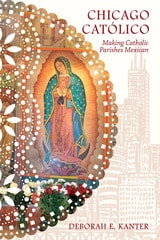
Chicago Católico
Making Catholic Parishes MexicanDeborah E. Kanter
University of Illinois Press, 2020
Deborah E. Kanter tells the story of neighborhood change and rebirth in Chicago's Mexican American communities. She unveils a vibrant history of Mexican American and Mexican immigrant relations as remembered by laity and clergy, schoolchildren and their female religious teachers, parish athletes and coaches, European American neighbors, and from the immigrant women who organized as guadalupanas and their husbands who took part in the Holy Name Society. Kanter shows how the newly arrived mixed memories of home into learning the ways of Chicago to create new identities. In an ever-evolving city, Mexican immigrants and Mexican Americans’ fierce devotion to their churches transformed neighborhoods such as Pilsen.
The first-ever study of Mexican-descent Catholicism in the city, Chicago Católico illuminates a previously unexplored facet of the urban past and provides present-day lessons for American communities undergoing ethnic integration and succession.
Chinese American Transnationalism
The Flow of People, ResourcesSucheng Chan
Temple University Press, 2005
Chinese Americans in the Heartland
Migration, Work, and CommunityHuping Ling
Rutgers University Press, 2022
Chino
Anti-Chinese Racism in Mexico, 1880-1940Jason Oliver Chang
University of Illinois Press, 2017
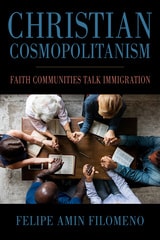
Christian Cosmopolitanism
Faith Communities Talk ImmigrationFelipe Amin Filomeno
Temple University Press, 2024
Christian Cosmopolitanism shows that mutual understanding can result when people share their personal stories, feelings, and thoughts about immigration. They reflect and deliberate on collaborative action to advance common interests and shared values, which can unleash the cosmopolitan potential of the Christian community.
Including practical tools for church leaders, Christian Cosmopolitanism promotes dialogue as a cultural practice that can help diverse communities overcome segregation and become socially cohesive.
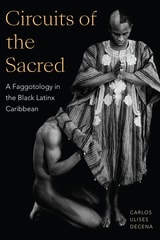
Circuits of the Sacred
A Faggotology in the Black Latinx CaribbeanCarlos Ulises Decena
Duke University Press, 2023
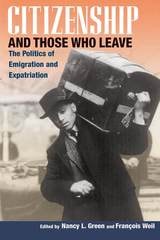
Citizenship and Those Who Leave
The Politics of Emigration and ExpatriationEdited by Nancy L. Green and Fran‡ois Weil
University of Illinois Press, 2006
Exit, like entry, has helped define citizenship over the last two centuries, yet little attention has been given to the politics of emigration. How have countries impeded or facilitated people leaving? How have they perceived and regulated those who leave? What relations do they seek to maintain with their citizens abroad and why? Citizenship and Those Who Leave reverses the immigration perspective to examine how nations define themselves not just through entry but through exit as well.
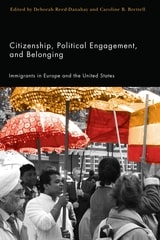
Citizenship, Political Engagement, and Belonging
Immigrants in Europe and the United StatesReed-Danahay, Deborah
Rutgers University Press, 2008
Immigration is continuously and rapidly changing the face of Western countries. While newcomers are harbingers of change, host nations also participate in how new populations are incorporated into their social and political fabric.
Bringing together a transcontinental group of anthropologists, this book provides an in-depth look at the current processes of immigration, political behavior, and citizenship in both the United States and Europe. Essays draw on issues of race, national identity, religion, and more, while addressing questions, including: How should citizenship be defined? In what ways do immigrants use the political process to achieve group aims? And, how do adults and youth learn to become active participants in the public sphere?
Among numerous case studies, examples include instances of racialized citizenship in “Algerian France,” Ireland’s new citizenship laws in response to asylum-seeking mothers, the role of Evangelical Christianity in creating a space for the construction of an identity that transcends state borders, and the Internet as one of the new public spheres for the expression of citizenship, be it local, national, or global.

Collateral Damage
The Influence of Political Rhetoric on the Incorporation of Second-Generation AmericansSean Richey
University of Michigan Press, 2023
Collateral Damage provides an overview of how political communication influences the process of incorporation with the broad society as well as its political parties. Sean Richey shows that how politicians talk about immigrants affects how their children perceive America and their feelings about the nation. These perceptions and feelings in turn greatly influence the children’s desire to incorporate into American political society. He also shows that regardless of a speaker’s intended outcome, what is said can still have a deleterious effect on incorporation desire, a communicative process that he terms “collateral damage.” Richey uses new experimental and survey evidence, as well as the rhetoric of Donald Trump as a test case, to examine how anti-immigration communication influences the incorporation of the children of immigrants.
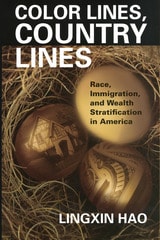
Color Lines, Country Lines
Race, Immigration, and Wealth Stratification in AmericaLingxin Hao
Russell Sage Foundation, 2007
Color Lines
Affirmative Action, Immigration, and Civil Rights Options for AmericaJohn David Skrentny
University of Chicago Press, 2001
Contributors:
Erik Bleich
Lawrence D. Bobo
Frank Dobbin
John Aubrey Douglass
Hugh Davis Graham
Kyra R. Greene
Erin Kelly
George R. La Noue
Jennifer Lee
Michael Lichter
Deborah C. Malamud
Sunita Parikh
John C. Sullivan
Thomas J. Sugrue
Carol M. Swain
Steven M. Teles
Roger Waldinger
Christine Min Wotipka
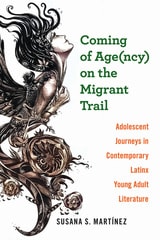
Coming of Age(ncy) on the Migrant Trail
Adolescent Journeys in Contemporary Latinx Young Adult LiteratureSusana S. Martínez
The Ohio State University Press, 2025
Contemporary Asian American Communities
Intersections And Divergencesedited by Linda Trinh Võ and Rick Bonus
Temple University Press, 2002
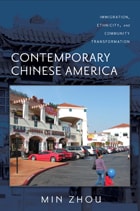
Contemporary Chinese America
Immigration, Ethnicity, and Community TransformationMin Zhou, foreword by Alejandro Portes
Temple University Press, 2009
Contemporary Chinese America is the most comprehensive sociological investigation of the experiences of Chinese immigrants to the United States—and of their offspring—in the late twentieth and early twenty-first centuries. The author, Min Zhou, is a well-known sociologist of the Chinese American experience. In this volume, she collects her original research on a range of subjects, including the causes and consequences of emigration from China, demographic trends of Chinese Americans, patterns of residential mobility in the U.S., Chinese American "ethnoburbs," immigrant entrepreneurship, ethnic enclave economies, gender and work, Chinese language media, Chinese schools, and intergenerational relations. The concluding chapter, "Rethinking Assimilation," ponders the future for Chinese Americans. Also included are an extensive bibliography and a list of recommended documentary films.
While the book is particularly well-suited for college courses in Chinese American studies, ethnic studies, Asian studies, and immigration studies, it will interest anyone who wants to more fully understand the lived experience of contemporary Chinese Americans.
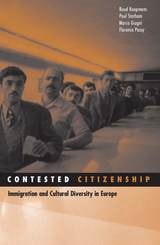
Contested Citizenship
Immigration and Cultural Diversity in EuropeRuud Koopmans
University of Minnesota Press, 2005
Revealing striking cross-national differences in how immigration and diversity are contended by different national governments, these authors find that how citizenship is constructed is the key variable defining the experience of Europe’s immigrant populations. Contested Citizenship provides nuanced policy recommendations and challenges the truism that multiculturalism is always good for immigrants. Even in an age of European integration and globalization, the state remains a critical actor in determining what points of view are sensible and realistic—and legitimate—in society.
Ruud Koopmans is professor of sociology at Free University, Amsterdam. Paul Statham is reader in political communications at the University of Leeds. Marco Giugni is a researcher and teacher of political science at the University of Geneva. Florence Passy is assistant professor of political science at the University of Lausanne, Switzerland.
Continental Shifts
Migration, Representation, and the Struggle for Justice in Latin(o) AmericaBy John D. "Rio" Riofrio
University of Texas Press, 2015
Applying a broad geographical approach to comparative Latino literary and cultural studies, Continental Shifts illuminates how the discursive treatment of Latinos changed dramatically following the enactment of NAFTA—a shift exacerbated by 9/11. While previous studies of immigrant representation have focused on single regions (the US/Mexico border in particular), specific genres (literature vs. political rhetoric), or individual groups, Continental Shifts unites these disparate discussions in a provocative, in-depth examination.
Bringing together a wide range of groups and genres, this intercultural study explores novels by Latin American and Latino writers, a border film by Tommy Lee Jones and Guillermo Arriaga, “viral” videos of political speeches, popular television programming (particularly shows that feature incarceration and public shaming), and user-generated YouTube videos. These cultural products reveal the complexity of Latino representations in contemporary discourse. While tropes of Latino migrants as threatening, diseased foreign bodies date back to the nineteenth century, Continental Shifts marks the more pernicious, recent images of Latino laborers (legal and not) in a variety of contemporary media. Using vivid examples, John Riofrio demonstrates the connections between rhetorical and ideological violence and the physical and psychological violence that has more intensely plagued Latino communities in recent decades. Culminating with a consideration of the “American” identity, this eye-opening work ultimately probes the nation’s ongoing struggle to uphold democratic ideals amid dehumanizing multiethnic tension.
Conversations Across Our America
Talking About Immigration and the Latinoization of the United StatesBy Louis G. Mendoza
University of Texas Press, 2012
In the summer of 2007, Louis G. Mendoza set off on a bicycle trip across the United States with the intention of conducting a series of interviews along the way. Wanting to move beyond the media’s limited portrayal of immigration as a conflict between newcomers and “citizens,” he began speaking with people from all walks of life about their views on Latino immigration. From the tremendous number of oral histories Mendoza amassed, the resulting collection offers conversations with forty-three different people who speak of how they came to be here and why they made the journey. They touch upon how Latino immigration is changing in this country, and how this country is being changed by Latinoization. Interviewees reflect upon the concerns and fears they’ve encountered about the transformation of the national culture, and they relate their own experiences of living and working as “other” in the United States.
Mendoza’s collection is unique in its vastness. His subjects are from big cities and small towns. They are male and female, young and old, affluent and impoverished. Many are political, striving to change the situation of Latina/os in this country, but others are “everyday people,” reflecting upon their lives in this country and on the lives they left behind. Mendoza’s inclusion of this broad swath of voices begins to reflect the diverse nature of Latino immigration in the United States today.
Cosmologies of Credit
Transnational Mobility and the Politics of Destination in ChinaJulie Y. Chu
Duke University Press, 2010
Counterstreams in Migration
Ethiopians' Choices to Stay, Leave, or ReturnHewan Girma
Temple University Press, 2026
Weaving together nearly 100 stories of non-migrants, returnees, and repeat migrants from Ethiopia, Girma advances a theory of migra-emotions, emotions specific to migration, to understand decisions and experiences, such as the imaginary of home and the lived reality of alienation, disaffection abroad, and feelings of duty to one’s homeland.
Looking beyond the meanings of migration or processes of integration, Girma explores the emotional subtext of migration aspirations. In doing so, Counterstreams of Migration complicates conventional understandings of migration and provides a more complete picture of migrant stories.
Critical Perspectives on Latino Education in Massachusetts
Lorna Rivera and Melissa Colón, editors
University of Massachusetts Press, 2025
In Massachusetts, the Latino population increased by 475 percent between 1980 and 2017, marking a dramatic growth. This diverse ethnic community of Puerto Ricans, Dominicans, Salvadoreans, Colombians, Brazilians, and more also contains a wide range of cultures, immigration and migration experiences, languages, and socio-political backgrounds. However, there are numerous commonalities involving education. Recent research at the Mauricio Gastón Institute for Latino Community Development and Policy reveals that Latino students in Massachusetts are more likely to attend public schools, in communities with significant academic achievement and opportunity gaps as well as other challenges, from food scarcity to higher rates of unemployment. At the same time, the state-wide shift to standards-based education has had a disproportionately negative impact on Latino students, who already feel the effects of politically motivated anti-immigrant policies and laws that limit bilingual education.
This collection of essays, from those working inside the classroom as well as researchers taking a broader look at policy, addresses the array of issues facing Latino students in Massachusetts. These perspectives paint a complex picture of the educational experience for Latinos, and offer expert suggestions for improving classrooms, school environments, and ultimate educational outcomes for an important growing demographic in the Commonwealth.
In addition to editors Lorna Rivera and Melissa Colón, this volume’s contributors include Almudena G. Abeyta, Nasteho Ali, Cristina Araujo Brinkerhoff, Michael Berardino, Alex Briesacher, Thomas Conroy, Judenie Dabel, Liya Escalera, Luis Enrique Esquivel, Deyja Enriquez, Isahiah Erilus, Nyal Fuentes, Jazmin Rubi Flete Gomez, Manuel Frau-Ramos, Kimberly A. S. Howard, Patricia Krueger-Henney, Steven Lue, Mary Jo Marion, Timothy E. Murphy, Cecilia Nardi, Laurie Occhipinti, Alexandra Oliver-Davila, Chong Myung Park, Angelica Rodriquez, Marta T. Rosa, Diana Santiago, Melissa Sargent, Ester Shapiro, V. Scott H. Solberg, Fabián Torres-Ardila, Ashley Torres Carrasquillo, Paul Trunfio, Carmen N. Veloria, and Heilam Xie.
Crossing Borders
Changing Social Identities in Southern MexicoKimberly M. Grimes
University of Arizona Press, 1998
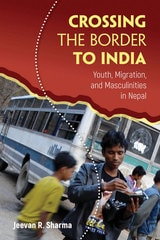
Crossing the Border to India
Youth, Migration, and Masculinities in NepalJeevan R. Sharma
Temple University Press, 2018
Given the limited economic opportunities in rural Nepal, the desire of young men of all income and education levels, castes and ethnicities to migrate has never been higher. Crossing the Border to India provides an ethnography of male labor migration from the western hills of Nepal to Indian cities. Jeevan Sharma shows how a migrant’s livelihood and gender, as well as structural violence impacts his perceptions, experiences, and aspirations.
Based on long-term fieldwork, Sharma captures the actual experiences of crossing the border. He shows that Nepali migration to India does not just allow young men from poorer backgrounds to “save there and eat here,” but also offers a strategy to escape the more regimented social order of the village. Additionally, migrants may benefit from the opportunities offered by the “open-border” between India and Nepal to attain independence and experience a distant world. However, Nepali migrants are subjected to high levels of ill treatment. Thus, while the idea of freedom remains extremely important in Nepali men’s migration decisions, their actual experience is often met with unfreedom and suffering.
Crossing the Border
Research from the Mexican Migration ProjectJorge Durand
Russell Sage Foundation, 2004
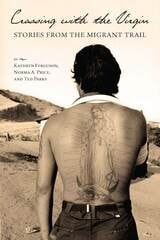
Crossing with the Virgin
Stories from the Migrant TrailKathryn Ferguson, Norma A. Price, and Ted Parks
University of Arizona Press, 2010
Crossing With the Virgin collects stories heard from migrants about these treacherous treks—firsthand accounts told to volunteers for the Samaritans, a humanitarian group that seeks to prevent such unnecessary deaths by providing these travelers with medical aid, water, and food. Other books have dealt with border crossing; this is the first to share stories of immigrant suffering at its worst told by migrants encountered on desert trails.
The Samaritans write about their encounters to show what takes place on a daily basis along the border: confrontations with Border Patrol agents at checkpoints reminiscent of wartime; children who die in their parents’ desperate bid to reunite families; migrants terrorized by bandits; and hovering ghost-like above nearly every crossing, the ever-present threat of death.
These thirty-nine stories are about the migrants, but they also tell how each individual author became involved with this work. As such, they offer not only a window into the migrants’ plight but also a look at the challenges faced by volunteers in sometimes compromising situations—and at their own humanizing process.
Crossing With the Virgin raises important questions about underlying assumptions and basic operations of border enforcement, helping readers see past political positions to view migrants as human beings. It will touch your heart as surely as it reassures you that there are people who still care about their fellow man.

Cuban Miami
Robert M Levine
Rutgers University Press, 2000
For two centuries, Cuban exiles have found their way to the United States, especially to Florida. But since Castro's victory in 1959, Miami has seen almost one million Cubans arrive by sea and air. The impact on this area has been enormous. Miami---known as the "Exile Capital"---has a greater cultural affinity to Havana and the rest of Latin America than to Tallahassee, Florida's capital.
Cuban Miami is the first analytical, photographic record of Cuban migration to south Florida. Robert M. Levine and Moises Asis have interviewed members of every sector of the Cuban exile community, from the first pioneers to the mass waves in the early 1960s to those who arrived by raft during the late 1990s. In their wide-ranging investigation of Cuban-U.S. history, they touch upon all aspects of Cuban influence: politics, cuisine, music, assimilation, discrimination, and institution buildings. Miami has more Cuban food establishments than the nearby island does. The city has been fertile ground for germinating a unique synthesis of Cuban and Americans are the most prosperous immigrant group in the United States today, this success has come at a price---living in exile can exact a personal toll.
Cuban Miami is a feast for the eyes, including 180 photographs and original cartoons drawn for the book by Jose M. Varela, a well-known member of the Cuban-American community.
Culture across Borders
Mexican Immigration and Popular CultureEdited by David R. Maciel and María Herrera-Sobek
University of Arizona Press, 1998
Cultures of Migration
The Global Nature of Contemporary MobilityBy Jeffrey H. Cohen and Ibrahim Sirkeci
University of Texas Press, 2011
Around the globe, people leave their homes to better themselves, to satisfy needs, and to care for their families. They also migrate to escape undesirable conditions, ranging from a lack of economic opportunities to violent conflicts at home or in the community. Most studies of migration have analyzed the topic at either the macro level of national and global economic and political forces, or the micro level of the psychology of individual migrants. Few studies have examined the "culture of migration"—that is, the cultural beliefs and social patterns that influence people to move.
Cultures of Migration combines anthropological and geographical sensibilities, as well as sociological and economic models, to explore the household-level decision-making process that prompts migration. The authors draw their examples not only from their previous studies of Mexican Oaxacans and Turkish Kurds but also from migrants from Europe, sub-Saharan Africa, the Pacific, and many parts of Asia. They examine social, economic, and political factors that can induce a household to decide to send members abroad, along with the cultural beliefs and traditions that can limit migration. The authors look at both transnational and internal migrations, and at shorter- and longer-term stays in the receiving location. They also consider the effect that migration has on those who remain behind. The authors' "culture of migration" model adds an important new dimension to our understanding of the cultural beliefs and social patterns associated with migration and will help specialists better respond to increasing human mobility.